Brookston Beer Bulletin

Jay R. Brooks on Beer

  • Home
  • About
  • Editorial
  • Birthdays
  • Art & Beer

Socialize

  • Dribbble
  • Email
  • Facebook
  • Flickr
  • GitHub
  • Instagram
  • LinkedIn
  • Pinterest
  • RSS
  • Twitter
  • YouTube

Powered by Genesis

Patent No. 3908871A: Keg Closure And Coupler Assembly

September 30, 2015 By Jay Brooks

patent-logo
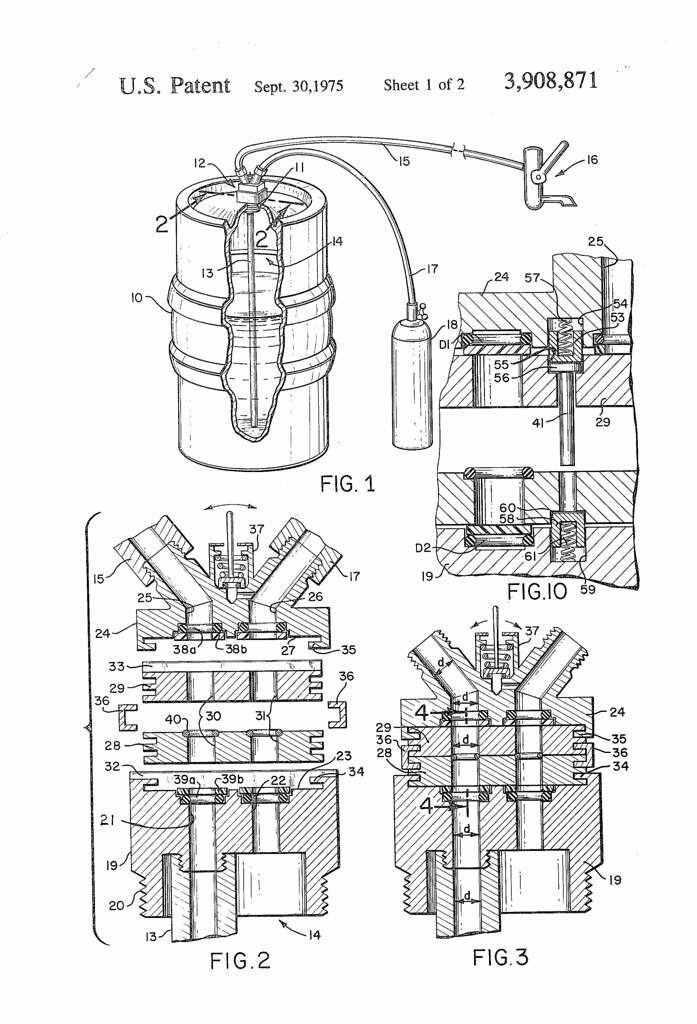
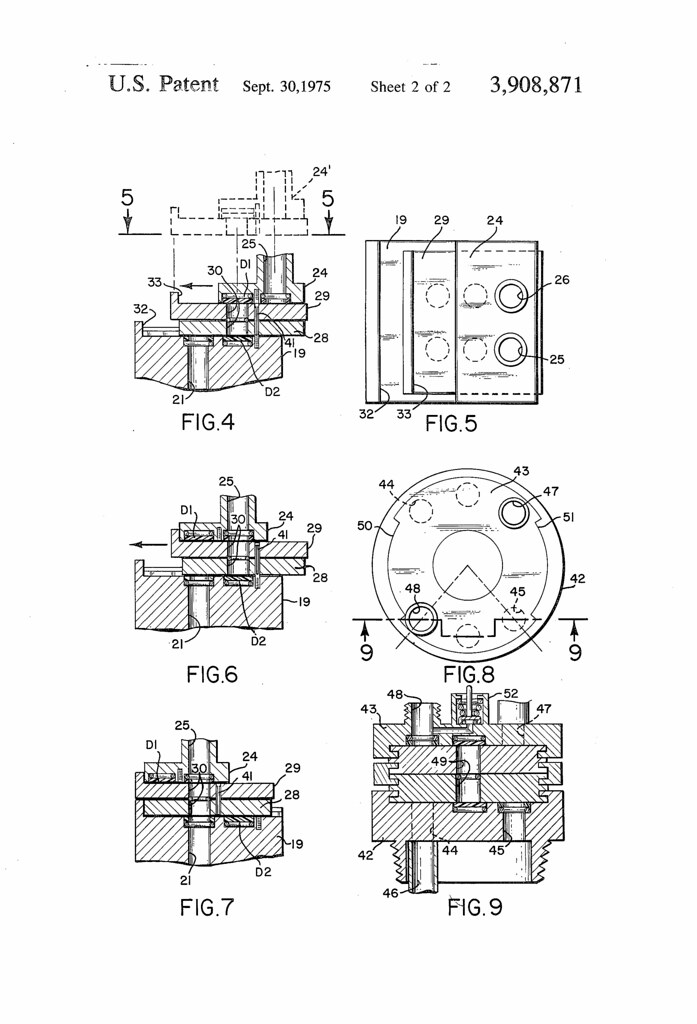
Today in 1975, US Patent 3908871 A was issued, an invention of Antonin Gottwald, for his “Keg Closure and Coupler Assembly.” Here’s the Abstract:

The assembly includes a keg connector body having first and second passages communicating with the interior of the keg and a dispensing line connector body having first and second passages communicating with a dispensing line and a source of compressed gas. Lower and upper separable plates having registering bores are disposed between the two bodies. Relative movement between the plates and the bodies enables closing off of both the interior of the keg and the dispensing line and source of compressed gas, the plates then being separable with the respective closures still in effect.
Untitled
Untitled

Filed Under: Beers, Just For Fun, Politics & Law, Related Pleasures Tagged With: History, Kegs, Law, Patent

Patent No. 2428321A: Hop Picking Fingers

September 30, 2015 By Jay Brooks

patent-logo
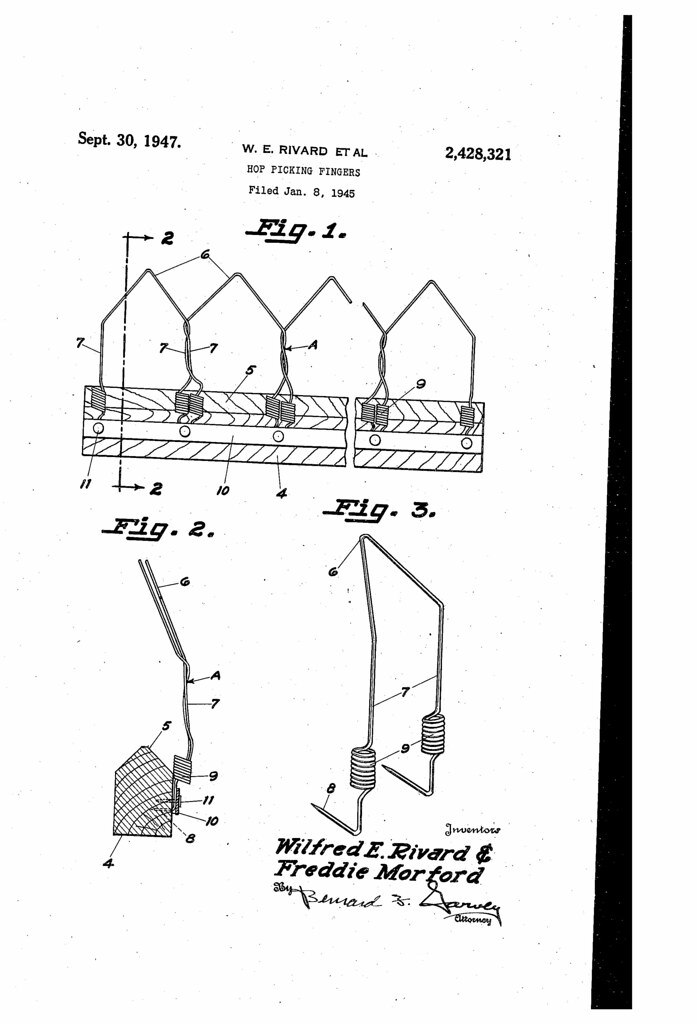
Today in 1947, US Patent 2428321 A was issued, an invention of Freddie Morford and Wilfred E. Rivard, for their “Hop Picking Fingers.” There’s no Abstract, although in the description it includes this summary:

In hop-picking machines, as presently used, there are approximately twenty thousand fingers per machine and it is necessary after each day-of-operation to check each of the fingers, many of which invariably require straightening. During the straightening operation, some of the fingers break, due principally to crystallization, and must be replaced. The maintenance and replacement of the fingers is costly and in addition, each finger bent during operation, decreases the operating efficiency of the machine. After much experimentation, we have found that the device of the present invention corrects these shortcomings with the. result that the original operating efficiency of the fingers, and their appurtenances, is retained throughout the entire hop picking season.

It is therefore within the contemplation of this invention to provide hop picking fingers which are not subject to distortion when normally used, yet are inherently resilient to yield, under load, Within predetermined limits.

It is further within the objects of the invention to employ fingers which will be unaffected by crystallization; to reinforce each finger at its locus of stress; to provide a finger which may be flexed to any degree within maximum demands even under extraordinary working conditions; to provide a finger in which the yieldable reinforced portions are coaxial with the fingers to retard crystallization of the fingers and effect instant return of the fingers to their normal position upon release of load stress; and to provide fingers which may be used with standard hop-picking machines without appreciable increase in cost.

It is also an object of this invention, not only to provide a hop picking finger which includes a pair of springs arranged in a particular manner, but likewise to interengage the fingers preparatory to securing the latter to the finger bar for uniform distribution of stress.

Untitled

Filed Under: Beers, Just For Fun, Politics & Law, Related Pleasures Tagged With: Brewing Equipment, History, Hops, Law, Patent

Patent No. 2906435A: Air Pressure Actuated Beer Dispenser And Coil Cleaner

September 29, 2015 By Jay Brooks

patent-logo
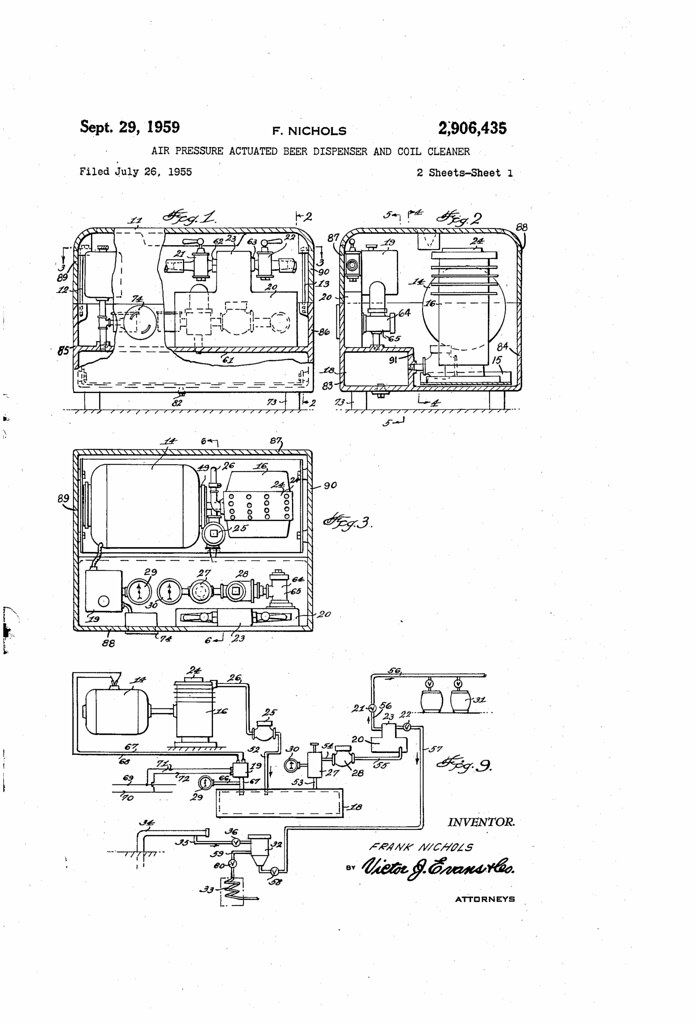
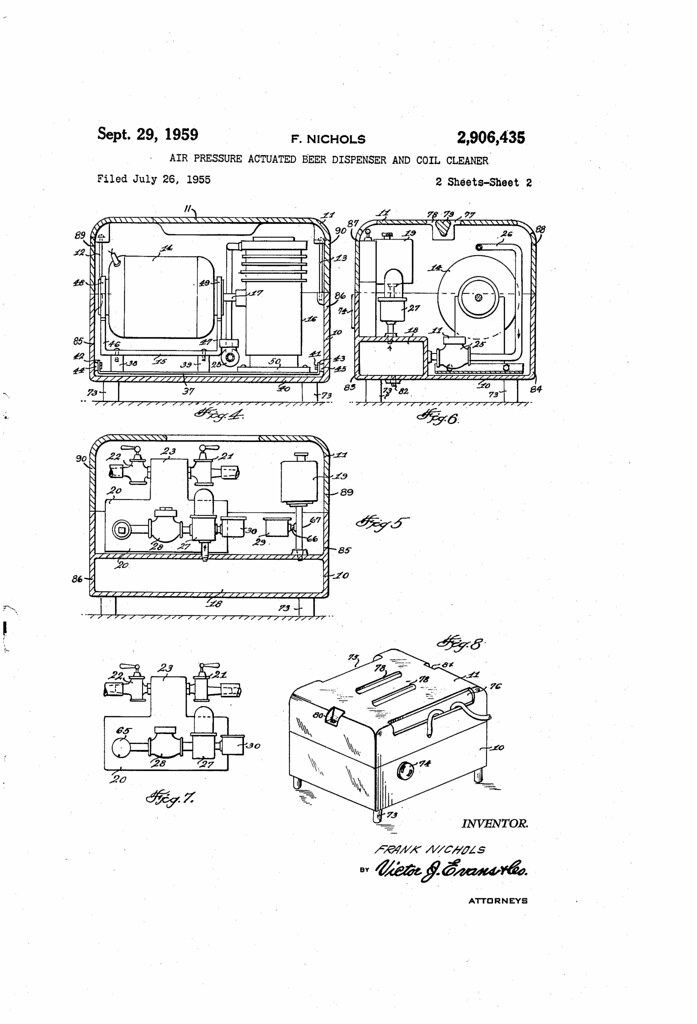
Today in 1959, US Patent 2906435 A was issued, an invention of Frank Nichols, for his “Air Pressure Actuated Beer Dispenser and Coil Cleaner.” There’s no Abstract, although in the description it includes this summary:

This invention relates to beer dispensing apparatus in which beer is on tap continuously, and in particular, beer dispensing apparatus where beer is supplied from kegs or other containers to cooling coils and taps by filtered air under pressure continuously and in which the coils are cleaned by a detergent suspended in water and wherein the moisture is removed by air under pressure.

The purpose of this invention is to provide beer dispensing apparatus in which all foreign tastes or flavors due to leakage of oil, gases, and the like into the system are eliminated.

Untitled
Untitled

Filed Under: Beers, Just For Fun, Politics & Law, Related Pleasures Tagged With: History, Kegs, Law, Patent

Patent No. 327099A: Bottle Stopper

September 29, 2015 By Jay Brooks

patent-logo
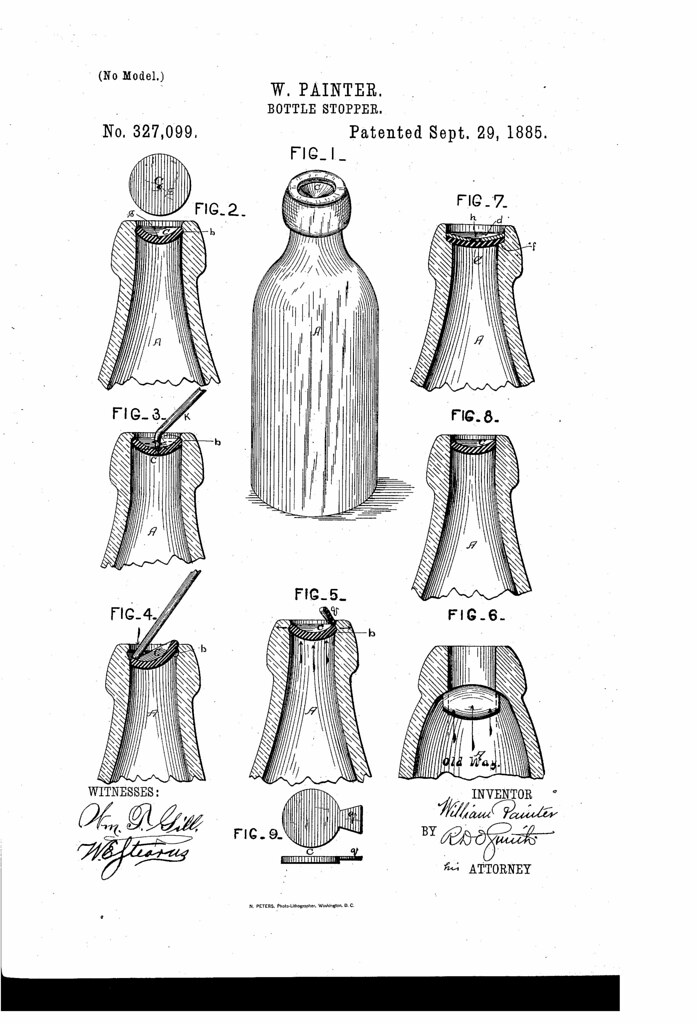
Today in 1885, US Patent 327099 A was issued, an invention of William Painter, for his “Bottle Stopper.” Painter patented a number of bottle-related items, but is undoubtedly best known for having invented the first crown bottle top. There’s no Abstract, although in the description it includes this summary:

My invention is particularly designed for use with bottles or similar vessels containing fluids under pressure from eft’ervescence or otherwise; but it is adapted as well for use where such pressure does not exist.

Stoppers have heretofore been made secure against internal pressure in one of two ways by using a tie-wire, also by special stopperriety; or by placing the stopper inside the bottle and so arranging it that the stopper is forced against a seat or packing by the pressure within. The first of these methods is objectionable because of the expense, and in some cases the inconvenience of its use and liability of accidental opening, The second is so for the same reasons, and for the outside of the bottle is an obstruction to ready and effectual cleansing both of the bottle and stopper. Stoppers secured by external fastenings are retained solely by the power of the device to overcome the internal pressure. Those within the bottle are retained because they present a solid mass too large to pass through the bottleneck. In neither case referred to does the lateral expansion of the stopper itself against the interior of the bottle mouth enter as an element of its action in resisting internal pressure, as it does with stoppers made according to my method.

My invention differs from all others in the respects named. It is made of thin material, and placed within the bottle. neck or mouthward, so that it presents the resistance of an inverted arch or dome having its haunches supported by contact with the walls of the bottle-mouth, which are preferably indented or grooved to afford a more secure hold. Pressure upon an arch is always transferred in part as lateral pressure against its abutment, while a similar pressure upon a solid body having the same convexity does not tend to I displace the abutment laterally, but to shear of the bottle neck and stopper off the edges of such solid body. This physical principle illustrates the actual difference between my cup-shaped disk-stoppers and all others with which I am acquainted.

Untitled

Filed Under: Beers, Just For Fun, Politics & Law, Related Pleasures Tagged With: Bottles, Crowns, History, Law, Packaging, Patent

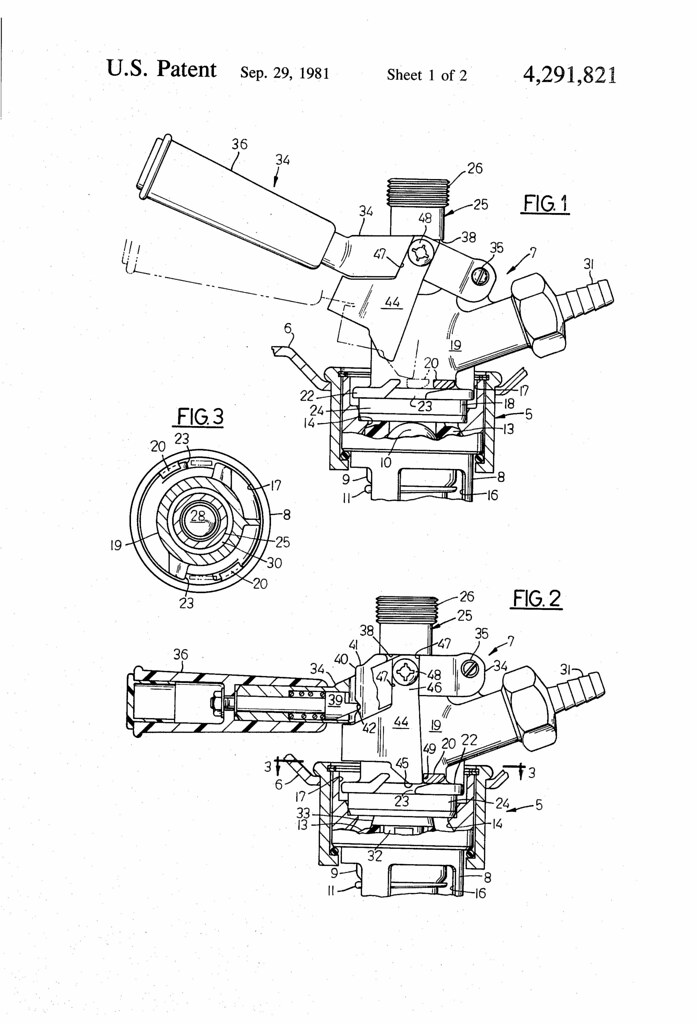
Patent No. 4291821A: Keg Tapping System Unit And Valve Interlock

September 29, 2015 By Jay Brooks

patent-logo
Today in 1981, US Patent 4291821 A was issued, an invention of James E. Nezworski, assigned to The Perlick Company, Inc., for his “Keg Tapping System Unit and Valve Interlock.” Here’s the Abstract:

In a keg tapping system, a keg unit in each keg has coaxial gas and liquid valves, and a tavern unit, detachably connectable to the keg unit, has a lever actuated plunger that is depressed to open the valves in the keg unit and to open a gas valve in the tavern unit. The keg unit has a well in its top in which the tavern unit is rotatably received and diametrically opposite lugs projecting into that well to cooperate with a flange on the tavern unit body in providing a bayonet connection between the units. Affixed to the lever on the tavern unit is an abutment carrier having abutment portions cooperable with said lugs. If the bayonet connection is not fully engaged, one abutment portion engages an upper surface on one of the lugs to prevent the lever from being swung down to its valve-open position; with the lever down, an abutment portion engages a lug to prevent rotation of the tavern unit to a position at which the bayonet connection is disengaged.

Untitled
Untitled

Filed Under: Beers, Just For Fun, Politics & Law, Related Pleasures Tagged With: History, Kegs, Law, Patent

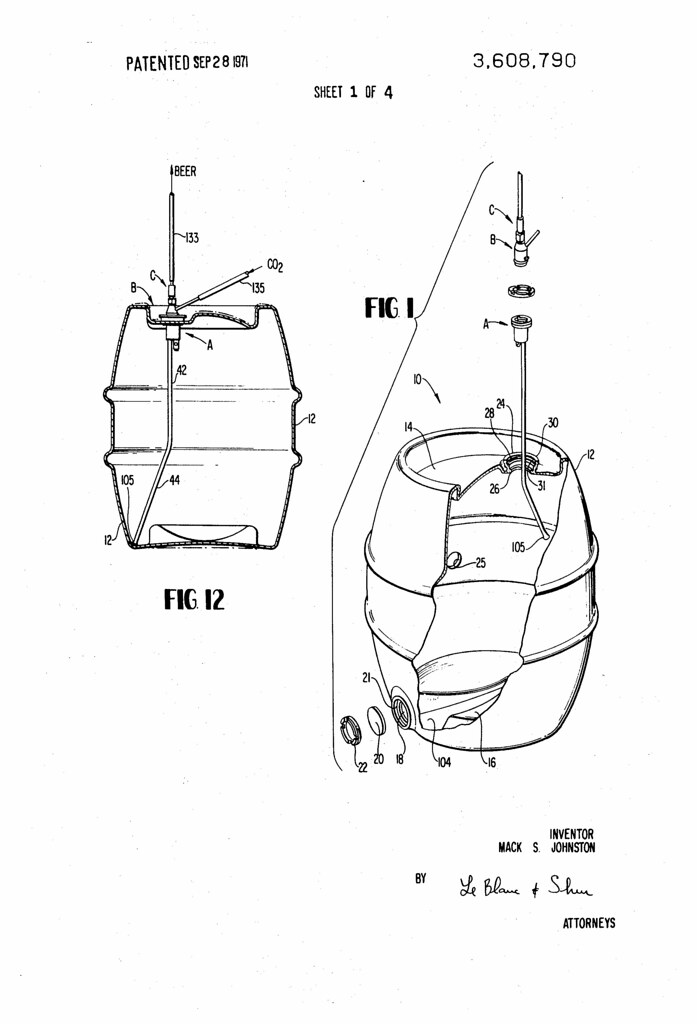
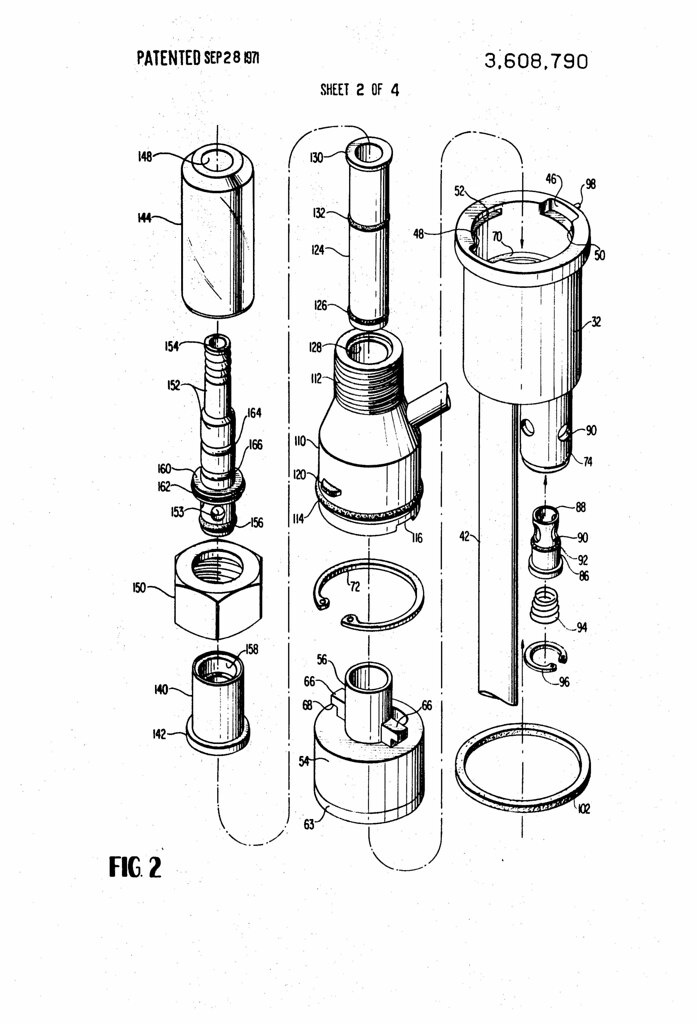
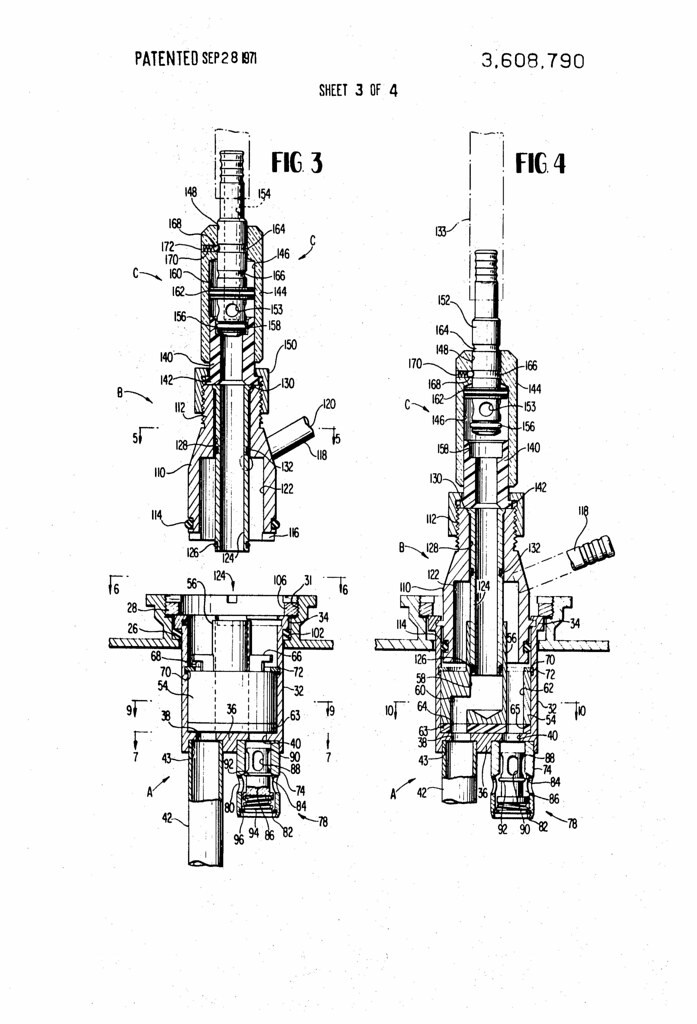
Patent No. 3608790A: Tapping Device For Beer Kegs

September 28, 2015 By Jay Brooks

patent-logo
Today in 1971, US Patent 3608790 A was issued, an invention of Mack S. Johnston, for his “Tapping Device For Beer Kegs and the Like.” There’s no Abstract, although in the description it includes this summary:

The present invention relates to a new improved tapping device for drawing fluids such as beer from containers such as beer kegs or barrels using a gas to drive the fluid from the container. Particularly, the present invention relates to a new improved tapping device usable with conventional beer kegs of the type having a 1% inch tapping opening and comprising a novel keg adapter for sealing and the keg opening, a unique coupler reliably attachable to the adapter at the dispensing establishment for dispensing beer, a new siphon tube configuration for the keg adapter whereby the keg may be substantially completely drained of beer notwithstanding its employment in high-pressure systems, and a novel beer shutoff valve for the coupler whereby flow of beer from the keg to the faucet can be shutoff at the keg.

Untitled
Untitled
Untitled
Untitled

Filed Under: Beers, Just For Fun, Politics & Law, Related Pleasures Tagged With: History, Kegs, Law, Patent

Patent No. 1155009A: Beer-Racking Apparatus

September 28, 2015 By Jay Brooks

patent-logo
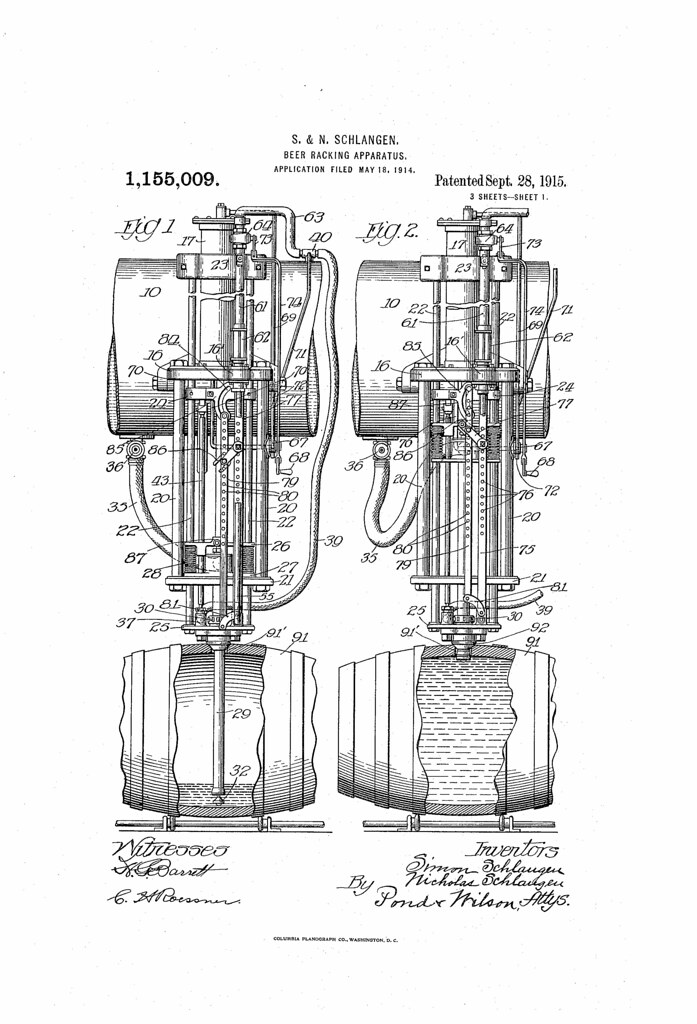
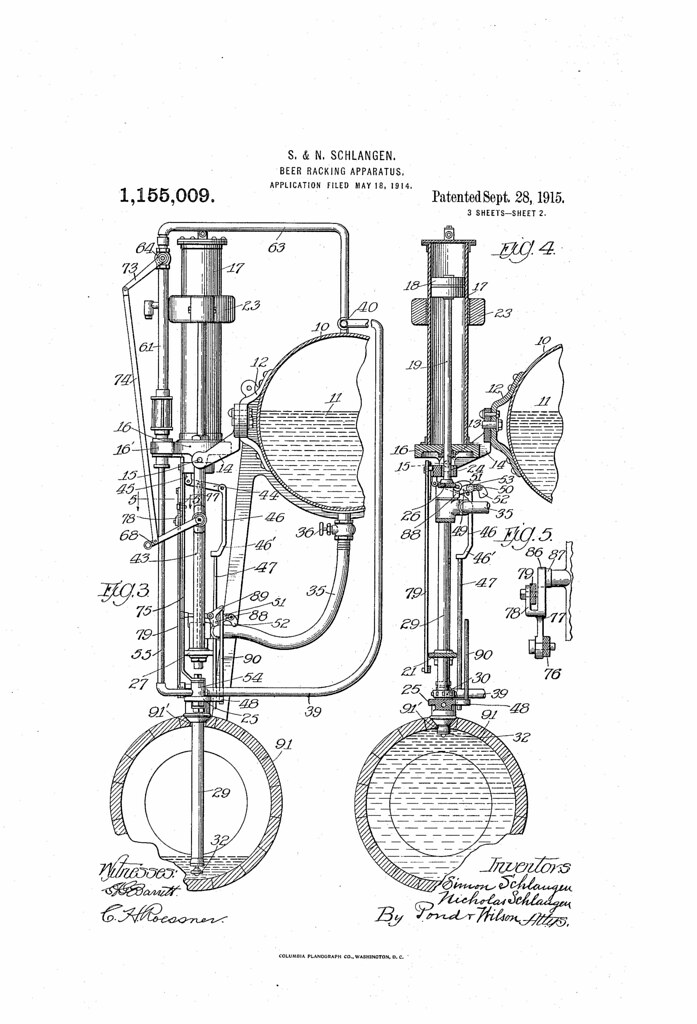
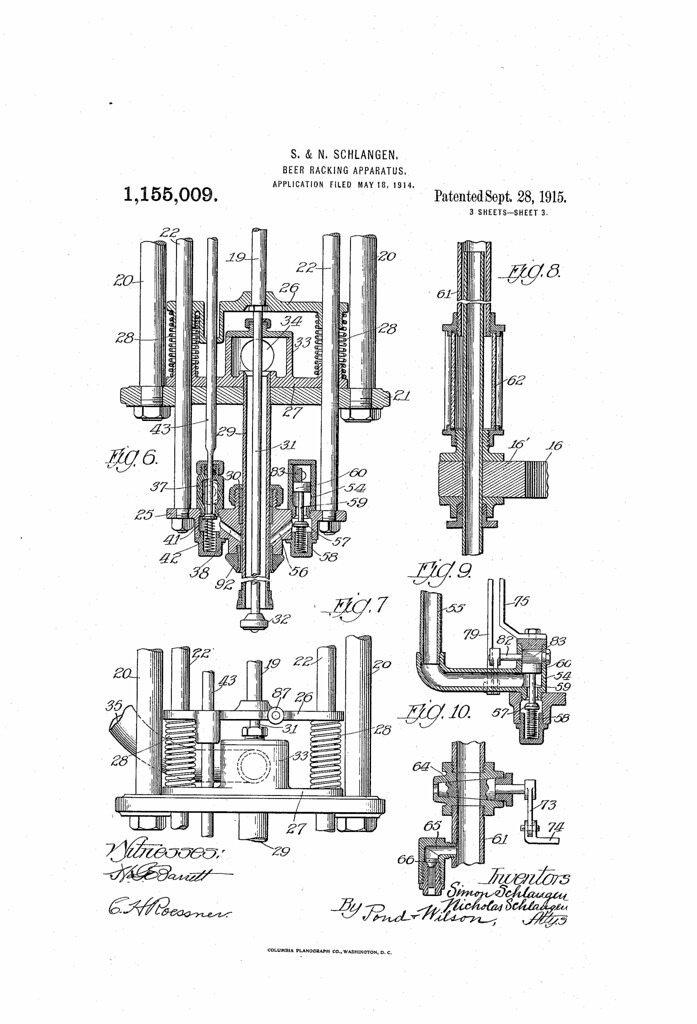
Today in 1915, US Patent 1155009 A was issued, an invention of Simon Schlangen and Nicholas Schlangen, for their “Beer-Racking Apparatus.” There’s no Abstract, although in the description it includes this summary:

This invention relates to improvements in Beer-Racking Apparatus, of which the following is a specification.

Among the objects’aimed at by the invention are; to provide a construction whereby it shall be possible to secure an even and uniform filling of the packages regardless of the variations in the amounts of expansion and contraction which different packages exhibit under the application and release of the counter-pressure to which they are subjected in the filling operation, to provide a construction not requiring any adjustment of parts to adapt it to the filling of packages of different sizes; to provide a construction wherein the contents of the filled package shall be vented to the atmosphere through the counter-pressure return pipe during the withdrawal of the filling tube from the package, thereby insuring the complete filling of the package by back-flow oi liquid from the counter-pressure return pipe to fill the space created by the withdrawal oi the filling tube regardless of the amount of expansion and contraction of the package; to provide a construction which will more effectively prevent waste and loss of beer at the bung of the package when the 3 seal is broken; and generally, to provide a simplified and improved racking mechanism of the type referred to.

Untitled
Untitled
Untitled

Filed Under: Beers, Breweries, Just For Fun, Politics & Law, Related Pleasures Tagged With: Brewing Equipment, History, Law, Patent, Science of Brewing

Patent No. 0283797A1: Keg Tap

September 28, 2015 By Jay Brooks

patent-logo
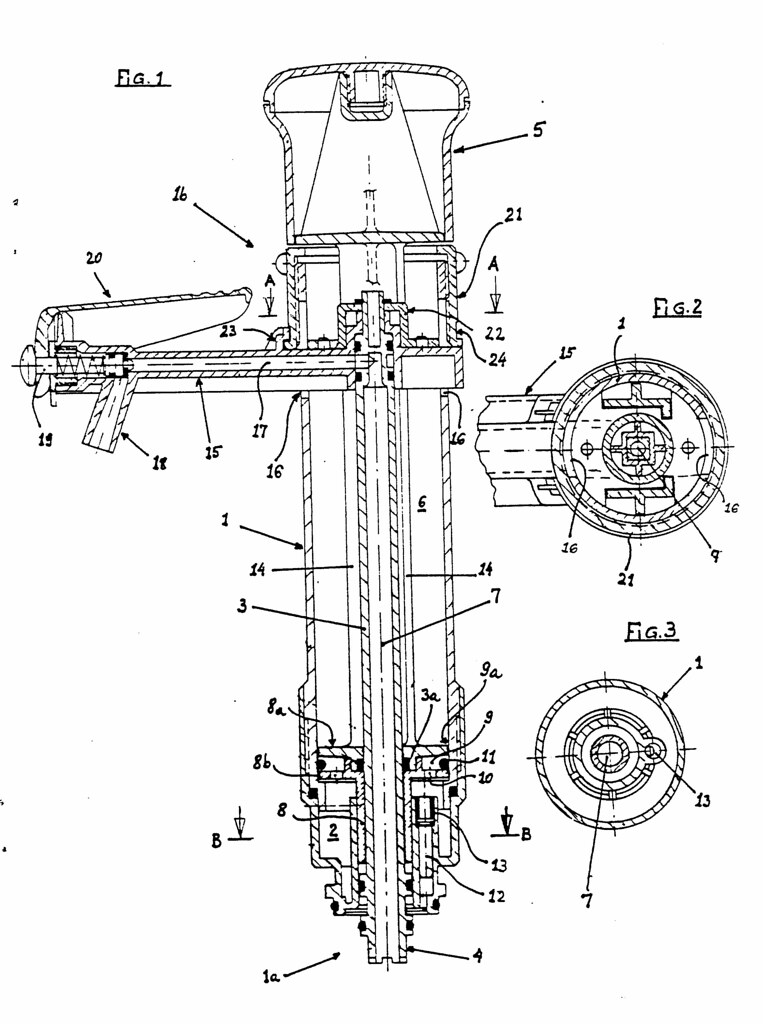
Today in 1988, US Patent 0283797 A1 was issued, an invention of Digby Hubbard, for his “Keg Tap.” Here’s the Abstract:

It is described for household use a Keg tap, in which through a pressure chamber (2) surrounds, essentially cylindrical housing (1) an axially movable valve-opening rod (3) with valve-opening element (4) and is plugged by a piston (8) is disposed in the lower region of the housing (1) and the located here pressure chamber (2) limited. The valve opening rod (3) is at the same riser, and has a continuous liquid passage (7) leading at one end from the valve-opening element (4) to the outside and at the opposite end in a fluid channel (17) merges, in a substantially right angle arranged to the fluid flow (7), with shut-off valve (19) and thus closable spout (18) provided with brackets (15) is recessed. Of the pressure chamber (2) closing piston (8) is connected via piston rods (14) with a handle (5), with which the piston (8) is actuated independently of the valve-opening rod (3).

Untitled

Filed Under: Beers, Just For Fun, Politics & Law, Related Pleasures Tagged With: History, Kegs, Law, Patent

Patent No. 3275447A: Process For The Preparation Of Highly Concentrated Dry Hops By Freezing

September 27, 2015 By Jay Brooks

patent-logo
Today in 1966, US Patent 3275447 A was issued, an invention of Adam Muller, for his “Process for the Preparation of Highly Concentrated Dry Hops by Freezing.” There’s no Abstract, although in the description it includes this summary:

The invention relates to a novel process for the preparation of a dry hops concentrate which contains substantially all of the lupulin components or bitter principles of the hops.

Hops concentrates have been prepared by organic solvent extraction methods and by dry methods. Dry methods of forming hops concentrates have not been completely successful since substantial losses of the bitter principles occur when discarding a portion of the strobile bracts which are the major component of raw hops. Known dry processes for forming hops concentrates high in lupulin values comprise separating the leaf and stem residues and the lupulin components by coarse flaking and screening of the hop strobiles or by fine comminution of the hops. However, complete recovery of the lupulin components has not been possible by these known dry methods and therefore only hop extracts produced by organic solvent extraction have gained commercial importance.

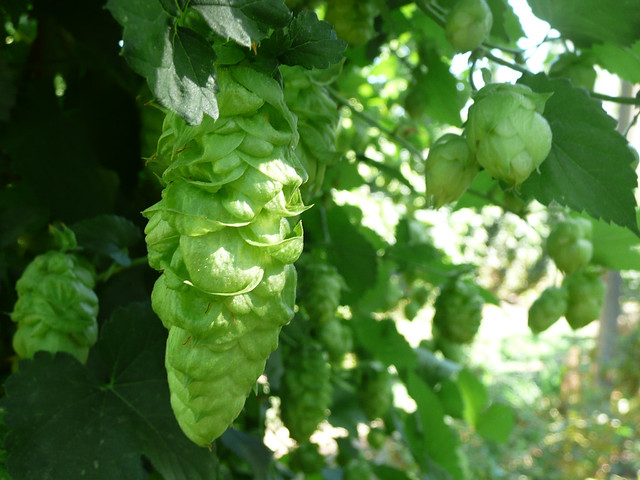
The process of the invention for the preparation of a hops concentrate which contains substantially all the lupulin values in the hops comprises freezing the hops wherein the lupulin forms distinct particles, comminuting the frozen hops to a particle size of 200 to 6000 microns whereby the lupulin particles are freed from the hops, separating the comminuted hops into a coarse fraction containing no lupulin and a fine fraction containing substantially all the lupulin in the hops and recovering the fine fraction.

The hops are frozen to a temperature of less than 10 0., preferably to a temperature of l5 to 30 C., although lower temperatures may be used. The said temperatures are necessary in order to form the lupulin particles which are often sintered together. into clumps. The deep-freezing may be effected in a freezing chamber or by evaporation of liquids having a low boiling point such as carbon dioxide, liquid nitrogen, etc.

By comminuting the hops to a particle size of 200 to 6000 microns, all of the lupulin glands, even those anchored in cone-like fashion in the leaf parenchyma of the strobile bracts, are separated from the hops in the form of individual beads so that a considerable savings in hops can be achieved during hopping of the wort due to the larger surface area of the bitter principle carriers.

hs-close-07

Filed Under: Beers, Just For Fun, Politics & Law, Related Pleasures Tagged With: History, Hops, Law, Patent

Patent No. 2131632A: Barrel

September 27, 2015 By Jay Brooks

patent-logo
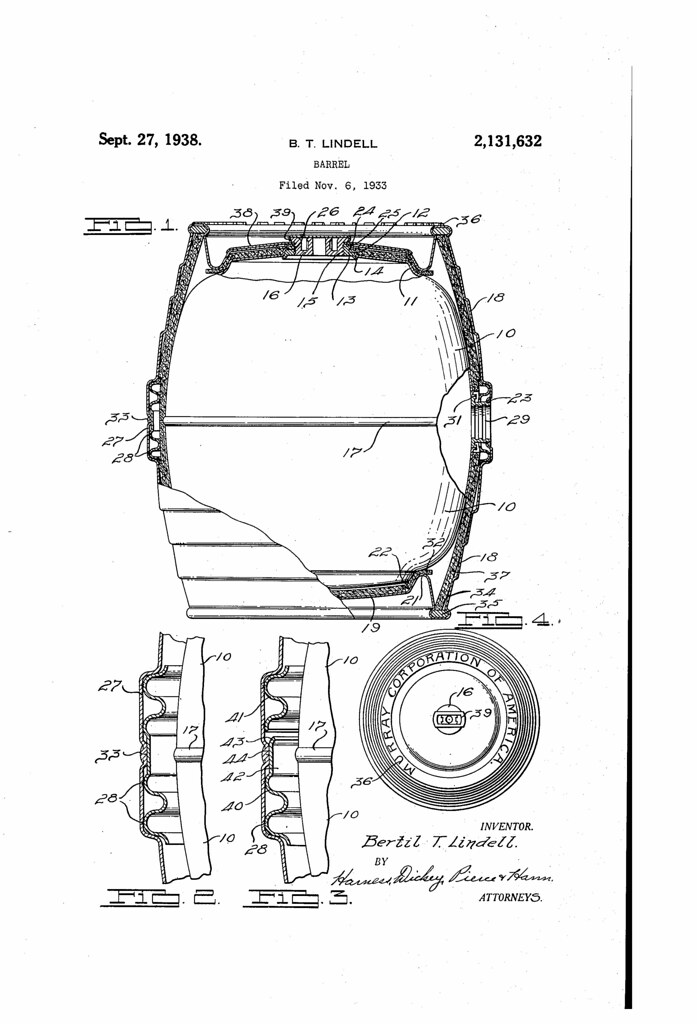
Today in 1938, US Patent 2131632 A was issued, an invention of Bertil T. Lindell, for his “Design for a Barrel.” There’s no Abstract, although in the description it includes this summary:

My invention relates to barrels and particularly to a barrel of the all-metal type having an inner and outer shell portion which are entirely insulated from each other. 5 In the co-pending application of C. H. Widman, A. P. Nacey and B. T. Lindell Serial No. 673,350 filed May 29, 1933, and assigned to the assignee of the present invention, a barrel was disclosed wherein reinforcing and insulating portions were provided for supporting and sealing the inner .eontainer portion against a transfer of heat. The present invention is a further extension of the novelty of the above mentioned barrel in that the inner and outer container portions are pre the insulating material is disposed between congruous surfaces which are shaped in such manner as to provide lateral and longitudinal support at the shoulder portions of the barrel. In this manner, the barrel is completely insulated except for the metal bungs where some transfer of heat will naturally occur owing to their direct contact with the contained liquid.

Untitled

Filed Under: Beers, Just For Fun, Politics & Law, Related Pleasures Tagged With: Barrels, History, Kegs, Law, Patent

« Previous Page
Next Page »

Find Something

Northern California Breweries

Please consider purchasing my latest book, California Breweries North, available from Amazon, or ask for it at your local bookstore.

Recent Comments

  • Bob Paolino on Beer Birthday: Grant Johnston
  • Gambrinus on Historic Beer Birthday: A.J. Houghton
  • Ernie Dewing on Historic Beer Birthday: Charles William Bergner 
  • Steve 'Pudgy' De Rose on Historic Beer Birthday: Jacob Schmidt
  • Jay Brooks on Beer Birthday: Bill Owens

Recent Posts

  • Historic Beer Birthday: Joseph Metcalfe February 28, 2026
  • Beer In Ads #5135: What Record’s Bock Beer Is February 27, 2026
  • Historic Beer Birthday: Albert Braun February 27, 2026
  • Historic Beer Birthday: John J. Schlawig February 27, 2026
  • Beer In Ads #5134: Lord Bushkill On Bushkill Bock February 27, 2026

BBB Archives

Feedback

Head Quarter
This site is hosted and maintained by H25Q.dev. Any questions or comments for the webmaster can be directed here.