Brookston Beer Bulletin

Jay R. Brooks on Beer

  • Home
  • About
  • Editorial
  • Birthdays
  • Art & Beer

Socialize

  • Dribbble
  • Email
  • Facebook
  • Flickr
  • GitHub
  • Instagram
  • LinkedIn
  • Pinterest
  • RSS
  • Twitter
  • YouTube

Powered by Genesis

Historic Beer Birthday: Christian Schmidt

June 24, 2025 By Jay Brooks

schmidts-beer
Today is the birthday of Christian Schmidt (June 24, 1833-September 6, 1894). Schmidt was born in Magstadt, Wurtemberg, Germany but moved to Philadelphia as a young man. In 1859, he became a partner with the Robert Coutrennay Brewery but bought him out the following year, renaming the brewery the Christian Schmidt Brewing Company until his sons joined the brewery in 1892, when it became known as C. Schmidt & Sons.

Here’s a biography of both Schmidt and his brewery from Workshop of the World — Philadelphia:

Christian Schmidt, an immigrant from Wurtemberg, Germany, purchased the Robert Courtenay brewery which primarily produced ale at this site in 1860. The acquisition of other breweries, such as Peter Schemm, in addition to the production of lager beer, boosted output to 100,000 barrels by 1892. A marked expansion of the physical plant kept pace with the brewery’s growth.

The last quarter of the nineteenth century was Philadelphia’s shining era for large and small breweries. Bergner and Engel (120,000 barrels), and William Massey and Company (75,000 barrels), were the third largest and eleventh largest breweries respectively in the U. S. in 1877. By 1895, Bergner and Engel with 250,000-300,000 barrels had fallen to 15th place; the largest local brewery. Other major companies were Engels and Wolf, Betz and Bergdoll. Christian Schmidt was succeeded by his son Edward who headed the company from 1895 until 1944. There were 421 employees at Schmidt’s in 1943. It had survived and thrived through new technologies—refrigeration, and political impediments, even Prohibition, which decimated other breweries both locally and nationally. Only 26 breweries operated in Pennsylvania in 1960. Philadelphia lost brands such as Esslinger, Poth, Gretz and Class and Nachod.

Schmidt family ownership ceased in 1976 with the sale of the brewery to William H. Pflaumer. By the late 1970s Schmidt’s was the tenth-largest American brewery. It operated a plant in Cleveland, Ohio which facilitated mid-west regional sales. Valley Forge Brewing Company was acquired in the 1960s, Duquesne Brewing Company (Pittsburgh) in 1972, and label and brewing rights to Reading and Bergheim were purchased in 1976, Rheingold in 1977, Erie Brewing Company, with its Koehler brands in 1978. In 1981, Ortlieb, the only other Philadelphia brewery, was purchased by Pflaumer. Schmidt’s, unable to cope with the marketing muscle of the giant national brewers even though it employed 1,400 and produced three million barrels of beer as recently as 1984, sold its brands to G. Heileman Brewing Company of La Crosse, Wisconsin, in April 1987. Production of the Schmidt’s labels slumped to about $1.6 million barrels in 1986, less than one percent of the total U. S. Market. The demise of Schmidt’s marked the end of the large brewery in Philadelphia.

In Rich Wagner’s Philadelphia Beer: A Heady History of Brewing in the Cradle of Liberty, he has this to say about Christian Schmidt:

c-schmidt-bio

schmidts-1930s
The Schmidt’s brewery in the 1930s.

And in One Hundred Years of Brewing, published in 1903, this was the entry for C. Schmidt & Sons.

Filed Under: Birthdays, Just For Fun Tagged With: Germany, History, Pennsylvania, Philadelphia

Historic Beer Birthday: John Gardiner Jr.

June 19, 2025 By Jay Brooks

Today is the birthday of John L. Gardiner Jr. (June 19, 1857-October 31, 1931). Gardiner was most likely born in Philadelphia, where his father, John Gardiner Sr., moved from upstate New York to buy the James Smyth Brewery in 1874, renaming it John Gardiner & Co. Brewery. In 1883, Gardiner renamed it again, this time the Continental Brewing Co., which remained its name until it closed at the start of prohibition in 1920. I haven’t been able to confirm his involvement with his father’s brewery, but it seems likely as the eldest surviving son that he would have operated the family brewery after his father passed away in 1903. One source, “The Brewer’s Hand-Book for 1918,” appears to list him as President of the brewery that year, and another Jr., his own son, as Secretary (although his Find-a-Grave page does not list a son), so I suspect I don’t have this quite right yet..

Junior’s father and his family are mentioned in the history of Schmidt’s Brewery, where he worked:

For generations the name of Gardiner had been well known in brewing circles. The family owned the Continental Brewing Co. in Philadelphia. John Gardiner married a daughter of Christian Schmidt. John Gardiner Jr., and Edward A. Gardiner, sons of John Gardiner, joined Schmidt’s to add new luster, in, respectively, sales and finance., to the family management team.

During the entire period of relegalization- including the peak year of 1955- and through to 1958, John Gardiner Jr., a grandson of the founder, was sales and advertising manager for the brewery. Mr. Gardiner, now a vice president, saw sales rise under his management from 106,000 in 1934 to almost 2 million in 1955.

Edward A. Gardiner, his brother, now chairman of the board, was responsible for the financial arrangements which made possible the various expansions of the brewery in the 1930’s, 40’s and early 50’s. It was Mr. Gardiner’s raising of the funds to accommodate the expansion of the company in 1947 and 1948 which kept the brewery abreast of modern changes and in a position to meet the difficult competitive challenge of the postwar years.

Filed Under: Birthdays, Breweries, Just For Fun Tagged With: Pennsylvania, Philadelphia

Historic Beer Birthday: Joseph Theurer

May 24, 2025 By Jay Brooks

Schoenhofen
Today is the birthday of Joseph Theurer (May 24, 1852-May 14, 1912). Born in Philadelphia of German descent, who became a well-known brewer in both his native Pennsylvania and Illinois. After he married Emma Schoehofen, he became VP of his father-in-law’s Chicago brewery, the Peter Schoenhofen Brewing Company in 1880. After Peter passed away in 1893, Theurer became president and remained at the helm until his own death in 1912.

joseph-theurer

Here’s a biography from Find a Grave:

Joseph Theurer, who was of German descent, was born in Philadelphia in 1852. He became one of the most knowledgeable brewers of his day. He served as Treasurer of the Illinois State Brewers Association from 1898 to 1911 and he held title of President of the United States Brewing Association from 1903 to 1905.

Joseph arrived in Chicago in the Fall of 1869 and worked as an apprentice to brewers Adam Baierle and K.G. Schmidt. In 1871, he had been working at the Huck Brewery for less than a week when the brewery was destroyed in The Great Chicago Fire.

So he returned to Philadelphia for a year to work at the brewery of Bergdoll & Psotta. And then headed back to Chicago in 1872 to work at Bartholomae & Leicht brewery until 1874. He was also employed for one season at the Clybourn Avenue Malthouse of F. Wacker & Co. before returning to Philadelphia until his marriage to Peter Schoenhofen’s daughter, Emma Schoehofen, in 1880.

Upon his marriage to Emma, he became Vice President of Schoenhofen Brewing Company in Chicago until his father in law Peter’s death in 1893. Joseph took over as President of Schoenhofen Brewing from 1893 until 1911.

In 1896, Joseph commissioned what is now known as the Theurer-Wrigley Mansion. The Mansion, built in the late Italian Renaissance style, was designed by Richard Schmidt and listed on the National Register of Historic Places in 1979. The 20,000+ square foot mansion features 11 bedrooms and 6 baths. Furnished with nearly all Tiffany light fixtures, many have been removed by previous owners or sold. An original Tiffany stained glass window from the Mansion is currently on display at the Chicago History Museum. Recent reports show the Mansion being listed for 9.5 million dollars as a foreclosure in 2011, but it has since been purchased and is currently occupied by a single owner.

On May 14, 1912 Joseph died from pneumonia and was laid to rest along with Peter Schoenhofen in the magnificent Egyptian revival style tomb in Graceland Cemetery. Services were conducted on May 17th in front of the tomb and conducted in both English and German. Attendees included members of the Illinois and Cook County Brewers Associations as well as a large number of charitable organizations, family and close friends.

Joseph was survived by his widow Emma, two sons, Peter S. and Joseph Jr., and two daughters Miss Margareta Theurer and Mrs. Marie (Richard) Ostenrieder.

joseph-theurer-late

The Encyclopedia of Chicago has a concise history of the Peter Schoenhofen Brewing Co.:

Peter Schoenhofen, a Prussian immigrant, was in Chicago working in the brewing trade by the 1850s. In 1861, he started a partnership with Matheus Gottfried; they were soon operating a brewery at Canalport Avenue and 18th Street where, during the early 1860s, they made about 600 barrels of lager beer a year. In 1867, Schoenhofen bought out his partner, and the company became the Peter Schoenhofen Brewing Co. By 1868, annual output had increased to about 10,000 barrels. During the 1890s, when the business was owned by the City Contract Co. of London, England, annual output reached 180,000 barrels. Around 1900, the Schoenhofen family regained control of the company, which employed about 500 people at its brewery on West 12th Street by 1910. During this time, the company was also known as the National Brewing Co. The company’s “Edelweiss” brand of beer was a big seller. Operations shut down during Prohibition, but by 1933, after the national ban on alcohol production was lifted, the company was back in business as the Schoenhofen-Edelweiss Co. After being purchased by the Atlas Brewing Co. in the late 1940s, Schoenhofen became part of Dewery’s Ltd. of South Bend, Indiana, in 1951, and thereafter assumed the Dewery’s name. By the beginning of the 1970s, there was nothing left of its Chicago operations, although Dewery’s reintroduced the famous Edelweiss brand in 1972 after nearly a decade-long hiatus.

Edelweiss-Beer-Paper-Ads-Peter-Schoenhofen-Brewing-Co

Today, the land where the brewery was located is known as the Schoenhofen Brewery Historic District and to see earlier photos of that area, Forgotten Chicago has a short history, with lots of pictures.

edelweiss-yellow

Filed Under: Birthdays, Breweries, Just For Fun Tagged With: Chicago, History, Illinois, Philadelphia

Beer In Ads #4978: Poth’s Bock Beer

May 23, 2025 By Jay Brooks

Last year I decided to concentrate on Bock ads. Bock, of course, may have originated in Germany, in the town of Einbeck. Because many 19th century American breweries were founded by German immigrants, they offered a bock at certain times of the year, be it Spring, Easter, Lent, Christmas, or what have you. In a sense they were some of the first seasonal beers. “The style was later adopted in Bavaria by Munich brewers in the 17th century. Due to their Bavarian accent, citizens of Munich pronounced ‘Einbeck’ as ‘ein Bock’ (a billy goat), and thus the beer became known as ‘Bock.’ A goat often appears on bottle labels.” And presumably because they were special releases, many breweries went all out promoting them with beautiful artwork on posters and other advertising.

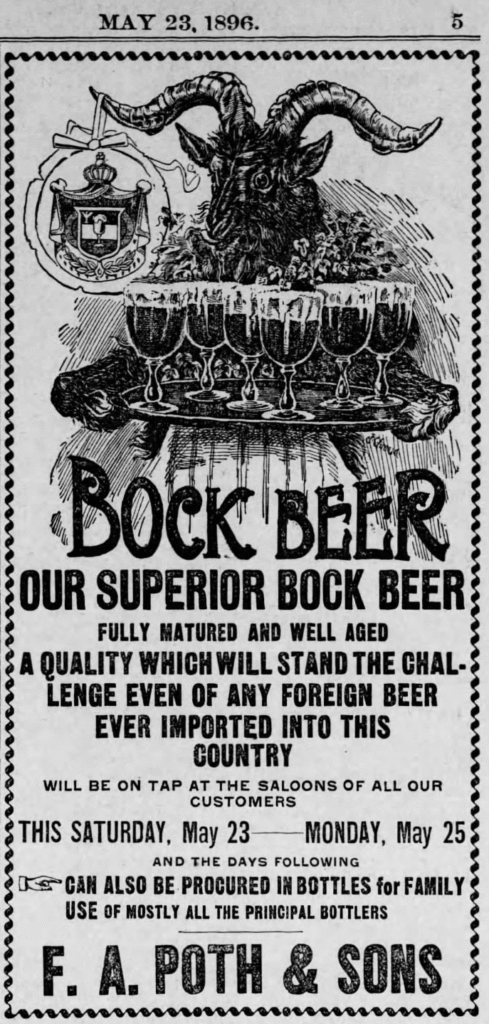
Friday’s ad is for Poth’s Bock Beer. The ad was published on May 23, 1896. This one was for F.A. Poth & Sons, which was founded in 1865. This ad ran in the Philadelphia Times of Philadelphia, Pennsylvania.

Filed Under: Art & Beer, Beers, Breweries, Just For Fun Tagged With: Advertising, Bock, History, Pennsylvania, Philadelphia

Beer In Ads #4969: It Deserves First Prize

May 14, 2025 By Jay Brooks

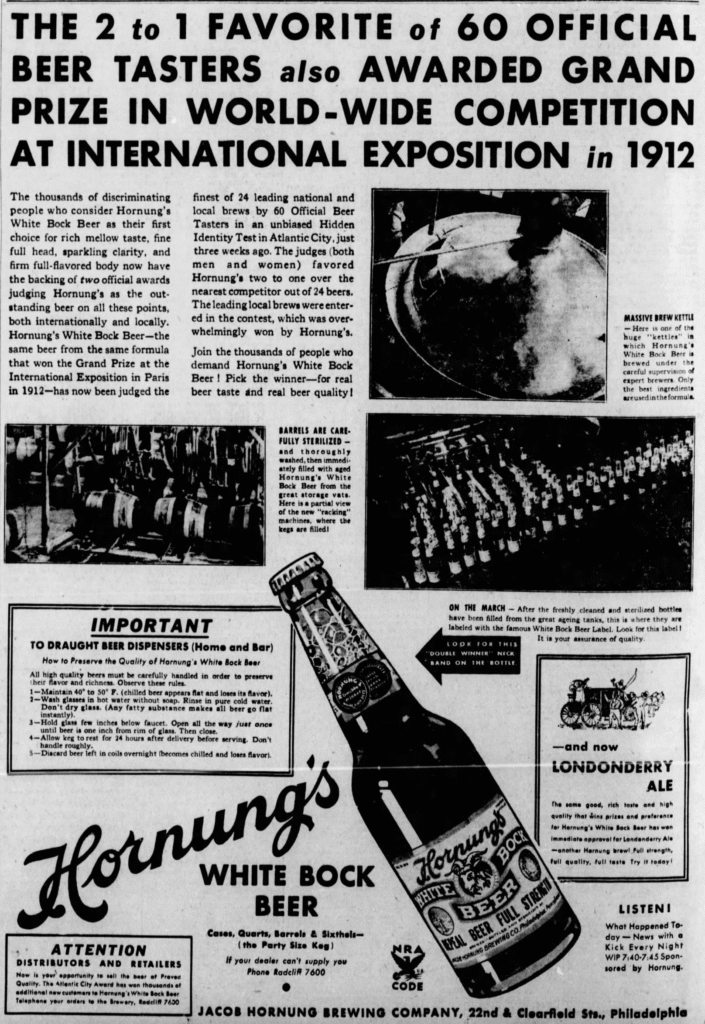
Last year I decided to concentrate on Bock ads. Bock, of course, may have originated in Germany, in the town of Einbeck. Because many 19th century American breweries were founded by German immigrants, they offered a bock at certain times of the year, be it Spring, Easter, Lent, Christmas, or what have you. In a sense they were some of the first seasonal beers. “The style was later adopted in Bavaria by Munich brewers in the 17th century. Due to their Bavarian accent, citizens of Munich pronounced ‘Einbeck’ as ‘ein Bock’ (a billy goat), and thus the beer became known as ‘Bock.’ A goat often appears on bottle labels.” And presumably because they were special releases, many breweries went all out promoting them with beautiful artwork on posters and other advertising.

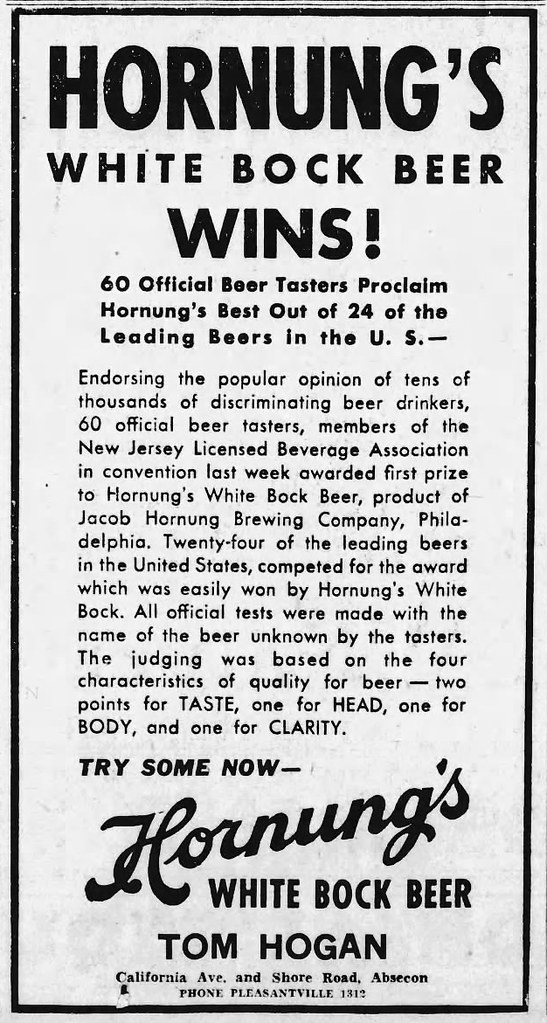
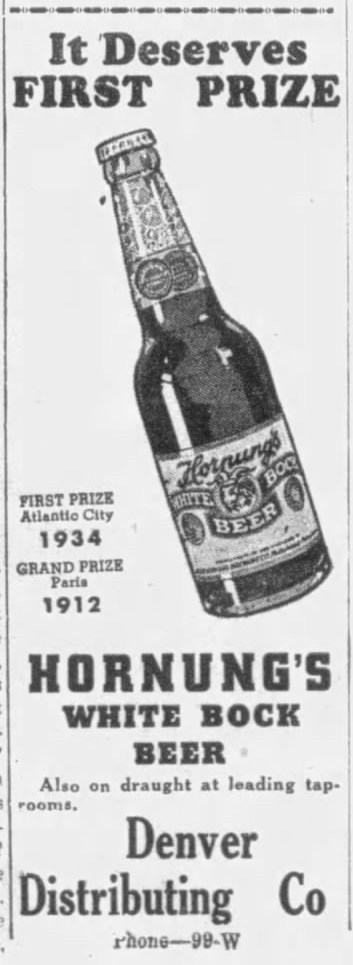
Wednesday’s ad is for Hornung’s White Bock Beer, which was published on May 14, 1936. This one was for the Jacob Hornung Brewing Co. of Philadelphia, Pennsylvania, which was originally founded in 1885. This ad ran in The Ephrata Review, of Ephrata, Pennsylvania.

Filed Under: Art & Beer, Beers, Breweries, Just For Fun Tagged With: Advertising, Bock, History, Pennsylvania, Philadelphia

Beer In Ads #4950: What Is Bock Beer, Otto?

April 24, 2025 By Jay Brooks

Last year I decided to concentrate on Bock ads. Bock, of course, may have originated in Germany, in the town of Einbeck. Because many 19th century American breweries were founded by German immigrants, they offered a bock at certain times of the year, be it Spring, Easter, Lent, Christmas, or what have you. In a sense they were some of the first seasonal beers. “The style was later adopted in Bavaria by Munich brewers in the 17th century. Due to their Bavarian accent, citizens of Munich pronounced ‘Einbeck’ as ‘ein Bock’ (a billy goat), and thus the beer became known as ‘Bock.’ A goat often appears on bottle labels.” And presumably because they were special releases, many breweries went all out promoting them with beautiful artwork on posters and other advertising.

Thursday’s ad is for Poth’s Bock Beer and was published April 24, 1908. The brewery was the F.A. Poth & Sons Brewery of Philadelphia. This ad ran in The Philadelphia Inquirer, of Philadelphia, Pennsylvania. This bock explainer ad starts with a phrase worthy of “What’s the Frequency, Kenneth?” with “What is Bock Beer, Otto?”

Filed Under: Art & Beer, Beers, Breweries, Just For Fun Tagged With: Advertising, Bock, History, Pennsylvania, Philadelphia

Beer In Ads #4949: Poth’s Bock Ready April 16th

April 23, 2025 By Jay Brooks

Last year I decided to concentrate on Bock ads. Bock, of course, may have originated in Germany, in the town of Einbeck. Because many 19th century American breweries were founded by German immigrants, they offered a bock at certain times of the year, be it Spring, Easter, Lent, Christmas, or what have you. In a sense they were some of the first seasonal beers. “The style was later adopted in Bavaria by Munich brewers in the 17th century. Due to their Bavarian accent, citizens of Munich pronounced ‘Einbeck’ as ‘ein Bock’ (a billy goat), and thus the beer became known as ‘Bock.’ A goat often appears on bottle labels.” And presumably because they were special releases, many breweries went all out promoting them with beautiful artwork on posters and other advertising.

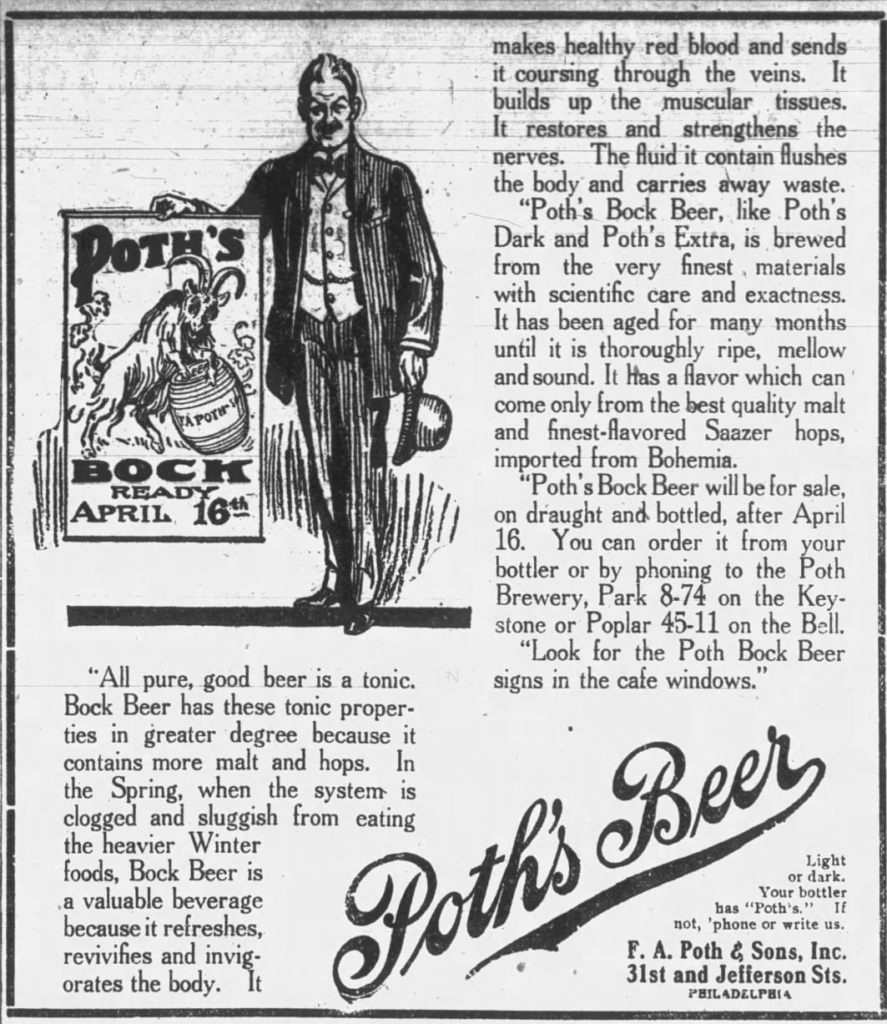
Wednesday’s ad is for Poth’s Bock Beer and was published April 23, 1908. The brewery was the F.A. Poth & Sons Brewery of Philadelphia. This ad ran in The Courier Post, which serve South Jersey and the Delaware Valley. The ad announced that “Poth’s Bock [will be] ready April 16th,” which is interesting since it ran a week after its release date.

Filed Under: Art & Beer, Beers, Breweries, Just For Fun Tagged With: Advertising, Bock, History, Pennsylvania, Philadelphia

Beer In Ads #4941: Poth Bock Beer

April 15, 2025 By Jay Brooks

Last year I decided to concentrate on Bock ads. Bock, of course, may have originated in Germany, in the town of Einbeck. Because many 19th century American breweries were founded by German immigrants, they offered a bock at certain times of the year, be it Spring, Easter, Lent, Christmas, or what have you. In a sense they were some of the first seasonal beers. “The style was later adopted in Bavaria by Munich brewers in the 17th century. Due to their Bavarian accent, citizens of Munich pronounced ‘Einbeck’ as ‘ein Bock’ (a billy goat), and thus the beer became known as ‘Bock.’ A goat often appears on bottle labels.” And presumably because they were special releases, many breweries went all out promoting them with beautiful artwork on posters and other advertising.

Tuesday’s ad is for Poth Bock Beer and was published April 15, 1892. The brewery was the F.A. Poth Brewing Co., of Philadelphia, Pennsylvania, which was originally founded in 1864. This ad ran in the Philadelphia Times, of Philadelphia, Pennsylvania.

Filed Under: Art & Beer, Beers, Breweries, Just For Fun Tagged With: Advertising, Bock, History, Pennsylvania, Philadelphia

Beer In Ads #4924: Poth’s Bock Beer

March 29, 2025 By Jay Brooks

Last year I decided to concentrate on Bock ads. Bock, of course, originated in Germany, in the town of Einbeck. Because many 19th century American breweries were founded by German immigrants, they offered a bock at certain times of the year, be it Spring, Easter, Lent, Christmas, or what have you. In a sense they were some of the first seasonal beers. “The style was later adopted in Bavaria by Munich brewers in the 17th century. Due to their Bavarian accent, citizens of Munich pronounced ‘Einbeck’ as ‘ein Bock’ (a billy goat), and thus the beer became known as ‘Bock.’ A goat often appears on bottle labels.” And presumably because they were special releases, many breweries went all out promoting them with beautiful artwork on posters and other advertising.

Saturday’s ad is for Poth’s Bock Beer and was published March 29, 1907 in the Philadelphia Inquirer, of Philadelphia, Pennsylvania. The ad was for the F.A. Poth & Sons Brewery, also of Philadelphia, and it’s an interesting advertising approach told in a story involving a waiter and restaurant patron having a conversation about bock beer.

Filed Under: Art & Beer, Beers, Breweries, Just For Fun Tagged With: Advertising, Bock, History, Pennsylvania, Philadelphia

Beer Birthday: Suzanne Woods

April 24, 2019 By Jay Brooks

allagash
Today is Suzanne Woods’ 41st birthday. I first met her during my trip to Philadelphia for Philly Beer Week its inaugural year. She used to write online as the Beer Lass and now is the mid-atlantic territory manager for Allagash, though when I first met her she worked for Sly Fox Brewing outside of Philadelphia. Join me in wishing Suzanne a very happy birthday.

slyfox-12
With Suzanne during a visit to Sly Fox Brewing at the beginning of Philly Beer Week.

An afro'd Suzy Woods and Wendy, from Dogfsh Head, with the Hammer
An afro’d Suzy and Wendy, from Dogfish Head, with the Hammer during Philly Beer Week 2010.

sidecar-4
Outside the Philly Bar, Sidecar, with some colorful local characters at the bar.

suzanne-woods-5
Suzanne posted this photo of herself when she was five when she turned thirty, eleven years ago.

Filed Under: Birthdays Tagged With: Pennsylvania, Philadelphia

« Previous Page
Next Page »

Find Something

Northern California Breweries

Please consider purchasing my latest book, California Breweries North, available from Amazon, or ask for it at your local bookstore.

Recent Comments

  • Bob Paolino on Beer Birthday: Grant Johnston
  • Gambrinus on Historic Beer Birthday: A.J. Houghton
  • Ernie Dewing on Historic Beer Birthday: Charles William Bergner 
  • Steve 'Pudgy' De Rose on Historic Beer Birthday: Jacob Schmidt
  • Jay Brooks on Beer Birthday: Bill Owens

Recent Posts

  • Historic Beer Birthday: Oliver Hughes May 20, 2026
  • Historic Beer Birthday: Benjamin, Lord Iveagh May 20, 2026
  • Historic Beer Birthday: Eduard Buchner May 20, 2026
  • Historic Beer Birthday: Louis de Luze Simonds May 20, 2026
  • Historic Beer Birthday: Johann Adam Lemp May 20, 2026

BBB Archives

Feedback

Head Quarter
This site is hosted and maintained by H25Q.dev. Any questions or comments for the webmaster can be directed here.