Brookston Beer Bulletin

Jay R. Brooks on Beer

  • Home
  • About
  • Editorial
  • Birthdays
  • Art & Beer

Socialize

  • Dribbble
  • Email
  • Facebook
  • Flickr
  • GitHub
  • Instagram
  • LinkedIn
  • Pinterest
  • RSS
  • Twitter
  • YouTube

Powered by Genesis

State Alcohol Administrators Slam Alcohol Justice

January 27, 2012 By Jay Brooks

ncsla
You probably knew that each state has some form of an ABC, an alcohol control organization that after Prohibition was created to administer their state’s laws regarding alcohol. Not surprisingly, they also have an organization where the professionals in these state organizations can get together and share information, how they do things, and generally learn from and help one another be better at their jobs. It’s called the National Conference of State Liquor Administrators, or NCSLA. Their stated purpose is:

The purposes of the Association shall be to promote the enactment of the most effective and equitable types of state alcoholic beverage control laws; to devise and promote the use of methods which provide the best enforcement of the particular alcoholic beverage control laws in each state; to work for the adoption of uniform laws insofar as they may be practicable; to promote harmony with the federal government in its administration of the Federal Alcohol Administration Act; and to strive for harmony in the administration of the alcoholic beverage control laws among the several states.

They have an annual convention where they get together, along with other events throughout the year. Also, in addition to the obvious members, it’s also open to distributors, suppliers, retailers, law firms, health organizations and anyone else with an interest in the administration of alcohol at the state and federal level.

Well. Earlier this week, Alcohol Justice posted a press release entitled Big Alcohol Dominates Alcohol Regulator Meeting, which touted an article in the new edition of the journal Addiction that they claim “Documents Unhealthy Influence of Alcohol Industry over State Regulators.” Not surprisingly, the author of the article, Sarah M. Mart, is the Director of Research for Alcohol Justice. So they created the propaganda, then promote it is as if it’s news and/or impartial information and it’s not surprising that it just happens to support their agenda. Is the concept of a self-fulfilling prophecy lost on them?

In this case, the article, Top priorities for alcohol regulators in the United States: protecting public health or the alcohol industry?, purports to examine the “NCSLA Annual Meeting [that] took place 20–24 June 2010 in New Orleans, Louisiana.” Smart claims as a “finding” that “[m]ore than two-thirds (72.2%) of the 187 conference attendees were from alcohol producers, importers, wholesalers, retailers or their attorneys. Nearly two-thirds (65.0%) of the 40 panelists were from the alcohol industry. The author of this paper was the only attendee, and the only panelist, representing public health policy.”

In the press release, Alcohol Justice spins it this way.

In a peer-reviewed article in the February 2012 issue of Addiction, Sarah Mart, director of research at Alcohol Justice, has documented the alcohol industry’s excessive involvement in a 2010 annual conference of state liquor administrators.

“With alcohol use being the third leading preventable cause of death in the U.S, you would think state regulator meetings would focus on the most effective and cost-effective ways to reduce alcohol-related harm,” stated Mart. “But this event was really about the industry’s agenda.”

Mart’s article details her experience at the annual National Conference of State Liquor Administrators (NCSLA), which took place in June 2010. More than two-thirds (72%) of the 187 meeting attendees, and 65% of the panelists, were from the alcohol industry. The rest represented state alcohol control systems and federal government agencies. Mart was the only participant representing public health policy.

“The NCSLA is dominated by the global companies that produce, import, distribute and sell alcohol,” said Mart. “Not surprisingly, the Association’s liquor control agenda lacks public health considerations.”

On average, 79,000 deaths annually are attributed to alcohol consumption. In 2005, there were over 1.6 million hospitalizations and 4 million emergency room visits for alcohol-related causes. Alcohol-related costs to state budgets are staggering, yet this trade organization of state regulators, which could play an important role in reducing the harm, has no stated position supporting public health.

“Big Alcohol panelists actually sent regulators a warning message: Be industry-friendly. Don’t rock the boat of commerce with public health concerns, or your job may be on the line,” reported Mart. “The Federal officials that were present also spoke about supporting the industry, instead of protecting public safety. That was a disappointment.”

Sounds bad, right? Well, the NCSLA sees it a different way. They’ve now responded with their own press release telling the other side of this story.

NCSLA, The Inclusive Crucible Of Alcohol Policy Issues, Dismayed By Inaccuracies Of “Sour Grapes”

When requested to comment on the recent press release from an entity named “Alcohol Justice”(formerly known as The Marin Institute), NCSLA President William A. Kelley, Jr. today said,

“The National Conference of State Liquor Administrators (“NCSLA”) has for decades been the only organization of the 50 states with the sole clear, transparent and inclusive purpose of effectively controlling alcoholic beverages. That purpose cannot be effective without input from all interested parties. Indeed since this Nation was founded, the fundamental principle of American government has been to make decisions with the consent of the governed. That requires substantive communication with and consideration of the concerns and competing interests of those who would be subject to regulatory action by the federal and state government. This is the hallmark of a real democracy.

The NCSLA is dismayed at the conduct of any organization which has chosen to re-brand itself and seeks to create relevance for its new brand by pandering for headlines, while taking no real, affirmative action to support and defend the federal and state beverage alcohol regulators in the executive, judicial and legislative branches of state and federal government. These federal and state regulators stand alone as they fulfill their lawful obligations to strike a balance between the protection of the common good and the service of the public demand for the different sorts of alcoholic beverages made available by this legitimate, responsible industry.

The agenda of self-promotion by “Alcohol Justice” is obvious and unavailing. The telling fact is that the now re-branded entity formerly known Marin Institute has repeatedly chosen not to become a member of the NCSLA despite the numerous invitations that have been extended to them and the years of courtesies from the NCSLA they have enjoyed in the form of expense-paid attendance at NCSLA conferences and participation on NCSLA panels. It is equally telling that this statement comes when further special treatment has been denied this re-branded entity while at the same time it was directly invited and encouraged to join the NCSLA, take a seat at the proverbial table, but on the same terms as those long met by other public health and public advocacy groups. It is disheartening when any entity with substantial financial resources, yet without the economic hardships endured for years by state beverage alcohol regulators, appears content to do nothing.

The silence of this re-branded entity is deafening in the national dialogue that continues as Congress, The President of the United States, the people of the state of Washington and the representatives of the people in all the 50 states grapple with the modern issues of beverage alcohol control. This struggle is the American legacy of that failed experiment named “Prohibition.”

I look forward to the honor of leading the NCSLA when it convenes in Washington D.C. to continue its efforts in fostering principles and techniques of balanced alcoholic beverages control. Unfortunately it appears that this re-branded entity chooses to continue to sit on the sidelines in its complacency, fermenting in its sour grapes. Perhaps sometime soon the reality will be recognized that much is expected from those who are given much.”

Nicely said, Mr. Kelley. Nicely said.

Filed Under: Editorial, News, Politics & Law Tagged With: Anti-Alcohol, Law, Press Release, Prohibitionists, State Agencies

The Absurdity Of Binge Drinking Statistics

January 11, 2012 By Jay Brooks

binge-barney
This is one of those things that’s increasingly pissing me off, because it avoids real problems that some people have with alcohol in favor of trying to turn individual problems into an epidemic. It’s not. If anything, overall consumption of alcohol is decreasing. But it’s hard to get funding, finance addiction clinics and raise money to fight the scourge of alcohol if you don’t make the situation sound as dire as possible.

Take binge drinking, for example. ABC News just did a story (thanks to Julia Herz for tweeting it) about a “new” report claiming that 38 million Americans “binge drink an average four times a month.” Their story, entitled CDC: Millions of Americans are Binge Drinkers, details how the CDC is claiming that 1 in 6 “adults binge drinks about four times a month, and on average the largest number of drinks consumed is eight.” Not only that, but this is apparently on the rise. Here’s what the CDC website has to say.

New estimates show that binge drinking is a bigger problem than previously thought. More than 38 million U.S. adults binge drink, about 4 times a month, and on average the largest number of drinks consumed is eight. Binge drinking is defined as consuming four or more drinks for women and five or more drinks for men over a short period of time.

In the ABC report, Dr. Fulton Crews, director of the Center for Alcohol Studies at the University of North Carolina at Chapel Hill is quoted in what must be one of the most out-of-touch statements ever made on this subject. “But most people don’t realize that binge drinking is unhealthy.” Seriously? Is there anyone who hasn’t been bombarded with neo-prohibitionist propaganda, whether it’s our government, MADD, Alcohol Justice or some other anti-alcohol group. My kids started receiving the message literally in kindergarten, before they were even able to process it. There isn’t a man or woman alive who believes that drinking too much is good for you.

What people might not know is that what it means to be a “binge drinker” is not as concrete as these “reports” insist. How binge drinking is defined keeps changing, and always it’s narrowing, pulling more people into the circle of binge drinkers, not because they’re suddenly drinking more, but because how it’s defined has changed. I don’t want to repeat myself too much, but I detailed some of the history of this transformation a couple of years ago, in two posts entitled Inflating Binge Drinking Statistics and Son of Binge Drinking Statistics Inconsistencies. And the year before that I wrote about it in Inventing Binge Drinking. What’s clear is that binge drinking went from something somewhat vague — you knew it when you saw it — to ever more specific definitions, the kind that could be quantified and used to alarm people, and, by no small coincidence, be used by anti-alcohol folks in their propaganda.

So yet again the definition seems to be changing. The actual number of “too many” drinks has been somewhat fixed for the last few years at 5 for a man and 4 for a woman. But what keeps changing is the period of time. Initially it was “in a row,” then “within a few hours.” This latest CDC “report” says “in a sitting” and “over a short period of time,” which conceivably could be almost any length of time. At least the ABC report mentions this inconsistency, noting that the definition of the National Institute on Alcohol Abuse and Alcoholism, says the alcohol must be consumed in “two hours or less.” That works out to a beer every thirty minutes for a woman, and for a man, one every 24 minutes.

But what’s also absent from their definition of binge drinking is weight. The definition of being considered drunk is always expressed as a calculation combining time, the amount of alcohol consumed and the weight of the person drinking it. But binge drinking never takes that into account, apart from dividing up gender, presumably under the premise that men are generally bigger than women. That reality, of course, is not true in every case. And it may be indelicate to say so, but with our obesity issues as a nation, in theory it should be taking us longer to actually get drunk today than it did twenty years ago. But the reality is that a 200-pound man will take longer to get drunk than a 120-pound man. The same amount of alcohol will effect the two differently. So why should both be defined as binge drinkers if one becomes inebriated but the other does not?

And frankly, there’s another elephant in the room that troubles me, but is rarely, if ever, talked about. If you’re an adult and choose to drink 5 beers in a row, are not driving, and are not in any other way putting yourself or others at risk, why shouldn’t you be allowed to go a little crazy once in a while? You are, actually. It’s not illegal. Although neo-prohibitionists might not like it, there’s nothing to stop you from going on a bender if you feel like it. You shouldn’t be made to feel guilty about it. If it gets out of hand, your friends and family will likely step in. If it doesn’t so what? Who are you hurting? But every time these “reports” come out, the implication is that binge drinking is bad no matter what. But not all bingeing is the same, especially as they now define it. The average beer dinner runs to at least five courses (unless Sean Paxton is doing it), meaning that every single person attending such a beer dinner is considered a dangerous “binge drinker” by the CDC and other government agencies. Is that rational or realistic? Of course not. That’s entirely different from a person who bellies up to the bar and downs five shots of rotgut in rapid succession. Yet both are considered equally dangerous and costing society untold millions of dollars. It’s absurd.

Here’s some more of the statistical data, which it should be noted was complied through a telephone poll, from the CDC’s press release:

As reported in this month’s Vital Signs, the CDC found that those who were thought less likely to binge drink actually engage in this behavior more often and consume more drinks when they do. While binge drinking is more common among young adults aged 18–34 years, binge drinkers aged 65 years and older report binge drinking more often—an average of five to six times a month. Similarly, while binge drinking is more common among those with household incomes of $75,000 or more, the largest number of drinks consumed on an occasion is significantly higher among binge drinkers with household incomes less than $25,000—an average of eight to nine drinks per occasion, far beyond the amount thought to induce intoxication.

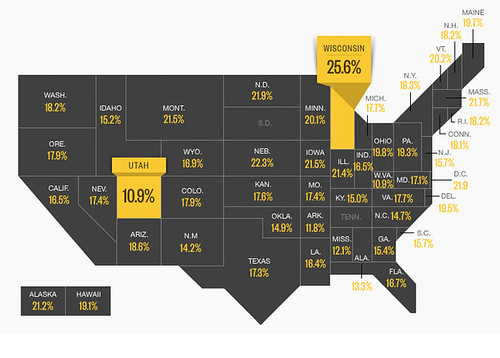
Adult binge drinking is most common in the Midwest, New England, the District of Columbia, Alaska, and Hawaii. On average, however, the number of drinks consumed when binge drinking is highest in the Midwest and southern Mountain states (Arizona, Nevada, New Mexico, and Utah), and in some states— such as Louisiana, Mississippi, and South Carolina—where binge drinking was less common.

But perhaps where this absurdity becomes most evident is in one of the CDC’s suggestions on how to combat binge drinking, which they list under the heading “what you can do.” Here’s the suggestion: “Follow the U.S. Dietary Guidelines on alcohol consumption; if you choose to drink, do so in moderation — no more than one drink per day for women and no more than two drinks per day for men.” Except those are NOT the most recent USDA dietary guidelines. Not even close. The 2010 guidelines “defines ‘low-risk’ drinking as no more than 14 drinks a week for men and 7 drinks a week for women with no more than 4 drinks on any given day for men and 3 drinks a day for women.” So that’s two government agencies that can’t agree on safe levels of consumption, and one that’s essentially lying about it to bolster their own point of view. The UK has had similar problems with their guidelines, when it was revealed a few years ago that their government just made up the safe guidelines, which then became carved in stone for the next twenty or more years, despite being literally plucked out of thin air.

Before the angry comments start flooding in again, I should point out that I don’t believe that binge drinking is always a good idea, or that people should do it all the time. I’m not arguing in favor of it. However, I do believe one does have the right to go on a binge if they feel like it (and as long as they’re being safe and aren’t doing so frequently enough to alarm those people closest to them). I do believe that how the CDC and others define binge drinking is ludicrous and does more harm than good. By making almost everyone a binge drinker through their ever-narrowing definition, they’re avoiding dealing with the serial binge drinkers who really are hurting themselves, and possibly others around them. This does nothing to combat the people who really need help. All it does is demonize all alcohol drinkers, making us all the same, which even the most jaded neo-prohibitionist has to admit, we’re not. It’s not how many drinks one has, or over what period of time, it comes down to how one handles themselves in that situation. If you’re a safe and responsible drinker, none of the rest of that even matters. Drink by example, that’s my new motto.

UPDATE: One of the biggest problems with studies like this is how uncritically they’re reported by the mainstream media. The most common way a press release like this one is used is by taking it and maybe changing around the words slightly but essentially just regurgitating it wholesale, not doing any follow up or critically examining it, and accepting all of it without question. That’s not what journalism should be, but in many cases that’s what it’s become, sad to say. Case in point is The Daily’s piece on it, Binge There, Done That. On the plus side, there’s this cool infographic they created based on the data from the telephone polls that the CDC conducted. On the negative side, there’s no key to the data, but the report mentions that it’s the “percent of the population” that are binge drinkers.

120112-binge-drinking

Filed Under: Editorial, Politics & Law Tagged With: Anti-Alcohol, Prohibitionists, Statistics

Snacking Between Meals Leads to Alcoholism & Death

December 14, 2011 By Jay Brooks

target-alcohol
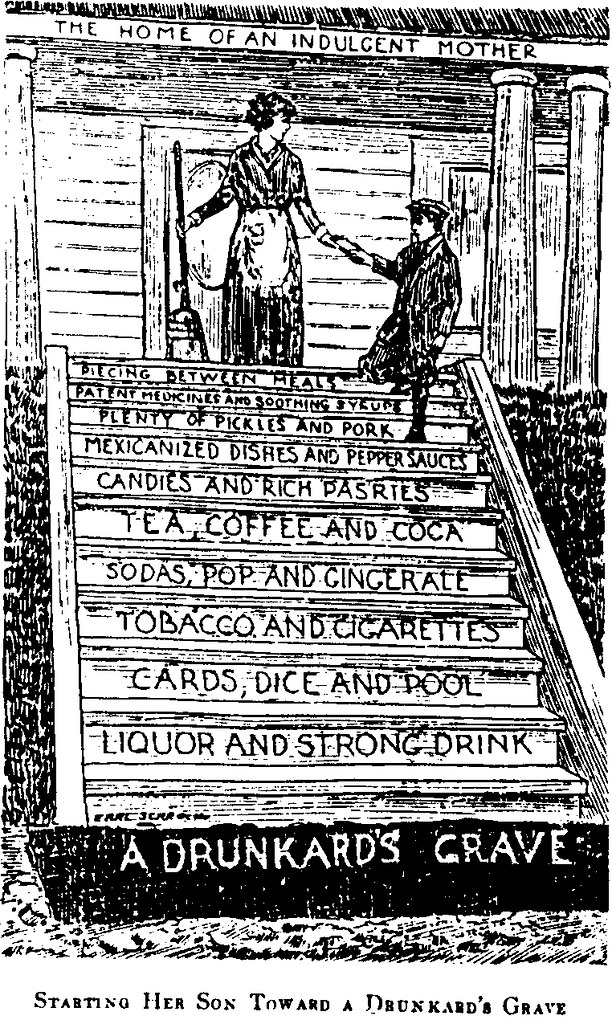
Before Prohibition became a reality, the prohibitionists used shameless propaganda to advance their cause, and it became increasingly absurd as time went on. When the temperance movement began in the 1830s, it was primarily against hard liquor, and beer was thought of as a drink of moderation, which by comparison it was. But over time, the movement became more and more intolerant of not just all alcohol, but many other things, such as coffee, pickles, pie, sugar, tea, and even meat. Abstinence itself became a goal. It became entirely fanatical, and in many cases was backed by religious factions and led by preachers. This transition is chronicled nicely in Jessica Warner’s “All or Nothing: A Short History of Abstinence in America.”

So by 1915, when this piece of propaganda was published, the prohibitionists were in the full flower of absurdity. It’s from a temperance program by evangelist Thomas F. Hubbard, published by the Wagoner Printing Company of Galesburg, Illinois. It’s showing how you could destroy the life of your son by being an “indulgent mother,” leading them down the path (or stairs) to “a drunkard’s grave.” So remember; never, ever be nice to your children. Just look what might happen.

gateway

See if you can follow the logic. If you allow your son to have a little food between meals, a.k.a. “a snack,” it will undoubtedly make him ill, causing you to ease his pain by giving him — gasp — medicine and “soothing syrups.” That, in turn, will undoubtedly lead you to let him eat too many pickles and pork (it’s always bacon’s fault) and “Mexicanized Dishes and pepper sauces,” you know … spices! But once he’s got a taste for flavor, he won’t be so easily satisfied anymore. Hot foods and the “other white meat” will, of course, lead your son to an indulgent life of rich pastry and candy, damn the luck. He’ll want to wash down all those sweet confectionaries with “tea, coffee and coca” (sic). And you know that can’t be good. It’s a slippery slope from there. He’ll then want to drink “sodas, pop and ginger ale.” After that, your son will need to relax with a cigarette or other tobacco. What else could he possibly want? He had no choice, really. You can’t really blame him. After soda pop, everyone needs to light up. It’s only natural. And once you begin smoking, you can’t really help but start gambling. It’s inevitable. Once you light up that ciggie, playing cards, throwing dice and picking up a pool cue can’t be far behind. It just can’t be helped. And you know what every gambler on the face of the Earth does, right? You got it: drink “liquor and strong drink.” And he can’t just drink it on occasion, but he keeps on drinking it, never stopping until he reaches “a drunkard’s grave.” And all because you gave him some Goldfish or Cheez-Its between meals. It’s so obvious. One unbroken chain from snacking to death, with no possible way to break the cycle. It’s like walking down the stairs. Gravity takes over and you can’t help but keep taking each successive step until you have one foot in the grave.

It is, of course, completely absurd, but one has to assume prohibitionists really believed it, just as some people today actually believe that one drink makes someone an alcoholic. And while I can’t imagine today’s anti-alcohol groups rising to this level of evangelical disinformation, they are, sad to say, moving in that direction. Alcohol Justice, for example (who insist they’re not neo-prohibitionists), has hardened their position of late and now takes the position that there are no safe levels of moderate drinking. They no longer take issue with whether one drink, or two drinks or however many drinks is appropriate for moderate consumption. They’re now proselytizing that zero is the only number of drinks that will keep you from falling into a life of ruin and becoming a burden on society, costing the teetotalers many millions of dollars. Total abstinence is now the only way to save yourself. That sure sounds like history repeating itself to me. With MADD, the Robert Wood Johnson Foundation and many others turning toward this position and using increasingly absurdist propaganda, often in the form of “pseudo-scientific studies,” to further their agenda how long can it be before we see this sort of thing in the present. So remember mothers, keep beating your children and never indulge them anything, no matter how much pain they’re in or how much pleasure it might give them. Compassion and love are for sissies. If you want to keep your son out of the drunkard’s grave, you’ll need to crack the whip. After all, it’s for their own good. I’m sure the neo-prohibitionists would approve.

beer-syringe-white
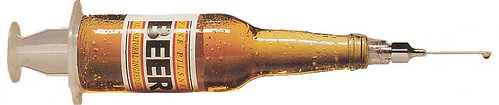
Modern anti-alcohol propaganda: beer leads directly to heroin, or beer is the same as heroin.

Filed Under: Editorial, Politics & Law Tagged With: History, Prohibition, Prohibitionists, Propaganda

Ken Burns Discusses Prohibition

December 13, 2011 By Jay Brooks

no-beer
I suspect many of you watched the Ken Burns documentary series Prohibition, based on the Daniel Okrent book Last Call, when it aired a few months ago on PBS. In the latest issue of Reason magazine there is an interview with Ken Burns, discussing the documentary. Since they mentioned that there was a filmed version of the interview on Reason.tv, I thought I’d share that version of the Prohibition interview.

Filed Under: Politics & Law Tagged With: History, Prohibition, Prohibitionists, Video

MADD Rates The States

November 17, 2011 By Jay Brooks

drunk-driving
According to a press release sent out by the neo-prohibitionist organization MADD yesterday, it’s the five-year anniversary of the launching of their Campaign to Eliminate Drunk Driving® program, which you can tell is all about the results since they went to the trouble to get a “registered trademark” on the name. I also find it somewhat ironic that an organization whose name is “Mothers Against Drunk Driving” has to start a side campaign within its organization to eliminate drunk driving. Isn’t that supposed to be their main purpose? It was, of course — once upon a time — but it’s moved so far from that simple idea now that it seems it’s almost an afterthought so that five years ago they had to create a new program to address the issue of drunk driving.

So yesterday they released the somewhat arrogantly-named “Report to the Nation, which rates each state on its progress toward eliminating drunk driving.” The news is just what you’d expect, indeed what it is every time. “[W]e’ve made substantial progress together, but there is still much work to be done.” And so it goes. Every time. They have to make progress, or why do they even exist, but there always has to be more to do, or else who would keep giving them money? That dichotomy creates contradictions that call all of their assertions into question. For example, on page 6 of the 32-page report, a splash page entitled “A New Hope,” the headline is “drunk driving fatalities reduced by almost half.” And that would certainly be good news, I don’t dispute that. Except that what they refer to as “remarkable progress” in the first paragraph morphs into something entirely different by the second paragraph, which begins: “Despite great progress, drunk driving fatalities have remained relatively stagnant since the mid-nineties, with roughly one out of three highway deaths caused by a drunk driver.” Now how exactly can fatalities be “reduced by almost half” while at the same time “remaining relatively stagnant?”

It’s a game, sadly. Non-profits may not care about profits the way corporations do, but that doesn’t mean they don’t care about money … a lot. They complain constantly about the money that alcohol companies spend on lobbying or influencing policy, but that’s exactly what these neo-prohibitionist groups do, too. Most non-profits may start out with the best of intentions, with a clear goal in mind, but then seem to collapse under their own weight into money-sucking organizations nearly as bad as those they often rail against as they grow larger. In a sense, they become victims of their own success. They become “institutions,” with fixed costs, offices, salaries to pay, consultant fees, marketing materials, advertising, webmasters, etc. They need a lot of money just to take care of their day-to-day costs, never mind whatever they’re trying to achieve. MADD’s gone so far from their original intent that when my son was in kindergarten, he got a bookmark from them during “red Ribbon Week” so he’d know that drugs are bad. Never mind that he parroted that message the next time we tried to give him medicine when he was sick, not quite old enough to process that not ALL drugs were bad.

The “report” also floats yet another made up number of how much it all costs, this time that “drunk driving costs the United States more than $132 billion annually.,” similar to the CDC’s recent $223.5 billion figure, though that was for “excessive alcohol use,” not just driving. Their “research” was done by the Pacific Institute for Research and Evaluation (PIRE), and their figure “includes $61 billion in monetary costs, plus quality-of-life losses valued at $71 billion,” just as notoriously impossible to quantify as lost wages, though they did still try to include “crashes outside of work involving employees and benefit-eligible dependents.” The full study itself, however, is not included in the “report,” just a one-paragraph summary of it so I don’t know all of the particulars.

Another aspect of the report is about “turning cars into the cure,” which really means just “ignition locks,” one of the most invasive ideas ever implemented, especially for first-time offenders who do not constitute the bulk of the problem. What continues to bother me about this is that MADD, and the rest of the Anti-Alcohol bunch, continue to ignore supporting a much better solution, the technology to create cars that drive themselves. That technology is surprisingly close to becoming a reality, with several prototypes in various states of development and being tested. It would virtually eliminate not just drunk driving, but bad driving, texting and telephone issues while driving, and so much more. Just input the address of where you want to go into a computer and the car takes you there while you sit and watch. Instead, MADD seems to prefer technology that punishes. At a minimum, why not support both?

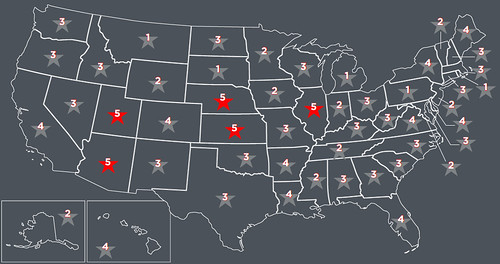
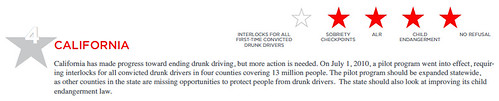
But the bulk of the “report,” around half of it, is their evaluations of how each state is doing to combat drunk driving, at least according to their criteria. They use a five-star scale, with each star representing whether the state does what MADD wants them to regarding the following:

  1. Interlocks for All First-Times Convicted Drunk Drivers
  2. Sobriety Checkpoints
  3. Administrative License Revocation
  4. Child Endangerment
  5. No Refusal

MADD-rating-states-map

Five states got highest marks:

  1. Arizona
  2. Illinois
  3. Kansas
  4. Nebraska
  5. Utah

And like a good bell curve, five got just 1 (nobody got a zero):

  1. Michigan
  2. Montana
  3. Pennsylvania
  4. Rhode Island
  5. South Dakota

There’s also an interactive map where you can see how your state did. California, for example, got a surprising 4. I’m sure Alcohol Justice would disagree with that one.

MADD-rating-states-cal

The states that got a five are still, of course, encouraged to do more. And by more, MADD means for each state to accept what they think is the best approach. Do what we say, or risk a bad rating, that seems to be at least part of the message. With most states receiving a three, there’s plenty of room for improvement, and plenty of need for more fund-raising.

Filed Under: Editorial, News, Politics & Law Tagged With: Anti-Alcohol, Prohibitionists, Statistics

Fomenting Female Fear

November 16, 2011 By Jay Brooks

women
The purported scientific journal Alcoholism: Clinical and Experimental Research has just published another doozy, this one entitled The Legacy of Minimum Legal Drinking Age Law Changes: Long-Term Effects on Suicide and Homicide Deaths Among Women. The idea was to compare people drinking before the age was raised to 21 with when 18-year olds could still legally imbibe, but the conclusions are .. well, off the deep end and unnecessarily alarmist. So, of course, anti-alcohol groups are running with the results, just as you’d expect.

Despite it being in a “scientific journal” it appears to be nothing more than junk science. They start with this premise. “Prior to the establishment of the uniform drinking age of 21 in the United States, many states permitted legal purchase of alcohol at younger ages. Lower drinking ages were associated with several adverse outcomes, including elevated rates of suicide and homicide among youth.” Really? So the other 139 nations who allow people 18 or under are all killing their kids, getting them to commit suicide more often or generally simply not caring about their health. Most of the rest of the world allows their citizens to drink before they turn 21. Apart from the eight countries where it’s illegal for everyone — mostly for religious reasons — only a dozen countries are as high as 21 (only 5 according to Alcohol Problems & Conclusions), like us. Clearly, the rest of the world hates its kids, right?

Here’s the rest of the Abstract:

Methods:  Analysis of data from the U.S. Multiple Cause of Death files, 1990 to 2004, combined with data on the living population from the U.S. Census and American Community Survey. The assembled data contained records on over 200,000 suicides and 130,000 homicides for individuals born between 1949 and 1972, the years during which the drinking age was in flux. Logistic regression models were used to evaluate whether adults who were legally permitted to drink prior to age 21 were at elevated risk for death by these causes. A quasi-experimental analytical approach was employed, which incorporated state and birth-year fixed effects to account for unobserved covariates associated with policy exposure.

Results:  In the population as a whole, we found no association between minimum drinking age and homicide or suicide. However, significant policy-by-sex interactions were observed for both outcomes, such that women exposed to permissive drinking age laws were at higher risk for both suicide (OR = 1.12, 95% CI: 1.05, 1.18, p = 0.0003) and homicide (OR = 1.15, 95% CI: 1.04, 1.25, p = 0.0028). Effect sizes were stronger for the portion of the cohort born after 1960, whereas no significant effects were observed for women born prior to 1960.

Conclusions:  Lower drinking ages may result in persistent elevated risk for suicide and homicide among women born after 1960. The national drinking age of 21 may be preventing about 600 suicides and 600 homicides annually.

Okay, the first thing that should stick out is the statement that “[i]n the population as a whole, we found no association between minimum drinking age and homicide or suicide.” But then they go on to suggest “significant” findings for just women, even though their findings show that for suicide, a woman is only 12% more likely to commit suicide if she starts drinking legally at 18, and 15% more likely to be murdered. That hardly sounds “significant” and seems small enough that statistical error alone could account for some of the difference. But more importantly, it makes no allowance for any of the literally millions of other factors that lead to any person committing suicide or being murdered. And there’s just no causation or direct correlation linking the two outcomes. The difference in time alone could account for the statistical difference. The time when the age was 18 was different than later, when it was 21. Times change, and so accordingly would how people react to it.

And again, even though it’s only women who the “study” found were affected, they note that the “trends were not mirrored among men,” but examining all this data that “proves” a link for women, their answer to why it doesn’t increase a risk for men is this. “It’s hard to say why that happened.” Well, how scientific. When the results are what they’re looking for, they point to the data. When the data doesn’t support the conclusion they want, they don’t know what happened. Hmm.

Join Together’s headline, Lower Legal Drinking Age Linked to Higher Risk for Homicide, Suicide in Women, claims there is a definite link (which the study itself never says). And their graphic shows a presumably passed out woman in front of a blurry empty bottle of liquor. At the end of their article, lead researcher Richard Grucza says the following. “In fact, what we have here is a natural experiment that supports that idea, by demonstrating an unintended but positive consequence that comes from having raised the drinking age.” But there’s nothing natural about that conclusion. Just like MADD in the past has claimed victory against drunk driving deaths while ignoring improved car safety, mandatory seat belt laws and countless other factors, this “study” looks at two cohorts of numbers and jumps to a conclusion worthy of Evel Knievel’s rocket car leap over the Snake River without ever showing a connection actually linking the two outcomes. Really, they just assume there is a connection, presumably for no better reason than they’re looking for one.

It just feels like there’s no real evidence to truly support such far-reaching conclusions, more like they’re using the data to force an outcome. They’ve certainly over-simplified society and the complex ways in which people determine they want out or want to take someone else out. So they blame alcohol, and when people started drinking.

Filed Under: Editorial, News, Politics & Law Tagged With: Cranks, Prohibitionists, Science, Statistics

Societal Costs vs. Personal Costs For Alcohol

November 3, 2011 By Jay Brooks

cdc
At first glance I thought my pals at Alcohol Justice (AJ) got their hooks in the Center for Disease Control and Prevention (CDC), because I don’t know anyone better at making up behaviors that cry out for personal responsibility that are ascribed to society (for the cost) and business (for the fault). Their absurd “charge for harm” campaign, which seeks to make alcohol companies, the businesses that sell their products, and the communities that they live in wholly responsible for the personal decisions and behavior of a minority of people who abuse alcohol, seems to have been swallowed whole in a new study, apparently by the CDC, that was recently published in the American Journal for Preventative Medicine. That study, not surprisingly, was the subject of a recent AJ press release, CDC Releases New Cost Study: Excessive Alcohol Use Cost the U.S. $223.5 Billion in 2006, which they summarize:

Of the total costs, 72.2% ($161 billion dollars) is attributed to lost productivity in the workforce. The remaining costs are attributed to healthcare (11%), criminal justice (9.4%), and effects such as property damage (7.5%). While the CDC has had strong data on premature deaths caused by alcohol consumption (79,000 annually, with an estimated 2.3 million years of potential life lost each year), it last performed an economic cost analysis in 1998, when the annual cost was estimated to be $184.6 billion.

While $223.5 billion dollars is a massive number — almost 3 times what the federal government spent on pre-primary through secondary education in 2010 — the authors of the study believe that it is a substantial understatement of the true costs of alcohol use in the United States. They recommend “effective interventions to reduce excessive alcohol consumption—including increasing alcohol excise taxes, limiting alcohol outlet density, maintaining and enforcing the minimum legal drinking age of 21 years, screening and counseling for alcohol misuse, and specific countermeasures for alcohol- impaired driving such as sobriety checkpoints.” With the national cost of alcohol consumption ringing in at nearly $2 per drink, we could not agree more.

Of course they couldn’t agree more, it’s catnip to their agenda and I wouldn’t be surprised to find a closer link to the study that has not been disclosed since it seems so much like a self-fulfilling prophecy of their own propaganda with conclusions that so closely mirror their own proposals to “fix” alcohol abuse at the expense of the majority of responsible drinkers and local craft brewers who positively affect their local economies and communities. And my instinct turns out to be true, though not with AJ, but because this study “was supported by generous grants from the Robert Wood Johnson Foundation to the CDC Foundation.” For me, that’s the smoking gun. If you don’t know who the Robert Wood Johnson Foundation is, they’re the mother of all neo-prohibitionist groups, and they fund most of the other ones, setting the agenda for a majority of other anti-alcohol organizations nationwide. Supposedly, AJ no longer accepts donations from the Robert Wood Johnson Foundation, though when I asked when they stopped receiving support from them, I never got an answer.

But a closer look at the study reveals that the charges it ascribes to “society” are not actually borne by society at large, at least to my way of thinking, but instead are paid privately by the individuals who supposedly abused alcohol or the private companies that employ them. To me, that makes them false statistics because they say one thing that turns out to not actually be true. So let’s look as those numbers of societal “costs.” Here’s the breakdowns, according to AJ’s press release:

  1. 72.2%: Lost productivity in the workforce
  2. 11%: Healthcare
  3. 9.4%: Criminal justice
  4. 7.5%: Property damage

Okay, the biggest expense blamed on alcohol abuse is “lost productivity in the workforce,” accounting for nearly three-quarters of the total, or about $161 billion. But unless they work for the government (and there’s no data on what percentage might) the costs, it seems to me, would be paid by the private companies they work for. And if they continually show up late, hungover or so they can’t do their job, how many would remain employed for an extended period of time? However you slice it, that’s not me or society paying for the poor performance of that binge-drinking employee. I suppose you could argue that a company filled with such people might result in higher prices passed along to consumers, but any such company that doesn’t weed out employees who don’t perform their jobs well is most likely going to go out of business for other reasons, as well.

The other lost productivity category is early mortality by alcohol-abusers. These people apparently selfishly die before they can do enough work to be considered to have paid their debt to be a member of society. But if you drink yourself into an early grave, your unfinished work or debt to society has got to be the least of your troubles. It’s more likely that the reasons for your early demise have multiple causes, many of which were probably not addressed by the society who was as responsible for you as they claim you were to country, state, community and family. I honestly can’t see how you can total dollar amounts for work undone by one individual, when undoubtedly another person stepped in and did it instead. I don’t mean to sound cold, but with unemployment so high, when a position becomes available under such circumstances, I feel confident that there will be someone to take that job and get the work done. So how does that cost society anything?

But let’s also look at the number itself, $161 billion. GDP at the end of 2006 (the same timeframe as this study) was $13.58 trillion. That makes this “cost to society” 1.19% of GDP. Not only is that a pretty small percentage though, even if true, nothing in their reasoning suggests it’s anything close to the truth.

The next highest cost is from healthcare. But again, unless the binge drinker has no health insurance and doesn’t pay his own medical bills, how is society paying? For those with insurance, their policy pays their medical bills, and whatever isn’t covered under their policy they become personally responsible for. I admit that it’s more likely that a person who abuses alcohol, and may not be able to keep down a job, might not have health insurance, but in the only civilized nation without universal healthcare I would argue that’s more a failure of our society than a cost to it. Whoever ends up paying for the medical care of binge drinkers, it seems more likely it will be insurance companies first, responsible individuals second, and, if at all, society last.

Third, criminal justice apparently accounts for 9.5%. What is meant by “criminal justice” includes $73 billion, of which “43.8% came from crash-related costs from driving under the influence, 17.2% came from corrections costs, and 15.1% came from lost productivity associated with homicide. Other categories include fire loss, crime victim property damage and “special education” about “fetal alcohol syndrome.” In the full text of the study, Table 2 lists who they think is responsible for all these costs, whether the government, the drinker and his family or society (though I should point out how that was arrived upon is completely absent from the study). Given that the entire study supposedly claims the “cost of excessive alcohol consumption in the United States in 2006 reached $223.5 billion,” you’d think that the personal costs even they admit to would not be a part of the total at all. Even by the CDC study’s own admission, 41% of the costs they claim are to society, are actually “paid” by the individual drinker (and his family). That’s almost half that don’t appear to be a cost to society as a whole. How does that not call into question their methodology and/or their conclusions?

But many of these other categories seem plain silly. Fire loss and property damage? Those are crimes, whether or not the person perpetrating them was drinking or not. To say it’s alcohol-related if they had a drink before they robbed someone seems as ludicrous as including a car accident in which the passenger was drinking in drunk driving statistics (which actually has been routinely done). And corrections? If you’re in jail for a crime you committed, yes that’s a cost to society, but that’s a cost we’ve all agreed is supposed to be borne by society, like the police and fire departments. It’s not like there’s some special jails that don’t count or count double if the criminal had a drinking problem. It’s really just a way to inflate the numbers and, as usual, make the problem with alcohol abuse seem far worse than it is.

And while I’m on that subject, let’s briefly mention how absurd the very definition of a “binge drinker” is in compiling these statistics, too. I’ve written about this many times, such as in Inflating Binge Drinking Statistics, Son of Binge Drinking Statistics Inconsistencies and Inventing Binge Drinking.

Lastly, “property damage,” which is really “other effects,” is listed as 7.5% of the harm blamed on alcohol. This is very confusing, because in the study’s Table 1, “criminal justice” is actually listed under “other effects” so I’m not sure what AJ is up to with their list. So I’ve actually addressed property damage above here, though Table 1 also includes a separate column for “crime-related” so the row for “criminal justice” is 100% “crime-related” so I’m not sure what’s being doubled-up on, but surely something is odd, if not intentionally.

The other factors not accounted for, as usual, are any positive effects of alcohol. Although both the study and AJ makes a big deal about what negative effects they couldn’t quantify, they’re completely unconcerned about any omitted positive ones. Certainly there are economic benefits for local communities as well as society at large. But even ignoring those, this “study” undoubtedly does not take into account how total mortality is improved by moderate, responsible drinking as set forth in the most recent FDA dietary guidelines, as well as a number of scientific studies and meta-studies that have shown the same thing. How many people who do drink moderately as part of a healthy lifestyle actually save society money because of their responsible behavior, which includes a drink or two daily?

It also doesn’t take into account how many crimes are prevented or stress relieved which might otherwise have led to “costs to society” because a person had a drink or two and calmed down, relaxed and decided not to do something rash, stupid or illegal. Given that the majority of people who drink alcohol do so responsibly and do not cost society anything, even by these absurd standards, it seems likely a lot more “costs” are actually prevented by moderate alcohol consumption. So where’s the balance? As even this “study” admits, “[m]ost of the costs were due to binge drinking — it’s the subtitle of the CDC’s press release — although the CDC claims “[e]xcessive alcohol consumption, or heavy drinking, is defined as consuming an average of more than one alcoholic beverage per day for women, and an average of more than two alcoholic beverages per day for men, and any drinking by pregnant women or underage youth.”

Of course, that’s at odds with the most recent dietary guidelines that the FDA released, which “defines ‘low-risk’ drinking as no more than 14 drinks a week for men and 7 drinks a week for women with no more than 4 drinks on any given day for men and 3 drinks a day for women.” But the anti-alcohol groups didn’t like that definition, and they gave the money for this study to be done, so they can safely ignore anything that doesn’t fit the conclusion they paid for. Why the government is so hot to be in bed with anti-alcohol factions is a bit trickier, but I feel confident money and control are at the root. The CDC’s handling of autism research has made me more than a little suspect of their motives and their ties to the medical industry and academic institutions.

But the larger picture is the question of Societal Costs vs. Personal Costs for alcohol. Few other products sold in America are as demonized as alcohol and it remains one of the few that continues to be blamed en masse for the actions of a minority of people who abuse it. Whatever harm they do personally is writ large across the entire spectrum of consumption, as if everybody who drinks is a bad person costing society its moral compass and leading us down the mother of all bad roads. We are becoming the scapegoats for all of society’s ills. Make no mistake about it, there are people who want a return to prohibition and the groundwork is being laid as we speak to try it again. And we know how well it turned out the last time. But we should be honest about it. Everything we do costs society something, but only alcohol is singled out to pay for the small number of people who abuse it. It’s a question of weighing the good with the bad and what’s best for a majority of people. Given that the vast majority of people are responsible drinkers who enjoy both drinking alcohol and the rituals that go along with it, I’d say that society has always been better off when its populace could have a beer. And that’s good both for the individual and society as a whole.

Filed Under: Breweries, Editorial, Politics & Law Tagged With: Anti-Alcohol, Government, Health & Beer, Prohibitionists, Propaganda, Statistics

Stop A Mate Driving Drunk: Legend

October 27, 2011 By Jay Brooks

new_zealand
Monday, I posted some PSA’s aiming to prevent drunk driving in rural Australia — Prevent Mate Morphosis. They used something we’re not used to seeing here in the U.S.: humor. Now here’s another great PSA, this time from New Zealand, that uses a sense of humor to get its message across without pandering or using propaganda. You might have to watch it twice to pick up the idiomatic patois but I love how straight forward it is and how they don’t make such a big deal out of everything. The friend is worried about his mate, is afraid of saying something and appearing uncool, and decides it’s worth it. His friend agrees, problem solved. Everybody’s safe. Beautiful. Bloody legend, indeed.

The Inspiration Room also has some commentary on the thinking behind the ad, which was created by the New Zealand Transportation Agency and launched last Sunday.

Filed Under: Beers, Editorial, Politics & Law Tagged With: Anti-Alcohol, New Zealand, Prohibitionists, Video

Prevent Mate Morphosis

October 24, 2011 By Jay Brooks

w-anchor
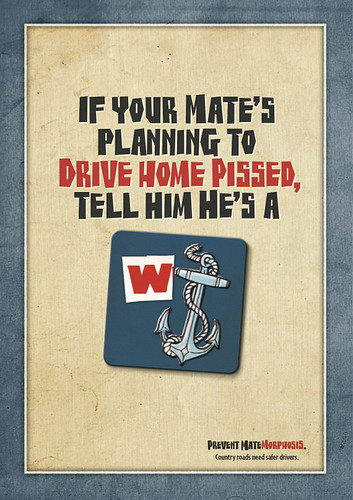
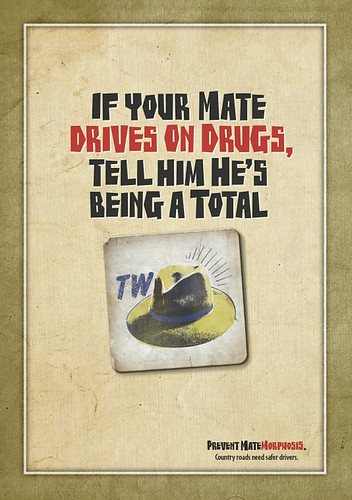
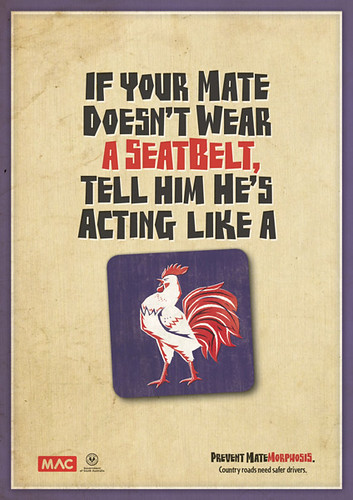
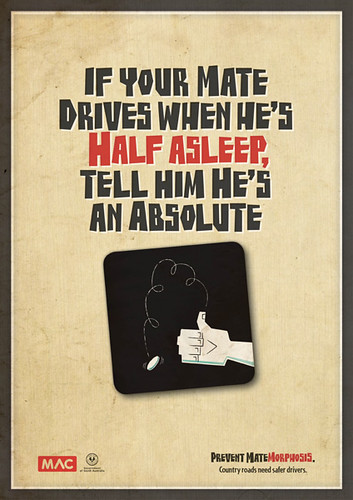
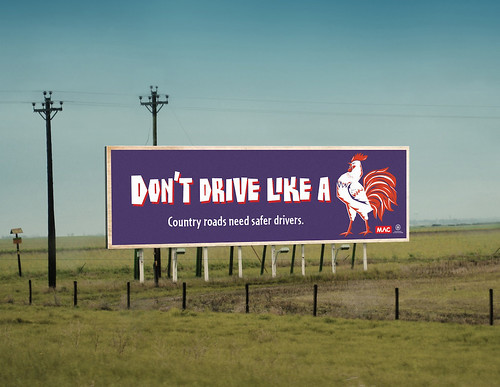
While searching for more information about yesterday’s featured artist for my Beer In Art series, I discovered a second artist named Ben Sanders, this one working as an illustrator in Australia. Perhaps more importantly, he’s actually worked on a campaign to reduce drunk driving down under. The campaign, sponsored by the Motor Accident Commission, was designed to try and reduce drunk driving in the rural areas of southern Australia. Called Prevent Mate Morphosis, it employs a device you’d never see used by our own government and especially not by the neo-prohibitionists: irreverent humor.

Motor_Accident_Commission_(MAC)_Knob_ibelieveinadv

Here’s how they describe the campaign:

Just like on the footy field, mateship is the glue that unites regional communities.

Mates look out for mates — it’s a big part of the Aussie culture. And they’d never intentionally do anything that would cause us harm. It’s just that sometimes, our mates can turn into blokes who, let’s just say, make bad decisions. Especially on the roads.

In this advertising campaign we’ve come up with a new name for this change in a mate’s behaviour. We’re calling it “Matemorphosis” — when your mate gets behind the wheel and morphs into a knob.

Motor_Accident_Commission_(MAC)_Wanker_ibelieveinadv

They continue by saying it’s “For Country People, By Country People:”

This is the first road safety campaign that’s specifically made for country South Australians, by country South Australians. The TV ads don’t use actors, but real people from different regions across SA and were filmed at Callington Football Club oval.

The campaign acknowledges that too many deaths occur on our roads because country roads are different to anywhere else. We all know we can’t change where we drive, but we can change how we drive. And the campaign makes the point that it’s up to all of us to make country roads safer.

Motor_Accident_Commission_(MAC)_Twhat_ibelieveinadv

But they sure seem like they’d get your attention far more effectively because they stop and make you think. Then they make you laugh, which in my mind would make them more memorable, as well.

mac0484_regional-toilet-posters3

Obviously, not all the idioms would translate to American English, but surely we could come up with equally effective and equally funny ones. Not that the folks in MADD and their ilk would, or even could, embrace any strategy that might involve humor. They’d undoubtedly complain that you can’t make light of so serious a problem. But if it furthers their supposed goal of reducing drunk driving, it really shouldn’t matter how the message is communicated, so long as it’s effective. Frankly, I’ve always believed you’d get a lot further being reasonable and human than constantly hammering the same serious propaganda.

mac0484_regional-toilet-posters5.2

And below is one of the billboards in action. I’d much rather see this on the road than a frying pan with an egg in it telling me that’s my brain or a needle sticking out of a bottle of beer equating it to heroin. Such heavy-handed imagery doesn’t work because it doesn’t ring true. It looks like propaganda because it is propaganda. Maybe a little humor would be better? It’s making me laugh … and pay attention.

Motor_Accident_Commission_(MAC)_Cock_ibelieveinadv

Filed Under: Art & Beer, Beers, Editorial, Just For Fun, Politics & Law Tagged With: Australia, Humor, Prohibitionists

Propaganda Masquerading As A Report

October 5, 2011 By Jay Brooks

alcohol-justice
When is a report not a report? When it’s created as propaganda by an organization with the sole purpose of advancing its anti-alcohol agenda. In fact, just calling such propaganda a “report” seems dishonest in and of itself. Witness today’s press release from the self-appointed sheriff of Alcohol Alley, the newly renamed Alcohol Justice (f.k.a. the Marin Institute) entitled “Drunk With Power: Industry Kills Alcohol Mitigation Fees in California in 2010.” Talk about a loaded title. To my mind, a “report” should at least pretend to be an impartial, unbiased examination of a set of data. But as the title suggests, those of us in the alcohol industry are all “drunks,” abusing power and indiscriminately “killing.” That’s how we’re portrayed, as pure evil. Yeah, that describes me and just about everybody I know in the beer world. I hate kids and dogs, and just love pulling the wings off of flies, just for the fun of it.

The press release explains that the “report” examines the political lobbying by alcohol companies and money spent by them. Now I’m not a big fan generally of the corporate influence of our current political system, but it’s not illegal. The reason Alcohol Justice (AJ) is able to compile the lobbying money spent is because it has to be disclosed at all levels. It is, in plainer terms, legal and transparent. Nobody’s done anything wrong. They claim it “details the ever-present dominance of the alcohol industry and its lobbyists on California policymakers in 2010.” But dominance over whom? Over what? It’s not as if alcohol companies are the only people or organizations spending money on lobbying. Every company and/or industry does so. Their corporate charters all but demand that they engage in lobbying. Like it or not, it’s a part of doing business in California and the United States.

The majority of the AJ “report” includes a long list of money received by California politicians from alcohol lobbyists or as political contributions. And they’re drawing the conclusion that they therefore must have been bought off. But their “report” proves no direct correlation between receiving money and how a politician votes on legislation having to do with alcohol regulation. In fact, some of their data seems to contradict that idea.

Just looking at money received from one sector ignores any money they may also have received from any other, possibly even competing, industry or interest. And it doesn’t take into account what portion of the total money any politician received comes from alcohol and/or who else gave them contributions.

Maybe I’m jaded, but even the amounts themselves seem small, especially as a percentage of the total they received. Total lobbying expenditure by all alcohol companies is $1.3 million, according to AJ. One figure I found said that there was $552.6 million spent on lobbying in California in 2008. So that means the alcohol portion, even if they spent that much three years ago, is only 0.23% of all lobbying dollars spent. Hardly the “drunk with power” that AJ churlishly decries. That hardly demonstrates a “dominance of the alcohol industry and its lobbyists,” as they characterize it. More like a drop in the pint glass that is California politics.

The executive summary of the “report” claims that alcohol companies spent $5 million on both lobbying, campaign contributions and other political spending in 2010. Given how big our economy is, that also seems like a vanishingly small amount, especially when it is claimed that it bought so much. According to Follow the Money, California campaign contributions totaled $716,750,583 for 2010. AJ claims that of that $5 million figure, $1,572,939 was spent on candidate contributions. That means that a mere 0.22% of campaign contributions come from alcohol companies. Again, that hardly indicates the undue influences that AJ claims in their “report.”

To me, it’s just as likely that many, if not most, of the politicians don’t view the alcohol companies as pure evil, the way Alcohol Justice does. They probably see them as job creators, having a positive impact on a depressed economy and providing some enjoyment to their customers, quite necessary when so many people are out of work and their spirits so low. Not everybody who drinks abuses it, in fact most people don’t.

The politicians are most likely just people like you and me who like a drink once in a while. They’re part of the majority of people who drink moderately and responsibly, and therefore they can see the legislation for what it is: the work of fanatics who see compromise as a weakness, view all alcohol as bad, believe moderation is not the answer, and for whom only total prohibition is the only result that will satisfy them. And so they vote against it, like they should; like any reasonable person would. The majority of their constituents don’t agree with the radical ideas of neo-prohibitionists. Like most reasonable people, these politicians and the people they represent, don’t see alcohol as inherently bad; the only negative is the abuse of it by a small minority that is rarely addressed by legislation claiming to be for that purpose.

The “mitigation fees” they claim were killed by lobbying are not even a true metric. The idea that the companies that make and sell alcohol should have to pay for the damage caused by its abuse by a minority of individuals is not exactly a time worn idea. NRA lobbyists are not working to insure that gun makers don’t have to pay to mitigate the “harm” done by people shooting one another with their guns. Likewise, the red meat industry isn’t working to insure that cattle ranchers and meat packing plant owners don’t have to pay to mitigate the “harm” done by people who eat too much steak and hamburgers. Those are, quite properly, matters of personal responsibility. But according to the AJ, there is no personal responsibility for the actions of people who abuse alcohol. In that case, it’s always the fault of the people who make and sell it.

The “report” also claims that “only $10,000 was reported being spent by the industry in San Francisco to defeat Supervisor John Avalos’ Charge for Harm fee” (emphasis added), which made me laugh. Avalos may have introduced it, but it was really a Marin Institute (now AJ) initiative from start to finish. But they mention that because they think more money was spent, and wasn’t disclosed. Talk about being a sore loser.

The report also singles out a couple of politicians for their association with the alcohol industry. For example, they detail how former San Francisco mayor Gavin Newsom is, in their words, “firmly entrenched in the alcohol industry.” And that is offered as the only proof that he is somehow beholden to the interests of alcohol companies. It’s incredibly insulting to suggest that someone in politics is incapable of being impartial if they also derive some of their income from the alcohol trade. It could simply be, as Newsom himself suggested, that he saw through the “charge for harm” fiasco and viewed it for what is was — a bad idea that unfairly punished the majority of law-abiding responsible citizens — as so many others did.

The “report” begins, and ends, with the conclusion that “[t]he alcohol industry continued its ever-present dominance at all levels of California politics in 2010.” But the numbers they cite in their self-fulfilling “report” are meaningless in the vacuum of their reasoning without placing them in the larger context of the much more complicated state of politics in California. $5 million sounds like a lot of money until you actually think about how little that is compared to everything else that the state is facing. The alcohol industry in California isn’t drunk with power in California. Hell, it isn’t even tipsy.

In the same year that the alcohol industry spent $3,683,148 (the AJ’s $5 million figure minus lobbying), California agriculture spent $9,658,149, the computer industry spent $30,749,507, the energy industry spent $72,667,630, finance, insurance and real estate interests spent $64,002,966, the health care industry spent $18,759,752 and labor unions spent $76,563,954. Those industries spent 2.6, 8, 20, 17, 5 and 21 times the alcohol industry, respectively. Geez, just general business interests (not part of a specific industry) spent $29,912,733, over 8 times what the alcohol industry spent. Maybe it’s not the alcohol industry after all that’s drunk with power.

Filed Under: Editorial, Politics & Law Tagged With: Prohibitionists, Statistics

« Previous Page
Next Page »

Find Something

Northern California Breweries

Please consider purchasing my latest book, California Breweries North, available from Amazon, or ask for it at your local bookstore.

Recent Comments

  • Ernie Dewing on Historic Beer Birthday: Charles William Bergner 
  • Steve 'Pudgy' De Rose on Historic Beer Birthday: Jacob Schmidt
  • Jay Brooks on Beer Birthday: Bill Owens
  • Steve 'Pudgy' De Rose on Beer Birthday: Charles Finkel
  • Steve 'Pudgy' De Rose on Beer Birthday: Bill Owens

Recent Posts

  • Historic Beer Birthday: Daniel Jung February 11, 2026
  • Beer In Ads #5198: Back Again! Wiedemann’s Genuine Bock Beer February 10, 2026
  • Historic Beer Birthday: Jacob Hammel February 10, 2026
  • Historic Beer Birthday: John Kauffman February 10, 2026
  • Beer In Ads #5197: It’s Here! Rahr’s Bock Beer February 9, 2026

BBB Archives

Feedback

Head Quarter
This site is hosted and maintained by H25Q.dev. Any questions or comments for the webmaster can be directed here.