Brookston Beer Bulletin

Jay R. Brooks on Beer

  • Home
  • About
  • Editorial
  • Birthdays
  • Art & Beer

Socialize

  • Dribbble
  • Email
  • Facebook
  • Flickr
  • GitHub
  • Instagram
  • LinkedIn
  • Pinterest
  • RSS
  • Twitter
  • YouTube

Powered by Genesis

Patent No. 1302922C: Process For Producing A Malt Beverage Having Improved Foaming Properties

June 9, 2016 By Jay Brooks

patent-logo
Today in 1992, US Patent 1302922 C was issued, an invention of Joseph L. Owades, for his “Process for Producing a Malt Beverage Having Improved Foaming Properties and Product Produced Therefrom.” Here’s the Abstract:

The foaming properties of a brewed malt beverage are improved by adding to the beverage during the normal brewing process a measured quantity of ginseng.
beer_foam

Filed Under: Beers Tagged With: History, Law, Patent, Science of Brewing

Patent Nos. 3323919A & 3323920A: Preparation Of Concentrated Fermented Malt Beverage Of Low Hop Content & Concentration Of Beer By Crystallization And Distillation

June 6, 2016 By Jay Brooks

patent-logo
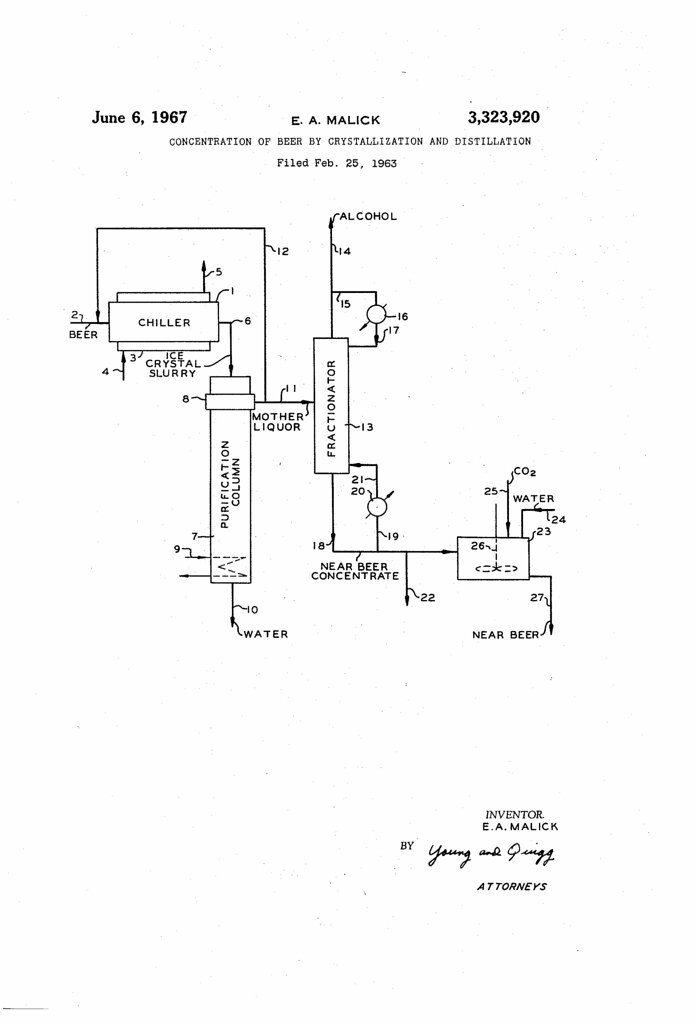
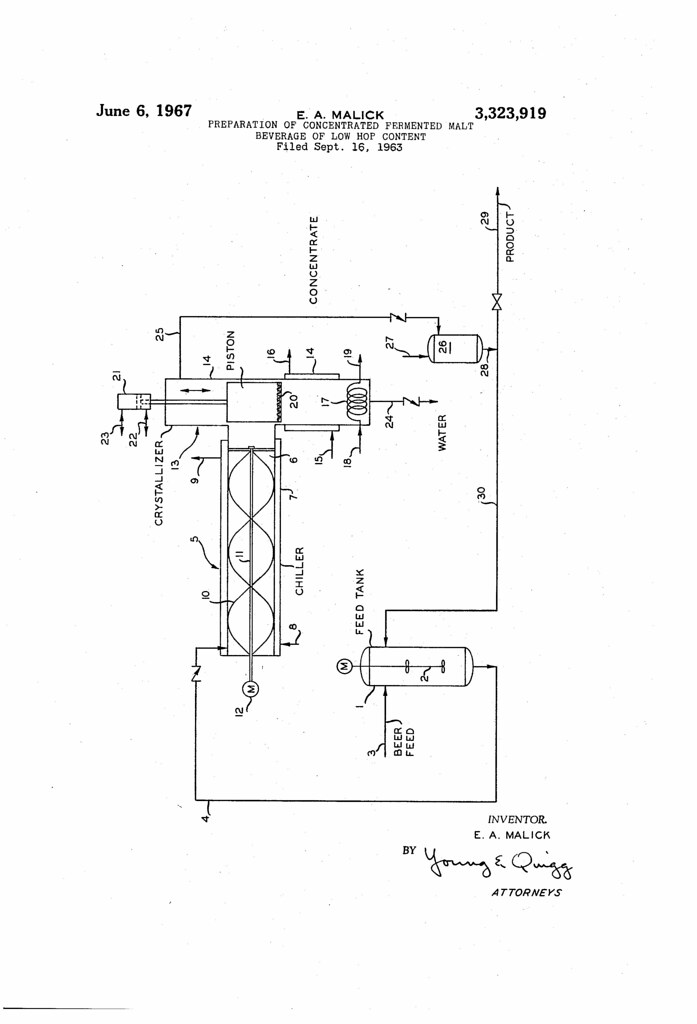
Today in 1967, US Patent 3323919 A and US Patent 3323920 A was issued, both an invention of Emil A Malick, assigned to the Phillips Petroleum Co., for his “Preparation Of Concentrated Fermented Malt Beverage of Low Hop Content” and “Concentration of Beer By Crystallization and Distillation.” There’s no Abstract, though it’s described this way in the applications:

This invention relates to a process for the preparation of a novel fermented malt beverage. In another aspect, it relates to the fermented malt beverage so produced as a new composition of matter.

The concentration of aqueous solutions, such as fruit juices, wines and beer, by crystallization to remove water therefrom and produce a concentrate which is reconstituted by dilution thereof with water, is receiving increasing attention in the food processing and allied industries. In the case of beer, it has been shown that significant savings in brewing, storage, and shipping can be gained by the freeze concentration of beer and its reconstitution; that the taste, aroma, and keeping qualities of the reconstituted beer are as good as, and in some cases better than, the beer produced by the present standard brewing process; and that the useful storage or shelf life of the beer, whether stored in a concentrated or reconstituted state, is greatly increased.

In the freeze concentration of beer, especially by the process known in the brewing industry as the Phillips Fractional Crystallization Process and basically covered by US. Reissue Patent 23,810 to J. Schmidt and US. Patent 2,854,494 to R. W. Thomas, the concentrate which is produced from beer made by the standard brewing process generally will have an unacceptable harsh, bitter taste which is generally unpalatable to the layman as well as brewmasters and beer connoisseurs, though when reconstituted such concentrate yields an excellent beverage.

Accordingly, an object of this invention is to provide a process for preparing a novel fermented malt beverage. Another object is to provide such a malt beverage as a new composition of matter. Further objects and advantages of this invention will become apparent from the following description and accompanying drawing in which the single figure schematically illustrates an embodiment of fractional crystallization apparatus which can be used in preparing the novel malt beverage of this invention.

I have now discovered that a novel concentrate of beer, which is itself an appealing, palatable malt beverage having excellent taste and aroma, can be made by freeze concentration of beer brewed from wort hopped with an amount of hops that is inversely proportional to the amount of water removed from the beer by said freeze concentration, said amount of hops being substantially below that used in the standard beer brewing process. For example, where 75 percent of the water is removed from the beer by freeze concentration thereof, the amount of hops added to the Wort and boiled therewith will be, according to this invention, about one-fourth the amount generally used in making a conventional beer, or a reconstituted beer from a beer concentrate. In other respects, the beer from which the novel beverage or concentrate of this invention is obtained can be made or brewed by the standard brewing process, such as that used in making the American type of Pilsener beer. Preferably, in addition to employing the reduced amount of hops, as described above, any conventional additives normally used in brewing which will, upon freeze concentration of the beer, attain an undesirably high level in the concentrate such as to degrade the taste and other desirable properties thereof, are also reduced in the amount conventionally employed.

The amount of water which is removed from the low-hops beer by freeze concentration thereof, according to this invention, can vary and generally will be in the range of 25 to 85 weight percent, preferably to weight percent. Correspondingly, the inversely proportional amount of hops to be used in making the beer to be freeze concentrated will generally be about 5 to 20 pounds per barrels of brew, preferably about 10 to 16 pounds per 100 barrels of brew.

The wort, from which the novel beverage of this invention is made, can be conventionally prepared by mashing barley malt with water, for example at 67 to 70 C., and, if desired, suitable precooked adjuncts, such as unmalted barley, corn grits or flakes, rice, and like cereal and starchy products, the malt usually making up from 50 to 75 percent of the total brewing materials. The temperature is thereafter raised, for example to 75 C., to inactivate the enzymes. Undissolved grain and husks are removed from the mash generally in so-called lauter tubs or mash filters. The resulting soluble or sweet wort is then hopped in a brewing kettle, using the small quantity of hops mentioned above. If desired, the hops used can be made up of 25 to 30% imported or choice Fuggles and 70 to 75% domestic hops. Following hopping, or boiling of the hopped wort, brewing can be completed according to the standard brewing process using the usual standard brewing procedures, equipment and materials, all of which are of general knowledge and are substantially the same throughout the industry in the United States. For example, the hopped wort (or brew) is strained, cooled, and subjected to bottom fermentation by the addition of a yeast, e.g., one pound of liquid yeast per barrel of brew. After fermentation is completed, the yeast is removed and the young beer or ruh is clarified, aged, pasteurized, stored, filtered, chill-proofed, carbonated, finished, and filtered. Alternatively, any one or all of these latter operations can be eliminated and it is within the scope of this invention to prepare the novel beverage of this invention by freeze concentrating the beer, with or without first filtering it, as it leaves the fermenters, or as it leaves the clarifying tanks or cellar, or after it leaves the lagering cellar. Such alternatives can be used because during freeze concentration suspended solids such as yeast and hop resins will be removed along with the ice. Because of the low temperatures of the free concentration step, e.g., 25 to 32 F., the solubilities of undesirable materials such as those which normally give rise to haze and sediment (which materials are normally removed by clarification and on storage or lagering) are decreased and they precipitate and can be removed with the ice. Also, since the freeze concentration is carried out at low temperatures, and the alcoholic content is increased, bacterial activity and undesirable changes due to the activity of residual yeast cells or spores are decreased or stopped, and pasteurization can be eliminated without impairing the desirable shelf life and keeping qualities of the novel concentrate.

The ethyl alcohol content is increased by the freeze concentration, for example a low-hops beer with 3 to 8 volume percent alcohol can be concentrated to increase the alcohol content to 5 to 25 volume percent, preferably 7 to 18 volume per-cent. The alcoholic content of the concentrate will vary with the alcoholic content of the beer which is concentrated and the number of concentration stages used. As compared with a concentrate prepared by freeze concentration of a standard beer made with about four times as much hops, the concentrate of this invention has about one-half or less the amount of furfuryl alcohol content, e.g., the concentrate of this invention has less than 0.3 Weight percent furfuryl alcohol, and can have as low as 0.002 weight percent furfuryl alcohol.

The freeze concentration step can be carried out batchwise, for example using a plurality of alternate ice-generators and centrifuges connected in series, or, preferably, by continuously cooling the beer to produce a slurry of ice crystals and mother liquor, melting the crystals, passing at least a portion of the melt in contact with and countercurrent to the crystals, and separating the mother liquor (or beer concentrate) and the melted ice, such continuous process being preferably carried out in a plurality of stages, e.g. three. If desired, the concentrate which is produced by the freeze concentration step can be filtered to remove any precipitated materials not removed with the melted ice. Suitable apparatus for carrying out the freeze concentration of the low-hops beer by a continuous process is that shown in said patents to Schmidt and Thomas. Schmidts process involves moving a mixture of crystals and adhering liquid through a liquid removal zone, a reflux zone and a melting zone, removing liquid in said liquid removal zone, melting crystals in said melting zone, withdrawing part of the melt from the melting zone and forcing another part of the melt in a direction countercurrent to the movement of crystals in said reflux zone. In Thomas process (which is an improvement over the separation of the type disclosed by Schmidt), the solids in the purification zone are counter-currently contacted with a pulsating flow of reflux liquid by application against the melt of pulsating pressure generated by a pulse pump, the pulsation of the reflux liquid occurring during sustained application of force to the crystals to feed the same into the liquid removal zone.

The alcoholic malt beverage or elixir prepared according to this invention differs from beer in taste and is whol ly unlike any drink hereto produced, although it has a basic beer-like flavor. Unlike reconstituted beer of concentrates made from beer brewed with the regular amount of hops, reconstituted beer of the novel concentrates of this invention has a terrible taste. Like beer, the malt beverage of this invention willhave varying amounts of unfermented sugars and dextrins, proteinlike substances, flavoring constituents derived from malt and yeast, and minor constituents such as various inorganic salts, metabolic by-products of yeast, vitamins, traces of iron and copper, etc. The beverage of this invention will usually have some residual carbonation and, if desired, it can be further carbonated to -O.4O.6 weight percent carbon dioxide.

US3323919-0

This invention relates to a method for concentrating aqueous solutions by crystallization and distillation. In another aspect, it relates to a method for the preparation of an alcoholic beverage.

Near-beer is conventionally prepared by first making a regular beer and then removing a portion of the alcohol by distillation. It is generally accepted that these near beers do not have the quality of the regular beer, probably because the distillation of the regular beer results in the degradation and/or removal of some of the flavor and odor components.

Although this discussion will be simplified by primary reference to the preparation of near-beer, it is obvious that the invention is also applicable to any process for the removal of a volatile component more volatile than water from a multi-component aqueous liquid. Thus, the invention is also applicable to the preparation of near wine of low alcohol content as well as other alcoholic beverages where it is necessary to reduce the alcohol content.

US3323920-0

Filed Under: Beers, Breweries, Just For Fun, Politics & Law, Related Pleasures Tagged With: History, Law, Non-Alcoholic, Patent, Science of Brewing

Patent No. 4836097A: Whirlpool For Coarse Sludge Separation In Brewing Of Beer

June 6, 2016 By Jay Brooks

patent-logo
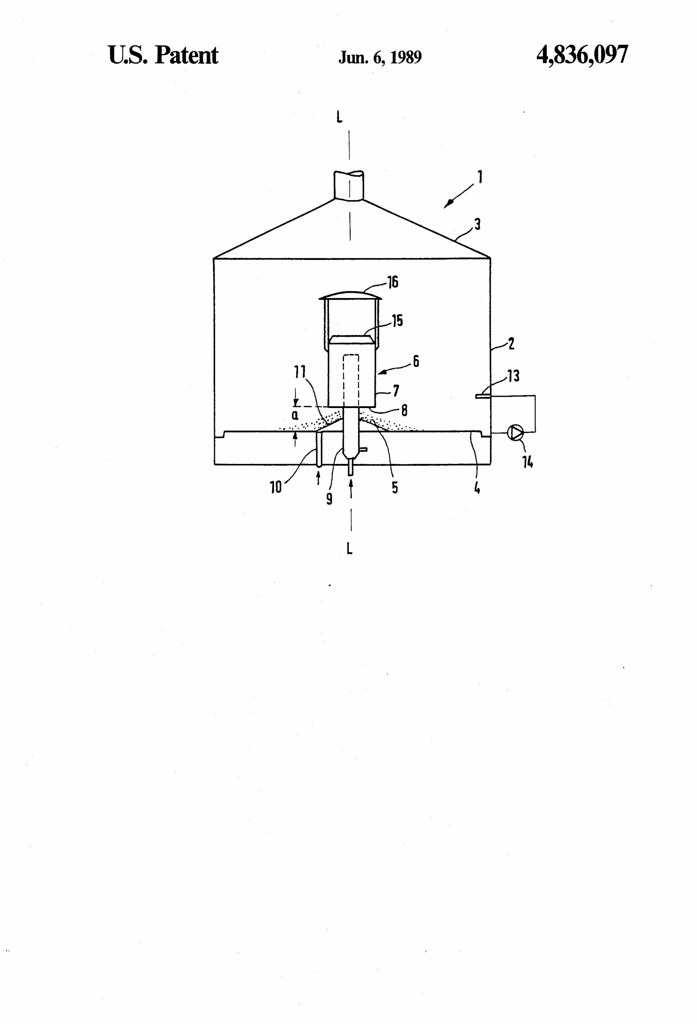
Today in 1989, US Patent 4836097 A was issued, an invention of Hans Tretter, assigned to Anton Steinecker Maschinenfabrik Gmbh, for his “Whirlpool for Coarse Sludge Separation in Brewing Of Beer.” Here’s the Abstract:

The present invention refers to a whirlpool for coarse sludge separation from the wort in brewing of beer, said whirlpool being being constructed as a circular receptacle provided with a base on which the sludge deposits and with a heating means for heating the wort.

For providing a possibility of treating the wort in a space-saving manner and without any special insulating measures in the wort heating process, the invention is characterized by the features that a rotationally symmetrical inner boiler is provided as a heating means, said inner boiler being arranged in the interior of the receptacle such that it is concentric with the longitudinal center axis of the receptacle and such that its lower side extends in spaced relationship with the base of the receptacle.

US4836097-1

Filed Under: Beers, Breweries, Just For Fun, Politics & Law, Related Pleasures Tagged With: Brewing Equipment, History, Law, Patent, Science of Brewing

Patent No. 279019A: Beer Chip

June 5, 2016 By Jay Brooks

patent-logo
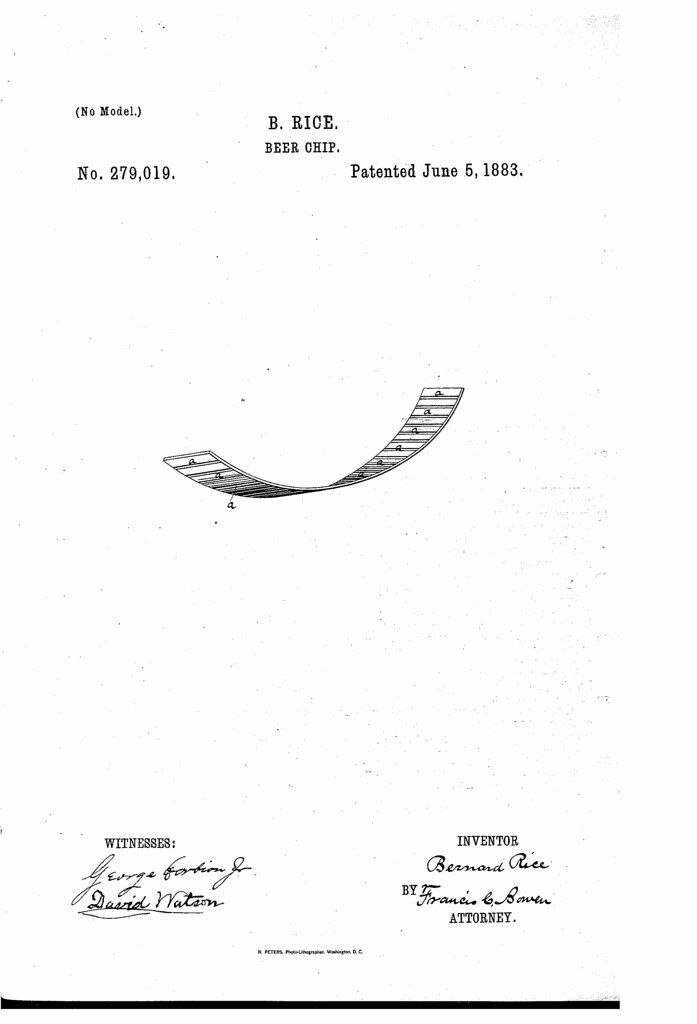
Today in 1883, US Patent 279019 A was issued, an invention of Bernard Rice, for his “Beer Chip.” There’s no Abstract, though it’s described this way in the application:

This invention relates to that class of beer chips in which groves or indentations are made upon the surface surfaces of the chips for the purposes of increasing their superficies. Prior to my invention such grooves have been impressed upon the surfaces of the chips, as by calendering-rolls; but such method of producing the grooves is objectionable,because when the chips are applied to repeated use the grooves are obliterated by the natural expansion of the wood when exposed to the beer, and hence it is necessary to re-indent the chips after each use in order to preserve the desired condition thereof.

My invention is designed to overcome such objection; and to this end it consists in a chip having portions of the wood removed in proper lines across the grain to produce the desired grooves or indentations, as hereinafter more fully described.

This is almost exactly the same as a previous application and patent grant from Rice a year earlier, with Patent No. 257977A.

US279019-0

Filed Under: Beers, Breweries, Just For Fun, Politics & Law, Related Pleasures Tagged With: History, Law, Patent, Science of Brewing

Patent No. 258664A: Process Of Making Brewers Yeast

May 30, 2016 By Jay Brooks

patent-logo
Today in 1882, US Patent 258664 A was issued, an invention of Friedrich Meyer, for his “Process of Making Brewers Yeast.” There’s no Abstract, though it’s described this way in the application:

This invention has relation to a process for compounding brewers yeast; and it consists in forming from hops, malt, and water under certain degrees of heat a first yeast, which is afterward used in certain proportions in another step or series of steps, wherein malt, water, and hops are again employed and subjected to heat at varying temperatures to form a second yeast, which is again employed with malt, water, and hops, subjected to heat as before and tested by a saccharometer, to form a third or stock yeast, which will last from four to six months, and from which, together with malt, hops, and water, a present use yeast, which will last about one month, may be formed by compounding therewith malt, hops, and water at certain temperatures, all of which will be hereinafter fully pointed out in the body of the specification and claim.

In carrying out this process I take the proportions of about one-half ounce of hops to one-half gallon of boiling water, throw the hops into the yeast-can, and add the boiling water, and stir this mixture until the heat recedes to 190 Fahrenheit. I then add three quarts of cracked barley-malt and mash it well, after which 1 add one quart of boiling water and stir the mixture until the heat recedes to 160 Fahrenheit, when I cover the can and let the contents stand for five minutes. I then increase the heat by adding as little boiling water as possible until 176 Fahrenheit has been reached, when I again cover the can and let it stand for one hour, then cool the contents of the can by stirring them until the heat has receded to 90 Fahrenheit. I then put the liquid thus formed into a stone jar and place the jar into warm water at a temperature of about 80 or 90 Fahrenheit, and keep the heat of the Water up to that point by using boiling water until the liquid has ceased to ferment, which will be from thirty-six to forty-eight hours. As this yeast will last only from six to eight hours, the preparations for the formation of the second yeast should be completed at this time.

To make the second yeast, I take one gallon (dry measure) of cracked barley-malt and put it in the yeast can, and pour one-half gallon of boiling water thereon, and mash well together. This should be permitted to stand ten minutes, and then raised to a temperature of 176 Fahrenheit by adding boiling water to the amount of about three gallons. It should be then covered and permitted to stand for about one hour, after which it should be strained through a brass sieve into a clean tin can and placed 011 the stove, where it should boil for one hour and be skimmed during the operation of boiling. If one hours boiling should prove to be insufficient, it may be boiled a little longer. It, should register, when properly boiled, about 20 saccharometer, and the test should be made at 90 Fahrenheit. About two ounces of hops should then be added by stirring them in until the hops are thoroughly wetted, and the cover should be again replaced and the contents of the can boiled from three to five minutes longer. Remove the can from the stove and let it stand fifteen minutes, and then strain the contents of the can through a brass sieve into a stone jar, and cool it to about 94 Fahrenheit by setting the stone jar into cold water in the winter season. In summer it should be reduced to 90 Fahrenheit, as the natural temperature at this season will cause the temperature of the liquid to rise in a short time. Then add to the liquid thus produced one pint of the first yeast to each gallon of the liquid. Then wrap the jar in cloth, and set it away in a place where the temperature may be maintained at from to Fahrenheit until it is done fermenting, which’ will be about thirty-six hours. Then be ready to proceed to the formation of the third yeast, as this, which is termed the second yeast, will not keep longer than from ten to twelve hours.

To form the third yeast, I place four gallons of boiling water in the yeast-can and permit the heat to recede to 180 or 176 Fahrenheit. I then add about sixteen pounds of cracked barley-malt and mash well. The can is then rinsed down with about one-half gallon of boiling water and stirred until the temperature is about 150, and then left to stand about ten minutes. Boiling water should then be added and the contents of the can stirred until the heat reaches 176 Fahrenheit, after which it should be covered and left to stand for one hour, and should then be strained through a brass sieve. Then take this liquid and place it in a clean tin can and set it on the stove and boil it from three to five hours, skimming it during the operation of boiling, until it be comes of a consistency of 38 saccharometer under a test at 90 Fahrenheit. Then put in one-half pound of hops and stir until the hops are thoroughly wetted, and then boil from three to five minutes longer. Remove the can from the stove, stir the contents, cover the can, and let it stand covered for about fifteen minutes, during which time it should be stirred occasionally, and then strained through a brass sieve into a clean yeast-can, and reduce its temperature to 91 Fahrenheit by placing the yeast-can into cold water. Then add one quart of the second yeast above described and stir well. The temperature during this stirring should be maintained at about 00 Fahrenheit. Then wrap the can in cloth and place it in a place where the temperature may be maintained at between and Fahrenheit until fermentation ceases, which will be about forty-eight hours. This yeast, called the third yeast, will then be lit for use. This third or stock yeast will keep from four to six months, and should always be thoroughly shaken before using. This stock yeast is intended for shipment for use in making a fourth or pre-cut use yeast, which, when made as herein after described, will keep about one month.

To make the fourth or present-use yeast, I take fifteen quarts of boiling water and place it in the tin yeast-can and let it reach a temperature of 170 Fahrenheit, and then place in it about sixteen pounds of cracked barley malt, mash well, and rinse down with about one quart of boiling water and stir until the temperature is about 150 Fahrenheit, then cover the can and let it stand about ten minutes. I then add boiling water until the temperature reaches 176 Fahrenheit, which requires about sixteen quarts of boiling water. I then let it stand on the stone and boiled for about three hours to thicken it, care being taken to skim the contents during the operation of boiling. The proper consistency should be about 30 saccharometer under a test at 90 Fahrenheit. When at this consistency about six ounces of hops should be thoroughly stirred in, and the contents should be boiled from three to five minutes longer. The can should then be removed from the stove and left to stand for about fifteen minutes, during which time it should be stirred occasionally. It should then be strained through a brass sieve into a yeast-can, which should be placed in cool water, stirred, and reduced to a temperature of 90 Fahrenheit. One quart of the third or stock yeast should then be added by stirring it in under a temperature of 90 Fahrenheit, and the can wrapped up and placed in a position where a temperature of from 60 to 70 Fahrenheit can be maintained until fermentation ceases, which will be about forty-eight hours, after which it will be fit for use.

The superiority of this stock yeast over the yeast now employed lies in this, that it may be kept in stock for a period of six months, and from it a present-use yeast may be made that will last for a period of about one month, while the yeasts now employed will keep but a few hours at the furthest.

Beer_brewing_bubbles

Filed Under: Beers, Breweries, Just For Fun, Politics & Law, Related Pleasures Tagged With: History, Law, Patent, Science of Brewing, Yeast

Patent No. 700833A: Manufacture Of Fermented Liquors

May 27, 2016 By Jay Brooks

patent-logo
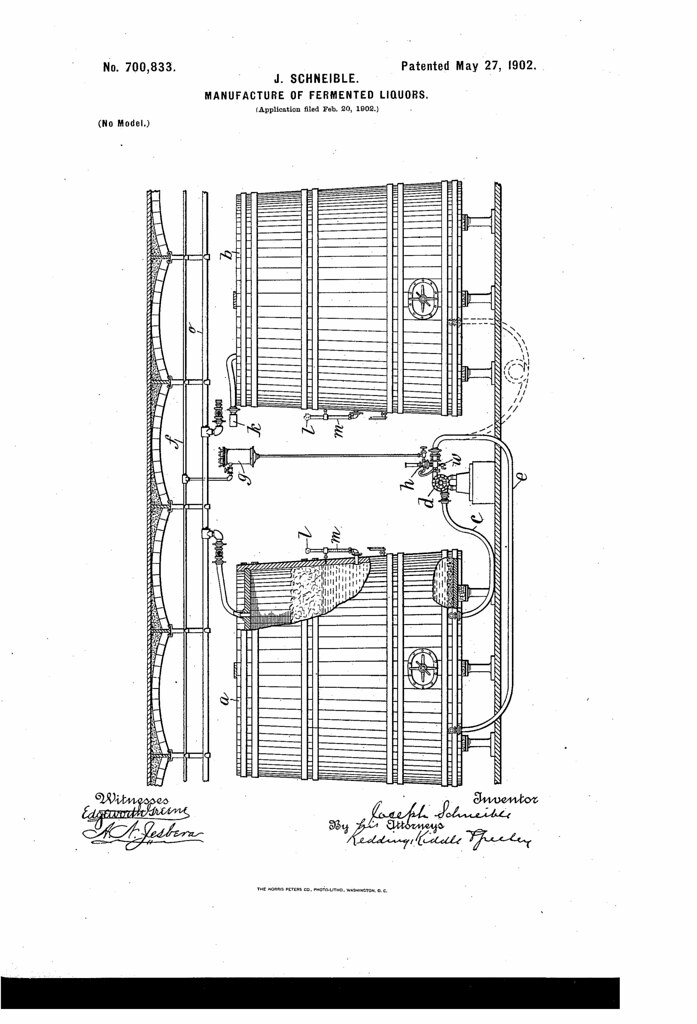
Today in 1902, US Patent 700833 A was issued, an invention of Joseph Schneible, for his “Manufacture of Fermented Liquors.” There’s no Abstract, though it’s described this way in the application:

This invention relates particularly to the carrying on of the fermentation of liquors such as malt beverages, for example and to the culture, propagation, and separation of yeast for further use As the fermentation of such liquors is now commonly practiced the yeast propagated for further use is separated and collected under conditions which are liable to result in contamination of the yeast by contact with air,usually teeming with wild ferments and very often with fungi, and in subsequent injury to the finished product.

It is the object of this invention to provide for the carrying on of the fermentation and the separation of the yeast in such a manner as to avoid exposure of either yeast or liquor to such contaminating and injurious influences, while at the same time the fermentation is carried on under practically normal conditions as to pressure.-

In accordance with this invention the newly-fermented liquor containing the yeast in suspension for further inoculation is transferred from the vessel in which the fermentation was carried on to a clean vessel, in which the separation of the yeast intended for further work from the liquor takes place and from which the liquor is withdrawn, thereby leaving the yeast in the clean vessel. The further quantity of liquor to be fermented is then introduced into the vessel containing the yeast and is inoculated thereby,thus avoiding altogether the removal of the yeast from the vessel in which the same has been allowed to separate from the fermented liquor and avoiding its exposure to the contaminating influences above referred to. This process is carried on successively in the manner referred to, the newly-fermented liquor being transferred from the vessel in which the inoculation has taken place and the main fermentation was carried on to a clean vessel, as before.

US700833-0

Filed Under: Beers, Breweries, Just For Fun, Politics & Law, Related Pleasures Tagged With: Brewing Equipment, History, Law, Patent, Science of Brewing

Patent No. 1760071A: Centrifugal Separator

May 27, 2016 By Jay Brooks

patent-logo
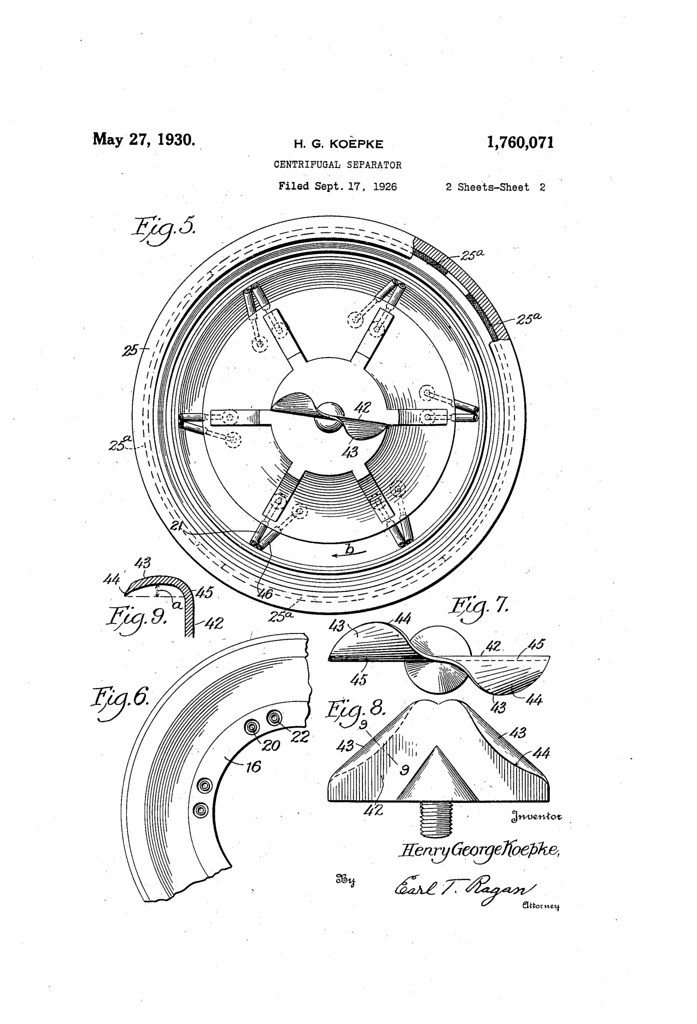
Today in 1930, US Patent 1760071 A was issued, an invention of Henry George Koepke, for his “Centrifugal Separator.” There’s no Abstract, though it’s described this way in the application:

My invention relates to centrifugal separators of the discharge nozzle conical type, primarily constructed for the separation of yeast from most of the associated liquids in which it has been’ propagated.

US1760071-0
US1760071-1

Filed Under: Beers, Breweries, Just For Fun, Politics & Law, Related Pleasures Tagged With: Brewing Equipment, History, Law, Patent, Science of Brewing

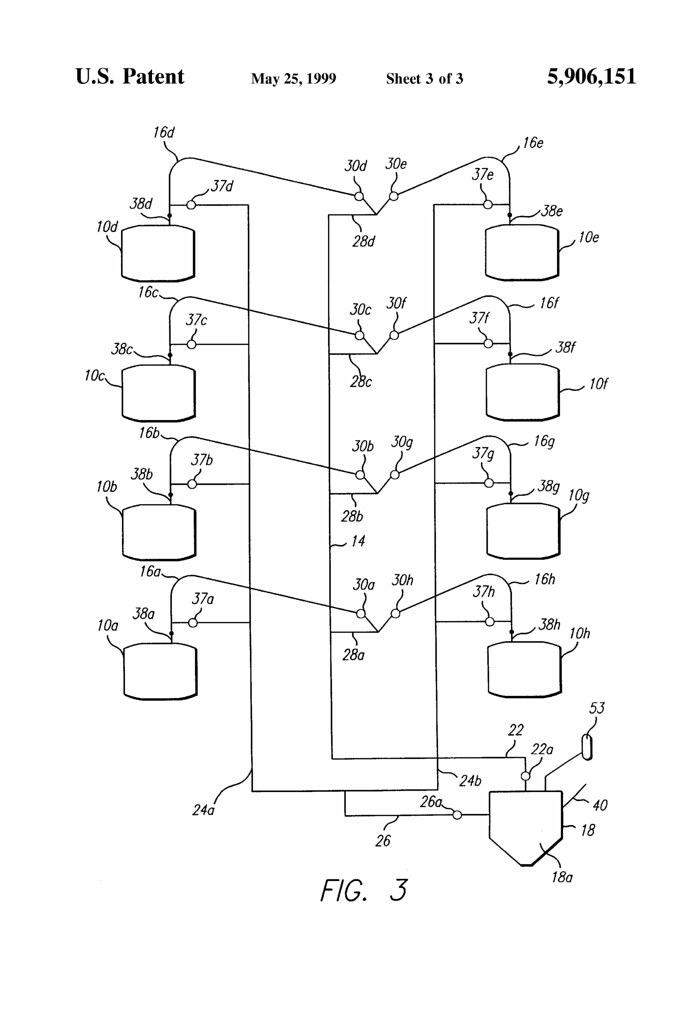
Patent No. 5906151A: Apparatus And Method For Brewing An Alcoholic Beverage

May 25, 2016 By Jay Brooks

patent-logo
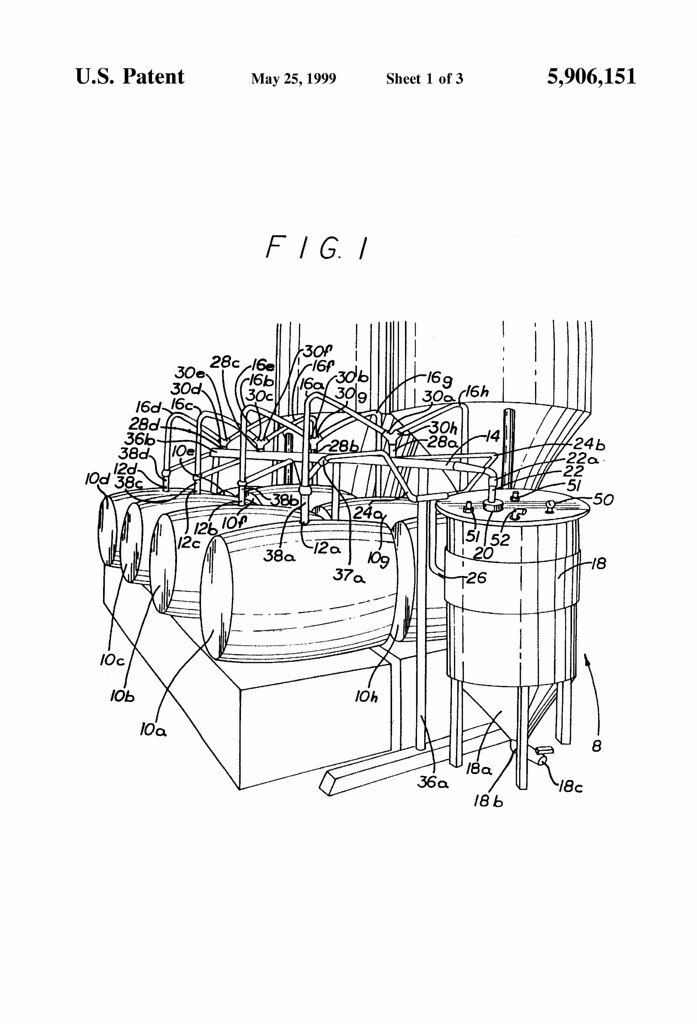
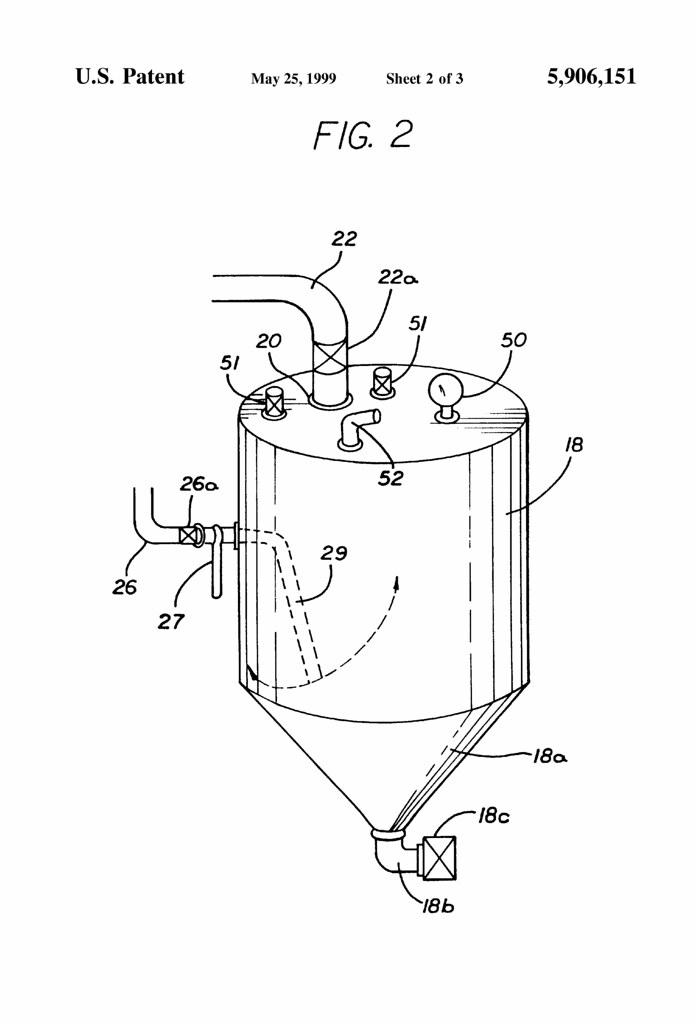
Today in 1999, US Patent 5906151 A was issued, an invention of Adam Firestone, Jeffers Richardson, Donald E. Othman, and Michel A. Blom, assigned to Firestone Walker, LLC, for their “Apparatus And Method For Brewing An Alcoholic Beverage and Beverage Brewed by Same.” Here’s the Abstract:

An apparatus for brewing an alcoholic beverage includes a plurality of wooden barrels including at least one first wooden barrel, at least one second wooden barrel, and at least one third wooden barrel; an enclosed trough; a plurality of first conduits providing flow communication between each of the plurality of wooden barrels and the enclosed trough; an enclosed catch pot in flow communication with the enclosed trough; a plurality of second conduits providing flow communication between the enclosed catch pot and each of the plurality of wooden barrels; and devices, such as valves, for controlling flow between each of the plurality of wooden barrels and the second conduit. The at least one first wooden barrel is a new barrel that has been filled with an alcoholic beverage up to 5 times, the at least one second wooden barrel is a middle aged barrel that has been filled with an alcoholic beverage from 6 to 12 times, and the at least one third wooden barrel is an old barrel that has been filled with an alcoholic beverage from 13 to 30 times.

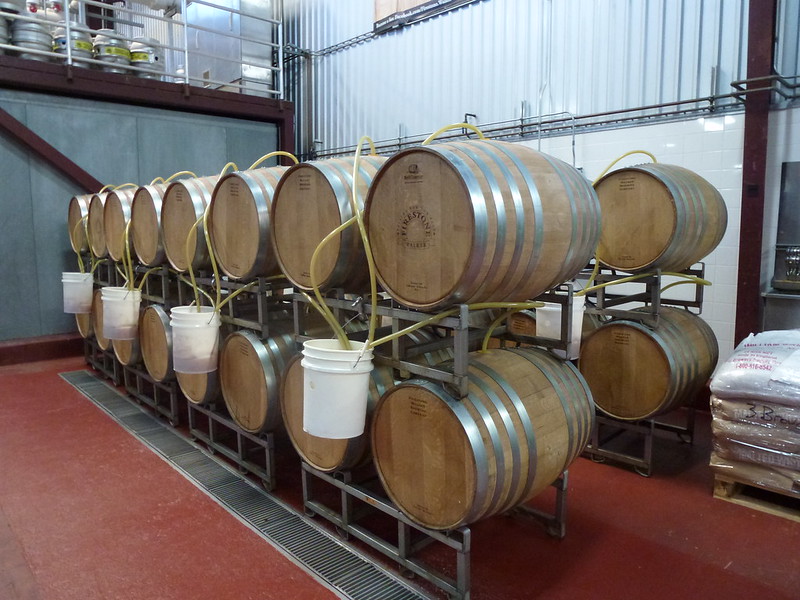
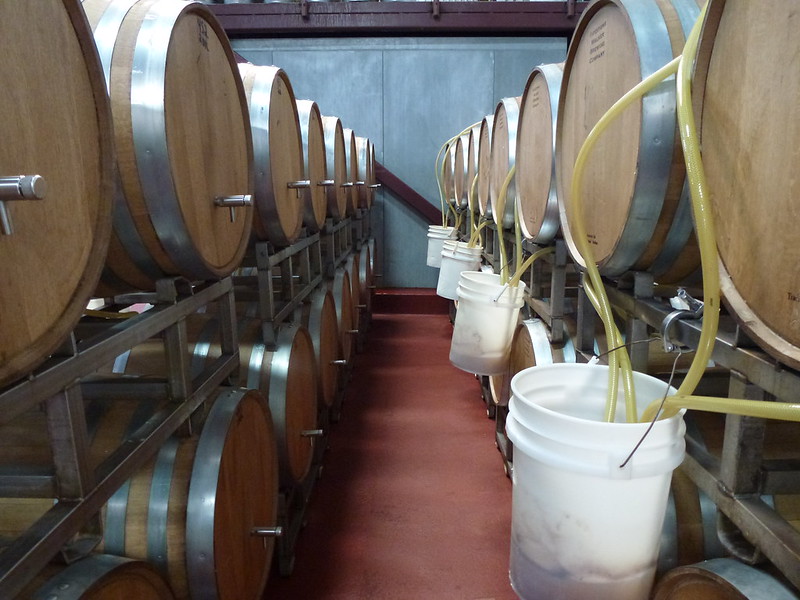
This is essentially a patent for Firestone Walker’s modified Burton Union System that they pioneered when they first started, and then scaled-up when they bought the old SLO Brewery in Paso Robles and increased the size of their beer production. Jeffers, of course, is still there is the Barrelmeister, or Director of the Firestone Walker Barrelworks. That system is one of only two such brewing systems left in the world, the other being at Marston’s in Burton-on-Trent in England.
US5906151-1
US5906151-2
US5906151-3

Here’s a few photos of the system at the Paso Robles brewery in 2012.

P1040642

P1040672

Filed Under: Beers, Breweries, Just For Fun, Politics & Law, Related Pleasures Tagged With: Brewing Equipment, California, History, Law, Patent, Science of Brewing

5,000-Year-Old Beer Recipe Found In China

May 24, 2016 By Jay Brooks

pottery
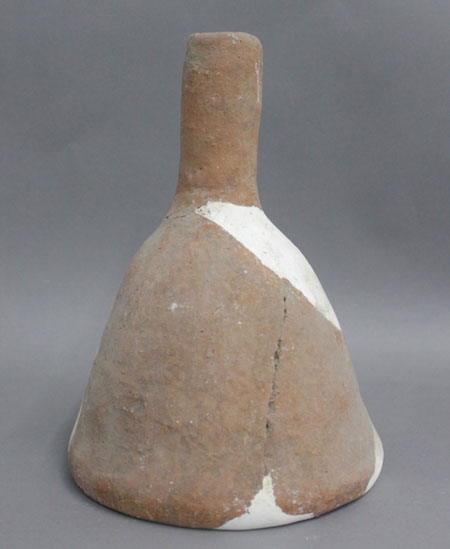
There was exciting news yesterday about a find in China by a research team from Stanford University. According to one source, “Archaeologists have discovered what they believe to be the earliest direct evidence of beer brewing in China, a trove of beer-making equipment dating from between 3400 and 2900 BCE, discovered at the Mijiaya site in Shaanxi province. Along with this archaeological find, scientists conducted an analysis of residue on the ancient pottery, jars, and funnels found, revealing a surprising recipe for the beer.” Their findings will be published in the PNAS (Proceedings of the National Academy of Sciences of the United States of America).

Here’s the abstract:

The pottery vessels from the Mijiaya site reveal, to our knowledge, the first direct evidence of in situ beer making in China, based on the analyses of starch, phytolith, and chemical residues. Our data reveal a surprising beer recipe in which broomcorn millet (Panicum miliaceum), barley (Hordeum vulgare), Job’s tears (Coix lacryma-jobi), and tubers were fermented together. The results indicate that people in China established advanced beer-brewing technology by using specialized tools and creating favorable fermentation conditions around 5,000 y ago. Our findings imply that early beer making may have motivated the initial translocation of barley from the Western Eurasia into the Central Plain of China before the crop became a part of agricultural subsistence in the region 3,000 y later.

china-stanford-5

Significance

This research reveals a 5,000-y-old beer recipe in which broomcorn millet, barley, Job’s tears, and tubers were fermented together. To our knowledge, our data provide the earliest direct evidence of in situ beer production in China, showing that an advanced beer-brewing technique was established around 5,000 y ago. For the first time, to our knowledge, we are able to identify the presence of barley in archaeological materials from China by applying a recently developed method based on phytolith morphometrics, predating macrobotanical remains of barley by 1,000 y. Our method successfully distinguishes the phytoliths of barley from those of its relative species in China.

I’m not sure how that squares with Chateau Jiahu, the beer made by Dogfish Head based on a 9,000-year-old find in China, from Northern China. They also found preserved pottery jars “in the Neolithic village of Jiahu, in Henan province.” The difference, as far as I can tell is the ingredients themselves, although in both they do use barley. This beer recipe calls for broomcorn millet (Panicum miliaceum), barley (Hordeum vulgare), Job’s tears (Coix lacryma-jobi), and tubers to be fermented, whereas the earlier one from Jiahu used “pre-gelatinized rice flakes, Wildflower honey, Muscat grapes, barley malt, hawthorn fruit, and Chrysanthemum flowers.” So their claim that this is older seems suspect unless there’s some qualifier I’m missing. As is typical, academic papers are only available online if you’re already an academic or are willing to pay to look at it for a short period of time, so I’ve not been able to look at their full claims or at the recipe itself, except what’s been written about it by more mainstream news outlets.

According to Gizmodo’s coverage:

Step aside with your claims to long legacies, craft breweries! This reconstructed beer recipe is over 5,000 years old. It’s the earliest beer recipe—and the earliest known use of barley—in China.

Archaeologists at Stanford University, while digging along China’s Wei River, made an intriguing discovery: A marvelously complete set of brewing equipment. And at the bottom of that equipment was something even more wonderful: Residue from the drink it once brewed.

After scrapping that gunk from the pots, researchers analyzed it and confirmed that it was, indeed, leftover froth from a 5,000-year-old beer. They were also able to pin down the recipe of that beer to an unlikely, but delicious-sounding, combination of broomcorn millet, barley, Job’s tears, and tubers.

So they claim, or rather Stanford claims, this is “the earliest known use of barley in China.” I didn’t think that the Chateau Jiahu added the barley to the original recipe, which was developed with the Patrick McGovern from the University of Pennsylvania, and I have a call into Dogfish Head to find out. But failing that, there’s a 4,000-year difference in the two claims that it seems hard for me to believe the Sanford team wouldn’t have uncovered.

The report from CBS News calls the barley a “secret ingredient,” which seems really odd, but seems to reflect the surprise of the researchers on this project. But McGovern’s find in the Jiahu area of China is more than ten years old, and got considerable media attention when the modern version of the beer was first released in 2007, so again I’m not sure a) how they could have missed it or b) what makes this find different, and if it is why none of the news reports are addressing that difference. Some news outlets, such as IFL Science, do mention that beer is older than 5,000 years, which is fairly well-known. Whether it was known in China at the very beginning, as it was in the fertile crescent seems to be gaining ground as a theory.

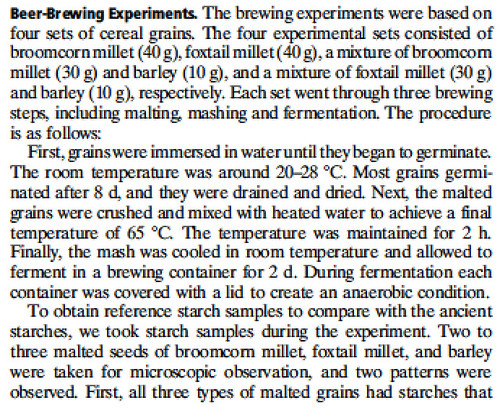
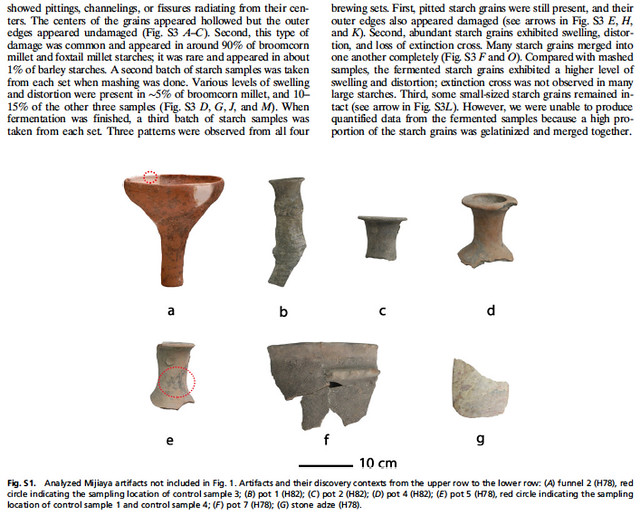
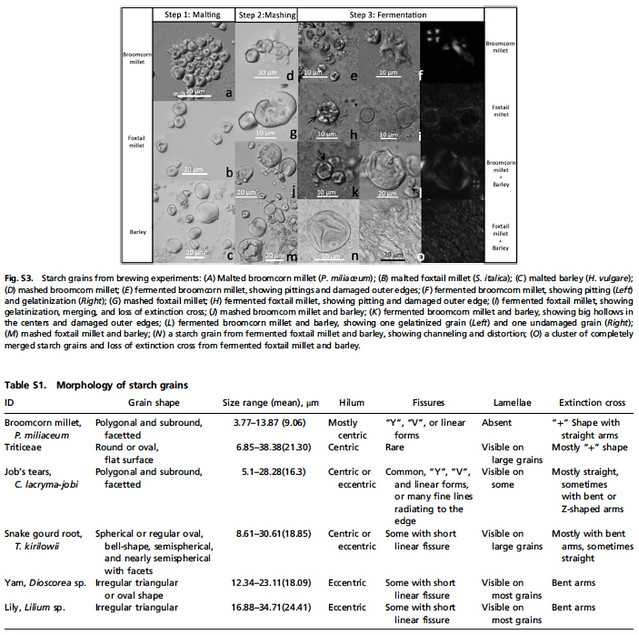
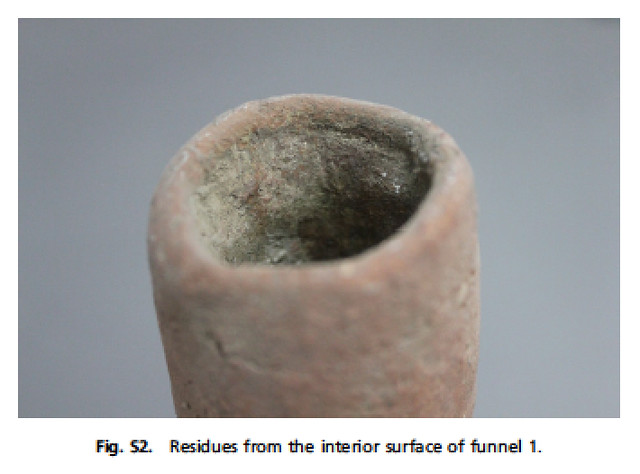
Although most of the paper is unavailable, there is supplemental information that is available, and that does give some information about the brewing process:

china-stanford-1

china-stanford-2
china-stanford-4
china-stanford-3

Filed Under: Beers, Just For Fun, News, Related Pleasures Tagged With: Archeology, China, History, Malt, Science of Brewing

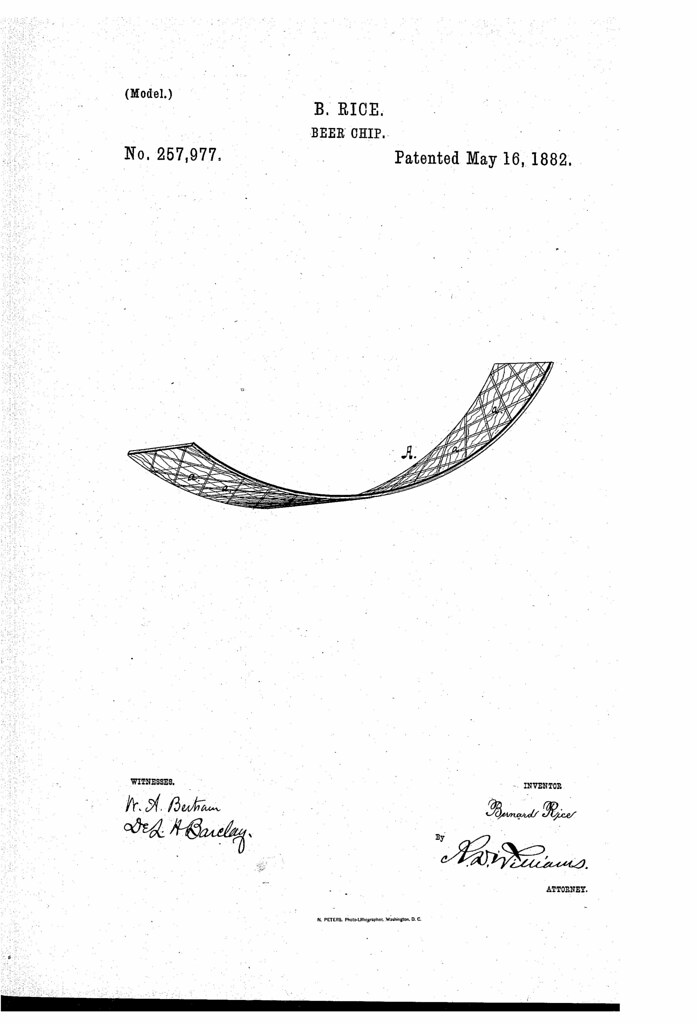
Patent No. 257977A: Beer Chip

May 16, 2016 By Jay Brooks

patent-logo
Today in 1882, US Patent 257977 A was issued, an invention of Bernard Rice, for his “Beer Chip.” There’s no Abstract, although in the description it includes this summary:

My said invention relates to the chips or shavings employed by brewers for clarifying the beer in vats or thus previous to kegging it. These chips consist of beechwood, by preference, and have heretofore been used in the form of thick shavings, or of sawed lath-like chips, straight and flat, or of a mixture of the two. Grave objections lie to either form, which it is the design of my invention to obviate. The shavings invariably break in numerous places on the convex side, form ing interstices into which the particles of yeast and impurities settle, rendering it impossible to properly cleanse the shavings in the usual revolving washers. The sawed chips, while not open to this objection, are deficient in superficies, are liable to pack and stick together, and on the whole are inferior to the shavings. The desideratum is a shaving or chip having a large superficies, curved so as not to pack nor adhere to other chips, tough enough to withstand the agitation in the washer without breaking, and one which will not mildew when kept in stock. Such a chip I have succeeded in preparing, and that at a cost less than that of the chips as heretofore made. In practice I cut a sheet of veneer from a revolving login the usual way, choosing by preference the inner portion of the log, which is free from knots, and comparatively free from resin, and thoroughly dry the sheet. Either before or after drying I cut it into chips about eighteen inches long by one and a quarter inch wide, and pass them between heated calender rolls. This process has the effect to compact the fiber and prevent the chips from becoming soggy and sinking in the vats, to toughen them and prevent them from breaking in the cask or washer, and it gives them a. permanent curvature, so that they never straighten out. It also increases the density of the wood, rendering it of substantially the same specific gravity as the beer, whereby the chips do not tend to float exclusively at the surface, but remain suspended in the beer. The calendering, furthermore, dries out the sap and resin.

In order to insure a proper bending of the chips, an extra roller or bender may be attached to the calendering machine; but that is not essential. The rolls may also have embossed figures or lines, so as to indent the chips and increase their superficies.

US257977-0

Filed Under: Beers, Breweries, Just For Fun, Politics & Law, Related Pleasures Tagged With: History, Law, Patent, Science of Brewing

« Previous Page
Next Page »

Find Something

Northern California Breweries

Please consider purchasing my latest book, California Breweries North, available from Amazon, or ask for it at your local bookstore.

Recent Comments

  • Ernie Dewing on Historic Beer Birthday: Charles William Bergner 
  • Steve 'Pudgy' De Rose on Historic Beer Birthday: Jacob Schmidt
  • Jay Brooks on Beer Birthday: Bill Owens
  • Steve 'Pudgy' De Rose on Beer Birthday: Charles Finkel
  • Steve 'Pudgy' De Rose on Beer Birthday: Bill Owens

Recent Posts

  • Beer In Ads #5185: It’s Bock Time January 28, 2026
  • Historic Cider Birthday: H.P. Bulmer January 28, 2026
  • Beer Birthday: Shane McNamara January 28, 2026
  • Historic Beer Birthday: John Goetz January 28, 2026
  • Beer Birthday: Jean-Marie Rock January 28, 2026

BBB Archives

Feedback

Head Quarter
This site is hosted and maintained by H25Q.dev. Any questions or comments for the webmaster can be directed here.