Brookston Beer Bulletin

Jay R. Brooks on Beer

  • Home
  • About
  • Editorial
  • Birthdays
  • Art & Beer

Socialize

  • Dribbble
  • Email
  • Facebook
  • Flickr
  • GitHub
  • Instagram
  • LinkedIn
  • Pinterest
  • RSS
  • Twitter
  • YouTube

Powered by Genesis

Patent No. 34943A: Beer Measure

April 15, 2016 By Jay Brooks

patent-logo
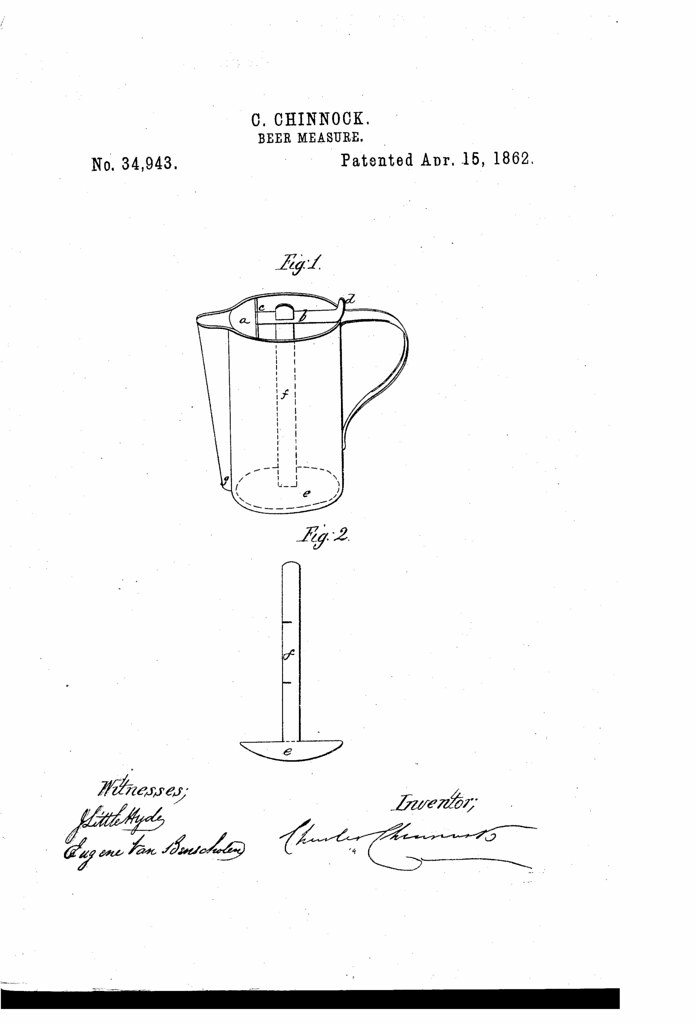
Today in 1862, US Patent 34943 A was issued, an invention of Charles Chinnock, for his “Beer Measure.” There’s no Abstract, although in the description it includes this summary:

I have invented a new and improved can and measure for liquids liable to froth or foam when drawn or measured and also to separate the froth or foam from the liquid when pouring into other vessel or vessels.
US34943-0

Filed Under: Beers, Breweries, Just For Fun, Politics & Law, Related Pleasures Tagged With: Brewing Equipment, History, Law, Patent, Science of Brewing

Patent No. 3505946A: Apparatus For Reconstituting Concentrated Wort

April 14, 2016 By Jay Brooks

patent-logo
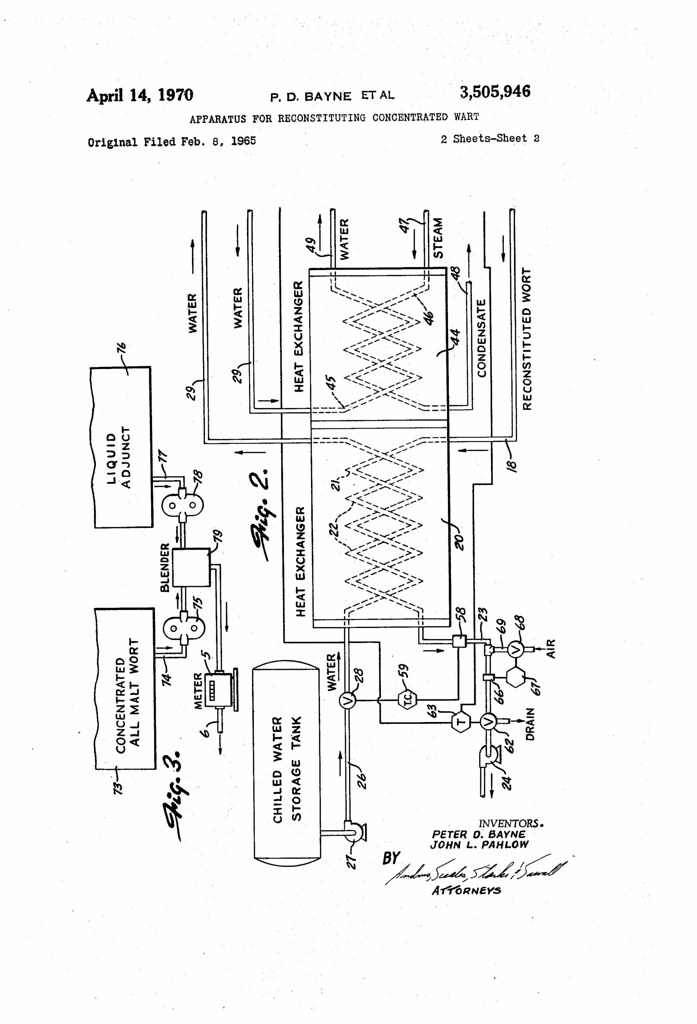
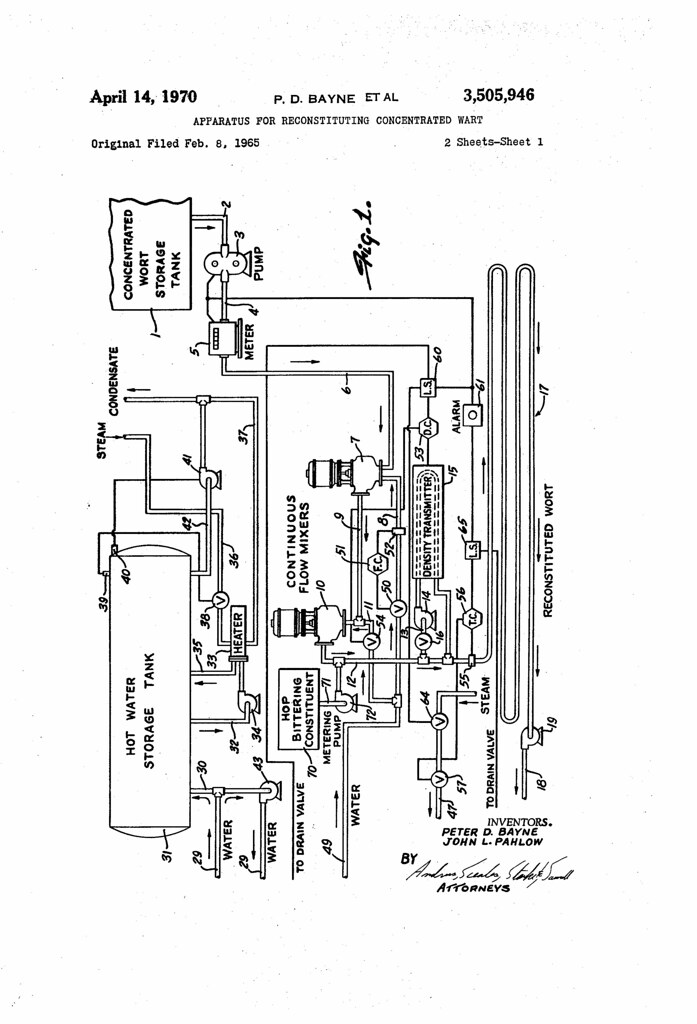
Today in 1979, US Patent 3505946 A was issued, an invention of Peter D. Bayne and John L. Pahlow, assigned to Schlitz Brewing Co., for his “Apparatus For Reconstituting Concentrated Wort.” There’s no Abstract, although in the description it includes this summary:

This invention relates to a process of brewing and more particularly to a process and apparatus for reconstituting concentrated brewers wort.

Wort concentration has great potential and can offer advantages by increasing the production efficiency of existing plants, increasing production volume without a corresponding increase in capital expenditure and providing a simplification of both production processes and control of product uniformity without sacrificing quality of product.

More specifically, concentrated wort provides several distinct advantages. Brewhouse equipment generally works at peak capacity for only a few months of the year. By concentrating wort during off season periods a more efficient use of the facility results so that the brewhouse equipment can be used more efficiently throughout the year.

In addition, concentrated wort can be shipped to distant points where it can be reconstituted, fermented, finished in plants which can be built at relatively low cost because they do not require the expensive grain handling and brewhouse equipment. Moreover, weight savings can be realized by shipping the wort concentrate as opposed to shipping malt and raw grains required for conventional brewing.

A system of wort concentration and reconstitution has outstanding potential in conjunction with a continuous or accumulated batch fermenting system. Wort concentrate is stable in storage and the concentrate can be metered into the present system in the desired flow rate, reconstituted, and then passed directly into the continuous fermenting system without storage. Using the reconstituting system of the invention in conjunction with a con tinuous fermentation process averts the necessity of holding the reconstituted wort at temperatures and under conditions which might create microbiological growth. Moreover, combining the reconstituting system with a continuous fermentation system completely eliminates the necessity of large storage tanks and chillers for maintaining a supply of wort for fermentation and provides a substantial cost saving in plant and equipment design over that of conventional systems.

The concept of wort concentration provides an alternate approach to the problems that some brewers have attempted to solve by freeze concentration of beer. Wort concentrate, because it does not contain alcohol, does not present the legal ramifications which accompany freeze concentrated beer.

The present invention is directed to a continuous, high capacity process for reconstituting concentrated wort. The wort is reconstituted without color gain, loss of hop bitter or alteration of flavor. According to the invention, concentrated wort at a temperature of from 60 to F., but preferably under and having a solids content of 80% is continuously pumped from a storage tank and/or shipping containers and passed into a mixing system. Deionized water, or filtered mains water, depending upon the purity of the water, is introduced into a mixer at a constant flow rate and is mixed with the stream of concentrated wort to partially reconstitute or dilute the wort. In some cases, particularly in high capacity installations, a second mixer in series may be employed and a second stream of either deionized water or filtered mains water is introduced into the second mixer down stream from the first mixer. This second or breakdown stream of water is continuously introduced at a variable flow rate and mixed with the partially reconstituted wort to complete the reconstitution to the fermentation gravity.

US3505946-0
US3505946-1

Filed Under: Beers, Just For Fun, Politics & Law, Related Pleasures Tagged With: History, Law, Patent, Science of Brewing, Wort

Patent No. 2547988A: Process For Improving The Foam Of Fermented Malt Beverages And Product Obtained Thereby

April 10, 2016 By Jay Brooks

patent-logo
Today in 1951, US Patent 2547988 A was issued, an invention of Hilton B. Levy, Arthur L. Schade and James S. Wallerstein, for his “Process For Improving the Foam of Fermented Malt Beverages and Product Obtained Thereby” for beer bottles. There’s no Abstract, although in the description it includes this summary:

The present invention relates to fermented malt beverages and more particularly to beverages of this type characterized by the capacity for forming a. stable, that is, a long-lived foam.

It is accordingly the general object of the present invention to provide fermented malt beverages Whose foam-head is longer-lasting in character than the foam-head produced by the normal components of these beverages as at present manufactured.

It is a further object of the invention to improve a persistent or enduring foam which he lasting qualities of the foam-head of fermented beverages by adding to such beverages at any suitable time in the course ,of their manufacture, but preferably after the fermenting and initial or coarse filtering, but prior to the storage period, a small quantity of a soluble non-toxic carboxy-methyl cellulose, preferably in the form of its alkali metal salt, such as the sodium and potassium salts.

We have now discovered that the foam of beer may be prolonged in a simple and economical manner by the addition to the beer of, small amounts of a water-soluble, heat-stable form of carboxy-methyl cellulose, as, for example, the

sodium salt of such material. This is commonly called cellulose gum, and, is a completely harmless and edible material. When solutions of, for example, sodium carboxy-methyl cellulose are added to beer in a concentration of 5 to 200 parts per million, the duration of the foam is greatly increased and a persistent froth is produced which endures for as much as several hours. Preparations of the sodium carboxy-methyl cellulose are particularly valuable when they are of a high viscosity type, and they increase the foam duration period many times.

beer_foam

Filed Under: Beers, Breweries, Just For Fun, Politics & Law, Related Pleasures Tagged With: History, Law, Patent, Science of Brewing

Patent No. CA2133272A1: Preparation Of Beer, Probably Samuel Adams Triple Bock

April 7, 2016 By Jay Brooks

patent-logo
Today in 1995, CA 2133272 A1 was issued, an invention of Charles J. Koch, though the “Applicant” is listed as Charles J. Koch, Boston Beer Company Limited Partnership D/B/A Boston Beer Company (The), A Massachusetts Partnership; General Partner, Boston Brewing Company, Inc., for his “Preparation Of Beer.” Here’s the Abstract:

High alcohol beer having a full, round flavor is prepared by employing as the yeast a wine or champagne yeast, and a sweetened wort.

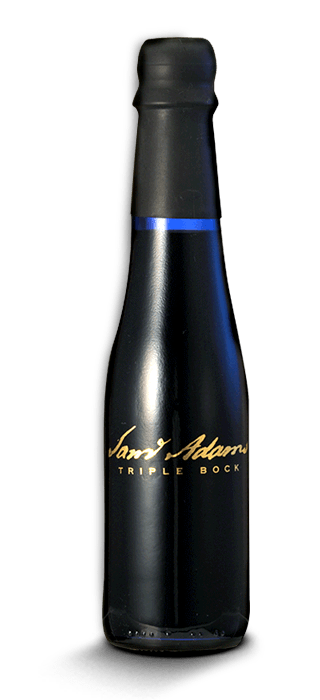
While I can’t be sure, I think this is essentially for Samuel Adams’ Triple Bock, which was first released in 1994. While the patent wasn’t granted until 1995, it was filed in the fall of 1994, but the “priority date” listed is October 6, 1993. The “inventor” listed is Charles J. Koch, who was Jim Koch’s father, although under “applicant” the Boston Beer Co. is also listed. In addition, I recall Jim explaining that it was in fact Champagne yeast that was used to create the beer. So it certainly seems likely that they patented the process used to make that unique beer. I still have a few bottles of it in my cellar though the last couple I opened tasted a lot like soy sauce. To be fair, the bottles that were opened during an anniversary dinner that I was lucky enough to attend in Boston Beer Co.’s barrel room a few years ago were tasting quite good. Although the OCR errors make it difficult reading, it’s still interesting to see the thought process and how they went about it laid out. I may have to open another bottle soon.

bottledetaillargetriplebock

Filed Under: Beers, Food & Beer, Politics & Law, Related Pleasures Tagged With: History, Law, Patent, Science of Brewing, Yeast

Patent No. 8409647B2: Silica Microgels For Reducing Chill Haze

April 2, 2016 By Jay Brooks

patent-logo
Today in 1919, US Patent 8409647 B2 was issued, an invention of Robert Harvey Moffett, Jeffrey Allen Odle, and Rafael Januario Calabrese, assigned to E. I. Du Pont De Nemours And Company, for their “Silica Microgels For Reducing Chill Haze.” Here’s the Abstract:

The present invention provides a method of reducing chill haze in a protein containing liquid (especially beverages resulting from fermentation such as beer and wine) by contacting the liquid with silica microgels having an average microgel diameter of at least 18 nm, more preferably at least 45 nm, and most preferably at least 70 nm. It has now been discovered that microgels having an average microgel diameter of less than about 18 nm do not adequately reduce chill haze of a protein containing liquid. In particular, while microgels having an average microgel diameter of less than about 18 nm cause the coagulation of haze-forming components, these components remain suspended in liquid and continue to cause haze despite allowing the liquid to settle for long periods of time. Conversely, it has now been discovered that microgels having an average microgel diameter of at least about 18 nm cause the coagulation and precipitation of haze-forming components and the rapid settling thereof without the use of an organic polymer which acts as a flocculating agent.

US08409647-20130402-D00001
US08409647-20130402-D00002

Filed Under: Beers, Breweries, Just For Fun, Politics & Law, Related Pleasures Tagged With: History, Law, Patent, Science of Brewing

Patent No. 2035962A: Brew Kettle

March 31, 2016 By Jay Brooks

patent-logo
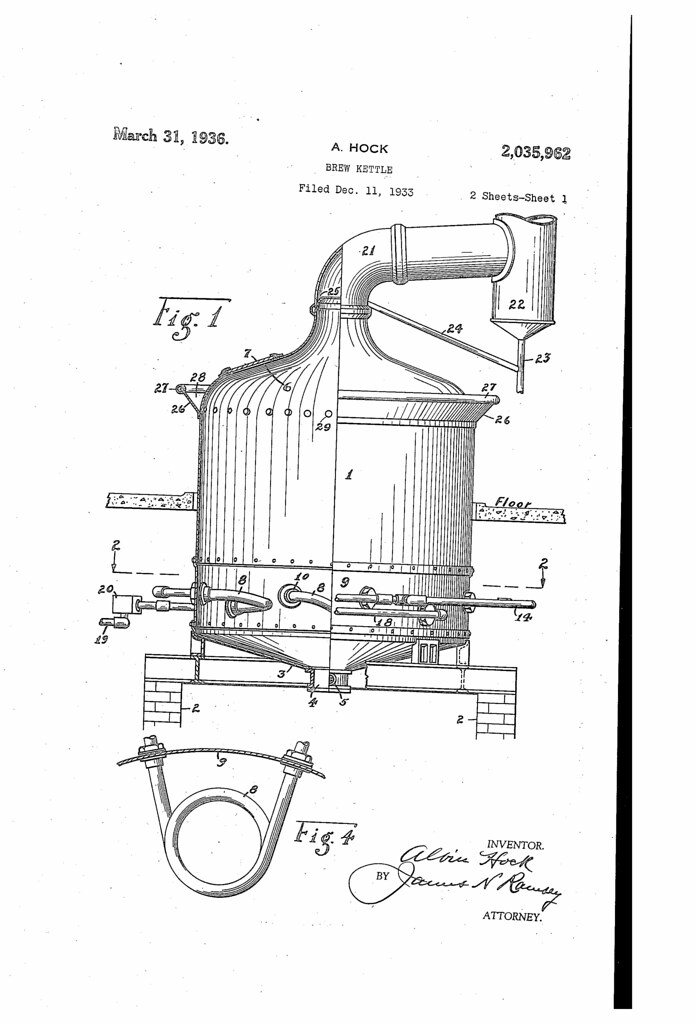
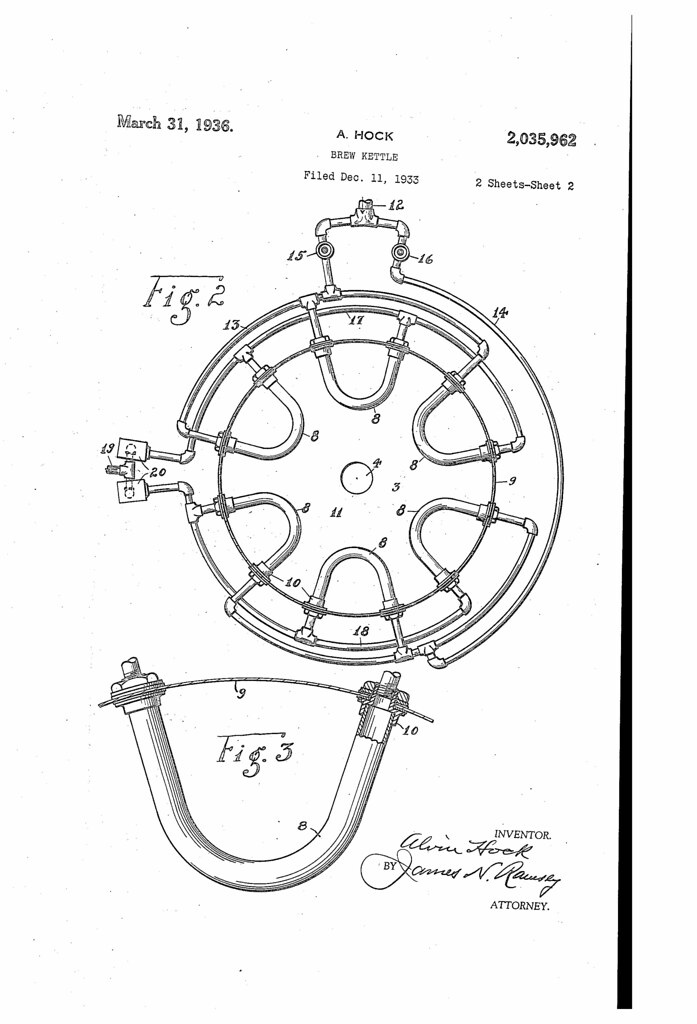
Today in 1936, US Patent 2035962 A was issued, an invention of Alvin Hock, for his “Brew Kettle.” There’s no Abstract, although in the description it includes this summary:

My invention consists in providing a closed kettle or receptacle preferably having a downwardly converging bottom provided with a central outlet therein and having above said bottom a series of U-tubes extending into and out of the kettle and connected to steam inlet and exhaust outlet tubes whereby steam will circulate through said U-tubes which are immersed in the liquid and whereby heat is given off to said liquid from the entire surface of said tubes, so that all of the heat thus transferred is fully utilized.

US2035962-0
US2035962-1

Filed Under: Beers, Breweries, Just For Fun, Politics & Law, Related Pleasures Tagged With: Brewing Equipment, History, Law, Patent, Science of Brewing

Patent No. 3175912A: Synthetic Organic Chemical Preservative For Beer

March 30, 2016 By Jay Brooks

patent-logo
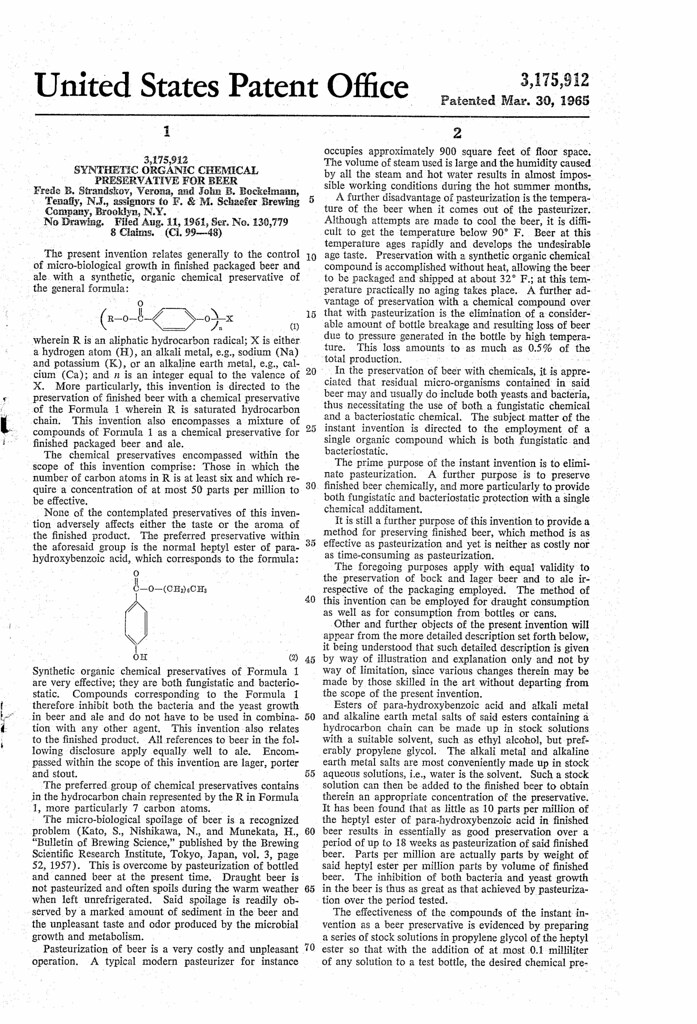
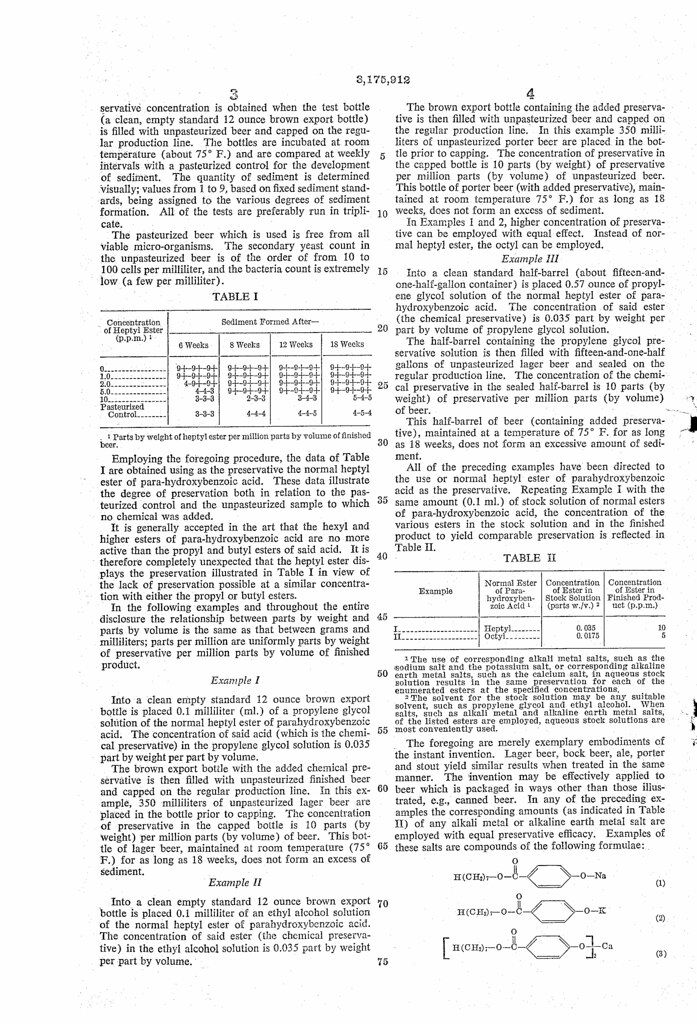
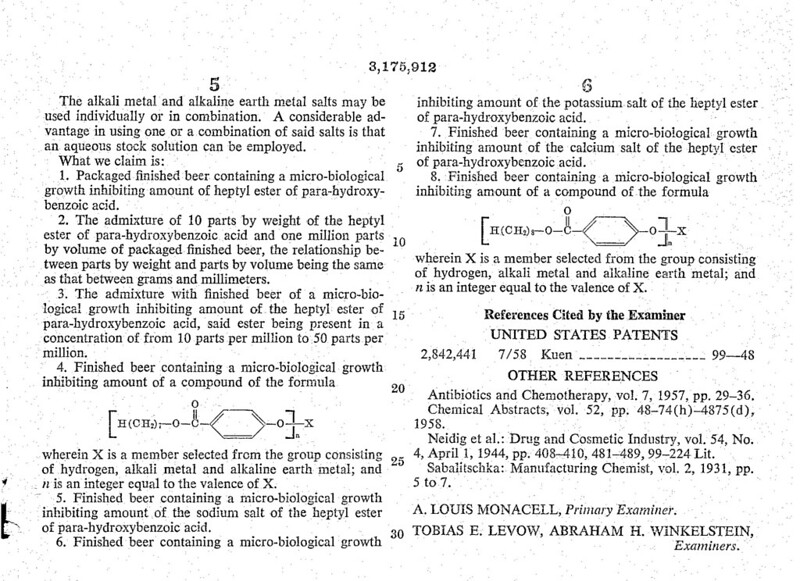
Today in 1965, US Patent 3175912 A was issued, an invention of John B. Bockelmann and Frede B. Strandskov, assigned to Schaefer Brewing Co., for their “Synthetic Organic Chemical Preservative For Beer.” There’s no Abstract, although in the description it includes this summary:

The present invention relates generally to the control of micro-biological growth in finished packaged beer and ale with a synthetic, organic chemical preservative of the general formula:

Wherein R is an aliphatic hydrocarbon radical; X is either a hydrogen atom (H), an alkali metal, e.g., sodium (Na) and potassium (K), or an alkaline earth metal, e.g., cal cium (Ca); and 11 is an integer equal to the valence of X. More particularly, this invention is directed to the preservation of finished beer with a chemical preservative of the Formula 1 wherein R is saturated hydrocarbon chain. This invention also encompasses a mixture of compounds of Formula 1 as a chemical preservative for finished packaged beer and ale.

US3175912-0
US3175912-1
US3175912-2

Filed Under: Beers, Just For Fun, Politics & Law, Related Pleasures Tagged With: History, Law, Patent, Science, Science of Brewing

Patent No. 1177117A: Method Of Preparing Beer

March 28, 2016 By Jay Brooks

patent-logo
Today in 1916, US Patent 1177117 A was issued, an invention of Oscar M. Lamsens, for his “Method of Preparing Beer.” There’s no Abstract, although in the description it includes this summary:

In beers which are brewed in the ordinary w manner, there is a’tendency to cloud or become turbid when they are chilled; specifically after pasteurization. Such beer or beer that has been bottled for sometime and is consequently in such condition otherwise as to become clouded when chilled, is found on examination to contain coagulated albuminoids. In other words the albuminoids that are ordinarily carried in the beer in such condition as to be invisible, become coagulated when the beer is reduced in temperature. and so impair the brilliancy and clearness of the liquor.

This invention relates to the preparation of beers and ales, and more particularly beers for bottling, whereby the product possesses great stability and does not tend to become clouded or turbid. even when chilled to a considerably lower than normal temperature, the liquor in fact being what lazily be termed chill proof beer or the According to the method herein described, advantage is taken of the fact that the yeast which is present in greater or less quantities in the beer before it has been thoroughly settled, carries or contains proteolytic enzymes but in such manner because of the organization or structure of the yeast cells that the class of albuminoids in beer which 40 tend to become coagulated; under reduction of temperature, do not get into contact with the enzymes and are not affected thereby;

Schlitz-brewhouse

Filed Under: Beers, Breweries, Just For Fun, Politics & Law, Related Pleasures Tagged With: Brewing Equipment, History, Law, Patent, Science of Brewing

Patent No. 1995814A: Steam Boiler

March 26, 2016 By Jay Brooks

patent-logo
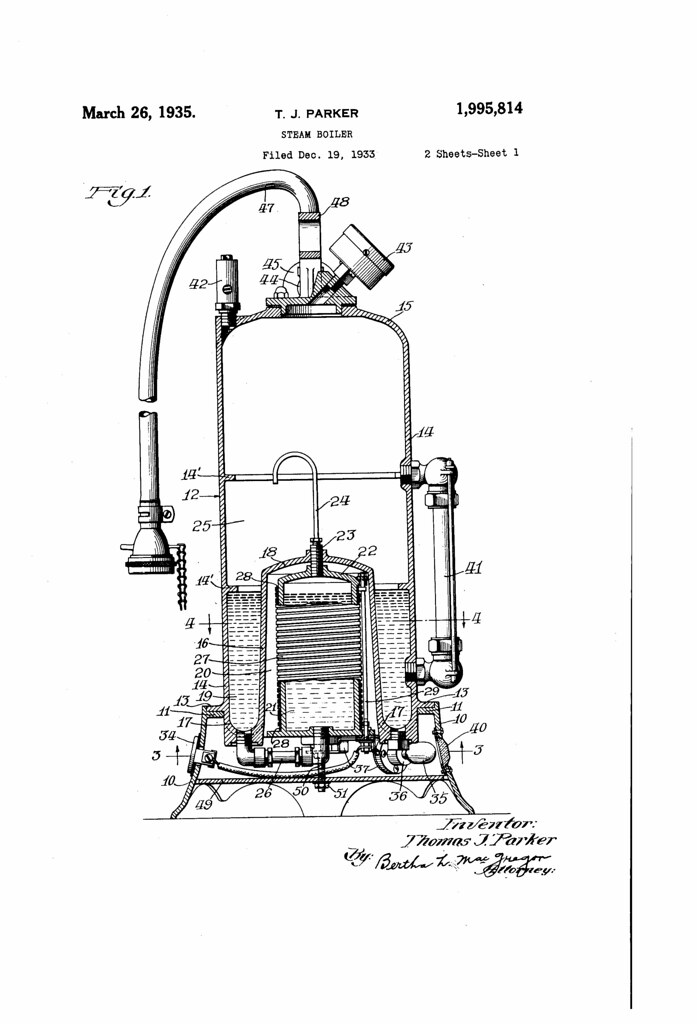
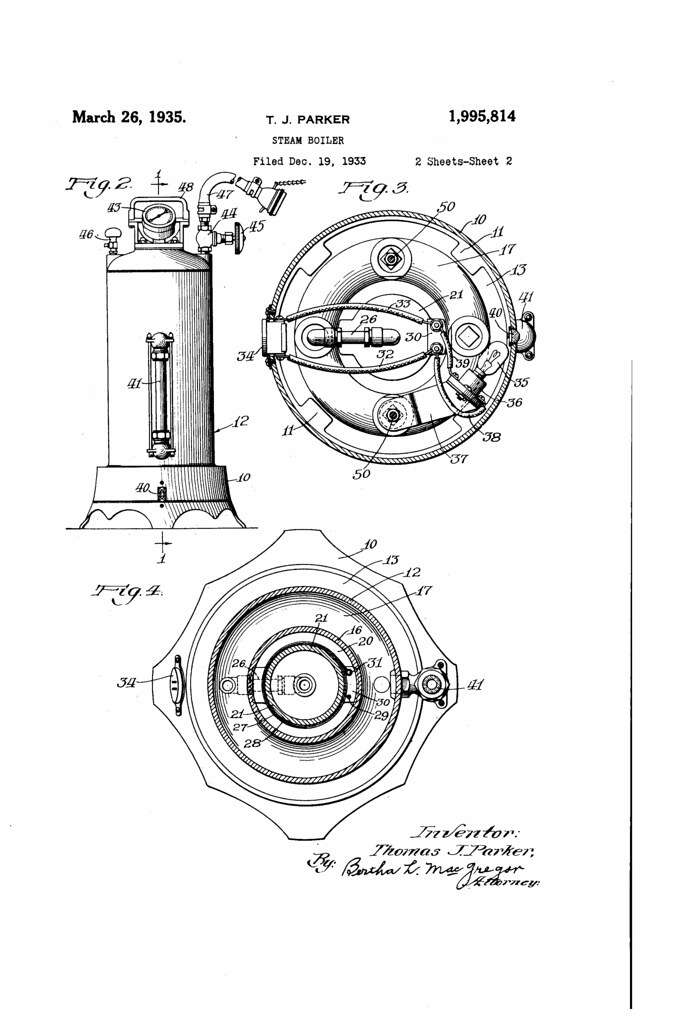
Today in 1935, US Patent 1995814 A was issued, an invention of Thomas J. Parker, for his “Steam Boiler.” There’s no Abstract, although in the description it includes this summary:

This invention relates to boilers and more particularly to electrically heated boilers for generating steam. The boiler herein shown and described is a miniature boiler particularly adapted for generating steam for cleansing and sterilizing fluid conduits, such as beer coils, but obviously the invention may be applied to various uses requiring steam under pressure.

One of the objects of the invention is to provide a boiler in which steam of desired pressure may be quickly and efficiently generated. Another object is to provide for heating the water in the boiler to generate steam by means of a novel and very efficient electric heating element mounted in direct heat contact on and surrounding a generating cylinder which is part of the circulatory system of the boiler.

US1995814-0
US1995814-1

Filed Under: Beers, Breweries, Just For Fun, Politics & Law, Related Pleasures Tagged With: Brewing Equipment, History, Law, Patent, Science of Brewing

Patent No. 4507325A: Process Of Brewing With An Adjunct Of Highly Fermentable Sugar

March 26, 2016 By Jay Brooks

patent-logo
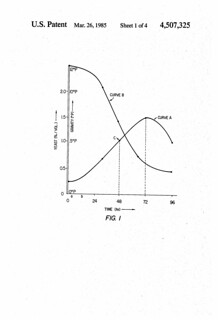
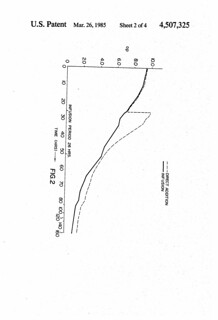
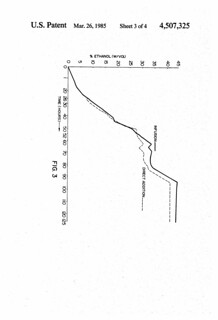
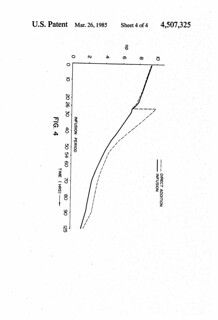
Today in 1985, US Patent 4507325 A was issued, an invention of Kenneth H. Geiger, assigned to Labatt Brewing Company Limited, for his “Process of Brewing with an Adjunct of Highly Fermentable Sugar.” Here’s the Abstract:

The present invention provides an improved brewing process which utilizes an adjunct comprising a highly fermentable sugar. In the process, brewers’ yeast is allowed to act upon a, preferably all-malt, wort until said yeast is partially developed, following which, the adjunct is introduced into the partially fermented wort in a manner which will not have adverse effects on the yeast and the brewing process carried to completion. The adjunct is introduced over a period of time such that the Plato value of the fermenting wort substantially does not increase and osmotic shock is avoided. The process is especially advantageous when used to produce the so-called light beers.

US4507325-1 US4507325-2

US4507325-3 US4507325-4

Filed Under: Beers, Just For Fun, Politics & Law, Related Pleasures Tagged With: History, Law, Patent, Science of Brewing

« Previous Page
Next Page »

Find Something

Northern California Breweries

Please consider purchasing my latest book, California Breweries North, available from Amazon, or ask for it at your local bookstore.

Recent Comments

  • Ernie Dewing on Historic Beer Birthday: Charles William Bergner 
  • Steve 'Pudgy' De Rose on Historic Beer Birthday: Jacob Schmidt
  • Jay Brooks on Beer Birthday: Bill Owens
  • Steve 'Pudgy' De Rose on Beer Birthday: Charles Finkel
  • Steve 'Pudgy' De Rose on Beer Birthday: Bill Owens

Recent Posts

  • Historic Beer Birthday: Philip Zorn February 21, 2026
  • Historic Beer Birthday: Rudolph J. Schaefer February 21, 2026
  • Beer Birthday: Kate Bernot February 21, 2026
  • Historic Beer Birthday: William J. Lemp February 21, 2026
  • Beer Birthday: Sayre Piotrkowski February 21, 2026

BBB Archives

Feedback

Head Quarter
This site is hosted and maintained by H25Q.dev. Any questions or comments for the webmaster can be directed here.