Brookston Beer Bulletin

Jay R. Brooks on Beer

  • Home
  • About
  • Editorial
  • Birthdays
  • Art & Beer

Socialize

  • Dribbble
  • Email
  • Facebook
  • Flickr
  • GitHub
  • Instagram
  • LinkedIn
  • Pinterest
  • RSS
  • Twitter
  • YouTube

Powered by Genesis

The Journey Of Beer Ingredients

January 6, 2016 By Jay Brooks

beer-ingredients
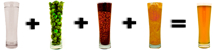
Here’s a fun infographic showing the Journey of Beer Ingredients and called “Glorious Beer.” It was created by Lockstep Studio, who began selling the posters in early December of last year. It’s a different approach than most of these, following the separate journeys of water, barley, hop and yeast until eventually they meet up and have a party, so you can have one, too.

Journey-of-Beer-Ingredients
Click here to see the infographic full size.

Filed Under: Beers, Just For Fun Tagged With: Infographics, Ingredients, Science of Brewing

Patent No. 3227557A: Continuous Fermentation Process With Sedimentable Microorganisms

January 4, 2016 By Jay Brooks

patent-logo
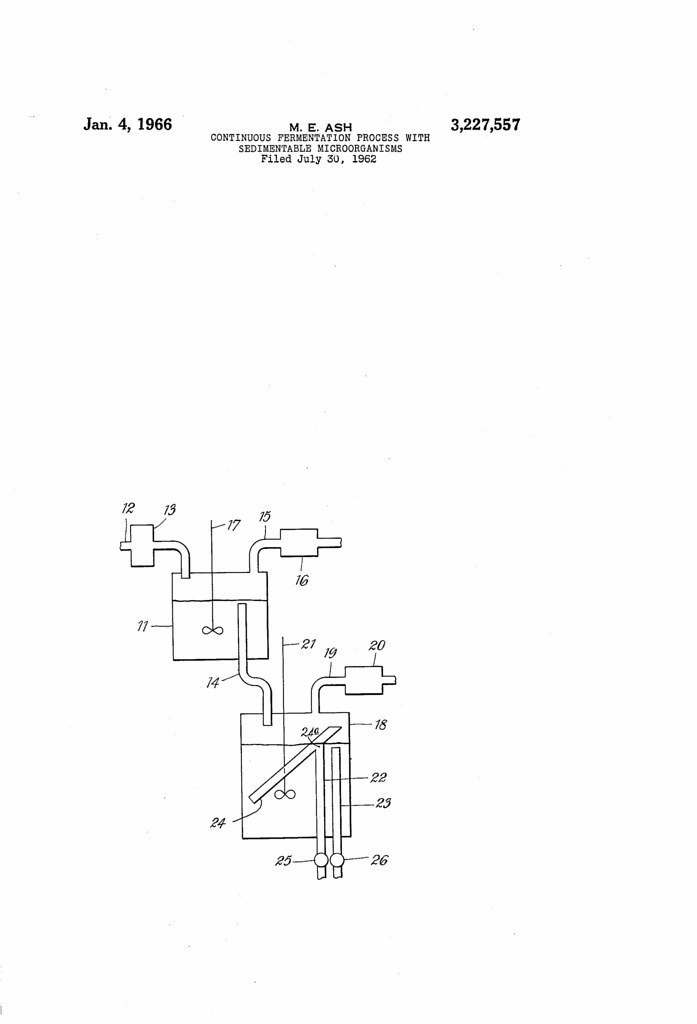
Today in 1966, US Patent 3227557 A was issued, an invention of Michael Edward Ash, assigned to Guinness Son & Co. Ltd., for his “Continuous Fermentation Process with Sedimentable Microorganisms.” There’s no Abstract, although in the description it includes this summary:

This invention relates in general to continuous fermentation systems of the kind in which liquid suspensions comprising a dispersion of said fermentable micro-organisms in a liquid substrate of relatively lower specific gravity, are caused to flow through a fermenting vessel or series of vessels.

More specifically, the invention is concerned with a method and apparatus for controlling the relative degree of concentration of micro-organism in substrate as between any two or all of the stages: inflow, vessel and outflow.

In particular, the invention has been developed for use in connection with the continuous fermentation of Erewers wort in a chemostat system.

The invention is however believed to be applicable to any microbiological process in which a sedimentable micro-organism is operated in a nutrient liquid, and is in the form of a mechanical dispersion in liquid nutrient of relatively lower specific gravity, so that in the absence of turbulence, the micro-organism tends to settle at the bottom of the vessel.

It has already been proposed continuously to ferment Brewers wort or other ferment-able substrate in a plurality of sequentially arranged stirred or unstirred vessels, and to separate the fermenting micro-organism (yeast) from the fermented product (beer) by settlement in a separate vessel or in a part of the final fermentation vessel separated from a stirred region by a baffle.

US3227557-0

Filed Under: Beers, Breweries, Just For Fun, Politics & Law, Related Pleasures Tagged With: Brewing Equipment, Guinness, History, Law, Patent, Science of Brewing

Patent No. 3071403A: Crowned Bottle Rejection Pin For Bottle Pick Up Apparatus

January 1, 2016 By Jay Brooks

patent-logo
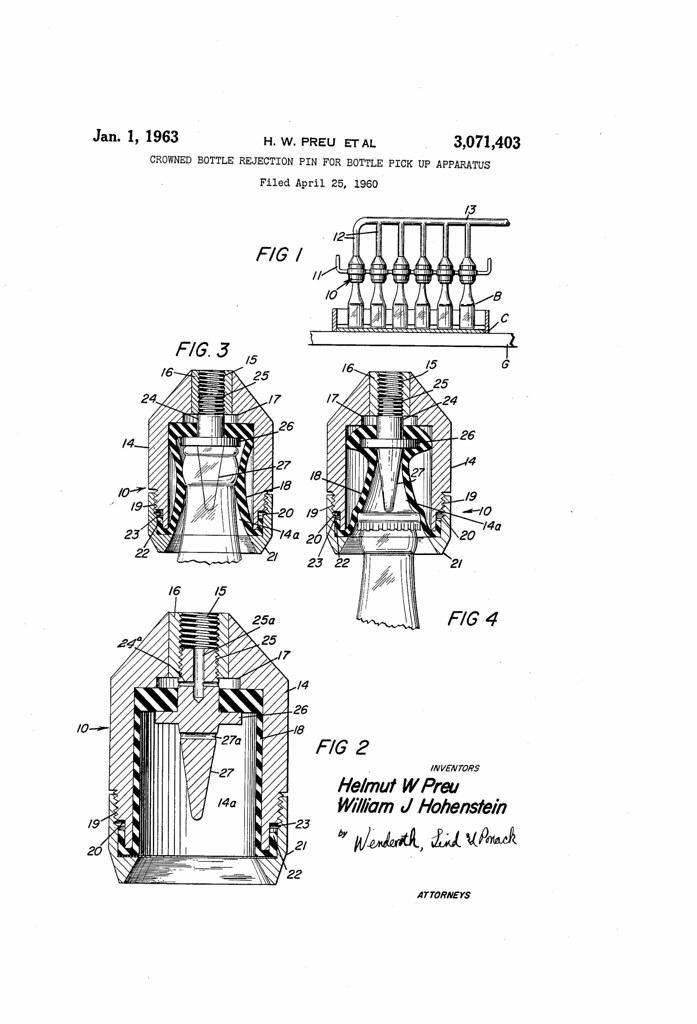
Today in 1963, US Patent 3071403A was issued, an invention of William J. Hohenstein and Helmut W. Preu, assigned to Schaefer Brewing Co., for their “Crowned Bottle Rejection Pin For Bottle Pick Up Apparatus.” There’s no Abstract, although in the description it includes this summary:

The present invention relates to a crowned bottle rejection pin for use on apparatus which picks up empty bottles for moving them from place to place.

A conventional apparatus for removing empty bottles, such as beer bottles or the like, from cases for transferring them to a conveyer for movement into a washing machine, has a plurality of heads thereon which have an expandable rubber sleeve within them. The heads are connected to a source of compressed air so that when the heads are lowered over the tops of the bottles in a case of empty bottles, the compressed air is fed to the heads and it expands the rubber sleeves around the tops of the bottles. The apparatus is then operated to lift the empty bottles from the case or the like and move them to a conveyer.

It often occurs, however, that caps or crowns will be placed on the tops of the bottles after they are empty, and when the heads on the bottle removing apparatus move down around the tops of the empty bottles, they will pick up the crown as well as the empty bottle and transport it to the conveyer to the washing machine. The crown will remain on the bottle in the washing machine and prevent a brush spindle which cleans the inside of the bottle as well as the rinsing tube from entering the bottle. This malfunction results in the spindles and rinse tubes being bent out of shape, requiring a thirty to fifty minute shutdown of the machine to replace the bent parts.

It is an object of the present invention to provide a pin which can be placed within the heads on the bottle removing apparatus which will prevent the head from picking up an empty bottle which has a crown thereon, yet which will not prevent the head from picking up a bottle without such a crown thereon.

US3071403-0

Filed Under: Beers, Breweries, Just For Fun, Politics & Law, Related Pleasures Tagged With: Bottles, Brewing Equipment, History, Law, Packaging, Patent, Science of Brewing

Patent No. 3071469A: Process In The Manufacture Of Beer

January 1, 2016 By Jay Brooks

patent-logo
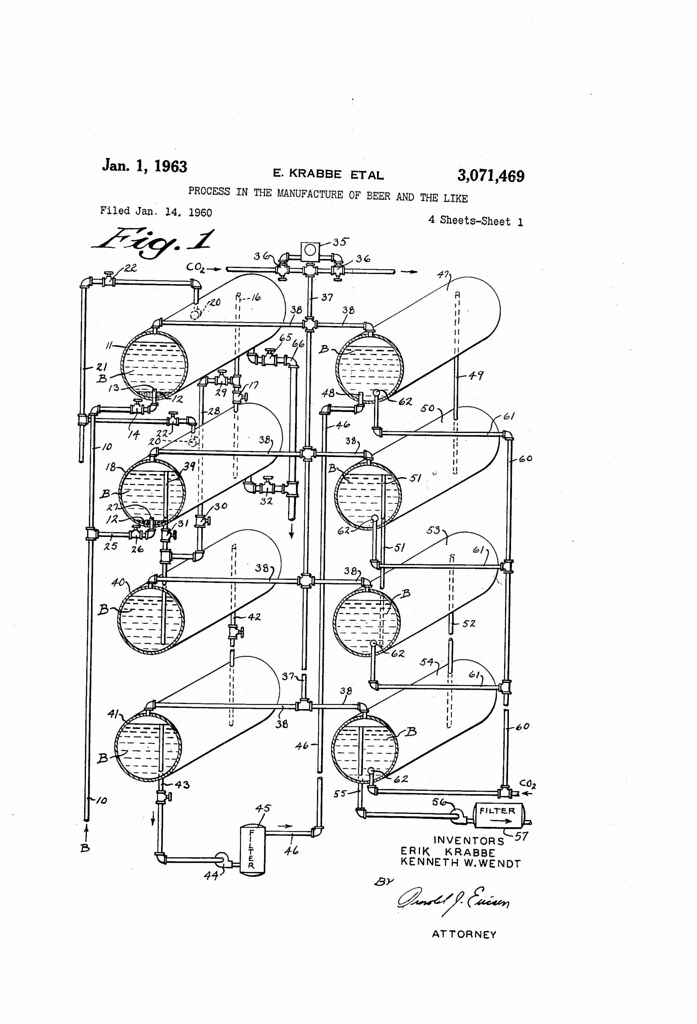
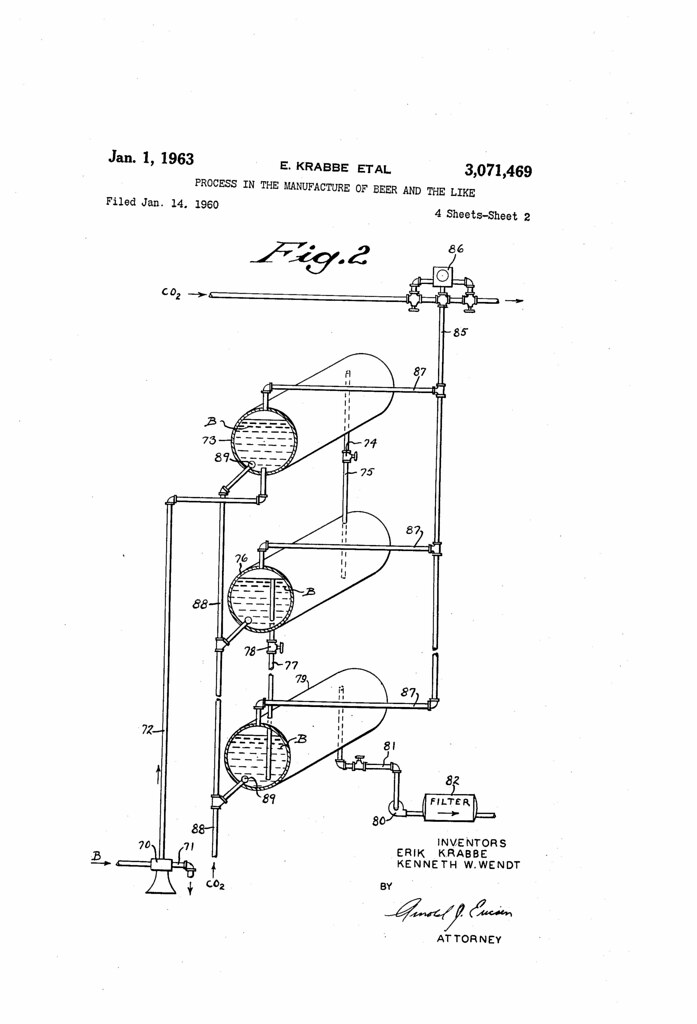
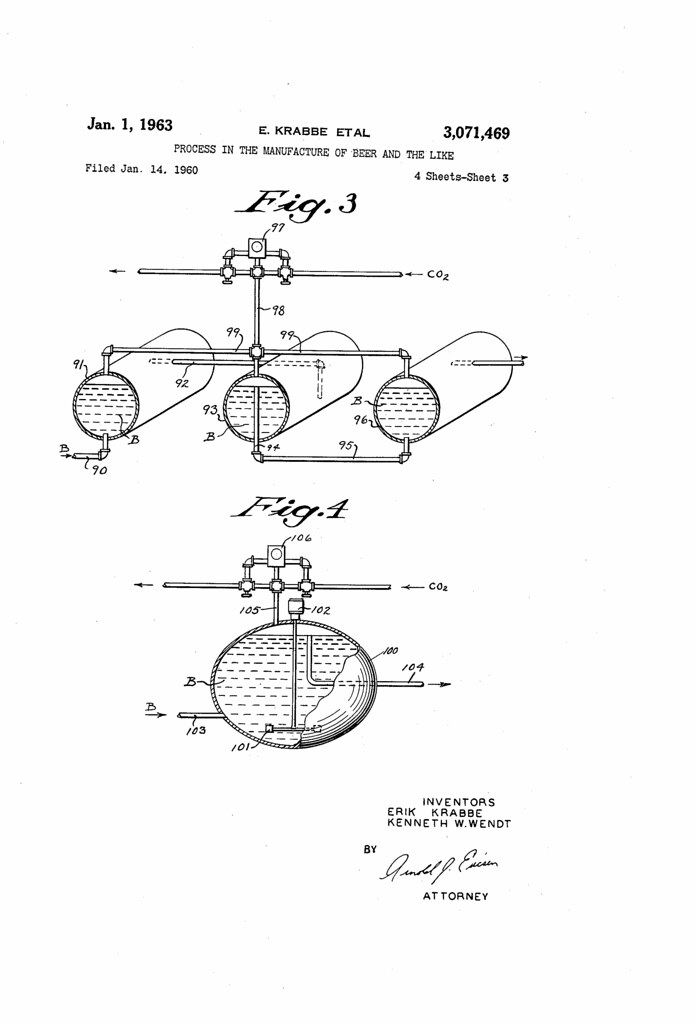
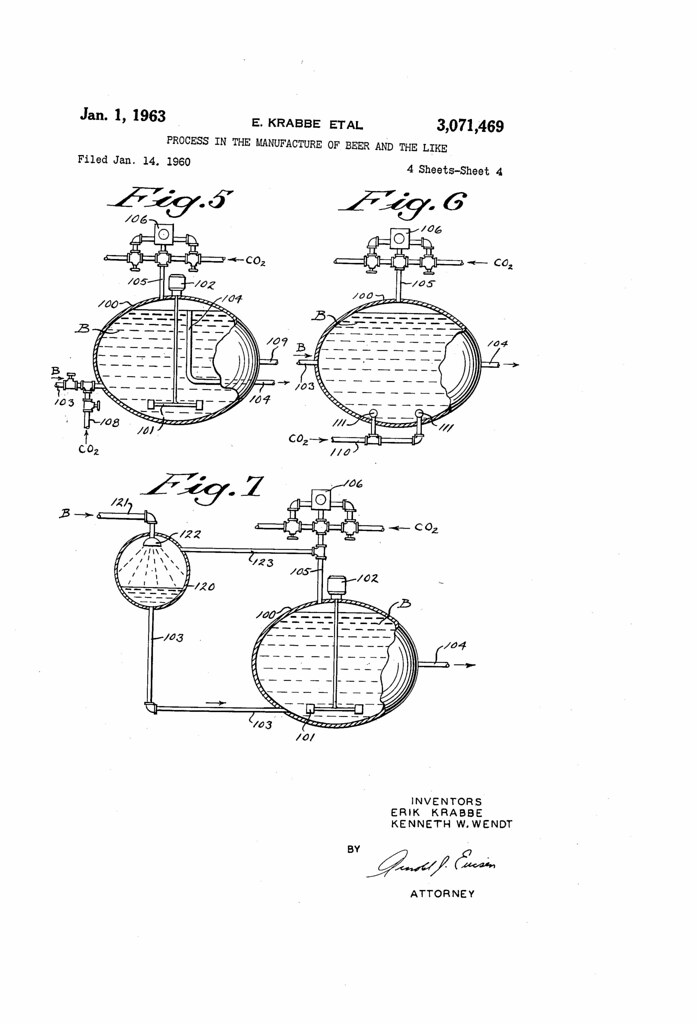
Today in 1963, US Patent 2226813 A was issued, an invention of Erik Krabbe and Kenneth W. Wendt, assigned to Miller Brewing, for his “Process in the Manufacture of Beer and the Like.” There’s no Abstract, although in the description it includes this summary:

The present invention relates to an improved process and apparatus for the manufacture of beer and the like and includes among its objects the provision of improved apparatus for aging and finishing of beer and fermented beverages, and of improved procedures for accomplishing the same.

The present invention contemplates a number of embodiments, including installations for the conversion of existing tank storage facilities to a system of continuous flow aging and without undue modification thereof. Other embodiments provide disclosures of relatively more economical construction for use in new installations, and which provide similar desirable results in the end product.

US3071469-0
US3071469-1
US3071469-2
US3071469-3

Filed Under: Beers, Breweries, Just For Fun, Politics & Law, Related Pleasures Tagged With: Brewing Equipment, History, Law, Patent, Science of Brewing

Patent No. 717493A: Wort-Cooler

December 30, 2015 By Jay Brooks

patent-logo
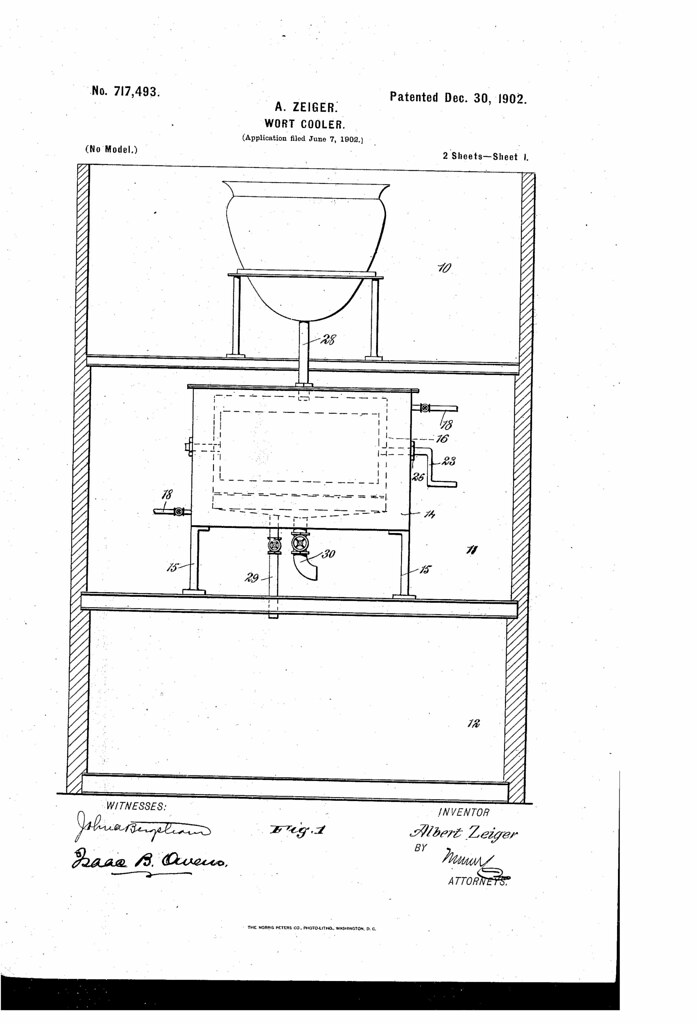
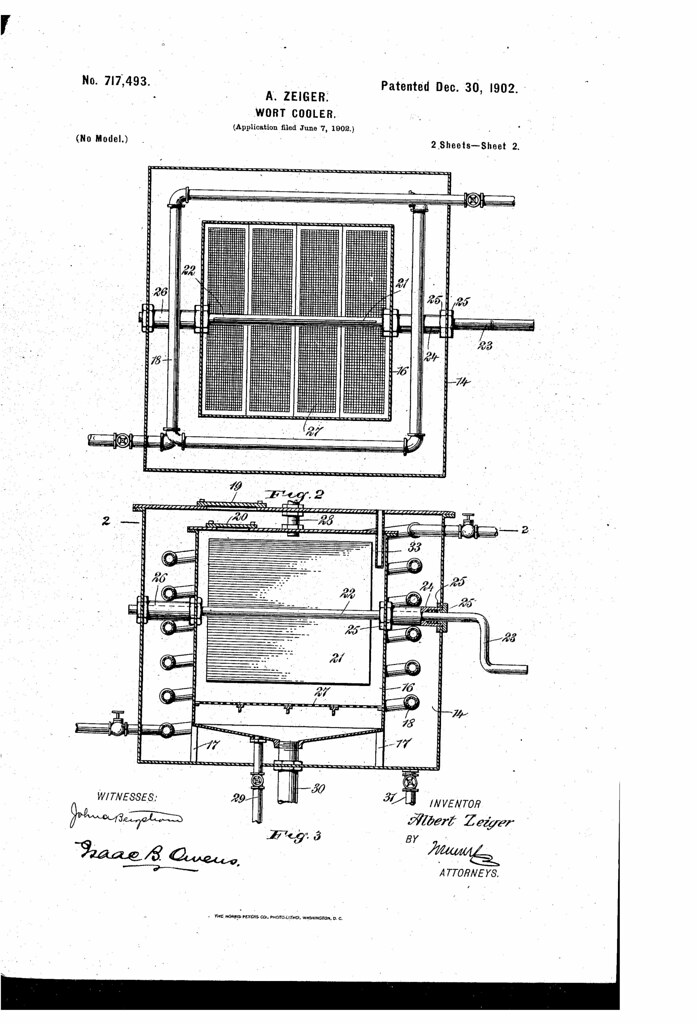
Today in 1902, US Patent 717493 A was issued, an invention of Albert Zeiger, for his “Wort-Cooler.” There’s no Abstract, although in the description it includes this summary:

This invention relates to an apparatus for cooling wort as it comes from the kettles in the brewery; and it embodies certain novel features of construction and arrangement of parts which enables it to be used not only as a wort-cooler, but as a strainer to remove the hops from the wort, thus permitting the wort to be run directly from the cooler into the fermenting-room and dispensing with the necessity of the hopper-jack, which has heretofore been used.

US717493-0
US717493-1

Filed Under: Beers, Breweries, Just For Fun, Politics & Law, Related Pleasures Tagged With: Brewing Equipment, History, Law, Patent, Science of Brewing, Wort

Patent No. 466310A: Wort And Yeast Aerator For Beer Vats

December 29, 2015 By Jay Brooks

patent-logo
Today in 1891, US Patent 466310 A was issued, an invention of Otto Hitter, for his “Wort and Yeast Aerator For Beer Vats.” There’s no Abstract, although in the description it includes this summary:

I have invented a-certain new and useful Improvement in Wort and Yeast Aerators for Beer Vats, of which the following is a full, clear, and exact description, reference being had to the accompanying drawings, forming part of this specification.

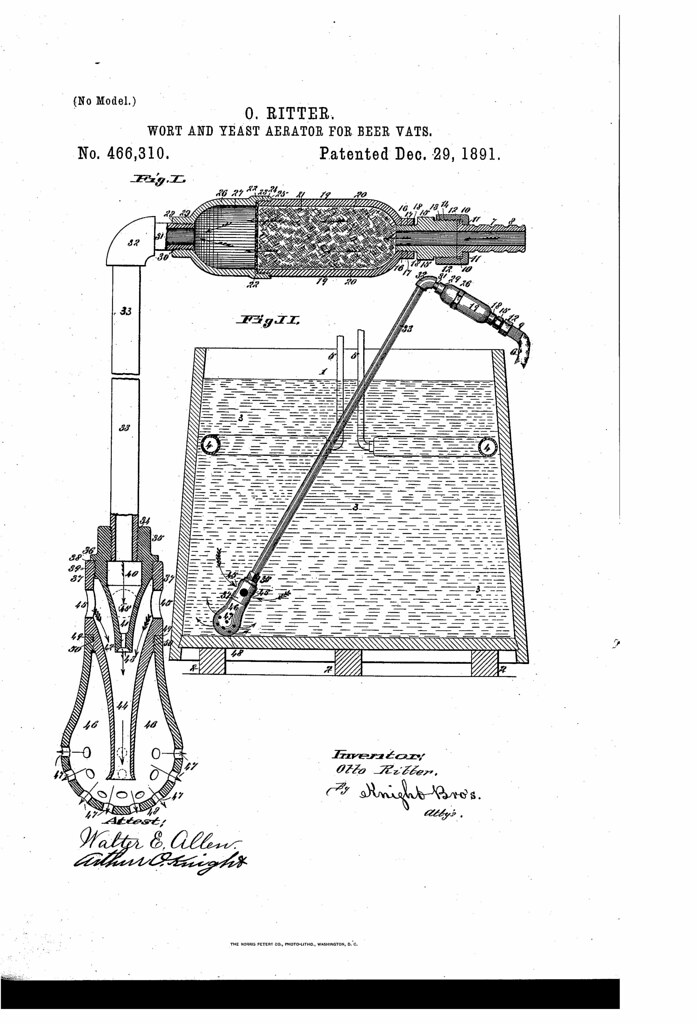
This apparatus is constructed and arranged consists in features of novelty hereinafter fully described, and pointed out in the claims. Figure I isa detail view of the aerator and shows the coupling for the air-hose, the air filter, the bulb-casing of which later forms a handle or hold for the operator, by which he directs the instrument. It also shows the inception filtered air-chamber, the supply air tube, and the compound aerating-bulb; and Fig. II is a vertical section of a brewers fermenting vat and shows the yeast and wort aerator in active operation therein.

US466310-0

Filed Under: Beers, Breweries, Just For Fun, Politics & Law, Related Pleasures Tagged With: Brewing Equipment, History, Law, Patent, Science of Brewing, Wort

Patent No. 3225510A: Article Cartoning Machine

December 28, 2015 By Jay Brooks

patent-logo
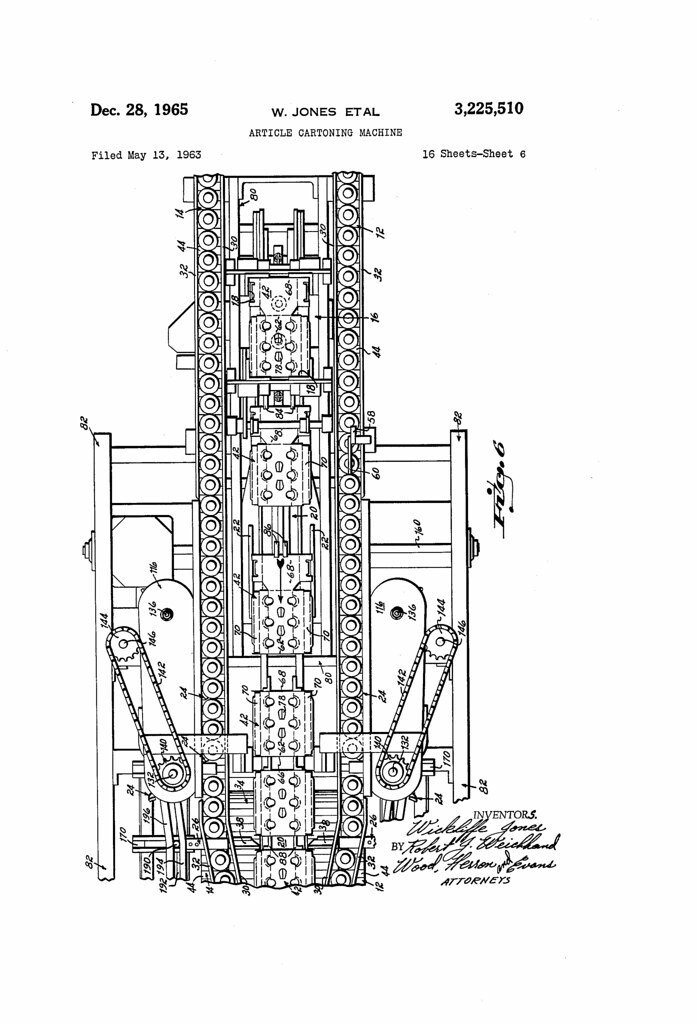
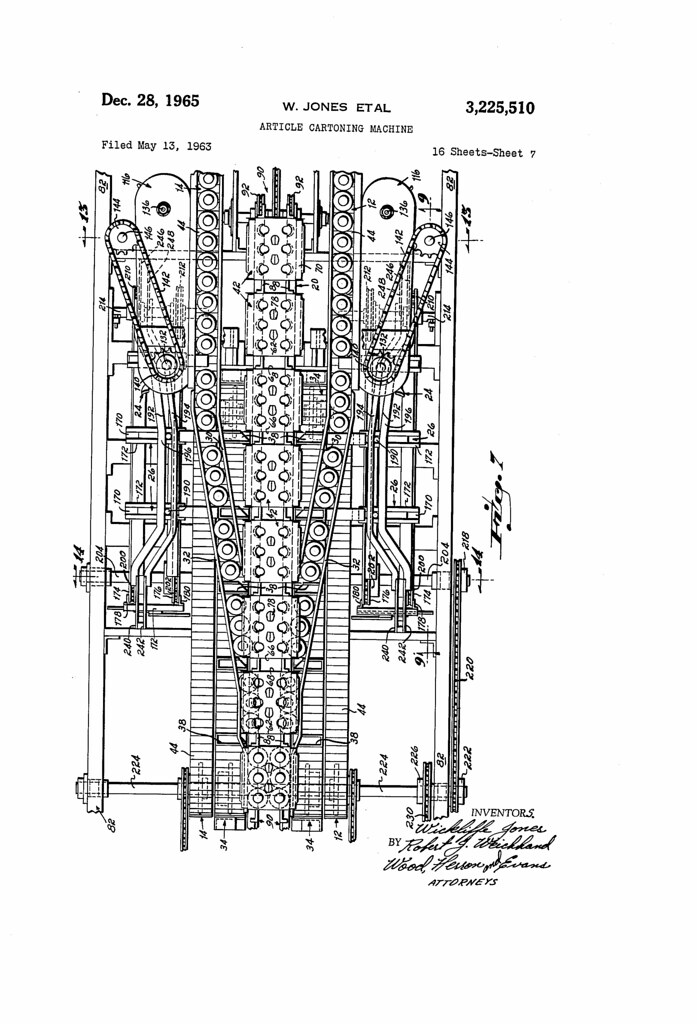
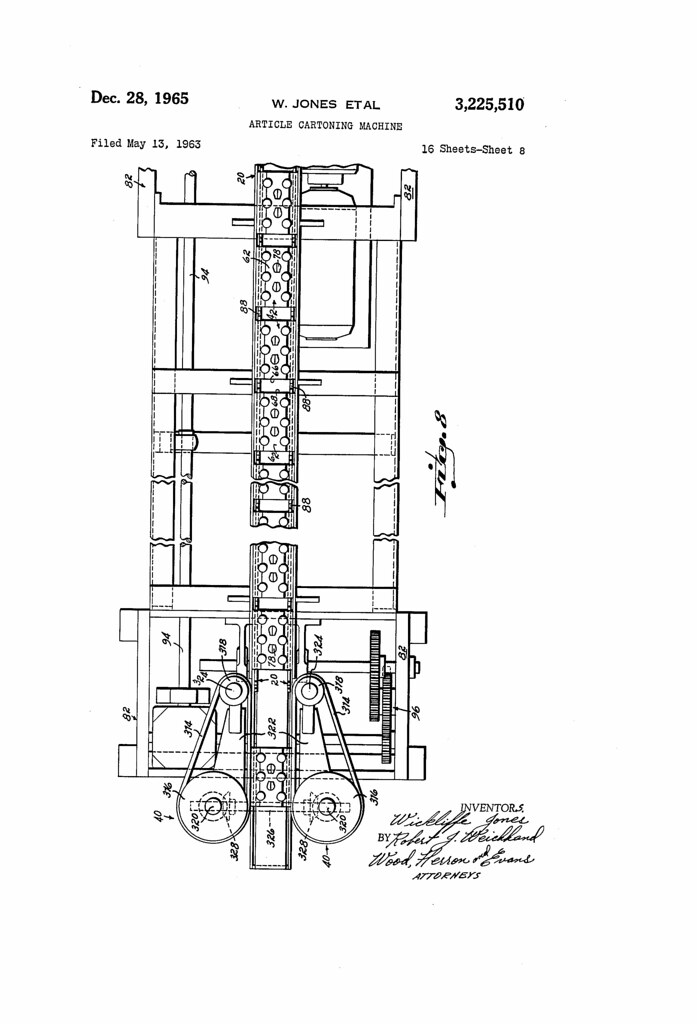
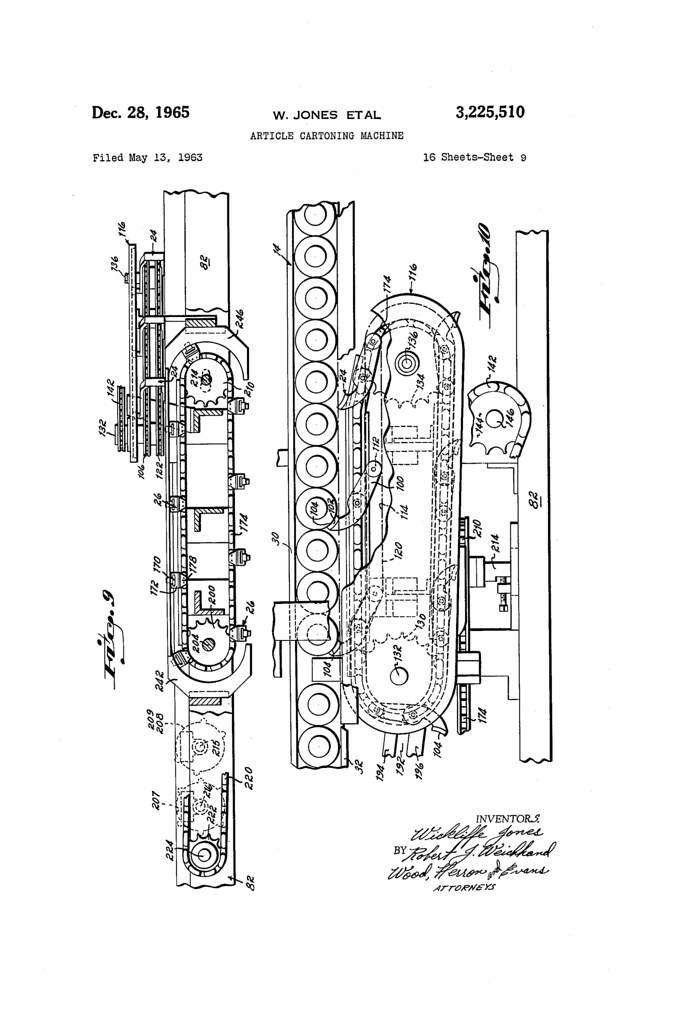
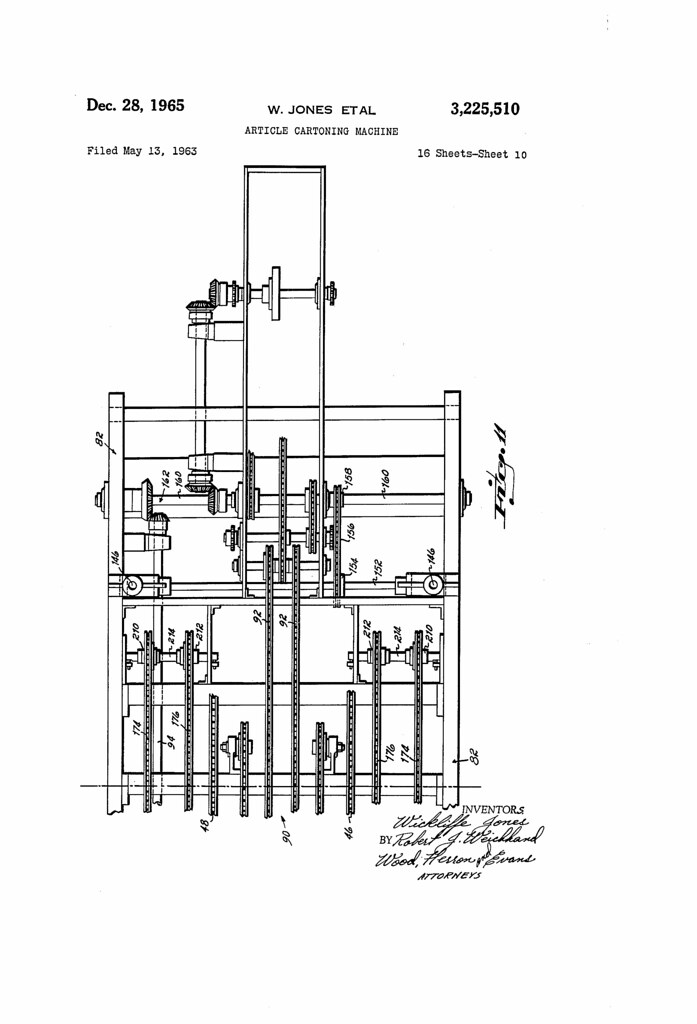
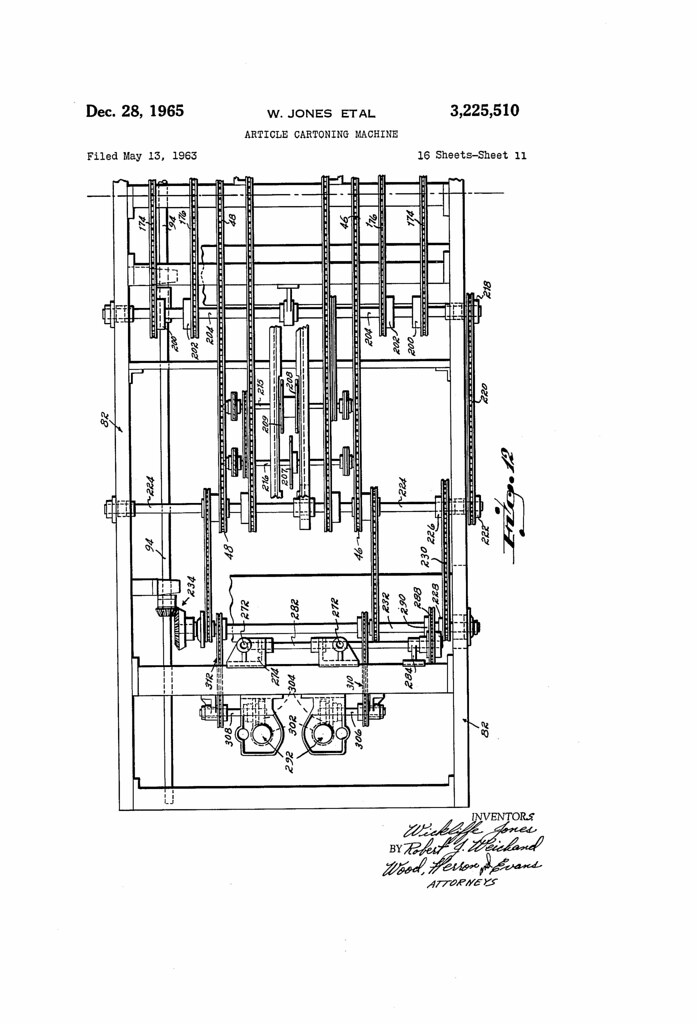
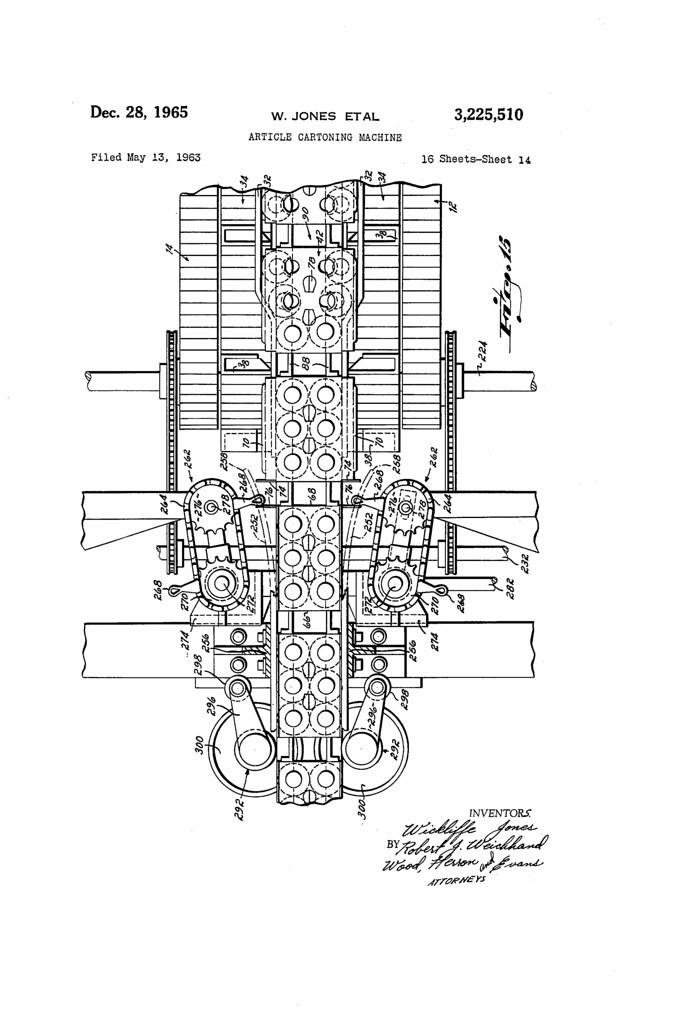
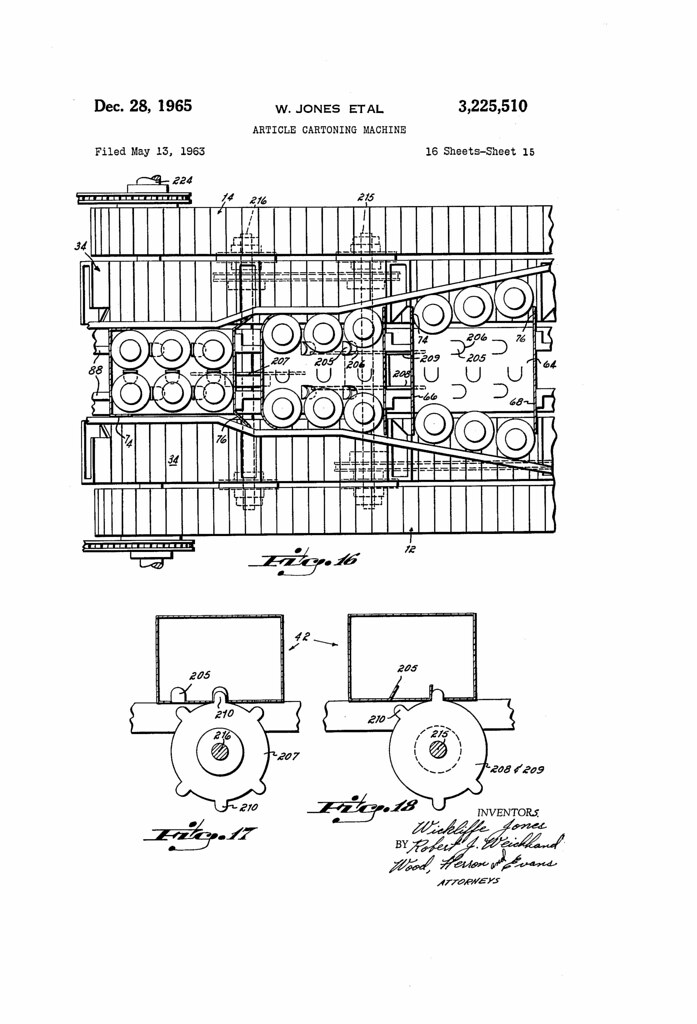
Today in 1965, US Patent 3225510 A was issued, an invention of Robert J. Weichhand and Wickliffe Jones, for their “Article Cartoning Machine.” There’s no Abstract, although in the description it includes this summary:

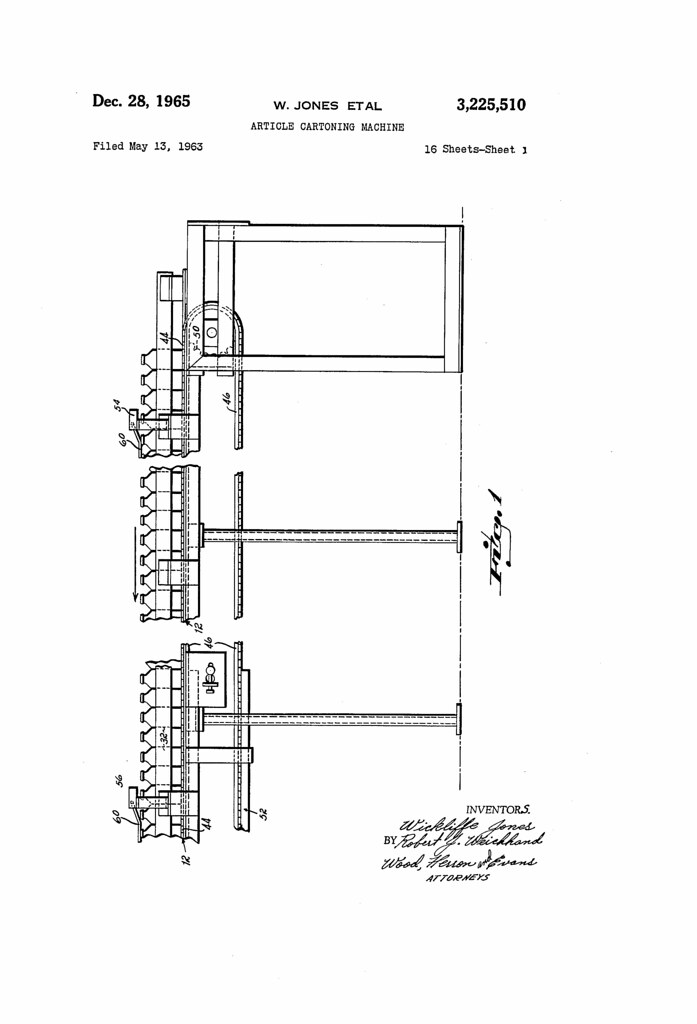
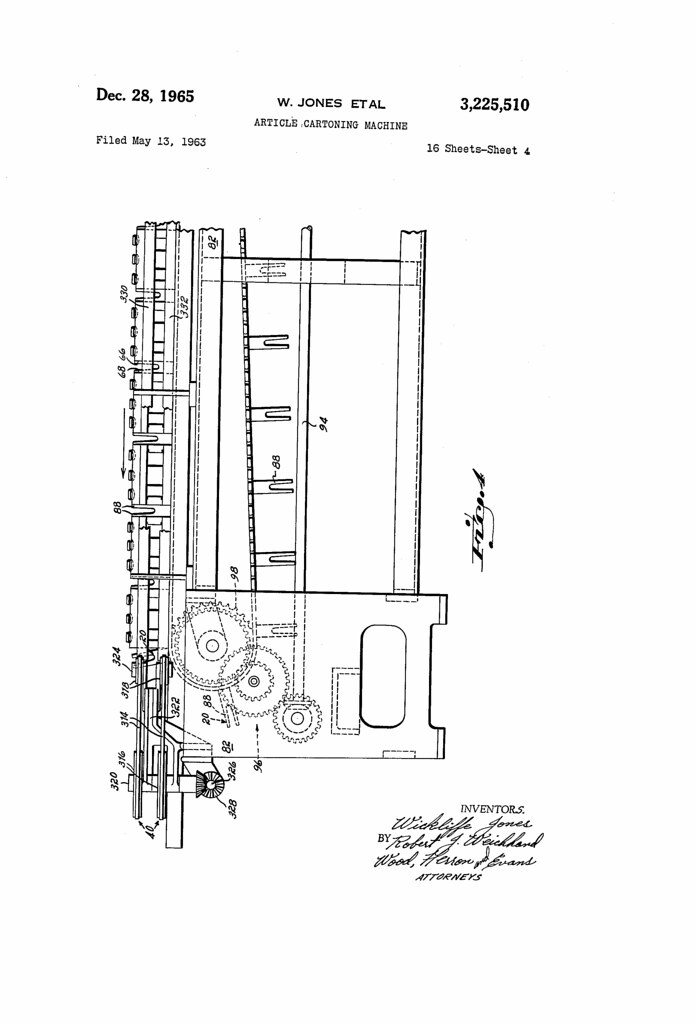
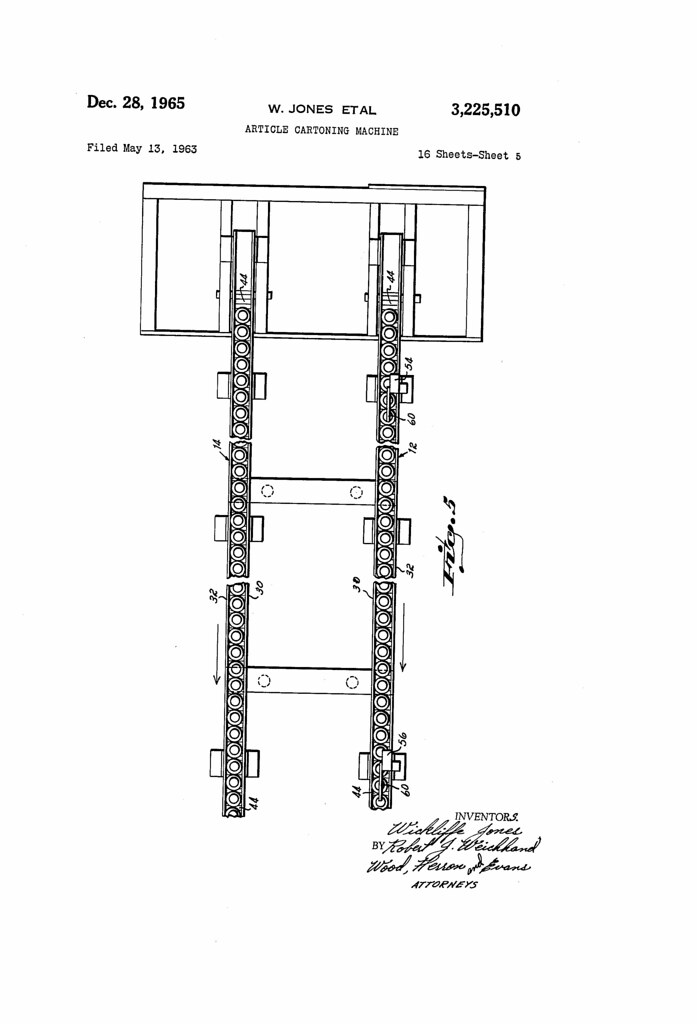
This invention relates to article packaging and more particularly to a machine for packing beer bottles in conventional six-pack or eight-pack cartons.

More specifically, the machine of this invention is intended for packaging beer bottles in cartons which are formed of paperboard material and which are furnished in a fiat collapsed condition. The collapsed cartons are loaded in stacked formation into a magazine, which includes mechanism for withdrawing the collapsed cartons individually from the lower portion of the magazine subsequently to be erected and loaded. In order to obtain the high loading rate, as indicated above, the bottles, which are fed in a continuous stream, are segregated into groups and the groups advanced into the erected carton from opposite ends. After being loaded with the bottles, liquid adhesive is applied to the flaps of the cartons, then the flaps are folded to a closed position and sealed before the loaded cartons are discharged from the machine.

To perfect a cartoning machine which will handle 600 to 1,200 or more bottles per minute and package them in an automatic manner, the bottles must flow in a substantially straight line continuous movement without any stopping or starting. At the rate of movement of this machine, the inertia of stopping the bottle and starting it again or of jerky acceleration and deceleration would break the bottle or at least scar and tear the paper label. It has thus been an object of this invention to provide a bottle cartoning machine which utilizes smooth acceleration and deceleration substantially straight line continuous flow of the bottles to be packaged and which eliminates abrupt impact reciprocating or oscillating elements which might break the bottle or at least scar the labels upon the bottles. It should be understood that while this machine has been described with reference to packaging bottles, it is equally adaptable to packaging other articles. Of course a machine operable to handle fragile glass is capable of handling metal containers such as beer cans.

The machine includes a series of continuous motion conveyor systems for advancing and erecting cartons after they have been withdrawn individually from the magazine. Thus, the first conveyor apparatus receives the carton blank as it is withdrawn from the bottom of the magazine and includes means for handling the flaps which project outwardly from the opposite open ends of the advancing blank. A first stage conveyor apparatus advances the blank toward a main carton transport conveyor and concurrently partially erects the carton. The partially erected carton is then transferred to a main carton conveyor and during transfer is completely erected by con- Patented Dec. 28, 1965 ice tinuously advancing spacer lugs on the main carton transport conveyor. These lugs coact with the first stage conveyor apparatus to completely erect the carton. The spacer lugs of the main carton conveyor confine the carton firmly in its erected condition and advance it toward the bottle loading zone with the several carton flaps extending outwardly to an open position to avoid any interference of the bottles as they are advanced into the open end of the erected carton.

As the erected carton advances to the loading zone, six cans (or eight cans in the case of an eight-pack) are fed laterally from a pair of parallel bottle conveyors into the opposite ends of the carton by stationary converging guide rails. The bottles are segregated into groups of three each (or four in the case of an eight-pack) and fed into the carton. The segregating mechanism consists of restraining fingers which enter in front of every third bottle. These restraining fingers move at a slower rate than the bottle conveyors so that the restraining fingers slow the movement of the bottles. The down stream finger then releases a group of three which move away from the finger or move downstream at a rate determined by the bottle conveyor which is moving faster than the restrained bottles. As soon as the group of three bottles have moved downstream so as to establish a gap between the restrained bottles and the unrestrained ones, spacer fingers enter the gap so as to maintain the spacing between the now grouped bottles. Guide rails then force the group of bottles across a continuously moving bucket conveyor which maintains the spacing of the groups and into the open sides of the cartons. After the bottles are loaded into the carton, liquid adhesive is supplied to the flaps and the flaps are folded to a closed position and sealed as the carton advances toward the discharge end of the machine.

A further objective of the invention has been to provide an improved segregating mechanism for forming articles into groups while advancing the articles toward a packaging zone where the segregated groups are fed transversely into the open end of an advancing carton.

US3225510-0
US3225510-1
US3225510-2
US3225510-3
US3225510-4
US3225510-5
US3225510-6
US3225510-7
US3225510-8
US3225510-9
US3225510-10
US3225510-11
US3225510-12
US3225510-13
US3225510-14

Filed Under: Beers, Breweries, Just For Fun, Politics & Law, Related Pleasures Tagged With: Bottles, Brewing Equipment, History, Law, Packaging, Patent, Science of Brewing

Patent No. 531314A: Process Of And Apparatus For Preparing Beer

December 25, 2015 By Jay Brooks

patent-logo
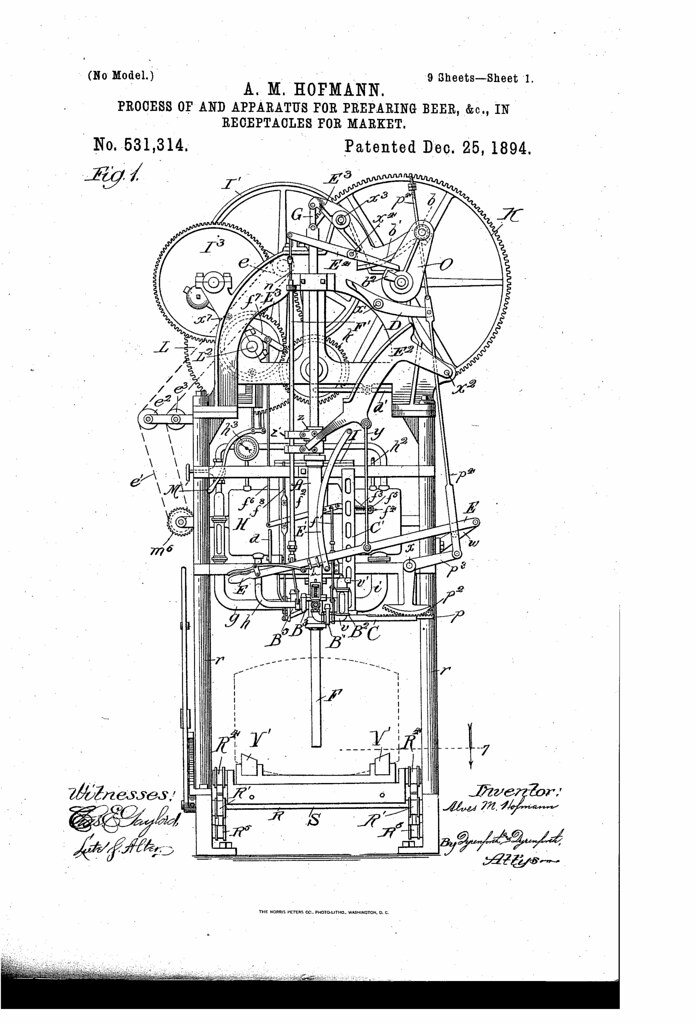
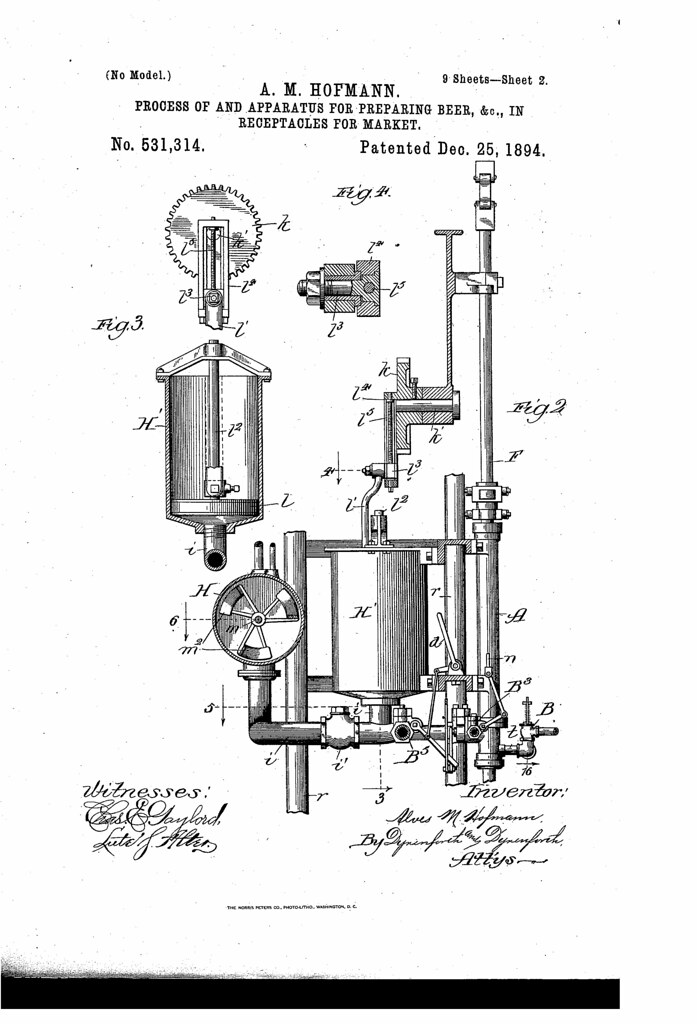
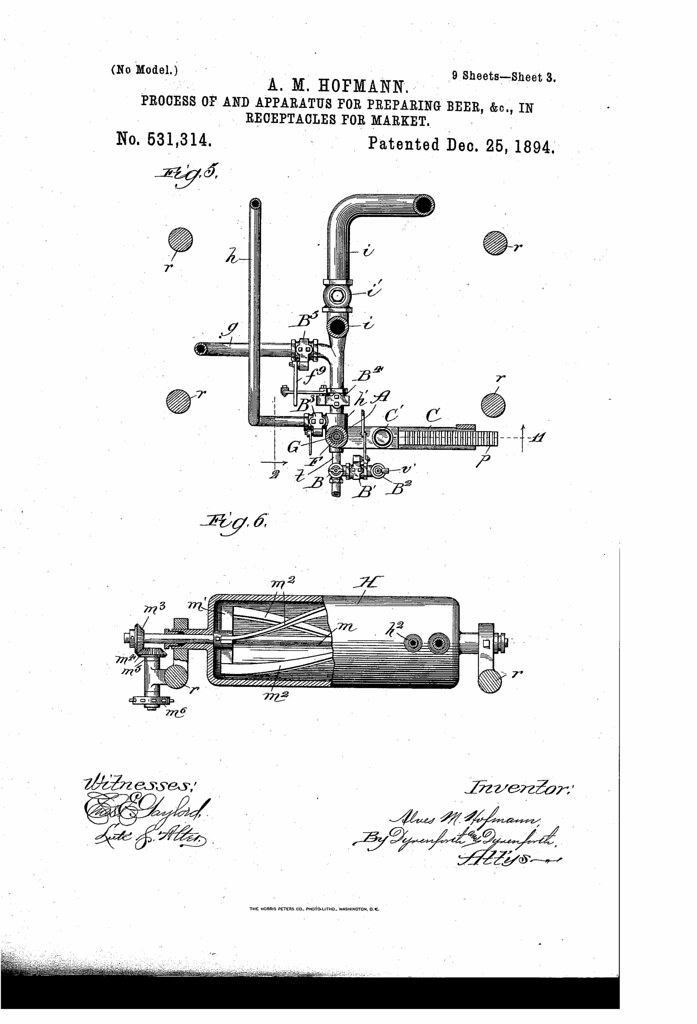
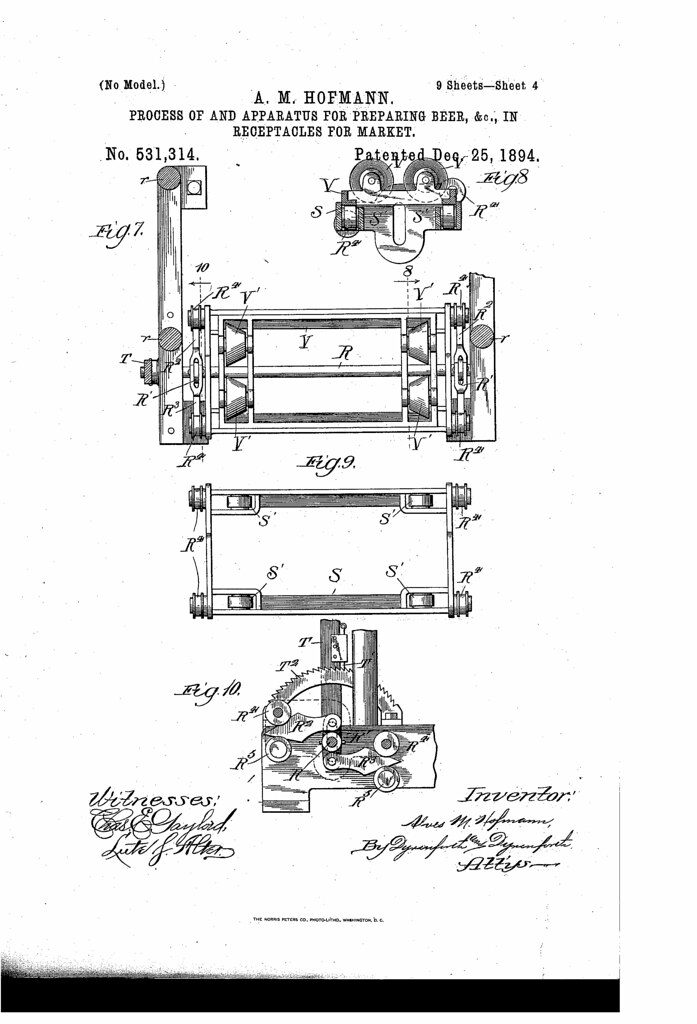
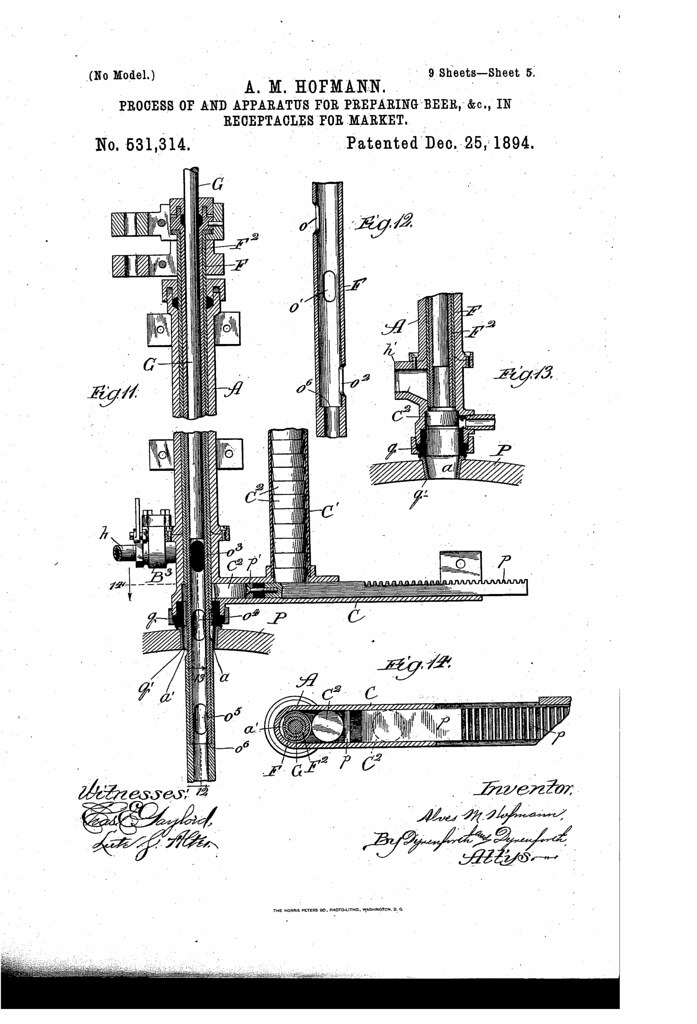
Today in 1894, US Patent 531314 A was issued, an invention of A.M. Hofmann, for his “Process of and Apparatus for Preparing Beer.” There’s no Abstract, although in the description it includes this summary:

It may be stated at the outset that I have primarily designed my improvement for the particular application to beer in barrels or kegs orin bottles, and I therefore, and for the sake of convenience, hereinafter confine the description of my invention in its application to racking, carbonating and bunging beer, though it is also applicable to, and I desire to be understood as intending it for, any and all liquids or beverages requiring similar treatment to prepare them in receptacles for the market.

A known manner of carbonating a beverage to prepare it for the market is to introduce into the holder containing it a liquid (preferably of the same kind) in small quantity proportionately to the quantity contained in the holder, but so highly charged with the gas, for which -,it affords a vehicle and a mixing or incorporating medium, as to supply the contents of the receptacle,and thoroughly impregnate them, with a charge of gas adequate for all requirements in the beverage.

I find that where the carbonating procedure referred to is employed on beer, the diffusion of the gas through the beer in the receptacle, however thoroughly it may be produced, is not lasting where the receptacle is not completely, or at least approximately, filled with the beer to be charged, which it rarely is; since the space left on filled affords, as it were, a pocket, in which the gas tends to accumulate, and whence it quickly escapes on opening or venting the receptacle, leaving the beer, when poured or drawn for consumption, insufficiently carbonated. Incomplete filling of the receptacles is, perhaps, as likely of occurrence where the receptacles are glass bottles as where they are barrels or kegs, notwithstanding that the transparent nature of the former renders the matter of completely filling them readily accomplishable.

My process consists in withdrawing from a .receptacle after filling it with beer (taken by preference directly from the cask) a suitably small proportion of its contents, and replacing the quantity thus withdrawn with an equal, or approximately equal, quantity of liquid highly charged with gas, thereby, practically, withdrawing the desired quantity from the receptacle, then charging it excessively with gas, and returning to the receptacle the same liquid, charged, that was withdrawn from it. Thus, after a receptacle has been completely filled, or substantially so, with the beer to be carbonated, (and complete filling of a barrel or keg is a matter as simple as filling a bottle) by withdrawing ascertain quantity to make room or the charge, and replacing it with an equal or substantially equal quantity of the supercharged carbonating liquid, the desirably full condition of the receptacles is attained.

US531314-0
US531314-1
US531314-2
US531314-3
US531314-4
US531314-7

Filed Under: Beers, Breweries, Just For Fun, Politics & Law, Related Pleasures Tagged With: Brewing Equipment, History, Law, Patent, Science of Brewing

Patent No. 664824A: Cold Air Pressure Apparatus For Beer

December 25, 2015 By Jay Brooks

patent-logo
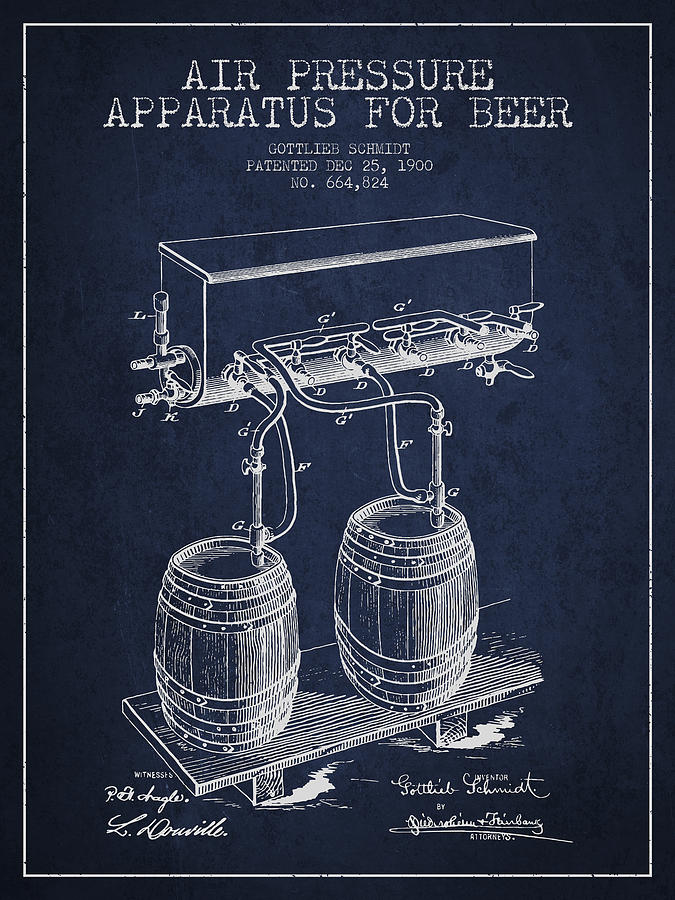
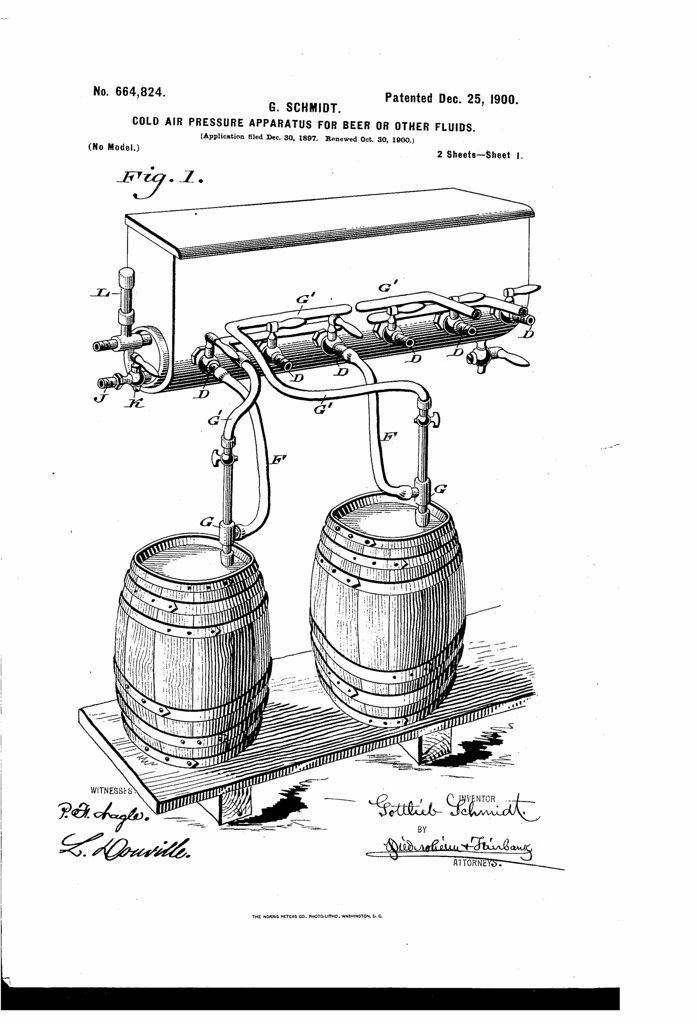
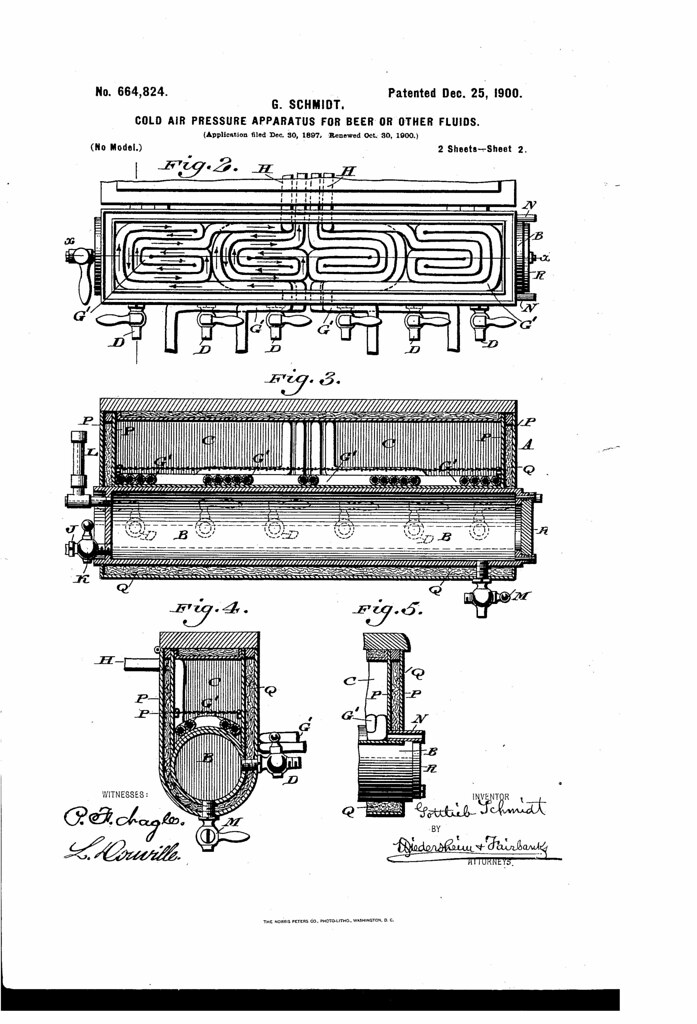
Today in 1900, US Patent 664824 A was issued, an invention of Gottlieb Schmidt, for his “Cold Air Pressure Apparatus For Beer or Other Fluids.” There’s no Abstract, although in the description it includes this summary:

My invention relates to an apparatus involving an air-chamber and a refrigerator adapted more particularly for cooling beer or other fluid, wherein cold air will be directed under pressure to said fluid where it is to be dispensed, the construction and operation of the parts thereof being hereinafter set forth, and the novel features thereof pointed out in the claims.

apparatus-for-beer-patent-from-1900-navy-blue-aged-pixel

And here are the original drawings filed with the application:
US664824-0
US664824-1

Filed Under: Beers, Breweries, Just For Fun, Politics & Law, Related Pleasures Tagged With: Brewing Equipment, History, Law, Patent, Science of Brewing

Patent No. 3418135A: Light-Insensitive Malt Beverage

December 24, 2015 By Jay Brooks

patent-logo
Today in 1968, US Patent 3418135 A was issued, an invention of Peter D. Bayne, assigned to Schlitz Brewing Co., for his “Light-Insensitive Malt Beverage and Process of Producing the Same.” There’s no Abstract, although in the description it includes this summary:

This invention relates to a process of producing a malt beverage such as beer, and more particularly to a process of producing a malt beverage which is insensitive to light.

Malt beverages such as beer and ale are not stable to light. When subjected to light, the beer develops an odor and flavor characterized as skunky. To prevent the development of the sunstruck or skunky odor, beer is generally packaged in colored bottles which minimizes exposure to sunlight. Even though packaged in colored bottles or in cans or kegs, the beer can nevertheless develop the sunstruck odor by virtue of the short exposure to sunlight in drinking glasses.

It has been found that the presence of isohumulones are responsible for the development of the sunstruck odor in beer. The hops, which are boiled with the wort, contain resins and oils which are contained in the lupulin. The resins include the alpha and beta resins, with the alpha resins containing a bitter acid called humulone and the beta resins containing an acid called lupulone. The alpha acids provide the bitter flavor for the beer while the beta acids have low solubility in the Wort and do not appreciably enter into the brewing process.

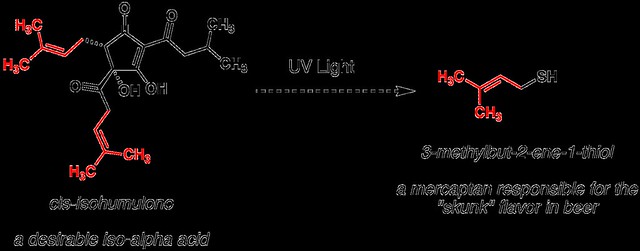
During the brewing-process, the humulone fraction is isomerized to the corresponding isohumulones. The sunstruck odor substance in beer has been identified as a mercaptan,3-Inethyl-2-butene-l-thiol, which is formed by the photolysis of the siX-membered side chain on the isohumulone molecule. The free radical formed by the intervention of sunlight splits Off carbon monoxide, forming the 3-methyl-2-butenyl radical. This product, in turn, reacts with hydrogen sulfide, which is formed from proteins or amino acids by photochemical action, to form 3- methyl-Z-butene-l-thiol. This mercaptan is considered to be the main component of the sunstruck odor in malt beverages.

To prevent the sunstruck odor, it has been proposed to convert a carbonyl group of the isohumulones into a secondary alcohol by reduction. In this reduced form, the molecule becomes insensitive to sunlight and there is no formation of odor on exposure to sunlight. This conversion has been carried out in the past by use of sodium borohydride as disclosed in Patent No. 3,079,262, but the use of sodium borohydride has not been completely successtul in that the reaction is difiicult to control. The contact time between the sodium borohydride and the isohumulone must be accurately controlled in order to effect a complete reduction of the isohumulones In addition, the sodium borohydride is a relatively costly material which adds to the overall cost of the beer.

The present invention is directed to a process for producing a light-insensitive malt beverage by reducing the isohumulones by use of an alkali metal dithionite. More specifically, the process consists of initially extracting ground hops with a solvent, such as hexane. The solvent is then evaporated, leaving a dark resinous oil which is isomerized in a dilute alkaline solution. After the isomerization, the material is neutralized to pH of 6.0 to 7.0 with a mineral acid and the lupulone, wax and chlorophyll are removed by further extractions with a solvent. The aqueous phase is then further acidified to a pH in the range of 1.0 to 2.0 and the isohumulones extracted with a solvent such as diethyl ether. The reduction is then accomplished by contacting the ether-isohumulone extract -with an aqueous solution of sodium dithionite.

After the reduction, the reduced isohumulone extract is separated from the dithionite solution and washed with brine. The ether is then removed by distillation to produce the reduced isohumulone concentrate.

The reduced isohumulone when added to a standard unhopped wort or beer produces a beer which does not develop the characteristic sunstruck odor when subjected to sunlight and at the same time allows precise control of the isohumulone bitterness levels which was hitherto impossible by traditional hopping methods.

isohumulone-degradation1

Filed Under: Beers, Just For Fun, Politics & Law, Related Pleasures Tagged With: History, Hops, Law, Patent, Science of Brewing

« Previous Page
Next Page »

Find Something

Northern California Breweries

Please consider purchasing my latest book, California Breweries North, available from Amazon, or ask for it at your local bookstore.

Recent Comments

  • Ernie Dewing on Historic Beer Birthday: Charles William Bergner 
  • Steve 'Pudgy' De Rose on Historic Beer Birthday: Jacob Schmidt
  • Jay Brooks on Beer Birthday: Bill Owens
  • Steve 'Pudgy' De Rose on Beer Birthday: Charles Finkel
  • Steve 'Pudgy' De Rose on Beer Birthday: Bill Owens

Recent Posts

  • Historic Beer Birthday: Philip Zorn February 21, 2026
  • Historic Beer Birthday: Rudolph J. Schaefer February 21, 2026
  • Beer Birthday: Kate Bernot February 21, 2026
  • Historic Beer Birthday: William J. Lemp February 21, 2026
  • Beer Birthday: Sayre Piotrkowski February 21, 2026

BBB Archives

Feedback

Head Quarter
This site is hosted and maintained by H25Q.dev. Any questions or comments for the webmaster can be directed here.