Brookston Beer Bulletin

Jay R. Brooks on Beer

  • Home
  • About
  • Editorial
  • Birthdays
  • Art & Beer

Socialize

  • Dribbble
  • Email
  • Facebook
  • Flickr
  • GitHub
  • Instagram
  • LinkedIn
  • Pinterest
  • RSS
  • Twitter
  • YouTube

Powered by Genesis

The Incredible Beerable Egg

April 19, 2015 By Jay Brooks

egg
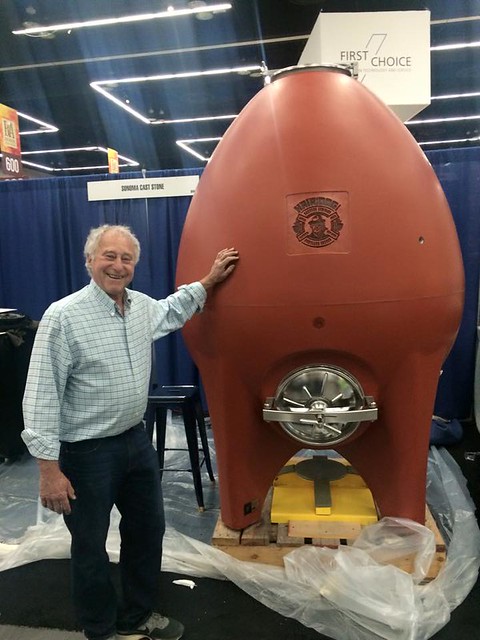
One of the highlights of this years Craft Brewers Conference in Portland was a potential innovation in brewing undertaken by Alan Sprints at Hair of the Dog Brewing. Alan posted a picture of his newest fermenter arriving to be displayed at the trade show, with Steve Rosenblatt from Sonoma Cast Stone, who manufactured the concrete fermenter.
egg-arrives

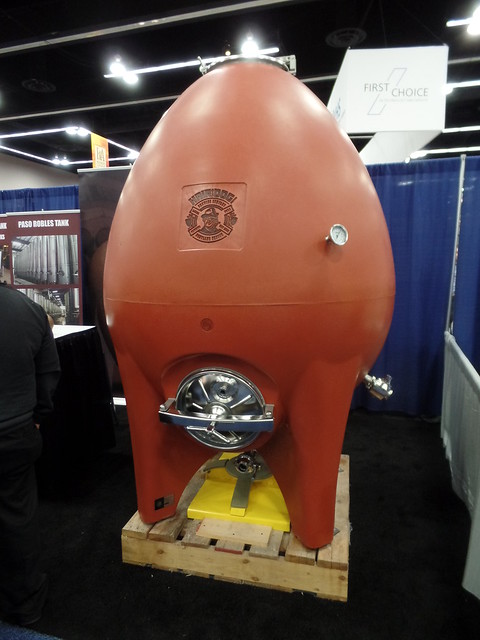
I was immediately intrigued and finding it in the trade show was one of my first missions of CBC. It turns out it was made in Petaluma, which is just down the road from where I live. The company has been making concrete fermenters for the wine industry, but this is the first one they’ve made for a commercial brewer. They have a separate website for this part of their business, Concrete Beer Tanks.
SAM_0428

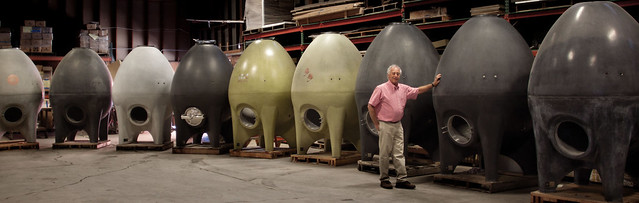
There’s two sizes, the Amphora, which is 320 gallons and the one Hair of the Dog ordered, which is the Egg Shape, which is 476 gallons (or just over 15 barrels).
egg-wide

Their brochure lists the benefits of a concrete fermenter:

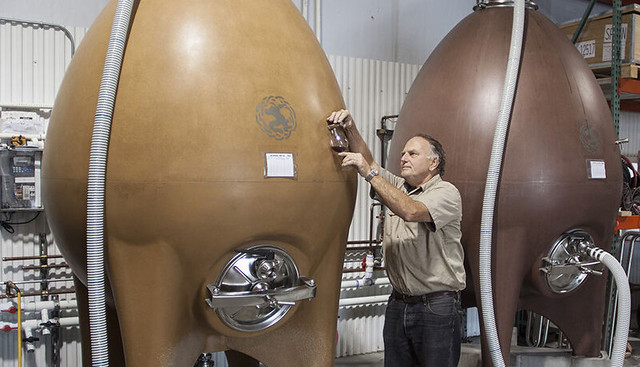
  • Concrete has natural temperature stability, and our tanks offer an optional, embedded glycol system for precise control.
  • Concrete allows the design of organic shapes, promoting convectional fermentation flow with no corners for fluid to pocket or stagnate.
  • The porosity of concrete allows for micro-oxygenation to aid in initiating the fermentation process.
egg-1

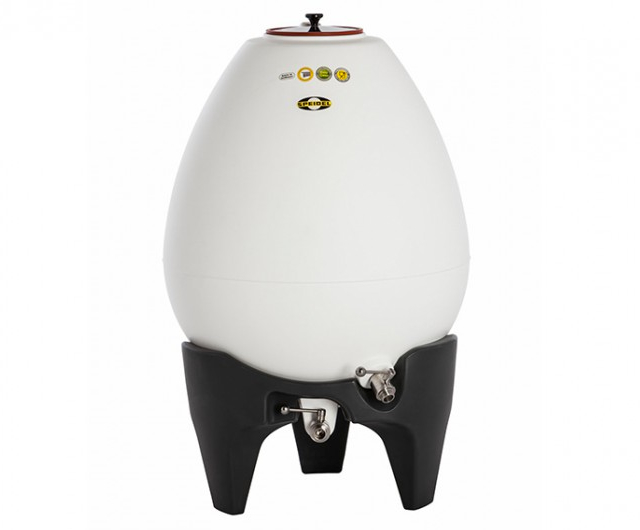
Apparently the wine industry has been using these increasingly in recent years, but they have been used for centuries prior to the advent of stainless steel. Just a quick search reveals quite a few articles about their growing use in winemaking. For example, in Wine Spectator, Wine Enthusiast, Wines and Vines, Seattle Magazine and the North Bay Business Journal. And there’s at least one other domestic manufacturer, Vino Vessel and a German company, Speidel, that makes a Gärei Fermentegg, or Fermentation Egg.
gaerei

Here’s how Speidel describes their fermentation egg:

The organic fermentation in the egg-form is based on the golden ratio without corners and edges. Wine, beer and cider could move fluently during the fermentation and storage. This gentle process guarantees on keeping the completely development of the product. The idea of fermentation or aging in the egg is just to come back to the ancient methods but with the new materials. Already in the ancient times beer has been placed for resting into the egg-formed amphoraes. Recently there were several successful tests for storage wine in the egg-formed fermentation vessels made of concrete. Shortly after Speidel has developed the fermentation egg made of food-safe polyethylene.

The fermentation egg is appropriate for the fermentation of wine, beer and cider. Fans and devotees of the fermentation egg confirm that the fermentation process runs spontaneous, therefore wine and beer taste more filigree and complex. Check it out and convince yourselves! Our food-safe polyethylenes have high permeability of oxygen. This ensures the evenly influence of oxygen and perfect conditions for the fermentation and maturation. It is very easy to clean the egg because of its smooth surface inside.

Here’s a drawing of the tank.
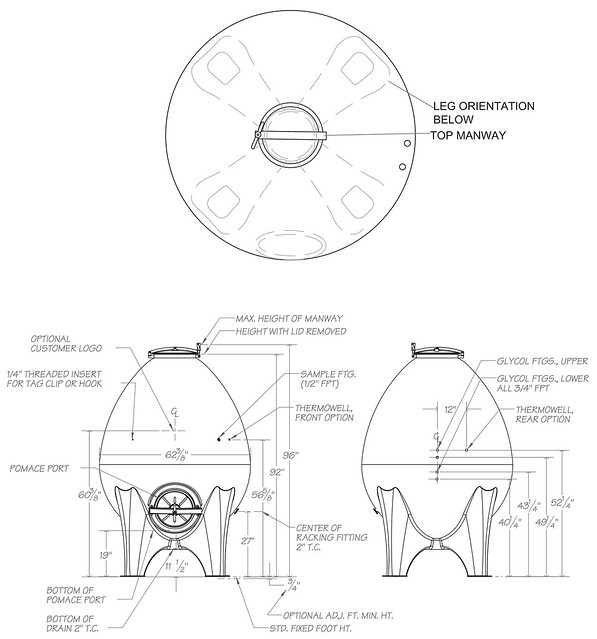
egg-tank-specs

Sonoma Cast Stone online has their reasons why brewers should consider concrete beer tanks:

Winemakers love concrete…

Winemakers all over the world are rediscovering the benefits of using concrete as a medium for fermentation, finding the virtues of both of oak and stainless steel with the drawbacks of neither. Now, most of the world’s highest-rated wines are made in concrete.

The craft beer industry is at least as creative and dynamic as the wine industry, and we at Sonoma Cast Stone are thrilled to offer you artisans of fermentation a new medium to create with. We predict a renaissance of innovation, producing an exciting, new generation of wild beers, sour beers, meads and porters.

Concrete is cool! No… really.

Concrete can take the heat, or the cold. It’s a natural insulator and will stabilize the temperature of whatever is inside of it. This stability makes for a smooth and gradual fermentation, because there are no temperature spikes to make the yeast become aggressive.

Sonoma Cast Stone also offers a unique temperature control system. Our system is hidden within the walls of the tank itself and does not make contact with that wine.

Just breathe!

Concrete is porous, albeit on a microscopic scale, and that’s where it beats stainless steel. The environment in stainless steel is too perfect to be ideal for fermentation. A gradual introduction of micro-oxygenation, the wine remains flat. It cannot breathe and evolve.

Wine fermented in concrete has the round mouthfeel of wine fermented in oak, but it has much greater purity of fruit flavor, even a greater intensity of fruit color. For fermentation, storage or aging, concrete is simply phenomenal.

Staying neutral…

Even neutral oak is not neutral. All oak will give a bit of itself to your beer, whether you like it or not. Concrete makes for a truly neutral vessel, imparting only a slight and desirable minerality.

What this means for a beer maker is control. Control over what your beer tastes like, and with the optional, embedded glycol tubing system, you also have precise control over the temperature you maintain throughout fermentation.

Hair of the Dog Brewing had their new concrete tank delivered yesterday and it should be installed and ready to go shortly. Alan told me that Adam will be the first beer he makes in concrete. It will be interesting to see how the new Adam tastes, especially in comparison to the old version.
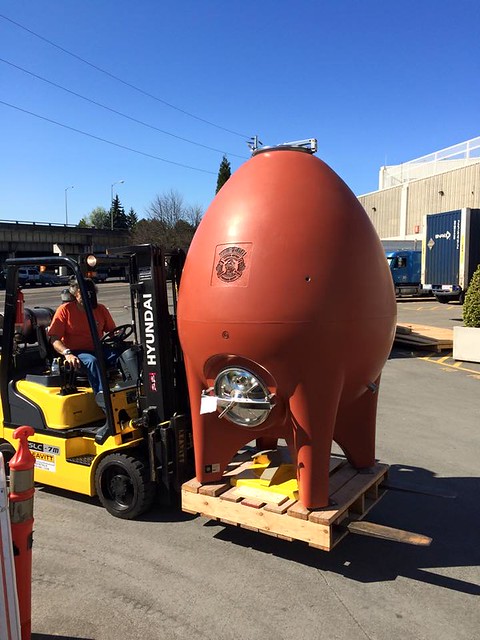
egg-delivered

Filed Under: Beers, Breweries, Just For Fun, News, Related Pleasures Tagged With: Brewing Equipment, Science of Brewing

Patent No. 256550A: Cooling Beer

April 18, 2015 By Jay Brooks

patent-logo
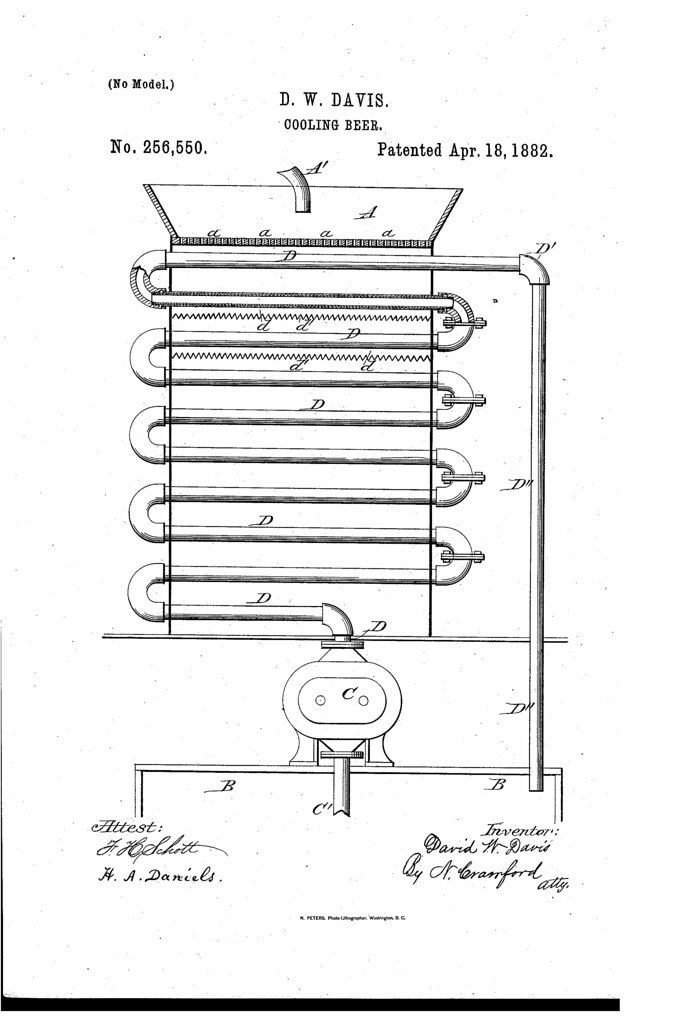
Today in 1882, US Patent 256550 A was issued, an invention of David W. Davis, for his “Cooling Beer.” There’s no Abstract, but in the description states the following:

My invention consists in a new process ot cooling beer, which process can be applied to most of the devices in use for that purpose, und especially to that class of coolers known as the Baudelot Cooler, and the process is produced by the device that will be fully hercinafter described.

US256550-0

Filed Under: Breweries, Just For Fun, Politics & Law, Related Pleasures Tagged With: Brewing Equipment, History, Law, Patent, Science of Brewing

Patent No. 580536A: Process Of And Apparatus For Finishing Beer

April 13, 2015 By Jay Brooks

patent-logo
Today in 1897, US Patent 580536 A was issued, an invention of Jacob F. Tiieurer and Paul Fischer, assigned to The Pabst Brewing Company, for their “Process of and Apparatus for Finishing Beer.” There’s no Abstract, but the description says simply it’s an “invention which will enable others skilled in the art to which it pertains to make and use the same, reference being had to the accompanying drawing, and to the letters of reference marked thereon, which forms a part of this specification. The main object of our invention is to finish beer and other beverages in such a way as to give them the desired freshness, vivacity, and keeping qualities, and in the attainment of that object to economize space and time and to produce a superior article.”
US580536-0

Filed Under: Beers, Breweries, Just For Fun, Politics & Law, Related Pleasures Tagged With: Brewing Equipment, History, Law, Patent, Science of Brewing

Patent No. 989546A: Bottle-Filling Machine

April 11, 2015 By Jay Brooks

patent-logo
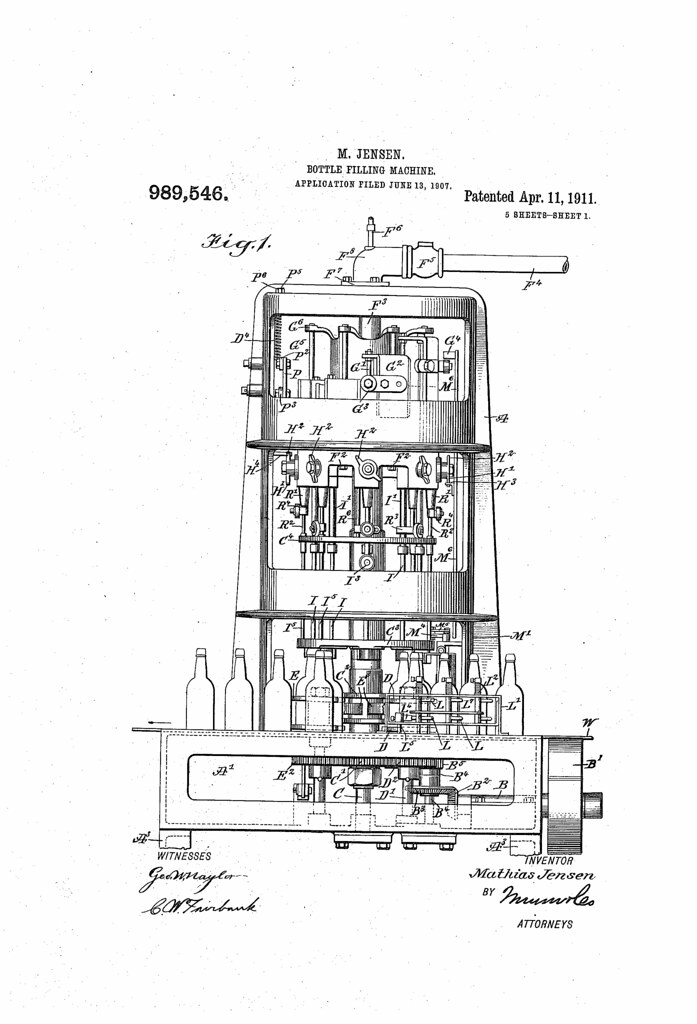
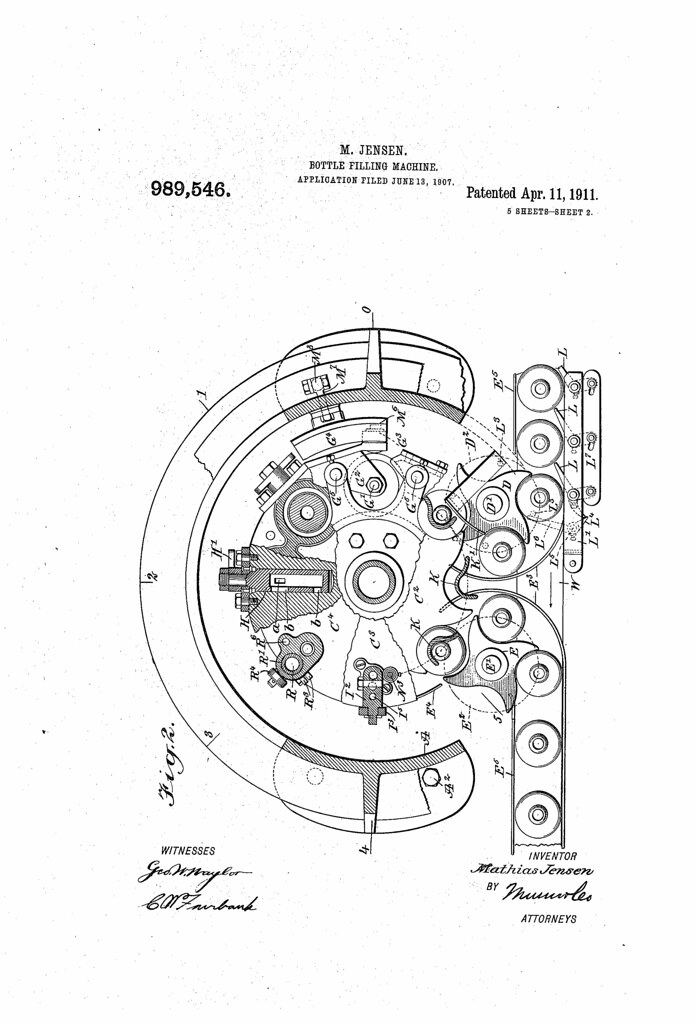
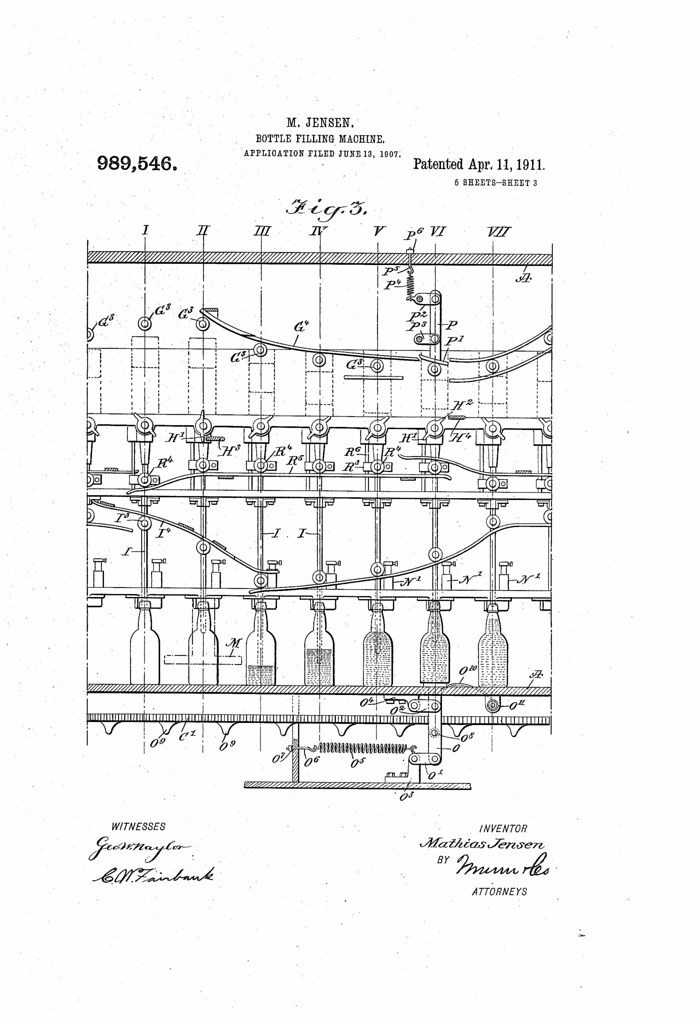
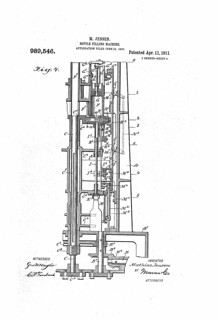
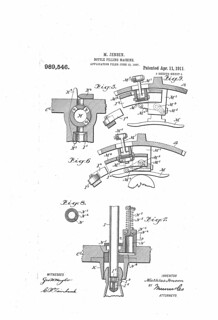
Today in 1911, US Patent 989546 A was issued, an invention of Mathias Jensen, for his “Bottle-Filling Machine.” There’s no Abstract, but there’s this description. “invented a new and Improved Bottle-Filling Machine, of which the following is a full, clear, and exact description.”

This invention relates to certain improvements in machines for filling bottles, cans, or other containers with liquid or semi-liquid` substances, and more particularly to that type of machine in which a series of empty containers are continuously delivered to the machine, automatically filled in succession, and continuously delivered thereof. In a filling machine embodying all of the various features of my invention, the containers are conveyed along an endless belt to the machine and the latter operates to remove them from the belt, fill them in succession, and return them to the belt. The machine is so constructed that after filling each bottle, the liquid is removed from the bottle to a predetermined level below the mouth thereof, irrespective of slight variations in the height of successive bottles.

US989546-0
US989546-1
US989546-2

US989546-3 US989546-4

Filed Under: Beers, Breweries, Just For Fun, Politics & Law, Related Pleasures Tagged With: Brewing Equipment, History, Law, Patent, Science of Brewing

Patent No. 4915959A: Decarboxylation Of Acetolactate To Diacetyl, Enzymatic Reduction To Acetoin

April 10, 2015 By Jay Brooks

patent-logo
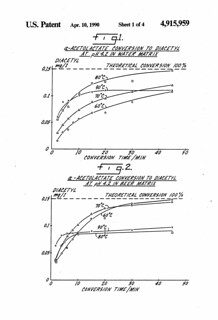
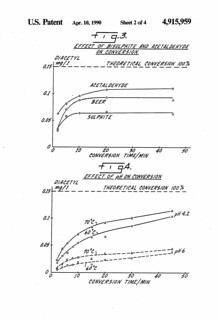
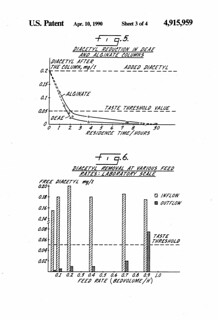
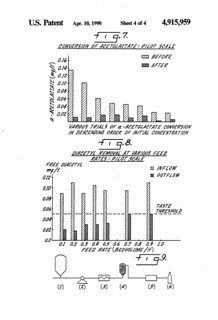
Today in 1990, US Patent 4915959 A was issued, an invention of Esko Pajunen, Veijo Makinen, Heikki O. Lommi, and Markku S. Loisa, for their “Method for the Continuous Maturation of Fermented Beer” or the “Decarboxylation of Acetolactate to Diacetyl, Enzymatic Reduction to Acetoin.” Here’s the Abstract:

Beer is fermented by the use of yeast and after fermentation the yeast is removed and the maturation or lagering of the beer is accomplished by a continuous maturation process which involves heat treating the beer to convert all or substantially all the alpha acetolactate and other diacetyl precursors present to diacetyl, cooling the beer, and feeding the heat treated fermented beer through a reaction column packed with immobilized yeast cells at a flow rate which effects the conversion of said diacetyl to acetoin in order to lower the concentration of said diacetyl to levels which do not result in tastes normally considered unacceptable for a beer.

US4915959-1 US4915959-2

US4915959-3 US4915959-4

Filed Under: Beers, Breweries, Just For Fun, Politics & Law, Related Pleasures Tagged With: History, Law, Patent, Science of Brewing

Patent No. 4197321A: Process For Brewing Beer And Treating Spent Grains

April 8, 2015 By Jay Brooks

patent-logo
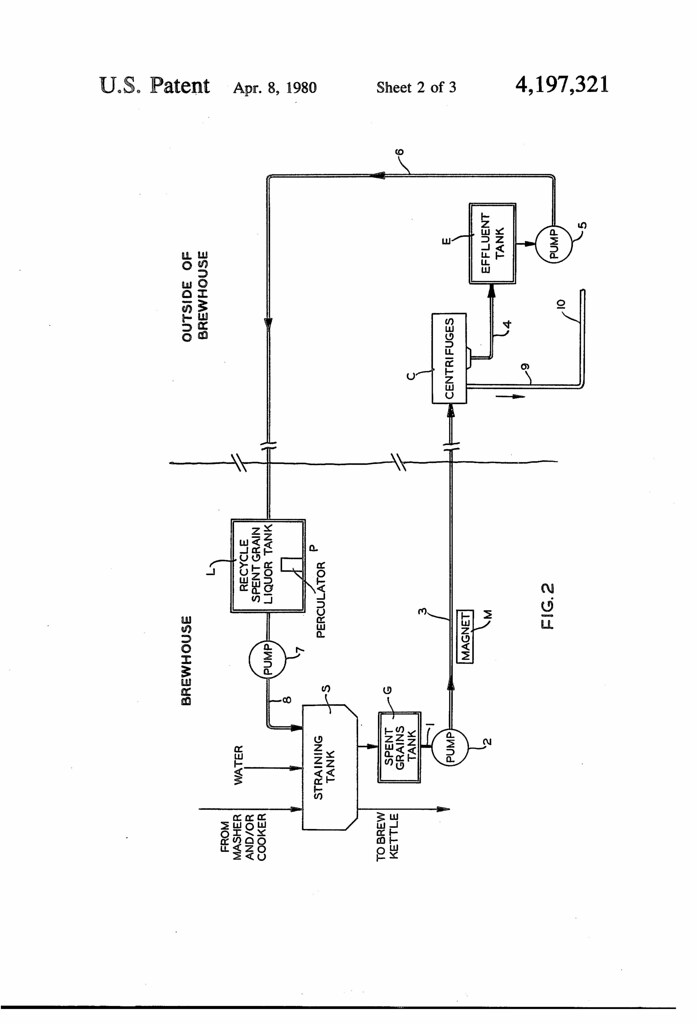
Today in 1980, US Patent 4197321 A was issued, an invention of Gustav W. Chyba and John H. Dokos, assigned to Anheuser-Busch, Incorporated, for their “Process for Brewing Beer and Treating Spent Grains.” Here’s the Abstract:

In the brewing of beer, spent grain at about 90% moisture from a straining tank having no internal rotating rake is collected and pumped to a centrifuge which reduces the moisture of the spent grain to about 70% and provides spent grain liquor of about 2.0 to 4.5% or more of total solids. The spent grain liquor is stored in a tank at 165° F. to 170° F. and held until it is used up to 50% of the sparge liquid for a subsequent brew in the straining tank. The spent grains at about 70% moisture are directed to a large holding tank. Nutritious brewery waste streams are added thereby increasing the nutritional value.

US4197321-1
US4197321-2
US4197321-2

Filed Under: Beers, Breweries, Just For Fun, Politics & Law, Related Pleasures Tagged With: Brewing Equipment, History, Law, Patent, Science of Brewing

Patent No. 3128188A: Beer Lagering Process

April 7, 2015 By Jay Brooks

patent-logo
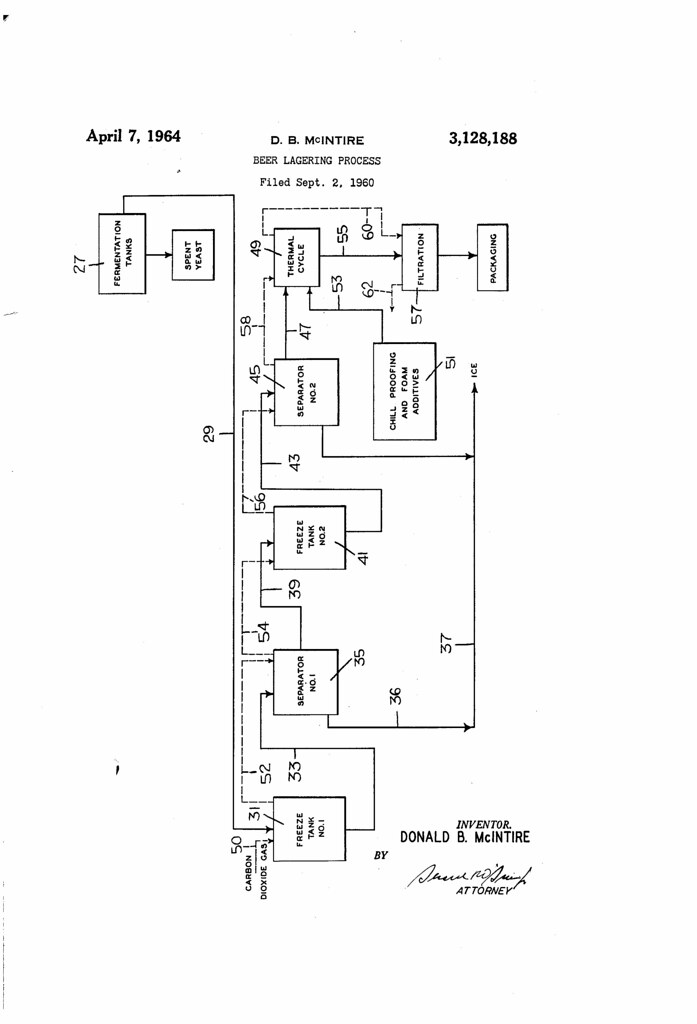
Today in 1964, US Patent 3128188 A was issued, an invention of Donald B. McIntire, assigned to the Union Carbide Corp., for his “Beer Lagering Process.” There’s no Abstract, but here’s how it’s described. “The main object of the present invention to provide a process for producing lagered beer without storing the beer.” I think what I’m most curious about is what interest a company like Union Carbide would have in holding a patent for making lager beer? The process is described in great detail as the description continues.

In accordance with the present invention, there is provided a process for lagering ruh beer comprising freezing water from the ruh beer so as to produce a slurry of concentrated beer, ice, and other solids; and removing the ice and other solids from the concentrated beer, while maintaining the beer in a substantially inert atmosphere throughout all process steps. Thus, the inventive process produces concentrated, lagered beer by freeze concentrating ruh beer.

Another novel and important feature of the present invention resides in the removal of calcium oxalate from the lagered beer product. Calcium oxalate is usually formed during normal brewing processes, and it is well established in the brewing literature that this compound is an extremely undesirable constituent of conventional beer. The oxalate normally plates out in processing tanks and lines, forming beer stone and resulting in a complex cleaning problem. Calcium oxalate also contributes to haze and offensive avors in beer and is generally considered to contribute to the highly undesirable phenomenon known as gushing Oxalates are also undesirable from a nutritional standpoint, since an excess of oxalates in the body is one factor which reduces the absorption of calcium from the intestine. While conventional beer always contains a substantial portion of oxalate, both the lagered beer concentrate formed by the present invention and the reconstituted product contain negligible amounts of oxalate because the calcium oxalate is precipitated out during the freezing step, and then subsequently removed from the concentrated beer along with the ice and other solids. Thus, not only is the expensive and time-consuming storage process eliminated by the inventive process, but the quality of the final product is unexpectedly and significantly improved.

In addition to, and possibly as a result of, the removal of calcium oxalate, the process of the present invention improves the flavor and haze stability of the resultant beer product. Indeed, beer produced by diluting the novel 3,128,188 Patented Apr. 7, 1964 ICC l concentrate ‘appears to be superior in flavor and clarity not only to other reconstituted concentrates, but also to fresh, high-quality draft beer, even though the concentrate and/or the reconstituted product may be as much as a year old. Because of its inherent bacteriological stability, the stabilized beer concentrate may be stored for long periods without the deterioration in flavor, clarity, and uniformity which conventional lagered beer, even when pasteurized, always suffers.

Although the inventive process can theoretically be used to produce lagered beer of any desired concentration, concentration above about five-fold, i.e., a concentrate possessing one-fifth the volume of the beer as originally fermented, usually results in deterioration of the desirable qualities of the product. Accordingly, less than five-fold volume concentrations are deemed preferable.

US3128188-0

Filed Under: Beers, Breweries, Just For Fun, Politics & Law, Related Pleasures Tagged With: Brewing Equipment, History, Law, Patent, Science of Brewing

Patent No. 1092538A: Beer And Hops Separator

April 7, 2015 By Jay Brooks

patent-logo
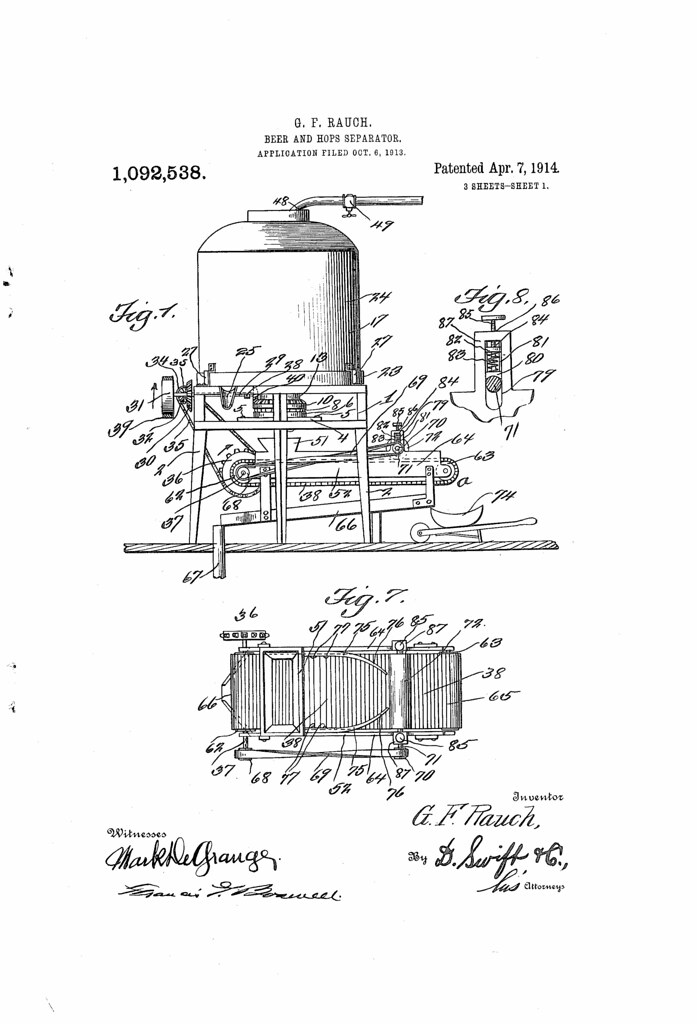
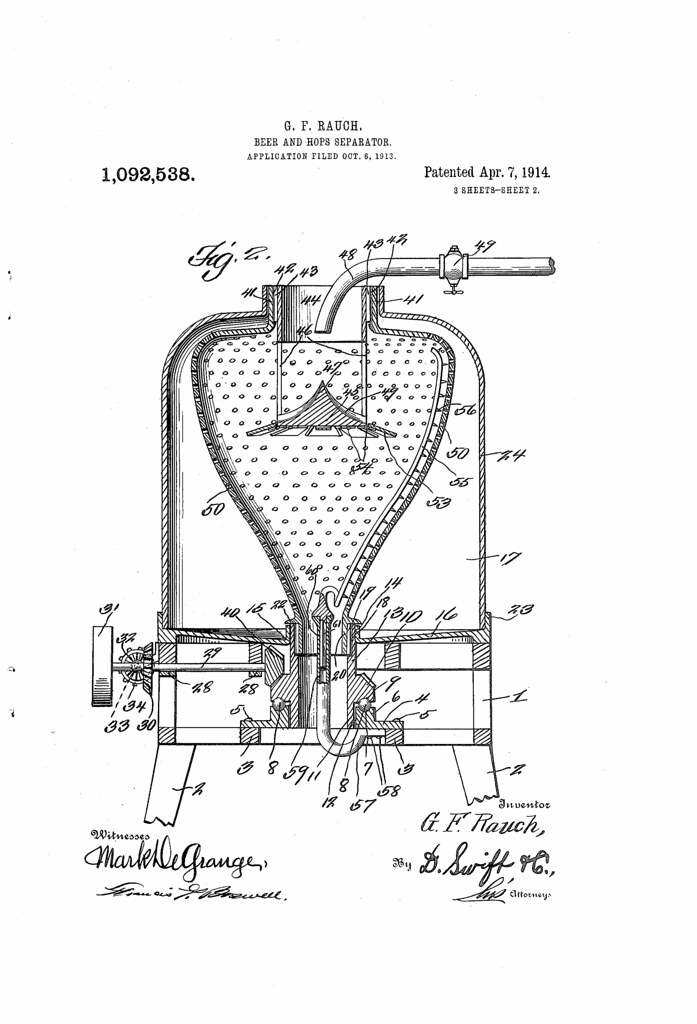
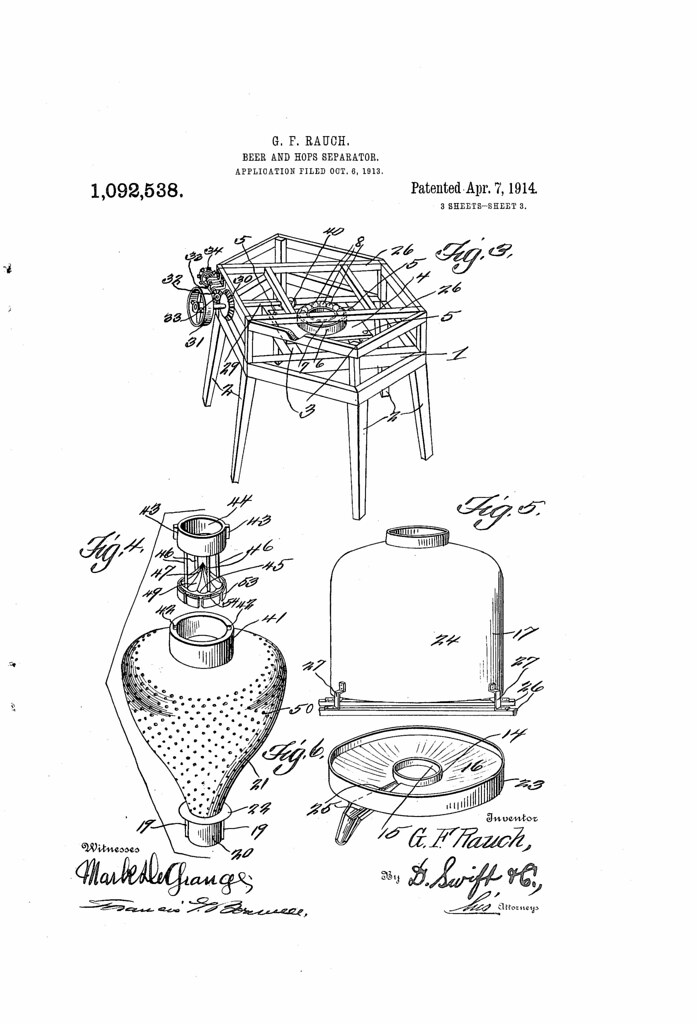
Today in 1914, US Patent 1092538 A was issued, an invention of George F. Rauch, for his “Beer and Hops Separator.” There’s no Abstract, but here’s how it’s described. “This invention relates to the art of brewing, and particularly to a new and useful separator, for separating the beer and hops.” Apparently it has several features:

One of the features of the invention is the provision of a receptacle in which a revoluble pear-shaped screen is, mounted, having a distributor or splasher for swirling or splashing the fluid or combination of beer and hops against the inner circumference of the pear-shaped screen.

Another feature of the invention is the provision of a plurality of agitator wings carried by the distributer or splasher, which wings owing to the centrifugal force swing outwardly, so as to splash the fluid or combination of hops and beer against the inner circumference of the pear shaped revoluble screen, the beer passing through the perforations of the screen, while the hops pass centrally down through the screen.

Another feature of the invention is the provision of a stationaryv supported rake pear-shaped or conical screen, to prevent the hops from adhering or clinging to the inner circumference of the pear-shaped screen. In other words. the hops that may hang to the inner surface of the creen are raked or combed ofi as the screen revolves.

The beer that percolates through the perforations of the pear-shaped screen deposits and is carried oil by a spout. The hops pass centrally down through the screen.

Another feature of the invention is the provision of a conveyor disposed beneath the outlet of the screen to receive the hops, which are conveyed to and under a yieldably mounted pressure roller, so as to squeeze any further beer that may remain with the hops as they leave the screen.

US1092538-0
US1092538-1
US1092538-2

Filed Under: Beers, Breweries, Just For Fun, Politics & Law, Related Pleasures Tagged With: Brewing Equipment, History, Hops, Law, Patent, Science of Brewing

Patent No. 917019A: Apparatus For Mixing Liquids With Gases

April 6, 2015 By Jay Brooks

patent-logo
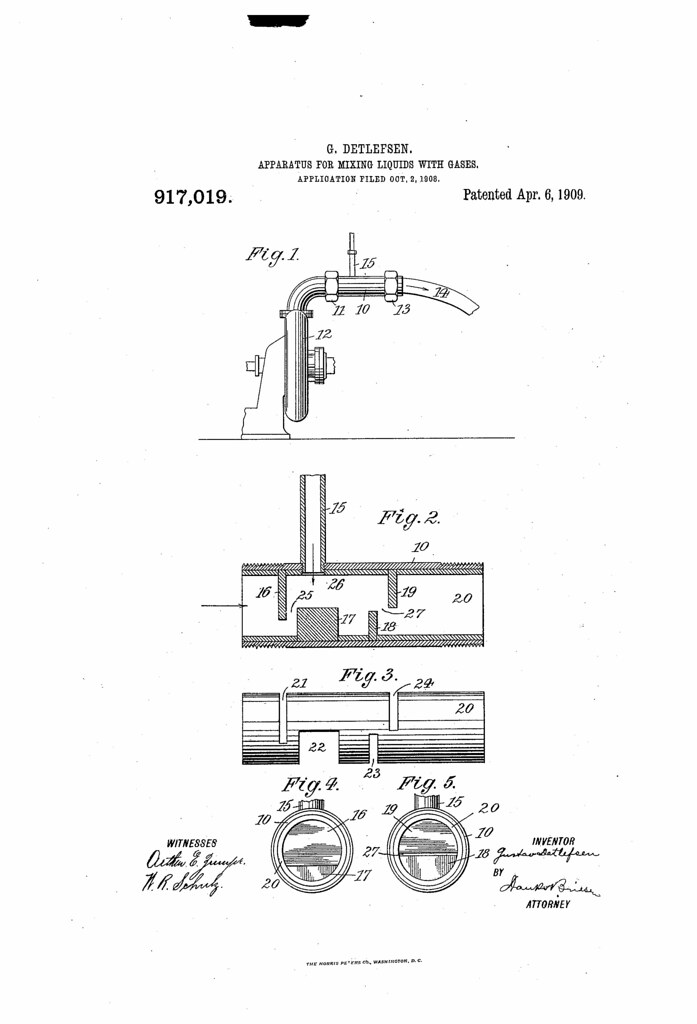
Today in 1909, US Patent 917019 A was issued, an invention of Gustav Detlefsen, for his “Apparatus for Mixing Liquids with Gases.” There’s no Abstract, but here’s how it’s described. “This invention relates to an improved apparatus for mixing liquids with gases, the device being more particularly designed to charging beer with carbonic acid gas while the beer flows from the chip cask to the racking apparatus. The construction is such that the liquid is thoroughly agitated while being charged with the gas, so that an intimate mixture is obtained.”
US917019-0

Filed Under: Beers, Breweries, Just For Fun, Politics & Law, Related Pleasures Tagged With: Brewing Equipment, History, Law, Patent, Science of Brewing

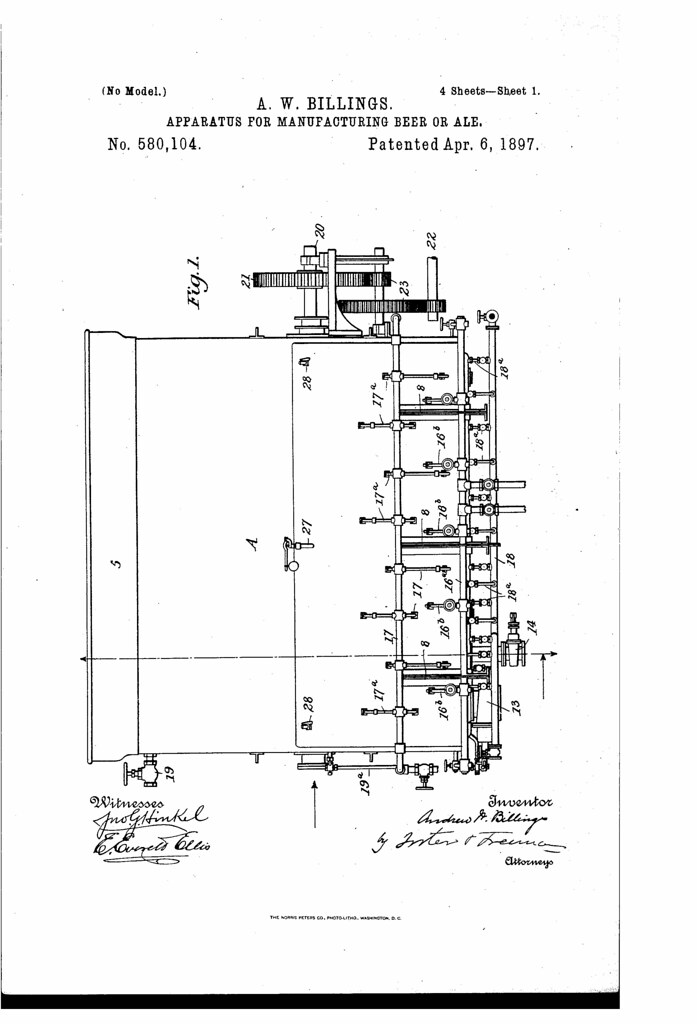
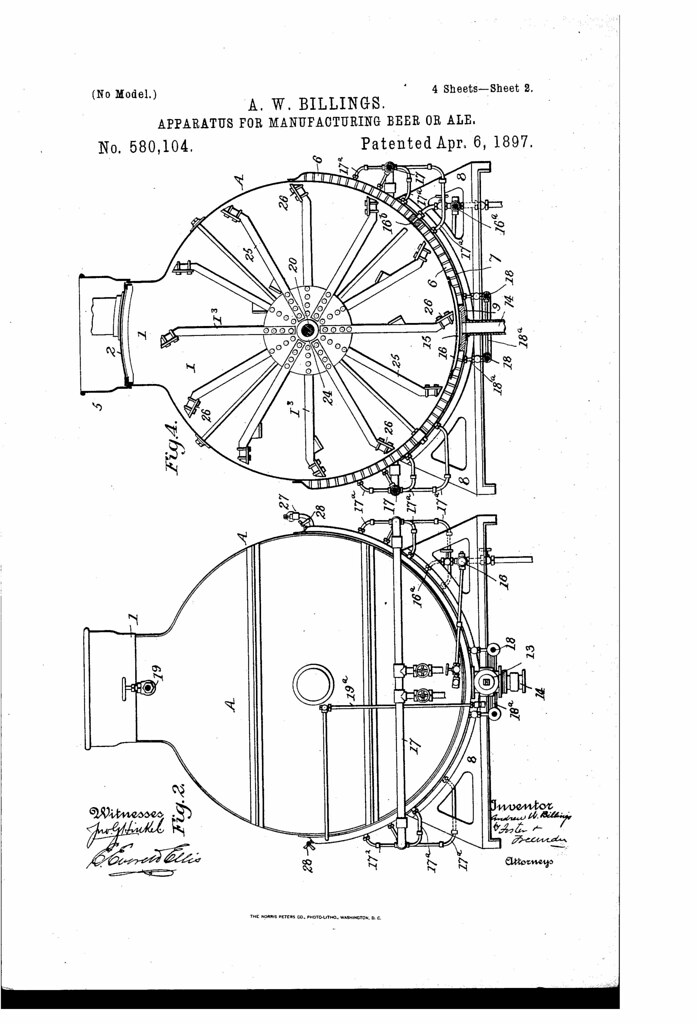
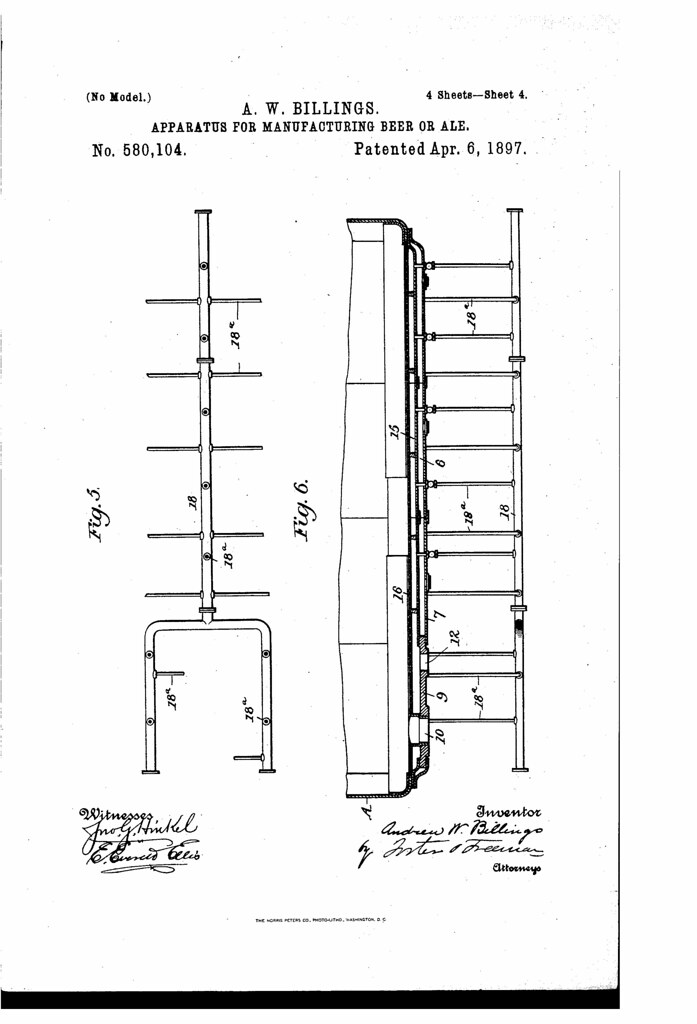
Patent No. 580104A: Apparatus For Manufacturing Beer Or Ale

April 6, 2015 By Jay Brooks

patent-logo
Today in 1897, US Patent 580104 A was issued, an invention of Andrew Worthington Billings, for his “Apparatus for Manufacturing Beer or Ale.” There’s no Abstract, but here’s how it’s described. “It is the object of the invention to provide an apparatus by the use of which malt liquors may be manufactured in a simpler, quicker, and less expensive manner than heretofore and to effect the aeration of wort in the same apparatus in which the mashing and boiling take place. A further object of the invention is to insure the perfect sterilization of the air used in the aeration of the wort and to regulate the flow of such air in the manner hereinafter more particularly pointed out.”

US580104-0
US580104-1
US580104-2
US580104-3

Filed Under: Beers, Breweries, Just For Fun, Politics & Law, Related Pleasures Tagged With: Brewing Equipment, History, Law, Patent, Science of Brewing

« Previous Page
Next Page »

Find Something

Northern California Breweries

Please consider purchasing my latest book, California Breweries North, available from Amazon, or ask for it at your local bookstore.

Recent Comments

  • Ernie Dewing on Historic Beer Birthday: Charles William Bergner 
  • Steve 'Pudgy' De Rose on Historic Beer Birthday: Jacob Schmidt
  • Jay Brooks on Beer Birthday: Bill Owens
  • Steve 'Pudgy' De Rose on Beer Birthday: Charles Finkel
  • Steve 'Pudgy' De Rose on Beer Birthday: Bill Owens

Recent Posts

  • Beer In Ads #5125: Bowler Brothers’ Bock February 22, 2026
  • Beer Birthday: Fred Bueltmann February 22, 2026
  • Historic Beer Birthday: John Emmerling February 22, 2026
  • Beer In Ads #5124: Möerlbach Bock February 22, 2026
  • Historic Beer Birthday: George M. Biner February 22, 2026

BBB Archives

Feedback

Head Quarter
This site is hosted and maintained by H25Q.dev. Any questions or comments for the webmaster can be directed here.