Brookston Beer Bulletin

Jay R. Brooks on Beer

  • Home
  • About
  • Editorial
  • Birthdays
  • Art & Beer

Socialize

  • Dribbble
  • Email
  • Facebook
  • Flickr
  • GitHub
  • Instagram
  • LinkedIn
  • Pinterest
  • RSS
  • Twitter
  • YouTube

Powered by Genesis

Patent No. 1086931A: Fluid-Separator

February 10, 2015 By Jay Brooks

patent-logo
Today in 1914, US Patent 1086931 A was issued, an invention of George Anton Orth and Joshua J. White, for their “Fluid-Separator.” There’s no Abstract, but in the description it states the “object of the invention is to provide a separator, particularly adapted for use in connection with ales and beers, for separating sediment from the body of the fluid.” The description continues:

The invention embodies among other features a device provided with an inlet pipe for connection with the main barrel or the keg and an outlet pipe for connection with the tap or faucet, the mentioned pipes terminating in a container, with an end of the inlet pipe terminating in a separator cup provided with a valve operable by a float arranged within the container and movable upwardly therein as the depth of the fluid in the container increases, the float in its upward movement being adapted to close the inlet pipe to prevent the entrance of additional fluid and in its downward movement being adapted to permit the valve to open to admit more fluid to the container.

By connecting our device directly with the keg or barrel, the pressure in the device will be the same as in the keg or barrel, so that when the fluid is taken from the tap it will be as fresh as if it were taken directly from the keg.

US1086931-0

Filed Under: Beers, Breweries, Just For Fun, Politics & Law, Related Pleasures Tagged With: Brewing Equipment, Law, Patent, Science of Brewing

Patent No. 5716653A: Process For Brewer’s Yeast Debittering

February 10, 2015 By Jay Brooks

patent-logo
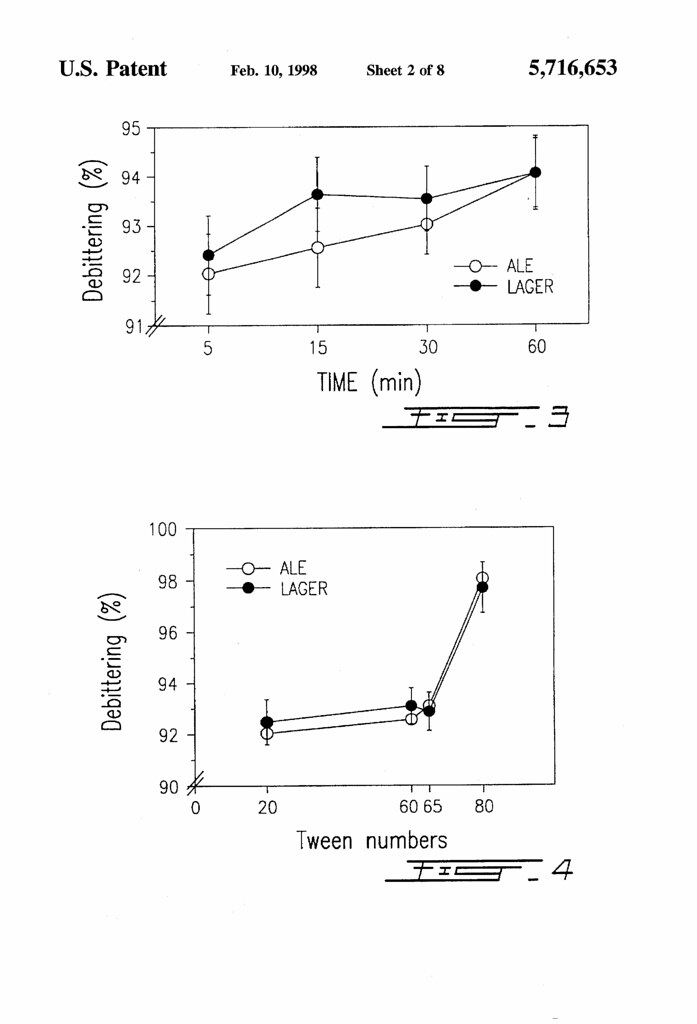
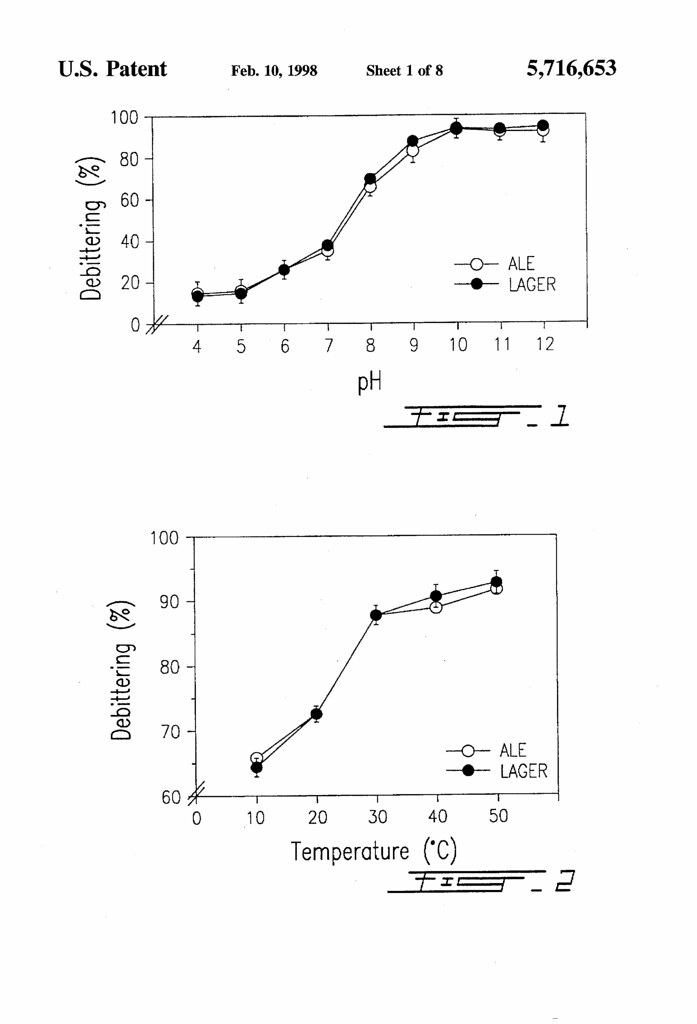
Today in 1998, US Patent 5716653 A was issued, an invention of Ronald E. Simard and Mohammed Bouksaim, for their “Process For Brewer’s Yeast Debittering.” Here’s the Abstract:

This invention relates to a process for debittering spent brewer’s yeast, aiming at maximal efficiency with minimal impact on yeasts for their further use as live cells. The process consists in bringing a yeast suspension in contact with a surfactant containing unsaturated fatty acids, like Tween 80® (0.2% to 20% v/v), adjusting pH to 10.0 with NaOH 2N and agitating during 5 minutes at 50 rpm and 50° C. A bitterness reduction of 98% is obtained, without affecting yeast viability or protein content. Furthermore, the debittered yeasts treated with 20% Tween 80® can be reactivated (viability of 100% and increased production of CO2) by growing them in a suitable medium for a sufficient time (about two to six hours). These reactivated yeasts have restored biological properties which are expected to allow the use of these spent yeasts in complete or partial replacement of new yeasts in bakery industry and in spirit and beer fabrication. This application for an industrial by-product brings a plus-value by exploiting its biological activity and its nutritional value and furthermore, represents an interesting solution for an environmental problem.

So essentially this idea is to take yeast after it’s been used in brewing beer, removing any bitter compounds and then using it again to bake bread. I know in England, at Marston’s in Burton-on-Trent, for example, sells their spent yeast to the nearby plant that makes Marmite, and is similar to the Australian Vegemite.
US5716653-1
US5716653-2

Filed Under: Breweries, Food & Beer, Just For Fun, Politics & Law, Related Pleasures Tagged With: Law, Patent, Science of Brewing, Yeast

Patent No. 4315038A: Process For Preparing Protein Flour From Brewery Waste

February 9, 2015 By Jay Brooks

patent-logo
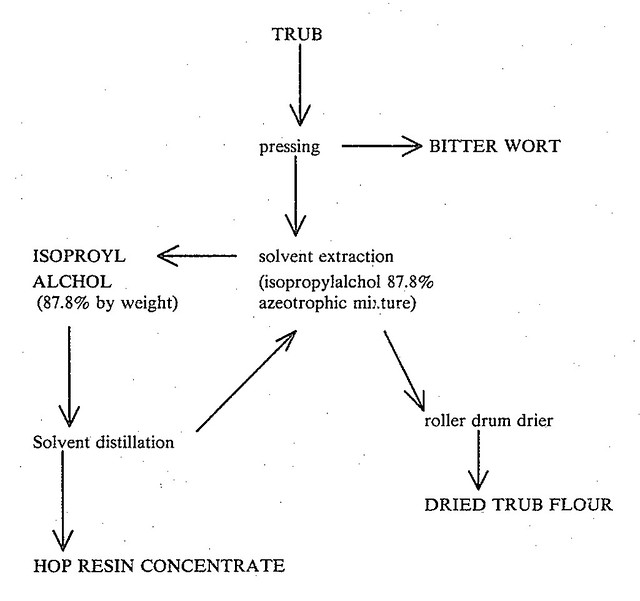
Today in 1982, US Patent 4315038 A was issued, an invention of Phillip M. Townsley and Robert L. Weaver, assigned to The Molson Companies Limited, for their “Process for Preparing Protein Flour from Brewery Waste .” Here’s the Abstract:

Trub obtained from the wort kettle of a brewing system is rich in protein and thus can be used in human foods. The trub is processed to yield a trub flour by extraction with an azeotropic mixture of isopropanol and water, and drying to remove the solvent in a roller drum drier, the latter yielding the trub flour in dry flake form.

US4315038-1

Filed Under: Breweries, Just For Fun, Politics & Law, Related Pleasures Tagged With: Law, Patent, Science of Brewing

Patent No. 948463A: Filling-Machine

February 8, 2015 By Jay Brooks

patent-logo
Today in 1910, US Patent 948463 A was issued, an invention of Frank C.H. Strasburger, for his “Filling-Machine.” There’s no Abstract, but according to the description, the “invention relates to’ machines for filling bottles with beer or other charged liquids and its object is to accomplish the filling operation without the loss of gas in suspension in the liquid and without the production of foam in the bottles. Attainment of this primary object of the invention also has for its object to utilize the pressure in the liquid tank for closing the liquid valve; to establish a counter-pressure in the bottle before the liquid valve is opened; to operate the liquid valve by a diaphragm and cause the valve to open by equalizing the pressure on both sides of the diaphragm; and to close the liquid valve by exhausting the pressure on one side of the diaphragm.”
US948463-0

Filed Under: Beers, Breweries, Just For Fun, Politics & Law Tagged With: Brewing Equipment, Law, Patent, Science of Brewing

Patent No. 3234026A: Process For The Manufacture Of Beer, Ale And The Like

February 8, 2015 By Jay Brooks

patent-logo
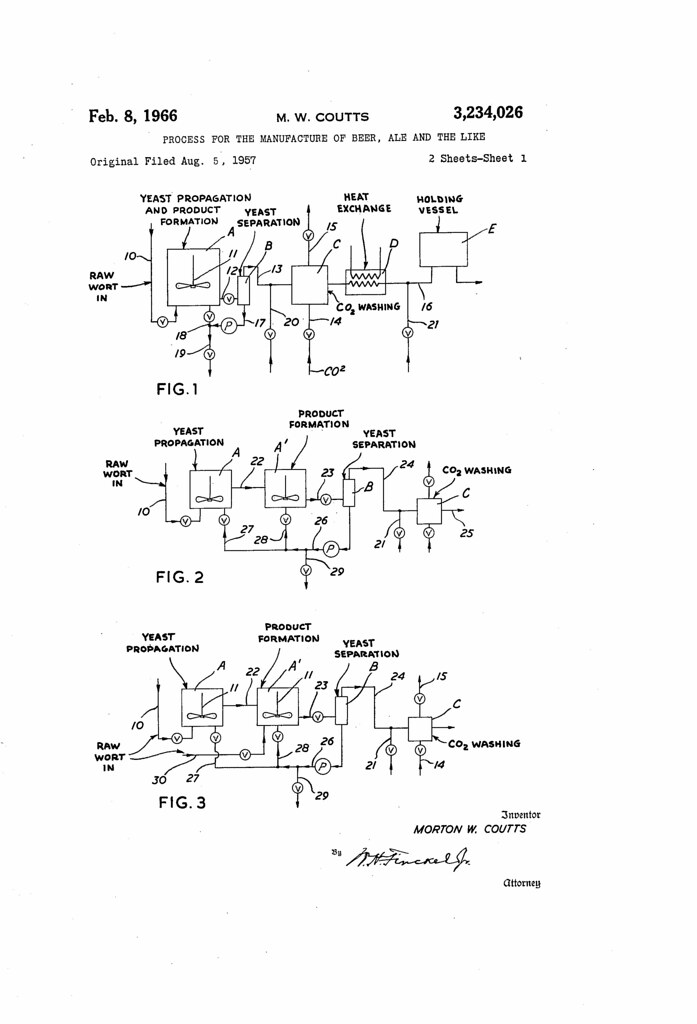
Today in 1966, US Patent 3234026 A was issued, an invention of Morton William Coutts, for his “Process for the Manufacture of Beer, Ale and the Like.” There’s no Abstract, but according to the description, the “invention relates to a continuous method for the fermentation of brewery wort for the production of a portable non-distilled alcoholic beverage product. This application is a continuation of my application Serial No. 676,187, filed August 5, 1957 A major object of the invention is the provision of an improved process for the production of such products which will enable the production thereof with greatly decreased fermenting time than is possible by present processes and which will give better control of flavour at greatly decreased cost of manufacture.”
US3234026-0
US3234026-1

Filed Under: Beers, Breweries, Just For Fun, Politics & Law, Related Pleasures Tagged With: Brewing Equipment, Law, Patent, Science of Brewing

Patent No. 4138499A: Preparation Of Beer With Reduced Calories

February 6, 2015 By Jay Brooks

patent-logo
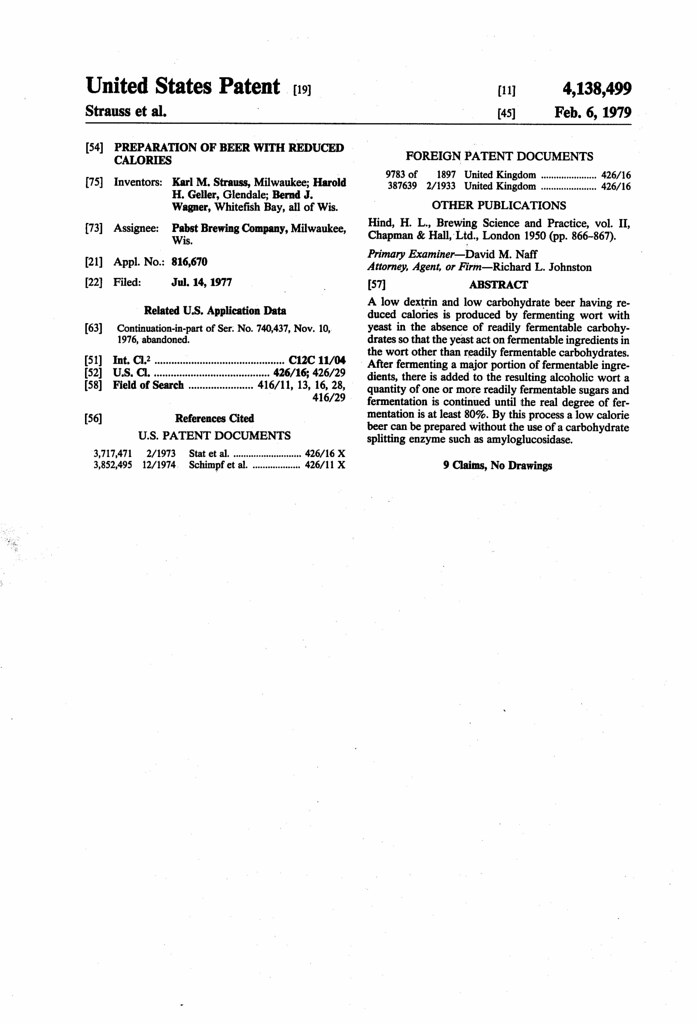
Today in 1979, US Patent 4138499 A was issued, an invention of Karl M. Strauss, Harold H. Geller, and Bernard J. Wagner, assigned to Pabst Brewing Co., for their “Preparation of Beer with Reduced Calories.” Here’s the Abstract:

A low dextrin and low carbohydrate beer having reduced calories is produced by fermenting wort with yeast in the absence of readily fermentable carbohydrates so that the yeast act on fermentable ingredients in the wort other than readily fermentable carbohydrates. After fermenting a major portion of fermentable ingredients, there is added to the resulting alcoholic wort a quantity of one or more readily fermentable sugars and fermentation is continued until the real degree of fermentation is at least 80%. By this process a low calorie beer can be prepared without the use of a carbohydrate splitting enzyme such as amyloglucosidase.

US4138499-0

Filed Under: Beers, Breweries, Just For Fun, Politics & Law, Related Pleasures Tagged With: Law, Light Beer, Patent, Science of Brewing

Patent No. 37578A: Improved Extract Of Malt

February 3, 2015 By Jay Brooks

patent-logo
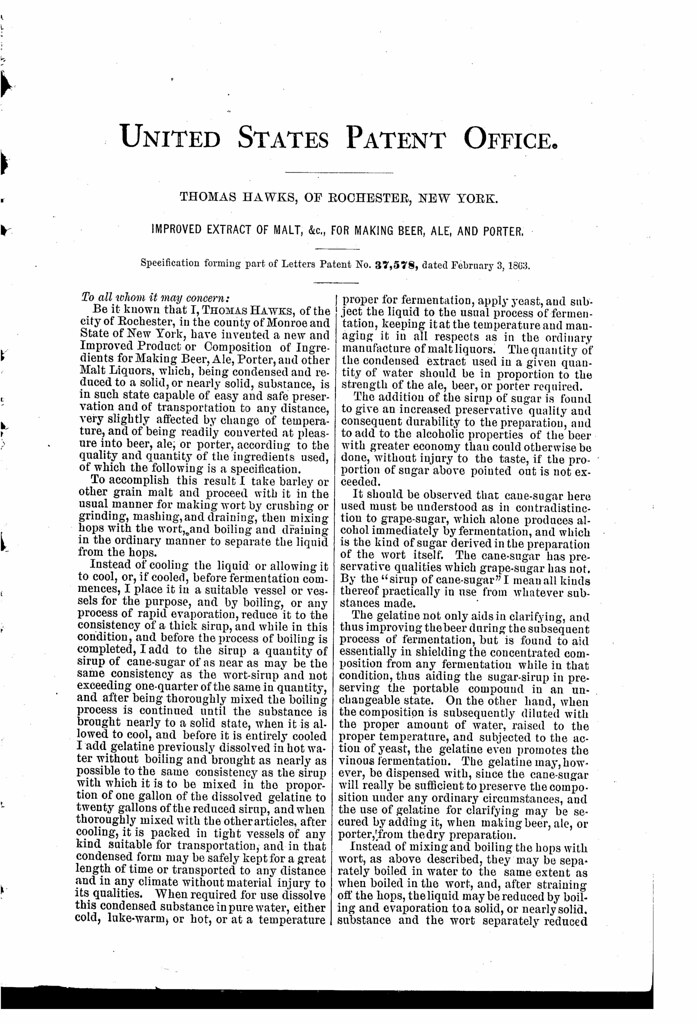
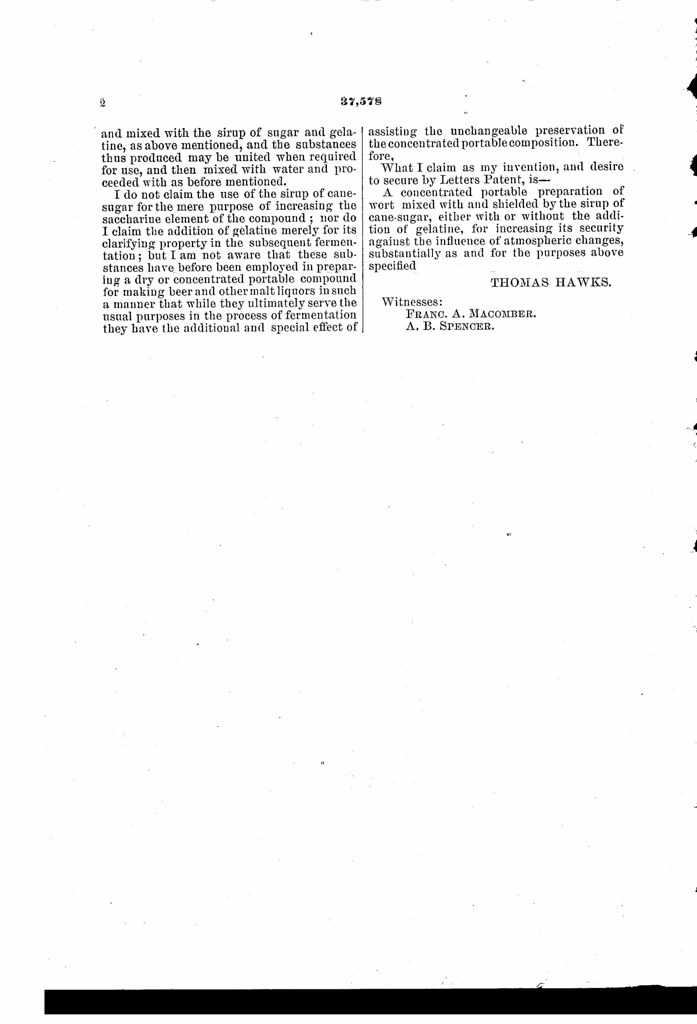
Today in 1863, US Patent 37578 A was issued, an invention of Thomas Hawks, for his “Improved Extract of Malt.” There’s no Abstract, but the entire application is rendered as a two-page image. This is a very old patent, older than most commercial breweries still with us, issued in the middle of the Civil War.

US37578-0
US37578-1

Filed Under: Breweries, Food & Beer, Politics & Law, Related Pleasures Tagged With: Law, Malt, Patent, Science of Brewing

Patent No. 5282413A: Installation For Steeping Grains

February 1, 2015 By Jay Brooks

patent-logo
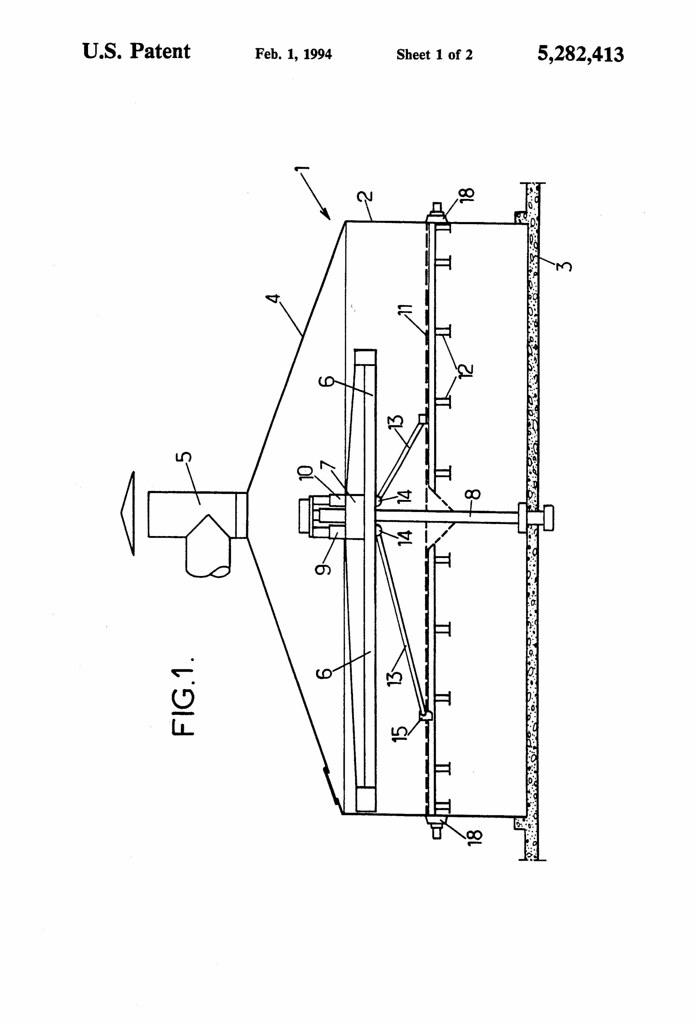
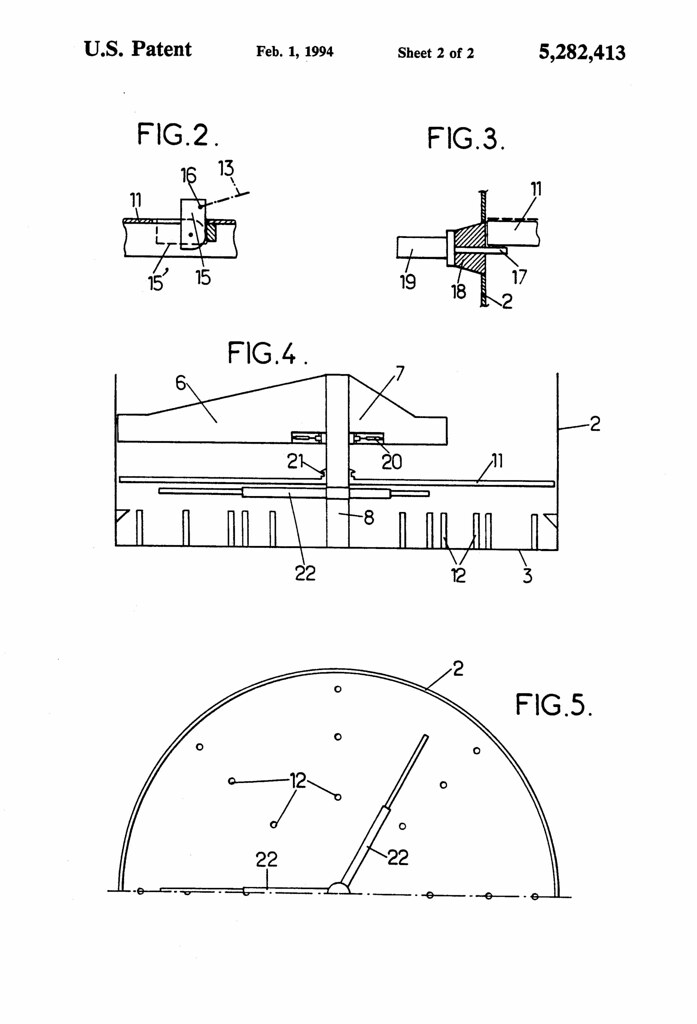
Today in 1994, US Patent 5282413 A was issued, an invention of Rene Sauvage, James Roget, Jean Amstutz, and Guy Flament, for their “Installation for Steeping Grains.” Here’s the Abstract:

Installation for steeping grains of the type comprising a tank (1) provided with a cylindrical lateral wall (2), with a bottom (3) and with a perforated platform (11) disposed at a certain distance from the bottom (3) and on which the grain rests in a layer of suitable thickness, the upper surface of this layer of grains being able to be levelled by a rotary system with raking arms (6) carrying blades and associated with a first motor (9) capable of rotating them, a second motor (10) being coupled to the system in order to make it vertically movable. This installation comprises removable connection making it possible to connect, mechanically and temporarily, the perforated platform (11) to the system with raking arms (6) and blades or directly to the second motor (10).

US5282413-1
US5282413-2

Filed Under: Breweries, Just For Fun, Politics & Law, Related Pleasures Tagged With: Brewing Equipment, Malt, Patent, Science of Brewing

Patent No. 3232211A: Continuous Brewing Apparatus

February 1, 2015 By Jay Brooks

patent-logo
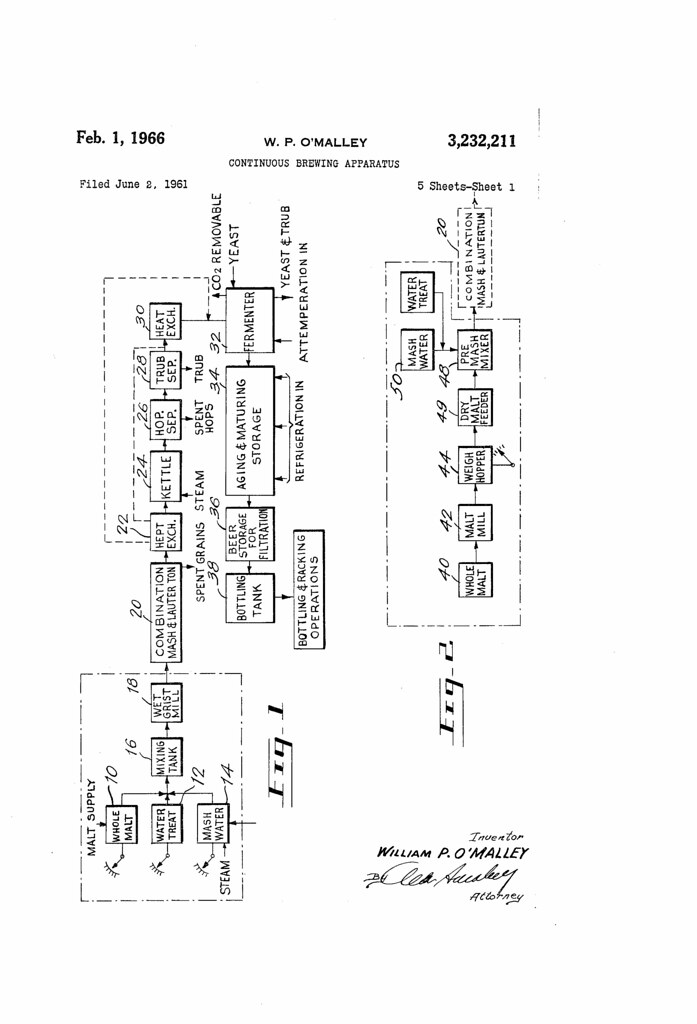
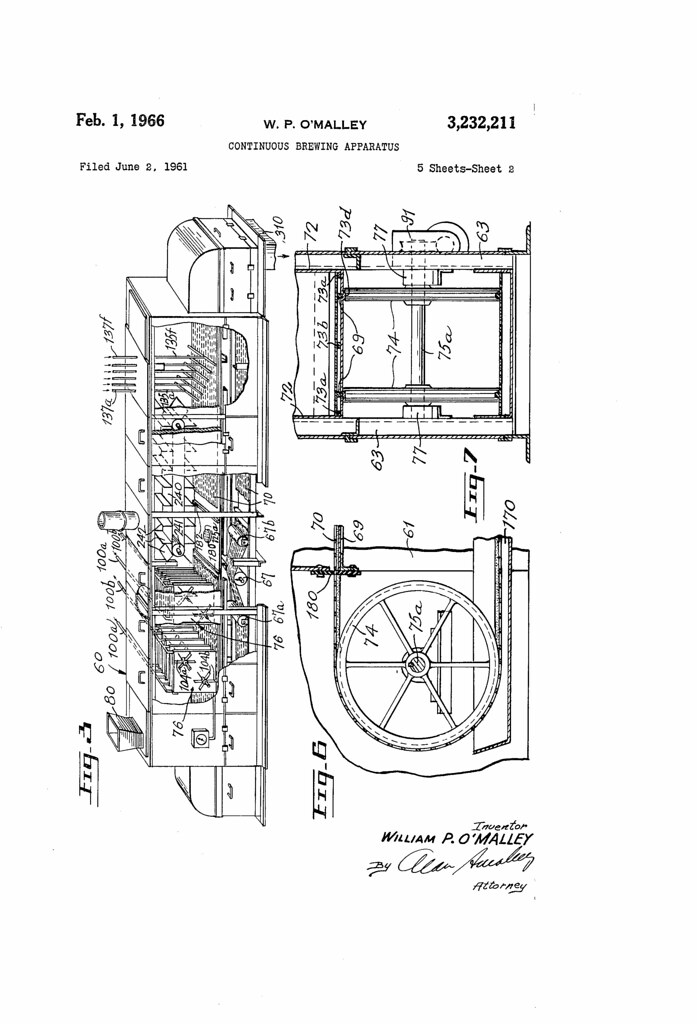
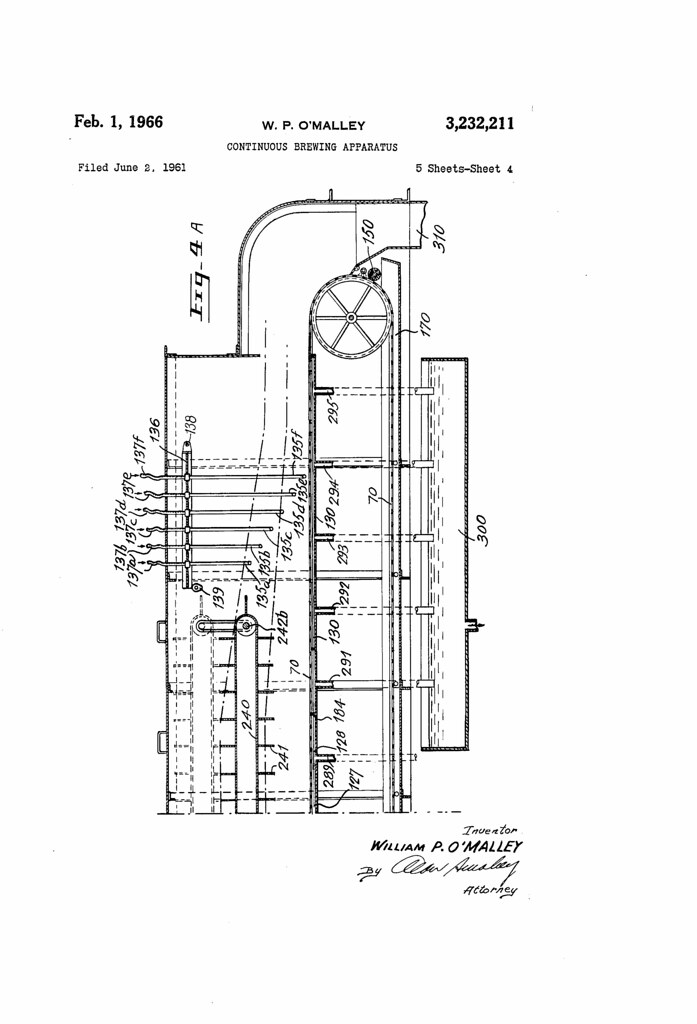
Today in 1966, US Patent 3232211 A was issued, an invention of William P. O’Malley, assigned to Malley Brewery Ltd. of Montreal, Canada, for his “Continuous Brewing Apparatus.” There’s no Abstract, but there’s this in the description.

The present apparatus is designed so as to incorporate all of the operations and techniques used in the batch process. Thus, by imparting continuity to the individual batch process operations, the result obtained is a continuous brewing process, which can perhaps best be described by the somewhat contradictory statement, that it is the batch process made continuous.

The continuous brewing process of the invention is accordingly based on the principles of batch processing, and it follows that for each unit of the batch process, there must be a corresponding unit for the continuous process.

Since the sequence and nature of the batch operations in any of its units are already established and Well defined, the design of the continuous unit is consequently limited and governed to some extent by the physical aspect of the batch operations for that unit.

As a result, the design of the present continuous unit was made around the operations existing in the batch unit, imparting the added factor of continuity to the operations without altering their character or nature in any way.

In order to duplicate the batch process while maintaining the desired continuity certain new apparatus must be provided to take the place of the apparatus where separate fillings, mixings, restings and withdrawal were necessary with the batch process. With this in mind the present invention provides such apparatus as will be described in more detail later and wherein a main feature resides in the construction of a combination mash and lauter tun designed specifically for continuous operation.

US3232211-0
US3232211-1
US3232211-2
US3232211-3
US3232211-4

Filed Under: Breweries, Just For Fun, Politics & Law, Related Pleasures Tagged With: Brewing Equipment, Patent, Science of Brewing

Patent No. 4801462A: Copper Heat Exchange Tubes

January 31, 2015 By Jay Brooks

patent-logo
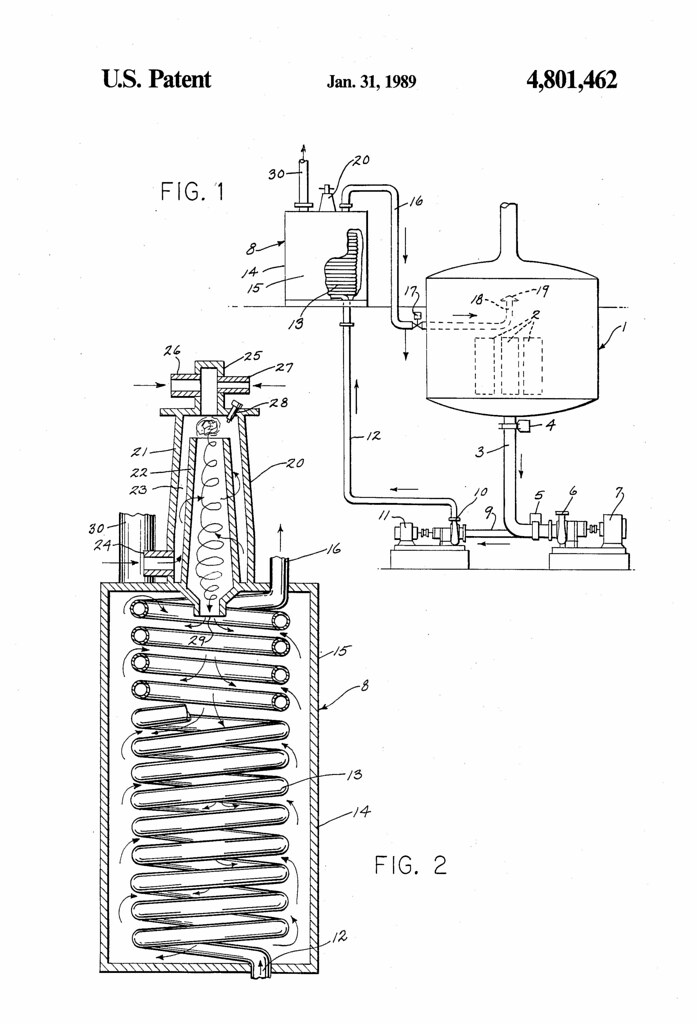
Today in 1989, US Patent 4801462 A was issued, an invention of Arthur Tonna, assigned to The Stroh Brewery Company, for his “Copper Heat Exchange Tubes.” Here’s the Abstract:

Wort, heated to boiling in a brew kettle, is continuously withdrawn from the brew kettle and passed through a copper heat exchange coil in an external heat exchanger. Hot combustion gases are discharged at high velocity into direct contact with the heat exchange coil to thereby heat the wort flowing through the coil to a temperature in the range of 220° to 240° F. The heated wort is then returned to the brew kettle and discharged at a location beneath the level of the wort in the kettle. The direct firing of the wort in the copper heat exchange coil provides improved flavor characteristics for the beer.

US4801462-1

Filed Under: Breweries, Just For Fun, Politics & Law, Related Pleasures Tagged With: Brewing Equipment, Patent, Science of Brewing

« Previous Page
Next Page »

Find Something

Northern California Breweries

Please consider purchasing my latest book, California Breweries North, available from Amazon, or ask for it at your local bookstore.

Recent Comments

  • Ernie Dewing on Historic Beer Birthday: Charles William Bergner 
  • Steve 'Pudgy' De Rose on Historic Beer Birthday: Jacob Schmidt
  • Jay Brooks on Beer Birthday: Bill Owens
  • Steve 'Pudgy' De Rose on Beer Birthday: Charles Finkel
  • Steve 'Pudgy' De Rose on Beer Birthday: Bill Owens

Recent Posts

  • Beer In Ads #5125: Bowler Brothers’ Bock February 22, 2026
  • Beer Birthday: Fred Bueltmann February 22, 2026
  • Historic Beer Birthday: John Emmerling February 22, 2026
  • Beer In Ads #5124: Möerlbach Bock February 22, 2026
  • Historic Beer Birthday: George M. Biner February 22, 2026

BBB Archives

Feedback

Head Quarter
This site is hosted and maintained by H25Q.dev. Any questions or comments for the webmaster can be directed here.