Brookston Beer Bulletin

Jay R. Brooks on Beer

  • Home
  • About
  • Editorial
  • Birthdays
  • Art & Beer

Socialize

  • Dribbble
  • Email
  • Facebook
  • Flickr
  • GitHub
  • Instagram
  • LinkedIn
  • Pinterest
  • RSS
  • Twitter
  • YouTube

Powered by Genesis

Brewbot: An Automated Homebrewing Machine

April 5, 2011 By Jay Brooks

robot
This is an odd one, if not without a certain interest just for the effort involved and how it works. For a design contest, The RX MCU Design Contest, sponsored by Renesas, an Australian designer, Matt Prattau (a.k.a. Zizzle), created the Brewbot, an automated homebrewing system that does all the work.

Here’s his introduction, from the contest submission:

Home brewing beer can be a rewarding mix of art and science. It allows the brewer to explore the thousands of possibilities available using the dozens of varieties of hops, malt, yeast and other interesting ingredients. The process can be time consuming and results can vary due to many factors, including precision, technique and consistency used by the brewer in the process.

Imagine an appliance in your kitchen that could take the time and labor out of the brewing process and brew a consistent batch of beer each time thus allowing the user to focus on the ingredients and recipe.

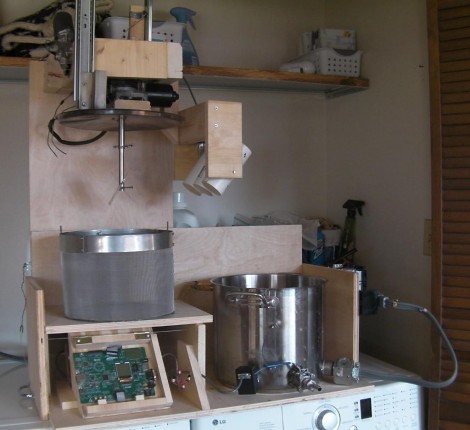
I always thought that the actual work of homebrewing was part of the fun, not something to be avoided, but still, you have to admire the way he did it. Here’s what it looks like. The submission page also includes links to schematics and other information about the design. He’s also set up a blog where he tracks his progress entitled Brewbot Mk2
automated-beer-brewery

Hack A Day blogged about the Brewbot, and had this to say:

You can see the development board there just to the left of the brew kettle. It’s network connected with a web interface that allows you to take recipes from Brewtarget and import them directly to the system. All you need to do is make sure that you load up the grain basket and boil addition modules to match your recipe. The bot takes it from there, filling the kettle, preheating that water, lowering the grains and maintaining temperature for the mash, and completing the boil with additions from the servo-controlled PVC pipe pods. Experienced brewers will notice a few steps missing, like the sparge, and a quick way to cool the finished wort. But this does take a huge part of the drudgery out of our hands. If only it had a clean-in-place system … then we’d really be happy!

But to get a real feel for it, check out the video where the designer walks you though the steps of how it works.

Filed Under: Breweries, Just For Fun Tagged With: Homebrewing, Science, Science of Brewing

American Dietetic Ass’n Toasts Beer For Good Health During American Heart Month

February 10, 2011 By Jay Brooks

eat-right-ada
The Anti-Alcohol wingnuts of the world tend to go apoplectic anytime it’s suggested that alcohol might have any health benefits. It just doesn’t fit their world view. I’ve seen it happen. Oh, some of the comments I’ve gotten. But, of course, myriad studies have shown just that and even our government acknowledged that fact in the recent dietary recommendations. That didn’t stop the wingnuts from a letter writing campaign because they just couldn’t stand the idea of the Fed’s recommendation that it’s safe to drink more than two drinks a day, even on occasion. Oh, the horror! Believe it or not, it’s illegal for beer labels to make health claims, even if they’re true.

So I took great pleasure when I saw the American Dietetic Association today sent out a press release about an article that was published in their ADA Times extolling the benefits of beer, and its numerous nutrition and health benefits for American Heart Month, which is February.

From the press release:

While red wine is often touted as the heart-healthy libation, more evidence is showing beer has a great deal of nutrition and health-promoting qualities as well, according to an article published in the Winter 2011 issue of the American Dietetic Association’s member publication, ADA Times.

“Red wine enjoys a reputation for sophistication and health benefits, but as interest in artisan brewing gains momentum and emerging research reveals unique nutrition properties, beer is finding redemption not only as a classy libation with deep roots in many cultures, but as a beverage with benefits,” writes registered dietitian and ADA Spokesperson Andrea Giancoli.

February is American Heart Month, a time dedicated to raising awareness of the leading cause of death in the U.S. — cardiovascular disease. One in three adults has some form of heart/cardiovascular disease. Many of these deaths and risk factors are preventable and food choices have a big impact on your heart’s health, even if you have other risk factors.

Moderate consumption of any alcoholic beverage, including beer, has been shown to increase HDL cholesterol, lower LDL cholesterol and reduce the risk of blood clotting, Giancoli writes in ADA Times. Moderate alcohol consumption has also been associated with a lower incidence of gallstones, decreased risk of type 2 diabetes and improved cognitive function in older adults.

“Beer specifically has been associated with additional health outcomes, including lowering the risk of kidney stones in men compared to other alcoholic beverages, possibly due to its high water content and diuretic effect,” Giancoli writes. “Compounds in hops may also slow the release of calcium from bone that is implicated in kidney stones. Additionally, beer drinkers seem to have a more protective effect towards greater bone mineral density due to the high content of silicone in beer.”

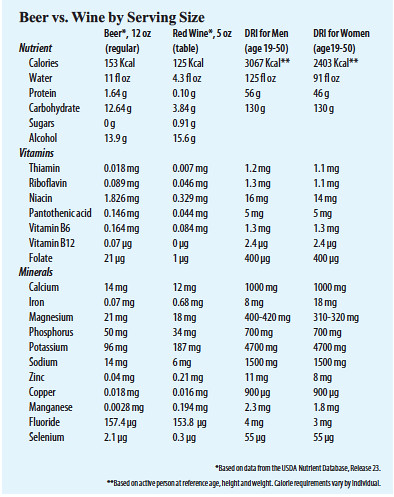
Like wine, beer is fat free. Carbohydrates, which make up about one-third of the calories in beer, mostly come from partially broken down starch. Protein, which is nearly non-existent in wine, is present in small amounts in beer — about 4 percent of the total calories.

Most beers are between 3 percent and 6 percent alcohol by volume, although some beers can contain as much as 10 percent alcohol, “and some are much higher.” Giancoli writes. “Wines are between 12 percent and 14 percent ABV. Because the average beer has a lower ABV and more than two and half times as much water, it contributes to fluid intake more so than wine.”

Although the USDA Nutrient Database lists beer’s fiber content as zero grams recent studies have shown lager contains up to 2 grams of soluble fiber per liter, while dark beers can contain up to 3.5 grams. “Although wine and beer are neck-and-neck when it comes to mineral composition, each providing some potassium, magnesium, phosphorus and fluoride (the latter presumably contributed through the water source), beer is the winner when it comes to selenium and silicon,” Giancoli writes.

Here’s a chart from the article comparing what’s in beer and wine.

beer-vs-wine-nutri

And here’s some more from the article itself:

A recent report from global research group Mintel shows that 33 percent of all beer drinkers in the U.S. are consuming less imported beer because they’re opting for domestic craft beer instead. in addition, nearly 60 percent of beer drinkers say they like to try craft or microbrew beers, and 51 percent would try more if they knew more about them, suggesting consumer education is the key to cultivating growth in the artisan beer market.

And about micronutrients:

Beer Outshines Wine with Many Micronutrients
One 12-ounce regular beer contributes folate, vitamin B6, niacin, pantothenic acid and riboflavin. Beer is also a plant source of vitamin B12, supplying about 3 percent of the recommended daily amount for adults, according to the USDA Nutrient database (although other sources claim higher B12 contents in beer).

So drink a toast to a healthy heart this month. And make sure it’s beer.

Filed Under: Beers, Editorial, News Tagged With: Health & Beer, Science

Thoughts On The New Dietary Guidelines From Beer Business Daily

February 3, 2011 By Jay Brooks

spirits-wine-beer
You most likely hard that the USDA released the quinquennial Dietary Guidelines for Americans at the end of last month. The 2010 version made a number of small, but significant changes with regard to food, such as “make half your plate fruits and vegetables” and “drink water instead of sugary drinks.”

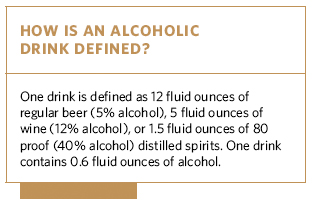
In Chapter 3, they also made one small change to how they define an “alcoholic drink.”

alcohol-defined

Harry Schuhmacher commented on the guidelines in today’s Beer Business Daily newsletter. With Harry’s permission, below I’ve reprinted his thoughts on the Dietary Guidelines and specifically the changes to the alcohol portion of them:

Earlier this week the USDA issued its 2010 Dietary Guidelines as it does every 5 years. It states: “One drink is defined as 12 fluid ounces of regular beer (5% alcohol), 5 fluid ounces of wine (12% alcohol), or 1.5 fluid ounces of 80 proof (40% alcohol) distilled spirits. One drink contains 0.6 fluid ounces of alcohol.”

Now, you’d think this maybe isn’t a big deal. Well, you’d be wrong on that. It is.

Here’s why: The previous USDA Dietary Guidelines five years ago had very similar language, although it was fought tooth and nail by the beer and wine lobbies. However, this time the feds added the crucial last sentence: “One drink contains 0.6 fluid ounces of alcohol.” [Emphasis added.]

This further puts the Feds on record as saying, basically, a drink is a drink is a drink, even though we all know in reality that’s not the case. You can be sure that Diageo and DISCUS — the spirits lobby — worked with a laser focus to get this sentence added. It’s the next step toward alcohol equivalency (for excise tax, labeling, and consumer access issues), even though Diageo and DISCUS have previously said this is not what they’re after.

LABELING: First let’s consider labeling. As we know, the federal TTB is considering (since 2003) allowing alcohol producers to include voluntarily display serving facts (which includes standard alcohol content for servings) on labels. This is an issue that large distillers support, but brewers and wineries typically oppose because some believe the push for serving facts is a stalking horse for equivalency.

INDUSTRY SPLIT ON STANDARD DRINK: The Wine Institute and DISCUS are on the same side of most issues, such as opposing the CARE Act, but standard drink isn’t one of them.

DISCUS followed the release of the Guidelines with a statement. “The Government today emphasized the scientific fact that a standard drink of beer, wine and distilled spirits each contains the same amount of alcohol,” said Dr. Monica Gourovitch, Distilled Spirits Council’s svp of scientific affairs. “Alcohol is alcohol and it all should be treated equally, as a matter of public health and public policy.”

Monica told our sister publication, WSD, that the updated definition is “very clear” and shows that “each standard drink contains the same amount of alcohol.” When looking at the science involved, each serving has the “same effect on the body — potential benefits and potential risks.” She also noted that the National Institute on Alcohol Abuse and Alcoholism (NIAAA) already defines a standard alcoholic drink as anything containing 0.6 fluid ounces.

Wait ….. 0.6 fluid ounces of alcohol? Not 0.5 fluid ounces? There are plenty of public health folks who defined drinks as having 0.5 fluid ounces of alcohol as a standard drink. Who, I wonder, lobbied the USDA to add that extra 0.1 fluid ounce to the definition?

The Wine Institute, for one, is livid. For once they are on the other side of DISCUS on an issue. The WI issued a statement on Tuesday, saying there is no such thing as a standard drink: “We agree with the time-tested definition of a serving as being 12 fl. oz. of regular beer, 5 fl. oz. of wine, or 1.5 fl. oz. of 80-proof distilled spirits but are concerned about the additional statement that each of the drinks contains the same amount of alcohol. A precise fluid-ounces-of-alcohol statement implies that the alcohol content is the same for every drink of wine, beer or distilled spirits when, in reality, alcohol content varies widely from drink to drink. Consumers should not be misled into believing there is such a thing as a ‘standard drink.’ In fact, the term ‘standard drink’ does not appear in the Dietary Guidelines.” This is true. But it doesn’t dull the fact that a federal agency has swallowed the equivalency argument hook, line and sinker while the rest of the industry sleeps.

The Beer Institute and the NBWA have remained mute on this issue, so far. But clearly it is important: As one alcohol politico told me: “Once the language is in a federal government guideline, it’s in the bloodstream.” What he meant by that is that, since the USDA has defined a drink as 0.6 ounces of alcohol, it gives the TTB cover to move forward with their “serving facts” labeling, and maybe it gives the states the argument to increase taxes on beer and wine and offer it at more times and in more channels, and maybe it gives the feds something to point to when considering an excise tax increase. It’s a slippery slope, my friends, toward equalization of taxes and access among the beverages, which works against beer and wine and is probably just bad public policy. In fact, if alcohol excise taxes were suddenly equivalent, it would virtually kill the wine and beer industries, and we’d be a nation of vodka swillers like Russia, wiping away 200+ years of cultural and policy differences between the beverages. It was Thomas Jefferson who logically first put forward the notion that moderation should be nurtured by the government by encouraging the consumption of beer and wine over spirits.

As usual, a distributor put it most succinctly: “So a Four Loko is the same as Jack Daniels is same as Coors Light is same as Mad Dog 20/20 is same as a hot 17% abv California cab is the same as an 11% abv Italian white? Really?”

It brings to mind the old story where August Busch III went to Capitol Hill and demonstrated to a Congressman considering equivalency that a drink is not a drink. He reportedly said, “I’ll drink these three Budweisers, and you drink these three dry martinis, and at the end we’ll see who is more intoxicated.” It’s a shame our beer industry leaders don’t pull more stunts like that.

Ethanol is ethanol, to be sure. But different types of bev-alc are consumed by the majority of Americans in different ways. Ethanol is ethanol, but a drink is not a drink.

Thanks Harry. If you don’t know about his Beer Business Daily, especially if you’re in the beer business, I highly recommend it. You really should subscribe to Harry’s newsletter.

Filed Under: Beers, Editorial, Food & Beer, Politics & Law, Related Pleasures Tagged With: Government, Guest Posts, Science

Did A Thirst For Beer Spark Civilization?

January 14, 2011 By Jay Brooks

egyptian-dudes
Today’s UK newspaper, The Independent, has a nice write-up of Patrick McGovern’s theory (among others) that it was the desire of early man to brew beer that caused them to abandon their hunter gatherer ways and settle down to a life of farming, in the process sparking nothing short of civilization itself.

In the article, Did A Thirst For Beer Spark Civilization?, McGovern says “I think most people see (this theory) as a very plausible scenario. But we don’t have all the evidence. I just wanted to put it out there as a worldwide hypothesis. Then over time maybe the different pieces can be put together from across the world.” McGovern is the author of Uncorking the Past — a book I heartily recommend — that goes into great detail about the evidence for his theories.

Patrick McGovern, Author of "Uncorking the Past"
Patrick McGovern signing boos at GABF in 2009.

Filed Under: Beers, Just For Fun, News, Related Pleasures Tagged With: Beer Books, History, Science

Beer and Dieting

January 13, 2011 By Jay Brooks

diet
The UK tabloid newspaper, The Daily Mirror, reported today that a study at the University of Barcelona revealed that “[d]rinking up to a pint of beer a day is good for your health — and can even help you lose weight.” They also “found those who have a Mediterranean-style diet and drink moderately are healthier than those who don’t” and that “beer could cut the risk of high blood pressure.”

Filed Under: Beers, News Tagged With: Science, Spain, UK

Birds Fly, Men Drink

December 16, 2010 By Jay Brooks

wright-bros-plane
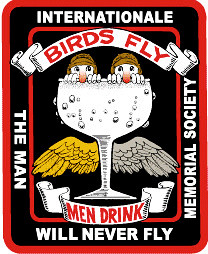
Tomorrow is the anniversary of the Wright Brothers plane flying at Kitty Hawk, North Carolina in 1903. Today, 56 years later, the Man Will Never Fly Memorial Society was founded, also at Kitty Hawk, North Carolina. The society appears to be completely tongue-in-cheek, as evidenced by their “history” and “mission.” Still, you have to long any organization whose motto is “Birds Fly, Men Drink.”

Our History

Our Society was born at Kitty Hawk on one of those dark and windy nights when nothing flew; even the seagulls bounced from place to place like hoppy toads. Our founders, who had been invited to attend a ceremony on December 17, honoring a pair of bicycle mechanics from Dayton Ohio, began drinking and thinking on the evening of December 16. They drank and they thought until the myth of the Wright Brothers’ flight in 1903 became as hard to swallow as the bootleg rye they imbibed.

Thus was born the society’s motto: “Birds Fly, Men Drink”. And thus its purpose: Exposure of the widely held myth of machines moving through the air with men “flying” them. This myth, it was clear, had its origins in folklore, long before the Wright Brothers. First came the nonsense of Cupid flying through the air. Then there was the fairy tale of Pegasus, a winged horse. Next came the fabled Arabian carpet. And the bit of flummery about a flying stork that dropped babies down chimneys. Small wonder that humankind, nourished on such nonsense, would believe that bicycle mechanics could move through the air like winged fowl.

Accepting the challenge these myths have perpetuated, The Man Will Never Fly Memorial Society has fought the hallucination of airplane flight with every weapon at its command save sobriety. We remain dedicated to the principle that two Wrights made a wrong at Kitty Hawk.

birds-fly

Our Mission

Members of the Man Will Never Fly Society are not opposed to flight. Birds do it, Bees do it, even educated fleas do it, as Cole Porter once said. But when you stop to think about it, do you actually believe that a machine made of tons of metal will fly? Small wonder that the editor of a Dayton newspaper said, when informed of the mythical first flight in 1903. “Man will never fly. And if he does, he will never come from Dayton.”

The Society’s members believe that balloons fly, but we do not believe in flying machines. Indeed, members of the Society have proposed a variety of apparati for movement through the ozone. One of our members is even cultivating an enormous jumping bean which, when saddled and heated by a laser, will propel a human for great distances.

But let us hear no more of plane moving through the air, unless they are hurled by carpenters. Airports and airplanes are for the gullible. Little do “plane” passengers realize that they are merely boarding Greyhound buses with wings, and that while aboard these winged buses, given the illusion of flight when cloud like scenery is moved past their windows by stagehands in a very expensive theatrical performance.

We ask you to gather under our banner and combat the myth that man can, did, or will ever fly, except in his or her imagination.

Filed Under: Just For Fun, Related Pleasures Tagged With: History, Humor, Science

Eliminating Drunk Driving 100%

December 12, 2010 By Jay Brooks

car-transformer
So I was reading through the new issue of Playboy magazine that came last week when I came upon an article entitled 15 Innovations That Will Change the World. Some pretty impressive ideas, but the one that stood out for me was “Robocars,” cars that drive themselves using sophisticated sensors, omni-directional video-cameras, radar detectors and advanced GPS systems.

robocars

But what really surprised me was this. “[A]dvocates say robocars will be ferrying many of us hither and yon by 2020. Most major car companies have an autonomous car division, crafting future driverless cars right now.” Holy crap, we’re only a decade away from robocars! Even with them most likely being too pricey initially for most people, give them another ten years after introduction for the price to come down, and that means a majority of us will be able to afford them. That would mean in just twenty years it’s conceivable few people will be doing their own driving anymore.

That could mean the end of drunk driving, mobile phone distractions and all manner of driver error accidents. It’s somewhat surprising given how much potential there is for robocars to virtually eliminate DUIs that the anti-alcohol groups have been completely silent about them. Instead, MADD is pushing the ridiculous ignition lock technology. Why aren’t they supporting robocars? Why aren’t they and the other non-profits supposedly committed to curbing drunk driving and keeping the roads safer funding research into the technology to make robocars a reality even sooner?

That’s not a rhetorical question, I really want to know why they’re not doing more to support robocar technology. Could it be so cynical a reason as it would make them irrelevant and make it almost impossible for them to raise money? If I’ve learned anything about non-profits lately it’s that they’ve become permanent institutions whose paid employees are actually no longer incentivized to carry out their organization’s mission to its conclusion because doing so would put themselves out of work in the process. When was the last time a disease or societal problem was actually solved and/or eradicated? Polio? Small Pox? Yet there are so many more non-profits compared to thirty plus years ago, when I was a kid. But the only thing they seem effective at is creating scary statistics and propaganda to make whatever the issue is as dire as possible and raising money.

But back to the Robocars, meet Junior:

junior-1
Junior, a self-driving prototype, created using a mostly stock 2006 Volkswagen Passat, which is the same car I drive, though mine’s a few years older and doesn’t include an autopilot, sad to say.

VW is financing the creation of both Junior and his brother Stanley at Stanford’s Volkswagen Automotive Innovation Lab, and the car company is funding VAIL, too. The research center was dedicated last year.

junior-2
Inside the back of Junior.

junior-3
Inside the back seat of Junior.

And below is a video of one of Junior’s test drives.

Frankly, I can’t wait until the day I can stop driving and leave it to the computers. I’ll be able to drink more without having to worry at all, especially about the draconian laws associated with drinking and driving. They should be a thing of the past, though I imagine one or two groups will fight this new technology tooth and nail. Police and local governments will most likely hate this, because it will remove one of their biggest revenue streams. I’m willing to bet they’ll question the “safety” of the robot drivers and try to block their implementation as long as humanly possible.

But apart from that, this seems like it would be the proverbial win-win for everybody else. Brewers along with bars and restaurants that serve it would likely see a dramatic rise in business without the chilling effect of our current laws and lack of viable mass transit alternatives. In theory they could even save money by no longer having to spend marketing dollars on those “drive responsibly” campaigns.

MADD and the other anti-alcohol organizations should be in favor of it because it would literally eliminate drunk driving for everyone who purchases one of the Robocars. Unfortunately, I believe that some of the anti-alcohol folks, and especially MADD, are not really interested in stopping drunk driving, but instead have shifted their focus to eliminating alcohol altogether. Of course, that will also stop drunk driving, too, but at the expense of destroying so much more: the economy, people’s livelihoods, the health advantages of moderate drinking, quality of life and simply enjoying a drink.

But watching the actions and policy decisions of these groups for as long as I have, I honestly think they’d prefer that result to one which would actually eliminate needless deaths while keeping the alcohol industry intact and even benefiting its business. None that I’m aware of have ever done anything to encourage or support alternate modes of transportation such as building mass transit infrastructure as a way of keeping people who’ve been drinking off the roads. Between that and their silence on Robocars it makes it hard not to at least question their true motives. With the very real possibility that drunk driving could be eliminated 100% in just twenty years (or less) it seems reasonable to expect that supporting that technology would at least be part of their policy and/or strategy. That they don’t, I think, speaks volumes. Show me the Robocars!

Filed Under: Beers, Breweries, Editorial, Politics & Law Tagged With: Prohibitionists, Science

Nubian Antibiotic Beer

December 9, 2010 By Jay Brooks

nubians
For reasons passing understanding, apart from anti-alcohol propaganda, beer is forbidden from advertising its many recognized health benefits. For people against alcohol, saying beer is good for you, or at least isn’t bad for you (in moderation), is apparently the same as saying “drink up.” And for goodness sake, we’d never want to tell people to do something that might be good for their health, especially if a small minority can’t handle the truth … er, the beer.

But despite our peculiar inability to be reasonable regarding alcohol, beer and health have been inextricably linked since the beginning of civilization when drinking beer was safer than the water. But there may have been at least one more medicinal use of beer, at least in the variety brewed by ancient Nubians, “an ethnic group originally from northern Sudan, and southern Egypt now inhabiting East Africa and some parts of Northeast Africa.” And for a time, they even ruled over ancient Egypt, beginning in the 25th Dynasty.

Conventional wisdom has it that the use of antibiotics is a modern invention, thought to be no more than eighty years old, but archeologists have found in the bones of ancient Nubian skeletons traces of tetracycline, “a broad-spectrum polyketide antibiotic produced by the Streptomyces genus of Actinobacteria, indicated for use against many bacterial infections.” This suggests that the use of antibiotics may be 2,000 years older than previously thought.

From Discovery News’ coverage:

Some of the first people to use antibiotics, according to the research, may have lived along the shores of the Nile in Sudanese Nubia, which spans the border of modern Egypt and Sudan.

“Given the amount of tetracycline there, they had to know what they were doing,” said co-author George Armelagos, a biological anthropologist at Emory University in Atlanta. “They may not have known what tetracycline was, but they certainly knew something was making them feel better.”

Armelagos was part of a group of anthropologists that excavated the mummies in 1963. His original goal was to study osteoporosis in the Nubians, who lived between about 350 and 550 A.D. But while looking through a microscope at samples of the ancient bone under ultraviolet light, he saw what looked like tetracycline — an antibiotic that was not officially patented in modern times until 1950.

And Physorg.com adds this, from Emory anthropologist George Armelagos and medicinal chemist Mark Nelson of Paratek Pharmaceuticals:

“We tend to associate drugs that cure diseases with modern medicine,” Armelagos says. “But it’s becoming increasingly clear that this prehistoric population was using empirical evidence to develop therapeutic agents. I have no doubt that they knew what they were doing.”

Armelagos is a bioarcheologist and an expert on prehistoric diets. In 1980, he discovered what appeared to be traces of tetracycline in human bones from Nubia dated between A.D. 350 and 550. The ancient Nubian kingdom was located in present-day Sudan, south of ancient Egypt.

Armelagos and his fellow researchers later tied the source of the antibiotic to the Nubian beer. The grain used to make the fermented gruel contained the soil bacteria streptomyces, which produces tetracycline. A key question was whether only occasional batches of the ancient beer contained tetracycline, which would indicate accidental contamination with the bacteria.

Their results were published in the September issue of the American Journal of Physical Anthropology Here’s the abstract:

Histological evidence of tetracycline use has been reported in an ancient X-Group population (350–550 CE) from Sudanese Nubia (Bassett et al., 1980). When bone samples were examined by fluorescent microscopy under UV light at 490 Å yellow–green fluorophore deposition bands, similar to those produced by tetracycline, were observed, suggesting significant exposure of the population to the antibiotic. These reports were met skeptically with claims that the fluorescence was the result of postmortem taphonomic infiltration of bacteria and fungi. Herein, we report the acid extraction and mass spectroscopic characterization of the antibiotic tetracycline from these samples. The bone samples were demineralized in anhydrous hydrogen fluoride which dissolved the bone-complexed tetracycline, followed by isolation by solid phase extraction on reverse-phase media. Chemical characterization by high pressure liquid chromatography mass-spectroscopic procedures showed that the retention times and mass spectra of the bone extract were identical to tetracycline when treated similarly. These results indicate that a natural product tetracycline was detectable within the sampled bone and was converted to the acid-stable form, anhydrotetracycline, with a mass + H of 427.1 amu. Our findings show that the bone sampled is labeled by the antibiotic tetracycline, and that the NAX population ingested and were exposed to tetracycline-containing materials in their dietary regime.

As they discovered, the most likely source of their “dietary regime” that included the antibiotic was Nubian beer. Back in 2000, Armelagos figured out it was most likely the beer, and he published his findings in the magazine Natural History, in an articled entitled Take Two Beers and Call Me in 1,600 Years.

But back to Discovery News:

His team’s first report about the finding, bolstered by even more evidence and published in Science in 1980, was met with lots of skepticism. For the new study, he got help dissolving bone samples and extracting tetracycline from them, clearly showing that the antibiotic was deposited into and embedded within the bone, not a result of contamination from the environment.

The analyses also showed that ancient Nubians were consuming large doses of tetracycline — more than is commonly prescribed today as a daily dose for controlling infections from bad acne. The team, including chemist Mark Nelson of Paratek Pharmaceuticals, reported their results in the American Journal of Physical Anthropology.

They were also able to trace the antibiotic to its source: Grain that was contaminated with a type of mold-like bacteria called Streptomyces. Common in soil, Strep bacteria produce tetracycline antibiotics to kill off other, competing bacteria.

Grains that are stored underground can easily become moldy with Streptomyces contamination, though these bacteria would only produce small amounts of tetracycline on their own when left to sit or baked into bread. Only when people fermented the grain would tetracycline production explode. Nubians both ate the fermented grains as gruel and used it to make beer.

The scientists are working now to figure out exactly how much tetracycline Nubians were getting, but it appears that doses were high that consumption was consistent, and that drinking started early. Analyses of the bones showed that babies got some tetracycline through their mother’s milk.

Then, between ages two and six, there was a big spike in antibiotics deposited in the bone, Armelagos said, suggesting that fermented grains were used as a weaning food.

Today, most beer is pasteurized to kill Strep and other bacteria, so there should be no antibiotics in the ale you order at a bar, said Dennis Vangerven, an anthropologist at the University of Colorado, Boulder.

But Armelagos has challenged his students to home-brew beer like the Nubians did, including the addition of Strep bacteria. The resulting brew contains tetracycline, tastes sour but drinkable, and gives off a greenish hue.

Maybe that could be used for St. Patrick’s Day? As for the antibiotics, they’re not even the only medicinal uses of beer in ancient in times, according to Armelagos:

The first of the modern day tetracyclines was discovered in 1948. It was given the name auereomycin, after the Latin word “aerous,” which means containing gold. “Streptomyces produce a golden colony of bacteria, and if it was floating on a batch of beer, it must have look pretty impressive to ancient people who revered gold,” Nelson theorizes.

The ancient Egyptians and Jordanians used beer to treat gum disease and other ailments, Armelagos says, adding that the complex art of fermenting antibiotics was probably widespread in ancient times, and handed down through generations.

Pretty fascinating stuff. It’s too bad you can’t get antibiotics today by the case … or keg.

egyptian-beer-party

Filed Under: Beers, News Tagged With: Archeology, Health & Beer, History, Middle East, Science

FDA To Rule Caffeine Unsafe In Alcohol

November 16, 2010 By Jay Brooks

caffeine
Harry Schuhmacher, of Beer Business Daily, just issued a news alert that he’s learned from the website of New York Senator Charles Schumer that the FDA “will rule ‘that caffeine is an unsafe food additive to alcoholic beverages, effectively making products such as Four Loko, Joose, and others like them, prohibited for sale in the United States.'”

According to the press release from Senator Schumer:

SCHUMER: FDA TO EFFECTIVELY BAN CAFFEINATED ALCOHOLIC DRINKS; FTC WILL NOTIFY MANUFACTURERS THAT THEY MAY BE ENGAGED IN ILLEGAL MARKETING OF UNSAFE BEVERAGES

After Months of Pressure by Schumer, FDA to Send Notice to Manufacturers of Caffeinated Alcoholic Beverages that Product is Not Considered Safe; Move Will Effectively Ban Products from the Market

FTC to Send Notices to Manufacturers That They Are Engaged in the Marketing of Unsafe Alcoholic Drinks

Schumer: Let This Serve as a Warning to Anyone Who Tries to Peddle Dangerous Beverages to Our Kids, Do it, And We Will Shut You Down

U.S Senator Charles E. Schumer announced today that the Food and Drug Administration (FDA) will rule that caffeine is an unsafe food additive to alcoholic beverages, effectively making products such as Four Loko, Joose, and others like them, prohibited for sale in the United States. Additionally, the Federal Trade Commission (FTC) plans to notify manufacturers that they are engaged in the potential illegal marketing of unsafe alcoholic drinks. These announcements come after months of intense pressure by Senator Schumer to have the drinks banned because of serious risks to consumer health and safety.

“Let these rulings serve as a warning to anyone who tried to peddle dangerous and toxic brews to our children. Do it and we will shut you down,” said Schumer. “This ruling should be the nail in the coffin of these dangerous and toxic drinks. Parents should be able to rest a little easier knowing that soon their children won’t have access to this deadly brew.”

After calls by Schumer to ban the drinks in New York, just this past week, the State Liquor Authority and the state’s largest beer distributors agreed to stop selling these dangerous drinks in New York. In addition to New York’s efforts, Oklahoma, Utah, Michigan, and Washington acted to ban the drinks as did a number of colleges, including Ramapo College, Worcester State University, the University of Rhode Island and the Wentworth Institute of Technology.

Popular drinks such as Four Loko and Joose contain as much as 2-3 coffee cups worth of caffeine and 2-3 cans of beer per container — a potent, dangerous mix that can be extremely hazardous for teens and adults alike. Last month, nine students passed out and were hospitalized after drinking Four Loko, leading states and universities across the country to issue ban, limit, or issue warnings about the drink.

Compounded with its health risks, beverages like Four Loko pose a unique danger because they target young people. The style of the beverages – with a vibrantly colored aluminum can colors and funky designs — appeal to younger consumers, increasing the likelihood that the beverages will be consumed by young adults and creating a problem for parents and business owners who might be misled by the branding. Four Loko is also stocked next to other energy drinks, creating further confusion.

Last week, Schumer was joined in his efforts to ban the drink by Jacqueline Celestino, grandmother of Nicole Lynn Celestino, an 18 year old from Long Island who passed away after drinking the caffeinated alcoholic beverage Four Loko. Nicole, went into cardiac arrest after drinking Four Loko this past August, she had taken a diet pill that day. Nicole’s family has become outspoken advocates for a ban on alcoholic caffeinated drinks like Four Loko.

The dangers of these drinks are well known. A recent study found that young and underage drinkers who combine alcohol with caffeine, which occurs with increasing frequency given the prevalence of beverages like Four Loko and Joose, are more likely to suffer injury, be the victim of sexual assault, drive while intoxicated, and require medical attention than drinkers who consume caffeine-free beverages. In 2008, Anheuser-Busch InBev NV and MillerCoors LLC reformulated caffeinated alcoholic beverages under pressure from several states and regulatory bodies, but smaller companies like the manufacturers of Four Loko and Joose managed to remain unnoticed.

According to the statement, the Federal Trade Commission (FTC) plans to notify manufacturers of caffeinated alcoholic beverages “that they are engaged in the potential illegal marketing of unsafe alcoholic drinks.”

There’s a lot of nonsense in that press release, and no one knows how whatever ruling the FDA makes will effect beer with coffee, tea or caffeine added for flavor.

First there’s this rant: “‘Let these rulings serve as a warning to anyone who tried to peddle dangerous and toxic brews to our children. Do it and we will shut you down,’ said Schumer. ‘This ruling should be the nail in the coffin of these dangerous and toxic drinks. Parents should be able to rest a little easier knowing that soon their children won’t have access to this deadly brew.’”

Did I miss a meeting. People under 21 can’t buy these products now. My kids, your kids, everybody’s kids have no access to these so-called “deadly brews.” If they do find a way to get them (which I have no doubt of) then that’s a failure of another kind. And doing away with them altogether effectively takes them away from law-abiding adults who want to purchase them. That just makes no sense to me. It’s as if they’re saying we can’t control the portion of the population that are under 21 so we’re going to punish everybody because we can’t do our job.

But that aside, there’s absolutely nothing preventing anybody from simply mixing a caffeinated drink with alcohol and making their own drink. That’s the whole reason companies started making pre-packaged RTD’s with alcohol and caffeine in the first place, because people were already doing that on their own. They didn’t create the demand, they responded to it and simply gave the people what they wanted.

This will do virtually nothing to stop people from drinking caffeine and alcohol together. It may make it more difficult and less convenient, but the cat is out of the bag. If anything, going back to people making these drinks themselves will make them less safe, not more, because there will be no standardized ratio for mixing the two.

Toward the end, Schumer claims “[t]he dangers of these drinks are well known.” Really, people have been drinking caffeine and alcohol together as long as the two have existed. Has it become more popular lately? Maybe, but people were doing it pretty regularly as long ago as when I was a young adult, thirty years ago. I’d love to see that study he cites, I’m willing to bet there are holes in it you could drive a truck through.

But the real danger is that undoubtedly craft beers that have beers with caffeine added for flavor, whether coffee or tea, will get dragged under in the government’s zeal to look like they’re doing something to protect people from themselves. Say goodbye to coffee stouts, a drink no underage kid would drink with a ten-foot straw.

Filed Under: Beers, Editorial, News, Politics & Law Tagged With: Malternatives, Science

Two New Studies Show Benefits For Beer Drinking Women

November 16, 2010 By Jay Brooks

women
Two new studies were presented yesterday at the American Heart Association’s annual meeting in Chicago. According to the Wall Street Journal, “[b]oth studies, by researchers at Brigham and Women’s Hospital in Boston and Harvard University, used data from the landmark Nurses’ Health Study, which started in 1976 and involves more than 200,000 women.”

The results of the two studies, and additional ones presented at the meeting, included findings that suggest “women might not have to limit themselves to the [previous] one-drink-a-day guideline.” Also, “[w]omen who have an alcoholic drink or two a day in midlife turn out to be healthier overall in their old age. Another study presented at the conference showed that women who had a daily drink had a lower risk of stroke.”

amer-heart-assn

From the Wall Street Journal:

The research into stroke risk looked at 73,450 women who were free of heart disease and cancer when they entered the study. They were followed from 1984 to 2006. Women who had up to one drink a day had a 20% reduction in stroke risk compared with non-drinkers. There was no impact on stroke risk among most women who drank larger amounts, such as two or three drinks daily. But women who were also on hormone-replacement therapy and who had two drinks a day had an increased stroke risk.

A third study released at the conference by researchers at the University of Rome in La Sapienza, Italy, showed that two to three drinks daily among male heart-bypass-surgery patients was associated with a 25% decline in the rate of subsequent cardiovascular problems like heart attacks and strokes compared to non-drinkers. But the risk of dying increased among people who had four or more drinks daily and had a particular heart problem affecting the left ventricle. The study involved more than 1,000 patients followed for about 3.5 years.

Women who had about two drinks daily also had fewer cardiovascular problems after bypass surgery but the benefit was smaller than seen in men. The researchers said many patients had wondered if they should stop drinking after bypass surgery so a study was designed to look at clinical outcomes among drinkers and non-drinkers.

While they caution that the jury’s still out on certain diseases that affect women, such as breast cancer, the overall effect of moderate drinking remains a positive force on total mortality. This new evidence, along with the mountain that precedes it, highlights yet more reasons why the Breast Cancer Action organization’s churlish denunciation of all alcohol companies in October was so obnoxious and wrong, which I wrote about at length in Biting the Hand That Feeds You.

One of the studies showed more evidence to confirm the prevailing theory that regular, moderate consumption of alcohol will keep you healthier, increasing the odds that you’ll live to a more advanced age than a person who abstains.

Qi Sun, a Harvard medical instructor, looked at nearly 14,000 women who had survived to age 70. Dr. Sun said he found that 1,499 of the women were free of major diseases like cancer and heart disease and had no physical impairments or memory problems. He looked at the amount of drinking these women had done at midlife, or about age 58 on average. Women who reported having one to two drinks most days of the week had a 28% increase in the chance of “successfully surviving” to at least age 70 compared with non-drinkers. Like other studies, Dr. Sun found women drinking most days of the week were more likely to be healthier than women who drank one or two days a week.

That’s advice my wife follows faithfully. Glad to know she’ll probably outlive me.

Filed Under: Beers, Editorial, News, Politics & Law Tagged With: Science, Women

« Previous Page
Next Page »

Find Something

Northern California Breweries

Please consider purchasing my latest book, California Breweries North, available from Amazon, or ask for it at your local bookstore.

Recent Comments

  • Ernie Dewing on Historic Beer Birthday: Charles William Bergner 
  • Steve 'Pudgy' De Rose on Historic Beer Birthday: Jacob Schmidt
  • Jay Brooks on Beer Birthday: Bill Owens
  • Steve 'Pudgy' De Rose on Beer Birthday: Charles Finkel
  • Steve 'Pudgy' De Rose on Beer Birthday: Bill Owens

Recent Posts

  • Beer In Ads #5185: It’s Bock Time January 28, 2026
  • Historic Cider Birthday: H.P. Bulmer January 28, 2026
  • Beer Birthday: Shane McNamara January 28, 2026
  • Historic Beer Birthday: John Goetz January 28, 2026
  • Beer Birthday: Jean-Marie Rock January 28, 2026

BBB Archives

Feedback

Head Quarter
This site is hosted and maintained by H25Q.dev. Any questions or comments for the webmaster can be directed here.