Brookston Beer Bulletin

Jay R. Brooks on Beer

  • Home
  • About
  • Editorial
  • Birthdays
  • Art & Beer

Socialize

  • Dribbble
  • Email
  • Facebook
  • Flickr
  • GitHub
  • Instagram
  • LinkedIn
  • Pinterest
  • RSS
  • Twitter
  • YouTube

Powered by Genesis

Serenity In Beer & Ale

October 2, 2009 By Jay Brooks

ubif
During World War 2, the brewing industry trade organization known as the United Brewers Industrial Foundation, which was formed by the USBA in 1937, worked with the U.S. Government to create a series of ads to build morale and on their own to highlight the positive aspects of beer. Out of these grew the more familiar “Beer Belongs” series and the “Home Life in America” series of ads that the United States Brewers Foundation created and ran from 1945 to 1956. You can read my article about these later ads in the current issue of All About Beer magazine. But I recently came upon the ad below that ran in Life magazine’s August 4, 1941 issue, at page 29. I just love the language of the text, which I reprinted below, because it’s hard to read with the ad displayed so small. (Though you can click on it or here to see a larger view.)

In a hurrying, scurrying world


there’s serenity in beer and ale

 
Telephones jangling … radios blaring … auto horns honking … airplanes roaring. In big city or small town, peace is hard to find … and precious.

YES! It’s a busy, dizzy world in which we live! And every man and woman in it needs now and then to get away from it all. Needs to sit down quietly and shut out the din and noise for a peaceful hour or so.

In your needed hours of relaxation, beer can play a pleasant part. For this delicious brew does more than delight your taste. Its mellow, kindly nature helps to unsnarl tangled nerves, helps to refresh a weary body, helps to restore a faltering spirit.

Made from nature’s choicest grains and flavored with plump, ripe, fragrant hops, beer is a mild, wholesome brew. In fact, from earliest times, men have called beer and ale the “beverages of moderation.” Make them part of your own plan of balanced, tolerant, temperate living.

UBIF

Isn’t that just beautiful. It brings a tear to your eye. Beer is certainly part of my own balanced, tolerant, temperate living. It’s funny how the pressures of life in 1941 seem almost exactly the same as those of 2009, isn’t it? I need a vacation. Good thing I’m taking one in less than two weeks.

Filed Under: Art & Beer, Breweries, Editorial, Just For Fun Tagged With: Advertising

Beer In Art #45: The Hindu God Shiva As Bhairava, Bestower Of Beer

September 30, 2009 By Jay Brooks

art-beer
Today’s work of art is an unusual one. I chose it because it’s on display at the Denver Art Museum, where a good portion of the beer community has been all last week for the Great American Beer Festival. It’s a sculpture from around the 1600s of Bhairava, one of the forms the Hindu god Shiva can take.

bhairava_1967

It’s originally from Nepal and is “polychromed wood, 33 1/4 in. high.” The museum described the work as follows:

Here, the Hindu god Shiva is shown in his terrifying form, Bhairava, which he assumes to destroy evil. He stands menacingly astride a prostrate human figure and is framed by an ornate multi-colored archway carved with deities and mythical creatures, including the sun-bird Garuda at the top. The hole at the front of the lotus base was perhaps used with a spout attachment in festivals when from an elevated position Bhairava would dispense beer to devotees below.

Searching around a little more, it seems Bhairava is also commonly known as “The Bestower of Beer.”

Wikipedia has some basic information about Bhairava:

Bhairava (Sanskrit: भैरव, “Terrible” or “Frightful” Tamil: பைரவன், வயிரவன்)), sometimes known as Bhairo or Bhairon or Bhairadya, is the fierce manifestation of Shiva associated with annihilation. He is one of the most important deities of Nepal, sacred to Hindus and Buddhists alike.

He is depicted ornamented with a range of twisted serpents, which serve as earrings, bracelets, anklets, and sacred thread (yajnopavita). He wears a tiger skin and a ritual apron composed of human bones. Bhairava has a dog as his divine vahana (vehicle).

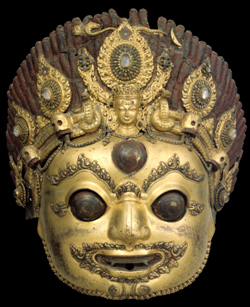
At the Rubin Museum of Art in New York City, there’s a mask of Bhairava on display, also from 16th century Nepal.

Bhirava mask

From the Rubin’s description:

While in his peaceful forms Shiva is depicted in human form, his wrathful form, the terrifying Bhairava, is shown as more monstrous than human, with demonic features that reflect his ultimately destructive purpose. Still this wrathful emanation remains connected to his non-violent alter ego. Not only does Shiva’s serene countenance gaze down from the center of Bhairava’s crown, but the terrible form also shares several important iconographic attributes with his peaceful counterpart, reinforcing Shiva’s dual role as destroyer and regenerator.

The Hindu god Shiva is a many-sided god. In this mask he appears in a wrathful state as Bhairava, while you can also see his peaceful alter-ego at the top of his crown. As the embodiment of Shiva’s destructive power, Bhairava eliminates ignorance and the ego to help practitioners reach spiritual enlightenment.

Bhairava is very popular, particularly in the small Himalayan country of Nepal. He is worshipped in temples and during festivals and by Hindus and Buddhists alike. Large Bhairava masks, such as this one, are unique to Nepal and play an important role in the festival celebration of Indra-jatra (a festival in the Katmandu Valley, celebrated by both Hindus and Buddhist practitioners.) On specific evenings home-brewed beer, stored in a hidden pot, is dispensed through a tube that emerges from the mask’s mouth. Devotees consume this beverage (created as an offering to Bhairava) with the belief that it will bring blessings upon them in the coming year.

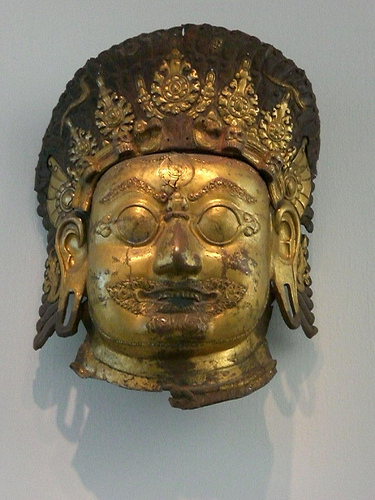
Yet another mask can be found at the Art Institute of Chicago. In the description on Knile’s Flickr page (who took the photograph of the mask below), he also mentions the beer aspect of the Bhairava.

Nepalese-made copper head of Bhairava, a form Shiva takes. A vat of beer sat behind the head, and tubes went down to the mouth from the vat. Believers would drink from these tubes.

bhairava_mask

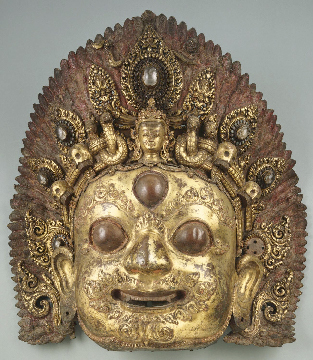
In 1999, the Philadelphia Museum of Art acquired a mask of the Nepalese God Bhairava, Bestower of Beer, which they describe with this story:

Lavish public festivals were vital to the politics of the Malla period. Some Malla kings revived fading traditions, while others introduced new practices to public worship in order to reinforce their claims to the throne or sway public opinion. This mask of Bhairava, a wrathful form of Shiva, was created during the Malla period for such a celebration. During a festival like Indra-Jatra, which is celebrated annually over several days in early fall, a mask like this is connected to a large pot filled with home-brewed beer. At an auspicious moment, the mask, garlanded with leaves and flowers, is wheeled out on a wooden platform and the sanctified beer is released suddenly, spurting out of its open mouth. As music plays, crowds of worshipers jostle to catch a mouthful of beer, considered a gift and a blessing from the god. Both Hindus and Buddhists worship this deity who is honored as the protector of the city of Kathmandu.

bhairava_mask-3

Known as the Face of Bhairava, it was made in the Kathmandu Valley, Nepal during the Malla Period (1200-1769), but is most likely circa 16th century. It’s made of mercury-gilded copper alloy repoussé with rock crystal, paint, foil, and glass and measures 29 x 25 x 18 inches.

In a 1999 press release, they elaborate:

The Hindu god Shiva bears many different names and forms across South Asia. In Nepal, the most important of these is Shiva in the form of Bhairava. Bhairava is a feared and ferocious god, needing to be pacified with offerings, but he is also a powerful guardian and the destroyer of evil. The Philadelphia Museum of Art welcomes a newly acquired image of this terrifying-yet beloved-deity. Fierce, powerful, elegant and delightful, the Face of Bhairava glares at visitors from high on a wall in the Gallery of Himalayan Art.

A huge, mask-like face, the Museum’s image of Bhairava is two and one-half feet high. Three bulging eyes, tangled hair, bared fangs, and ornaments of skulls and snakes indicate the god’s fierce nature. The gilded sculpture is constructed of multiple pieces of hand-beaten copper. Its face is topped with an exquisite crown wrought with lusciously realistic flowers and foliage, and inset with large cabochon rock crystals and glass jewels. Four perky serpents intertwine their bodies to form the crown. Their scales are overlaid with helmet-like skulls disgorging pearl chains and a small head of Shiva in his peaceful form. This sculpture most likely dates to the 16th century. Red pigment and ritual powder coat the curling flames that fan out above the crown, evidence that the image was worshiped for many years. Although missing its original round earrings, neck, and two lower hair segments, this fragile image of Bhairava has survived in an astonishingly complete state.

Monumental heads of Bhairava are made in Nepal for various festivals but most notably for Indra-Jatra, an important and complex multi-day event that takes place in early fall in the city of Kathmandu. Named after Indra, king of the gods’ heaven, the festival focuses on the reaffirmation of Nepal’s more worldly ruler. Along with honoring the dead, activities include the re-consecration of the king by the Kumari (the living goddess), and the commemoration of the conquest of Kathmandu by King Prithvi Narayan Shah, who conquered Nepal in the 18th century and founded the present dynasty. Another activity of Indra-Jatra is the honoring of Bhairava, who is not only one of the servants of the Kumari, but also the protective deity of the city of Kathmandu.

On the afternoon of the third day of the festival, an enormous mask-like copper image of Bhairava, much like the Museum’s sculpture, is specially garlanded with leaves and flowers and placed on a cart. The actual image in use today in Kathmandu was consecrated in 1795 and during most of the year is sequestered behind a latticework screen near the royal palace. During the festival, it is brought out and a large clay pot of home-brewed beer is placed behind and within the face. A copper pipe is run from the pot through a hole in the mouth of the image (the grinning mouth of the Museum’s Bhairava bears a hole the size of a penny between its fangs). After the Kumari has been honored, sanctified beer spouts from the pipe, drawn by gravity but appearing to spurt from Bhairava’s open mouth. As music plays, worshippers jostle to catch a mouthful of beer, for it is considered a gift and a blessing from the god. Other smaller images of Bhairava, made of metal, clay or wood—and also rigged to dispense beer—are used during the festival; the Museum’s Bhairava was originally intended for this purpose.

In the The Roots of Tantra, by Sunthar Visuvalingam and Elizabeth Chalier-Visuvalingam, there’s a fascinating chapter called Between Veda and Tantra: Pachali Bhairava of Kathmandu (Towards an Acculturation Model of Hindu-Buddhist Relations) in which they reveal just how closely beer is associated with the worship of Bhairava:

In the Newar tradition, each god has generally two temples. One is situated outside the town, and the god is venerated there in the open-air temple called a pitha. The other is inside the town, and the god is venerated in a closed temple called a dyahche in Newari. This dyahche is, in fact, a special room inside the house of the family who keeps the Bhairava jar. In the closed temple, Pachali Bhairava is represented by and worshiped as a jar filled with beer.

You can see yet another Bhairava mask at the Dallas Museum of Art and one being auctioned at Christie’s.

On a website about the Himalayan Gods, they reveal in that tradition “the inter-relationship between the worshiper and the worshiped is demonstrated each year on the night of the full moon during the Indra Jatra festival when the great mask of Bhairava, dated 1795, in the palace square in Kathmandu, issues sacred beer from its open mouth through a bamboo pipe to waiting devotees below.”

In Part 6. “Socio-Political Levels in the Sacrificial Schema, “they describe how at “[t]he annual festival of Pachali Bhairava is based on the Hindu sacrificial schema, where there reappears the ancient theme of the theft of the Fire and Soma (ambrosia), represented in the present case by the jar of beer.”

A God known as “The Bestower of Beer” and “worshiped as a jar filled with beer!” How have I never heard of this before?

Filed Under: Art & Beer, Beers Tagged With: History, Nepal, Religion & Beer

Beer In Art #44: Donald Curran’s Having A Pint

September 20, 2009 By Jay Brooks

art-beer
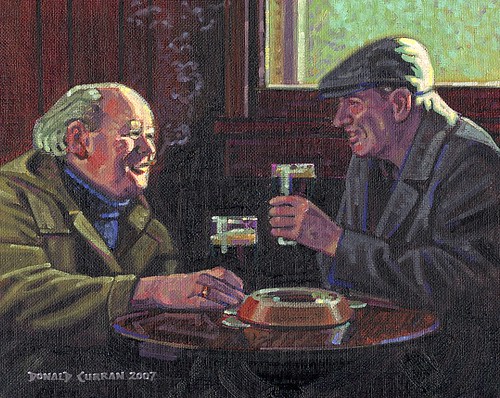
Today’s artist is Donald Curran, who lives in St. Louis. He spent most of his career as an illustrator, including “designing and illustrating high end collectible steins for Anheuser-Busch.” After turning his attention to fine art, he’s been creating paintings of a wide range of subjects, including this one, entitled Having a Pint.

Curran_having-a-pint

This one was painted in 2007 and Curran, like all his works, describes it simply. “This is a painting I did of two gentlemen having a pint in a pub in Ennis, County Clare.” Given he worked for A-B, it’s probably not too surprising that he’s done a number of paintings of life in pubs. Here are a few of them below.

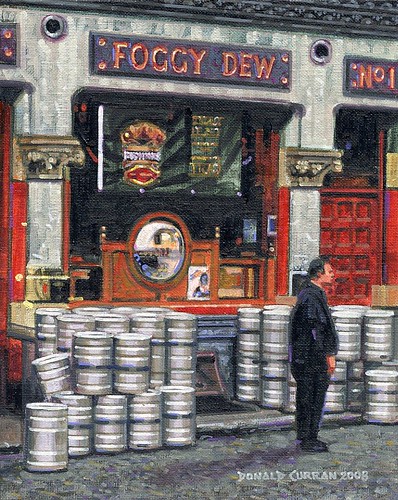
Curran_foggy-dew
Dublin Pub. “This is a painting I did of a man waiting for the beer delivery truck in front of a pub in Dublin, Ireland.”

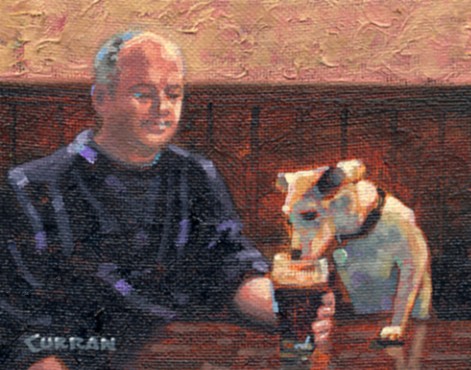
Curran_sharing-a-beer
Sharing a Beer. “This is a painting in a series of three I did of a little dog watching a man drink a beer in a pub in Ireland. The dog finally gets it’s wish.”

From the biography on his website:

After graduating from high school, he studied at the Kansas City Art Institute. In 1975 Donald began a career as a successful illustrator. As an illustrator he is best known for designing and illustrating high end collectable steins for Anheuser-Busch, Inc. After twenty years of working for hundreds of major national and international companies, he decided to devote himself to his first love of fine art painting.

Donald now creates paintings of all the things he loves. He claims finding material to paint is as easy as keeping your eyes open. His travels around the world provide him the material that motivate him to paint. His home in Missouri will always be a major influence on his work. The change of seasons and beauty of the mid-west continue to keep him residing there.

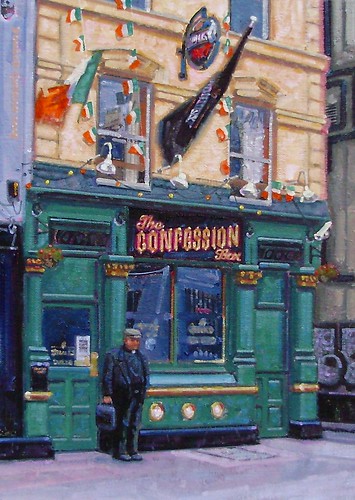
Curran_confession-box
A Dublin Pub. “This is a painting I did of the famous “CONFESSION BOX” pub in Dublin.”

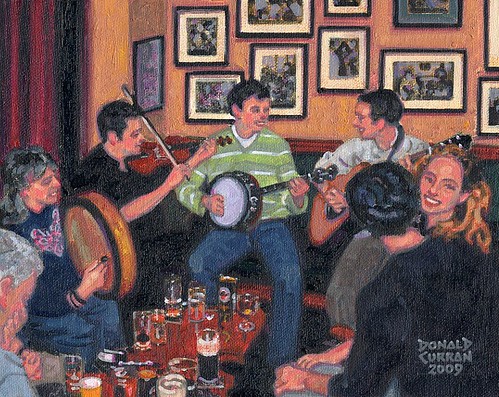
Curran_Galway-pub
Galway Pub Music. “This is a painting I did of a group of people singing and playing music at the Tig Coili Pub in Galway.”

Donald’s work has been exhibited in numerous museums, galleries and exhibitions. His paintings can be found in collections throughout the US, Canada, Europe and Asia. He was commissioned to do three paintings for the 2002 Winter Olympic Games in Salt Lake City, Utah.

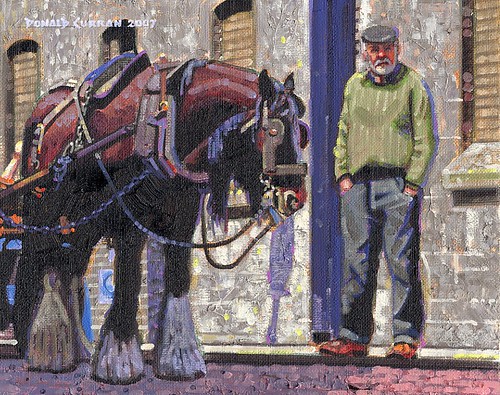
Curran_outside-Guinness
Outside the Guinness Brewery. “This is a painting I did of a man with his horse and wagon standing outside the Guinness Brewery in Dublin.”

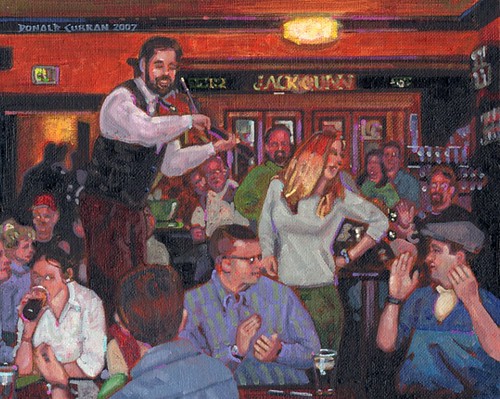
Curran_pub-party
Party at the Pub. “This is a painting I did of the inside of a pub in the city of Cork. It looked like everyone was having a grand time!”

You can also see additional pieces by Curran at Mystic Sea, the Museum of America and the Sea, Artnet, the gallery at his website, and his blog.

Filed Under: Art & Beer Tagged With: Ireland, Missouri

Beer In Art #43: Petrus Staverenus’ Man Brandishing A Beer Glass

September 13, 2009 By Jay Brooks

art-beer
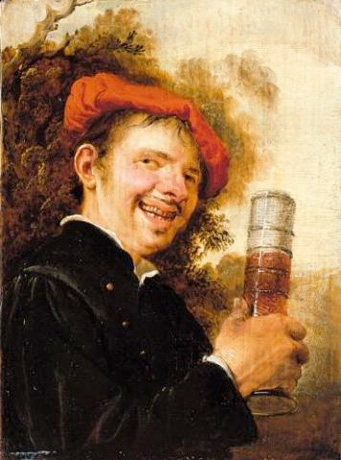
Today’s artist is Dutch, and all I know is that he was active from around 1634 to 1654. His name was Petrus Staverenus and the painting below is called Man Brandishing A Beer Glass, although it’s sometimes also titled A Man in a Landscape, Raising a Beer Glass.

Petrus_Staverenus-beer

I know Staverenus is considered to be an “Old Master,” but that pencil mustache — though undoubtedly common four centuries ago — seems almost comical now. He looks like a villain in a melodrama. A bit too “Snidely Whiplash.” Along with that goofy hat and the smirk on his face, he certainly seems untrustworthy to me; the 17th century equivalent of a used car salesmen.

The auction house, Christie’s, listing another piece by him, doesn’t know much more, either. “Little is known about the artist. He is recorded in The Hague in 1634-54.” You can also see another work at ArtFact.

Filed Under: Art & Beer

Beer In Art #42: Cat Scott’s Paintings Of Beer On The Wall

September 6, 2009 By Jay Brooks

art-beer
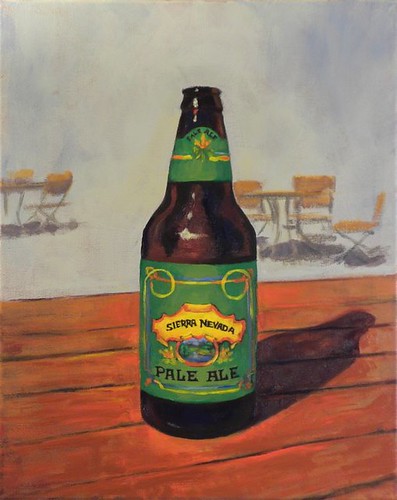
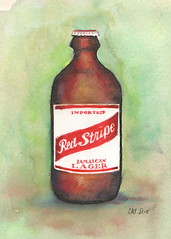
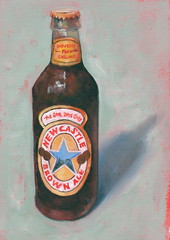
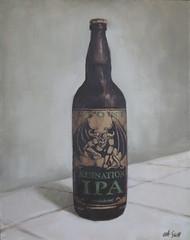
Today I want to showcase an artist who’s painting a series of beer bottles that will eventually be nearly 100. The artist, Cat Scott, is calling the series 99 Paintings of Beer on the Wall. She’s finished a dozen so far, and here’s a familiar one, Sierra Nevada Pale Ale.

Cat_Scott-Sierra_Nevada

Scott is primarily an illustrator and graphic designer, but loves to paint and draw in her spare time. Of the project itself, she says. “I like beer, and I like painting. So why not combine the two? I intend on doing 99 paintings of many different types of beer.”

Cat_Scott-red_stripe Cat_Scott-newcastle

Here’s some biographical information about Scott, from her website:

I was born and raised in Louisville, Kentucky and, like many artists, spent my childhood drawing and painting. With generous gifts of art supplies from my parents, I developed quite a knack for rendering. After taking as many art classes as possible during my high school years, I ventured off to the University of Dayton to study graphic design. My love for the fine arts led me to concentrate on Illustration.

After receiving several awards for my art and being honored as the Most Outsanding Graduating Senior in Visual Communication Design, I graduated with honors in 2003. In 2006 I attended the Illustration Academy and worked with illustrators and artists such as John and Mark English, Sterling Hundley, George Pratt, Gary Kelley, Brent Watkinson, Anita Kunz, and CF Payne.

My full time gig as a Graphic Designer in Santa Monica, California gets the rent paid and inspires creativity, but there’s nothing like taking a pen/brush/marker to paper.

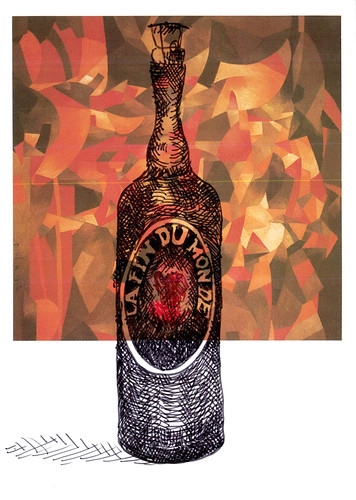
One of my favorites is her Unibroue La Fin Du Monde, which is actually different then the rest of the works. It’s not painted, but instead is a pen and ink drawing over top of a postcard of Francis Picabia’s La Source (“The Spring”).

Cat_Scott-LaFin_DuMonde

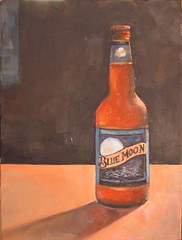
Here’s two more. With twelve done, she has 87 left to paint. It may take a few years, but it will be fun to watch. If you own a brewery, maybe you want to consider commissioning her to paint one of your bottles. That way you get a cool painting, you support the arts and further the project.

Cat_Scott-blue_moon Cat_Scott-Stone_Ruination

You can more of her work at her own website, Cat Scott and her blog. She’s also a member of Girls Who Draw, a website featuring a baker’s dozen of female artists showcasing their art.

Filed Under: Art & Beer Tagged With: California, Southern California

Beer In Art #41: Dudley Pout’s Barley & Beer Time

August 30, 2009 By Jay Brooks

art-beer
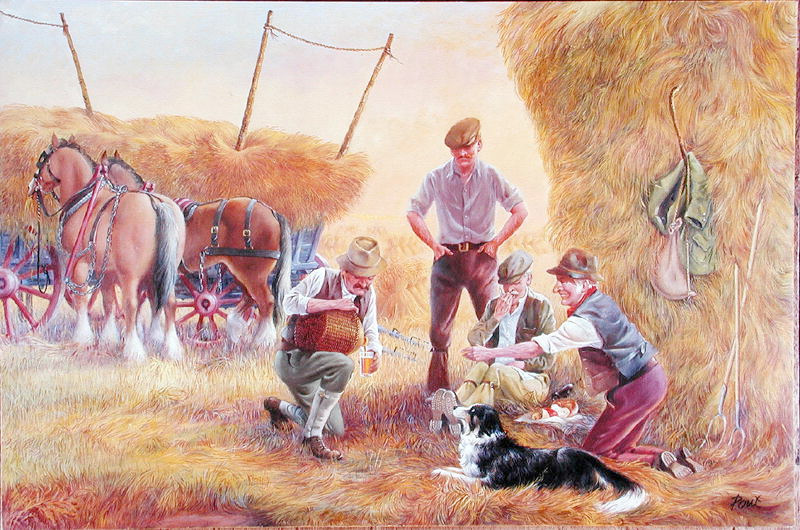
Today painting is entitled Barley and Beer Time and was created by Dudley Pout.

Dudley_Pout-barley_beer

Apparently Pout was primarily an illustrator comic artist who was most well-known for his movie poster artist. He was born on a farm and began doing oil paintings of farm scenes after retiring and moving back to the same type of farm he grew up on. There’s not to much information I could find about him, except on a blog about British comics called Bear Alley, who fills in some biographical detail.

Edward Dudley Pout was born at Frog Island Farm, Herne, Kent, on 24 November 1908, the 2,000 acre farming estate being owned jointly by Pout’s father and his four brothers. The Pout family moved to various farms, and at the age of 8, young Dudley attended the village school at Swalecliffe where his headmistress recognised his drawing ability and arranged for an interview with the principal of Margate School of Art. He was awarded a full-time Art Scholarship, and at the age of 13 became their youngest ever student.
…
After the War, Pout continued to work as a freelance commercial artist, and [from the 1950s through 1962, he drew comic books until], mindful of the decline in sales and concern for his wife’s poor health, was forced to leave comic strips behind.

Pout moved back to Kent and resumed farming, specialising in cross-breeding cattle. He retired in 1973 to a small house in Biddenden, Kent, where he painted in oils for pleasure, although he also produced a series of ‘Farming in Bygone Days’ paintings for a postcard company. Pout lived at Gribble Bridge Lane Farm, Biddenden, Ashford, Kent, where he died on December 12, 1991, aged 83.

So that suggests that Barley and Beer Time was most likely painted in the 1970s or 80s.

You can a peak at his comic book work at Bear Alley and more of his later oil paintings at the Bridgeman Art Gallery.

Filed Under: Art & Beer Tagged With: barley

Beer In Art #40: Emily Zasada’s Beer Paintings

August 23, 2009 By Jay Brooks

art-beer
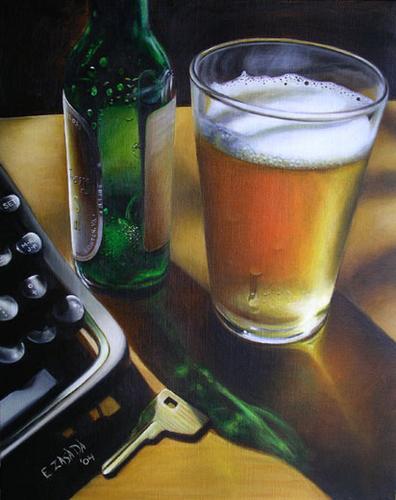
This Sunday’s work of art is by a contemporary artist from Virginia who often paints wine, in fact so much so that her domain name is winepaintin.gs. Her name is Emily Zasada, and she’s also done a couple of paintings of beer, too. The painting below is a still life called Beer, Typewriter and Key

Zasada_Emily-Beer_Typewriter

From her biography at her website:

Why realism?

I’m not sure. I’m not a patient person, so even I don’t always understand why I’ve chosen to focus on this type of art. But the details of objects fill our lives; they’re background players and constant companions, even though they’re largely unnoticed. Consider the faint curve of the keys of the computer keyboard under your fingers, for example, or the pale translucent light that lightly brushes the rim of your coffee cup. All of these tiny things give our life texture and beauty, if we stop just for a moment to examine them and pause in the middle of an enormously rushed day.

So I guess that transferring these details into a painted image pays homage to these details, carved out by light and scattered throughout our daily lives. Light is so important in my paintings that possibly it isn’t really realism that I’m after, but a glowing version in which the light that brushes over an object and carves shadows around and through it is itself an artist, changing the hues and shapes of objects as the hours pass in a day.

I’m self taught, and have been painting for nearly 5 years. An article about my work was featured in the spring 2005 edition of the Virginia Wine Gazette, and one of my paintings was also chosen for the cover art. One of my paintings was also featured on the cover of the Long Island Wine Gazette and another painting was featured as the cover of the program for the 2006 Virginia Wine Festival.

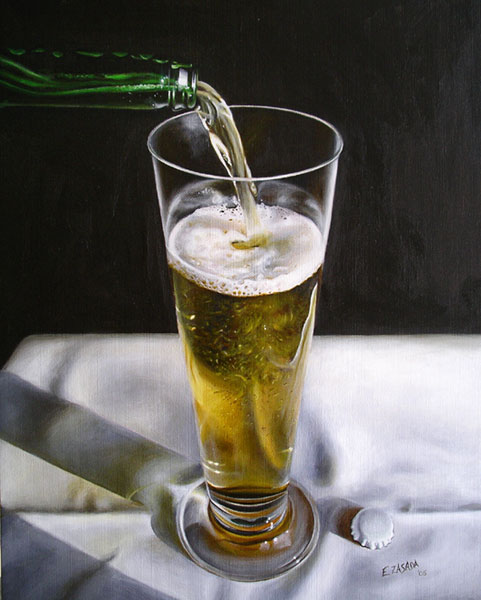
Despite her wine focus, I discovered at least one more beer painting she did, this one entitled Afternoon Pour.

Zasada_Emily-Beer_Pilsner

You can see more Zasada’s artwork at a gallery at Art Wanted and, of course, at her main website.

Filed Under: Art & Beer Tagged With: Virginia

Fishnet Cans

August 17, 2009 By Jay Brooks

beer-gal-2
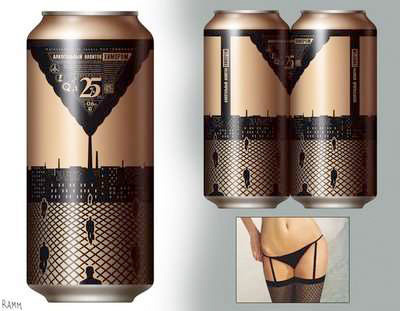
First there was Nude Beer (in its many incarnations), then Wanker, Skinny Blonde Ale and now comes the latest beer to play to the basest instincts of the male beer drinker: lingerie canned beer with fishnet stockings.

lingerie-beer

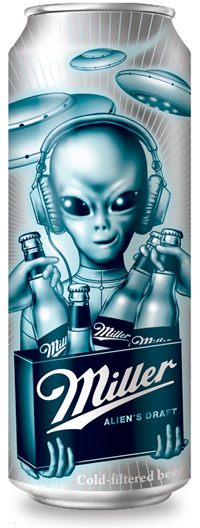
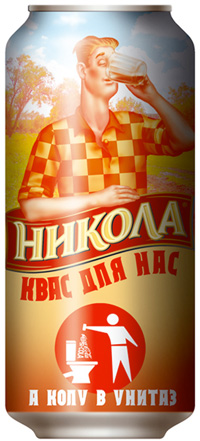
At least that was my original thought. The Fishnet Cans have been blogged and re-blogged all over that series of tubes known as the internet. But, as it turns out, they are just one of a pretty big series of can designs by Russian artist/illustrator Ramm ND. It’s not necessarily his or her fault that so many chose to highlight the one prurient themed can and ignored the more poignant works. Human nature is what it is. Take a closer look at the Fishnet Cans and you’ll begin to see new details that defy it being simply to titillate. Then take a look at his entire oeuvre of cans. Some are beer and some are soda, but they’re all more interesting than I would have guessed from just seeing the one in fishnets.

ramm-miller

In fact, going through Ramm’s entire portfolio is eye-opening. And I think he’s making some larger points. These aren’t just can designs, they’re works of art using cans as the medium.

ramm-hhkoaa

Ramm also has another portfolio on Coroflot.

Filed Under: Art & Beer, Beers, Editorial Tagged With: Cans, Packaging, Women

Beer In Art #39: Phoebus Levin’s Life In The Hop Garden

August 16, 2009 By Jay Brooks

art-beer
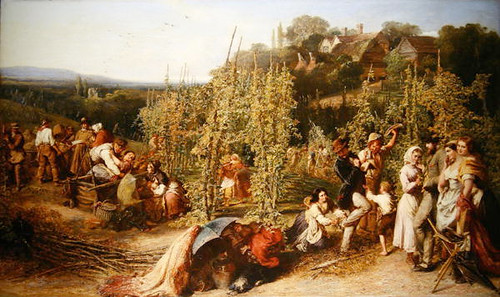
Today’s work of art depicts Life in the Hop Garden, and is by illustrator Phoebus Levin. It was painted in 1859 and today the original resides at the Towneley Hall Art Gallery and Museum located in Burnley, Lancashire.

Phoebus_Levin-hop_garden

Levin lived from 1836-1878 and was born in Berlin, but exhibited in London from 1855-1878. That’s about all the biographical information I could find about him. You can see a few more of his works at My Art Prints and ArtNet.

Filed Under: Art & Beer Tagged With: England, Hops, UK

Beer In Art #38: Lawson Wood’s Nine Pints Of The Law

August 9, 2009 By Jay Brooks

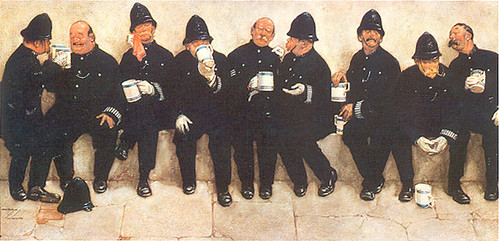
Since I just returned from England and the Great British Beer Festival I thought it made sense that today’s work of art is decidedly British. It’s a humorous work entitled Nine Pints of the Law by famed illustrator Lawson Wood.

Wood-Lawson_9-pints

One website describes the painting like this:

World-worn and weary after a hard day’s work, these British bobbies still have the strength to heave a hefty pint of ale. Artist Lawson Wood takes a lighthearted look at his country’s comical constables in characteristically British style.

And here’s a brief overview of Wood, according to one biography:

Clarence Lawson Wood (1878 – 1957) was born at Highgate, the grandson of the landscape painter L J Wood. He studied at the Slade School and at Heatherley’s and was the chief artist on the staff of C Arthur Pearson Ltd for a number of years. He served in the Kite Balloon Wing of the Royal Flying Corps during the First World War.

Wood’s work is usually in ink and watercolour and most of it is humorous in style and content and he was a member of the London Sketch Club. His repertoire of characters includes policemen, army officers, Stone Age people with dinosaurs and, most popularly, the orang-utan, Gran’pop, introduced in the 1930s.

Gran’pop appeared weekly in the Sketch for a number of years and his fame translated to the US, where Wood prepared at least four animated cartoons for production in Hollywood.

Lawson Wood, as he signed his work, retired from the world of illustration and lived in Kent in seclusion until he died at the age of 79.

For a more thorough biography, check out Been Publishing, I’m Back, and there’s also Art in a Click. To see more of his work, try the Baron Fine Art Gallery, Chris Beetles or Poster Unlimited.

Filed Under: Art & Beer Tagged With: England, Illustration, UK

« Previous Page
Next Page »

Find Something

Northern California Breweries

Please consider purchasing my latest book, California Breweries North, available from Amazon, or ask for it at your local bookstore.

Recent Comments

  • Bob Paolino on Beer Birthday: Grant Johnston
  • Gambrinus on Historic Beer Birthday: A.J. Houghton
  • Ernie Dewing on Historic Beer Birthday: Charles William Bergner 
  • Steve 'Pudgy' De Rose on Historic Beer Birthday: Jacob Schmidt
  • Jay Brooks on Beer Birthday: Bill Owens

Recent Posts

  • Historic Beer Birthday: Frederick Gettelman Jr. August 1, 2026
  • Beer In Ads #5307: Heute Bock Double Goats July 31, 2026
  • Historic Beer Birthday: Rita Daigle July 31, 2026
  • Beer Birthday: Jonathan Surratt July 31, 2026
  • Beer In Ads #5306: Heute Bock! From The Tap July 30, 2026

BBB Archives

Feedback

Head Quarter
This site is hosted and maintained by H25Q.dev. Any questions or comments for the webmaster can be directed here.