Brookston Beer Bulletin

Jay R. Brooks on Beer

  • Home
  • About
  • Editorial
  • Birthdays
  • Art & Beer

Socialize

  • Dribbble
  • Email
  • Facebook
  • Flickr
  • GitHub
  • Instagram
  • LinkedIn
  • Pinterest
  • RSS
  • Twitter
  • YouTube

Powered by Genesis

Beer In Ads #4: Thirst Is Only Through Good Beer

November 5, 2009 By Jay Brooks

ad-billboard
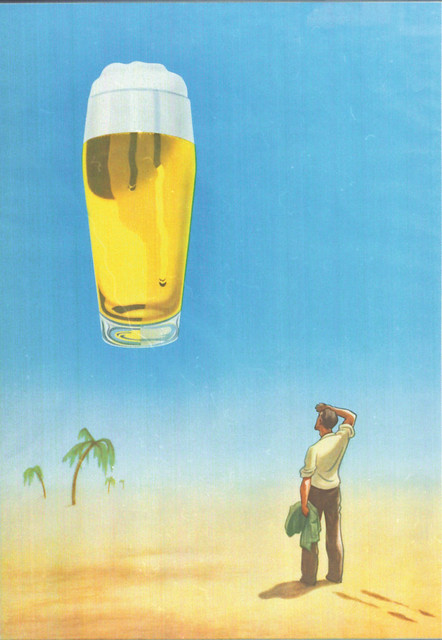
Today’s beer ad is from Germany. I saw an original of it framed at the Franconian Brewery Museum in Bamberg when I was there a couple of years ago. It was originally an advertisement for Gaffel Kolsch. The text reads “Durst wird durch Bier erst schon,” which Google translates as Thirst Is Only Through Good Beer. That’s the best-sounding one I came across, though I suspect it’s closer to something like “Thirst Is Only Quenched Through Good Beer.” Other translators came up with “thirst becomes through beer first already,” “thirst becomes by beer only already” and “thirst with beer is just been.” If you’re fluent in German, let me know what a better translation is. Still, I love the idea of being out in the desert and the mirage you see is a giant glass of beer. What better sight could there be under such circumstances?
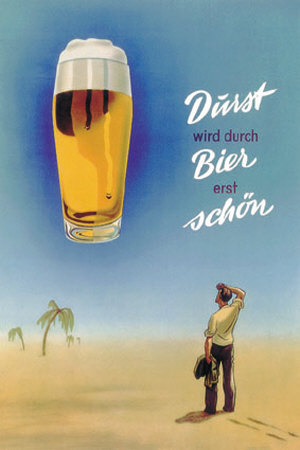
durst-bier

It was also sold as a poster without the text.
Gaffel_Koelsch_Bierglas_Mann-in-der-Wueste-high

Filed Under: Art & Beer, Beers, Just For Fun Tagged With: Advertising, Germany

Beer In Art #50: Pieter Bruegel’s Peasant Dance

November 1, 2009 By Jay Brooks

art-beer
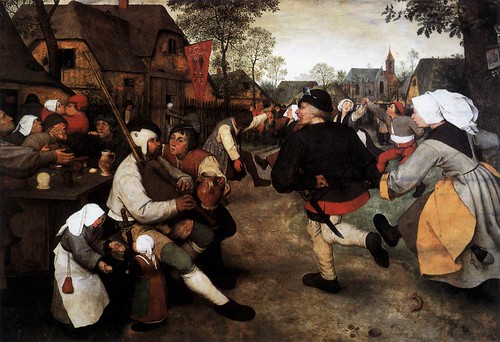
For today’s work of art we return to an old master, Pieter Bruegel (the Elder), considered by many to be the greatest Flemish sixteenth-century master. He was born in the Netherlands around 1525 and died in 1569. He was a Renaissance painter who began the Bruegel Dynasty that included six well-known artists. (It was originally spelled Brueghel, but in 1559 he stopped signing his paintings with the “h” in his last name). He was especially known for his landscape paintings that were populated by peasants, and in fact “is often credited as being the first Western painter to paint landscapes for their own sake, rather than as a backdrop for history painting.” Sadly, only 45 of his works survive to the present. In March, I featured his painting Harvesters, and today’s work by Brugel is entitled Peasant Dance, the original of which is at the Kunsthistorisches Museum in Vienna, Austria. It was painted in the last years of Bruegel’s life, most likely between 1566 and 1568.

Bruegel-peasant-dance

The Web Gallery of Art describes their interpretation on the meaning of Peasant Dance:

Like The Peasant Wedding, it is likely that Bruegel intended this painting to have a moral sense rather than simply being an affectionate portrayal of peasant life. Gluttony, lust and anger can all be identified in the picture. The man seated next to the bagpipe player wears a peacock feather in his hat, a symbol of vanity and pride. The occasion for the peasants’ revelry is a saint’s day, but the dancers turn their backs on the church and pay no attention whatsoever to the image of the Virgin which hangs on the tree. The prominence of the tavern makes it clear that they are preoccupied with material rather than spiritual matters.

But the Humanities Web describes in much less sinister terms. “The joviality of this picture is infectious. Bruegel’s eye objectively captures many scenes: cantankerous drunkards; a couple kissing; a feisty older man pulling a young peasant woman to join him in a dance; and children imitating their dancing elders.”

Encyclopedia.com also has a nice article on the artist, and indicate the importance that the Peasant Dance represented in Bruegel’s career:

The Peasant Dance (ca. 1566-1567) represents a new and important direction that Bruegel was to develop in the last years of his career. In this work the painter changed to a “large-figure” style in which highly animated peasants are organized to convey the rhythms and patterns of the dance. Also, by reducing forms to their elemental essences Bruegel achieved a clarity of design and coloration that has seldom been rivaled in Western painting.

If you want to learn more about the artist, Wikipedia, the Metropolitan Museum, Art Show Magazine, the Art Archive or the ArtCyclopedia are all good places to start. And to see more of his work, both Ricci-Art and Art Show Magazine have good collections, and Pieter-Bruegel-the-elder.org appears to have most of his known works.

Filed Under: Art & Beer Tagged With: Europe

Wacky Packages

October 31, 2009 By Jay Brooks

halloween
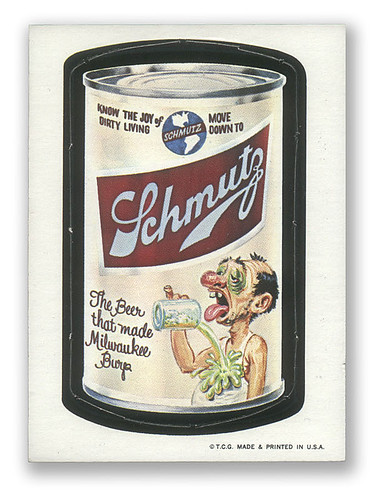
I kept looking at those four spoof beer labels that I posted earlier today for Hoppy Halloween because they reminded me of something, but I couldn’t quite put my finger on it. Then it hit me: Wacky Packages, those weird parody stickers that Topps debuted in 1967. Like most eight-year olds at the time, they were quite popular with me and my friends. What I didn’t realize is that they’ve continued to make them almost ever since. The Wacky Packages Website has a complete listing of all the Wacky Packages put out over the years and Topps even continues to maintain a new “official” Wacky Packages website. Not surprisingly, there have been several beer spoofs done, the first one being the very first year. It was a spoof of Schlitz, then one of the most popular beer brands.

wp-schlitz

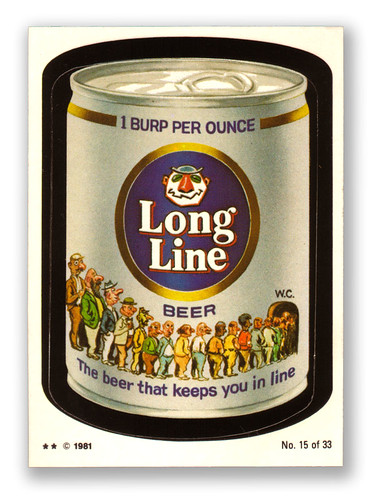
Later ones included most of the other popular national beer brands and a few originals, like Long Line Beer, from 1981. A search of the website revealed nine different beer brands, with some variations of Pabst and a few additional beer-related ones for other products.

wp-long-line

Below is a slideshow of all of the beer-themed Wacky Packages I found, including one of port wine just because I liked it and a few that are only beer-related.

Filed Under: Art & Beer, Beers, Just For Fun Tagged With: Halloween

Art In Ads #3: The King Of Spades

October 29, 2009 By Jay Brooks

ad-billboard
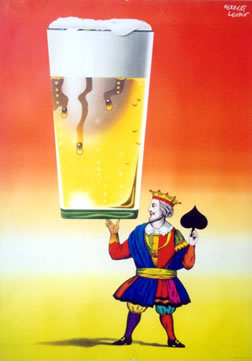
Today’s beer ad is another beautiful illustration, though I have no idea either what beer is being advertised but the artist is Herbert Leupin, a Swiss poster artist who lived from 1916 to 1999. This work was created in 1953. Whatever the brewing company, it’s a beautiful illustration. Perhaps if the King of Spades had offered his beer to Red Queen in Alice in Wonderland, she might not have been so mean.

The King of Spades

Filed Under: Art & Beer, Beers, Just For Fun Tagged With: Advertising

Beer In Art #49: Sharon Hammond’s Belgian Beer Cafe

October 25, 2009 By Jay Brooks

art-beer
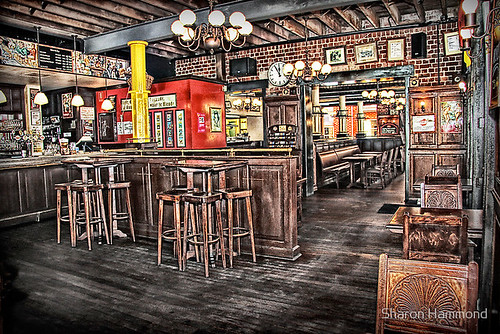
For today’s artwork we’ve gone almost as far away from the U.S. as possible, to Adelaide, Australia. Adelaide is the capital of South Australia, and is fairly large, with a little over 1.1 million people. It’s also home to the Belgian Beer Cafe Oostende, the interior of which is the subject of today’s work of art by local artist Sharon Hammond.
Sharon-Hammond_adelaide
Although it initially fooled me, the work is actually a photograph that’s been processed to look more like a painting. The photograph is called Belgian Beer Cafe Adelaide and is the interior of what looks like a very large bar.

On the cafe’s website, they describe the bar:

The Belgian Beer Cafe – Oostende is designed to take you back to a simpler time. Belgian Cafes circa 1930 to 1955 to be exact. As you look through the venue you will notice decorative items typical to this period are cleverly displayed. Not drawing attention to themselves per se, but adding to the unique atmosphere as a whole. Clocks, posters and lighting fixtures are all reminiscent of the era.

Consider the panelling and seating made of specially imported European oak, tastefully combined with numerous vintage pieces dating back to the beginnings of last century, and you’ll begin to see why the Belgian Beer Cafe – Oostende is fast become one of Adelaide’s favourite venues. Of course the magnificent Belgian beers and cuisine, along with the service that won the 2002 & 2004 AHA Best Bar Presentation & Service awards certainly helps.

As for the artist, Sharon Hammond, there’s not much biographical information, apart from some mildly revealing journal entries. She lives in Adelaide, as far as I can tell, and she has more of her works on Red Bubble and on Kiss the Frog.

Filed Under: Art & Beer Tagged With: Australia, Belgium, Photography

Beer In Ads #2: The Spanish Senorita

October 22, 2009 By Jay Brooks

ad-billboard
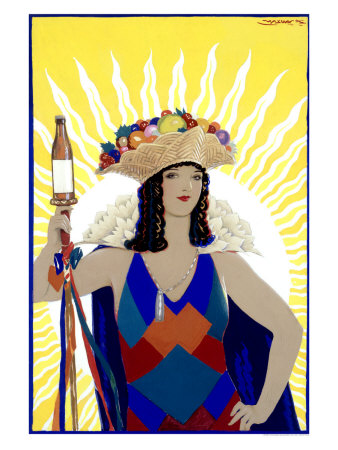
Today’s beer ad is a beautiful illustration by Achille Mauzan, an Italian artist who created many posters and other illustrations during the Art Deco period from the 1920s-40s and beyond. He was born Luciano Achille Mauzan in the French Riviera but spent most of his life in Italy and Argentina. This ad was created for an unknown Spanish beer, depicting a senorita, “adorned in customary garb, having this brand fixed atop a staff-like scepter.”

Achille Mauzan: The Spanish Senorita

Filed Under: Art & Beer, Beers, Just For Fun Tagged With: Advertising, Europe, History, Spain

Beer In Art #48: Stan Ruszala’s Asheville Bars & Beer

October 18, 2009 By Jay Brooks

art-beer
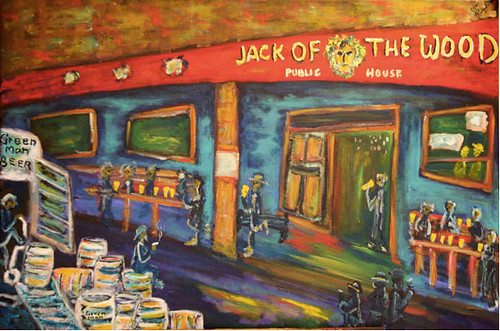
Since we’ve been in Asheville, North Carolina all week, I was happy to stumble on a local artist at a Cuban restaurant we ate at, called Havana. The artist’s name is Stan Ruszala, and he had a little exhibition going on in the back room of the restaurant. He appears to live near Asheville and paints beer and other alcohol subjects in Dublin, Las Vegas, New York, and, of course, Asheville. Here’s his painting of the bar Jack of the Wood (which also brews Green Man Ales down the road).
Ruszala_jack-in-wood

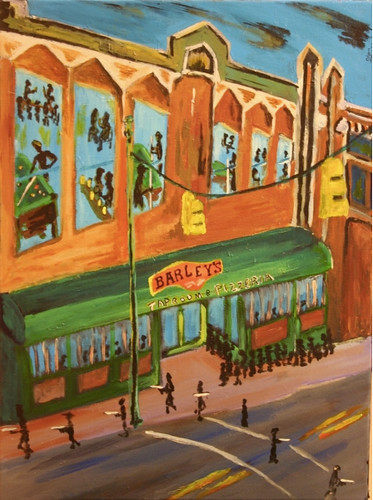
And here’s one of the city’s best places for local beers, Barley’s Taproom.
Ruszala_barleys

His biography from his website gives some more detail about him:

Stan Ruszala was born and raised in Springfield Massachusetts. Although he has always had an interest in art, he began painting prolifically about five years ago when his wife noticed artistic talent in sketches and doodles he would leave around the house. She promptly bought him everything she thought he could possibly need to pursue a career in art. Stan picked up a brush, and you are looking at the result. He finds most of his inspiration from city scenes at night and chooses to paint mostly crowded streets in front of local or famous establishments. His use of a black canvas to begin, and fluorescents to highlight help distinguish his unique style. Stan has had numerous art shows, sold several pieces and is being displayed all over the world. He lives near Asheville, North Carolina with his wife Mickey and their ~13 pets.

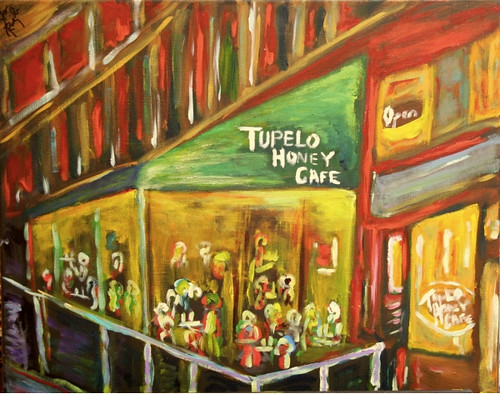
And while not strictly a beer place, we did eat at the famous Tupelo Honey Cafe, depicted here by Ruszala, one of two paintings of the restaurant.
Ruszala_tupelo

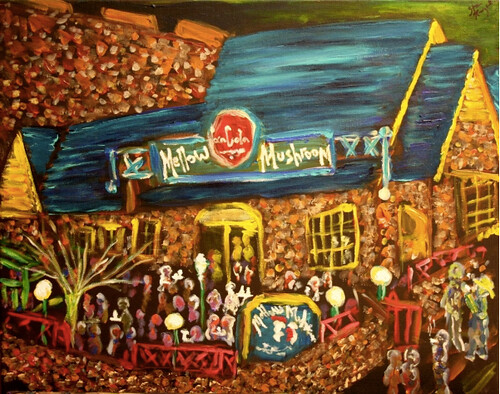
And the kids just loved the pizza at Mellow Mushroom, and the beer list was pretty darn good, too.
Ruszala_mellow-mush

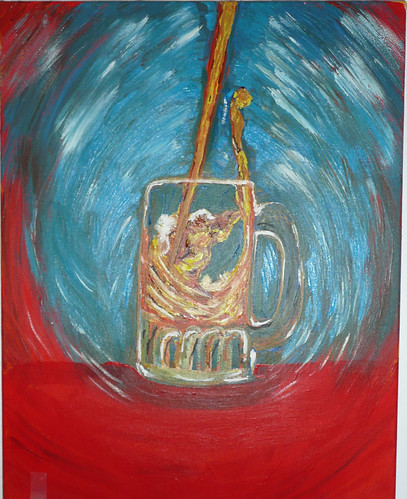
I think my favorite painting of Ruszala’s was an untitled one that wasn’t on his website but which was in the exhibit at Havana. Unfortunately, the colors are washed out a little bit in my photo, but it’s a dramatic moment captured on canvas.
Ruszala_beer

Filed Under: Art & Beer Tagged With: Asheville, North Carolina, Southern States

Beer In Art #47: UC Berkeley’s Historical Beer Exhibition

October 12, 2009 By Jay Brooks

art-beer
This past Saturday, October 10, the Heart Museum at UC Berkeley held a special beer fair and symposium for their latest exhibit, 99 Bottles of Beer: Global Brewing Traditions 2500 BC – Present.

99-bottles

I’m fascinated by the history of beer and especially the notion that beer just might possibly be responsible for civilization itself. The Berkeley exhibit was also the subject of one of my recent newspaper columns. I was able to meet with the curator, Ira Jacknis, and preview the collection as he spoke about the exhibition.

The artistry of many of the pieces is obvious, but instead of choosing just one or two, here is the entire collection and a summary of the Beer Fair and Symposium that kicked off the beer exhibition, which will be on display at the Hearst Museum at UC Berkeley for at least one year. Stop by and see it in person when you have a chance.

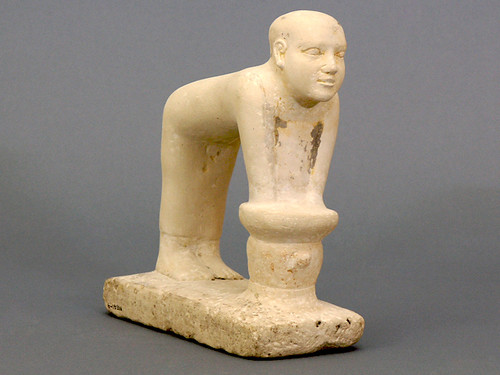
Cat. No. 6-19811
The oldest piece in the collection was from the Old Kingdom in Egypt from the 5-6 Dynasty (2465-2150 BCE). It’s the figurine of a servant woman “straining mash for beer” in painted limestone.

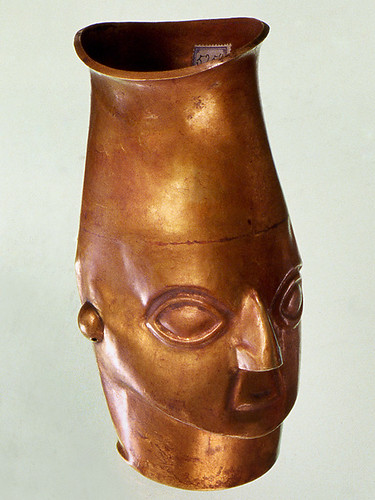
Cat. No. 4-5255
A corn beer tumbler in gold from the Ica Valley of Peru. It dates from the Late Intermediate Period (1000-1476). According to the museum, “Incans graduated their drinking vessels, according to material. The lowest-ranked used gourd bowls, the better-off had finer ceramic and wooden cups, while gold and silver cups were reserved for the elite. The cups were often used in pairs, especially the ornate ones of the emperor.”

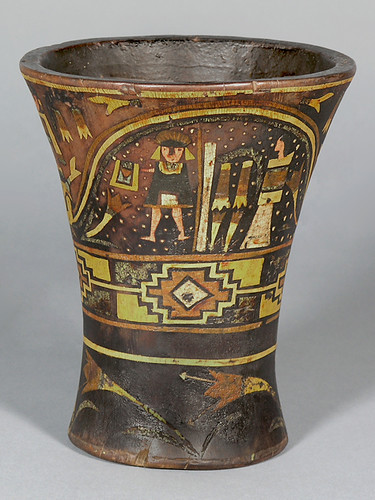
Cat. No. 16-14917
Another corn beer cup from Peru, this one made of polychromed lacquered wood. It was found in Cuzco and is believed to be from the late 16th-17th century. “Like the ancient Incan cups, these wooden cups were made and used in matched pairs. While the shape was conservative, the decoration was innovative, the figures and flowers showing a Spanish influenced. Apparently, they ceased being made after the 1820s. The beer was sprinkled or poured on the ground as a divine offering.”

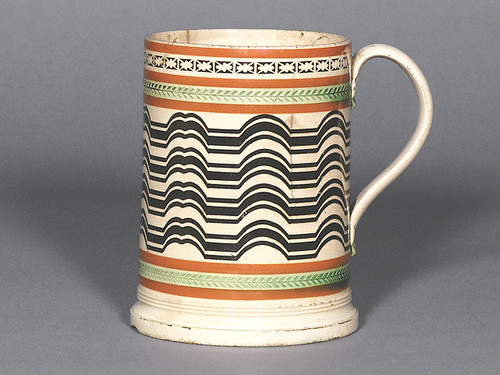
Cat. No. 7-6408
An English mug from the early 1800s, probably from the first quarter of the 19th century. It’s made of lead-glazed pearlware and was found in Staffordshire.”

Below is a slideshow of the day’s events, the collection itself (including press shots) and some photos from my preview of the collection. This Flickr gallery is best viewed in full screen. To view it that way, after clicking on the arrow in the center to start the slideshow, click on the button on the bottom right with the four arrows pointing outward on it, to see the photos in glorious full screen. Once in full screen slideshow mode, click on “Show Info” to identify each photo.

Filed Under: Art & Beer, Events Tagged With: Bay Area, California, History, Northern California, Photo Gallery

Beer In Ads #1: Beer Belongs

October 8, 2009 By Jay Brooks

ad-billboard
For nearly a year now, every Sunday I’ve been exploring the intersection of the world of art with beer in my Beer In Art series. In searching for more art to showcase, I keep coming upon wondrous examples of advertising illustration. So far, I’ve been reluctant to use them because there’s plenty of fine art involving beer to keep my Sunday’s busy for quite some time. So instead, I figured I’d start featuring advertising art with beer as a separate series. Every Thursday I’ll highlight a beer ad, usually one from the past, that has some impressive artwork associated with it.

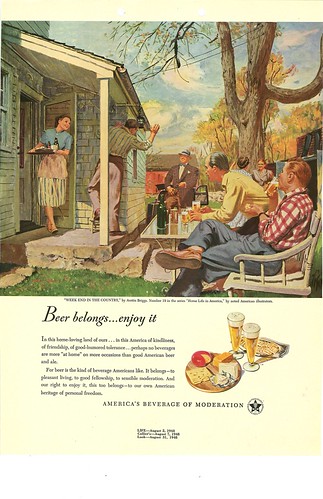
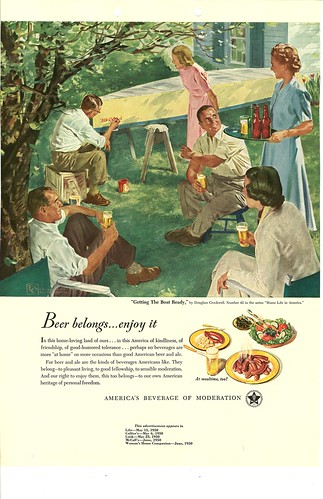
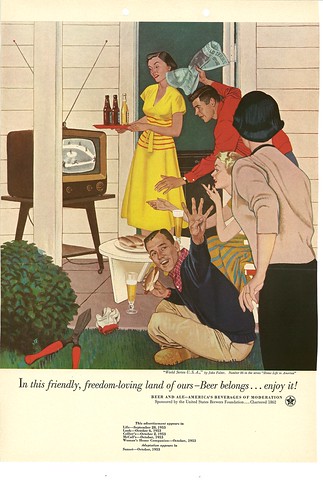
To begin, there can be no better choice than the Beer Belongs series that the United States Brewers Foundation (USBF) did from 1945-1956. The bulk of the series, known as the Home Life in America series, ran from 1946-1956 and included 120 numbered ads. In addition, there were several more unnumbered ads that both preceded the Home Life series and were run after its conclusion. They were so popular, even Mad Magazine did a spoof of the ads. You’ve probably seen them at flea markets and antique shows. I have several of them framed in my hallway. About a year ago, I became curious about how many ads were produced and tried to learn about their history. Unfortunately, there wasn’t much out there and after trolling auction sites and the internet for a good six months, off and on, I put together a complete list of all the ads. I collected graphic versions of all the ads with the help of the Beer Institute and got a taste of their origins and history by reading the minutes of meetings by the USBF and looking at old trade publications and books that mention the ad campaign.

That led to an article about this popular ad campaign in this month’s All About Beer magazine (the November 2009 issue, beginning at page 44). Obviously, All About Beer couldn’t run all of the ads, so I’ve put them into a Flickr gallery so you can view all 120 of them, possibly for the very first time anywhere. That’s at the bottom of this post. You can also see the rest of them (the ones that came before and after, along with the spoofs) at my Beer Belongs … Enjoy It! page. There, you can also read some more about the ads and find out a little bit more of their history, though I’d also encourage you to pick up the article in this month’s All About Beer, too, to get the full picture.

bb-header

Here are three representative examples from the Home Life in America series:

019. Week End In the Country by Austin Briggs, 1948
#19 in the Home Life in America series. Week End in the Country, by Austin Briggs, 1948.

042. Getting the Boat Ready by Douglass Crockwell, 1950
#42 in the Home Life in America series. Getting the Boat Ready, by Douglass Crockwell, 1950

086. World Series U.S.A. by John Falter, 1953
#86 in the Home Life in America series. World Series U.S.A., by John Falter, 1953.

You can see all 120 of the Home Life in America series in the gallery below. This Flickr gallery is best viewed in full screen. To view it that way, after clicking on the arrow in the center to start the slideshow, click on the button on the bottom right with the four arrows pointing outward on it, to see the photos in glorious full screen. Once in full screen slideshow mode, click on “Show Info” to identify each ad’s title, artist and the year it ran.

Filed Under: Art & Beer, Beers, Just For Fun Tagged With: Advertising, History

Beer In Art #46: Christopher Nevinson’s The Hop Fields

October 4, 2009 By Jay Brooks

art-beer
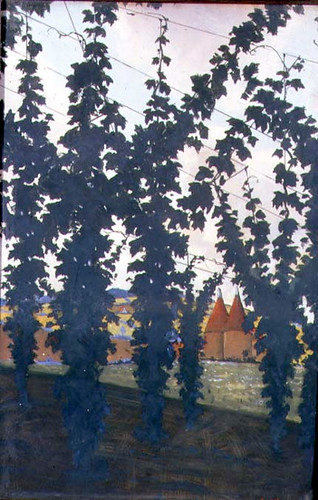
Today’s artist is a British Futurist named Christopher Richard Wynne Nevinson. While many of his paintings and illustrations appear to tackle more contemporary themes like urban life and World War I, he did paint some more idyllic landscapes like The Hop Fields.

Nevinson_hop-fields

In fact, his most striking images are almost all the war paintings, showing the unpleasantness of modern warfare. That seems somewhat ironic, as the Futurist movement he is associated with was about making a break with the old and changing the future, more of a political and societal movement rather than one concerned with paintings styles. But I suppose despite World War I being the first modern war, war itself is one of mankind’s oldest instincts revealing its horrors is in keeping with Futurist ideals.

It’s unclear when Nevinson painted The Hop Fields during his career, or where exactly it was done. But it certainly seems right at home during the Arts & Crafts movement that ended around 1910. The hops themselves seem a little thin, but I like that you can see the round buildings in the distance through the vines. You can even buy a print of the The Hop Fields at Bridgeman Art On Demand.

Nevinson’s biography from Wikipedia:

Christopher Richard Wynne Nevinson (13 August 1889 – 7 October 1946) was an English painter. He is often referred to by his initials C. R. W. Nevinson. He was the son of the famous war correspondent and journalist Henry Nevinson and the suffrage campaigner Margaret Nevinson. Educated at Uppingham School, which he hated, Nevinson went on to study at the St John’s Wood School of Art. Inspired by seeing the work of Augustus John, he decided to attend the Slade School of Art, part of University College London. There his contemporaries included Mark Gertler, Stanley Spencer, Paul Nash and Dora Carrington. Gertler was, for a time, his closest friend and influence, but they subsequently fell out when both men fell in love with Carrington.

On leaving the Slade, Nevinson befriended Marinetti, the leader of the Italian Futurists, and the radical English writer and artist Percy Wyndham Lewis. However, Nevinson fell out with Lewis and other ‘rebel’ artists when he attached their names to the Futurist movement. Lewis went on to found the Vorticists, from which Nevinson was excluded (though he is said to have coined the title for the Vorticists’ famous magazine, Blast).

At the outbreak of World War I, Nevinson joined the Friends’ Ambulance Brigade with his father, and was deeply disturbed by his work tending wounded French soldiers. For a brief period he served as a volunteer ambulance driver, before ill health forced his return to England. He used these experiences as the subject matter for a series of powerful paintings which used Futurist techniques to great effect. Subsequently appointed an official war artist, his later paintings lacked the same powerful effect. A large collection of his work can be found in the Imperial War Museum in London.

Shortly after the end of the war, Nevinson traveled to New York, where he painted a number of powerful images of the city. However, his boasting, and exaggerated claims of his war experiences, together with his depressive and temperamental personality, made him many enemies, in both the USA and England. Roger Fry of the Bloomsbury Group was a particularly virulent critic.

Nevinson was credited with holding the first cocktail party in England in 1924 by Alec Waugh

The first cocktail party in England? How cool is that?

There’s also biographies of Nevinson at Modern British Artists and also at Encyclopedia.com.

You can also see additional pieces by Nevinson at ArtCyclopedia, Artnet, Bridgeman, at the Tate Collection, and the The World Images Kiosk at UC Berkeley.

Filed Under: Art & Beer Tagged With: England, Hops

« Previous Page
Next Page »

Find Something

Northern California Breweries

Please consider purchasing my latest book, California Breweries North, available from Amazon, or ask for it at your local bookstore.

Recent Comments

  • Bob Paolino on Beer Birthday: Grant Johnston
  • Gambrinus on Historic Beer Birthday: A.J. Houghton
  • Ernie Dewing on Historic Beer Birthday: Charles William Bergner 
  • Steve 'Pudgy' De Rose on Historic Beer Birthday: Jacob Schmidt
  • Jay Brooks on Beer Birthday: Bill Owens

Recent Posts

  • Historic Beer Birthday: Frederick Gettelman Jr. August 1, 2026
  • Beer In Ads #5307: Heute Bock Double Goats July 31, 2026
  • Historic Beer Birthday: Rita Daigle July 31, 2026
  • Beer Birthday: Jonathan Surratt July 31, 2026
  • Beer In Ads #5306: Heute Bock! From The Tap July 30, 2026

BBB Archives

Feedback

Head Quarter
This site is hosted and maintained by H25Q.dev. Any questions or comments for the webmaster can be directed here.