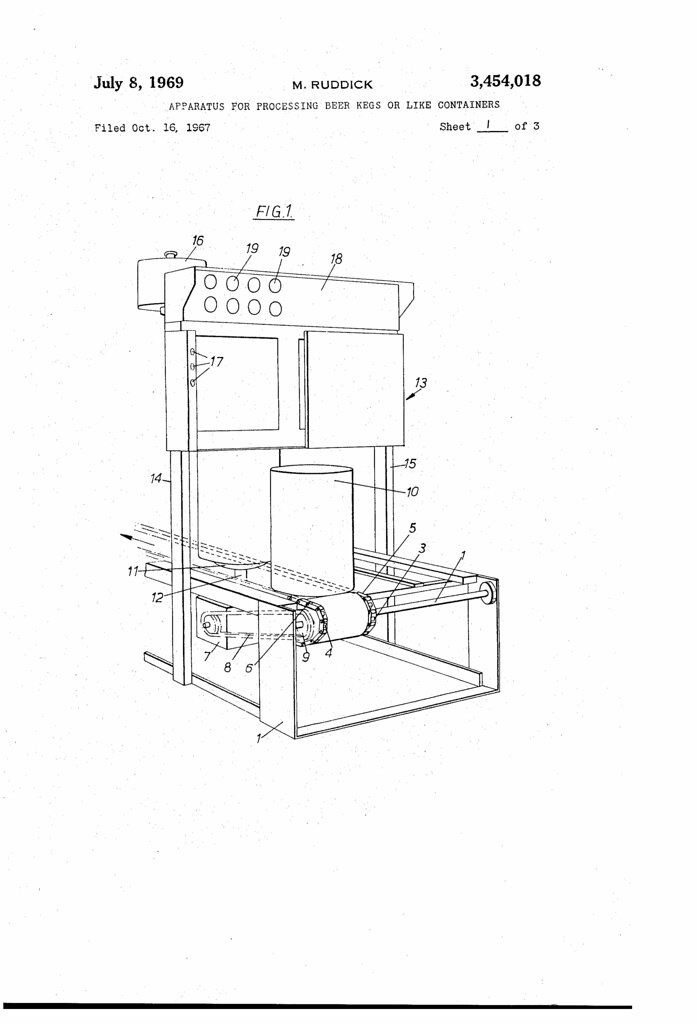
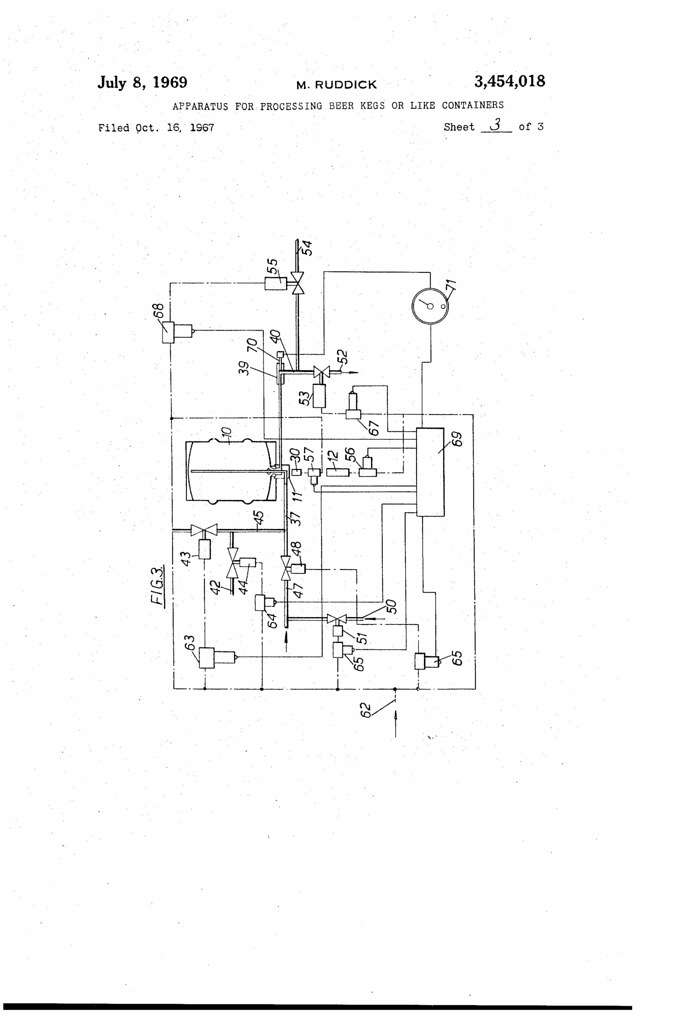
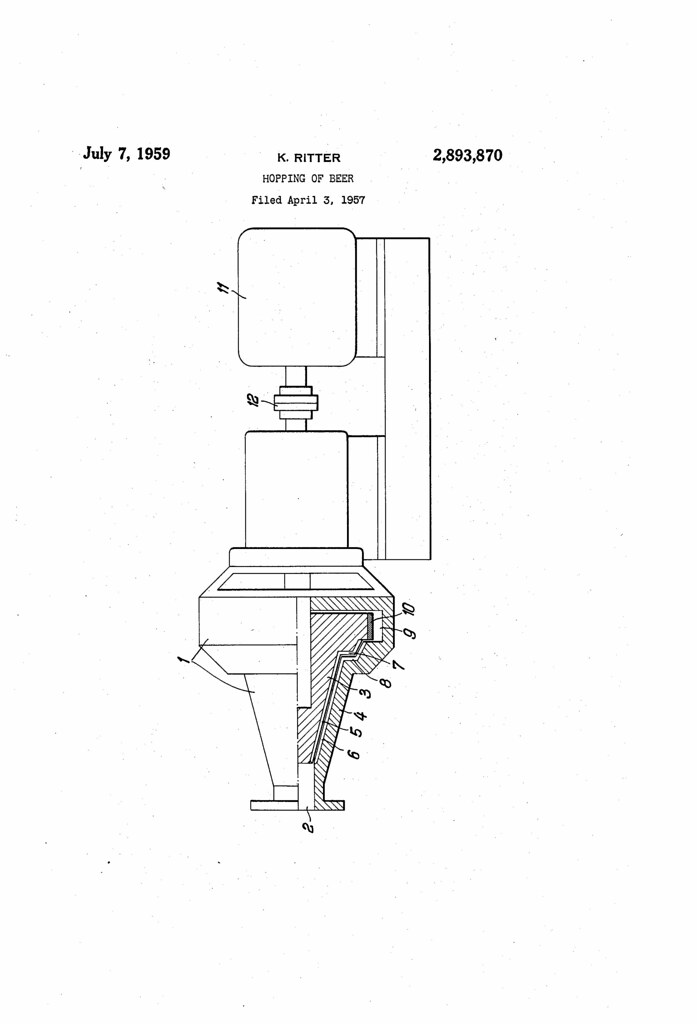
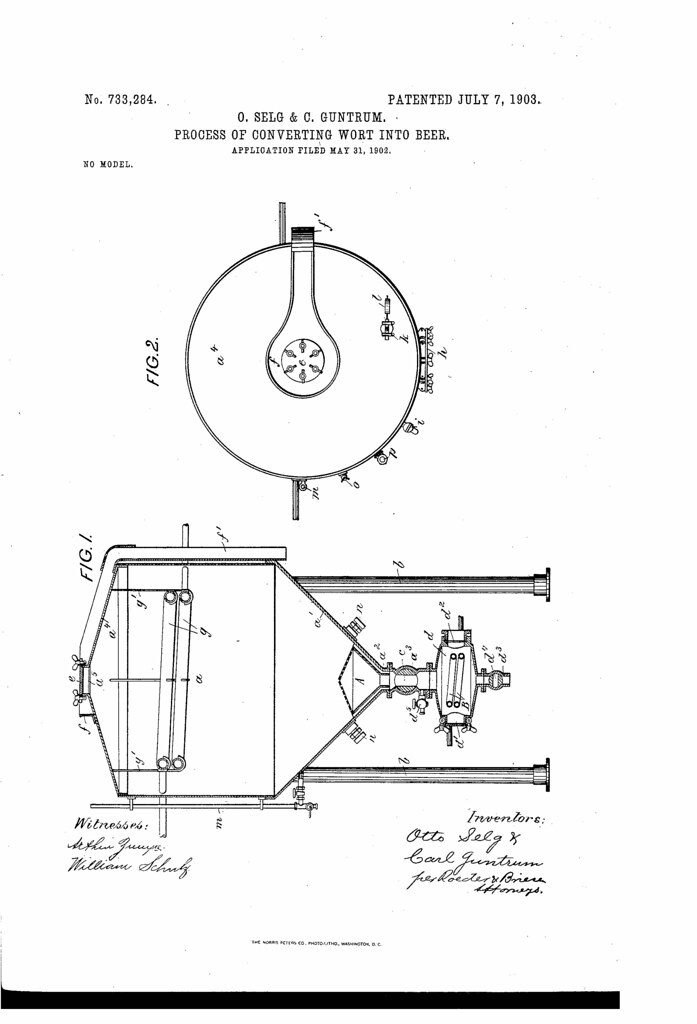
Today in 1888, US Patent 382023 A was issued, an invention of John C. Bauee, for his “Beer-Bottling Machine.” There’s no Abstract, but the description states that his “invention relates to improvements in machines for filling bottles with beer or other effervescent liquid; and it consists, generally, in an automatic cut-off valve which is opened by the bottle as it is brought in contact with it, and the liquid is allowed to pass into the bottle without being exposed to the atmosphere, thereby retaining the gases which would otherwise pass off and deteriorate the liquid, and be closed and the flow of the liquid stopped when the bottle is removed.”

Patent No. 3807463A: Apparatus For Filling Beer Cans

Today in 1974, US Patent 3807463 A was issued, an invention of W. Heckmann, H. Jordan, U. Knabe, K. Plock, K. Quest, F. Rademacher, and D. Unger, assigned to Holstein & Kappert Maschf, for their “Apparatus for Filling Beer Cans or the Like.” Here’s the Abstract:
The filling devices in an apparatus which fills beer cans orbit about a vertical axis and have upright housings supporting cylindrical centering members which carry deformable gaskets for the mouths of cans. Such canes are supported by a conveyor which orbits with the filling devices and is movable up and down or is held against vertical movement during rotation with the filling devices. The introduction of liquid into the cans takes place subsequent to introduction of a compressed gas, and such gas can be used to bias the gaskets against the mouths of cans during filling. When the filling of a can is completed, the pressure in its interior is increased to facilitate separation from the respective gasket. That supply of beer which remains in a channel of the housing on closing of the beer-admitting valve can be expelled in response to expansion of gas in a chamber which receives such gas by way of the container and is sealed from the container by beer in the channel. The expansion of gas in the chamber takes place in response to opening of a valve which reduces the pressure of gas above the body of liquid in the container.


Patent No. 1756548A: Can-Filling Machine

Today in 1930, US Patent 1756548 A was issued, an invention of Oswald H. Hansen, for his “Can-Filling Machine.” There’s no Abstract, but the description states that the “invention relates to improvements in the construction and operation of machines for automatically measuring and for placing measured batches of fluent substances into successive receptacles while they are transported in series through the machine.”

Patent No. 2038939A: Method Of Making Prune Beer

Today in 1936, US Patent 2038939 A was issued, an invention of Eberhard A. Klepper, for his “Method of Making Prune Beer.” There’s no Abstract, but the description is below, giving the objects of the invention for making prune beer. The application was filed in October of 1933, just as prohibition was scheduled to end three months later, but not issued until 1936. It’s hard to understand why anyone would have thought prune beer was a good idea at the same time that legal beer was returning after a thirteen year drought.


A few months later, the Milwaukee Sentinel on August 16, 1936 ran a short article about prune beer.


A San Jose newspaper on November 14, 1936 reported that a man in Hollister, California was actually trying to build a brewery to make prune beer using “sub-standard prunes” using the method described in this patent.

I wonder if it ever opened? The last brewery in Hollister I knew about was Bill Millar’s San Andreas Brewing, which is also where Stone’s Mitch Steele got his start. They made a cranberry beer I really liked, Cranberry Noel, but not a prune beer as far I recall. Whatever the fate of prune beer, it doesn’t look like it ever really took off.
Norway’s E.C. Dahls Joins Brooklyn Brewery Family

The Brooklyn Brewery announced today that E.C. Dahls Joins the Brooklyn Brewery Family. E.C. Dahls Brewery was originally founded in 1856 (there’s more history at Wikipedia) and today is owned by the Carlsberg Group. Here’s the press release from the Brooklyn Brewery:
Welcome to the Continuing International Adventures of Brooklyn Brewery. In our last episode, just over a year ago, we teamed up with our friends and importers at Carlsberg to open Nya Carnegiebryggeriet (NCB) in Stockholm, Sweden. NCB is our first sister brewery and its launch was the first time any American craft brewery ever entered into such a venture abroad. Today we’re proud to announce that we’re getting the gang back together once again to welcome E.C. Dahls Brewery in Trondheim, Norway into the Brooklyn Brewery family.

We’re excited to be part of a new era in brewing at E.C. Dahls. Founded in 1856, Dahls has been a treasured presence in Trondheim for generations, and its traditional pilsner is a household name there. We’re dedicating ourselves to preserving this storied history while infusing the new venture with the spirit of brewing creativity and innovation that have become hallmarks of Brooklyn Brewery around the world. The new E.C. Dahls will blend American and Norwegian culinary cultures to create new beers that we’ll enjoy brewing and we believe Norwegian beer fans will enjoy drinking.
This is far from our first journey to Trondheim, of course. Brewmaster Garrett Oliver has regularly gone out of his way to visit during his many travels. Between the streetscapes of the seaside city, the thriving Scandinavian food scene that Garrett has followed for more than a decade, and the wonderful local appreciation of Brooklyn beer, it was always pretty easy to be enthralled with Trondheim. A couple years ago, Garrett hosted a beer dinner with local restaurateur Roar Hildonen, and the two quickly bonded over Roar’s great food and stellar Cognac collection. Roar became a fast friend and will now join us in leading the kitchen of the planned E.C. Dahl’s Tasting Room.
“The new E.C. Dahls will celebrate the great tradition of Dahls and bring the brewery and its portfolio into the thriving world of craft beer,” said Garrett. “Norway already has a great beer scene, and we’re really excited to become an even more active part of it.” As in Stockholm at NCB, there will be no Brooklyn brewed in Norway but visitors will be able to have some Brooklyn in the Tasting Room.
The Carlsberg Group also released their own press release, where they characterize the deal as a “collaboration.”
With the aim of creating the premier beer experience in Norway, the collaboration will see a new brewery with pub, restaurant, conference facilities and visitor center established at the existing Ringnes E.C. Dahls brewery site in Trondheim, Norway. The brewery will produce both popular local Dahls beer, as well as new craft beers that take inspiration from both Norwegian and US craft brewing traditions.
The brewery will welcome beer and food enthusiasts from around the world and become a laboratory for new ideas and experimentation. E.C. Dahls will have a top-class restaurant operated by local restaurateur Roar Hildonen.
“This is great news for the E.C. Dahls brewery, and great news for beer lovers in Norway and beyond”, says Jørn Tolstrup Rohde, Senior Vice President for Western Europe at Carlsberg Group. “Carlsberg’s collaboration with Brooklyn continues to explore new possibilities in craft brewing. Carlsberg started its life as a small brewery in Copenhagen back in 1847, and thanks to the resurgence of craft brewing in recent times, more and more people are getting interested in the world of beer. We think that’s very positive.”
Another interesting international development as American beer spreads its reach globally.

Patent No. 1137495A: Apparatus For Dispensing Beverages

Today in 1915, US Patent 1137495 A was issued, an invention of Anton Landgrebe, for his “Apparatus For Dispensing Beverages.” There’s no Abstract, but the description states that the “invention relates to [a] beer apparatus and has particular reference to means for cooling and dispensing beverages and especially beer.”


Patent No. 2115335A: Can Filling Machine

Today in 1938, US Patent 2115335 A was issued, an invention of Samuel A. Hurst and Harrie A. Keck, for their “Can Filling Machine.” There’s no Abstract, but the description states that the “invention relates to an improvement in’ machines for filling cans and other receptacles with various kinds of materials, and more particularly to an improvement in machines for filling receptacles.”


Patent No. 1956218A: Capping Head

Today in 1934, US Patent 1956218 A was issued, an invention of George J Huntley and Harry A Rau, assigned to the Crown Cork & Seal Co., for their “Capping Head.” There’s no Abstract, but the description summarizes it. “The present invention relates to an improvement in capping heads and, more particularly, comprises a means for feeding closure or cap blanks to the capping mechanism of the capping head.”


Patent No. 3729321A: Preparation Of Beer

Today in 1973, US Patent 3729321 A was issued, an invention of N.L. Vacano, assigned to Rainier Companies, for their “Preparation Of Beer.” There’s no Abstract, but the description summarizes it. “This invention relates to the production of beer. More particularly, this invention is concerned with improvements in the process of producing beer starting with the wort, fermenting the wort with yeast to form green beer, aging of the beer and the subsequent finishing operation, as Well as improved apparatus for producing beer.”


Patent No. 672788A: Device For Hoisting And Transferring Bottled Beer In Bottling Establishments

Today in 1901, US Patent 672788 A was issued, an invention of Albert Lieber and August Meimberg, for their “Device for Hoisting and Transferring Bottled Beer in Bottling Establishments.” There’s no Abstract, but in the description summarizes it by stating that they’ve “invented new and useful Improvements in Devices for Hoisting and Transferring Bottled Beer in Bottling Establishments by Means of Air-Hoists and Transverse Carriers.” But below is a more detailed account.
Our invention relates to an improvement in the means for handling of large quantities of bottled beer for the purpose of pasteurizing. During the operation of this process the bottled beer has to be transferred in trays by means of trucks from the place of filling to the pasteurizing-tanks. Arriving at the tanks, the trays loaded with bottled beer must be elevated, so that the tray may be moved over the steaming-tank and then lowered into the same. It has been customary heretofore to perform these operations by means of hand or chain-hoists, necessitating the employment of a large number of men.
Our invention comprehends, in addition to the pasteurizing tank or tanks and the trays in which the bottled beer is contained while being transported and pasteurized, a raising and lowering means which travels on overhead tracks and carries the beer to position over the tank in which it is to be pasteurized and `from said tank after it (the beer) has been pasteurized. The raising and lowering means preferred by us comprises a cylinder having therein a piston-head and provided with a piston-rod having means by which a tray is detachably connected therewith. Said cylinder is also provided with means by which a suitable means or medium, preferably compressed air, is conveyed thereto for the purpose of actuating the piston and raising and lowering the tray with its contained bottles of beer. The construction is preferably such that the compressed air enters the cylinder at points which are both above and below the limits of travel of the piston-head and is conveyed to the inlets by pipes which have their contiguous ends joined by a valve-casing having a suitable valve, actuable to cause the compressed air to enter the upper part of the cylinder in order to drive the piston downward,and thereby lower the tray, with its contained bottles of beer, into the pasteurizing-tank or onto a truck after the beer has been pasteurized and to cause the air to enter the lower port in the cylinder when it is desired to raise the piston, and thereby lift the tray and beer from a truck or from said pasteurizing-tank. This means of raising and lowering the trays, with their contained bottles, by compressed air or other suitable fluid admitted below and above the piston-head, respectively, has especial advantages in the handling of bottled goods, as the action of the piston in both directions of its travel is cushioned by said duid, and said piston, together with the parts carried thereby, is caused to move slowly, steadily, and without jar, whereby the liability of breaking the bottles is reduced to a minimum and is materially less than it would be if the piston were caused to descend by gravity. The means adopted for detachably connecting the hoisting device with the trays are of peculiar construction and include pendent eyes or loops carried by said device to engage hooks on the trays, together with a slidable or movable safety device adapted to prevent accidental disconnection of the parts from each other.