Brookston Beer Bulletin

Jay R. Brooks on Beer

  • Home
  • About
  • Editorial
  • Birthdays
  • Art & Beer

Socialize

  • Dribbble
  • Email
  • Facebook
  • Flickr
  • GitHub
  • Instagram
  • LinkedIn
  • Pinterest
  • RSS
  • Twitter
  • YouTube

Powered by Genesis

Patent No. 672819A: Apparatus For Drying Hops

April 23, 2015 By Jay Brooks

patent-logo
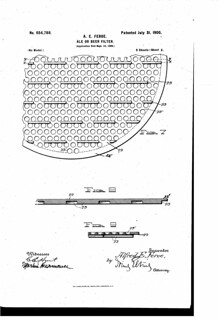
Today in 1901, US Patent 672819 A was issued, an invention of Alfred Blackie, for his “Apparatus For Drying Hops.” There’s no Abstract, and it takes a lot to explain everything, but essentially it’s a “kiln having an open sparred floor and a number of portable hop-receptacles having porous bottoms and tops, whereby currents of heated air may be passed through said floor and through said receptacles containing the hops for drying them.” But that’s pretty simplified, here’e more:

The present invention is illustrated in the accompanying drawings, in which Figure 1 is a plan view of the floor of a round kiln suitably prepared to receive the frames containing the hops to be dried, and Fig. 2 is a similar view showing such floor with the frames in position thereon. Fig. 3 is a perspective view showing one method of manipulating the frames. Fig. 4 shows a number of the frames as arranged on the cooling-floor after drying when it is desired to cool the hops quickly; and Fig. 5 showsthe manner of arranging such frames when the cooling is to take place more gradually. Fig. 6 is a plan view of a square kiln with frames suitably arranged thereon, and Fig. 7 shows an arrangement which may be used in connection therewith for manipulating the frames. Fig. 8 shows a modification of such arrangement. Fig. 9 is a sectional view showing one method of attaching the lids or covers of the frames in position, and Fig. 10 illustrates a modified arrangement for the same purpose. Fig. 11 is a plan view, and Fig. 12 a transverse section illustrating the method I prefer to employ for attaching the porous cloth or other suitable material to the lids or covers and bottoms of the frames.

This apparatus comprises an oast-house or kiln of any suitable form provided with an ordinary sparred floor 1, composed of slats or spars disposed apart from each other, leaving open spaces between them for the passage of air, and hop receptacles or frames 4, having porous tops and bottoms, disposed on said floor. When the hop-receptacles are placed directly on the floor, portions of the heated air for drying the hops rise through the floor between the receptacles and around the ends thereof and have no effect upon the hops and the heat is consequently wasted. To avoid this waste of heat, intermediate strips 2 of wood or other suitable material, together with similar end strips 2 and 2 are disposed on the floor 1 in such manner as to form completely-walled enclosures or compartments approximating in shape the hop-receptacles. The intermediate strips 2 are arranged in such position that they come immediately below the joints in the hop-receptacles 4 when the latter are placed in position in the kiln, and the end strips 2 close the end spaces under the outer ends of said receptacles adjacent to the inside wall of the cast-house or kiln and the strips 2 close the spaces under the inner ends of the receptacles, so as to prevent the escape of air around the frames. By this means the heated air will pass upward through the hop-receptacles only, and consequently the Whole thereof will be utilized in drying the hops, as the whole floorspace, except the parts beneath the porous hop-receptacles, is entirely closed or sealed. The strips referred to may be covered with felt, if desired. It continues from there.

US672819-0
US672819-1
US672819-2
US672819-3

Filed Under: Beers, Breweries, Just For Fun, Politics & Law, Related Pleasures Tagged With: History, Hops, Law, Patent

What 3,465 Breweries Are Doing To The Hop Supply

April 22, 2015 By Jay Brooks

hop
I admit there’s a certain “duh” factor to this, but it’s still interesting to see the numbers. With IPA and other hoppy beers accounting for over 20% of the craft beer market, there’s not enough hops being grown to keep up with current demand, and it will only get worse as interest continues to grow, as it seems likely the popularity of hoppy beers will be with us for the foreseeable future. This is from the May 2015 issue of Popular Science, which has a short article entitled Craft Beer is Annihilating the Hop Supply, which adds that demand for hops has “nearly quadrupled in the past decade.”

The article is subtitled “why that might be a good thing,” presumably alluding to the increased demand, but never really answers that question satisfactorily. There’s a quote from the former director of the Hop Growers of America, Doug MacKinnon, saying “Craft brewing is sucking up every pound of hops in the U.S. Growers can’t expand fast enough,” and suggesting that’s opening up the market beyond Washington, Oregon and Idaho, where U.S. hop growing has been concentrated at least since prohibition ended.

The article cites as proof that “single-acre hop operations are popping up on other types of farms across the country, including “Growers in New York, Minnesota, and Colorado,” and I’m also aware of similar efforts with commercial farms in Maine, Wisconsin and California, and I’m sure I’m forgetting somebody. Hops-Meister, which is near Clearlake, started in 2004 and grows ten different varieties on at least 15 acres. Co-owner Marty Kuchinski will be talking to my class tonight about hop farming. California used to grow more hops than any other state prior to prohibition, but never rebounded as farmers here found they could make more per acre growing grapes, but it’s why that legacy includes the town of Hopland and the Hop Kiln Winery. And New York used have an entire hop industry in the 19th century, until a downy mildew problem and other issues forced many to move production out west. So it’s little surprise that, with more modern farming methods, this growing demand would bring back hop farming to many parts of the country, not to mention a strong desire for brewers to have more local ingredients.

But the numbers just seem crazy: 27 million pounds of hops in 2014, and an estimated 31 million pounds this year.

hops-use

Filed Under: Beers, Breweries, Editorial, News, Related Pleasures Tagged With: Hops, IPA, United States

Patent No. 4659662A: Batch Fermentation Process

April 21, 2015 By Jay Brooks

patent-logo
Today in 1987, US Patent 4659662 A was issued, an invention of Win-Pen Hsu, assigned to J. E. Siebel Sons’ Company, Inc., for his “Batch Fermentation Process.” Here’s the Abstract:

Ethanol and fermented beverages such as beer or wine are produced in a batch process by contacting a fermentable substrate with yeast cells encapsulated within a porous, semi-permeable material. Contacting is carrier out in a vessel containing the substrate and a semi-permeable retaining means submerged in the substrate. Encapsulated yeast cells are maintained below the retaining means and in contact with the substrate during fermentation while being freely movable in a portion of the substrate. The retaining means is permeable to the substrate and is substantially impermeable to the encapsulated yeast cells. Preferably, the matrix encapsulating the yeast cells is an alginate gel.

US4659662-1
US4659662-2

Filed Under: Beers, Breweries, Just For Fun, Politics & Law, Related Pleasures Tagged With: Brewing Equipment, History, Law, Patent, Science of Brewing

Patent No. 1581918A: Production Of Fermentable Worts

April 20, 2015 By Jay Brooks

patent-logo
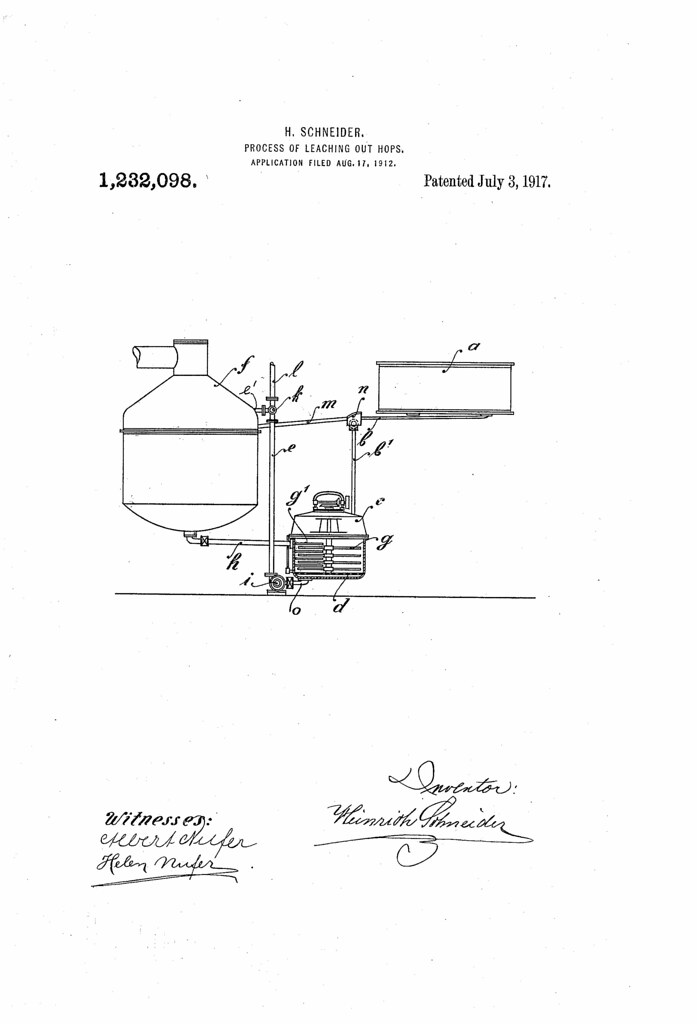
Today in 1926, US Patent 1581918 A was issued, an invention of William Hastings Campbell, for his “Production of Fermentable Worts.” There’s no Abstract, but the description states that “This invention relates to the production of fermentable worts, the production of industrial alcohol and the cultivation of yeast, and has for its object to provide improvements therein.” Here’s a bit more.

The invention consists broadly in the process of producing fermentable worts and the cultivation of yeast which comprises introducing the liquor component of the wort and the solid material from which the fermentable bodies are derived into apparatus in which a plurality of superimposed inclinable diaphragms are arranged, allowing the solid material to settle on the diaphragms, withdrawing the wort and discharging the solid material from the apparatus after a suitable washing operation to extract the soluble bodies mechanically held thereby.

US1581918-0
US1581918-1

Filed Under: Beers, Breweries, Just For Fun, Politics & Law, Related Pleasures Tagged With: History, Law, Patent, Science of Brewing

Patent No. 5304384A: Rapid Cooling

April 19, 2015 By Jay Brooks

patent-logo
Today in 1994, US Patent 5304384 A was issued, an invention of Cameron R. Murray and William J. Van der Meer, assigned to Labatt Brewing Company Limited, for their “Rapid Cooling.” Here’s the Abstract:

A process for preparing a fermented malt beverage wherein brewing materials are mashed with water and the resulting mash is heated and wort separated therefrom. The wort is boiled, cooled and fermented and the beer is subjected to a finishing stage, which includes aging, to produce the final beverage. The improvement comprises subjecting the beer to a cold stage comprising rapidly cooling the beer to a temperature of about its freezing point in such a manner that ice crystals are formed therein in only minimal amounts. The resulting cooled beer is then mixed for a short period of time with a beer slurry containing ice crystals, without any appreciable collateral increase in the amount of ice crystals in the resulting mixture. Finally, the so-treated beer is extracted from the mixture.

US5304384-3
US5304384-4
US5304384-5

Filed Under: Beers, Breweries, Just For Fun, Politics & Law, Related Pleasures Tagged With: Brewing Equipment, History, Law, Patent, Science of Brewing

The Incredible Beerable Egg

April 19, 2015 By Jay Brooks

egg
One of the highlights of this years Craft Brewers Conference in Portland was a potential innovation in brewing undertaken by Alan Sprints at Hair of the Dog Brewing. Alan posted a picture of his newest fermenter arriving to be displayed at the trade show, with Steve Rosenblatt from Sonoma Cast Stone, who manufactured the concrete fermenter.

egg-arrives

I was immediately intrigued and finding it in the trade show was one of my first missions of CBC. It turns out it was made in Petaluma, which is just down the road from where I live. The company has been making concrete fermenters for the wine industry, but this is the first one they’ve made for a commercial brewer. They have a separate website for this part of their business, Concrete Beer Tanks.

SAM_0428

There’s two sizes, the Amphora, which is 320 gallons and the one Hair of the Dog ordered, which is the Egg Shape, which is 476 gallons (or just over 15 barrels).

egg-wide

Their brochure lists the benefits of a concrete fermenter:

  • Concrete has natural temperature stability, and our tanks offer an optional, embedded glycol system for precise control.
  • Concrete allows the design of organic shapes, promoting convectional fermentation flow with no corners for fluid to pocket or stagnate.
  • The porosity of concrete allows for micro-oxygenation to aid in initiating the fermentation process.

egg-1

Apparently the wine industry has been using these increasingly in recent years, but they have been used for centuries prior to the advent of stainless steel. Just a quick search reveals quite a few articles about their growing use in winemaking. For example, in Wine Spectator, Wine Enthusiast, Wines and Vines, Seattle Magazine and the North Bay Business Journal. And there’s at least one other domestic manufacturer, Vino Vessel and a German company, Speidel, that makes a Gärei Fermentegg, or Fermentation Egg.

gaerei

Here’s how Speidel describes their fermentation egg:

The organic fermentation in the egg-form is based on the golden ratio without corners and edges. Wine, beer and cider could move fluently during the fermentation and storage. This gentle process guarantees on keeping the completely development of the product. The idea of fermentation or aging in the egg is just to come back to the ancient methods but with the new materials. Already in the ancient times beer has been placed for resting into the egg-formed amphoraes. Recently there were several successful tests for storage wine in the egg-formed fermentation vessels made of concrete. Shortly after Speidel has developed the fermentation egg made of food-safe polyethylene.

The fermentation egg is appropriate for the fermentation of wine, beer and cider. Fans and devotees of the fermentation egg confirm that the fermentation process runs spontaneous, therefore wine and beer taste more filigree and complex. Check it out and convince yourselves! Our food-safe polyethylenes have high permeability of oxygen. This ensures the evenly influence of oxygen and perfect conditions for the fermentation and maturation. It is very easy to clean the egg because of its smooth surface inside.

Here’s a drawing of the tank.
egg-tank-specs

Sonoma Cast Stone online has their reasons why brewers should consider concrete beer tanks:

Winemakers love concrete…

Winemakers all over the world are rediscovering the benefits of using concrete as a medium for fermentation, finding the virtues of both of oak and stainless steel with the drawbacks of neither. Now, most of the world’s highest-rated wines are made in concrete.

The craft beer industry is at least as creative and dynamic as the wine industry, and we at Sonoma Cast Stone are thrilled to offer you artisans of fermentation a new medium to create with. We predict a renaissance of innovation, producing an exciting, new generation of wild beers, sour beers, meads and porters.

Concrete is cool! No… really.

Concrete can take the heat, or the cold. It’s a natural insulator and will stabilize the temperature of whatever is inside of it. This stability makes for a smooth and gradual fermentation, because there are no temperature spikes to make the yeast become aggressive.

Sonoma Cast Stone also offers a unique temperature control system. Our system is hidden within the walls of the tank itself and does not make contact with that wine.

Just breathe!

Concrete is porous, albeit on a microscopic scale, and that’s where it beats stainless steel. The environment in stainless steel is too perfect to be ideal for fermentation. A gradual introduction of micro-oxygenation, the wine remains flat. It cannot breathe and evolve.

Wine fermented in concrete has the round mouthfeel of wine fermented in oak, but it has much greater purity of fruit flavor, even a greater intensity of fruit color. For fermentation, storage or aging, concrete is simply phenomenal.

Staying neutral…

Even neutral oak is not neutral. All oak will give a bit of itself to your beer, whether you like it or not. Concrete makes for a truly neutral vessel, imparting only a slight and desirable minerality.

What this means for a beer maker is control. Control over what your beer tastes like, and with the optional, embedded glycol tubing system, you also have precise control over the temperature you maintain throughout fermentation.

Hair of the Dog Brewing had their new concrete tank delivered yesterday and it should be installed and ready to go shortly. Alan told me that Adam will be the first beer he makes in concrete. It will be interesting to see how the new Adam tastes, especially in comparison to the old version.

egg-delivered

Filed Under: Beers, Breweries, Just For Fun, News, Related Pleasures Tagged With: Brewing Equipment, Science of Brewing

Patent No. 256550A: Cooling Beer

April 18, 2015 By Jay Brooks

patent-logo
Today in 1882, US Patent 256550 A was issued, an invention of David W. Davis, for his “Cooling Beer.” There’s no Abstract, but in the description states the following:

My invention consists in a new process ot cooling beer, which process can be applied to most of the devices in use for that purpose, und especially to that class of coolers known as the Baudelot Cooler, and the process is produced by the device that will be fully hercinafter described.

US256550-0

Filed Under: Breweries, Just For Fun, Politics & Law, Related Pleasures Tagged With: Brewing Equipment, History, Law, Patent, Science of Brewing

Patent No. 6051212A: Process For Producing Yeast Extract

April 18, 2015 By Jay Brooks

patent-logo
Today in 2000, US Patent 6051212 A was issued, an invention of Hisao Kado, Takumi Shibata, Fujio Kobayashi, and Masaki Kubota, assigned to Sapporo Breweries Limited, for their “Process for Producing Yeast Extract.” Here’s the Abstract:

In accordance with the present invention, it is provided a method for producing a yeast extract with the improvement in the color and odor characteristic to yeast extract and with no modification of the useful substances such as amino acid, etc. compared with conventional yeast extract.

By a simple method in accordance with the present invention, color and characteristic odor can be removed, with almost no loss of the contents of useful substances such as amino acid, etc. from the yeast extract solution produced in a conventional manner. Because the resulting yeast extract can be mixed with other materials for use, the yeast extract is applicable to various fields, for example for cosmetic products and healthy foods other than seasonings, which expectantly enlarges the applicable range of the yeast extract.

US6051212-1 US6051212-2

US6051212-3 US6051212-4

Filed Under: Beers, Breweries, Just For Fun, Politics & Law, Related Pleasures Tagged With: History, Law, Patent, Yeast

Patent No. 1800632A: Method Of Preparing Hop Extract And Products Containing Hop Extract

April 14, 2015 By Jay Brooks

patent-logo
Today in 1931, US Patent 1800632 A was issued, an invention of Emil C. Horst, for his “Method Of Preparing Hop Extract And Products Containing Hop Extract.” There’s no Abstract, but the description says simply it’s an “invention [that] relates to a method of preparing hop extract and the product obtained, the object being to obtain a hop extract containing all the desired constituents of hops of value for the manufacture of non-prohibited cereal beverages and other non-prohibited products.” And here’s how he summarizes it:

The method briefly stated consists first in extracting the volatile matter or oil from the fresh or dried hops. Secondly to extract the bitter constituents consisting of soft resins, the tannins, the coloring matter and the foam producing constituents, and third to combine the volatile oil of the hops and the extract to obtain a product containing all the constituents of hops required for the brewing of cereal beverages.

US1800632-0

Filed Under: Beers, Breweries, Just For Fun, Politics & Law, Related Pleasures Tagged With: History, Hops, Law, Patent

Patent No. 580536A: Process Of And Apparatus For Finishing Beer

April 13, 2015 By Jay Brooks

patent-logo
Today in 1897, US Patent 580536 A was issued, an invention of Jacob F. Tiieurer and Paul Fischer, assigned to The Pabst Brewing Company, for their “Process of and Apparatus for Finishing Beer.” There’s no Abstract, but the description says simply it’s an “invention which will enable others skilled in the art to which it pertains to make and use the same, reference being had to the accompanying drawing, and to the letters of reference marked thereon, which forms a part of this specification. The main object of our invention is to finish beer and other beverages in such a way as to give them the desired freshness, vivacity, and keeping qualities, and in the attainment of that object to economize space and time and to produce a superior article.”
US580536-0

Filed Under: Beers, Breweries, Just For Fun, Politics & Law, Related Pleasures Tagged With: Brewing Equipment, History, Law, Patent, Science of Brewing

« Previous Page
Next Page »

Find Something

Northern California Breweries

Please consider purchasing my latest book, California Breweries North, available from Amazon, or ask for it at your local bookstore.

Recent Comments

  • Bob Paolino on Beer Birthday: Grant Johnston
  • Gambrinus on Historic Beer Birthday: A.J. Houghton
  • Ernie Dewing on Historic Beer Birthday: Charles William Bergner 
  • Steve 'Pudgy' De Rose on Historic Beer Birthday: Jacob Schmidt
  • Jay Brooks on Beer Birthday: Bill Owens

Recent Posts

  • Historic Beer Birthday: Oliver Hughes May 20, 2026
  • Historic Beer Birthday: Benjamin, Lord Iveagh May 20, 2026
  • Historic Beer Birthday: Eduard Buchner May 20, 2026
  • Historic Beer Birthday: Louis de Luze Simonds May 20, 2026
  • Historic Beer Birthday: Johann Adam Lemp May 20, 2026

BBB Archives

Feedback

Head Quarter
This site is hosted and maintained by H25Q.dev. Any questions or comments for the webmaster can be directed here.