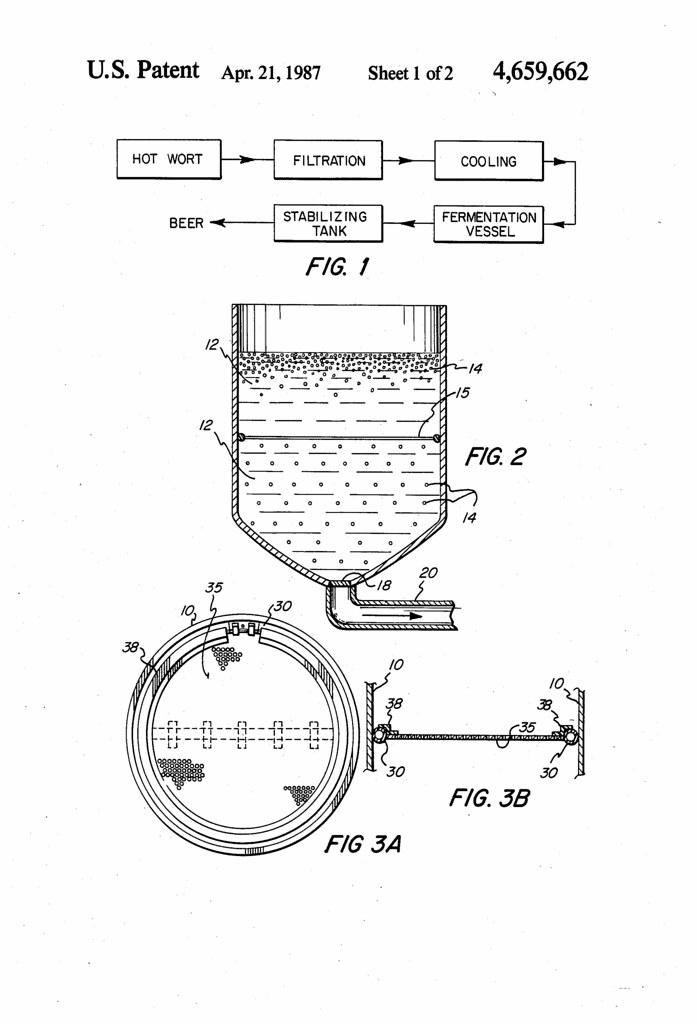
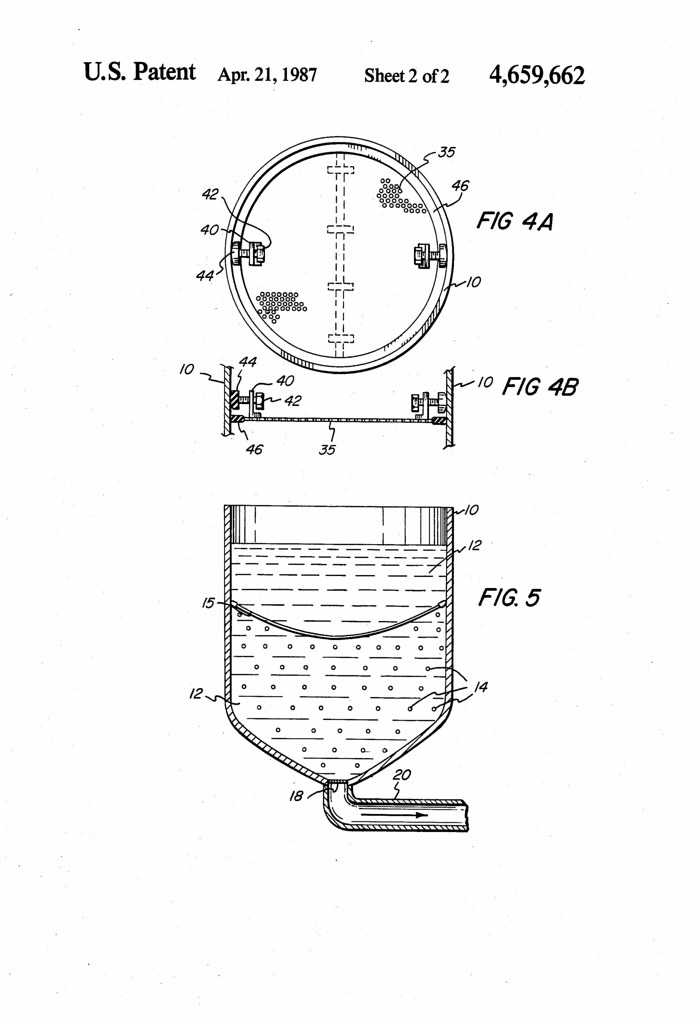
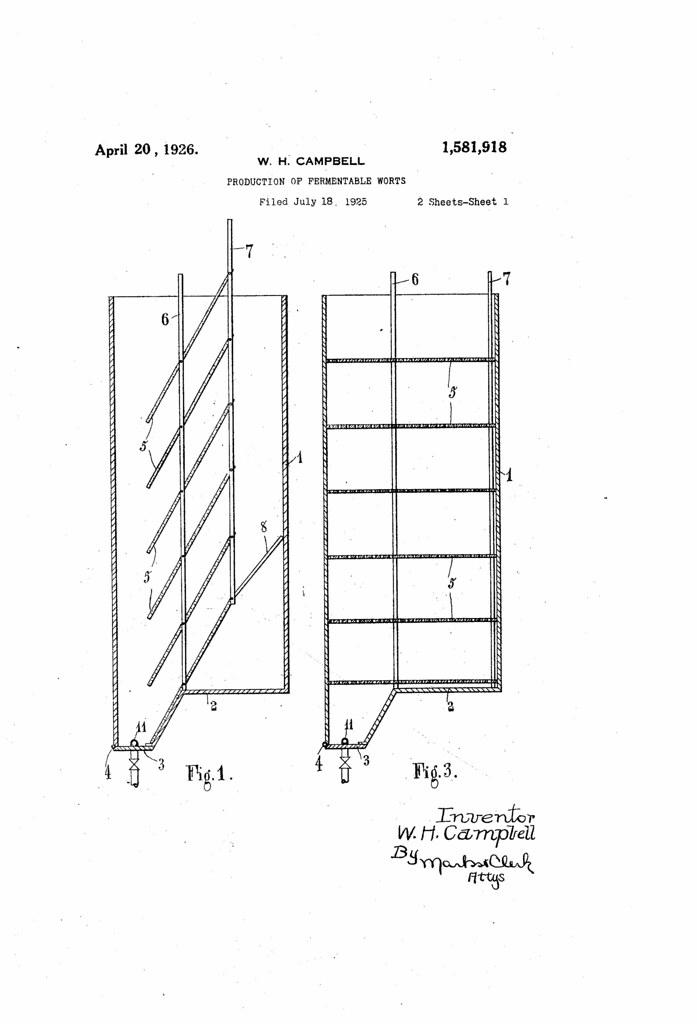
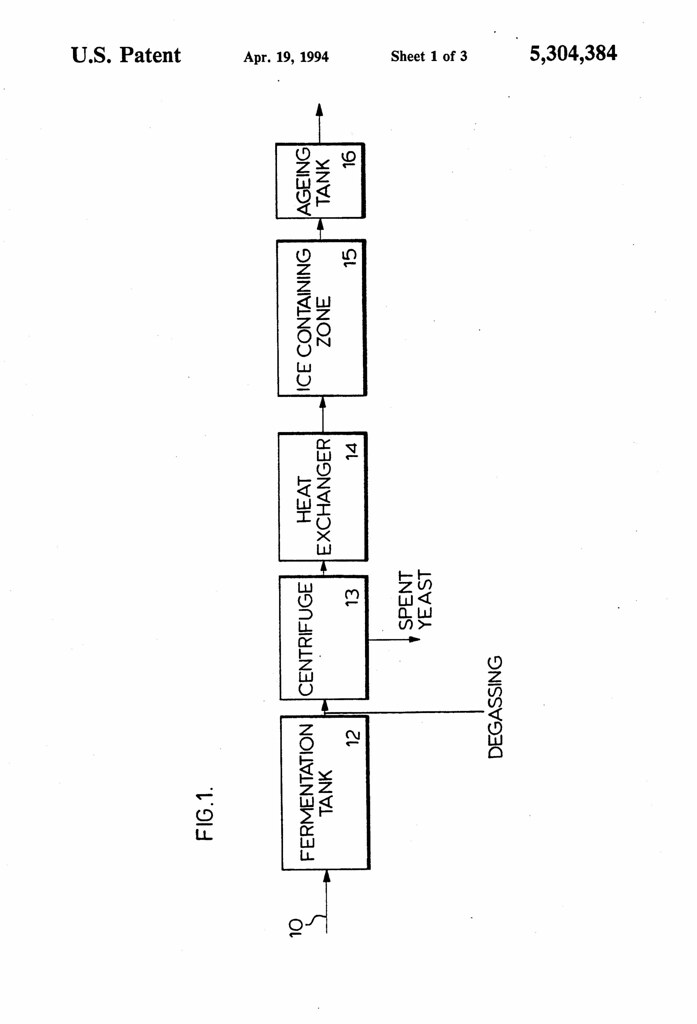
Today in 1966, US Patent 3234026 A was issued, an invention of Morton William Coutts, for his “Process for the Manufacture of Beer, Ale and the Like.” There’s no Abstract, but according to the description, the “invention relates to a continuous method for the fermentation of brewery wort for the production of a portable non-distilled alcoholic beverage product. This application is a continuation of my application Serial No. 676,187, filed August 5, 1957 A major object of the invention is the provision of an improved process for the production of such products which will enable the production thereof with greatly decreased fermenting time than is possible by present processes and which will give better control of flavour at greatly decreased cost of manufacture.”


Patent No. EP0224293B1: A Beer Tapping Installation

Today in 1990, US Patent EP 0224293 B1 was issued, an invention of Jacobus Dijkstra and Gijsbert Slootweg, assigned to Heineken Technisch Beheer B.V., for “A Beer Tapping Installation.” there’s no Abstract, but the description begins with the “invention relates to a beer tapping installation comprising a first cask installation and cooling unit adjacent a second cooling unit, a third unit supporting a tap and a storage space accommodating a gas container, a beer line with a cask coupling at its one end extending from the inside of the first unit to the tap and connected with its other end to said tap arranged near the free end of said third unit which comprises a hollow support protruding vertically from the coupled units, enveloping the beer line adjacent the tap and being in open communication with said first unit, the beer line with cask coupling being movable longitudinally of the hollow support, and a gas supply line extending between the gas container and the cask compiling.”

Patent No. 4138499A: Preparation Of Beer With Reduced Calories

Today in 1979, US Patent 4138499 A was issued, an invention of Karl M. Strauss, Harold H. Geller, and Bernard J. Wagner, assigned to Pabst Brewing Co., for their “Preparation of Beer with Reduced Calories.” Here’s the Abstract:
A low dextrin and low carbohydrate beer having reduced calories is produced by fermenting wort with yeast in the absence of readily fermentable carbohydrates so that the yeast act on fermentable ingredients in the wort other than readily fermentable carbohydrates. After fermenting a major portion of fermentable ingredients, there is added to the resulting alcoholic wort a quantity of one or more readily fermentable sugars and fermentation is continued until the real degree of fermentation is at least 80%. By this process a low calorie beer can be prepared without the use of a carbohydrate splitting enzyme such as amyloglucosidase.

Where Is Beer Country & Wine Country?

Someone posted a link in a comment last week, and I’d been meaning to take a closer look it. It’s from the Washington Post’s Wonkblog: Do you live in beer country or wine country? These maps will tell you.
I love the idea that there’s a Wonkblog, but it has taken liberties in analyzing its data in the past, and this one seems to continue that trend. Still, there is some interesting information here. But the map of where both wineries and breweries are located is somewhat misleading, because it covers over the one with fewer, even if there are a lot of both kinds there, which is the case.

More revealing, I think, is comparing the two individual maps, grape color is wine, hop green is beer. What becomes clear from looking at the two separately that’s lost in the map with both is that fermentation takes place, whether beer or wine, in higher concentrations in roughly the SAME locations nationwide.

With very few exceptions, areas that have heavy concentrations of wineries also have a lot of breweries, too. That can’t be a coincidence, can it? To me, that leads to the inescapable conclusion that there is no wine country or beer country, but instead pockets of fermentation, or fields of fermentation. I would not be surprised to learn that there is also a lot of cheese-making going on in the exact same areas, too. Fermentation, it seems, follows fermentation. But that makes sense, intuitively.
And here is beer wine individually, so you can see them in more detail closer up.


Also, curiously the Pacific Northwest is ignored in their analysis. In the text, they state that “beermaking dominates in the Denver region, and along the Southern California coast. Tucson may be wine country, but brewers rule in Phoenix. Brewers are strongly represented along the coast of Lake Michigan, and in most of Florida. Brewing is big in East coast cities too.” But three of the biggest, and darkest, green areas are the San Francisco Bay Area, Portland, Oregon and Seattle, all three with bigger concentrations of breweries than any other areas mentioned, with the exception of Denver and San Diego, which look roughly equal. So why the did? Beats me.
Wonkblog concludes with a chart showing trends in the numbers of new wineries and breweries, at least from 1998 through 2012. Was there really no data yet for 2014, or even 2013? And why did they use U.S. Census data for this chart, rather than where they got the other datasets for the maps? Also, I remember sower growth in the early 2000s, but the chart shows negative growth in the number of breweries from 2001 to 2010. Can that be correct? Or does that have something to do with it being Census data? Curious.

Patent No. 37578A: Improved Extract Of Malt

Today in 1863, US Patent 37578 A was issued, an invention of Thomas Hawks, for his “Improved Extract of Malt.” There’s no Abstract, but the entire application is rendered as a two-page image. This is a very old patent, older than most commercial breweries still with us, issued in the middle of the Civil War.


Urban Chestnut To Buy German Brewery

Here’s some interesting news, and a nice twist or role reversal of recent events. Florian Kuplent, the talented former Anheuser-Busch brewer, in 2011 opened the Urban Chestnut Brewery in St. Louis, after A-B was acquired by InBev. I first met Florian in Denver shortly after he’d brewed an excellent German-style hefeweizen at the Fort Collins A-B brewery. Kuplent was born in Bavaria, Germany, and also was trained as a brewer at Weihenstephan.

According to the St. Louis Post-Dispatch, Urban Chestnut “has acquired the Bürgerbräu Wolnzach brewery in Wolnzach, which is about 35 miles north of Munich.” That’s right, a small craft brewery has bought a German brewery. Apparently, Bürgerbräu Wolnzach closed down around six months ago, and Klupent saw an opportunity. The Post-Dispatch explains that the “St. Louis-based company plans to brew small batches of beer at the Bavarian facility in the second quarter of 2015. Financial terms of the acquisition were not disclosed.”

Patent No. 5282413A: Installation For Steeping Grains

Today in 1994, US Patent 5282413 A was issued, an invention of Rene Sauvage, James Roget, Jean Amstutz, and Guy Flament, for their “Installation for Steeping Grains.” Here’s the Abstract:
Installation for steeping grains of the type comprising a tank (1) provided with a cylindrical lateral wall (2), with a bottom (3) and with a perforated platform (11) disposed at a certain distance from the bottom (3) and on which the grain rests in a layer of suitable thickness, the upper surface of this layer of grains being able to be levelled by a rotary system with raking arms (6) carrying blades and associated with a first motor (9) capable of rotating them, a second motor (10) being coupled to the system in order to make it vertically movable. This installation comprises removable connection making it possible to connect, mechanically and temporarily, the perforated platform (11) to the system with raking arms (6) and blades or directly to the second motor (10).


Wish You Were Beer: Strong Beer Month 2015

It’s February, and that means it’s time for the 13th annual Strong Beer Month, once again with six new extreme beers each at 21st Amendment and Magnolia throughout the month. Try them all, and you get to keep the commemorative logo glass. Just collect all 12 punches in your Strong Beer Month ticket before the beer’s all gone. You can read all about it at the 21st Amendment website.
This year’s theme is the 1975 album “Wish You Were Here” by Pink Floyd. On the album from left to right are: Shaun O’Sullivan (21A co-owner) and Dave McLean (Magnolia owner).”

Here’s the lineup for the beer this year:
- Hendrick’s Imperial Stout: 9.1% abv
- Bike Lane Hopper Imperial Black IPA: 9.5% abv
- Beer Revolution Imperial Rye IPA: 9% abv
- Red Titan Uber Imperial Red Ale Aged on American Oak: 12%
- Dub Step Imperial I.P.A.: 10% abv
- POHW Imperial Blonde with Oats and Wildflower Honey: 9.5% abv
- Madcap Imperial Botanical Beer: 10.6% abv
- Promised Land Imperial IPA: 10.2% abv
- Tweezer Tripel Belgian-Style Tripel: 10.8% abv
- Old Thunderpussy Barley Wine: 11.8% abv
- Pride of Branthill Imperial ESB: 9.1% abv
- Smokestack Lightning Imperial Stout: 9.8% abv
And here’s the back cover, too, with more details about each beer:

Patent No. 3232211A: Continuous Brewing Apparatus

Today in 1966, US Patent 3232211 A was issued, an invention of William P. O’Malley, assigned to Malley Brewery Ltd. of Montreal, Canada, for his “Continuous Brewing Apparatus.” There’s no Abstract, but there’s this in the description.
The present apparatus is designed so as to incorporate all of the operations and techniques used in the batch process. Thus, by imparting continuity to the individual batch process operations, the result obtained is a continuous brewing process, which can perhaps best be described by the somewhat contradictory statement, that it is the batch process made continuous.
The continuous brewing process of the invention is accordingly based on the principles of batch processing, and it follows that for each unit of the batch process, there must be a corresponding unit for the continuous process.
Since the sequence and nature of the batch operations in any of its units are already established and Well defined, the design of the continuous unit is consequently limited and governed to some extent by the physical aspect of the batch operations for that unit.
As a result, the design of the present continuous unit was made around the operations existing in the batch unit, imparting the added factor of continuity to the operations without altering their character or nature in any way.
In order to duplicate the batch process while maintaining the desired continuity certain new apparatus must be provided to take the place of the apparatus where separate fillings, mixings, restings and withdrawal were necessary with the batch process. With this in mind the present invention provides such apparatus as will be described in more detail later and wherein a main feature resides in the construction of a combination mash and lauter tun designed specifically for continuous operation.


Patent No. 4801462A: Copper Heat Exchange Tubes

Today in 1989, US Patent 4801462 A was issued, an invention of Arthur Tonna, assigned to The Stroh Brewery Company, for his “Copper Heat Exchange Tubes.” Here’s the Abstract:
Wort, heated to boiling in a brew kettle, is continuously withdrawn from the brew kettle and passed through a copper heat exchange coil in an external heat exchanger. Hot combustion gases are discharged at high velocity into direct contact with the heat exchange coil to thereby heat the wort flowing through the coil to a temperature in the range of 220° to 240° F. The heated wort is then returned to the brew kettle and discharged at a location beneath the level of the wort in the kettle. The direct firing of the wort in the copper heat exchange coil provides improved flavor characteristics for the beer.