Brookston Beer Bulletin

Jay R. Brooks on Beer

  • Home
  • About
  • Editorial
  • Birthdays
  • Art & Beer

Socialize

  • Dribbble
  • Email
  • Facebook
  • Flickr
  • GitHub
  • Instagram
  • LinkedIn
  • Pinterest
  • RSS
  • Twitter
  • YouTube

Powered by Genesis

Stout & Cheddar Soup

January 28, 2008 By Jay Brooks

This tasty looking recipe was featured on Chicago’s ABC Channel 7, created by Michael Pivoney, Executive Chef at Marion Street Cheese Market.


Stout & Cheddar Soup (makes 6 servings)


  • 2 Tbsp. canola oil
  • 1 stick unsalted butter
  • 3 stalks celery, diced
  • 2 jumbo carrots, diced
  • 1 medium white onion, diced
  • 1 stalk of leek, diced
  • 4 cloves garlic, minced
  • ½ cup all-purpose flour
  • ½ cup rye flour
  • 2 bottles of stout beer (premium quality such as Guinness)
  • 1 quart chicken stock (vegetable stock may be substituted)
  • 1 tsp. thyme
  • dash of Worcestershire sauce
  • dash of tabasco
  • 2 cups finely-shredded cheddar cheese (premium quality)
  • Kosher salt and fresh cracked pepper


Method:

In a large soup pot, heat the oil and butter then saute the celery, carrots, onion, leeks and garlic over medium-high heat for approximately 10 minutes – until the onions are translucent Add the flour and saute over medium-low heat for approximately 8 minutes until flour is slightly brown and has a nutty scent. Whisk-in the stout beer and simmer for five minutes, then add chicken stock and thyme and dashes of Worcestershire sauce and tabasco. Continue to simmer and when mixture begins to thicken, slowly add the cheese, whisking constantly until well-combined. Season to taste with salt and pepper, then allow the soup to simmer over low heat an additional 30 minutes.

Puree the soup in a blender and serve hot.


Filed Under: Beers, Editorial, News Tagged With: Business, Europe

World’s First All-Rye Beer

January 23, 2008 By Jay Brooks

bear-republic
Most rye beers that I’m aware of use only around 10-20% rye with the rest being the more traditional barley. I’ve always liked that little something that rye adds to the beer and was in heaven over ten years ago during that year or so when it seemed like almost everybody was making a rye beer. These days, rye beers are a bit more on the rare side, though there’s still a few hundred being made in North America.

There is also a German style of beer, Roggenbier, which uses at anywhere from 25-65% rye malt, depending on whose account you accept. The German Institute says “half barley malt and equal portions of wheat and rye malts” are used while the BJCP guidelines say “Malted rye typically constitutes 50% or greater of the grist (some versions have 60-65% rye). Remainder of grist can include pale malt, Munich malt, wheat malt, crystal malt and/or small amounts of debittered dark malts for color adjustment.” Nothing against the BJCP, but I’m more inclined to to accept the version of the German Beer Institute since it’s an association of German breweries and related institutions.

So those are the common rye beers, what about using 100% rye? Well, probably the first and foremost reason you never hear about all-rye beers is that it is so difficult to brew with. Rye has no husks, like barley does, and that means it’s extremely difficult to sparge (which is spraying hot water on the spent grain) as without the husks it turns to a thick porridge or concrete.

There was a Irish brewer, Dwan Tipperary Brewing, who closed a few years back, who made a beer called All Rye Beer or All Rye Paddy at least once. But there’s no information as to whether it really used 100% rye malt, apart from that suggestive name. I’ve also come across an account of a homebrewer making an all-rye beer. MoreBeer’s forum also has a topic dedicated to why this is a difficult task.

ezryder-1

So perhaps I should change the title to the world’s only currently made commercial example of a 100% rye beer, but it doesn’t sound very sexy that way, now does it? At any rate, Bear Republic Brewing in Healdsburg, California on Friday, debuted what they believe to be the world’s first 100% rye beer. I was on hand to try some of the first keg of their new Easy Ryeder and talk with the brewers about it.

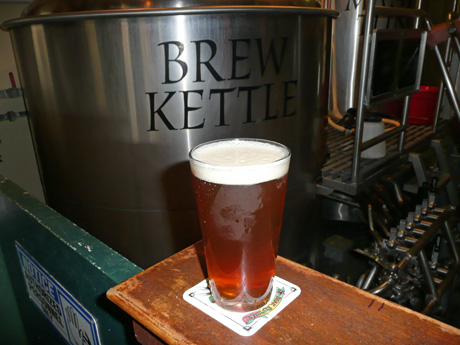
But let’s talk about the beer itself first. It had a dull copper color, slightly hazy, with a decent tan head. The nose was a little restrained, with some bready aromas, a touch of hops and, naturally, some rye character. But it was surprisingly smooth, mild and very drinkable, an easy ryeder indeed. I was surprised to learn it was 5% abv because it seemed more like a session beer to me, and I would have guessed a little lower than that. I thought the rye flavors might overpower the beer, but that’s not the case at all. It is light and refreshing throughout with just enough hop character (at 30 IBUs) for balance. It finishes with just a bit of rye flavor lingering, before dissipating quickly and cleanly. Again, I think my expectations were that if beer with just a fraction of rye tends to give it strong rye flavors and character, that with all rye it would be even more so, but that wasn’t really was not what happened. Instead, they managed to create a unique, ultimately very drinkable beer that in temperament seems closer to a wheat beer, but with the more barley-like flavors of rye.

The beer went through several trials before getting things right. To combat the wort turning to concrete, they had to watch the temperature fluctuations much more closely than usual (no more than 3-5 degrees or it turned to stone), and with bags of rice hulls added to make up for the lack of husks in rye malt. It was, of course, difficult to get the malt to break down and early test batches, if they didn’t become concrete-like, were still very thick and viscous and even hard to remove from the lauter tun at all. Even so, the first test batch that yielded drinkable results was the color of bad gravy, having a dull gray tint to it from all pale rye malt. Apparently it tasted fine, but who among us wants a beer the color of dishwater? Twenty-five pounds of chocolate rye malt was then added to give it the much more appealing color it exhibits today. The hops they used are Chinook and Saaz. It took four tries to get it right, as there really aren’t any manuals for tis kind of beer. Was it worth all that effort? I think so, as the results are quite tasty and in some ways different from anything else I’ve tried. It certainly must have been a learning experience and it’s interesting to see that it is possible on a commercial level to use only rye. It’s quite an achievement, and if you love rye — or just brewing innovation and creativity — you owe it to yourself to get up to Healdsburg to try this new beer.

ezryder-2
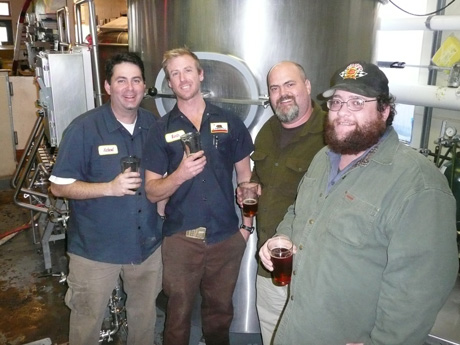
Bear Republic brewers Rich Norgrove, Jode Yaksic, Peter Kruger and Ray Lindecker. Jode, according to Rich, had the most to do with creating the Easy Ryder, from doing the research, test batches and coming up with the name.

Filed Under: Beers, Breweries, News, Reviews Tagged With: Bay Area, California, Ingredients, Malt, Northern California, Science of Brewing

Carnevale di Lost Abbey

January 22, 2008 By Jay Brooks

Port Brewing / The Lost Abbey will holding their first ever Carnevale di Lost Abbey on Groundhog Day, February 2 from 6 to 10 p.m. to celebrate the Venetian holiday with a masquerade ball and new beer release, appropriately named Carnevale Ale. The beer will be the Lost Abbey’s interpretation of a saison, but made with American hops.

From the press release:

For centuries Venetians have celebrated mid-winter and the beginning of Lent with a temporary upending of the social order. Denizens of the canal-lined city disguise themselves as paupers, princes, ladies, lovers and fools, and gather in the Piazza di San Marco to dine, drink and dance at the Carnevale di Venezia. Shortly revelers will soon be gathering in another San Marcos half a world away to carry on the Carenvale tradition with a New World twist.

On February 2nd, 2008 Port Brewing will throw its first Carnevale di Lost Abbey complete with masquerade and a special beer release to honor the ancient tradition. Beginning at 6pm the Lost Abbey will transform from brewery to Venetian piazza, offering party-goers food, music and, of course, Lost Abbey’s award-winning ales.

Coinciding with the celebration the brewery will also issues its first release of Lost Abbey Carnevale, a blonde Saison accented with American hops.

Carnevale di Lost Abbey will run from 6pm to 10pm, Saturday, February 2, 2008. Attendees who attend the masquerade in costume will be admitted free. A $10 charge will apply to those not in costumes. Food and music will also be free of charge. Beers will be offered at regular price.

The new Carnevale ale will also be available for purchase that evening. The beer is being released in 750ml cork-finished bottles with a price of $8.99 per bottle. Carnevale will also be available through Port Brewing’s standard distribution channels. More information on the Carnevale party and beer release can be obtained on The Lost Abbey website.

Filed Under: Beers Tagged With: Announcements, California, Other Event, Press Release, San Diego

If You Have More Money Than Sense

January 20, 2008 By Jay Brooks

The Cruzin Cooler, a motorized scooter with a top speed of 14 m.p.h. and using a cooler with a 27-beer can capacity as the seat, was chosen as one of three Dubious inventions we can live without from among the hundreds, possibly thousands, of new gadgets displayed at the recently held Consumer Electronics Show in Las Vegas. And it’s not hard to see why. Even if they didn’t around $500, I don’t think I’d find many uses for something like this.

From the Cruzin Cooler website:

Cruzin Cooler combines two basic necessities of life, the ability to have cold food or a beverage handy along with the means to get somewhere, without walking. With modern technology, the Cruzin Cooler is light-weight and comes in various sizes and colors and is available in gas and electric models, with a 10 mile range on electric models and 30 miles on the gas models.

The cooler is light enough to be driven to a location and then picked up and carried. The cooler can be used for hunting, sporting events, races, camping, golf or even a trip to the grocery store to keep your food cold all the way home. Marine use will be popular for the new cooler allowing you to take your fish/drinks/food/ ice to and from your boat with powered assistance and braking. Simply ride or power your way up and down ramps.

There are virtually hundreds of uses for the new coolers with thoughts of racing coolers not far behind!

As it’s big selling point, Chuck Miller, marketing director for its manufacturer, spouts the party line that “[i]t combines two basic necessities of life — somewhere to have cold food or a beverage handy, and the ability to get somewhere without walking.” Maybe it’s my curmudgeonly personality, but I have a car. That seems to work well enough to get me and my beer from place to place.

Apparently at least 38,000 people disagree with me, because that’s how many they’ve pre-sold in the U.S., and as for them, they’ll “never have to carry [their] ice chest again,” says Miller. Because that’s really be a huge burden, having to carry the cooler, hasn’t it?

From the UK’s Daily Mail:

Displayed at the Consumer Electronics Show in Las Vegas last week, the Cruzin Cooler, which comes with either a petrol engine or electric motor, can fit 27 drink cans into its ice-box interior. But thirsty owners can also attach trailers with the same capacity, to tow behind it. Miller claims American owners are such fans they stage Cruzin Cooler races.

Races, huh? I’ll believe it when I see it.


And look how versatile they are. You can wear lots of warm clothing and drive them outdoors, even in the snow, or you can wear almost no clothing and drive them indoors, at room temperature.


Filed Under: Beers, Editorial, Just For Fun, News Tagged With: National, Strange But True

Mississippi’s First Bottles of Beer

January 20, 2008 By Jay Brooks

If you’re a beer lover, I imagine Mississippi must not be the best place to live. During the last thirty years, while most of the rest of the country was discovering craft beer with wild abandon, less than a half-dozen microbreweries or brewpubs have opened. Of those, only two are left. And one of those, Kershenstine Diamond, is a contract brewery that makes their beer elsewhere in the Midwest. So that leaves just one brewery currently brewing in the entire state.

That brewery, Lazy Magnolia, is located in Kiln, Mississippi, which perhaps more famous as the hometown of Brett Favre, quarterback of the Green Bay Packers. They have also recently become the first brewery in the state to produce bottled beer with the release of their Southern Pecan, a nut brown ale, in six-packs. In fact, it’s the first time since Prohibition that bottled beer has been brewed and bottled in Mississippi.

From an article in a local newspaper, the Clarion Ledger:

There’s just one issue.

“They’re having problems keeping up with demand. They’ve got people really wanting the product,” distributor Frank Drennan of Capital City Beverages said. “On the bottling, they’re in the learning process. They’re trying to make sure they’re doing it correctly.”

Lazy Magnolia brewmaster and co-founder Leslie Henderson said bigger fermentation tanks will arrive in April. They will triple the brewery’s output to more than 30,000 gallons a month. By mid year, she hopes to be bottling 5,000 cases a month, up from about 700 now.

“We knew all along if we were successful, we would have to bottle. We decided to do draft only at first to see if there was a market. By the time we started bottling, the demand for it was so crazy we could not keep up,” Henderson, a chemical engineer from the Winston County area, said.

The brewery sits alongside the airport runway in Kiln, a Hurricane Katrina-ravaged town of 2,000 on the Gulf Coast. The company’s warehouse building is nondescript to the point of invisibility, the kind of place you pass three times before realizing it’s occupied.

But two of the beers crafted there took podium finishes at the 2006 Beer World Cup. Lazy Magnolia’s brands hold cult status with shaggy young men and middle-aged lawyers in dim roadside bars throughout Mississippi, Alabama and the Florida panhandle. Henderson plans to expand to Tennessee and south Louisiana this year.

I’m sure it will be some time before we see this beer in California, but I certainly applaud their efforts in being a pioneer in their own state. Well done.


Filed Under: Beers Tagged With: Packaging, Southern States

The Jaguar from Patagonia

January 16, 2008 By Jay Brooks

If you’re like me, when you think of beer from Argentina you think of Quilmes. It’s been the best-selling brand for decades and since being acquired by InBev, has been imported to over a dozen countries, including the United States. But there are actually over forty breweries in Argentina.

Another one of them, Patagonia, announced today they will be importing their beer into the U.S. through Aladdin Beverage. They already received label aproval and the first shipments should hit the docks of New York sometime in May.

From the press release:

Brewed and bottled in the oldest Brewery in Argentina (est. 1884), Patagonia represents the exact type of brand which Aladdin looks for. “Patagonia is a wonderful tasting Blond Ale. I love Blond Ales, so I have a bias towards them, but this is truly one of the best Blonds I have tasted. So much so that we have entered Patagonia into the 2008 World Beer Cup and I think we have a good chance of winning,” states Ted O’Connor, President of Aladdin Beverage.

Patagonia prides itself on being brewed with only all natural ingredients. In fact they go one step further and adhere to an old law dictated by Bavarian Duke William IV, which stated, beer is only considered premium if it is brewed with pure malted barley, hops, yeast, and water. That is it!

Curious about that odd-looking label? I was, and here’s the answer. Patagonia’s logo is a stylized representation of the jaguar. Apparently, jaguars were common in Patagonia (roughly the southern third of South America) until the 19th century, when they were hunted to near extinction by European explorers and settlers. To the native population, jaguars were sacred as a symbol of power and in some circles even considered a god. They were often important in local religions and were also associated with Courage, fertility, intelligence and magic.

The Jaguar is one of the four “big cats,” and the largest in the Western Hemisphere. The others include leopards, lions and tigers, oh my.

The Patagonia Jaguar.

Filed Under: Beers Tagged With: Business, International, Press Release

Stratemagizing A-B Advertising for ’08

January 14, 2008 By Jay Brooks

“Offensive in a good way” is how Tony Ponturo, vice-president of global media, sports and entertainment marketing for Anheuser-Busch, sees their strategy for advertising and marketing in 2008. By that he means they “can’t just be defensive in buying assets.” Although I’m pretty sure that’s exactly what every big beer company did once sponsorship of events, leagues, teams, etc. proved a lucrative way to get one’s brand name out there. So welcome to the new model? Doubtful, reading the Brandweek article on A-B’s marketing and advertising plans for 2008, I’m not exactly bowled over by novelty and a fresh approach.

At least we’ll see less new products this year. Of course, it would be hard to match the “80 new products and line extensions” of 2007. Executive V-P Bob Lachky, claiming A-B has “become smarter marketers,” listed only a few of the new product rollouts for this year.

  • Chelada (Bud-plus-Clamato)
  • LandShark Lager
  • Michelob fruit-flavored extensions
  • Shock Top (a Belgian white ale)
  • Wild Blue (a blueberry-flavored beer)

Hmm, none of those sound particularly promising, and I think I’ve already tried at least a couple of them (meaning only that they can’t be altogether new). And I love this bit of ad-speak.

But beer still has plenty of untapped white space, said Marlene Coulis, vp-consumer insights and innovations. Brews coming this year will likely be flavor extensions of existing brands.

“Untapped white space,” now there’s a phrase for you. I’ll be sure to work that into my lexicon this year somehow. It’s just too deliciously jargon-esque not to.

More from the Brandweek piece:

Call it a spin, but A-B is shedding its reliance on growth through distribution and pure image marketing that targets 21-27-year-old males. It has to. Bud and Bud Light have more than 90% distribution in big markets. To grow, A-B has to keep its core drinkers and attract “explorers”—people who seek variety in beverages. A-B also needs new products to win drinkers who reject the existing lineup.

To woo the uninitiated, A-B launched “the great American lager,” from DDB, New York [an ad agency —J], during January bowl games rather than wait for the Super Bowl. The Bud campaign cites product attributes like beechwood aging and seven-step brewing. [Those must be the embarrassing Rob Riggle (from the Daily Show) spots that I’ve been seeing. —J]

“The explorer group has never been talked to like this,” said Keith Levy, vp-brand management. “If we can reach them about what Bud stands for, we can grow.”

Still, the category’s penchant for advertising image in a bottle is not dead. “Image with a reason for being is powerful,” said Lachky. “We’re talking about the product more, and we understand better what the consumer needs are today. Image-only ads and attack ads are only sufficient within the category because our category is competing with wine and liquor.”

That’s why the advertising spend for Bud and Bud Light will increase by $70 million in 2008; cable and digital buys will at least double. Media spend for both brands was $219 million January-October 2007, per Nielsen Monitor-Plus. A-B will also seek more “cross platform” opportunities, as with the “Dude” campaign, which began online around Thanksgiving before jumping to TV a few weeks later.

Does any of that sound very different from what they’ve been doing for years and years? Not to me, and also not to Jim Morris who writes a consumer advertising blog, Advertising for Peanuts, who said in a recent post titled Beating Dead Clydesdales:

The recent history of Budweiser is strewn with carnage left in the wake of their fatal inability to leave a one-shot alone—frogs, whassupers, and now the eternal parade of the dude-utterers. Even when this brand does come across an idea with legs, they spot an ant and imagine a millipede, as has been the case with their long ago worn out “Real men of genius” radio campaign.

I realize that a good beer advertising idea is a rare and precious thing, seldom seen in these parts, but isn’t that all the more reason to nurture and protect it and respect its boundaries, rather than exploiting, devaluing and demeaning it until any memory of its original brilliance is eclipsed by the slagheap of its strained successors?

With the Super Bowl around the corner (Go Packers!), and the writer’s strike still going, advertisers are ponying up record amounts for 30-second spots during the big game. Prices this year are 15% more expensive than last year, as compared to being only 4% higher last year over the previous Super Bowl. A-B has reportedly bought 10 spots for its various brands. Let’s see how many of those are different from the usual fare.


Filed Under: Beers, Editorial Tagged With: Business, National

Lumpy Gravy: Now That’s A Beer Name

January 10, 2008 By Jay Brooks

By know you probably already know that Tony Magee, the iconoclastic owner/brewer of Lagunitas Brewing, is a big fan of Frank Zappa. So far, with the permission of Zappa’s widow, Gail Zappa (who runs the Zappa Family Trust), he’s released a Lagunitas beer on the 40th anniversary of each of Frank Zappa’s first two albums. First there was Freak Out and then Kill Ugly Radio, the original title of his second album, Absolutely Free. Now comes Lumpy Gravy, again using artwork from the original album. I haven’t tried it yet, but I can only hope it’s a brown ale. That would be most fitting.


Filed Under: Beers Tagged With: Bay Area, California

The Primo Return of Primo

January 9, 2008 By Jay Brooks

primo-new
This was first reported back in late November during what I’ll continue to call “The Great Ennui of Late ’07” when the Bulletin was looking pretty sparse. I’m returning to the new year reinvigorated, or at least willing myself to try, and so I’m trying to catch up on old news people have sent in, and this comes to me by way of my island connection, a regular Bulletin reader living in Hawaii. Thanks Doug. It seems the old iconic Primo Beer brand has returned as of December, so far in kegs only. Bottles will be back sometime in April.

primo-shirt

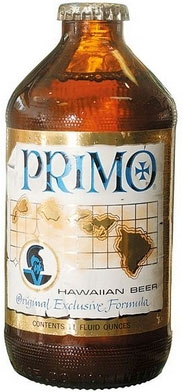
First, a little history. Primo Beer was originally made by the Honolulu Brewing & Malting Co., which was founded in 1898. After Prohibition ended, it was renamed the Hawaii Brewing Co. and by the 1950s became the best-selling beer on the islands. In 1963, Schlitz Brewing bought the brand, building a new brewery in ‘Aiea, and they continued making Primo until closing it in 1979. At its height, the Hawaiian brewery produced over 400,00 barrels per year. A few years later, in 1982, Stroh Brewing bought the brand and changed the label as well as the formula, trying to sell the brand outside Hawaii in several states. With mixed success, sales grew and then fell again, and eventually Stroh stopped making Primo in either 1997 or 98 (accounts differ on this point). A year or two later, Pabst acquired the brand, along with several others brands from Stroh’s and they are the current owners of the brand.

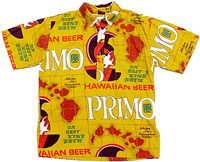
So last year, Pabst made the decision to bring back the label. And that makes sense, Primo was one of those iconic brands that people couldn’t help but associate with Hawaii. Using a silhouetted image of King Kamehameha, who in 1810 united the Hawaii Islands under his leadership of the Kingdom of Hawaii, was a genius marking move and the bold Hawaiian shirts made in the 1960s-70s with the Primo label continue to be collector’s items right up to the present.

The new Primo is being launched by the Primo Brewing Co., a division of Pabst Brewing. A new recipe was created by brewmaster Phil Markowski, who justly won fame and fortune for his beers at the Southampton Publick House on Long Island, New York.

The beer itself is being brewed by a craft brewery on the island of Kauai, Keoki Brewing, who initially will brew around 200 kegs each month. Once bottled production starts up, that will be handled stateside by Pabst in Irwindale, California. But since Pabst doesn’t own any breweries, that means Miller Brewing — who does own a brewery in Irwindale — will be contract brewing the beer for Pabst. According to a press release, “the draft and bottled versions will be distributed by Paradise Beverage Co.”

It will be interesting to see if they can successfully revive the brand. I imagine it will be great as a tourist beer and for locals looking to support a well-known local brand, at least as far as the draft beer is concerned. The bottles stateside may prove trickier, especially after the initial novelty wears off, as it inevitably will.

primo-btl

Filed Under: Beers, News Tagged With: Business, History, Western States

Reunion’s Reunion

January 7, 2008 By Jay Brooks

The second annual release of Reunion — A Beer for Hope will take place during the week of February 17, 2008. This year’s beer celebrates the life of Virginia MacLean, the inspiration and one of the founding partners of the Reunion beer collaboration. (See links page at Reunion Beer for stories on the 2007 release.)

This year’s beer is an Organic Red Rye Ale, once again brewed in cooperation with Bison Brewing in Chico, CA. It is a reddish-amber colored beer, with a pronounced malt forward profile balanced by the delicate spices of the hops and rye. It is 6.5% alcohol by volume.

The beer will be distributed through the SBS-Imports distributor network, to approximately 20 states, suggested retail price of $4.99-$5.99 per 22 ounce bottle.

Consumers may also mail order (starting mid-February) via the Michael Jackson Rare Beer Club. 100% of the profits generated by SBS-Imports will benefit the Institute for Myeloma & Bone Cancer Research (IMBCR). Donations to IMBCR accepted via Reunion Beer or directly at the IMBCR site. Bottle and label art available upon request. Full press release to follow in early February.

If you missed this story last year, here’s how it started.

Once upon a time, Pete Slosberg created Pete’s Wicked Ale. And the brown ale was good. He had help spreading the word, of course, and in the early days Alan Shapiro and Virginia MacLean also helped Pete’s become a nationally known microbrewery. Pete, of course, moved on to chocolate and Alan Shapiro worked for a time with Merchant Du Vin and now heads his own import company, SBS Imports. Virginia MacLean, in the meantime, left the beer business but as she approached her fortieth birthday was diagnosed with Multiple Myeloma, which is a type of bone cancer that currently has no known cure. For more information about the disease, see the MMRF or the Institute for Myeloma & Bone Cancer Research.

Last February, Pete Slosberg and Alan Shapiro got together and decided to help their friend by creating a new beer to help raise awareness and money to fund research into this disease. The beer was named “Reunion,” and it was a big, imperial brown ale and was the first commercial beer Slosberg had done since selling Pete’s Wicked Ale to Gambrinus in 1998. He worked with award-winning brewer Daniel Del Grande at Bison Brewing in creating the organic beer.

Unfortunately, last June Virginia McLean passed away in her home in Mountain View, California. But Pete and Alan decided to continue the fight against the disease that took their friend in her name and in her honor. When you start seeing this beer again this February, please buy a bottle or two to support this worthy cause.


About Multiple Myeloma & IMBCR:

Multiple Myeloma is a unique cancer of plasma cells that attacks and destroys bone. The term is derived from the multiple areas of bone marrow that are usually affected by the disease. Worldwide, over 1,000 people a day are diagnosed with this currently incurable form of bone cancer. Led by Dr. James Berenson, IMBCR is one of the world’s leading research organizations combating this disease. IMBCR specializes in developing novel chemotherapy drugs and treatments. For further information on multiple myeloma or IMBCR, please visit www.imbcr.org or contact 310-623-1210.


Filed Under: Beers, News Tagged With: California, Health & Beer, Northern California, Press Release

« Previous Page
Next Page »

Find Something

Northern California Breweries

Please consider purchasing my latest book, California Breweries North, available from Amazon, or ask for it at your local bookstore.

Recent Comments

  • Bob Paolino on Beer Birthday: Grant Johnston
  • Gambrinus on Historic Beer Birthday: A.J. Houghton
  • Ernie Dewing on Historic Beer Birthday: Charles William Bergner 
  • Steve 'Pudgy' De Rose on Historic Beer Birthday: Jacob Schmidt
  • Jay Brooks on Beer Birthday: Bill Owens

Recent Posts

  • Beer In Ads #5371: Miller Bock Beer October 11, 2026
  • Beer Birthday: Kirby Shyer October 11, 2026
  • Beer Birthday: Kushal Hall October 11, 2026
  • Beer Birthday: Jaime Ojeda Selamé October 11, 2026
  • Beer In Ads #5370: Salmon Bock October 10, 2026

BBB Archives

Feedback

Head Quarter
This site is hosted and maintained by H25Q.dev. Any questions or comments for the webmaster can be directed here.