Brookston Beer Bulletin

Jay R. Brooks on Beer

  • Home
  • About
  • Editorial
  • Birthdays
  • Art & Beer

Socialize

  • Dribbble
  • Email
  • Facebook
  • Flickr
  • GitHub
  • Instagram
  • LinkedIn
  • Pinterest
  • RSS
  • Twitter
  • YouTube

Powered by Genesis

Lost Abbey’s Red Poppy To Be Released January 19

January 4, 2008 By Jay Brooks

I got the word today that The Lost Abbey will finally be releasing their Red Poppy Ale on January 19.

From the press release:

The Lost Abbey will issue its long-awaited first release of Red Poppy Ale on January 19, 2008. A Flanders-style red ale made with sour cherries and aged in French Oak barrels for one year, the 60 case limited edition release will only be available directly from the brewery.

A medium-bodied ale, Red Poppy has a reddish-brown hue, rich fruit aroma, and a complex mélange sour cherry, plum and red wine flavors accented with notes of chocolate and vanilla. The beer’s name was inspired by head brewer Tomme Arthur’s annual springtime sojourns to Flanders, a time when fields of the Northern Belgian province are covered with the fiery red flowers.

Release Details:

60 cases
375ml cork-finished bottles
Four bottle maximum per person
5% ABV
$15 per bottle

And from the website:

Perhaps no country embraces the use of fruit in beers more so than Belgium. Numerous traditional as well as regional specialty ales are infused with every sort of fruit imaginable. In this way, the flavor of the fruit becomes especially prominent. Red Poppy Ale is a veritable celebration of Sour Cherries in an explosion of aromas and tastes. Brewed from a brown ale base and aged in our oak barrels for over 6 months, this beer is not for the faint of heart. The Golden Poppy is the state flower of California and the Red Poppy is found in Flanders Fields where our inspiration for this beer comes from.



Filed Under: Beers, News Tagged With: Announcements, California, Press Release, San Diego

Moylan’s To Squeeze Kilt Lifter Into Six-Packs

January 3, 2008 By Jay Brooks

Moylan’s Brewing of Novato, California has always had many, if not all, of their beers available in 22 oz. bottles. For the first time they’re debuting one of their beers, Kilt Lifter Scotch Ale, in six-packs of 12-oz. bottles.

From the press release:

Moylan’s Brewing Company will be sending six-pack bottles to the shelves come late January of 2008, just in time for the Superbowl in February. Moylan’s world-wide award winning Kilt Lifter Scotch Ale will be available in selected retail locations with suggested prices from $8.99-9.99. Denise Jones, Moylan’s Brewmaster, journeyed up to Sudwerk Brewing Company, in Davis CA, to work on expanding and perfecting the brewing of the ever popular Scotch Ale in a larger capacity; an agreement created partly out of owner Brendan Moylan’s respect for Sudwerk, it’s Brewmaster, and the quality of beer brewed onsite, and partly due to the desire to reach more customers with different packaging options. Moylan’s Brewing Company is excited about the reception of the new packaging and, if all goes well, plan on increasing the selection to include other award winning ales in smaller options. Curtis Cassidy, sales manager at Moylan’s Brewing Company states, “Starting off, we will be offering the new bottle size exclusively to California customers. After testing the waters with the Kilt Lifter six-packs, we plan on moving other Moylan’s beers into six-packs as well. We hope to be taking steps towards these goals by the end of 2008.”

The new Kilt Lifter in a 12 oz. bottle.

And the new Kilt Lifter six-pack carrier.


Filed Under: Beers, News Tagged With: Bay Area, Business, California, Packaging, Press Release

Harriet’s Beer For Girls

December 17, 2007 By Jay Brooks

Harriet Easton, age 19, appears to be one ambitious and entrepreneurially-minded young lass. She’s determined to fill the void created by a continuing drop in UK pub beer sales. “Figures released last month showed beer sales in pubs at their lowest level for 70 years. Seven million fewer pints per day are now being sold, with sales down 49 per cent since they peaked in 1979.” One obvious market being neglected is the female segment. So Easton, a politics student at Newcastle University, spent a year and a half — and £35,000 — on R&D to create a beer especially for women. It’s a “light ale with extract of orange and a modest 4.2 per cent alcohol.” Easton teamed up with a local brewery, Hanby Ales of Wem in Shropshire, to create the curiously named Harry’s Beer, which will be marketed to women beginning Monday at the Salopian Bar in Shrewsbury. On hand will be, Paula Waters, chairman of CAMRA. “Waters said: ‘I applaud the inventive way Harriet has brought this product to market. She’s a sassy and savvy young woman who has recognised there are others just like her who want to drink real ale and retain their femininity.'”

But as far as I can tell, this is not her first attempt. In August of this year there was at least one story about Harriet Easton in the Shropshire Star called These Girls Are For Real. At that time, they reported Easton debuting another beer, this one called Rushing Dolls beer for girls. In that article, Rushing Dolls was described as having “a zest of lime—it’s very light and hoppy.” There Easton was quoted as having created her beer because others were — I just love this expression — too blokey. Hop Talk even did a post about it in September. The lime version was “thought to be the first ever beer for girls” and now the new orange version is being similarly touted, this time by the Publican, who say it’s the “first real ale aimed specifically at women.” This time around, Easton says:

“Real ale has typically and consistently been marketed towards men with names full of cheesy puns and innuendo, and images of buxom wenches serving up frothy jugs,” said the politics student at Newcastle university. “They can keep all that — there’s no need to move on, lads — just move over”.

Still, I can’t help but think of Virginia Slims or pink trains for girls. It seems to me either a woman will develop a taste for beer or she won’t. I know plenty of women who already love craft beer, including my wife, and it didn’t take a specially designed beer for them to like beer. Trying to make one specifically for the ladies seems like a gimmick at best. But if it brings more women into the fold, I suppose that can’t be all bad.
 

Filed Under: Beers, Editorial, News Tagged With: Business, Europe, Great Britain, Strange But True

Forget Gatorade, Drink Beer

November 3, 2007 By Jay Brooks

football
As reported in England’s Telegraph, a new Spanish study has concluded that the best thing you can drink after playing vigorous sports is not Gatorade, but beer. Specifically, the study found that for the dehydrated person, beer helps retain liquid better than water. Wow, finally a good reason to work out.

Filed Under: Beers, News, Politics & Law Tagged With: Europe, Health & Beer

Killing Ugly Radio One Beer At A Time

September 28, 2007 By Jay Brooks

Last year I wrote that Tony Magee, the iconoclastic owner/brewer of Lagunitas Brewing has been a big Frank Zappa fan most of his life. That’s still true and he’s kept his promise to keep releasing Frank Zappa beers as the anniversaries of each album comes to pass. First it was Freak Out and now Lagunitas has released Kill Ugly Radio, which was apparently the name Zappa wanted to call his second album. The record company said no, and instead it was known as Absolutely Free. The new beer was also made with the permission of Zappa’s widow, Gail Zappa (who runs the Zappa Family Trust). Like the last one, the label uses artwork from the album.

When the Celebrator panel tried it for the New Releases section of the latest issue, here’s what we thought of the beer:

Like a cacophony of Zappa’s music, there’s a lot going on in this beer. In some ways it’s a bit like a saison on steroids with the peppery, zesty spices you’d expect, but with a very big hop presence. Perhaps a little unbalanced, but then so was Zappa. Again, like Zappa, it’s big and eccentric with a lot of tangents of flavors, in the end a fitting tribute. Highly Recommended for fans, merely Recommended for people who don’t get Zappa.


Click on the label for a larger view.
 

Filed Under: Beers Tagged With: Bay Area, California

Sierra Nevada to Bottle Fresh Hops

September 10, 2007 By Jay Brooks

Almost a dozen years ago, Sierra Nevada head brewer Steve Dresler was having lunch with renowned hop expert Gerard Lemmens. He had just returned from England, where he’d been helping a brewer there figure out how to use whole, unkilned hops. Gerard asked Dresler if he’d ever considered using fresh hops.

He hadn’t, of course, but the idea marinated and a few days later he mentioned it to Ken Grossman who told him to “go for it.” The first year, Dresler made only one 100-barrel batch. In the intervening years, as demand for the beer has risen quickly, many obstacles have been overcome, such as how to ship that many hops or how to convert a recipe from regular hops (which are 8-10% water) to fresh hops (which can be as much as 80% water). Also that first year, an entire UPS truck was filled with small boxes of fresh hops bundled together with holes poked into them. Today, they’re overnighted in mesh onion sacks laid out flat in a single layer of a 18-wheel refrigerator truck. Each year, both Cascade (@2/3) and Centennial (@1/3) hops are used, but because they’re different from year to year — and because the exact quantities of each differ — the beer has to be reformulated on the fly. When it’s brewed is always a moving target because it’s contingent on when the hops are ready to be picked. Often it’s around Labor Day weekend, but you never know. Over the last eleven years, the most Harvest Ale they’ve made in a single year has been around 800-900 barrels available on draft only.

This year, however, Sierra Nevada is taking a giant leap and is planning to brew 3,000 barrels, using 16,000 pounds of fresh hops in two batches. And more exciting still, two-thirds of it will be available nationwide in 24-oz. bottles. I suspect it will sell out fast, not least of which because even though they’re making triple the usual amount, it will be sent all over the country meaning only small amounts which reach most markets. I’ve learned that the final brew was done last Thursday, September 6, and they hope to have it in the bottles as early as September 24. Keep an eye out for it, and buy it right away. But more importantly, drink it right away, too. This is the very antithesis of a beer meant to be aged. Make up your own special event to drink it. Get some fresh, locally made food and cook up a great meal. Invite your favorite people over to share it with you. This is the best way to celebrate harvest time, with the fruits of the harvest, both food and drink.

Filed Under: Beers Tagged With: California, Hops, Northern California, Packaging, Seasonal Release

Sparkling Hop Liqueur?

August 21, 2007 By Jay Brooks

Kirin Brewery announced today that they will releasing their third quasi-beer into the populy Japanese alcohol category known as “third-category.” The Japanese media came up with that name, officially they’re classified as “other miscellaneous alcohol” or “liquor.” Naturally they’re subject to lower taxes, are often made with soybeans but without malt. The first and second categories are “beer” and “happoshu,” which is a low-malt beer with less than 67% malt.

Kirin’s newest entry into the lucrative Japanese quasi-beer market is “Sparkling Hop,” which, according to the press release, will “feature a distinctive aroma created by blending Japanese and New Zealand hop varieties. Strong pressure gives the product a rich head and a refreshing finish, Kirin officials said.”

Sparkling Hop’s target demographic is twenty-somethings, the same group that are buying the dreaded alcopops.

Also from the press release:

Sparkling Hop is made by mixing a “happoshu” low-malt drink with spirits. Under Japan’s liquor tax system, the new product is classified as a liqueur, whose tax rate is lower than those for beer and happoshu.

This is Kirin’s third product in the third category, following “Ryoshitsu Sozai” and “Nodogoshi Nama.” With the three products, Kirin hopes to beat out its rivals in the heavily crowded third-category market.

These “third-category” products along with the low-malt happoshu will likely never reach our shores, because they’re largely a result of taxation. If Japan’s tax structure was different, they wouldn’t exist. But they appear to be having the same damaging effect as alcopops are having here, not so much in terms of underage drinking (in Japan it’s age 20), but insofar as the sweeter drinks are finding favor with kids raised on sweet soft drinks who are not acquiring a taste for bitter drinks like beer as they age. It’s somewhat ironic that Japan’s beer industry in trying to get around the tax laws, may be shooting themselves in the foot with these lower-taxed, highly sweetened alcoholic drinks.


Filed Under: Beers, News, Related Pleasures Tagged With: Asia

World’s Rarest Bottle of Beer Sold on eBay

August 16, 2007 By Jay Brooks

A full bottle of Allsopp’s Arctic Ale, brewed and bottled in 1852, sold recently on eBay for a record $503,300. The eBay listing gives a great deal of historical information about the Arctic expedition, as well as the bottle itself:

Until the 1850s Allsopp’s Brewery was most notable for brewing some of the first India Pale Ales for export to the colonies. However, Samuel Allsopp was approached about a different recipe; Sir Edward Belcher was about to led an arctic expedition (1852) to search for the lost explorer Sir John Franklin. The Expedition needed a brew that withstand arctic and sub arctic temperatures, and provide a degree of sustenance and nutritious value. “Captain Belcher reported that Allsopp’s Arctic Ale proved to be “a valuable antiscorbutic”, helping fight off scurvy, the bane of all sea voyages in those days.” He added that the beer was “a great blessing to us, particularly for our sick” and that it refused to freeze until the temperature dropped well below zero.”

What you are looking at is an actual museum quality sealed and intact bottle of Samuel Allsopp’s Arctic Ale brewed for the 1852 Expedition to the Arctic lead by Sir Edward Belcher. This bottle of beer is likely the rarest, oldest, and most documented bottle of beer in existence! Not to mention the unbelievably unique history surrounding it. Accompanying the bottle is an actual limited handwritten history about the bottle itself.

That laminated card you see hanging off the bottle is the handwritten note, which reads:

“This ale was specially brewed and bottled in England, in 1852, for Kane’s Expedition in search of Sir John Franklin. A portion of the lot was cached in the Arctic; and was afterwards taken back to England, where it was bought by Allsopp, from whom Mr. Jus. Fennell obtained a part.

This bottle was given to me by Mr. Fennell May 13, 1919. Should I depart from this (by that time probably) dry world before consuming the contents, let my son and brethren perform my duties and enjoy my rights in that respect, on the eve of my funeral (if they find it in time) – unless such act be then illegal, in which case those of the aforesaid trustees who sufficiently learned in law shall advise ac-????? To the rule of ey fares.

Two bottles of this ale were guests of honor at the banquet given to Shackleton and Peary, in Boston, some years ago. (1907/1908) The skeletons of said guests were preserved as mementos of Sir John Franklin! (Useful suggestion regarding the “cast off shell” of the spirit.)

Signed: Percy G Bolster

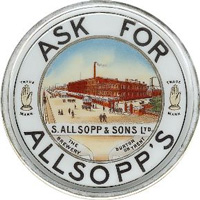
A short history of the Allsopp’s Brewery from MidlandsPubs.co.uk page on Staffordshire breweries:

allsopps-ask4

Based in the High Street of Burton-on-Trent, the history of this company can be traced back to the 1740’s. Samuel Allsop acquired the brewery in 1807. A new brewery and offices were constructed in 1859-60 close to the railway station. Throughout the 19th century Allsopp’s brewing business was second only to Bass in size. The new brewery site alone stretched between Station Street and Horninglow Street. They retained the original brewery in High Street, built a large maltings at Shobnall and numerous premises elsewhere. Samuel Allsopp was the first to export Burton Pale Ale to India in 1822. By 1890 their output had reached 460,000 barrels and they had a workforce of 1,750. However, the 20th century was not so favourable for the company and they went into receivership in 1913. Allsopp’s was eventually merged with the neighbouring Ind Coope & Co.Ltd. to form Ind Coope & Allsopp Ltd. The offices of the new brewery were later used as the headquarters of Punch Taverns and the Spirit Group.

There’s another interesting lecture transcribed that goes into great detail about what led to the Allsopp’s Brewery’s demise, entitled “The Fall of the House of Allsopp” by an R.G. Anderson.

What a fascinating little tale. I just hope they don’t open the bottle.

UPDATE: An alert Bulletin reader (thanks Scott) found a similar looking bottle that sold on eBay in June for a mere $305 and wondered if there was something “hokey going on.” A closer look at the two listings reveals that the person who bought the bottle for $305 is the same one who turned around and sold it for a half million. Now that’s a good return on investment.

Filed Under: Beers, Just For Fun Tagged With: Europe, Great Britain, History, Strange But True

Sierra Nevada Bottles Anniversary Ale

July 24, 2007 By Jay Brooks

For a long time now, if you wanted to try Sierra Nevada Brewing Co.‘s anniversary ale, you had to drive to Chico and visit the brewery pub, because that was the only place it was available … until now. This year, Sierra Nevada will be offering the 27th Anniversary Ale in bottles. I’ve only been fortunate enough to be in Chico at the right time to try the beer one time, many years ago. It’s great that it will now be much more widely available.

From the press release:

For the first time in its 27-year history, Sierra Nevada Brewing Co. will release its Anniversary Ale in bottles. For years, this coveted beer has only been available in the brewery pub in Chico, California during the fall season when the company celebrates the anniversary of its founding in 1980.

“When we heard people had driven all the way from San Francisco last year to try some of this beer, and how disappointed they were when they couldn’t take some home, we figured it was time to make our Anniversary Ale available to everyone on a consistent basis,” said brewery founder and CEO Ken Grossman.

Despite the pent-up demand, the company has historically only been able to produce its Anniversary Ale intermittently. Yet that hasn’t stemmed interest from devout followers who eagerly anticipate anything new from Sierra Nevada, which has been one of the innovators of the craft brewing renaissance since its founding in 1980.

“Ever since we put out our 25th Anniversary Ale in 2005, the demand to make this an annual beer has increased,” said Sierra Grossman, the company’s brand manager and daughter of the founder. “Since we don’t offer growlers to-go at the brewery, people have been pretty frustrated over the years that they haven’t been able to take any Anniversary Ale home.”

The 2007 Anniversary Ale features prominent usage of Cascade hops– the signature hop used in Sierra Nevada’s most popular product, Pale Ale. It is an American Style IPA with a big, fragrant pine and citrus hop aroma balanced by the sweetness of two-row pale and caramel malt. It finishes with an additional Cascade dry-hopping creating a big hop aroma Sierra Nevada fans will look forward to.

Filed Under: Beers, News Tagged With: California, Northern California, Press Release

Krusovice Komes to Amerika

June 19, 2007 By Jay Brooks

Monday night I attended a presentation at the Toronado for the San Francisco launch of Krusovice, a beer from the Czech Republic. An old friend of mine, Dave Deuser, is the local rep. for the beer, which is (or was, but more on that in a minute) part of the Binding Group, a German company that owns several breweries, including DAB, Radeberger, Clausthaler, and Tucher. He had Krusovice’s head brewer and a translator who works for the brewery in tow.

Binding USA is bringing two of Krušovice’s beers into the U.S. market, the Imperial and the Cerne. The Imperial, which they call a Czech Premium Lager, is very clean with soft, round flavors. I was quite impressed with it. It used all Saaz hops and was right up there with the best tasting lagers I’ve had. The Cerné is a dark lager made with pale and specialty malts. At only 3.8% abv, it was very easy drinking. It had delicious sweet malt flavors.

The presentation was very thorough and included a thick, spiral bound book that the brewer went over page by page, calling out “turn page now” in his best Germanic command voice. The Royal Brewery of Krušovice has a rich history, having been founded around 1517. In 1581, the brewery was purchased by Emperor Rudolf II, whose visage still appears on the labels. When he moved his capital from Vienna to Prague, he moved it to the nearby town of Krušovice and it became a “Royal Brewery,” a distinction it continues to claim to this very day.

In 1945, after World War II it became the property of the state, in this case Czechoslovakia, until it was privatized in 1991 and then was purchased by the Binding Group in 1994. Binding completely modernized the brewery facilities and began exporting the beer in 1997. As of 2005, Krušovice was the 5th largest brewery in the Czech Republic.

All their beers use a double decoction method, which is fairly common in Germany and for lagers. Many craft brewers use infusion mashing since it requires less equipment and is generally quicker, and while there is a debate about which method is better, it seems moot as long as the end result is both what you were trying to achieve and tastes good.

Krušovice is currently sold throughout most of Europe, Australia and now North America (or at least in the U.S. and Canada). 63% of Krušovice is sold in kegs, 32% in bottles and 5% in cans. It’s apparently wildly popular in Russia, which accounts for more than half of all exports.

And that brings us to the weird part of the evening. Halfway through their tour of the States, they got the word that Krušovice had been sold to Heineken, who was looking to make greater inroads into the Russian beer market. So it was a testament to everybody’s professionalism that presentation went as well as it did. My friend Dave didn’t now what his role would be now regarding Krušovice, but it’s likely Heineken will bring in their own people and the Binding folks won’t be involved any longer. As for the brewer, I’m sure he must have felt at least a twinge of uncertainty for his own fate, but everybody continued to champion the brand as if nothing had changed. I’m not sure I could have done as well under those circumstances.

It was a fun and informative evening, with two very tasty beers to make it all the more enjoyable.

Krusovice’s head brewer (at left) and his translator.

Filed Under: Beers, News Tagged With: Europe, History, International, National, Tasting

« Previous Page
Next Page »

Find Something

Northern California Breweries

Please consider purchasing my latest book, California Breweries North, available from Amazon, or ask for it at your local bookstore.

Recent Comments

  • Bob Paolino on Beer Birthday: Grant Johnston
  • Gambrinus on Historic Beer Birthday: A.J. Houghton
  • Ernie Dewing on Historic Beer Birthday: Charles William Bergner 
  • Steve 'Pudgy' De Rose on Historic Beer Birthday: Jacob Schmidt
  • Jay Brooks on Beer Birthday: Bill Owens

Recent Posts

  • Beer In Ads #5371: Miller Bock Beer October 11, 2026
  • Beer Birthday: Kirby Shyer October 11, 2026
  • Beer Birthday: Kushal Hall October 11, 2026
  • Beer Birthday: Jaime Ojeda Selamé October 11, 2026
  • Beer In Ads #5370: Salmon Bock October 10, 2026

BBB Archives

Feedback

Head Quarter
This site is hosted and maintained by H25Q.dev. Any questions or comments for the webmaster can be directed here.