
LANDMARK BEER COMPANY RELEASES ITS THIRD BEER, LANDMARK INDIA PALE ALE
Syracuse, NY — Landmark Beer Company is proud to announce that it’s much anticipated India Pale Ale is now available. This beer is a full flavored American style India Pale Ale. We use Centennial, Columbus and Cascade hops to give it a bold hop aroma, flavor and bitterness throughout.
Beer Facts:
Release Date: May 2007
Hop Variety: Columbus, Centennial, Cascade
Stats: 6.8% alcohol by volume, 68 bittering units
Availability: year round in bottle and draft form.
Deschutes 19th Anniversary Golden Ale
The newest beer from Deschutes is in celebration of their latest anniversary. The 19th Anniversary Golden Ale is also part of the Bond Street Series, which are put out in 22 oz. bottles for a limited time. All of the brewers at Deschutes get together and each pitches a style/recipe of beer they want to make in the pilot system as the next Bond Street beer. The brewers then debate the choices and pick the one they all like best, which is then the next beer in the series.
|
From the press release:
“We felt we had to do something special to mark our 19th Anniversary,” said brewmaster Larry Sidor, “so we took a vow of silence and brewed our first Belgian style ale ever to be bottled.”
The straw colored Strong Golden Ale is made from an impressively international list of ingredients that acknowledge the diverse roots of craft beer. “We used Czech Saaz, Slovenian Golding, Pacific Northwest Liberty, and Brewers Gold hops,” said Sidor, “along with French pilsner malt, and Belgian white candy diamonds and bitter orange peel from the island of Curacao for a little extra kick and sizzle.”
The vow of silence, a nod to the Belgian monks who brew some of the world’s most revered beers, may have been the biggest challenge for the brewers at Deschutes. About half way through adding the 180 bags of malt, one of the brewers inadvertently exclaimed, “Good Lord, this is a lot of malt.” Keeping with the spirit of their Belgian counterparts, another brewer answered, “Amen, brother.”
Deschutes Brewery, a pioneer of Oregon’s craft beer industry, opened as a small brew pub in Bend in 1988. As the central Oregon town made the transition from timber and ranching to an outdoor lifestyle destination, the brewery expanded. Deschutes produces 160,000 barrels of craft beer in several distinctive styles which are available in bottles and on tap throughout the region. A new brewpub is scheduled to open in Portland next year.
The 19th Anniversary Belgian-style Strong Golden Ale will be available from June through September in 22-ounce bottles and limited draft.
Squatter’s Brews Utah’s 1st Organic Beer
Jennifer Talley, the head brewer at Squatter’s Pub Brewery, which is operated by Salt Lake Brewing, has brewed the state’s first certified organic beer, an amber ale. Squatter’s is already known for their ecological leanings, having been named a Utah recycler of the year in 2004. So creating an organic beer does seem like the next logical step for them to make. According to the Salt Lake Tribune, Talley used “organic pale and caramel malted barley and aromatic hops,” using “barley is grown from organic seeds, using natural methods of pest control such as lady bugs and composting rather than chemical fertilizers.”
The taste, says brewmaster Jenny Talley, is a caramel-like maltiness with a hint of sweetness. Organic certification requires high levels of cleanliness and sanitation that already were in place, said Talley. But it also requires strict segregation of ingredients “from grain to glass.”
In addition to the Squatters Pub in downtown Salt Lake City, the new organic amber ale is also available at Park City and at the Salt Lake City International Airport. It will also begin appearing on grocery store shelves throughout Utah beginning this summer.
I’ve very much enjoyed Talley’s other beers and am glad to see yet another organic beer from a well-established brewery.
Jenny Talley, brewmaster at Squatters, shows off her Squatters Organic Amber Ale, the Utah’s only certified organic beer.
(Photo by Paul Fraughton, The Salt Lake Tribune)
NOTE: For some reason, the Squatters website requires a username and password, meaning no one can actually visit their website, or it give the following error message, “Insufficient system resources exist to complete the requested service,” with the same result. Hopefully, this is a temporary error and will be fixed shortly.
Zatec Is Coming
In German, the famous hop used in those original Czech pilsners is called “saaz” hops, but in the Bohemian part of the Czech Republic, where they’re grown, the word is “zatec,” named for the town where they were first grown. According to the town’s history, “the name of Zatec was first mentioned in the Thietmar of Merseburg Chronicle in 1004.” Today the town of Zatec has its own hop museum.
There’s also a brewery in town, Zatecky Pivovar, and they’ve been brewing in the same location for a long, long time.
The history of Czech breweries contains only two breweries with proven a tradition of brewing beer in a single location for more than 700 years — Svitavy (1256) and Žatec (1261). The Society of Žatec Privileged Brewers was established in Žatec in 1261. The two beers called “Samec” and “Kozel” were in high demand in Bohemia and at court, requested by nobility and lords, at the table as well as for festive parties.
|
Merchant Du Vin, the Seattle importer who also brings Ayinger, Lindemans, Orval, Rochefort, Samuel Smith, Traquair House, and Westmalle, among others, into the U.S., will now be distributing Zatec in the States, as well. According to the press release, product should be in the states some time this June. From the press release:
|
The Zatecky Pivovar in Zatec, Czech Republic.
Sprecher Remakes Shakparo Gluten-Free
I’m still catching up from the last four days of my vacation, when I had very limited internet access (I could check my e-mails, that was all). I’m amazed how dependent on it I’ve become. I can do without a phone, television, radio and even a daily shower but I start twitching like a junkie at the prospect of even one day without access to the internet. I know it’s a little sad, but there it is. So it goes. Anyway, on to more important things.
|
Sprecher Brewing in Glendale, Wisconsin, announced they will be reformulating one of their limited release beers to be gluten-free, making them the latest established brewery to enter the fray. Last year Sprecher first brewed Shakparo Ale, a beer made with sorghum, and most likely barley and/or wheat, as well. It was based on a west African recipe. Due to demand from customers suffering from Celiac disease (who cannot have several common grains in their diet, such as barley and wheat) Sprecher decided to begin making it with millet, in addition to the sorghum, so it would be wheat and barley-free. Sprecher describes their original Shakparo Ale as follows:
It also had an original gravity of 14P, was aged for 5 weeks, had only 9 IBUs and was 5.7% a.b.v. OnMilwaukee‘s food writer Amy L. Carlson put it this way.
Sorghum is a traditional grain throughout parts of Africa, and even the Guinness brewed for the continent has sorghum in it. Shakparo is also apparently a time-honored type of local brew, though there is little documentation about it. |
One of the few I’ve been able to find online, is the introduction to an article on how to homebrew Shakparo in the brewery.org library entitled “Shakparo: a Traditional West African Sorghum Beer.”
One example of the use of of traditional microbial biotechnology to produce ennobled foods is Shakparo beer, which have an immense social, economic, ritual, nutritional, sanitary role in the Idashaland, Dassa-Zoume, in the Savannah region of Republic of Benin, West Africa. It is brewed mainly from malted guinea corn (Sorghum vulgare, S. bicolor) is an example of the use. Sorghum, also called gros mil in French, seems to be the best cereal for shakparo brewing. Shakparo is a green beer, “wild” fermented,but not so “wild” as Russell and I concluded after private e-mail correspondence; shakparo yeast is somewhat cultured or maintained on an immobilized form on the fermenting vessels(clay pot or vegetable gurd). The beverage has a full body, long aftertaste, a fruity, pleasantly sour taste ( I’m as objective as I can),with a complex estery and organic acid flavor and yoghur and sorghum aroma. It is very thirst-quenching, and it is cloudy and yeasty, with a brownish pink color. The alcohol content ranges from 1 to 8% by volume. A fresh beer bubbles, contains 3 to 4 % alc. / vol and 6 % solids. The enjoyer burp and the typical aroma come back. The traditional form of the product has a short shelf life and must be consumed within a few days after ~ 24 h fermentation.
Shakparo is a traditional sorghum beer brewed by Idasha women, the “grand cru corse” version being consume mainly by man. Long before the rise of western feminism, women of the generally matrilinear beer drinker’s tribes used beer to ensure their power in the society. An Idasha myth reports that a grateful heroic ancestor build the first market for his mother to sell the fruit of her work, most notably her beer. Before “modernization” it was easy to find good shakparo in Dassa-Zoume and the region around region. Every “normal” home has it’s brewery (a part of the kitchen). Mothers teach brewing art and science to their girls before marriage. An Ifa verse which sets the temperance rule report that Beer and his brothers Palm Wine and Raphia Wine consulted the oracle. These beverages are highly esteemed by the thirsty gods of the Voodoo / Orisha based civilizations.
Shakparo can be considered to be in the same family as bantu beer (called kaffir beer before the south African revolution), pombe (East Africa) dolo (Burkina Faso, Mali), burukutu (Nigeria), pito (Ghana and Nigeria), bouza (Egypt, Ethiopia), merisa ( Soudan), hemeket or zythum or zythos, last word of the dictionary (Ancient Egypt), shukutu (Benin and Togo), Tchakpalo (Benin, Burkina Faso, Cote d’Ivoire), bil-bil (Cameroon). Tourists and culturally alienated Africans often look upon those products as primitive dirty and harmful stuffs and prefer to drink Becks, Heineken and Kronenbourg.
Despite the cultural importance of traditional sorghum beer, scientific investigations are few and often contradictory and there aren’t any geared towards shakparo specifically.
Still, an interesting development as this small niche continues to grow, especially after the recent introduction of Anheuser-Busch’s Redbridge Sorghum Beer.
Making Hay While the Sun Shines
The second of BridgePort’s new seasonal series will be out shortly. From the description, it sounds like it may be a good candidate for Lew Bryson’s “Session Beer Project.” We’ll know more, of course, when the samples start arriving.
BridgePort Brewing Co. is encouraging beer lovers to “Make hay while the sun shines,” an adage meaning to take advantage of any good opportunity that comes along. There’s no better truism for BridgePort’s new summer seasonal, Haymaker Extra Pale Ale: Haymaker is an ideal beer with which to take full benefit of the long summer days. Haymaker will appear on shelves and on draft the first part of May.
A refreshing extra pale ale, Haymaker features a distinct blend of four malts and three varieties of hops that create a slightly complex ale with a light body and a crisp finish. Its alcohol by volume of 5.3% complements the low bitterness — 15 bittering units — and original gravity of 12.8 degrees Plato. Bright golden in color, it can best be described as “sunshine in a glass.”
“We were looking to expand our seasonal lineup, and an extra pale ale was the ideal choice,” explained head brewmaster Karl Ockert. “We couldn’t be more pleased with the resulting color and flavor profile of the beer.”
Like the other two products in the BridgePort seasonal series, Haymaker’s packaging is a divergence from the BridgePort brand family. The beer’s label and six-pack carrier focus on a whimsical red rooster with a fiery crown standing upon a weathervane, set against the backdrop of a round sun bursting forth with rays of light. The rooster is tossing back an outline of a pint, which is filled with the golden sunlight. The blue sky and hay-colored fields evoke the warmth and imagery of summertime.
Haymaker is the second seasonal in a three part series, following BridgePort’s popular Beertown Brown. Haymaker will be available May through August, followed by Ebenezer Ale. The beer will be distributed in eight Western states: Alaska, Arizona, California, Colorado, Oregon, Idaho, Montana and Washington.
So It Goes: Kurt Vonnegut’s Beer Heritage

Sad news indeed was the passing of Kurt Vonnegut yesterday. Besides being one of America’s finest minds and literary talents, he was a favorite author of mine since I first read Breakfast of Champions at around age 14 or 15. Over the next few years I read Slaughterhouse Five, Cat’s Cradle, Player Piano and Welcome to the Monkey House, along with most of his other early books. Till the end his mind remained as agile as ever, evidenced by his searing appearance on Jon Stewart last year.

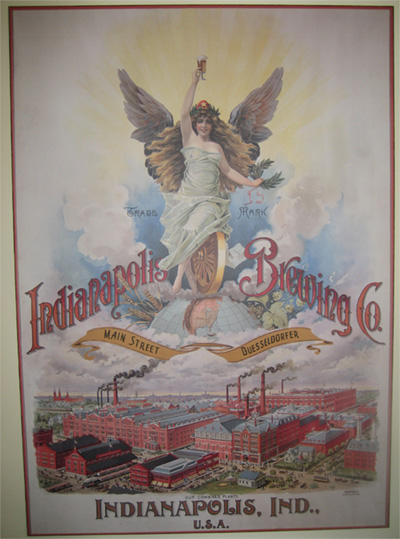
Paul Gatza, Director of the Brewers Association, reminded me of a story I’d almost forgotten about Vonnegut’s family and their association with beer. His grandfather, Albert Lieber, was heavily involved in the brewing industry in Indianapolis, Indiana. Albert’s father, Vonnegut’s great-grandfather, was Peter Lieber and he owned P. Lieber & Co (a.k.a. City Brewery) which later joined with two other Indianapolis breweries to form the Indianapolis Brewing Company in 1887. And in 1904 they won the grand prize gold at the St. Louis World’s Fair. Apparently one of Vonnegut’s short story collections also recounts this story, possibly “Palm Sunday.”
There’s a nice history of this at Indiana Beer, so let’s pick up the story with their account.
Kurt Vonnegut’s grandfather was Albert Lieber. The recipe for a dark lager beer that Peter Lieber devised was brewed by Wynkoop Brewing, Denver, in 1996 to celebrate the new library there. It was called Kurt’s Mile-High Malt. A “secret ingredient” of the brew was coffee.
I also recall someone telling me the father of Wynkoop’s founder — and current mayor of Denver — John Hickenlooper was a friend of Vonnegut and that he, too, is mentioned in one the novels, but I can’t for the life of remember if I ever knew which one.
One of the more personal tributes I’ve read was by Denver Post staff columnist and sports writer Woody Paige, a self-avowed fan, and entitled “My muse, more or less.” In it, he tells an undoubtedly more accurate tale of how Kurt’s Mile High Malt came to be.
Vonnegut came to Denver in 1996 to show two dozen of his sketches at a gallery and to introduce a new short story he had written for the label of a beer bottle. As he might say, most of what I’m telling you is true, except the parts I’m making up.
The owner of a LoDo microbrewery had the grand idea of producing specialty beers with famous authors writing stories for the labels. The brewpub owner, a disheveled sort, worked up the courage to ask Vonnegut to contribute, and he agreed, under the condition that the beer’s recipe be the same as his grandfather’s, brewed commercially in Indianapolis before Prohibition.
It turned out that the brewpub owner’s father lived down the hall from Vonnegut, and was his fraternity brother, when they attended Cornell. (Vonnegut later attended Tennessee, which is my school, and you’re thinking I’m making all of this up.)
The secret ingredient in the beer – called “Kurt’s Mile-High Malt” – was coffee. Vonnegut’s story on the label was entitled “Merlin,” about a golden knight with an automatic weapon.
Vonnegut documented his Denver visit in his last biographical novel, “Timequake,” and told of meeting his friend’s son — the brewpub owner.
The barkeep’s name: John Hickenlooper.
“Ting-a-ling,” as Vonnegut would write.
Hickenlooper knew of my idolization of Vonnegut and invited me and my daughter to spend time(quake) with Vonnegut. My daughter sat on a bus bench with him and talked about colleges, and I later had a beer with him.
Does anybody have a copy of the story or the label? I’d love to include it here if anyone does have it. Thanks. We’ve lost one of this country’s literary treasures, IMHO. Let’s all raise a glass to his memory with Vonnegut’s own words.
Still and all, why bother? Here’s my answer. Many people need desperately to receive this message: I feel and think much as you do, care about many of the things you care about, although most people do not care about them. You are not alone.
So it goes. (from Slaughterhouse Five, 1959)
UPDATE: Craig Hartinger from Merchant Du Vin sent me this photo of a reproduction poster of the Indianapolis Brewing Co. from around the same time as they won the gold medal in 1904. There’s also one of these hanging in the Celebrator’s offices, too. Thanks, Craig.
This Here’s the Wattle …
I confess I never really knew what exactly a wattle was, apart from some sort of Australian plant. But every time I hear the word — which admittedly doesn’t happen often — I think of the following declaration by the philosphy professors from the University of Woolamaloo in Australia. “This here’s the wattle — the emblem of our land. You can stick it in a bottle or you can hold it in yer hand.” All of their names are Bruce, of course, because the reference is from an episode of the brilliant British television show Monty Python’s Flying Circus.
But I saw recently that an Australian brewer, Barons Brewing, is using black wattle in their beer. So I figured it was time to figure out what the heck a wattle is, after all.
It turns out that a wattle is essentially the Australian word for an Acacia. Here’s what Wikipedia has to say about acacias:
Acacia is a genus of shrubs and trees of Gondwanian origin belonging to the Subfamily Mimosoideae of the family Fabaceae, first described from Africa by Linnaeus in 1773. Acacias are also known as thorntrees or wattles, including the yellow-fever acacia and umbrella acacias. There are roughly 1300 species of Acacia worldwide, about 950 of them native to Australia, with the remainder spread around the dry tropical to warm-temperate regions of both hemispheres, including Africa, southern Asia, and the Americas. The genus Acacia however is apparently not monophyletic. This discovery has led to the breaking up of Acacia into five new genera as discussed in list of Acacia species.
Black wattle, or Acacia mearnsii, is the variety being used by Barons Brewing.
Black wattle is a fast-growing leguminous nitrogen fixing tree. Native to Australia, A. mearnsii is often used as a commercial source of tannin or a source of fire wood for local communities. It threatens native habitats by competing with indigenous vegetation, replacing grass communities, reducing native biodiversity and increasing water loss from riparian zones. They are similar to Acacia dealbata. The species is named after E. A. Mearns who collected the type from a cultivated specimen in East Africa.
I’ve always been a fan of gruits and other beers made with herbs and spices. The complexity and range of flavors available by adding just a hint of one or more ingredients is astounding. And shrubs and trees, too, can work a similar magic on brewing. Beer made with spruce, for example, was quite common in colonial America where hops was in short supply. So I’m dying to try some of Baron’s new Black Wattle Superior, a Wattle Seed Ale.
Here’s what their website has to say about it:
In creating the Black Wattle range, we have used a combination of select malt and hops, brewed to traditional methods and standards. Black Wattle however, offers something special. All beers in the Black Wattle range feature a unique touch of Australia, incorporating native herbs and spices during the brewing process. The resulting beer delivers a wealth of flavours that have not been experienced in beer until today.
The first beer released is the Wattle Seed Ale, which starts with a blend of Australian and European malts, creating a rich flavour base of caramel with a hint of chocolate. The smooth malt flavours are lightly hopped and then infused with roasted Wattle Seed, bringing a unique and authentic Australian flavour to this fine red ale. The result is an outstanding ale that boasts a smooth taste profile balancing its robust character, an ultimately rewarding yet distinctive beer.
At 5.8% ABV and offering a long and lasting flavour, the Wattle Seed Ale is best enjoyed with or after a meal, complimenting a juicy steak, rack of lamb, or a prosciutto and rockmelon starter. Alternatively, this select ale will be enjoyed at almost any occasion by those who enjoy something special in a beer.
But I can’t bring up the Bruces from the Philosophy Department of the University of Woolamaloo without mentioning their “Philosophy Song.” I saw it performed live at the City Center in New York when my parents let me take my first unchaperoned trip to the Big Apple in 1976, when I was 17. It’s still one of my favorite Monty Python bits and I remain a huge fan of the show and much of the individual members’ later work, as well. The lyrics are reprinted below.
Bruces’ Philosophers Song
Immanuel Kant was a real pissant
Who was very rarely stable.Heidegger, Heidegger was a boozy beggar
Who could think you under the table.David Hume could out-consume
Wilhelm Friedrich Hegel, [later versions have ‘Schopenhauer and Hegel’]And Wittgenstein was a beery swine
Who was just as schloshed as Schlegel.There’s nothing Nietzsche couldn’t teach ya ’bout the raising of the wrist.
Socrates, himself, was permanently pissed.John Stuart Mill, of his own free will,
On half a pint of shandy was particularly ill.Plato, they say, could stick it away—
Half a crate of whisky every day.Aristotle, Aristotle was a bugger for the bottle.
Hobbes was fond of his dram,And René Descartes was a drunken fart.
‘I drink, therefore I am.’Yes, Socrates, himself, is particularly missed,
A lovely little thinker, but a bugger when he’s pissed.
Chilling Out
I know marketing is necessary to sell things, to build awareness and demand. But I have this old-fashioned, almost quaint notion that the product should come first. I think brewers should come up with the best beer they can and from there the marketers step in and figure out the best way to sell it. There’s nothing wrong with looking around the marketplace and looking for a hole to fill, of course, that makes perfect sense to me. Or taking something people already like and tweaking it a bit, such as adding more hops to an IPA to create Imperial IPAs. But these days, increasingly the big company’s new products are being created by marketing and then the brewers create something to fit the marketing plan.
|
I realize that’s how the modern commerce-driven world works, but it’s not always the best way to create a beer. Committees aren’t the best way to do everything. Last year, Coors’ “frost brew lined” cans put a blue film inside the can, with the potential to effect the taste of the beer, but the marketing plan trumped those concerns. Anheuser-Busch has taken a scatter-shot approach in which they test literally dozens of new products each year in the hopes some will stick, but because there’s so may they can’t really get behind any of them. It’s also the reason that over the years we’ve been subjected to “dry” beers, “ice” beers, “light (low-calorie)” beers, “low-carb” beers, tequila-infused beer, and other fad beers. As the late, great Bill Hicks was fond of saying. “If you’re in marketing in advertising … kill yourself. Seriously though, if you are, do. Aaah, no really, there’s no rationalization for what you do and you are the ruiner of all things good, seriously.” Perhaps an extreme view? There was also this great episode (the Competition) of the animated Dilbert series in which Dilbert goes to work for a rival company, Nirvana Co., that is a dream company to work for. It’s a company with bosses who listen, employees that treat one another with respect and best of all — no marketing department. After Dilbert suggests they might want a marketing department to sell a new product they’re launching, they add one … and all hell breaks loose. Within days (or is it hours) the headquarters is destroyed and the company is bankrupt. It’s a hilarious critique on what happens when marketing calls the shots and goes too far. The newest example of a marketing-driven beer is Miller’s new Chill, a beer based on a Mexican drink — a chelada — and apparently aimed at Hispanic drinkers. For some reason that strikes me as odd, like making a malt liquor for African-Americans or a Sake-based beer for Asian-Americans. It’s one thing to create a product that you reasonably believe will appeal to a specific customer, but to so unabashedly go after an ethnic or cultural group just seems so, well, tacky. Most of the news reports about Miller’s new release used the AP opening. “Se habla Miller? Miller Brewing Co. is hoping Hispanics speak its name next month when the company introduces a beer flavored with lime and salt in Latino areas.” The initial test markets will be Arizona, southern California, Florida, New Mexico and Texas. Miller is calling it an “American take on a Mexican classic,” which may be good propaganda but that’s about it. Anytime we — and by “we” I mean America as a whole — do “our” version of something we tend to ruin it. Americanization is not always a good thing, especially when it happens to the stuff we eat and drink. Think what Taco Bell did for Mexican food, or Olive Garden for Italian, or American-light lager for an authentic pilsner. |
Chelada is essentially a drink you create at a bar, and one definition is a “cerveza that has been poured into a glass with a salted rim containing lime juice and ice.” So essentially that makes a chelada a drink that is prepared at the bar, like a black and tan or a shandy. And while there are pre-packaged versions of both of those, I’ve never liked the idea of pre-made cocktails. There’s just something about the process of them being create in front of you (or making one yourself) that can’t be duplicated by the pre-made variety. Maybe it’s the fresh ingredients. Maybe it’s something else — but whatever it is — they definitely taste different.
From the AP report:
The low-calorie beer will compete with mainstream light beers, such as top selling Bud Light and competitor Coors Light, Marino said. It’ll be priced slightly higher than Miller Lite to compete with premium beers such as Anheuser-Busch’s Budweiser, he said.
“It’s a different beer,” Marino said. “It’s a different take on light beer than what consumers are used to.”
The lime green bottles feature green and silver modular designs reminiscent of Aztec art, with the word “Chill” in bold black letters across the front and “Chelada style” below. A television advertising campaign with the slogan “Se habla Chill” will air in the test markets, Marino said.
And, of course, a light green bottle is a bad choice because it will allow beer photooxidation, meaning the beer can easily become lightstruck. This will make it taste skunky after even minimal exposure to light, especially direct sunlight. This is Heineken’s biggest problem. But again, marketing the green bottles is more important than what the beer tastes like because Heineken could obviously switch to brown glass any time they wanted to. It would throw off all their marketing and advertising and brand awareness, and that’s why they don’t and aren’t likely to change any time soon. It is interesting to note that in the Netherlands and indeed much of the rest of the world, Heineken does come in a brown bottle. (As an aside, actually brown isn’t the best, either, as it does allow some UV rays in. But brown bottles offer the best protection for the money. Dark red would be best, but red glass is prohibitively expensive. That’s the reason photographer’s dark rooms use red bulbs when working with photo paper and manually developing photographs.)
Miller has been putting several of their beers in clear glass for many years, but to a certain extent have solved the lightstruck problem by using pre-isomerized hop extracts, which don’t oxidize. The culprit is 3-methyl-2-butene thiol (from iso-alpha-acid hops) combined with another thiol radical (from compounds in malt) that form prenyl mercaptans. Lew Bryson, in his piece “How to Ruin a Beer,” explains it like this.
Miller Brewing takes a further step. They take the iso-alpha acids and hydrogenate them, much like is done at refineries, by forcing hydrogen through the oils at extremely high pressures. This produces rho-iso-alpha acids, also known as tetralones. These tetralones have intensified bitterness, increase foam stability and retention, and offer a better resistance to sunlight. They would be ideal, only they do not maintain the precise flavor of fresh hops. Hopping rates in mainstream American beers being what they are, this isn’t a serious problem as long as the bitterness is right.
There’s no word whether or not Chill is manufactured in this way or not, though I presume it must be. Unless, of course, Miller sees Chill’s main competition as Corona. Since Corona is another popular beer that comes in clear glass, it too is more often than not lightstruck. It may be the reason they market it with a lime in it in the first place, to mask the inherent skunkiness. But strange as it seems, it’s possible Chill could be marketed with the same defect customers have come to expect in their Corona, making switching to Miller Chill that much easier. After all, it’s the marketing that sells Corona, not it’s taste. For the big beer companies, it’s always about the marketing and rarely about the beer. Perhaps that’s why I have such a hard time chilling out.
It’s the Hops, Stoopid
Lagunitas is introducing a new line of beers in 22 oz. bottles under the name “Sonoma Farmhouse.” The idea according to Lagunitas owner Tony Magee is to be able to do different kinds of beers than the usual Lagunitas fare under the new label.
|
The Sonoma Farmhouse labels are a little more serious, less playful than the regular ones, too. They also lack Tony’s famous — or infamous — rambling label stories. But for what they’re missing on the outside, inside the bottle is another story. The first release is a Saison Style Ale, and it’s one of the best American versions of the style I’ve had. Like all good saisons, it’s very refreshing, clean and would be great with food. I’m told there are herbs and/or spices in the beer, but Tony’s not saying which one or ones. The beer has a certain zestiness so it’s possible grains of paradise are at least one of the ingredients and there are also herbal notes, but who knows. Since the yeast also imparts spicy elements, it’s always a challenge to identify the exact ingredients in these complex beers. And in the end, it’s pointless, since it’s the synergy of how all the elements work together that really matters. The Sonoma Farmhouse Saison flavors are quite delicate, a quality Lagunitas is not exactly known for, but there’s nothing I don’t like about this new beer. Saisons were originally made by and for farmers to have in the fields. They were generally brewed late in the season so they’d stand a better of chance of making it through the summer. Saisons also walk a tightrope of strength (to last the summer) and drinkability (they need to quench a summer thirst). At 5.2% abv, this one is quite modest, but happily we have refrigerators, a luxury the French and Belgian farmers who pioneered this style did not. Next up in the Sonoma Farmhouse line is Hop Stoopid, something on the order of a triple IPA, around 100 IBUs. Meant to be a gentle spoof of the increasingly hoppy west coast beers, bottling should begin on Wednesday and be in stores shortly thereafter. I’m told it’s a huge hop bomb brewed with hop oils and hop extracts to really ramp up the bitterness. I’m going to the brewery on Thursday to try some of the first bottles. Tony has done some hop bombs before over the years, and as someone who has definitely acquired a taste for bitter beers, I suspect this beer will seem like night and day to the delicate flavors of the Saison. Lagunitas’ flagship is their IPA, itself an excellent example of a west coast IPA and quite hoppy, though still well-balanced. |
The next Sonoma Farmhouse beer from Lagunitas, Hop Stoopid.