Brookston Beer Bulletin

Jay R. Brooks on Beer

  • Home
  • About
  • Editorial
  • Birthdays
  • Art & Beer

Socialize

  • Dribbble
  • Email
  • Facebook
  • Flickr
  • GitHub
  • Instagram
  • LinkedIn
  • Pinterest
  • RSS
  • Twitter
  • YouTube

Powered by Genesis

Desperation Propaganda

July 5, 2015 By Jay Brooks

carlsberg-crown
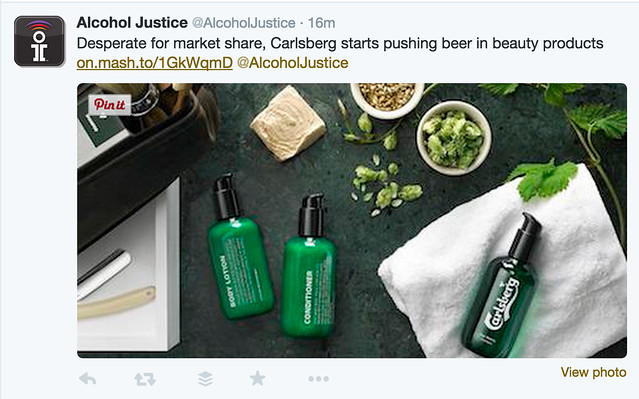
The ink was barely dry on my last post about Alcohol Justice’s tenuous grasp on honesty where they claimed Craft Brewers Just Don’t Care when they did it again, with this tweet:
AJ-tweet-15-07-05

The funniest part of their tweet is the claim that the Carlsberg Group, the fourth largest beer company in the world, producing 6.2% of the world’s beer, is “desperate for market share” and therefore gave up on beer and decided to diversify into beauty products. This they apparently concluded from an article on Mashable entitled Men, stop drinking beer and start rubbing it on your face. As the article itself makes abundantly clear — but is virtually ignored by AJ — using beer or beer ingredients in health and beauty products has been around forever and is nothing new. There are almost too many instances to mention. Shampoo with beer in it has been around for years, if not centuries. Dogfish Head and many others have been making soap with beer for just as long. There’s nothing in the article about why they’re diversifying (though anyone with a working knowledge of how a business operates will say “well, duh,” diversification is almost always a good move). These came out of the Carlsberg Lab, which has been doing research on beer for over 100 years, and in fact the lager yeast known as Saccharomyces pastorianus, was also once known as Saccharomyces carlsbergensis because of work done by the brewery on yeast in the late 1800s and early 20th century. Here’s the The press materials for the new products.

So there’s absolutely nothing to suggest that Carlsberg’s Beer Beauty products have anything whatsoever to do with desperation. Alcohol Justice just made that up. Why? Because they have to turn a lighthearted story into something they can use as propaganda. Because the truth is not something they seem remotely interested in. If anything, I think it shows their own desperation in trying to find something to complain about.

Carlsberg-beer-beauty

Filed Under: Beers, Editorial, Politics & Law, Related Pleasures Tagged With: Health & Beer, Prohibitionists

Patent No. PP8824P: Hop Plant Named “H87203-1”

July 5, 2015 By Jay Brooks

patent-logo
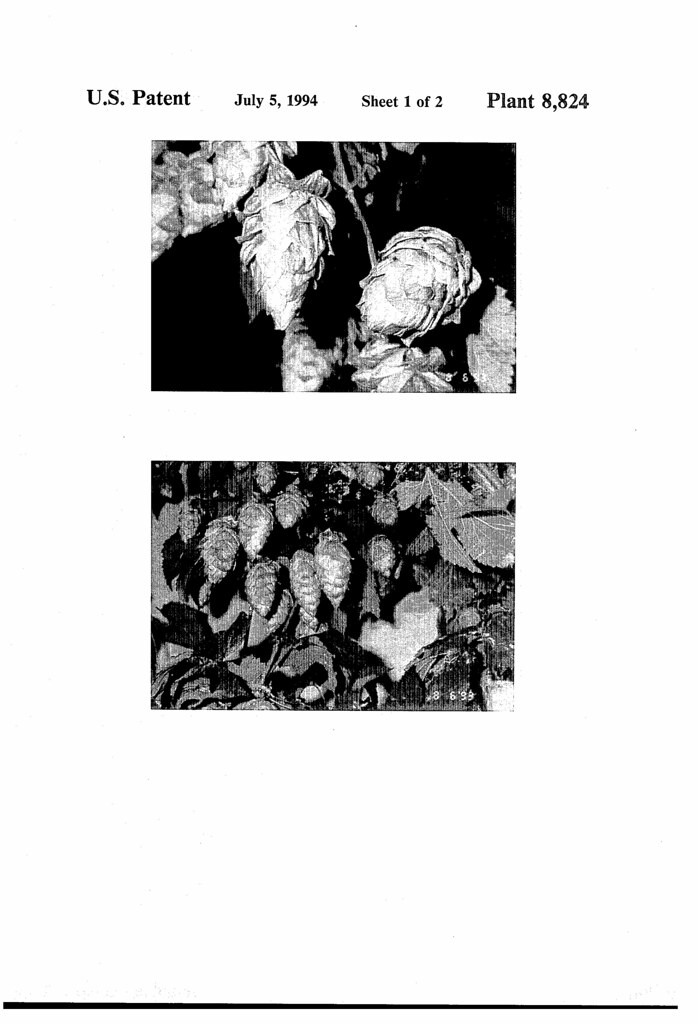
Today in 1994, US Patent PP8824 P was issued, an invention of Gene Probasco, assigned to John I. Haas, Inc., for his “Hop Plant Named ‘H87203-1.'” It’s almost identical to the previous patent for the hop plant named H87207-2. Here’s the Abstract for this one:

A new variety of hop plant (H87203-1) originating as the result of a controlled corss pollination between unpatented Galena female hop plant with unpatented John I. Haas, Inc. (Haas) male hop plant No. 833-53M, and unique particularly for its cones’ unusually high percentage of beta acids when compared to its female parent variety Galena (unpatented) and otherwise as herein described.

It’s been 21 years since this other hop variety was patented. Did it ever get its own name? Does anybody know?
Untitled

Filed Under: Beers, Just For Fun, Politics & Law, Related Pleasures Tagged With: History, Hops, Law, Patent

Patent No. PP8823P: Hop Plant Named “H87207-2”

July 5, 2015 By Jay Brooks

patent-logo
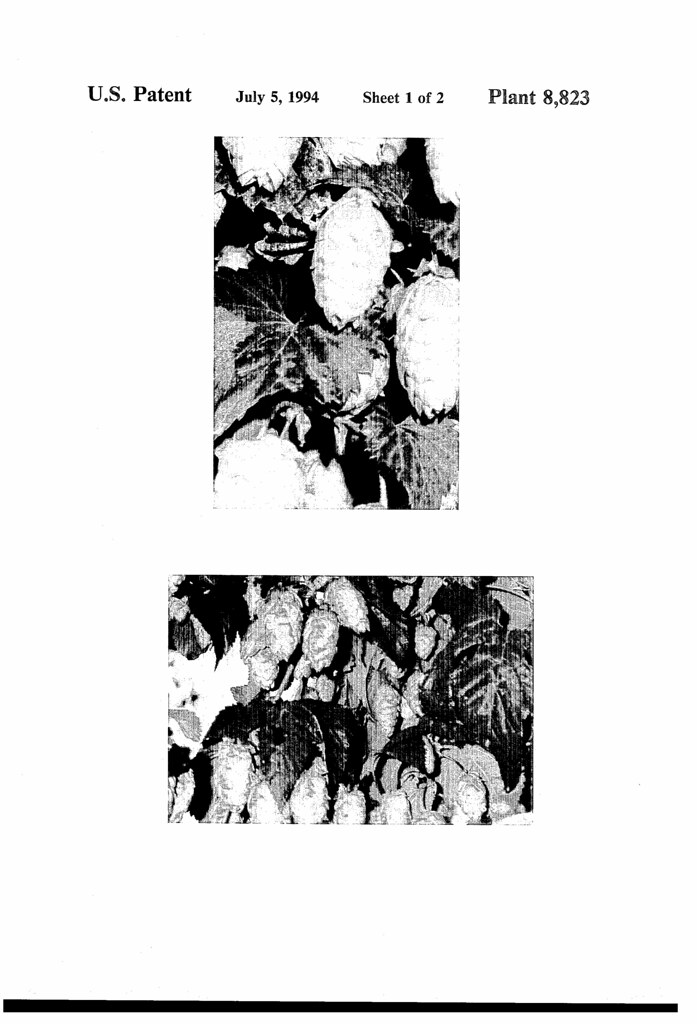
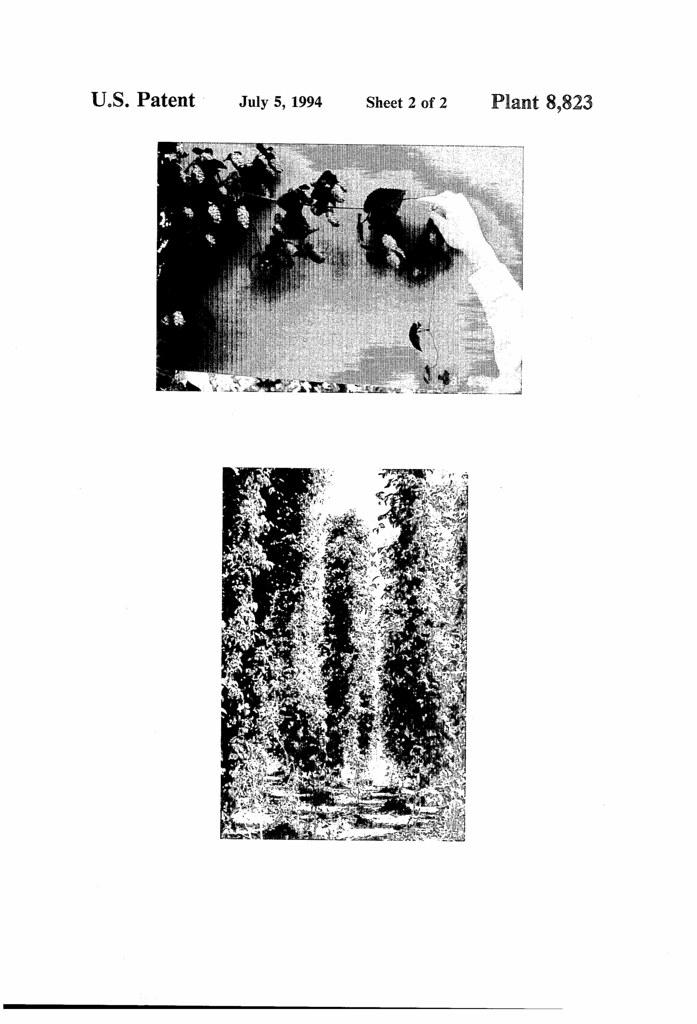
Today in 1994, US Patent PP8823 P was issued, an invention of Gene Probasco, assigned to John I. Haas, Inc., for his “Hop Plant Named ‘H87207-2.'” Here’s the Abstract:

A new variety of hop plant (H87207-2) originating as the result of a controlled cross pollination between unpatented Galena female hop plant with unpatented John I. Haas, Inc. (Haas) male hop plant No. 833-53M, and unique particularly for its cones’ unusually high percentage of beta acids when compared to its female parent variety Galena (unpatented) and otherwise as herein described.

It’s been 21 years since this hop variety was patented. Did it ever get its own name? Does anybody know?
Untitled

Filed Under: Beers, Just For Fun, Politics & Law, Related Pleasures Tagged With: History, Hops, Law, Patent

Craft Brewers Just Don’t Care

July 5, 2015 By Jay Brooks

calories
Nobody can piss me off faster than Alcohol Justice, the self-styled do gooders and self-proclaimed “watchdogs” of those of us in the evil alcohol empire. I just noticed this yesterday, but for at least the last week, they’ve been tweeting this inaccurate and misleading message that “High-calorie craft beer maker’s don’t care.” Here’s what they say:

AJ-tweet-15-07-04

You don’t have to be Noam Chomsky to parse this sentence and figure out what they’re saying. Beer has lots of calories and brewers just don’t give a shit, painting craft brewers in a negative light, something Alcohol Justice has turned in to an art form. But is that the truth? Is that even what the source of this claims? Regular readers won’t be surprised to learn that AJ once again has taken a statement and twisted into something else to promote their own agenda. Shocking, I know. The original source of this comes from an article in the Columbus Dispatch on June 26 entitled Small breweries sometimes make high-octane, high-calorie beers.

It’s all about calories and how some higher alcohol beers made by craft brewers have more calories than lower alcohol beers, which is a world class “duh.” If you claim you don’t know that more alcohol has more calories then I’m amazed at the level of ignorance you’re willing to admit. If you’re drinking an imperial stout and have convinced yourself it contains no more calories than a pale ale, you’re willfully deluding yourself, and you probably know it, even if you won’t admit it. But I’m not terribly interested in the calorie question, it’s been done to death and certainly isn’t going away anytime soon. What really annoys me is Alcohol Justice’s flippant hatred of brewers and insisting they don’t care, as if that makes them bad people. The reality, of course, is quite different. Here’s the relevant portion of the article:

Unless they’re aiming for a low-cal beer to appeal to dieters, day drinkers and the like, craft brewers say they don’t give two pints about calories. They’re after flavor and aroma and other qualities that make drinking good beer worth it. The qualities of your favorite porter or citrus-forward IPA depend upon a series of ingredient choices and the complex interplay of water, grain, hops and yeast that follows.

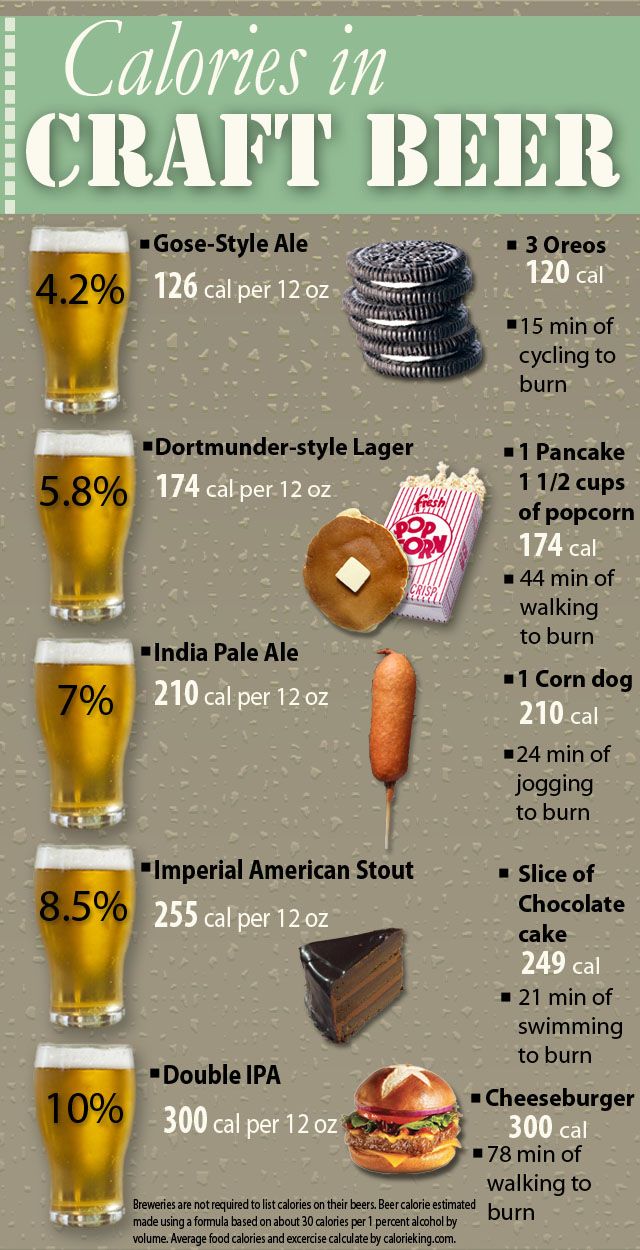
So it’s not that the brewers “don’t care” about higher calories, it’s simply that they place more emphasis on aromas and flavors, preferring to create beers that feature those more prominently. They’re not willfully making high calorie beers just to fatten people up and make them unhealthy, as AJ suggests. And why pick on brewers? This is especially galling since wine and sprits, with far more alcohol, has … wait for it … far more calories. Beer has the fewest calories of any alcoholic drink by ounce. I’m sure people will argue that people drink more beer so that’s moot. But the point of drinking better beer is to drink less of it. To me at least, beer with flavor is not made to pound, but to enjoy at a more reasonable pace, usually determined by the circumstances. Imperial stout is not made to be swigged, but shared in a snifter or similar glass, so the idea that it’s the same as any other beer seems at best facetious. If you’re downing pint glasses of Parabola or Ten FIDY you’re doing it wrong. Here’s an infographic that accompanied the article.

calories-in-craft-beer

But the larger point is why do we attack beer and alcohol makers for the natural amount of calories created by the way they’re made? We don’t do that for calorie-rich desserts like cake, ice cream and pie. You know what else is high in calories? Cereal, avocados, bananas, nuts and berries, granola bars, pasta, lobster and so many more foods we love. But we’re not lambasting the people who farm, grow or make those for not caring about how high in calories they are. That’s because they’re not intentionally making them high in calories, it’s just the result of their nature. The same is true for beer. Brewers aren’t intentionally making high-calorie beers to fuck with people the way Alcohol Justice so churlishly insists. They’re making them because they taste good, and people want them, not because they just “don’t care.”

Are there no ethical standards for non-profits? Shouldn’t “watchdogs” who claim the moral high ground have to at least be honest and truthful themselves? Because even though they claim “beer makers don’t care,” they certainly don’t seem to care about their own veracity, and instead twist anything they can to fit their increasingly narrow narrative that everything having to do with alcohol, and especially beer it seems, is bad.

Filed Under: Beers, Editorial, Politics & Law Tagged With: Health & Beer, Prohibitionists, Statistics

Patent No. 763973A: Bottle

July 5, 2015 By Jay Brooks

patent-logo
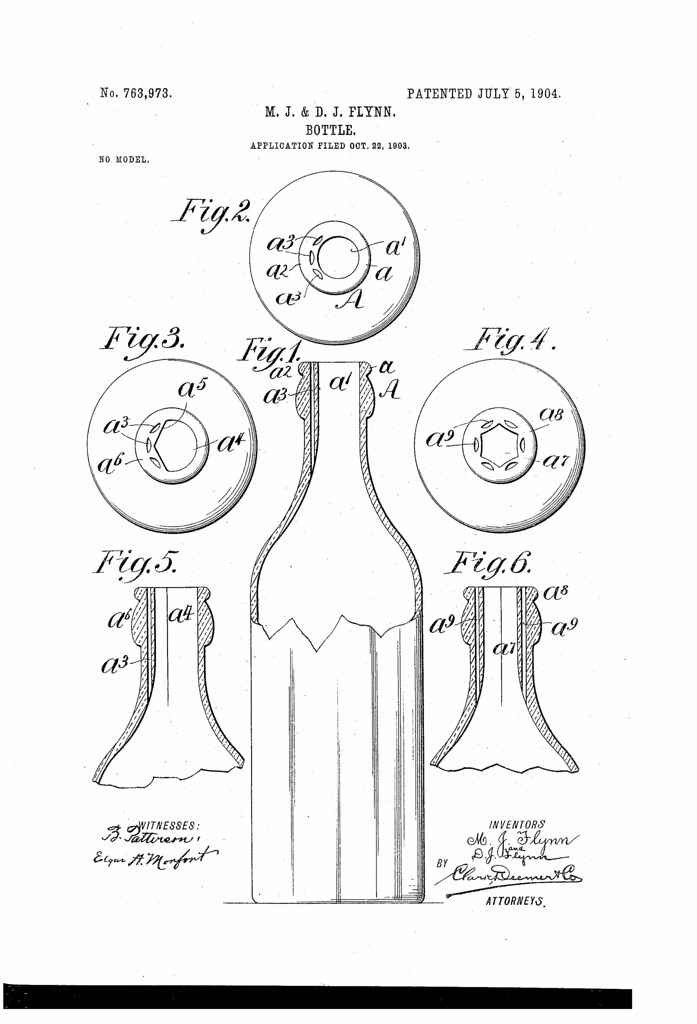
Today in 1904, US Patent 763973 A was issued, an invention of Michael Joseph Flynn and Dennis John Flynn, for their “Bottle.” There’s no Abstract, although in the description it includes this summary:

The subject of this invention is a bottle which while designed more particularly for containing beer and like beverages may be utilized for other liquids; and the principal object of the invention is to practically prevent to a considerable extent the improper reuse of the bottle.

With the above and other purposes in view the novel bottle comprises a mouth portion containing a main or pouring opening and a small auxiliary passage or passages, both the pouring-opening and the auxiliary passage or passages all being designed to be closed by a single metal cap having a crimped engaging flange, which type of cap is in vogue at the present time. In using my improved bottle upon the removal of the cap the liquid contents can be poured from the bottle through the main opening, the auxiliary passage or passages serving under such condition as a venting provision. Manifestly after such employment of the bottle it will be unserviceable for further use in connection with an ordinary cork, because when the latter is inserted within the main opening the open character of the auxiliary passage or passages will preclude the service of the bottle with carbonated or charged liquids, besides presenting the additional disadvantage of not completely closing the bottle. Corks of special shapes, including upper lateral flanges, might be resorted to; but such would add considerably to the expense and difficulty of using the bottle, and hence constitute obstacles that would ordinarily deter the improper reuse of the bottle.

Untitled

Filed Under: Beers, Just For Fun, Politics & Law, Related Pleasures Tagged With: Bottles, History, Law, Patent

Patent No. 4844932A: Separation Of Wort From Mash

July 4, 2015 By Jay Brooks

patent-logo
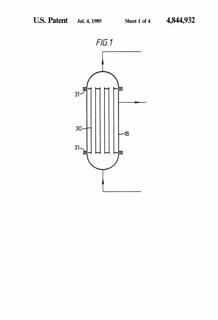
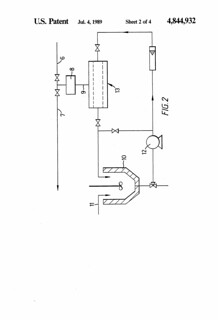
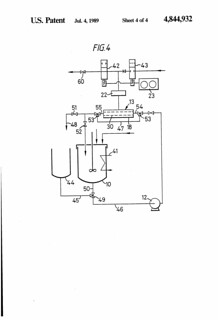
Today in 1989, US Patent 4844932 A was issued, an invention of Iyadh S. Daoud, assigned to The Brewing Research Foundation, for his “Separation of Wort From Mash.” Here’s the Abstract:

A barrier cross-flow separation method is used to separate wort from mash in beermaking. The separator medium is preferably a cylindrical element with an internal diameter of at least 20 mm and a pore size in a range of from 10 μm to 100 μm. High gravity wort is obtainable from a four-step separation process which can handle mash free of husk and including large amounts of cereal adjunct. The wort may be clarified in a subsequent filtering step.

Untitled

Filed Under: Beers, Breweries, Just For Fun, Politics & Law, Related Pleasures Tagged With: History, Law, Patent, Science of Brewing

Patent No. 2513765A: Mashing And Lautering Apparatus For Brewing

July 4, 2015 By Jay Brooks

patent-logo
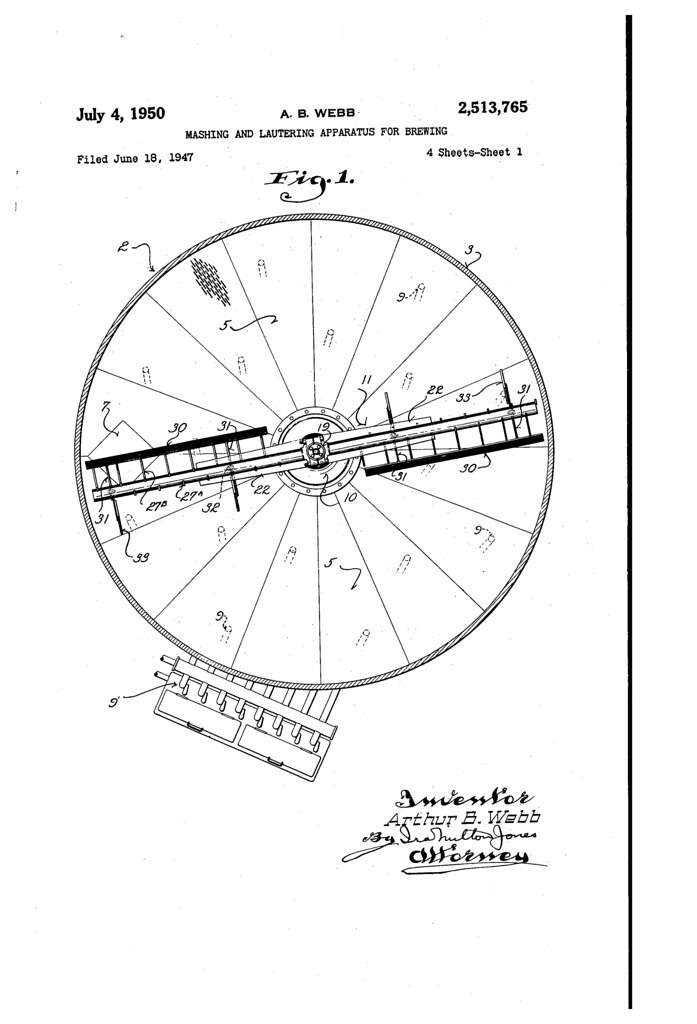
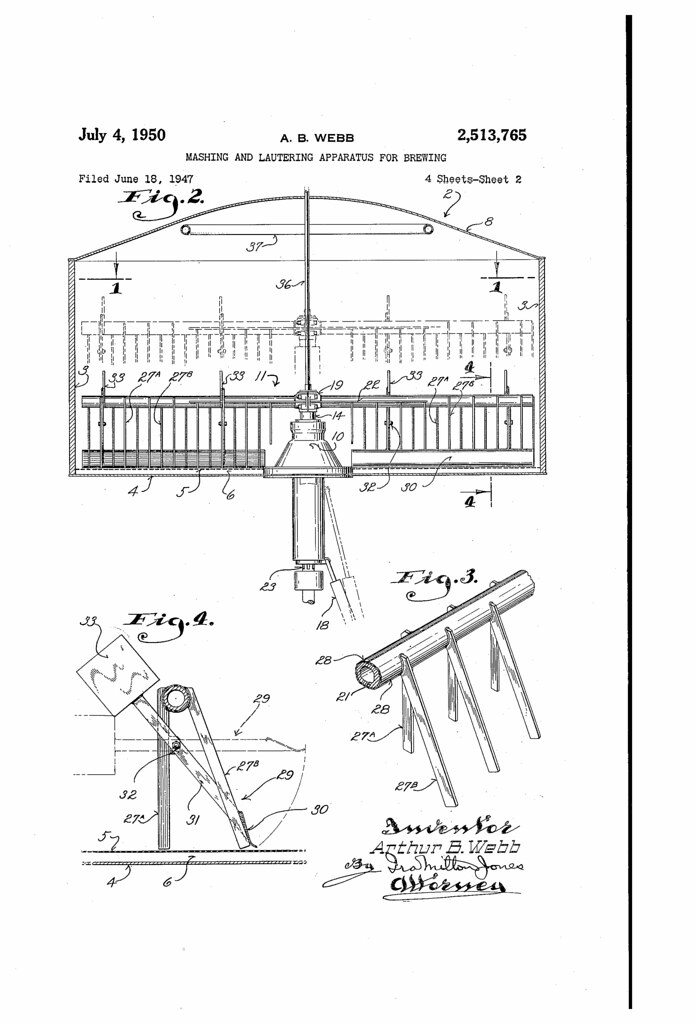
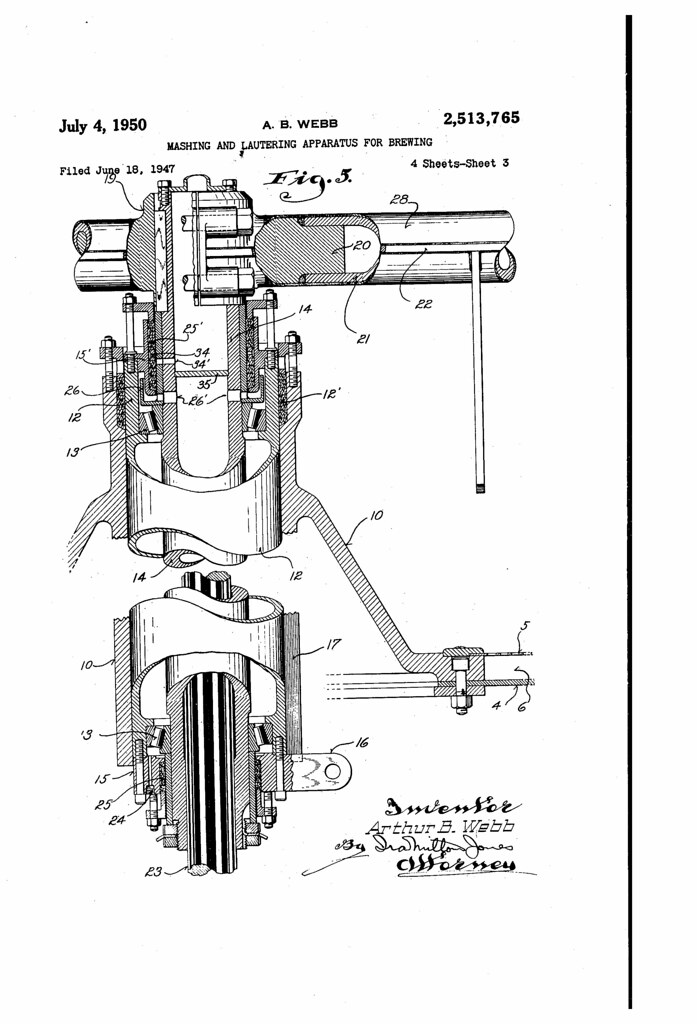
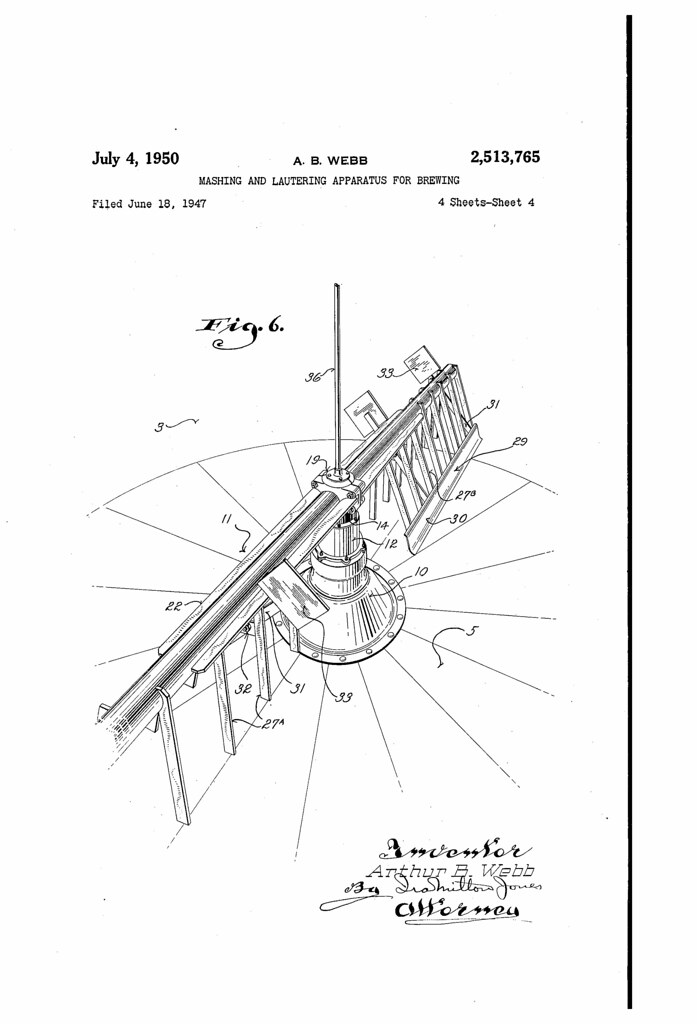
Today in 1950, US Patent 2513765 A was issued, an invention of Arthur B. Webb, assigned to the Cream City Boiler Company, for his “Mashing and Lautering Apparatus For Brewing.” There’s no Abstract, although in the description it includes this summary:

This invention relates to mashing and lautering equipment for use in brewing, and has as its general purpose to provide a combination mash and lauter tub or tank of simplified and improved construction.

Although this invention is primarily concerned with the construction of the aufhack or agitator which keeps the mash suitably agitated during mashing and lautering, and the plow or scraper by which the spent grain is swept out of the tank at the completion of the lautering off period, it will be advantageous to briefly outline the steps followed in mashing and lautering.

The mashing operation consists in cooking the grain in water to convert its starch content into sugar. This may be done in a separate tank, or as contemplated by the present invention the mashing and lautering may be done in the same tank.

Lautering is the drawing off of the extract or liquor from the bottom of the tank. During this procedure the mass is gently agitated, and towards the end of the lautering off, sparging water is sprayed over the contents to flush out all possible extract from the grain. At the completion of the lautering’ and sparging when all of the extract has been drawn off, the spent grain is discharged from the tank through a trapdoor in its bottom. I

In the lautering 01f of the extract the bottom layer of the mass serves as a filter bed. Hence, it is extremely important that this bottom layer be left undisturbed. If it is broken or disturbed, the extract being lautered off becomes turbid. Such breaking of the bottom filter layer thus entails long periods of quiescence to allow the turbidity producing particles to settle out and enable the bed to reform.

Satisfactory lautering, therefore, poses two difficult problems. To assure flushing all the extract from the mash, it is essential that the sparging water reach all portions thereof, and this requires having the aufhack or agitator blades reach down into the mass as far as possible. On the other hand the bottom layer which serves as a filter bed must not be disturbed. It thus follows that the extent to which the agitator blades can be lowered bears a relationship to the spacing between adjacent blades, for blades that are spaced far apart can be brought down closer to the bottom without breaking the bottom layer than blades that are spaced closer together past the desired wide spacing between adjacent blades has been achieved by increasing the number of radial arms-which carry the blades and, of course, staggering their radial distances from the axis of rotation so that the circular paths defined by the blades in operation are quite close together although the distance between adjacent blades is much greater. This obvious solution to the problem of effecting increased spacing between adjacent blades entailed the objection of having the inside of the tank cluttered up with mechanism.

As a result cleaning the tank became a tedious task. In such cleaning, the segmental screen sections which form the false bottom of the tank have to be lifted and are generally set up against the side wall of the tank. Inasmuch as these sections are quite large the presence of three (3) or more agitator arms inside the tank became a source of much inconvenience and irritation. Practically every time a screen section was lifted the agitator had to be moved.

With this objection in mind, the present invention has as one of its objects to provide an improved aufhack or agitator wherein only a single pair of arms carries all of the agitator blades, but in a manner spacing the operating portions of the blades and particularly the lower ends thereof far enough apart to preclude breaking the bottom filter layer, even though the blades are lowered to within a short distance from the false bottom.

As can be readily appreciated, the agitator blades in cutting through the relatively compacted mass, leave circular channels in their wake which if not closed allow the sparging water to by-pass portions of the mass with the result that all the portions of the grain are not flushed as effectively as desirable. Hence, it is another object of this invention to provide means for closing up the circular channels cut into the mass by the blades as they sweep around the tank.

More particularly it is an object of this invention to provide a novel trowel member adapted to ride upon the surface of the mass in a position trailing the agitator blades so as to close the circular channels formed by the blades.

Another object of this invention is to utilize the same structure for effecting the desired troweling action to also plow or scrape the spent grain into the discharge opening at the completion of the lautering off step and also serve as a mixing agitator during the mashing operation.

Another object of this invention is to so mount and arrange the combination plow and trowel structure that upon rotation of the agitator so that the top of the pedestal is submerged in the tank contents, the matter of providing adequate lubrication for the working parts without danger of having the lubricant seep out into the tank contents has always presented a problem.

Untitled


Filed Under: Beers, Breweries, Just For Fun, Politics & Law, Related Pleasures Tagged With: Brewing Equipment, History, Law, Patent, Science of Brewing

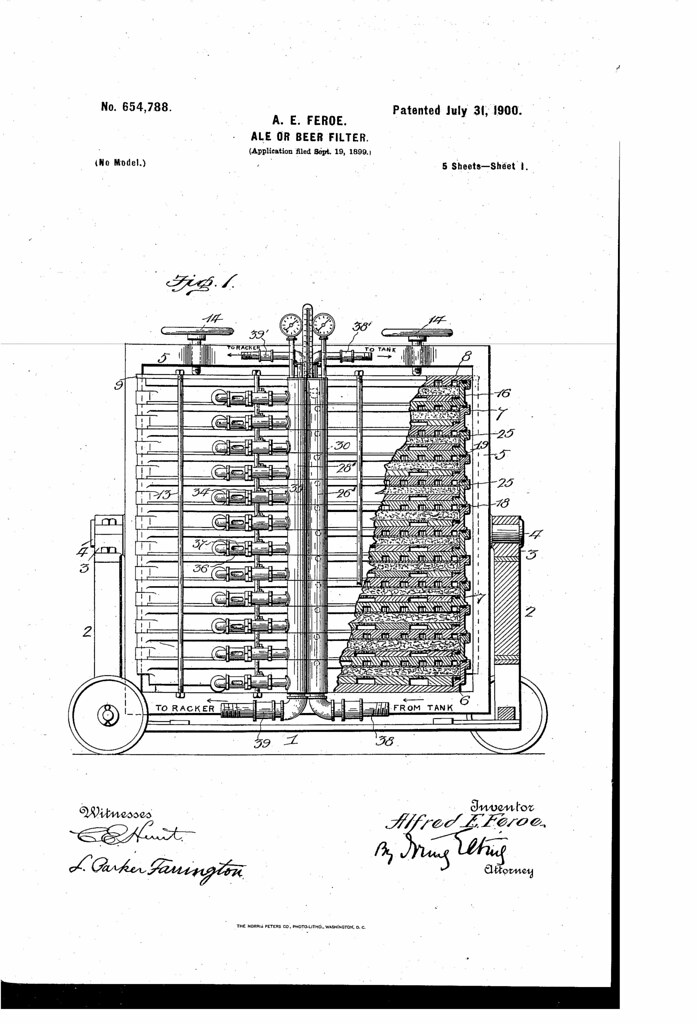
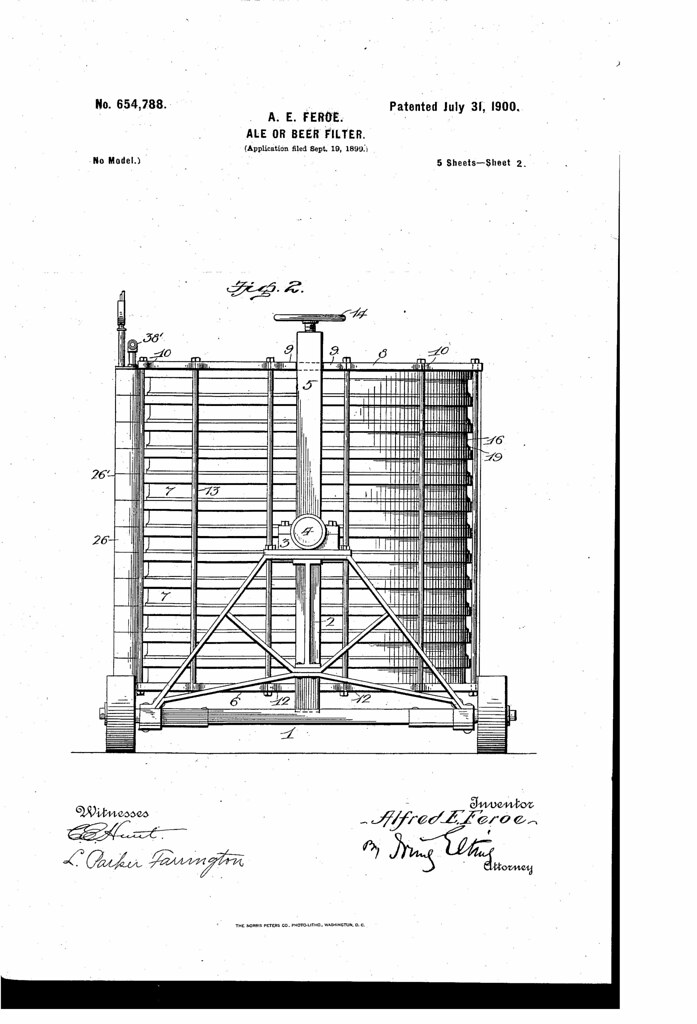
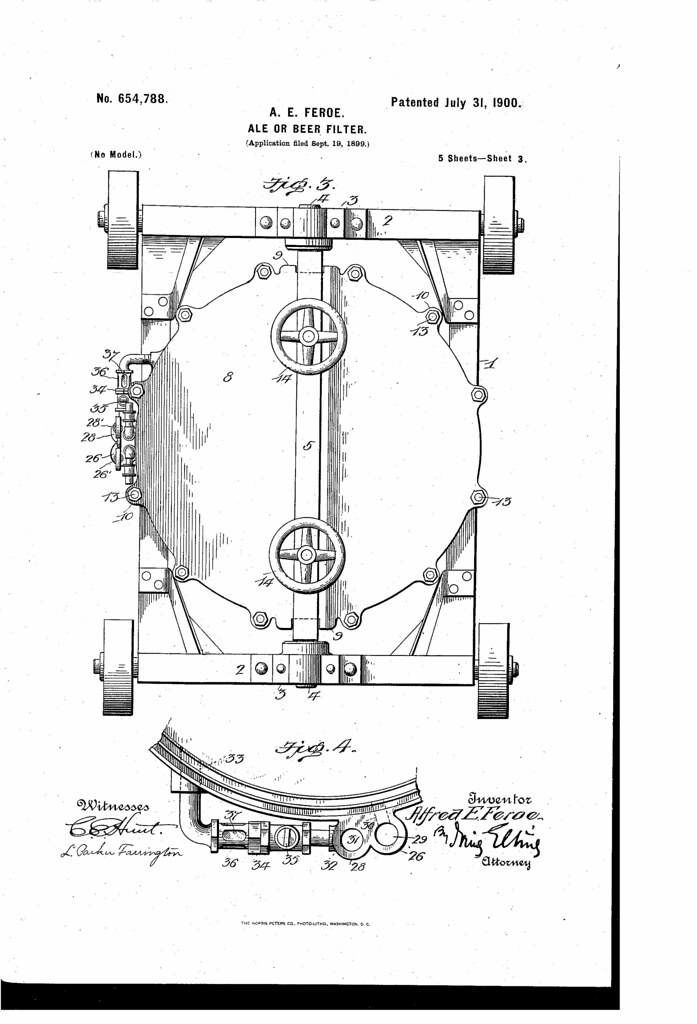
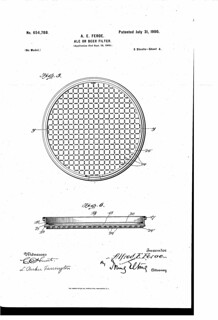
Patent No. 654788A: Ale Or Beer Filter

July 3, 2015 By Jay Brooks

patent-logo
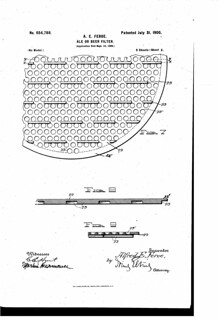
Today in 1900, US Patent 654788 A was issued, an invention of Alfred E. Feroe, for his “Ale or Beer Filter.” There’s no Abstract, although in the description it includes this summary:

My invention relates to an improved ale and beer filter for brewery use.

The object of my improvement is to provide a device of a very large capacity, simple in construction, strong, durable, and efficient in operation, and of as few parts as is consistent with perfect work.-

To attain these ends the invention comprises a series of filter-sections which when put together form a series of compartments. Each compartment has inlet and outlet passages and means for filtration and is a complete filter in itself.

Untitled


Filed Under: Beers, Breweries, Just For Fun, Politics & Law, Related Pleasures Tagged With: Brewing Equipment, History, Law, Patent, Science of Brewing

Patent No. 1232098A: Process Of Leaching Out Hops

July 3, 2015 By Jay Brooks

patent-logo
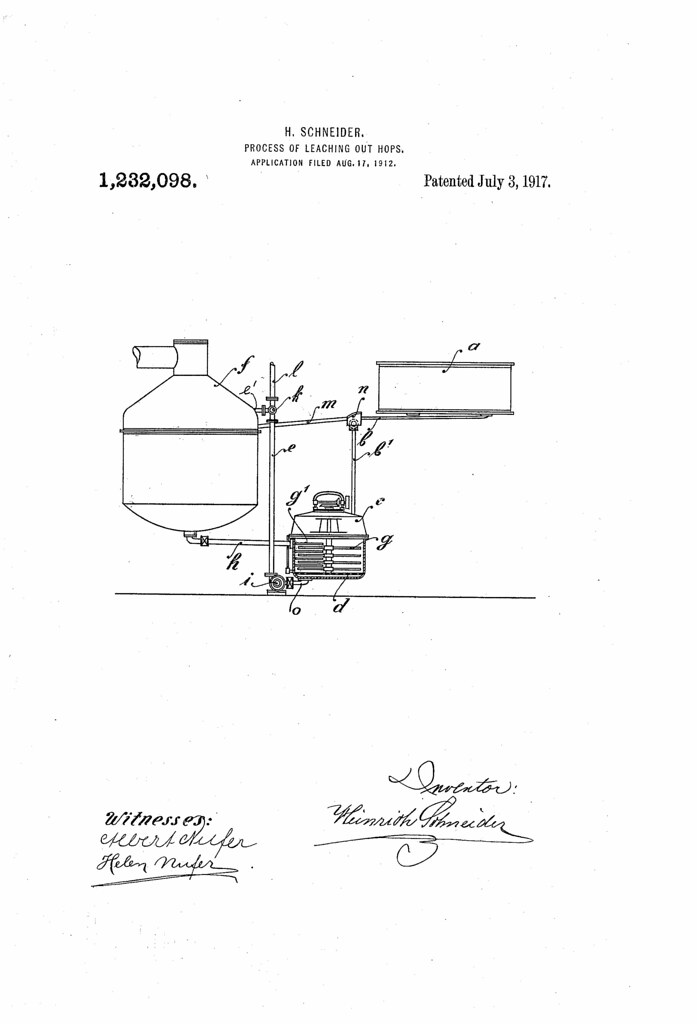
Today in 1917, US Patent 1232098 A was issued, an invention of Heinrich Schneider, for his “Process Of Leaching Out Hops.” There’s no Abstract, although in the description it includes this summary:

The object of the present invention is a process of leaching hops in a hop extracting apparatus provided with a strainer and stirring device, but passing the wort and after-wort through the hops on their way between the refining vat and the copper.

Untitled

Filed Under: Beers, Breweries, Just For Fun, Politics & Law, Related Pleasures Tagged With: Brewing Equipment, History, Hops, Law, Patent

Patent No. 2006450A: Capping Machine

July 2, 2015 By Jay Brooks

patent-logo
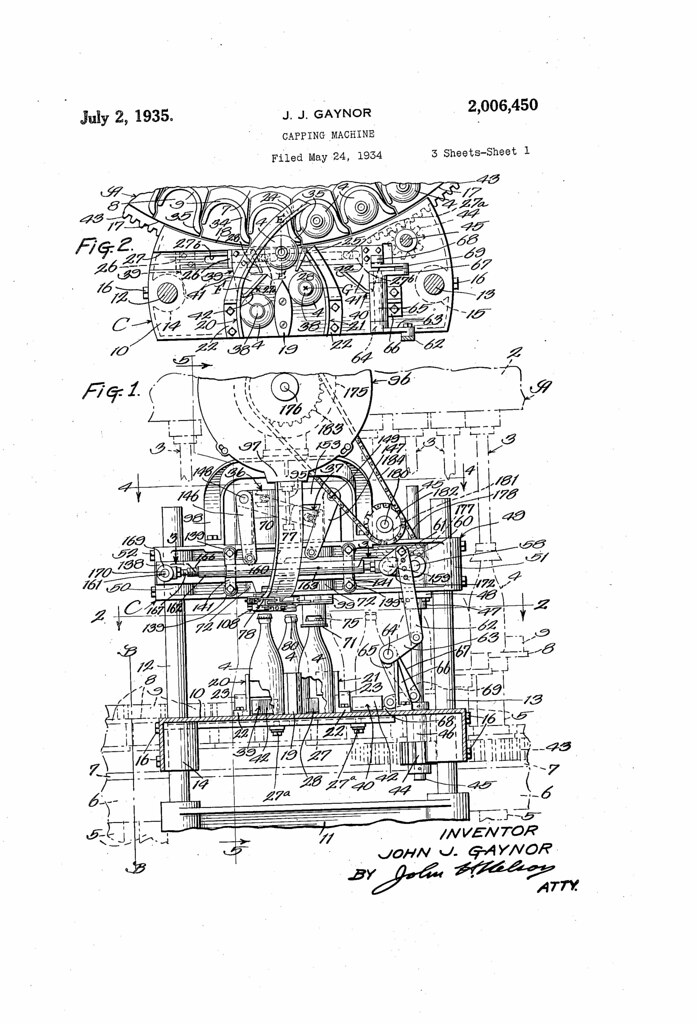
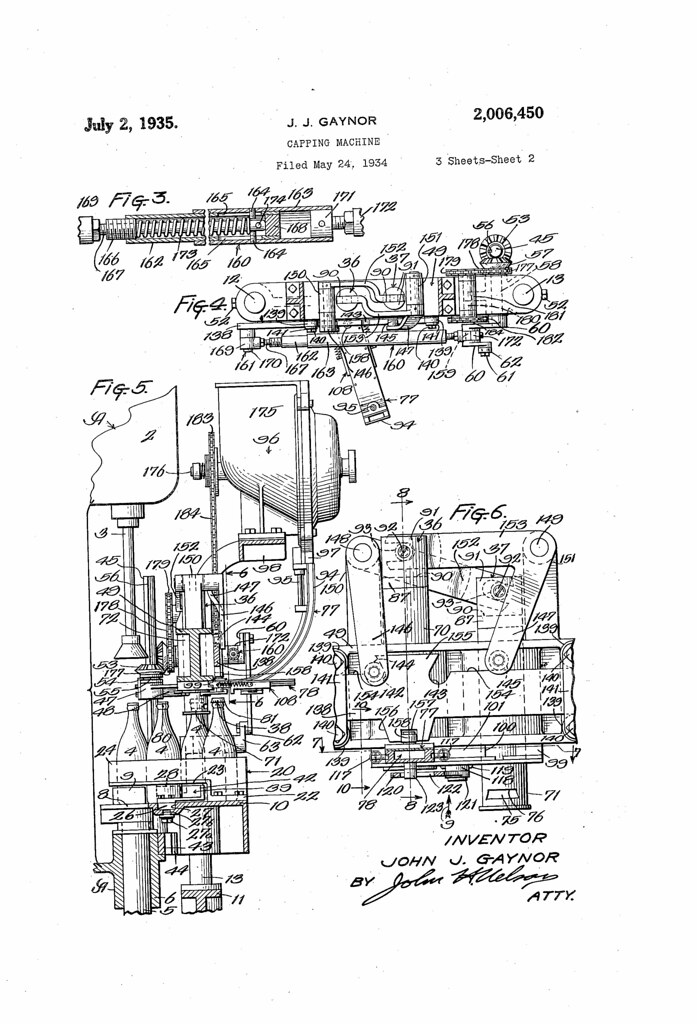
Today in 1935, US Patent 2006450 A was issued, an invention of John J. Gaynor, for his “Capping Machine.” There’s no Abstract, although in the description it includes this summary:

This invention relates to capping machines, or more particularly to bottle crowners of the double head type.

One of the objects of the invention is to provide such a machine of the simplest construction with a minimum number of actuating parts so as to promote compactness, and at the same time insuring reliability and effectiveness in operation; and whereby the caps as applied to containers by both capping heads will be uniform.

Another object of the invention is to provide such a capping machine that can be closely arranged in cooperative relation with the container conveying means of a rotary type container filling machine, so that the containers will be capped shortly after being transferred to the capping heads of the capping machine alternately. The type of filling machine referred to includes a circular rotating container conveyor having peripherally arranged vertically reciprocal container supports in which the containers are placed to be raised into filling heads which depend from the circular liquid supply tanks placed above the conveyor and connected to rotate therewith. As a rule the tank is of greater diameter than the conveyor, which relation of parts presents the problem in arranging the capping mechanism in close cooperative relation with the conveyor.

Untitled

Filed Under: Beers, Breweries, Just For Fun, Politics & Law, Related Pleasures Tagged With: Brewing Equipment, History, Law, Packaging, Patent, Science of Brewing

« Previous Page
Next Page »

Find Something

Northern California Breweries

Please consider purchasing my latest book, California Breweries North, available from Amazon, or ask for it at your local bookstore.

Recent Comments

  • Bob Paolino on Beer Birthday: Grant Johnston
  • Gambrinus on Historic Beer Birthday: A.J. Houghton
  • Ernie Dewing on Historic Beer Birthday: Charles William Bergner 
  • Steve 'Pudgy' De Rose on Historic Beer Birthday: Jacob Schmidt
  • Jay Brooks on Beer Birthday: Bill Owens

Recent Posts

  • Beer In Ads #5198: Heim’s Bock Beer! Ready To-Day April 1, 2026
  • Historic Beer Birthday: August Koch April 1, 2026
  • Historic Beer Birthday: Thomas Fowell Buxton April 1, 2026
  • Beer In Ads #5197: Bock Beer! On Tap After March 30 March 31, 2026
  • Beer Birthday: Dave Buhler March 31, 2026

BBB Archives

Feedback

Head Quarter
This site is hosted and maintained by H25Q.dev. Any questions or comments for the webmaster can be directed here.