Brookston Beer Bulletin

Jay R. Brooks on Beer

  • Home
  • About
  • Editorial
  • Birthdays
  • Art & Beer

Socialize

  • Dribbble
  • Email
  • Facebook
  • Flickr
  • GitHub
  • Instagram
  • LinkedIn
  • Pinterest
  • RSS
  • Twitter
  • YouTube

Powered by Genesis

Session #37: Drinking The Good Stuff

March 5, 2010 By Jay Brooks

vault
Our 37th Session is hosted by The Ferm and Sir Ron’s theme is The Display Shelf: When to Drink the Good Stuff, a dilemma many of us face. We’ve all accumulated “numerous bottles of beers that [were] subsequently cellared and designated as ‘to be opened on a special occasion.’ [The] dilemma, however, is matching an occasion with opening a particular bottle in [the] collection.”

The Ferm continues to elucidate their topic:

Finding a drinking occasion that lives up to the reputation of the bottle and the story of its acquisition is not a dreadful struggle to have, but it is a struggle nonetheless. When my good friends are over and we have had a few other beverages, will we still be able to enjoy my cave aged Hennepin that I bought after my tour of the brewery and have cellared for ten years? Will I miss it like I miss that four year old Golden Monkey?

The topic is open ended and the rules of The Session are close to nil. You can use your post to be persuasive or therapeutic. You may choose to tell a story of a great bottle you once opened or boast of your own beer collection.

So that got me thinking about my own beer cellar. It’s not as grand as a lot of impressive ones I’ve visited or have heard about. It’s not in a goldmine, for example. It doesn’t have Celtic granite columns. It’s not a converted walk-in, sadly. It’s just part of my network of four refrigerators, three of which are devoted exclusively to beer. One of the refrigerators is used for everyday beers, the ones my wife is allowed to drink. I used to employ a system where I put sticker dots on the beers she wasn’t allowed to open, but she (and my friends and relatives) just ignored them. So now there’s a separate refrigerator in the hallway, just off the kitchen, that I keep stocked with beer for her and guests. It’s worked beautifully, and I suspect the reason is a sort of “out of sight, out of mind” phenomenon where people aren’t tempted by what they can’t see.
session_logo_all_text_200

But nestled coolly inside one of them (the other is partly the queue for beers I need to taste for work) are a number of gems, but nothing I’d consider overly spectacular. I’ve seen spectacular, I’ve been fortunate to taste a lot of spectacular stuff, but I’ve never set out to collect beers in any systematic way so what I’ve got aging is a mishmash of what people were kind enough to gift me and a few things I’ve stumbled across that were just too good to pass up. I’ve got magnums and 12-oz. bottles of Anchor Christmas Ale going back into the 1980s. Some Thomas Hardy from the same time period. A few strong beers, old ales, dubbels and tripels, things like that. Some waxed-top barleywines from several brewers, and the ubiquitous Samuel Adams Triple Bock that it seems everybody has a few bottles of, myself included.

safe

But I suspect many of us have a least a few special beers we’ve been holding on to, and for me the more interesting question is when to open them. When is the right time to open the safe and let them flow freely? As the Ferm put it, the trick is “matching an occasion with opening a particular bottle in [the] collection.” Obvious choices are events like birthdays, anniversaries, weddings, and holidays. As the humorist Dave Barry expressed it, he will “drink beer to celebrate a major event such as the fall of communism or the fact that the refrigerator is still working.” But for some reason that rarely seems to work, and the bottles stack up. Literally.

I have a colleague who has a party to clear out his cellar — I think once a year. I’ve hosted a few “clearing out the garage of beer” events and they’ve been great fun. What it comes down to is that I don’t want to open a special bottle just for me. I want to share it. But I also want to share it with people who can and will appreciate how special it is. And while my wife has developed a great palate over the years, the rest of the family has largely not, so that makes holidays and family gatherings not the ideal occasion. There are some beers so cool, rare or otherwise special that you want to have as many people try them as you can. It’s that social aspect that make beer so worthwhile.

I keep trying to start a tasting club that would get together to taste beer once a month, but am continually stalled in trying to get the ball rolling for no better reason than I feel so busy all the time. The idea is to set aside the last Tuesday of every month and have a good number of brewers, other writers, and just people I know would appreciate trying different beers get together and open a few bottles, a mix of new samples and old gems. My plam is to have roughly 50 people on the list with the idea that if 6 or so show up any given month, we’ve got a good group. In that way, no one will feel any pressure to come every month, only if they’re free and have the desire to come. I think in that way, the garage wouldn’t get so clogged with beer to the point where I feel overwhelmed just trying to decide what to drink some days. And while I realize that’s not a problem for which I’ll be getting any genuine sympathy for having, it is a problem nonetheless.
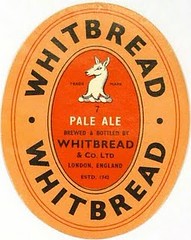
Whitbread-Pale

But there is one beer I have that continues to vex me concerning when and where to open it. Actually, I have two bottles of this beer, which were given to me by a Costello Beverage distributor’s rep. in Las Vegas, when I was still the beer buyer at BevMo and we still had two stores in Nevada. The bottles in question are from the Whitbread Brewery, and though I can’t confirm the veracity of everything in their story, here’s what I was told.

Port-Napier

Back in World War II, a British minelayer, the HMS Port Napier, sank off the coast of Scotland. Here’s what happened, according to Wikipedia:

After being loaded with her cargo, she dragged her anchor during a gale in the Kyle of Loch Alsh on 26 November 1940 and grounded in shallow water. While being unloaded there was a fire in the engine room, whereupon the harbour and towns nearby were evacuated, and she was towed well out into the loch and cast adrift in anticipation of an explosion.

A massive explosion on 27 November, which fortuitously didn’t set off any of the mines, blew her apart and she tipped over on her starboard side and sank in 20 metres of water with her port side visible at low tide.

In 1955 the Royal Navy took off the steel plating on her port side and removed the mines and 4000 anti-aircraft shells.

Today, she’s still a popular site for divers, even though the wreck is silty, “owing to its relative intactness and shallow location.”
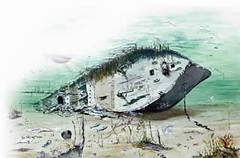
hms-port-napier-clr

But in 1993, some divers found something interesting that others had missed.

In 1993 eight divers visited the wreck of HMS Port Napier off the Isle of Skye, Scotland. The ship was a WWII mine layer which sank on its maiden voyage in 1940 when fire broke out in the engine room. The wreck lays in 24m of water. The divers found two crates of beer in the galley. They contained 48 bottles of Whitbread pale ale and the contents had been preserved by rubber-sealed screw-in bottle tops. The divers sampled some of the beer back on dry land and found it to be even better than new beer. “Foamy with a mature flavour” said one of the divers. They didn’t finish off the 48 bottles though. They saved a few of them for the Whitbread company.

www-10-5-93

So that part of the story I can more or less confirm. From here on out, it’s all uncorroborated, unless someone out there has more information. The Whitbread Brewery examined some of the bottles and managed to extract some still-living yeast from them, using it to brew some special beer. The bottles that I received were supposedly that beer, made with the 50+ year old yeast. If the yeast was found in 1993, then I don’t know exactly when Whitbread made the beer. They were still in business at least until 2000, when they sold out to what was then InterBrew (and now is InBev or Anhueser-Busch InBev) for £400 million. A few years later, in 2005, Whitbread (now a hotel chain, though they call it a “hospitality company”) even sold the original brewery building on Chiswick Street on London, where Samuel Whitbread founded his brewing empire in 1732. Today it’s an event center called, fittingly, the brewery.
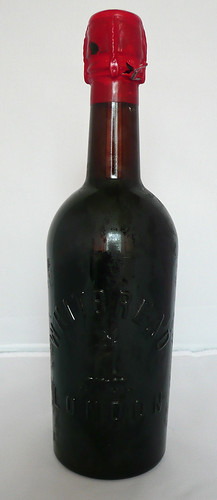
whitbread-full
This is one of the bottles. Note: the glass is perfectly smooth, what looks odd is just condensation as I’d just taken it from the refrigerator moments before taking this photo. Some of the bright red wax is starting to chip off just a little bit, but is otherwise in pretty good shape, all things considered.

I was given them around 1998 and was told to wait until the Millennium to open them, but to be honest I forgot about them that New Year’s Eve and then I never quite found another occasion that seemed worthy of opening one of them. So they’re roughly twelve years old now, and I’ve kept them properly chilled virtually the entire time (though I can’t vouch for the time before they were in my possession) brewed with yeast from a beer bottle that was under water since 1940, 70 years ago. I’ve heard of other people who’ve seen them, but I don’t know anyone else that has one, let alone two of them. I’m very curious what the beer tastes like, of course. I’d employ the above rule about “when surrounded by enough people who can and will appreciate trying it,” but somehow that doesn’t seem quite right. So when exactly should I open them? For what occasion? I’m stumped. What do you think?

whitbread-raised
Here’s a close up of the embossed bottle.

Filed Under: Beers, The Session Tagged With: Strange But True, UK, Whitbread

Next Session To Open The Good Stuff

February 9, 2010 By Jay Brooks

session-the
Our next Session will be hosed by The Ferm and his theme is The Display Shelf: When to Drink the Good Stuff, a dilemma many of us face. We’ve all accumulated “numerous bottles of beers that [were] subsequently cellared and designated as ‘to be opened on a special occasion.’ [The] dilemma, however, is matching an occasion with opening a particular bottle in [the] collection.”

The Ferm continues to elucidate their topic:

Finding a drinking occasion that lives up to the reputation of the bottle and the story of its acquisition is not a dreadful struggle to have, but it is a struggle nonetheless. When my good friends are over and we have had a few other beverages, will we still be able to enjoy my cave aged Hennepin that I bought after my tour of the brewery and have cellared for ten years? Will I miss it like I miss that four year old Golden Monkey?

The topic is open ended and the rules of The Session are close to nil. You can use your post to be persuasive or therapeutic. You may choose to tell a story of a great bottle you once opened or boast of your own beer collection.

Whatever approach you take, post it by March 5, 2010. And if you open one of your prized bottles, be sure to invite me over.

Filed Under: Beers, The Session Tagged With: Announcements

Session #36: Cask-Conditioned Beer

February 5, 2010 By Jay Brooks

session-the
Our 36th Session marks the three-year anniversary of our little project, spanning over 1,000 posts covering 36 topics, including today’s, which is cask-conditioned beer. Our host, Tom Cizauskas, from Yours For Good Fermentables, wants everybody to write from almost any angle so long as it’s about cask-conditioned beer. He gave a litany of ideas, which I earlier summarized as follows:

  • Ale vs. Lager Knockdown: “can lagers be cask-conditioned?”
  • Beer Ticker: “who makes the best, and who serves the best?”
  • Cellarmanship: “how should a pub handle a cask?”
  • Cultural Debate: “how Americans have ‘extremed’ the cask experience, or how Americans need further lessons from the British.”
  • Definitional: ” other than that CAMRA description, what ‘is’ cask-conditioned ale?”
  • Encomium: “how cask-conditioned ale will transform the world.”
  • Geek: ” at what temperature to serve, to sparkle or not sparkle, and how clear should clear be?”
  • International: “where was the most unexpected place you drank a pint of cask-conditioned ale?”
  • Lifestyle Essay: “how you first lost your cask-conditioned ale virginity.”
  • Pesce PETA: “can one be a vegetarian and drink cask ale?”
  • Style Harangue: “why saisons, for example, should have no place in a cask, or should.”
  • Zymurgical & Practical: “how does your brewery commercially produce and transport cask-conditioned ale?”

“Make it a sad story. Make it a love story. But … make it!” But ending with this entreaty to participate. “Above all, let’s have perspective folks, perspective! Cask-conditioned ale is not a matter of life and death; it’s much more.”

session_logo_all_text_200

I’ve been so swamped with SF Beer Week that I’ll have to keep this month’s Session post short, no small feat for me. So I figure I’ll go for “lifestyle essay” and tell the tale of how I lost my “cask-conditioned ale virginity.” It was my first trip to the UK, with my first wife (didn’t know that, yeah, I forget sometimes, too, it was so long ago) and we rented a flat near Clapham Junction. But we arrived one day before the flat was ready for us, so we had to find a hotel for one night. For no better reason than I loved the old Ealing Comedy Passport To Pimlico, I picked a small hotel in Pimlico, a small area in central London, officially part of the City of Westminster.

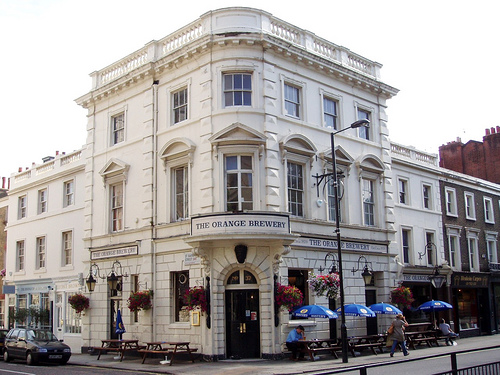
After checking in, we went for a walk and ended up at the Orange Brewery on Pimlico Road. I didn’t realize it at the time, but it had only opened that same year, in 1983. It was a brewpub, with the brewery in the basement. I remember that because I had a peek at it. After flying all night from the East Coast and lugging our bags on the Tube and to the hotel on a humid August day, I was pretty hot, tired and thirsty. So when I saw this corner bar, we immediately ducked inside.

orangebrewerypimlico

Over 25 years later, I can barely remember what I ordered. What I do remember is how much I immediately took to it, loved it in fact. Up until that point I’d pretty much taken for granted that all beer was served cold. To have one at cellar temperature was a revelation. It tasted so good. So I had another. And another. I was immediately hooked, though it would be years before I could indulge such passions on a regular basis. It’s really only been in the last decade or so that cask-conditioned ales have become more commonplace on this side of the Atlantic. While hardly ubiquitous, you can find them pretty easily, at least in the Bay Area where I live. We have our own local firkin festival that’s been going for about 6 or 7 years. There’s definitely a growing awareness and appreciation for them. We may never get to the point where the UK is — trying to save their real ale — but I think it’s safe to say that cask is here to stay and should continue to grow for the foreseeable future. I, for one, am very happy about that development.

Filed Under: Beers, The Session Tagged With: Cask

Three-Year Session Anniversary To Feature A Cask Of Characters

January 7, 2010 By Jay Brooks

session-the
The next Session, to be held February 5, will mark our three-year anniversary of The Session. Our 36th Session will coincidentally take place on the first day of SF Beer Week this year. Our Host, Thomas Cizauskas of Yours For Good Fermentables, has chosen the topic Cask-Conditioned Beer, which he describes as follows:

Cask-conditioned ale —or “real ale” as it is called, somewhat boastfully, by the Campaign For Real Ale (CAMRA), a beer consumer advocacy group in the UK— is defined by that organization as

beer brewed from traditional ingredients, matured by secondary fermentation in the container from which it is dispensed, and served without the use of extraneous carbon dioxide.

Viewers of [his] blog have read [his] opinions on cask-conditioned ale, and probably once too often. So, let’s hear yours, and not only yours. Why not invite brewers and drinkers and bemused casked-spectators to contribute essays for the Session?

He offers several approaches one might take the topic, with a colorful cask of characters:

  • Ale vs. Lager Knockdown: “can lagers be cask-conditioned?”
  • Beer Ticker: “who makes the best, and who serves the best?”
  • Cellarmanship: “how should a pub handle a cask?”
  • Cultural Debate: “how Americans have ‘extremed’ the cask experience, or how Americans need further lessons from the British.”
  • Definitional: ” other than that CAMRA description, what ‘is’ cask-conditioned ale?”
  • Ecomium: “how cask-conditioned ale will transform the world.”
  • Geek: ” at what temperature to serve, to sparkle or not sparkle, and how clear should clear be?”
  • International: “where was the most unexpected place you drank a pint of cask-conditioned ale?”
  • Lifestyle Essay: “how you first lost your cask-conditioned ale virginity.”
  • Pesce PETA: “can one be a vegetarian and drink cask ale?”
  • Style Harangue: “why saisons, for example, should have no place in a cask, or should.”
  • Zymurgical & Practical: “how does your brewery commercially produce and transport cask-conditioned ale?”

But in the end …

Make it a sad story. Make it a love story. But … make it! And make it here, Friday, February 5.

Write your story, then link to it here on the 5th as a comment or at my own post that day. A few days later, I’ll collate, analyze, comment, and link back. Include some photos, too: of casks, of imbibing their contents, of filling them.

Above all, let’s have perspective folks, perspective! Cask-conditioned ale is not a matter of life and death; it’s much more.

So let’s see who can cask new light on this subject and who scrapes the bottom of the barrel.

Filed Under: Beers, The Session Tagged With: Announcements, Cask

Session #35: New Beer’s Resolutions

January 1, 2010 By Jay Brooks

session-the
Our 35th Session is hosted by Christina Perozzi & Hallie Beaune, authors of the recently published beer book, The Naked Pint. For now the announcement is currently up on Beer For Chicks, but soon enough, the Session will be on The Beer Chicks, a new website by Perozzi & Beaune. But back to their Session topic — “New Beer’s Resolutions” — which they describe thusly:

So we want to know what was your best and worst of beer for 2009? What beer mistakes did you make? What beer resolutions do you have for 2010? What are your beer regrets and embarrassing moments? What are you hoping to change about your beer experience in 2010?

Hmm, that’s a lot to swallow. Ba-dump-bump. Rimshot!

Rim Shot  Cool Sounds sound bites

Best and worst beers of last year? I certainly had plenty of great beer throughout 2009. The new Utopias? Life & Limb? Pliny the Younger? Black Tuesday? Dark Lord? Tasting directly from the barrels at Russian River? I don’t think I could pick just one favorite. A worst beer? I tend to forget the bad as soon as it’s gone. I’d rather focus on the great beer. Beer mistakes? Undoubtedly, at least I hope so. As Joyce said, “a man’s errors are his portals of discovery.” Beer regrets? I’ve had a few. But then again, too few to mention. Embarrassing moments? For a second year in a row, I didn’t make it all the way through the Keene tasting at Brouwers, the day after the Hard Liver Barleywine Festival.

session_logo_all_text_200

“What are you hoping to change about your beer experience in 2010?” Okay, that’s a question I can sink my teeth into. This is probably going to sound odd, but I think I’d like to drink more beer in 2010. As it is, I drink almost every day. But usually it’s at home, afternoons and usually later in the evening with dinner. With a second grader and a kindergartner that need to get picked up every day and shepherded around to music lessons, etc., it’s not exactly easy to be out drinking every night. But in a sense that’s where the magic happens. Setting is important.

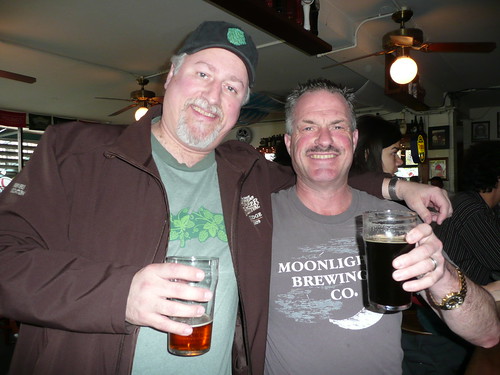
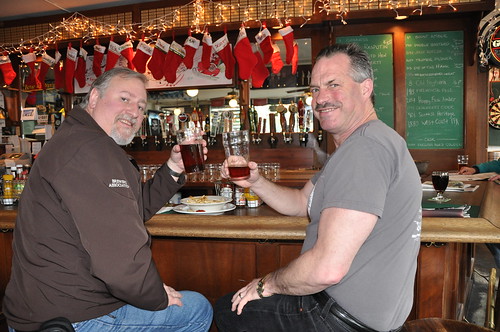
Me and Bruce Paton
In 2010, I want to do this more. Just be out more, drinking with friends.

So that’s my hope. To share a beer with more people this year, get out of the house more. Spend more time in bars, restaurants and breweries. That’s one of my New Beer’s Resolution, to drink more beer. Join me?

Bruce Paton & I drink the first beer of the day
Drinking my first beer on New Year’s Day at Barclay’s in Oakland with Bruce Paton, the Beer Chef. My first beer this year was Moonlight Toast, which I followed with Moonlight’s Christmas beer: Santa’s Tipple.

You can also see some more photos in this slideshow from today’s quick trip to Barclay’s.

Filed Under: Beers, The Session Tagged With: California, Northern California, Oakland

New Beer’s Day Session Topic Announced

December 9, 2009 By Jay Brooks

session-the
Our 35th Session falls smack on New Year’s Day, January 1, 2010 and the hosts, Christina Perozzi & Hallie Beaune, have chosen an appropriate topic for the holiday: New Beer’s Resolutions. Their announcement is currently up on Beer For Chicks, but come the new year, the Session will be on the newly launching The Beer Chicks, a new website by Christina Perozzi & Hallie Beaune, authors of The Naked Pint. In a nutshell, here’s what they mean by New Beer’s Resolutions:

So we want to know what was your best and worst of beer for 2009? What beer mistakes did you make? What beer resolutions do you have for 2010? What are your beer regrets and embarrassing moments? What are you hoping to change about your beer experience in 2010?

The month of January, of course, is named for the Roman god Janus, whose domain was gates, doors, doorways, beginnings and endings. He was the perfect choice when the calendar was changed around 713 B.C.E. when January and February were added to the Roman calendar (before that March and Spring were the beginning of the year). Janus is often depicted with two faces, one looking forward to the future and the other looking back to the past. That’s why the first holiday of the year is the ideal moment to stop and reflect on the year that just ended and to contemplate what path lies ahead in the coming one. Let’s hear how beer figures into that in 2010!

Filed Under: The Session Tagged With: Announcements, Holidays

Session #34: Stumbling Home

December 4, 2009 By Jay Brooks

session-the
Our 34th Session is hosted by Two Parts Rye, a quartet of bloggers in Ohio. Their topic is bringing us home, so to speak, with the provocatively titled Stumbling Home. Blog host Jim explains:

It’s time to give a shout out to your favorite watering hole. How good are the beers? Any interesting cast of characters? What are your drinking buddies like? They probably need to be embarrassed on the internet. Now’s the time.

You don’t have to limit yourself to one. Feel free to reminisce about the good old days if you like. Maybe you are a shut-in like this guy, and don’t get out that much, talk about the home bar.

There is a catch. This booze stuff has interesting side effects. That means, you can’t get behind the wheel. You gotta walk, take public transportation, or be a regular supporter of your favorite taxi company. Bicycles are acceptable but you still need to be careful.

While I’m not exactly a shut-in, having kids makes going out to bars just for the heck of it a pretty tough proposition. I don’t mind taking them, or them being in bars — I grew up going to bars with my parents — but they’re not that keen and it rarely fits with other stiff they have going on, doing homework, etc. Most of my bar visits have a specific purpose, for work, a tasting, an event of some kind. As a result, I don’t have a local, sadly. There’s really only two bars in walking distance from the one-horse town we live in. That’s the suburbs for you.

session_logo_all_text_200

So instead I’ll go back to the beginning. The first “local” I ever had was as an 18-year old stationed in Virginia shortly after I joined the Army after high school. I played in a military band and every musician in the Army, Navy and Marine Corps all had to attend a six-month music school near Norfolk. For reasons that pass understanding the locals hated the military and would literally harass and insult anyone with a crewcut. I still chuckle whenever I hear people talk about how universal the support for our military is. Not in Little Creek, Virginia in the late 1970s. But here’s the upside. There was a bar on base, crazily named the El Crocadrillo. The selection sucked, but the prices were like happy hour or lower all the time. We could be found there most evenings and stumbling home to our barracks later each night. Good times, sort of.

Afterward, I was stationed in New York City for the remainder of my tour of duty, playing with the 26th Army Band. Every bar in five boroughs was accessible by boat, bus or subway train. That was great. We spent a lot of our time in jazz clubs, from obscure hidden lofts you had to know the right people to find to the Village Vanguard. That’s where my love of better beer began. But as for stumbling home, the whole city was in range. Navigating the New York subway system took a certain skill after an evening of drinking and listening to music, but once you learned to get around, a whole new world opened up.

support_local_pub

The closest I ever came to a “Cheers” type of environment was the Britannia Arms in Cupertino. The first decade I was in California, I lived in the South Bay, first Santa Clara, then Sunnyvale, San Jose, Cupertino then San Jose again before moving to Oakland when my wife started law school at Berkeley’s Boalt Hall right after we married. But before we met, the gang of friends I hung out with would go to the Britannia Arms usually two or three times a week and at a minimum every Tuesday for quiz night. For several years we had a team — Abbey Something (a reference to “Young Frankenstein”) — and they had “seasons” for the quiz which encouraged us not to miss a quiz night. We got to know a lot of the other regular quiz folks and I’m still very good friends with one of the regular musicians we met there, and he even played at our wedding. They also had good pub food, a good selection of imports and even a few of those then new-fangled micros. I got to know the ex-pat British owners, Tom and Sue, fairly well. When I published my first book, “The Bars of Santa Clara County, A Beer Drinker’s Guide to Silicon Valley,” we had the launch party at the Britannia Arms. I miss the routine of having a local, a default place to go.

When I read about the English pub scene, plus the times I’ve experienced it, I feel sorry that here in the states we don’t really have any equivalent. Taverns historically used to be common meeting places, but Prohibition killed them off. As far as I know, they didn’t have that family friendly atmosphere that springs to mind when I think of the British pub. I’m sure a lot of that is idealized and isn’t like it’s portrayed in the countless British television programs I grew up watching or even like the American show “Cheers,” either. But the English pub is always portrayed as being family friendly, and that’s how I think bars really should be; bright, cheery places where you can get good beer, a hot meal, with music to listen to, books and magazines to read, and games to play. Fun for the whole family. It’s the rare bar in America that can boast such atmosphere, and most of the ones I know are imitations of British pubs transplanted over here. I get dirty looks when the kids come with me to a bar. That’s because of how drinking is demonized here, but I loved being in bars as a kid. Drunk people were very entertaining and always willing to buy a kid a root beer. They were wonderlands.

Still, I lament that American bars are nothing close to how I perceive the English pub, that it is a place that’s more than just for drinking. That said, I think the better beer bars, the ones highlighting craft beer or better imports, are more hospitable and inviting than the average corner bar that carries only the major big brands. If only I lived closer to them, I might find myself stumbling home much more often.

Filed Under: Beers, Breweries, The Session Tagged With: Geography, Home, Place

Subsequent Stumbling Session Scheduled

November 13, 2009 By Jay Brooks

session-the
The topic of our next Session has been announced and it’s Stumbling Home. Our host for Session #34, James Davoli at Two Parts Rye, describes what he means by that:

It’s time to give a shout out to your favorite watering hole. How good are the beers? Any interesting cast of characters? What are your drinking buddies like? They probably need to be embarrassed on the internet. Now’s the time.

You don’t have to limit yourself to one. Feel free to reminisce about the good old days if you like. Maybe you are a shut-in like this guy, and don’t get out that much, talk about the home bar.

There is a catch. This booze stuff has interesting side effects. That means, you can’t get behind the wheel. You gotta walk, take public transportation, or be a regular supporter of your favorite taxi company. Bicycles are acceptable but you still need to be careful. I have the cracked helmet and scars to prove it. Gotta love the 5 mph one man crash.

Walk back home by December 4 and let us know what you stumbled upon.

Filed Under: Beers, The Session Tagged With: Announcements

Session #33: Don’t Think Of A Pink Elephant

November 6, 2009 By Jay Brooks

pink-elephant
I’ll Have a Beer, a.k.a. Andrew Couch, our host for the 33rd monthly Session, begins his explanation of this month’s topic — framing beer — with a compelling story:

My sister once told me a story she had heard about a sculpture exhibit: on the winter day it opened, the artist placed a coat rack next to the door. Predictably, the patrons hung their coats on it. Each day the artist moved the rack a bit closer to the rest of the exhibit, until the day came when the visitors chose not to use the “piece of art” for their coats. That day the artist placed a sign on the coat rack that stated simply, “Art begins here.”

Framing as a concept has been around a long time in academia as a part of such disciplines as linguistics, communications theory and similar social sciences. But it became more mainstream in 2004 with the publication of UC Berkeley professor George Lakoff’s book on the subject of framing in politics, Don’t Think of an Elephant.
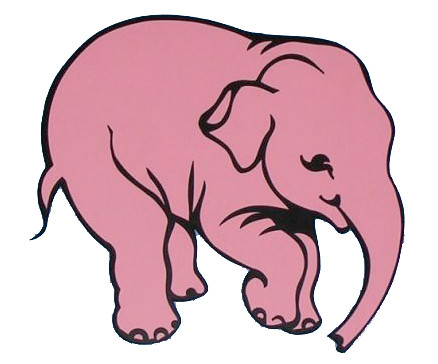
pink-elephant
Delirium Tremens’ pink elephant is my allusion to Lakoff’s book, and the idea of framing with regard to beer. But everything we write and say is framed, to one degree or another, as our language is very contextual. What words we choose and how we phrase our communications with one another gives a great deal of information, in some cases as much as the words themselves. The Republican Party is quite skilled at framing their agenda, calling an act that restricts people’s civil liberties “The Patriot Act” or a tax that falls disproportionally on the very rich a “Death Tax.” By calling it essentially the opposite of what it really is — as in say the Clear Skies Initiative that does little to make our skies any clearer — it’s easier to gain support for it since few people bother to look more closely at the substance. Take another example in the news lately: socialized medicine. Opponents of health care reform bandy this term around safe in the knowledge that people have a negative reaction to it. But it is almost meaningless. The term was crated by a PR firm on behalf of the American Medical Association in the late 1940s when Harry Truman had the temerity to try to reform health care then. The Cold War was just heating up and the PR firm correctly figured that by calling it “socialized” people with associate it with communism. This despite the fact that in school we all learned that we’re a social democracy and that the police department, fire department, post office, medicare, social security, unemployment and all manner of programs that make our lives better and few people would want to do without are forms of socialism. No matter, the framing of it has everything to do with how people react to it.

Framing isn’t necessarily as sinister as that suggests, and in fact more often than not it does accurately reflect the intentions of the communicator, especially outside politics. It’s only when framing is misused to manipulate that it takes a more sinister turn. When it comes to beer, not so much. But almost everything about a beer can be described in those terms, from the packaging to the beer’s name, style designation and label.

Couch describes this phenomenon with regard to beer:

Imagine persuasively describing craft beer to someone who has until now entirely missed out, maybe in a sales situation. Perhaps it’s a brown ale and you can can describe the caramel and toast flavors, or it’s a pale ale and you have fruit or herbs from the hops. You might start having to defend yourself if it’s an IPA and those hops taste earthy, resiny, or particularly bitter. You’ll definitely meet some resistance if your favorite is an imperial anything, brimming with intensity and a sharp kick, or if you’d like to convince a person of the credibility of a sour beer or anything for which you must use the word ‘funky’. Each of these descriptions is inevitably an attempt to ‘frame’ the beer, putting the consumer in the proper state of mind to drink it.

For better or worse, in everyday situations beer comes with a label. This label very really ‘frames’ the beer inside. The fact that the beer comes commercially-produced signals the presence of investment (if not skill). A style name or tasting notes indicates the general characteristics to expect. If you know the brewery the beer is framed with your past experiences. Even the label art will affect your expectations for the beer.

framed

Then Couch goes on to the assignment at hand:

What role does this framing play in beer tasting, especially for ‘professional evaluators’? Relate an amusing or optimistic anecdote about introducing someone to strange beer. Comment on the role a label plays in framing a beer or share a label-approval related story. I have not done much blind tasting, and I would be intrigued to hear about this ‘frameless’ evaluation of beer.

And drink a beer. Ideally drink something that you don’t think you will like. Try to pick out what it is about that brew that other people enjoy (make sure to properly frame the beer!).

As for tasting blind, it’s virtually a necessity for competitive judging. Being human, we all bring our prejudices and bias to the tasting table, no matter how much we try to avoid it. I can’t tell you how many times I’ve been surprised to discover what a beer I tasted blind was, freed from expectations and even faulty memories. One of the things that’s stressed at GABF judging is that if you think you can identify a beer you’re sampling blind, keep it to yourself. Not only are you usually wrong, but you’ll unduly influence others at the table. Memory is a curious thing, and I’ve read a great deal about it in the context of courtroom testimony where it’s not nearly as reliable as one might expect. More recent scientific inquiry is revealing just how poorly our memories can be. So anything we can do to remove those and any other bias, goes a long way toward making beer judging better and more fair for the beers being judged.

session_logo_all_text_200

One of my favorite beers to get people thinking differently about beer and what beer is and can be is Unibroue’s Quelque Chose. When it was more widely available, I used to serve it each year at an annual Christmas party we’d throw before the kiddles came along. Quelque Chose is French for “something different” and that it is. If you’re not familiar with it, Quelque Chose is an 8% abv dark beer fermented with wild cherries and intended to be served hot, around 160° F. Essentially you mull the beer in a pot filled with water. It was originally created to service the ski regions northwest of Montreal and it’s absolutely divine on a cold night.

But what makes it is seeing people’s faces the first time they try a hot beer that also tastes good. It’s priceless because it’s so far removed from their normal experiences with beer. In a sense, they’re so far outside the frame that they’re forced to see beer in a whole new way and, hopefully, it will be difficult for them to go back to the old view. As a result, this beer is perfect for turning people on their head. It can’t fit into the frames of colder and colder beer that the big breweries have been crowing about and the experience should suggest that cold beer is not always better. Actually, I’d argue it’s rarely, if ever, better, but then I feel most American bars serve their beer too cold already, robbing people of all the flavor they should be enjoying.

I think the usual frames — beer styles, labels and reputations — are double edged swords that are equal parts good and bad, depending on specific circumstances. All we can really do is be aware of them and how they influence us.

Filed Under: Beers, Politics & Law, The Session Tagged With: Canada

Framing Beer Announced For Next Session

October 4, 2009 By Jay Brooks

session-the
Andrew Couch at I’ll Have a Beer has agreed to host our 33rd Session and he’s announced his topic for it. And for those of us who are numbers geeks, it has nothing to do with Rolling Rock.
r-33-rolling-rock
Instead he begins with this wonderfully enigmatic tale:

My sister once told me a story she had heard about a sculpture exhibit: on the winter day it opened, the artist placed a coat rack next to the door. Predictably, the patrons hung their coats on it. Each day the artist moved the rack a bit closer to the rest of the exhibit, until the day came when the visitors chose not to use the “piece of art” for their coats. That day the artist placed a sign on the coat rack that stated simply, “Art begins here.”

Framing is a concept often associated with politics, but which in reality can be applied to virtually anything. Couch goes on to explain what he’s looking for, discussing the philosophy of framing beer and how to apply it to next month’s Session.

Imagine persuasively describing craft beer to someone who has until now entirely missed out, maybe in a sales situation. Perhaps it’s a brown ale and you can can describe the caramel and toast flavors, or it’s a pale ale and you have fruit or herbs from the hops. You might start having to defend yourself if it’s an IPA and those hops taste earthy, resiny, or particularly bitter. You’ll definitely meet some resistance if your favorite is an imperial anything, brimming with intensity and a sharp kick, or if you’d like to convince a person of the credibility of a sour beer or anything for which you must use the word ‘funky’. Each of these descriptions is inevitably an attempt to ‘frame’ the beer, putting the consumer in the proper state of mind to drink it.

For better or worse, in everyday situations beer comes with a label. This label very really ‘frames’ the beer inside. The fact that the beer comes commercially-produced signals the presence of investment (if not skill). A style name or tasting notes indicates the general characteristics to expect. If you know the brewery the beer is framed with your past experiences. Even the label art will affect your expectations for the beer.

What role does this framing play in beer tasting, especially for ‘professional evaluators’? Relate an amusing or optimistic anecdote about introducing someone to strange beer. Comment on the role a label plays in framing a beer or share a label-approval related story. I have not done much blind tasting, and I would be intrigued to hear about this ‘frameless’ evaluation of beer.

And drink a beer. Ideally drink something that you don’t think you will like. Try to pick out what it is about that brew that other people enjoy (make sure to properly frame the beer!).

Extra credit will be given for specific mention of the Post article prompting this topic, or for use of the phrase “priming the pump”.

Get framing. See you in November.

beer-framed

Filed Under: Beers, News, The Session Tagged With: Announcements, Blogging

« Previous Page
Next Page »

Find Something

Northern California Breweries

Please consider purchasing my latest book, California Breweries North, available from Amazon, or ask for it at your local bookstore.

Recent Comments

  • Bob Paolino on Beer Birthday: Grant Johnston
  • Gambrinus on Historic Beer Birthday: A.J. Houghton
  • Ernie Dewing on Historic Beer Birthday: Charles William Bergner 
  • Steve 'Pudgy' De Rose on Historic Beer Birthday: Jacob Schmidt
  • Jay Brooks on Beer Birthday: Bill Owens

Recent Posts

  • Historic Beer Birthday: Conrad Pfeiffer March 7, 2026
  • Beer In Ads #5148: Ach Himmel Mr. Goat March 6, 2026
  • Historic Beer Birthday: Conrad Windisch March 6, 2026
  • Historic Beer Birthday: Samuel Wainwright March 6, 2026
  • Beer In Ads #5147: Frankenmuth Is Michigan’s Largest Selling Bock March 6, 2026

BBB Archives

Feedback

Head Quarter
This site is hosted and maintained by H25Q.dev. Any questions or comments for the webmaster can be directed here.