Brookston Beer Bulletin

Jay R. Brooks on Beer

  • Home
  • About
  • Editorial
  • Birthdays
  • Art & Beer

Socialize

  • Dribbble
  • Email
  • Facebook
  • Flickr
  • GitHub
  • Instagram
  • LinkedIn
  • Pinterest
  • RSS
  • Twitter
  • YouTube

Powered by Genesis

Beer In Ads #108: Coors’ Golden Brewery

May 13, 2010 By Jay Brooks

ad-billboard
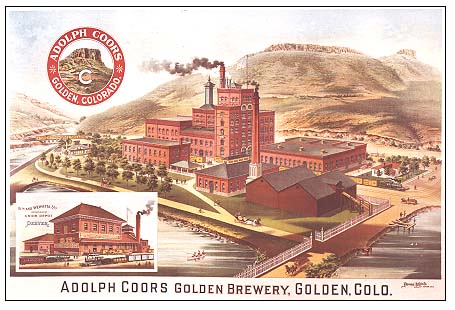
Thursday’s ad is for Coors. It’s an old advertising lithograph from around the 1890s. I love these kind of old ads that are merely showing off the industrial beauty of old breweries. This is, in a sense, vintage brewery porn. I attended a Coors event earlier tonight (more about that later) and so this seemed an appropriate ad to showcase today.
coors-lithograph

Filed Under: Art & Beer, Beers Tagged With: Advertising, Brewery Porn, Coors, History

The Beer Genie Out Of The Bottle

May 13, 2010 By Jay Brooks

beer-genie
The British Beer & Pub Association (or BBPA), a UK trade association for pubs, launched a new website recently called the Beer Genie. It’s aimed at bringing the “magic of beer” to consumers. The site is “themed around beer’s power of sociability” and certainly seems to have a lot of decent information. It’s also got quite a number of sections, including Beer & BBQ’s, World Cup Beers, the History of Beer, beer & Women, Beer Facts, Knowledge and Links, Beer & Christmas, Beer & Entertaining, Beer & Weddings and a Gallery. It certainly seems like a better effort than Here’s To Beer, A-B’s failed attempt to do something similar a few years ago. At least this has the support of more than one big brewery.

Filed Under: Beers, Just For Fun, Politics & Law Tagged With: UK

Beer In Ads #107: McEwan’s Everyone’s Choice Again

May 12, 2010 By Jay Brooks

ad-billboard
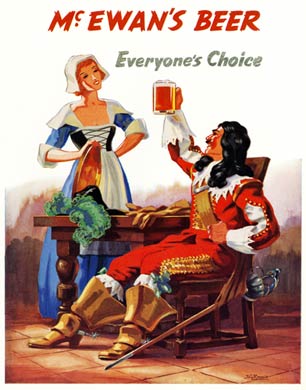
Wednesday’s ad is for McEwan’s from the 1950s. The ad uses their “Everybody’s Choice” tagline showing an idyllic scene from history, a cartoon version of the laughing cavalier, McEwan’s logo based on the painting by Frans Hals.

mcewans-50s

Filed Under: Art & Beer, Beers Tagged With: Advertising, History, Scotland

Beer In Ads #106: Budweiser, Age Old Partner With Fine Food

May 11, 2010 By Jay Brooks

ad-billboard
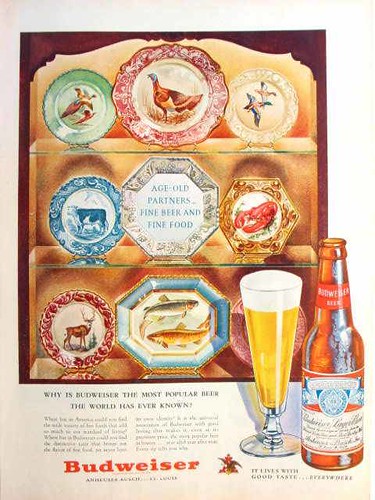
Tuesday’s ad is for Budweiser from the 1950s. The ad is positioning Budweiser as a food friendly beer. The dish in the center reads. “Age Old Partners — Fine Beer and Fine Food.” All the other dishes depict some of the foods they believe Bud will pair well with: pheasant, turkey, duck, beef, lobster, deer and fish. Having been to several beer dinners put on by Anheuser-Busch, I can’t say that Bud is a versatile as they suggest, and is frankly overwhelmed by most of those dishes. But it’s interesting to see them try to position it as an all-purpose food beer.

bud-dishes

Filed Under: Art & Beer, Beers Tagged With: Advertising, Budweiser, History

Oklahoma Governor Signs Homebrewing Bill

May 11, 2010 By Jay Brooks

oklahoma
Oklahoma Governor Brad Henry signed HB 2348, which means homebrewers can legally brew starting November 1, 2010. “Oklahoma law already allowed for the home production of wine and cider, but until now excluded beer.” 48 down, 2 to go. Just Alabama and Mississippi continue to have homebrewing illegal in their state. See the full story at the American Homebrewers Association.

Filed Under: Beers, News, Politics & Law Tagged With: Homebrewing, Midwest, Oklahoma

Beer In Ads #105: Weisbrod & Hess

May 10, 2010 By Jay Brooks

ad-billboard
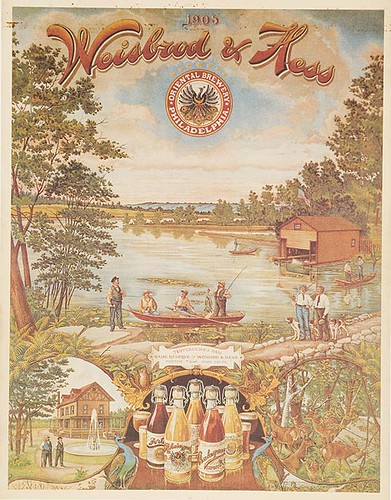
Monday’s ad is another oldie, from 1905. It’s for Weisbrod & Hess, a.k.a. Oriental Brewery of Philadelphia, Pennsylvania. It’s a complex and beautifully illustrated poster.

weisbrod-hess-1905

Filed Under: Art & Beer, Beers Tagged With: Advertising, History, Pennsylvania, Philadelphia

Smokin’ Aces Drink Bell’s Oberon

May 10, 2010 By Jay Brooks

bells
We were watching Smokin’ Aces 2: Assassins’ Ball last night — quick review: mildly entertaining action adventure with cartoon violence and not much of a plot. Most of the best bits were in the trailer.

smokin-aces-2

Anyway, a good portion of the film takes place in a bar. One of the beers served is Bell’s Oberon. There’s a prominent tap handle of it on the bar, where one scene takes place. When the frame part of the scene at one point, the Bell’s logo along with the Oberon label can be seen in the foreground on the left-hand side of the frame. And at several more points, either the Bell’s or Oberon graphics can be seen. I don’t know if Larry Bell paid for product placement or if someone who made the film was a big fan. Either way, that was fun to see.

bells-oberon

Filed Under: Beers, Just For Fun, Related Pleasures Tagged With: Film, Michigan, Midwest

Session Beers For The Next Session

May 10, 2010 By Jay Brooks

session-the
Our big 40th Session will be hosted by Erik Lars Myers from Top Fermented. He’s chosen a topic near and dear to Lew Bryson’s heart — as wll as many other beer lovers — session beers, which he describes as follows.

There are a thousand ways to approach this.

What is your definition of a session beer? Is it, as Dr. Lewis suggested at the Craft Brewers Conference this year, “a pint of British wallop” or is your idea of a session beer a crisp Eastern European lager, a light smoky porter, a dry witbier, or even a dry Flemish sour?

Is it merely enough for a beer to be low alcohol to be considered a session beer, or is there some other ineffable quality that a beer must hold in order to merit the term? And if so, what is that quality? Is it “drinkability”? Or something else?

What about the place of session beer in the craft beer industry? Does session beer risk being washed away in the deluge of extreme beers, special releases, and country-wide collaborations? Or is it the future of the industry, the inevitable palate-saving backlash against a shelf full of Imperial Imperials?

What are some of your favorite session beers? When and where do you drink them? If you’d like, drink one and review it.

So join us for the next Session, all about sessions, on Friday, June 4.

Filed Under: Beers, The Session Tagged With: Announcements

Guinness Ad #17: The Pelican Thief

May 8, 2010 By Jay Brooks

guinness-toucan
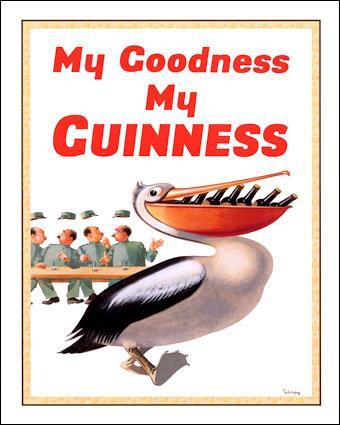
Our seventeenth Guinness poster by John Gilroy is part of the “My Goodness, My Guinness” series, showing a Pelican with his mouth filled with bottles of Guinness and, in the background, a table of zookeepers looking around, wondering what happened to their beer.

guinness-pelican

Filed Under: Art & Beer, Beers Tagged With: Advertising, Guinness, History

Session #39: Collaboration Beers

May 7, 2010 By Jay Brooks

collaboration
Our 39th Session is hosted by Mario Rubio who writes at both Brewed For Thought and, collaboratively at Rate Beer’s Hop Press. It’s appropriate then that he’s chosen Collaboration Beers as this month’ session topic, which he described in his announcement.

Feel free to have fun with the topic. Drink a collaborative beer. Who’s brewed some of your favorite collaborations? Who have been some of your favorite collaborators? Who would you like to see in a future collaboration?

As the topic is collaborations, working with each other is encouraged.

session_logo_all_text_200

As time is short for me, what with being overwhelmed with work of late and leaving later this afternoon for the Boonville Beer Festival, I’ll turn to an article I wrote for the January 2009 issue of All About Beer magazine. Entitled Brewing Togetherness, it was essentially on this very topic, with the subtitle “Collaboration Beers: The Natural Evolution of Craft Beer.” Here are the opening paragraphs:

Aristotle observed, in his classic work Metaphysics, that “the whole is more than the sum of its parts.” He may not have been talking about beer when he said that, but then again, he was on to something. Over the past decade or so, there’s a trend that’s been slowly building as craft brewers are increasingly making metaphysically delicious beers, in pairs or in groups, with the results often tastier than the sum of their part-iers’ efforts alone.

This recent trend of collaboration beers represents the next logical step in building relationships that brewers began thirty years ago at the dawn of modern craft brewing. Since then, an unprecedented sharing of knowledge and resources has led to an industry mature beyond its years. This is arguably the reason that American craft beer has built its excellent reputation in such a short time, and also why collaboration beers feel like such a natural extension of that success.

Of course, since trade guilds began in the United States, shortly after the start of the Civil War, brewers have been sharing technical information and basic advancements in brewing techniques. But today’s craft brewers have gone further. The kind of assistance they gave one another—early on and continuing through the present day—was unequivocal and without reservation.

When all the small breweries combined brewed such a tiny fraction of the total beer sold, nobody worried about market share, competition or trade secrets. Brewers in the craft industry were simply very open with one another, freely offering each other help, and freely asking for it, too, in a way that earlier generations and larger businesses wouldn’t dream of doing.

As several brewers noted, many early brewers came from a homebrewing background, and took their hobby and “went pro” at a time when there were few books available and hardly any readily available body of knowledge. Most brewers learned their craft in the kitchen, not in a formal school setting. As a result, brewers were already used to turning to other homebrew club members or on forums to fill in gaps in their knowledge.

But a curious thing happened once the size and number of small brewers increased and their market share grew bigger, too. Those close relationships endured as did their willingness to share, as brewers eschewed conventional business thinking and continued to help each other as often as needed. You’d be hard-pressed to find another business where people don’t protect their most valuable trade secrets and operational knowledge. Most industries employ corporate espionage to find out their competitors’ secrets and the threat of lawsuits to keep their own employees from defecting and taking their institutional knowledge with them to a competing firm.

You might be tempted to think that so cavalier an attitude could doom such businesses to failure or, at the very least, to not staying ahead of their competition. By any measure, however, you’d be deeply wrong. It may be counter-intuitive, to say the least, but by and large the breweries that have been the most open and helpful have also been the most successful.

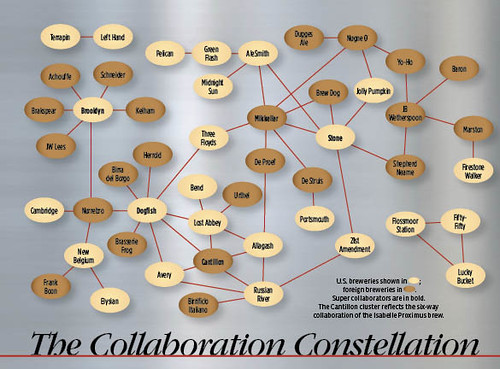
After that, I attempted to detail as many collaborations as I could, with eye toward documenting some early collaborations, both domestic and internationally, and describing the many different kinds of collaborations that brewers were doing. There were so many that a graphic was created for the article showing all the connections that I mentioned.

Collabrographic

And here’s how I concluded, with how the many brewers participating in collaborations feel about them.

The Future of Brewing Together

While there is no doubt that collaboration beers are a growing trend, not everyone is convinced they’re here to stay. Everyone seems to have a different reason for doing them and perceives their value differently.

Some people fear that collaborative brews may simply be a way to generate publicity. Before doing his own jointly-brewed beer, Ron Jeffries admitted to feeling “a little cynical about them.” But after being involved in one, he’s had to rethink that assumption. For him, “the collaboration experience was spiritual,” as well as educational. “It was great to spend time with people I respected, but didn’t really know that well. It was great to see a little bit more of how and why they do what they do.”

Many people echo the sentiment that a collaboration must be more than just a marketing exercise. Collaborations are, by necessity, compromises. Jeffries feels that if it goes too far it becomes more marketing-driven instead of being all about creating a great beer. “That’s the danger,” he says.

Tomme Arthur makes a musical analogy: “There must be a point. You can put Mötley Crüe and Guns N’ Roses on the same stage, but there’s no guarantee the results will be beautiful music.” Continuing the musical metaphors, Cilurzo adds, “Collaborations are like musician’s side projects, where you can gain inspiration. But it doesn’t mean the band breaks up.”

Arthur believes “there will continue to be a need for ambassadors overseas” providing an “opportunity to reach out. We all use the same ingredients, but there’s a world of difference.” Cilurzo adds, “In collaborations, you see things you might never have thought of on your own, and that’s the ultimate reward.” Calagione sees the trend as “a microcosmic symbol of how promiscuous the beer industry is, where we all share secrets with one another, where the consumer is generally catholic with their drinking habits, celebrating the breadth of styles available in the world.”

Todd Ashman sees collaborations as “a natural evolution” of the brewer’s networking experience and offers a way “to stay in touch with people you might not otherwise deal with regularly.” He adds, “It’s also a way to get your customers into the fold and keeps it interesting” for both them and the brewers. And that may be the truest test of all, that the consumers ultimately like and are willing to buy the collaboration beers.

While there is certainly competition among American craft brewers, it is a healthy competition, borne of trying to outdo one another, to show off, to push the envelope just a little bit farther. As Stone’s Mitch Steele says, “Craft brewers feed on what each other is doing.” Or as Calagione puts it, collaborations “remind everybody how creative and exciting the craft beer world is. Not only do we let our freak flag fly, but we also let it mingle.”

Undoubtedly, consumers can count on seeing and tasting more collaboration beers in the coming years. As long as brewers keep approaching the collaborations with their fellow brewers, whether at home or abroad, in the right spirit, then they’ll continue to create unique beers, often in limited quantities, that will keep the beer world continually excited about each new beer. As Dustin Watts, co-creator of the Midnight Project, sees the ultimate point of collaborations, they just scream, “Welcome to the world of craft beer, this is what it’s all about.”

The entire article is online, so you can read it at All About Beer’s online archive. Since then, one of my favorite collaborations has been the Life & Limb project between Sierra Nevada and Dogfish head.

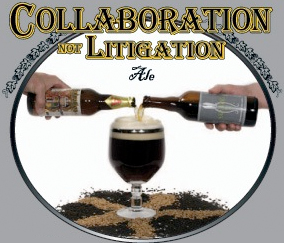
But the story behind the Collaboration Not Litigation between Russian River and Avery expresses the spirit of craft brewers best.
collab-not-lit

Filed Under: Beers, Breweries, The Session Tagged With: Collaborations, International

« Previous Page
Next Page »

Find Something

Northern California Breweries

Please consider purchasing my latest book, California Breweries North, available from Amazon, or ask for it at your local bookstore.

Recent Comments

  • Bob Paolino on Beer Birthday: Grant Johnston
  • Gambrinus on Historic Beer Birthday: A.J. Houghton
  • Ernie Dewing on Historic Beer Birthday: Charles William Bergner 
  • Steve 'Pudgy' De Rose on Historic Beer Birthday: Jacob Schmidt
  • Jay Brooks on Beer Birthday: Bill Owens

Recent Posts

  • Beer In Ads #5217: The King Of All Beers April 11, 2026
  • Historic Beer Birthday: Gambrinus April 11, 2026
  • Beer In Ads #5216: The Finest Bock, As Usual April 11, 2026
  • Historic Beer Birthday: Anton Heeb April 11, 2026
  • Beer In Ads #5215: Another Load Of “Milwaukee’s Choicest” April 10, 2026

BBB Archives

Feedback

Head Quarter
This site is hosted and maintained by H25Q.dev. Any questions or comments for the webmaster can be directed here.