Conventional wisdom is that during an economic downturn, recession or — let’s just say it out loud — depression, that certain businesses are not as challenged, usually ones that provide things that are either absolute necessities (food comes to mind) or make products people have decided for one reason or another that they’re reluctant to give up. Beer is traditionally one of these businesses that is generally thought to be recession-proof because people turn to it as a salve or an inexpensive way to relax, spend time with friends and loved ones and have a good time.
Craft beer, though more expensive than the mass-produced beer churned out by the big two, can still be characterized as an “affordable luxury.” Even the more expensive single bottles are cheaper than high-end wine or spirits yet I’d argue that they’re just as much of a special treat. Even when strapped for cash, everyone — me included — wants to splurge on themselves, even if only once in a while. It’s sad, but those are the moments we live for. Our economic system is so rigged to favor those at the top of the pyramid that almost everybody else is struggling most of the time. As the rich have gotten richer over the past few decades, real wages of a majority of Americans have fallen precipitously — thank you, Neocons — and the young in their twenties, thirties and even forties are among the first generations to be worse off then their parents.
Just consider that when I was a kid, most people I knew were in families where only one of their parents worked, usually their fathers. That my own mother worked — she was a nurse — was somewhat unusual in my neighborhood, which was by no means affluent. It was just a normal middle-class suburb, and a lower middle-class one at that. I can’t think of a single other person on my block where both parents worked full-time. There were one or two wives who worked part-time a few hours a week at local charities, but that was about it.
In 1960, when I was one, only 25% of married couples with children had both parents employed. By 1976, when I was junior in high school, only 33% of married couples with children had both parents employed, and only 31% of all women with babies younger than a year old worked. Today, how many families can boast that only one parent works outside the home? As of 2007 (according to the Bureau of Labor Statistics) the number of families in which both parents work is 62.2%, nearly double the number from the mid-1970s and far more than the 1960s. While I realize that some economists think that’s a choice that women make and that it’s not indicative of anything sinister, I also think they’re full of it. If it currently takes two salaries — each one of which takes 69 hours per week to earn what 40 hours got you just a few decades ago — to keep up with the Joneses, then something is seriously wrong with our society and the way we look at things. It’s not that I think that we should return to the 1950s — I really don’t, trust me on this one — but two salaries should mean twice as much prosperity as it did when only one spouse worked, but it clearly doesn’t.
Ever since the housing bubble exploded — surprising no one who was paying attention — things have been snowballing down prosperity mountain and all our proposed fixes merely trickle. From the housing market, the credit market and Wall Street took a nose dive, with several high-profile financial institutions finally revealing they’ve been out in the business world without any clothes on for quite some time. It’s only now that anyone appeared to notice. Our government, of course, threw money at the problem (as they always do) but only at the banks and financial institutions. Small businesses were allowed to fail, homeowners continue to lose their homes and personal bankruptcies continue to climb. Next, the big three American automakers jetted down to DC to beg for billions while corporation after corporation announced massive layoffs. The unemployment figures for October were just released, and at 6.5% it was the highest since 1990. Even the normally sunny Time Magazine has to admit that things look worse than in previous downturns and many economists think we’re in for hard times.
So if they’re right, are we in for another depression? And what exactly is the difference between a recession and a depression? There’s a not terribly funny joke among economists that a recession is when your neighbor loses their job and a depression is when you lose yours. But the truth is there is no hard and fast rule about the difference between the two. The media tends to define a recession as two or more consecutive quarters where there’s a decline in the Gross Domestic Product (GDP). By and large, economists don’t like that definition because it ignores many other variables, such as the unemployment rate or consumer confidence. Also, by pinning it to a quarterly figure, it makes it more difficult to determine the exact beginning or end and a short recession may go undetected altogether.
What I find frustrating about this lack of precision in defining our economic condition — no small thing considering how much it effects all of us — is that because of that imprecision it’s almost impossible to say anything with certainty except in hindsight. How that manifests itself is that every talking head claiming some sort of divine financial insight always errs on the side of caution, saying things look great, don’t worry, everything will be fine and other mostly bullshit sunny predictions. They do this for at least two reasons, one benign, the other not so much. First, they try to be reassuring because they’re afraid that people might panic and things that might look only a little bad would turn really bad simply as a result of their telling the truth. So they lie, though in this case it’s somewhat understandable why. Secondly, most of the people who we rely on for financial expertise have a stake in the game and stand to lose personally if things go south, so their advice tends to be very self-serving, like telling everyone not to sell while they’re privately unloading everything they own. This is also why in my opinion the system is rigged and it’s only the people on the outside that lose, the wealthy insiders almost always get to keep their money no matter how much they screw up. Senator Christopher Dodd, chair of the Banking Committee, recently fumed in a PBS interview about how many banks have taken the $300 billion you and I ponied up to “bail out” the credit markets and are hoarding it, buying up healthy companies and paying egregiously high bonuses to themselves — essentially everything but trying to jumpstart the economy by loosening up the availability of credit.
What’s this got to do with beer, apart from driving us all to drink more of it? Well, that’s really the question. Will this economic downturn, if it keeps spiraling downward like the cynic in me believes it will, also effect beer, even though it’s been largely recession-proof in the recent past? If the situation continues to worsen and we enter a full-fledged depression, will that change the game? During the great depression, beer was essentially out of the equation — at least legally — though it did help bring us out of it when FDR urged the repeal of Prohibition to boost morale and stimulate the economy. As the 75th anniversary of its repeal is less than three weeks away, it’s worth noting that it was economics that got us into prohibition and economics that got us out again. See, for example, page 438 if the Encyclopedia of Public Choice in Google Books. There’s also a nice overview of this in Reason magazine, from July 2007, entitled the Politics of Prohibition.
Prior to the creation in 1913 of the national income tax, about a third of Uncle Sam’s annual revenue came from liquor taxes. (The bulk of Uncle Sam’s revenues came from customs duties.) Not so after 1913. Especially after the income tax surprised politicians during World War I with its incredible ability to rake in tax revenue, the importance of liquor taxation fell precipitously.
By 1920, the income tax supplied two-thirds of Uncle Sam’s revenues and nine times more revenue than was then supplied by liquor taxes and customs duties combined. In research that I did with University of Michigan law professor Adam Pritchard, we found that bulging income-tax revenues made it possible for Congress finally to give in to the decades-old movement for alcohol prohibition.
Before the income tax, Congress effectively ignored such calls because to prohibit alcohol sales then would have hit Congress hard in the place it guards most zealously: its purse. But once a new and much more intoxicating source of revenue was discovered, the cost to politicians of pandering to the puritans and other anti-liquor lobbies dramatically fell.
Prohibition was launched.
But then a little thing called the Great Depression came along and lots and lots of people lost their jobs, meaning that the amount of income tax the federal government could collect also fell, initially about 15%. Three years into the Great Depression, income tax revenue dropped another 37% to 46% below pre-depression revenues and by 1933 they were 60% lower.
And so Congress (with the urging of anti-prohibitionists) was able to float the 21st Amendment successfully because they needed the money that alcohol taxes provided to their bottom line. One leading member of of the House of Representatives said at the time that he believed that without the economic necessity brought about the Great Depression that it would likely have taken at least another 10 years to repeal Prohibition, despite its obvious failure and unintended negative consequences.
Two things that bear watching in the present, as the weeks and months unfold, is what the economy does and what happens to the taxes on beer. Keeping in mind what’s happened in the past and especially with excise taxes, it seems to me these will be the most important factors that will affect how beer does through this recession. It may be that people do indeed keeping buying and drinking beer at the same rate, which would mean essentially that beer is indeed not affected at all by the economy (and it’s possibly even enhanced by a dip, such as if consumers forgo more expensive pleasures and instead choose beer when they “treat” themselves).
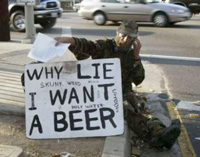
Or it could come to pass that the macro beers’ sales remain flat and craft beer sales begin to slow because people have less money and the price has gone up, due to a rise in energy costs and raw ingredients. It’s not happened yet, but there are signs that such a scenario may be on the horizon.
If the tax assault on the alcohol industry is successful in California, it will almost certainly spread to at least 38 other states. That will raise the price of beer across the board, further depressing the beer economy, if the not the whole shebang. It seems a little bit odd to me that politicians are entertaining budget fixes that essentially target specific industries that are already experiencing difficulties. What good does it do to extract another pound of flesh if the body then dies and you can’t get anything from it anymore? Not only are other segments of the economy not having higher taxes levied on them, but they’re actually being given money to insure that they don’t go out of business and more jobs aren’t lost. Not so with the alcohol industry. At a time when any sustainable industry should be seen as a positive in our very fragile economy, politicians (with neo-prohibitionists whispering in their ear) are doing just that; trying to make it more difficult for the alcohol industry to function. To say that seems short-sighted is an understatement.
The beer industry alone (again not including wine and spirits) supports over 1.7 million jobs and pumps around $189 billion into our economy, generating $25 billion in business and personal taxes and another $11.5 billion in consumption taxes. If history is any guide, that should mean politicians should respect our contribution.
And while less tangible and quantifiable, the contributions small breweries make is not just economic, but they are also good citizens of their communities, giving charitably back into them, spending much of their money locally (where possible) and running their businesses in a green, sustainable fashion. Harm them, and you harm the communities that support them, too.
Our economy today is arguably more complicated than before and during the Great Depression, so it’s obviously very hard to predict what might happen in the future. After the last depression, many social nets were put in place in an effort to prevent such a widespread economic situation from ever occurring again and to protect citizens from feeling its effects as acutely. FDR’s New Deal included programs to both help people out of their condition and also to keep it from happening again. There was opposition from conservative fronts while it was going on, but the problems were too great to ignore. In fact, the backlash of the New Deal is probably the neo-conservative movement of today, which has done so much to harm to our society lately.
For an excellent account of the politics of it, read Nobel prize-winning economist Paul Krugman’s The Conscious of a Liberal. In it he discusses conservative opposition to the New Deal programs and how many of them have been effectively chipped away at or removed completely by neo-cons — what he calls “movement conservatism” — beginning in the late 1970s, though the seeds were being sewn as far back as the 1950s.
I vividly recall growing up that all of my grandparents — and people of their same generation — were still very much effected by their experiences during the Great Depression. The notions of frugality, saving and near miserliness that meant survival back then continued to be factors they considered in making decisions some fifty years later. I had two dotty great aunts (sisters of my maternal grandmother) that always embarrassed me whenever we’d go out for a meal. One would steal as many sugar packets and other condiments as she could fit in her purse unseen and the other would carefully take as many as had been unused by our group. In other words, if there were five for lunch and one used a sugar packet in their coffee, she would take four sugar packets believing she was entitled to them since they went unused by the lunch party. That these otherwise normal, and by all accounts pretty well-off, people were so frugal to the point of being cheap was not anomalous to my family. I saw this behavior all the time. Ask me the next time you see me about the orange juice in my wife’s grandmother’s refrigerator when we visited her during our honeymoon. The difficulties of the Great Depression left a deep impression on an entire generation.
Is the beer industry’s glass half full or half empty? I admit that the prospect of another protracted depression is something that keeps me up at night. That so many of the protections that were intended to protect the economy and its citizens have been weakened or are gone altogether is a further source of concern. So is the fact that we may already be in one but not know it because we can’t define it and talking heads don’t want us to panic doesn’t help, either. Even if I don’t accept Morris Berman’s assertion (though I do — sigh) that we’ve entered a new Dark Ages (in his mesmerizingly depressing Twilight of American Culture) it’s hard to ignore that as a bully and the lone remaining Superpower that most nations view us less charitably than they did eight years ago. I’d like to believe our new President will be able to reverse our course, but I’m not sure the ship of state can be turned in time to miss the iceberg (that’s what happens to your metaphors when you have a 7-year old obsessed by the Titanic). While I’m cautiously “hopeful,” I’m also enough of a realist to know that he won’t be ale to walk into the oval office January 20 and make everything all better.
The Republicans will undoubtedly fight tooth and nail every step of the way and the Democrats in Congress continue to show what pussies they really are (as evidenced by their abject failure to remove Touché Turtle … er, Joe Lieberman, from his committee chair or the Democratic Caucus). So in my mind that’s a lot to overcome and very little in the way of seeing how to do it. That’s for the economy at large. What about the micro-economy that is beer? On the one hand, the industry’s been recession-proof for quite some time. But the game appears to be changing, possibly worsening, so that may not hold true if the economy continues to fall like a snowball rolling down a hill. Politicians should respect beers’ contribution to the economy in terms of jobs, tax revenue and just generating cash, but there are also neo-prohibitionist agendas that are seizing this moment in history as an opportunity to kick us while we’re down. These interests are pressing hard to raise the state excise tax and state by state promote other damaging legislation. Now is not the time to be apathetic or ignorant of how their efforts might effect all of us. Now more than ever, we have to be as vigilant as they are unceasing in their attacks. I don’t know what Beer in the Time of Recession will be like, but it’s probably going to be a bumpy ride. Strap in. Grab a beer. Pay attention. And perhaps most importantly, continue to support your local brewery as long as you can.