Brookston Beer Bulletin

Jay R. Brooks on Beer

  • Home
  • About
  • Editorial
  • Birthdays
  • Art & Beer

Socialize

  • Dribbble
  • Email
  • Facebook
  • Flickr
  • GitHub
  • Instagram
  • LinkedIn
  • Pinterest
  • RSS
  • Twitter
  • YouTube

Powered by Genesis

New Beer Magazine Covers Pacific Northwest

September 25, 2007 By Jay Brooks

According to the Portland Beer Blog Guest on Tap there’s another new beer magazine that’s hit the street. It’s Beer Northwest and will focus primarily on the Pacific Northwest. I met the publisher, Megan Flynn, at this year’s Oregon Brewers Festival and she seems like she has a good shot at succeeding with the new quarterly. Of course I may be slightly biased, I wrote the Washington Hops story listed on the cover. Go ahead, subscribe. You know you want to.



Filed Under: News Tagged With: Oregon, Washington

Beer’s Spiritual Problem?

September 24, 2007 By Jay Brooks

Apparently liquor and wine are divine, beer … not so much. That’s the apparent take of Wisconsin columnist Joe Orso who in a recent column, concludes that issues with people drinking beer in his local community are a “spiritual problem,” whatever that even means.

Admittedly, his community does appear to have had a spate of bad luck recently, as he relates.

In the past two weeks, a 19-year-old woman has died after drinking alcohol and falling off Grandad Bluff, Miss America has been to the area to speak to high school and college students about underage drinking and drunken driving, and a concert was held at Viterbo University to raise awareness about responsible drinking habits.

That’s a tragic event to be sure, but Grandad Bluff (pictured here) doesn’t look like the sort of place one should go to while drinking. I don’t want to sound cold, but not only did she show poor judgment but so did her friends. How that’s a spiritual problem or the fault of the beer I find somewhat baffling. As for Miss America, her cause celebre is children. I’m sure she’s on a tour of colleges making the same speech, she wasn’t targeting one community. The concert was a benefit for “Safe La Crosse” promoting responsible drinking behavior at the start of the new term. I’m willing to bet almost every campus has an organization like this one. So what?

My point is you can find or make connections wherever you want to find them. There doesn’t appear to be anything remarkable about these three events that would cause a reasonable person to conclude that the youth of today are in spiritual crisis and beer is the bogeyman responsible for it. But our amateur spiritualist isn’t finished. In his own personal life, he once lived with an alcoholic and he recently visited a friend who’s in detox. Oh my god! Two people he’s known throughout his life have problems with alcohol! Alert the media. Oh, wait he is the media. Why not focus on the maybe hundreds of people he knows or has known who aren’t alcoholics? Why try to connect dots that simply may not be there?

He’s heard anecdotally that young people are drinking simply because “there’s nothing else to do,” claiming to hear this excuse over and over again across the country. I have a hard time understanding why both his own lack of imagination and the similar dullness of the people he’s talking to leads to a conclusion that spirituality has anything to do with this. It sounds more like his community may have a problem. But instead his thinking goes like this. “When you look at a society and see so many of us spending weekends between 15 and 22 years old getting drunk, and then saying we do it because there’s nothing else to do, this becomes a spiritual problem.” Huh? When Orso asks “[h]ow are we treating our young people to make them feel like this?” you’d think the answer would be obvious, but apparently it isn’t.

Why say things like “[s]omething seems to be going on here with beer.” The author says he enjoys beer and has a favorite — Busch (ugh) — and he “look[s] forward to drinking it around a backyard fire every Christmas when [his] brothers and neighbors return home and [they] all catch up on each other’s lives.” In other words, he enjoys it in a social setting that creates conversation and a sense of togetherness. Does he not realize that’s precisely what goes on at teenage parties, too. Kids get together, drink, talk and bond as they struggle to figure out how to become adults. Teenagers struggle with all kinds of adult and quasi-adult behaviors and fumble their way through most of them. They’re supposed to, it’s through their failures and mistakes that they learn. But with our present taboos and draconian alcohol laws they have no positive role models for responsible drinking and many kids’ first experiences with beer may indeed be negative. They don’t have to be, but adults have created an environment that all but guarantees such a result. There will always be people who can’t handle certain things, be they alcohol, drugs, food, cigarettes or what have you. With alcohol the problem is exacerbated because of a criminal lack of education and misinformation, which in many places even forbids parents from teaching their own children about alcohol in the home. Such places presuppose that the state should be the ones to teach kids about alcohol but then they do absolutely nothing by way of educating them.

Orso concludes his column by suggesting that “we might shift the message a bit from ‘Drinking can hurt you, maybe kill you’ to ‘Why are you drinking so much?'” Well, for me such simplistic nonsense is what’s making me drink so much. He’s looking for easy answers to complex questions. But if you think the path to spiritual enlightenment is not paved with beer bottles, then I suppose no amount of logic will convince you otherwise. But could we please stop blaming beer for everything that’s wrong with the world? There are undoubtedly numerous reasons for drinking by teenagers (or anyone for that matter), but I seriously doubt that chief among them is a lack of spirituality. Frankly, I’d be shocked if it made the top hundred. But let’s ask all of the Orders of Monks who have been making truly inspired beers for centuries if they believe beer has caused them to be spiritually parched.


Filed Under: Editorial Tagged With: Mainstream Coverage, Midwest, Prohibitionists

Big Brewers Spending Less on Traditional Advertising

September 24, 2007 By Jay Brooks

According to a article at Advertising Age today, the three biggest brewers are spending less these days on traditional advertising, such as television, print and radio.

From the article:

According to TNS Media Intelligence, top brewers cut measured media spending a whopping 24%, about $131 million, during the first six months of 2007, following a 12% cut during 2006. At the same time, the brewers insist they haven’t cut spending at all — and in many cases have increased it.

What that means is that the dollars they are spending are being spent on things that traditional media folks don’t usually keep track of, such as sponsorships, promotional activity, product placement, bar events, concerts, stadium signage, specific sports promotions and local media. Part of that is simply to focus advertising on the dozens of test brands, the stealth micros and the alternative products that all three, though particularly Anheuser-Busch, have been experimenting with lately to compete with the craft segment, which is the only beer segment that’s been showing robust growth over the last few years.

So is this the traditional advertising world starting to panic? They talked to death about the big brewer’s forays into advertising on the internet and what that’s meant for them. They’re also equating trying to reach a younger demographic as another reason for the sharp declines in traditional ad buys. Does that mean since the younger generation has gotten wise to advertising, we’ll see traditional forms of it decline as a whole as they age? Somehow that seems doubtful, especially since in my humble opinion people aren’t really getting any smarter and advertising is certainly becoming more scientifically based. As a result, it’s hard to swallow the notion that young people are too savvy for advertising to work on them.

Citing a Beer Marketer’s Insights statistic that beer shipments from the big guys rose 2% at the same time traditional ad revenue fell, AdAge concludes that the non-traditional advertising must be working and even may be the key to that growth. They do qualify the 2% figure as “healthy,” at least “by the mature beer industry’s modest standards.”

But I seem to recall that the shipments figure is almost always around 1 to 2%, every year, no matter what. Maybe somebody has those figures in hand, but that’s certainly my memory. Other statistics like revenue, market share, and others have been fluctuating more, but not shipments, which have been fairly steady. At any rate, it seems hard to draw a conclusion from that statistic, even if my memory is faulty.

What really concerns me, if indeed what the article is suggesting is true — and the big three are throwing their massive resources at local media and cheaper, more targeted marketing — then they’ll be infringing on the only kinds of advertising and marketing craft brewers have been able to afford. Only a very few of the biggest microbreweries have been able to afford television advertising and even then it’s been limited and on cable networks. Regional and smaller breweries have only been able to afford the occasional print ad or radio spot, relying instead on guerrilla marketing, word-of-mouth and local community involvement. It will be very hard for them to compete with the big brewers’ ad budgets if they adopt a similar strategy.


Filed Under: Editorial Tagged With: Business, National, Statistics

Hunt’s Hop Tea

September 24, 2007 By Jay Brooks

teapot
A few weeks ago while helping Moonlight with their hop harvest, owner/brewer Brian Hunt broke out something I’d never seen before: hop tea. Now I’ve seen regular hop tea before, I’ve even bought some at the health food store and tried it, but this was something totally different. Brian told me the idea grew out of an experiment he was doing to see how hops reacted at different temperatures, which he presented at “Hop School” a few years ago. He discovered in the process that he could make a delicious hop tea and that it varied widely depending on the temperature of the water. Here’s how it works:

  1. Put approximately two-dozen fresh hop cones in a 16 oz. mason jar.
  2. Heat water to __X__ temperature.
  3. Fill jar with heated water and seal cap.
  4. Let the water come down to ambient room temperature.
  5. Refrigerate.
  6. Drink.

There appears to be four main factors that change depending on the temperature of the water. These are:

  1. Color
  2. Float
  3. Bitterness
  4. Tannins

hop-tea-1

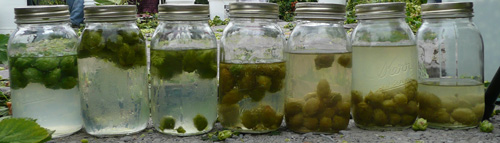
Intrigued by all of this and quite curious, Brian brought out seven examples of his hop tea made with water of different temperatures: 60°, 120°, 130°, 140°, 160°, 180° and 185°. They’re shown above from lower to higher temperature, left to right.

As you can see, the lower the temperature, the more green the hops are and the water remains less cloudy. At the higher temperatures, the hops are stripped of their green, becoming brown, and the water also becomes more brown. Also, as the temperature increases, the hops lose their buoyancy and begin to sink in the water. Although you can’t see it in the photo, the hotter the water, the more hop bitterness and at the upper range, tannins begin to emerge. Here’s what I found:

  • 60°: Fresh, herbal aromas with some hop flavors, but it’s light.
  • 120°: Bigger aromas, less green more vegetal flavors.
  • 130°: Also big aromas emerging, flavors beginning to become stronger, too, but still refreshingly light.
  • 140°: More pickled, vinegary aroma, no longer subtle with biting hop character and strong flavors.
  • 160°: Very big hop aromas with strong hop flavors, too, with a touch of sweetness. Tannins are becoming evident but are still restrained.
  • 180°: Big hop and vinegary aromas, with flavors becoming too astringent and tannins becoming overpowering.
  • 185°: Vinegary aromas, way too bitter and tannins still overpowering.

hop-tea-2
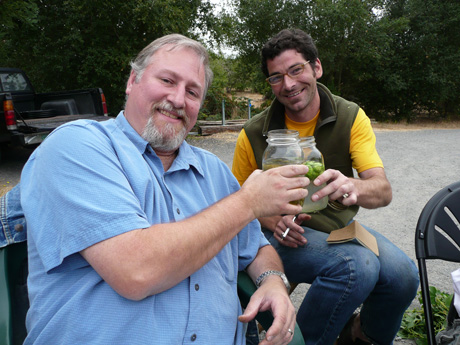
Trying each of the tea samples with Tim Clifford, who writes for Northwest Brewing News.

hop-tea-3

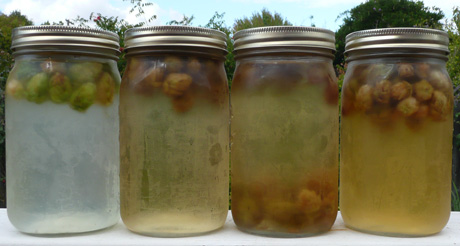
Brian was kind enough to let me take a small bag of fresh hops with me so I could recreate his experiment at home. I had enough for four samples and made tea at 100°, 140° and 160°. Using two dozen hop cones made the jars look light so I used three-dozen in the last jar, also using 160° water. I tasted them with my wife, hoping to get a civilian opinion, too. Here’s what we found:

  • 100°: Hops still green and floating. The nose was very vegetal and reminded my wife of the water leftover in the pot after you’ve steamed vegetables like broccoli or Brussels sprouts. The mouthfeel is somewhat gritty with light, refreshing flavors and only a little bitterness, which dissipates quickly.
  • 140°: Hops turned brown, but still floating. Light hop aromas with some smokey, roasted aromas and even a hint of caramel. Fresh hop flavors with a clean finish. My wife, however, made that puckering bitter face signaling she found it repugnant.
  • 160°: Hops turned brown, but most has sunk to the bottom of the jar. Strong hop aromas and few negatives, at least from my point of view. My wife was still making that face, cursing me for dragging her into this. Hop bitterness had become more pronounced and tannins were now evident, with a lingering finish.
  • 160° Plus: This sample had 50% more hops. The hops had also turned brown but, curiously, they were still floating. The nose was vegetal with string hop aromas. With a gritty mouthfeel, the flavors were even more bitter covering the tannins just slightly, but they were still apparent, and the finish lingered bitterly.

It seems like either 140° or 160° is the right temperature. Lower than that and you don’t get enough hop character (I’m sure that’s why the hops remain green) but above that the tannins become too pronounced. It appears you have to already like big hop flavor or you’ll hate hop tea. I found it pretty enjoyable and even refreshing though it’s still probably best in small amounts. You do seem to catch a little buzz off of it, which doesn’t hurt. I’m sure the amount of hops is important and more research may be needed on that front. Brian tells me that hop pellets can also be used though I doubt the jar of tea looks as attractive using them. They have the advantage of being available year-round, of course. If you use pellets, you need only about a half-ounce for each pint jar.

If you try to make Hunt’s Hop Tea on your own, please let me know your results. And please do raise a toast to Brian Hunt’s ingenuity.

Filed Under: Food & Beer, Just For Fun Tagged With: Bay Area, California, Hops

Men’s Journal Picks Their Favorite Beers Again

September 23, 2007 By Jay Brooks

Last year, the magazine Men’s Journal published in their October issue a list they called the “25 Best Beers in America.” This year marks the fourth annual list but this time it’s a departure from their standard list. Instead they chose their five favorites in five broad style categories and a further list of their choice of a beer for a specific occasion. As usual, there are some good beers on the list but probably just as many or more great beers that didn’t grace the list. This year the list also includes beers imported from Europe.

Last year I wrote the following about the list, and it seems just as true today.

It’s great news, of course, for the beers on the list. Hopefully they’ll get more attention and even possibly more sales generated from the article. But it doesn’t mean the beers not on the list aren’t in many cases every bit as good as those who made the cut this year. For those of us who judge beer regularly there are so many factors that come into play that a list like this one can never be truly taken serious for a variety of reasons. But the novelty of it appeals to all of us, myself included, and I imagine I scanned the list with as much interest as the average reader. Anything that shows craft beer in a positive light can’t be all bad, and this annual list is certainly another good way to spread the message of how many good beers are being made all over the country. Now if we can just get more people to start drinking them, that would be really something.

Here’s this year’s introduction from Men’s Journal:

THE DRINKING MAN’S GUIDE TO THE WORLD’S BEST BEERS

Provided it’s not the shakes that makes you reach for that cold one, there’s never been a better time to be a beer drinker. Delicious craft beer – roughly and imperfectly defined as high-quality brew made in smallish batches from the best possible ingredients, instead of corn syrup and generic grain – is everywhere. The average American now lives within 15 miles of a brewery making a fresh, local product. Imports from such beer-mad nations as Belgium and Norway previously unseen here are making their way into stores across the country. Even Anheuser-Busch wants in on the action; why else would the mega-brewer have released more than 85 experimental beers in the past two years? Which raises a fine question: What should you drink next? We canvassed brewers, importers, tavern-keepers, and chefs to find the best of the best.

However, how they really “did it” is explained later as follows. “We surveyed a Rolodex full of prominent beer industry players, asking them to name their favorite beers in several major categories, and tallied the results.” Well how scientific. Now I know these things are largely popularity contests already, but that strikes me as a pretty poor way to go about choosing what is presented as the “world’s best beer.” World’s “favorite” beers, possibly, but even that would be incorrect since they’re only the favorite beers of whoever was in their address book. Yes, I’m a curmudgeon to the end, but for these kinds of lists to be in any way meaningful there should be some kind of standards to get on the list in the first place. Otherwise, it’s just a beauty contest. But playing devil’s advocate, at least there are some very fine beers on the list and that’s a good thing for them, at least. There’s very few here that shouldn’t be enjoyed or sampled if they’re unfamiliar.

So with a few comments (in italics) that I couldn’t resist making, here is the Men’s Journal list for 2007:


The Best Pale Ales

  1. Firestone Walker Pale Ale
  2. Sierra Nevada Pale Ale
  3. Deschutes Mirror Pond
  4. Dogfish Head 60 Minute IPA (I guess this means by pale ale they mean any beer that’s pale in color, not the style?)
  5. Ridgeway Bitter (Ditto.)

The Best Stouts & Porters

  1. Deschutes The Abyss
  2. Guinness (Which one?)
  3. Stone Smoked Porter
  4. Bell’s Kalamazoo Stout
  5. Brooklyn Black Chocolate Stout

The Best Belgians (Presumably they mean Belgian-style?)

  1. Saison Dupont
  2. Rochefort 10
  3. Ommegang Three Philosophers
  4. Russian River Damnation
  5. St. Bernardus Triple

The Best Wheat Beers

  1. Aventinus Doppel Weizen-Bock
  2. Ayinger Brau-Weiss
  3. Allagash White
  4. Penn Weizen
  5. Widmer Hefeweizen

The Best Lagers & Pilsners

  1. Lagunitas Pils
  2. Victory Prima Pils
  3. Stoudt’s Pils
  4. Trumer Pils
  5. New Belgium Blue Paddle


BEST BEERS FOR EVERY OCCASION

“Best Beer” rankings rarely answer the most important question: What’s the best beer for right now? Here’s what to sneak into the ballpark, tow behind your canoe, drink in the morning, give to the babysitter (kidding!), and more.
 

  • In Case of Natural Disaster: Ommegang Hennepin
  • For Ballpark Hecklers: Miller High Life (Maybe to use as projectile, certainly not for drinking.)
  • Global-Warming Summer Beer: Thiriez Extra
  • Airport Layover Beer: Samuel Adams Boston Lager (Is that because it’s the only one at every airport?)
  • Marijuana Substitute: Deschutes Hop Trip
  • Liquid Courage: Stone Double Bastard
  • Mass Market “Microbrew”: Blue Moon
  • For an All-Nighter: North Coast Red Seal Ale (I’d think a lower alcohol true Session beer would be a better choice.)
  • For a One-Nighter: Celebrator Doppelbock
  • Oktoberfest Beer: Great Lakes Oktoberfest (Nothing against this fine beer, but why wouldn’t a German example be here?)
  • For the Scotch Lover: Lost Abbey Angel’s Share
  • Best with a Shot of Whiskey in It: Harp Irish Lager
  • Best “Light” Beer: Mahr’s Leicht (As light beers go, maybe, but why even bother? It’s like choosing the best way to be executed.)
  • Best Before Noon: North Coast Scrimshaw Pilsner
  • With a Good Cigar: Goose Island Bourbon County Stout
  • River Trip Beer: Dale’s Pale Ale
  • For the Goldman Sachs Broker: Samuel Adams Utopia
  • Hair-of-the-Dog Beer: Southampton Double White
  • Barbecue Beer: Aecht Schlenkerla Helles
  • To Impress a Beer Geek: Cantillon Lou Pepe
  • For Ice Fishing: Brooklyn Black Chocolate Stout
  • For the Earth-Firster: Butte Creek Organic Pilsner
  • Only Decent Mexican Beer: Negra Modelo (There are plenty of awful Mexican beers — with Corona probably the worst — but they’re not all bad.)
  • Ski Town Beer: Avery 14er ESB
  • To Buy with Spare Change: Pabst Blue Ribbon (Why?)


Filed Under: Editorial Tagged With: Mainstream Coverage, National

On Drinking Well

September 23, 2007 By Jay Brooks

I got this press release from Diageo and Zagat last week and was only able to glance at it because of some article deadlines, and I also saw that Stan Hieronymus wrote about this over at Appellation Beer. The two companies have launched a new website, Drinkwell, that uses the Zagat survey format but for restaurants serving drinks.

From the press release:

In an innovative industry collaboration, Diageo, the world’s leading premium drinks business with hallmark brands including Smirnoff, Guinness, Johnnie Walker, Baileys, J&B, Cuervo, Captain Morgan and Tanqueray, announced today that it has joined with Zagat Survey, the world’s leading provider of consumer survey-based content, to launch drinkwell(TM) (www.idrinkwell.com), the first online resource guide to restaurants that are dedicated to serving the highest quality drinks and drink service.

“When people go out they often start the evening with cocktails, and that experience — good or bad — can set the mood for the entire night,” said Steve Wallet, vice president of Channel Marketing for Diageo. “At Diageo our leadership and knowledge in the area of spirits, beer and wine is second to none. drinkwell(TM) combines Diageo’s expertise with Zagat’s, and the industry’s foremost mixologists, to create a one-of-a-kind online resource for consumers seeking a complete quality dining and drinks experience.”

Visitors to www.idrinkwell.com will have free access to the ratings that Zagat surveyors have given to the hundreds of drinkwell(TM) establishments across the country, based on the quality of drinks, service, atmosphere and cost.

“Eating is only one part of the consumer experience when visiting a restaurant,” said Tim Zagat, Co-chair and CEO of Zagat Survey. “The creation of drinkwell(TM) gives consumers a new way to make informed decisions about where to find the best drinks and service.”

drinkwell(TM) has partnered with several world-renowned beverage experts including Dale DeGroff, Steve Olson, Paul Pacult, Dave Wondrich and Doug Frost, to develop the drinkwell(TM) Academy Staff Training Program for participating establishments. drinkwell(TM) — accredited establishments are identified by a special black and brushed metal plaque, in the same way the burgundy Zagat Survey decal denotes a Zagat-rated restaurant.

That’s all well and good, but apparently by “world-renowned beverage experts” they mean people who know wine and spirits but precious little about beer. You’d think that would not be the case given that Diageo also owns the Guinness brand, but since acquiring it they’ve essentially squandered away all its respectability. I’ve never been entirely sure why Diageo bought Guinness, because they seem to have little feeling for the original Irish Stout, its history or even its customers. They’ve insulted consumers everywhere with such abominations as the widget-bottle, Red Guinness and Extra Cold Guinness.

Stan knows a lot of the initial fifteen cities that Drinkwell launched with better than I do and he notes that the Chicago listings are missing some of the Windy City’s best beer destinations. His nutshell take on Drinkwell?

The good news is it free. The bad news is there’s dang little beer.

Their listings for my local area include not just San Francisco but the entire Bay Area. Only 61 places are listed — I know they’re just getting started but that still feels like an infinitesimally small number — not one has much of a beer selection, though the cynic in me is willing to bet they all carry Guinness. In California, there are two main types of restaurant alcohol licenses, a Type 41 allows a restaurant to carry just beer and wine and a Type 47 allows beer, wine and spirits. There are others, of course, but for discussion purposes that’s the main difference: just beer and wine or both with spirits, too. All 61 of the Drinkwell’s Bay Area listings are “full bar” places, meaning they sell all three kinds of alcohol.

It would take forever to list what’s missing here but what’s wrong will take considerably less time. It’s not a bad idea to rate drinks selection, service, and the like but “drinks” should really mean all of the drinks, not just cocktail-friendly places. There’s more than a whiff of this being a self-serving promotion by Diageo to sell more of its spirits portfolio, which ends up cheapening Zagat, in my opinion.

Zagat bills itself as “the world’s leading provider of consumer survey based content about where to eat, drink, stay and play. With more than 300,000 surveyors worldwide, Zagat Survey rates and reviews restaurants, hotels, nightlife, movies, music, golf, shopping and a range of other entertainment categories and is lauded as the “most up-to-date,” “comprehensive” and “reliable” guide ever published.” Maybe, but I can’t help but thinking pairing with Diageo makes them much less independent. This “partnership” probably means Zagat is trading on their unbiased reputation for a large fee from Diageo to increase their business. That may be untraditional or even cutting-edge but it still smacks of old-fashioned crass advertising and marketing. Plus, there’s no reason I can think of why Zagat couldn’t include drinks information as a part of its regular survey information without Diageo’s biased assistance. If, as Tim Zagat says in the press release, “[e]ating is only one part of the consumer experience when visiting a restaurant,” why didn’t he conclude they should have added that to their current survey model? Why would they need to “partner” with a company that has such an obvious agenda?

But the real tragedy is beer is once again ignored as a part of a fine dining experience. It may be that many or even most of the 300,000 Zagat restaurant reviewers are biased with regard to their perceptions of beer, wine and spirits and it seems Diageo’s rationale for doing this is perfectly transparent: it’s to increase their business. Zagat had an opportunity to make their ratings more complete and with a broader appeal, including people looking for good beer in a restaurant setting along with wine and spirits. Instead it appears they decided to take the money and run. Maybe I’m overreacting as I’m so often accused and things will improve with time, but with Diageo driving the bus, so to speak, I can’t see how they’ll ever include good beer destinations as one of their stops. And that makes Zagat ultimately less useful to me, and perhaps many other lovers of great beer. In the end, the experience of eating and “drinking well” should be about all of the available choices to enhance that culinary adventure.


Filed Under: Editorial Tagged With: Business, National, Press Release, Promotions

Paris Banned from Munich

September 23, 2007 By Jay Brooks

I’m not much for celebrity gossip, but my wife uses it to decompress from her detail-oriented, stressful job — she’s an attorney. She finds that the mindless entertainment helps her unwind after days spent reading complex contracts and the like. So she was the one who came across this gem that seems too priceless to be true, but it is. According to the UK Sun, society parasite Paris Hilton is banned from Oktoberfest for the outfit she wore last year to the festival to advertise a canned wine brand. Oktoberfest officials believe last year that Hilton “cheapened” their event. “Munich tourism chief Gabriele Weishaeupl announced yesterday that celebrity promotions ‘are completely prohibited by the new festival rules’.” You just can’t make this kind of stuff up.

Paris Hilton’s offending costume at the 2006 Oktoberfest which led to her being banned from this year’s festival.


Filed Under: Just For Fun Tagged With: Europe, Germany, Strange But True

Bière de Manger

September 22, 2007 By Jay Brooks

Most people don’t think of France as a place for great beer, but there are several very fine, world-class small — tiny really — breweries in Northeastern France, not coincidently near the border of Belgium. Back in the mid-1800s this region of the world was home to 2,000 breweries. By the advent of the first World War it was half that, but during the German occupation their equipment was dismantled and sent back to the Fatherland. Between the two wars after after it, things stayed pretty much the same and today only around 25 breweries remain in the region.

So last night’s dinner themed “The Beers of France” may not have been as big a draw as some of the Beer Chef’s other beer dinners, but that a shame because the people who stayed away out of ignorance or prejudice missed a wonderful dinner and some fabulous beers.

Our salad course: composed salad of wild mushrooms, summer vegetables, duck ham and watercress.

All of the beers were courtesy of Shelton Brothers, a beer importer who brings in some of the finest beers from all over the world to the U.S. Here’s the Beer Chef, Bruce Paton, with Dan Shelton.

 
Since I believe these beers do deserve to better known, here’s some more information about the French beers that were part of the beer dinner. Seek them out and try them for yourself.


St. Droun French Abbey Ale

From the Brasseurs Duyck, founded in 1922, whose brand Jenlain is probably better known, St. Druon was re-named (the original name was Sebourg) in 2000 “as a tribute to Saint Druon and the little church in Sebourg, the next village to Jenlain. Druon, a homeless but pious orphan, wandered the roads until he settled in the village, and is still honoured and revered by pilgrims each year.” It’s been run by the same family for four generations.

From Shelton Brothers website:

Jenlain is the second largest independent brewery in France, and by far the largest one making bière de garde – France’s only original, traditional beer style. Jenlain is credited with reviving the style, and encouraging countless smaller bière de garde breweries in Northern France.

It’s a 6.0% abv Bière de Garde that uses a distinctive yeast that different from Duyuck’s other beers. it’s a very clean, refreshing beer and worked well with the diverse hors d’oeuvres.

The other beer we had with our appetizers was one of only two beer at the dinner that I’d had before, the Thiriez Extra. It’s a surprisingly hoppy beer, though not in a west coast sort of way. In France, the beer is known as “Les Frères de la Bière,” which means “The Friends of Beer.” It’s a collaboration of sorts between brewers in England, France, and Belgium. The beer uses an relatively unknown English hop called “Brambling Cross.” It’s really something of a session beer at 4.5% abv.

The second beer from Thiriez was their Blonde, which is a little spicier than the Extra in the way of a saison, and a little stronger, too, at 6.0%. It was paired with our first course, sea scallops in fennel nage.

From Shelton Brothers website:

Daniel Thiriez’s rustic little brick-and-beam brewery graces the village of Esquelbecq, plunk in the middle of the rolling farm country of French Flanders. With a brewing degree from a Belgian university, and decidedly ‘Belgian-oriented,’ Monsieur Thiriez makes ales with an earthy, slightly wild character that recalls the early days of farmhouse brewing, before there was a border between France and Belgium.

Thiriez Extra and Blonde

La Choulette Le Sans Cullottes and Ambree

The “no pants” beer, which is what “sans cullottes” refers to was the other beer of the evening I’d had before, and it’s a great Bière de Garde style beer. It’s 7.0% abv and quite effervescent, like a good champagne. This wonderful beer was paired with a composed salad of wild mushrooms, summer vegetables, duck ham and watercress.

From Shelton Brothers website:

La Choulette is a charming farmhouse brewery whose beers are classics of this French style. The brewery dates back to 1885. Alain and Martine Dhaussy bought it in the 1970’s and revived traditional brewing there. This, the brewery’s masterpiece, proudly pays homage to Les Sans Culottes – the “trouserless” craftsmen who could not afford uniforms but unflinchingly did the handiwork of the French Revolution. A number of brewers were included in their ranks.

The other beer from La Choulette was their Ambree, a slightly stronger Bière de Garde at 8.0% with a deeper amber color. I found it quite sweet, which nicely cut through the heavy meat course, loin of rabbit with bone marrow ravioli and onion apple gratin.

The last beer, Garvroche, is from St. Sylvstre, who is better known for their 3 Monts. The Gavroche is a bottle-conditioned amber ale, and at 8.5% was the strongest beer of the evening. The name comes from one of the characters in Victor Hugo’s Les Miserables, the generous and rebellious Paris urchin. It was divine with our dessert of poached pear with flan of fromage explorateur.

From Shelton Brothers website:

Serge Ricour is one of those guys – probably a genius, but it takes one to know one, and we’re not really sure we can meet that standard – who just produces fantastic beer, but doesn’t seem to know it himself. The Brasserie Ricour, or Brasserie St-Sylvestre (you use either one and everyone in town knows what you’re talking about) makes, arguably, the best beer of France: 3 Monts. We Shelton Brothers would probably argue with that, since we’ve found so many nice beers in France and brought them to the U.S. for your inspection, but you can’t really argue with the proposition that 3 Monts is, at least, one of the very best beers of France.

St. Sylvestre Gavroche


Filed Under: Events, Food & Beer Tagged With: California, Europe, Photo Gallery, San Francisco

Oktoberfest O’zapft is!

September 22, 2007 By Jay Brooks

Today is the first day of Oktoberfest in Munich, Germany, one of the world’s most famous beer festivals, though the German consider it a folk festival. I confess I’ve never gone and while I’d like to go at least once in my lifetime, I suspect it’s one of those experiences where once will be enough. As has been the tradition since 1950, today the Mayor of Munich, Christian Ude, tapped the first keg signaling the start of the festivities. In German, this tradition is called “O’zapft is!” meaning “it is tapped.” The first liter of beer poured was consumed by German premier Edmund Stoiber.

The festival will last sixteen days, ending, as it does each year, on the first Sunday in October. Since 1990, a modification has been introduced into the schedule so that is the first Sunday is either October 1st or 2nd then the festival will end on October 3rd, which is a holiday, German Unity Day, celebrating Germany’s reunification. This year, Oktoberfest ends on October 7. Unlike most beer festivals, it’s all day affair, with beer first served during weekdays at 10:00 am with last call not until 10:30 pm, and on the weekends things get started an hour earlier at 9:00 am.

There are over 100,000 seats in fourteen tents on just over 100 acres. About 72% attending are from locals from Bavaria with about 15% from outside Germany. Many of these aren’t used to handling a lot of alcohol and some pass out as a result of over-indulging. Locals call those who pass out “Bierleichen” (or if female, “Bierleiche”), which means “beercorpse.” Over the sixteen days of the festival last year the more than six and a half-million people attending Oktoberfest consumed an astounding:

  • Beer: 6.9 million litres (1.82 million gallons, or over 14.5 million pints)
  • Roasted steers: 102
  • Sausages: 144,635 pairs
  • Roast chickens: 494,135
  • Knuckles of pork: 43,492

Undoubtedly even more will be enjoyed this year.


One of the many Oktoberfest waitresses in the traditional “dirndl” dress (from the BBC’s Oktoberfest in Pictures) though the steins of beer are covering her bow. According to an AAP account, “[t]he dirndl has in any case become a fashion item this year. The knot in the bow reveals key information to potential suitors – on the right means the woman has a partner; on the left indicates she is available.”
 

Though the first Oktoberfest took place in 1810, it didn’t become an annual event until 1850. Here’s a history of the event, from the official website:

The Royal Wedding

Crown Prince Ludwig, later to become King Ludwig I, was married to Princess Therese of Saxony-Hildburghausen on 12th October 1810. The citizens of Munich were invited to attend the festivities held on the fields in front of the city gates to celebrate the happy royal event. The fields have been named Theresienwiese (“Theresa’s fields”) in honor of the Crown Princess ever since, although the locals have since abbreviated the name simply to the “Wies’n”.

Horse races in the presence of the Royal Family marked the close of the event that was celebrated as a festival for the whole of Bavaria. The decision to repeat the horse races in the subsequent year gave rise to the tradition of the Oktoberfest.

The Oktoberfest continues in 1811

In 1811 an added feature to the horse races was the first Agricultural Show, designed to boost Bavarian agriculture.
The horse races, which were the oldest and – at one time – the most popular event of the festival are no longer held today. But the Agricultural Show is still held every three years during the Oktoberfest on the southern part of the festival grounds.

In the first few decades the choice of amusements was sparse. The first carousel and two swings were set up in 1818. Visitors were able to quench their thirst at small beer stands which grew rapidly in number. In 1896 the beer stands were replaced by the first beer tents and halls set up by enterprising landlords with the backing of the breweries.

The remainder of the festival site was taken up by a fun-fair. The range of carousels etc. on offer was already increasing rapidly in the 1870s as the fairground trade continued to grow and develop in Germany.

174th Oktoberfest 2007

Today, the Oktoberfest is the largest festival in the world, with an international flavor characteristic of the 21th century: some 6 million visitors from all around the world converge on the Oktoberfest each year.

And since the Oktoberfest is still held on the Theresienwiese, the locals still refer to the event simply as the “Wies’n”. So “welcome to the Wies’n” means nothing other than “welcome to the Oktoberfest”!


Filed Under: Events Tagged With: Europe, Festivals, Germany, History, International

Craft Beer vs. Fine Wine Dining Challenge in San Diego

September 20, 2007 By Jay Brooks

Stone brewing is doing a beer vs. wine dinner next week that sounds like it should be great fun, not to mention informative and delicious. Here’s the press release for the dinner:

Stone Brewing CEO Greg Koch is a tireless exponent of the virtues of great beer, and is nothing if not confident of his company’s handiwork. Yet he concedes that the image of beer still has room for elevation in the culinary world. “The understanding of the extraordinary culinary aspects available in the world of beer is lagging,” says Koch. He maintains that beer offers more range and depth of flavor than what is found in any other beverage. And he aims to prove it. “I will never argue that you can’t carefully pair a great wine with certain select dishes with very good results,” says Koch. “However, I have no hesitation in arguing that, more often than not, great beer is a superior mate for great food.”

It does appear that the culinary world is waking up to the reality that great beer compliments great food. In the June 2007 issue of TIME a full-page article began with the headline “Instead of uncorking a vintage red, Michelin-starred chefs are tapping into a long list of artisanal beers.” The article continued to state that “Now some of the country’s best restaurants are offering craft beers – produced by small, independent brewers – on the menu and often suggesting food pairings.” Recently, National Public Radio’s Weekend Edition program ran a story extolling the virtues of pairing craft beers with food; and NBC’s Today show aired a similarly themed segment featuring Stone’s very own inimitable Arrogant Bastard Ale with Food & Wine magazine’s Senior Wine Editor in which it was proclaimed “Beer is the new wine.”

Celebrated Bocuse d’Or Chef Gavin Kaysen—of the Rancho Bernardo Inn’s equally celebrated restaurant El Bizcocho—may have yet to be convinced. After all, it’s not “Food & Beer” magazine that Chef Kaysen currently graces the cover of, it’s Food & Wine (which to the magazine’s credit recently featured a surprisingly enlightened article on the artisan beers of California’s Napa Valley). Koch indeed realizes he is placing the odds squarely against himself by agreeing to hold the challenge dinner at the clearly wine-centric environs of El Bizcocho. “I want the challenge to be extremely fair, if not even stacked against me,” says Koch.

Guests at the “Beer v. Wine” dinner will sample both a craft beer and fine wine selection specifically chosen for each course. Koch will introduce each beer, and Certified Wine Educator and Sommelier, Barry Wiss will introduce each wine. Wiss is Vice President of Trade Relations at Trinchero Winery in Napa Valley. Once guests taste both the beer and the wine, they will have a chance to fill out a small card with their preferences as to which beverage pairs best with the dish. Results will be tabulated and announced at the end of the dinner. Allowing that there are more gustatory possibilities than could possibly be represented by one meal, one of the contest’s stipulations is that the loser of this round has the right to challenge the opponent to another dinner at a venue of their choosing.

While Koch might be very confident when it comes to beer’s prowess in pairing with food, Wiss is somewhat more dubious. “There is no doubt that some foods are complemented by the tastes and flavors of beer, but those foods tend to be less complex, with the possible exception of spicy Latin and Asian cuisine,” explains Wiss. “For centuries wine has been the preferred accompaniment to the world’s finest dishes, and there is little doubt that it will remain that way.”

Who is correct? You can help determine by attending the Beer vs. Wine Dinner. Reservations can be made by contacting El Bizcocho at the Rancho Bernardo Inn.

Located at 17550 Bernardo Oaks Dr. in San Diego, CA, the Rancho Bernardo Inn, recently completed a $25 million enhancement and expansion project. The hotel is a member of Preferred Hotels and Resorts Worldwide and is the distinguished holder of many honors, including Mobil Four Star (18 years), and AAA Four Diamond (31 consecutive years) ratings. Rancho Bernardo Inn is owned by JC Resorts, whose other holdings include Surf & Sand Resort, Temecula Creek Inn, and JC Golf. For reservations and additional information, please call 800.770.7329 or visit www.ranchobernardoinn.com.


9.27

Craft Beer vs. Fine Wine Dining Challenge at El Bizcocho

Rancho Bernardo Inn, 17550 Bernardo Oaks Drive, San Diego, California
250.383.2332 [ website ]
 

Filed Under: Food & Beer Tagged With: Announcements, California, Press Release, San Diego

« Previous Page
Next Page »

Find Something

Northern California Breweries

Please consider purchasing my latest book, California Breweries North, available from Amazon, or ask for it at your local bookstore.

Recent Comments

  • Bob Paolino on Beer Birthday: Grant Johnston
  • Gambrinus on Historic Beer Birthday: A.J. Houghton
  • Ernie Dewing on Historic Beer Birthday: Charles William Bergner 
  • Steve 'Pudgy' De Rose on Historic Beer Birthday: Jacob Schmidt
  • Jay Brooks on Beer Birthday: Bill Owens

Recent Posts

  • Beer In Ads #5227: It’s Here! Bock Beer By Bosch April 20, 2026
  • Beer Birthday: Drew Beechum April 20, 2026
  • Beer Birthday: Des De Moor April 20, 2026
  • Beer Birthday: Brenden Dobel April 20, 2026
  • Historic Beer Birthday: Henry Becker April 19, 2026

BBB Archives

Feedback

Head Quarter
This site is hosted and maintained by H25Q.dev. Any questions or comments for the webmaster can be directed here.