Brookston Beer Bulletin

Jay R. Brooks on Beer

  • Home
  • About
  • Editorial
  • Birthdays
  • Art & Beer

Socialize

  • Dribbble
  • Email
  • Facebook
  • Flickr
  • GitHub
  • Instagram
  • LinkedIn
  • Pinterest
  • RSS
  • Twitter
  • YouTube

Powered by Genesis

Let’s Go, Cicerone

September 19, 2007 By Jay Brooks

cicerone-logo “It is a great thing to know our vices.”
 
     — Marcus Tullius Cicero (106-43 BCE)

Nobody I’ve discussed the issue of the title “beer sommelier” with thinks that the term is an appropriate one, because wine is intrinsically embedded into the definition. Over a hearty brew or two, many of us who think about words far too much have been trying to come up with a new word that’s the equivalent of sommelier but for the world of beer. Don Russell in his Joe Sixpack column suggested “Cellarman” Others have tossed out “Beermaster,” “Zymurgier” and even “Ale Consumption Engineer” for discussion. For me, none quite hit the right note.

Ray Daniels has dug deep and found a word that’s fallen out of use: Cicerone, which is pronounced “sis-uh-rohn.” He’s setting up a program where people can be certified in one of three levels of expertise by studying and taking exams based on syllabuses being created as we speak. So far, a draft of the novice syllabus is ready, which is to attain the first level, called a “Certified Beer Server,” along with the master syllabus for both “Certified Cicerone” and “Master Cicerone.”

From the website:

The word Cicerone (pronounced sis-uh-rohn) has been chosen to designate those with proven expertise in selecting, acquiring and serving today’s wide range of beers. The titles “Certified Cicerone” and “Master Cicerone” are protected certification trademarks. Only those who have passed the requisite test of knowledge and tasting skill can call themselves a Cicerone.

I confess that my initial reaction to the word wasn’t entirely positive, probably just because it is an unfamiliar word with no intuitive meaning. But by letting it marinate for a few days, it is beginning to grow on me. I certainly love the idea of having our own word. By using a word currently unknown to all but the most accomplished crossword puzzler, we can take it and make it our own. There are already rumblings and grumblings by people who don’t like the word because it isn’t beer-y enough or wasn’t decided upon by a committee of industry leaders. I say let’s just move past that and work on the more important task of creating a world where every fine restaurant has its own sommelier and cicerone. We could spend months and years debating the right word to use, and I for one probably have, but I’d rather keep my eye on the prize. I say kudos to Ray for hanging it out there and just going for it. The real trick for him is gaining acceptance on the front lines, at bars, brewpubs and restaurants. It’s in the beer industry’s best interests for an idea like this to take root, so I believe we should all support this idea and stop quibbling over the name. I, for one, am relieved to set aside that question. The sooner we’re united as an industry in using “cicerone,” the sooner it will gain broader acceptance, not only at eating and drinking establishments, but also with the general public, the civilian population. And when that happens we’ll have accomplished a grand leap forward toward our collective goal of getting beer the respect we all believe it deserves.

For my fellow word nerds, here’s some more information about the word “cicerone.” The website explains the origin of the word thusly:

Cicerone is an English word referring to “one who conducts visitors and sightseers to museums and explains matters of archaeological, antiquarian, historic or artistic interest.” For beer, a Cicerone will possess the knowledge and skills to guide those interested in beer culture, including its historic and artistic aspects. “Cicerone” now designates a person with demonstrated expertise in beer who can guide consumers to enjoyable and high-quality experiences with great beer.

According to my O.E.D., the word is taken from the name of the Roman orator and statesman, Marcus Tullius Cicero, and is “supposed [to be] referring to his learning or eloquence,” similar to the word mentor, which seems to fit. The OED definition is:

A guide who shows and explains the antiquities and curiosities of a place to strangers.

It was first used in print in 1726 and by the end of that century began to be used more in the general sense of a guide, before falling out of general usage in the mid-1800s. The OED suggests Ciceronage, Ciceroneship and Ciceronism to denote “the function or action of a Cicerone.” Also, according to the OED, it’s actual historical origin remains unknown and curiously was used in English before it ever shows up in Italian dictionaries.

Personally, I can’t wait to have my first restaurant experience where after the waiter hands me my menu, a man or woman standing behind the server walks up to the table, saying. “Good evening, I’ll be your Cicerone tonight.” That will be a wonderful day.
cicerone-banner-460

Filed Under: Editorial Tagged With: National, Websites

Mayflower Day

September 16, 2007 By Jay Brooks

Here’s To Beer is promoting September 16 as “Mayflower Day,” the day that the Pilgrims set sail for the New World. A few months later, tired, hungry and really, really thirsty (having run out of beer) they forgot all about their original intended destination of Virginia and instead settled in Massachusetts, landing famously at Plymouth Rock.

From the press release:

Although a little-known holiday, Mayflower Day had a big impact on making beer America’s favorite beverage of moderation.

Sunday, Sept. 16, marks the anniversary of the day the Mayflower departed from England in 1620 in search of the New World. For more than two months, the passengers and crew weathered storms, sickness and starvation without taking to land — until they ran out of beer. Beer was their primary beverage because, at that time, water could have been dangerous.

“Beer’s journey from a beverage of sustenance in colonial times to America’s alcohol beverage of choice is an integral part of our history,” said Bob Lachky, executive vice president, global industry development, Anheuser-Busch, Inc. “Whether an early settler or a modern adult, Americans share the same appreciation for beer. While today’s adults can enjoy complex varieties, styles and flavors, beer’s refreshment and drinkability remains tried and true.”

In early times, beer was made out of whatever ingredients adults could find, like pumpkins and molasses. Thirteen years before the pilgrims landed in Massachusetts, a group of settlers established a colony in Jamestown, Virginia. In 1609, the governor wrote a note back to England saying he needed two brewers to come over and establish a brewery in Jamestown. Beer was just that important.

Beer continues to reign supreme today. The latest Gallup Poll shows that of the 64 percent of Americans who consume alcohol, beer continues to be their beverage of choice, with 40 percent choosing it over wine and hard liquor.

A quick glance in the upper left-hand corner of the Bulletin should amply demonstrate that I am, among other things, a calendar geek. I have at least as many, and possibly more, books about calendars, time and dates than I do about beer. Back in the late Seventies, at the very same time I was discovering better beer, a book of mixed drinks I bought included an appendix with four reasons to drink a toast for every day of the year. The list included a mix of the usual holidays, some lesser known ones, famous people’s birthdays, and historical events. The notion of finding more of these for each day of the year captivated me and I began making lists of them for every day. In fact, my very first website — back at the dawn of time in 1995 — was “The Daily Globe,” a list of dates. Oddly enough, even though I took it off the internet in 1997, another website, JimJr Jokes, still has a copy of it hosted on their website. I don’t even mind that they didn’t ask me before stealing it whole, at least they gave me credit for all the work I put into creating it. There are a few others that stole it and gave me no credit whatsoever, such as Two Geeks on AOL. Curiously enough I first met Stephen Beaumont with reference to my dates page (he used them to come up with his daily phone messages) before we realized we both were in the beer business.

That brings us to “Mayflower Day,” a holiday that no one really has ever celebrated. It is listed in Chase’s Calendar of Events, which is the authority on current holidays and dates, but without a sponsor, website or town festival. But actually I’m okay with that. I think we need more holidays. And while it might have made a tad more sense for it to be celebrated on the day the Mayflower landed at Plymouth Rock — especially since it was running out of beer that contributed to the decision — that took place on December 26, the day after Christmas. That’s a terrible date to try to start a new holiday, not to mention that’s also Boxing Day, an English tradition. So September 16 it is, or rather that’s the date it is now. When the Pilgrims looked at their calendar as they set sail, the date was eleven days earlier. That’s because in 1620 England used the Julian calendar, which was off a bit. The Gregorian calendar is the one we use today and September 16 is the adjusted date. See? … calendar geek.

So I’m all in favor of raising a toast to those cranky, conservative Pilgrims. At least they loved their beer. Happy Mayflower Day everybody.

Anheuser-Busch’s Here’s To Beer ran this beautiful ad promoting “Mayflower Day” in USA Today last Thursday.


Filed Under: Uncategorized Tagged With: History

25 Years of California Brewpubs

September 15, 2007 By Jay Brooks

maps-ca
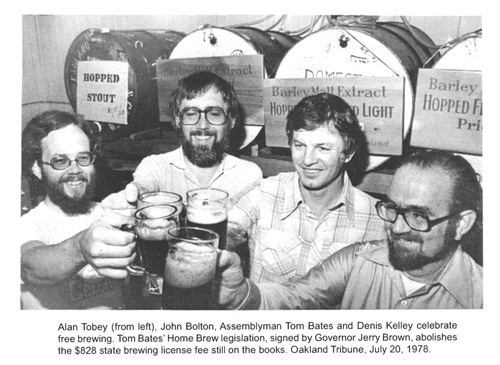
Thursday, September 13, marked the 25th of anniversary of the signing of the California bill — AB 3610 — which removed the “tied house” restriction then present in California prohibiting any person or company from brewing beer and selling it directly to the public. The new bill allowed beer to be sold where it was brewed, as long as the brewer also operated a restaurant at the same location. It was only the second brewpub law passed in the country at that time. The bill was written by then-state legislator Tom Bates, who is now the mayor of Berkeley.

California was home to three of the first five brewpubs in America. The second brewpub to open America (and the first in California) was the Mendocino Brewery in Hopland, California, which opened in August 1983. Mendocino Brewing has moved to a new facility in Ukiah and the Hopland location is now a bar, but the company is still going strong. The third brewpub in the U.S. was Buffalo Bill’s in Hayward, California, which opened in September 1984 and still a brewpub. And the fifth was Triple Rock Brewery in Berkeley, California, which opened in March 1986. It’s also the only one still owned by the same people who started it.

Triple played host Thursday to a ceremonial signing of the bill by Tom Bates, who authored the original legislation. They also presented a proclamation — which I helped write — signed by state legislator for District 14, Loni Hancock.

ccbw07-1
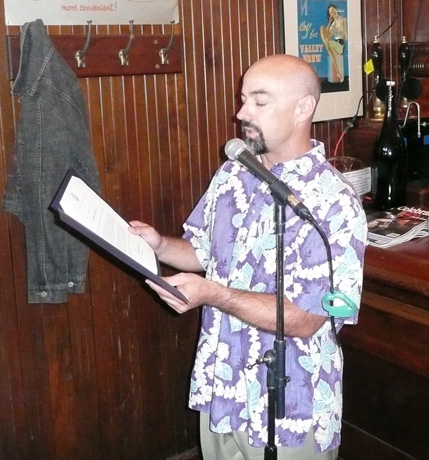
CSBA lobbyist Chris Walker reads a letter congratulating California small brewers from Governor Arnold Schwarzenegger.

ccbw07-2
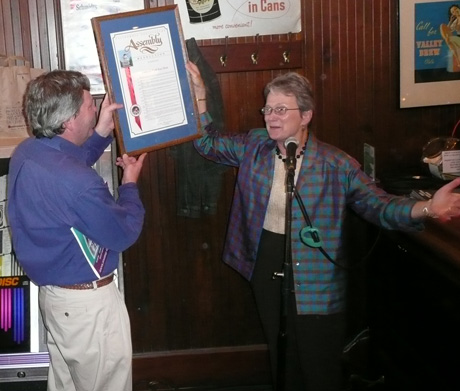
Representative Loni Walker presents the state proclamation to Triple Rock owner — and CSBA president — John Martin.

ccbw-proclamation
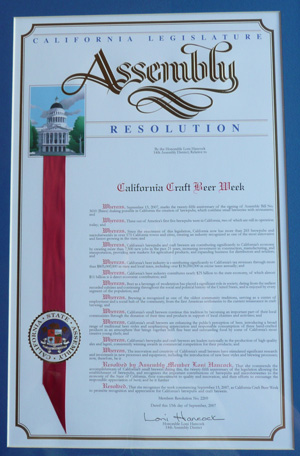
A close-up of the proclamation, which originally sough to declare the week beginning September 13 as California Craft Beer Week. Next year, with more lead time, we hope to make that an officially recognized holiday week for California.

ccbw07-3
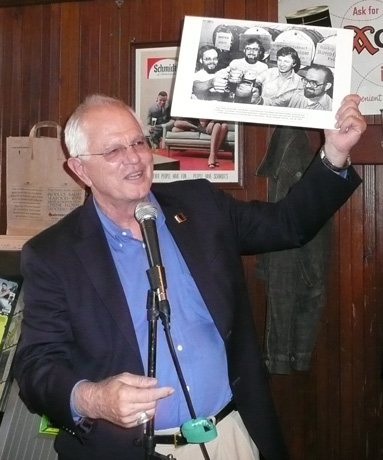
The brewpub bill’s author, Berkeley mayor Tom Bates, holds up a photo that ran in the Oakland Tribune 25-years before, of him celebrating the signing of Assembly Bill 3610.

brewpub-toast-1982
 

ccbw07-4
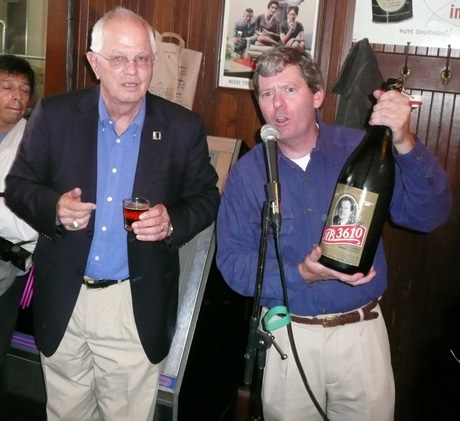
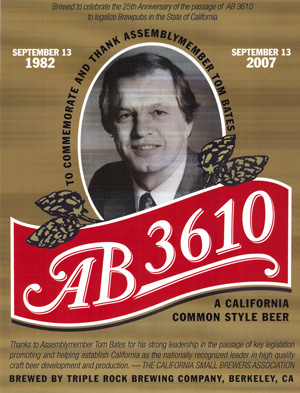
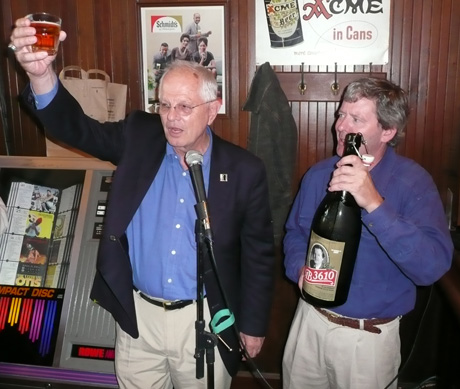
Then John Martin presented Mayor Bates with a specially made beer by Triple Rock brewer Christian Kazakoff. Wanting to make a truly California beer, Kazakoff brewed a California Common, better known as a steam beer. They called the beer AB 3610, in honor of the bill.

triplerock-ab3610
The commemorative beer’s label art.

ccbw07-6
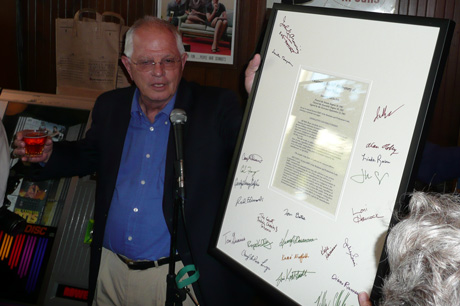
Then mayor Tom Bates presented a framed copy of the original AB 3610, inviting everyone present to sign the mat.

ccbw07-7
Everyone there also got a small glass of the commemorative beer and Mayor Bates led a toast to California’s beer industry.

Filed Under: Events Tagged With: Bay Area, California, History, Other Events, Photo Gallery

Budweiser Negotiating to Buy Budweiser

September 14, 2007 By Jay Brooks

No, you read that right. In April it was announced that the Czech Republic, who owns and operates Budejovicky Budvar — from the Bohemian town of Budweis — was considering selling it to the highest bidder to help with the country’s budget woes. Naturally they used the gentler word privatize, but the result is the same. Forbes is reporting that Anheuser-Busch has been in negotiations for some time now.

A-B and Budvar have been bickering over the Budweiser trademark for over a century, though recently A-B agreed to distribute Czechvar (Budvar’s trade name in the U.S.) in the American market. Buying the Czech brewery would make good sense from a business point of view, because the still numerous pending trademark disputes would simply vanish, saving untold millions in legal fees. Plus A-B would be able to market its own Budweiser uniformly throughout the world. Currently there are a number of nations where Budvar has prevailed in litigation and the American Budweiser must be sold in those countries under a different name. Buying the brewery then seems like it would be worth its weight in gold. Of course, the Czech government is apparently not one to let an opportunity pass it by and is exploiting the situation. They’re asking $1.5 billion, even though that’s twelve times its annual sales of just over $125 million. Most valuations use a formula of around 2.5 times annual sales, making a pricetag of $300 million or so a bit more reasonable, at least to prospective buyers.

A-B began selling beer under the name Budweiser (admittedly taking the name from the Bohemian town of Budweis) in 1876 (registering the trademark in 1878), whereas the present brewer, Budejovicky Budvar, didn’t begin brewing until 1895. But as the Czechs are quick to point out, beer was being brewed in the town of Budweis since the 13th century, since 1265 to be exact. And in that time before trademarks and brand names per se, beer brewed in the town was called Budweiser to distinguish it from beer made in other towns, it just wasn’t made by the same company. To a number of people, however, the dispute is about more than just who used the brand name first. To the Czechs it’s understandably a matter of national pride. How do you tell someone they can’t use the name of their own town on their own labels with a company name that also includes the name of the town?


Well if you’re Anheuser-Busch, you rely on the fact that you’ve spent millions and millions of dollars building a brand name and some upstart company shouldn’t be able to just waltz in and trade on all that hard work. And while I do understand A-B’s position, I’d be more sympathetic to it if this dispute just started recently after they really have created a worldwide brand name over many, many years spending untold dollars to do so. But that’s not exactly what happened. This dispute began early in the 20th century, only ten years or so after the modern Budvar was formed and only 30-odd years after Anheuser began using the Budweiser name. At that time they were certainly a successful company, but nowhere near the international behemoth they are today. Looked at today, it’s much easier to accept A-B’s arguments, but not when the dispute began. The vast majority of the effort and resources that A-B has spent building up the value of the brand name took place after Budvar began complaining that A-B was using their town’s name. I’m not sure that matters from a legal standpoint (though perhaps it should) but it just feels wrong. I know that’s idealistic and isn’t how the world really works, but I’m not convinced that most people want to live in a world where the bully with the most money usually wins. A-B may have even figured out a way to market Budweiser in the Czech Republic, by buying another local brewery, Jihocesky Pivovary, which is currently located in southern Bohemia. But in 1997 they found documents indicating they were the first brewery in Budweis, having been founded in 1795.

But buying Budejovicky Budvar would finally and forever put this dispute to bed. I just don’t know if that’s really the right result. It certainly doesn’t feel like it would end the controversy or really answer the question of who really should be entitled to use the name “Budweiser.”


Filed Under: Editorial, News Tagged With: Business, Europe, History, International, Law, National

Jeremiah Was a Beerfest

September 12, 2007 By Jay Brooks

Sunday was the second day of the 4th annual Brews on the Bay, sponsored by the San Francisco Brewers Guild. Each year it’s been held on the SS Jeremiah O’Brien, a World War II era Liberty Ship docked at Pier 45 at Fisherman’s Wharf.

The S.S. Jeremiah O’Brien, with Alcatraz in the background.

21st Amendment owner/brewer Shaun O’Sullivan with Marty, one of the Jeremiah O’Brien volunteers.


For more photos from this year’s Brews on the Bay, visit the photo gallery.
 

Filed Under: Events Tagged With: California, Festivals, Photo Gallery, San Francisco

Picking Hops at the Moonlight

September 12, 2007 By Jay Brooks

Sunday was picking day at Moonlight Brewery in Windsor, California. Having recently returned from Hop School in Yakima, Washington, I was eager to see once more the old-fashioned, slow way of picking hops. Brian Hunt invited me to help him and several friends and neighbors to help with this year’s harvest. I’ve helped out before, but this year was particularly fun because I had just witnessed the industrial hop processing in America’s Hopbasket, Yakima, Washington, and was interested to see the contrast between the two methods. I took over 500 photos of hops while in Yakima and hope to have those up shortly so you can see the entire process from ground to glass.
 

Moonlight Brewery owner Brian Hunt with a vine of hops freshly cut from his hopyard.

For more photos from this year’s hop harvest at Moonlight Brewery, visit the photo gallery.
 

Filed Under: Breweries Tagged With: Bay Area, California, Hops, Northern California, Photo Gallery

National Toast for Michael Jackson Planned

September 12, 2007 By Jay Brooks

Details for the National Toast to Michael Jackson are being finalized and it will take place on Sunday, September 30 at exactly 9:00 p.m. EST (6:00 p.m. for those of us on the left coast). Bars, breweries, brewpubs and restaurants are being invited to participate with the following press release:

“At 9:00 pm EST on Sunday, September 30, beer drinkers across the continent will raise a glass to the memory of the man who did more than anyone to further the cause of good beer, the one and only Beer Hunter, Michael Jackson. And your establishment can play a part!

“Participation is simple. Just download a copy of the official poster and print out as many as you want, adding in the details of your particular event. It could be a single toast, an all-night celebration or a more organized remembrance. Then decide how you’d like to contribute to the National Parkinson Foundation, whether “passing the hat” for donations, contributing all or a portion of the night’s revenue or selling a single keg for the charity.

Later this year, “a ceremonial contribution on behalf of all the participating bars, restaurants and brewpubs will be made at the Great American Beer Festival on Saturday, October 13. See the Brewers Association website for GABF information and tickets.”

If you own a bar, brewery, brewpub of restaurant, please consider participating. You can find more information on how to sign up at the Michael Jackson Memorial. If you’re just a lover of great beer, please ask your local favorite beer establishment to participate.


Filed Under: Uncategorized Tagged With: Announcements, National, Other Event, Press Release

Gourmet Gaul, Fermented France

September 11, 2007 By Jay Brooks

Usually the beer dinners that the Beer Chef, Bruce Paton, puts on involve one or two specific brewers. But this next one will feature the beers of a single country, and one that you don’t ordinarily think of — France. But while largely unknown, there are some very good beers there made by some very small brewers. Here’s a chance to try some of them, and have some great food to boot. It will be a four-course dinner and well worth the $80 price of admission. It will be held at the Cathedral Hill Hotel on Saturday, September 21, 2007, beginning with a reception at 6:30 p.m. Call 415.674.3406 for reservations by September 13.


The Menu:


Reception: 6:30 PM

Beer Chef’s Hors D’Oeuvre
Beer: Thiriez Extra and Jenlain St. Droun

Dinner: 7:30 PM

First Course

Sea Scallops in Fennel Nage

Beer: Thiriez Blonde

Second Course:

Composed Salad of Wild Mushrooms, Summer Vegetables, Duck Ham and Watercress

Beer: La Choulette Le Sans Cullottes

Third Course:

Loin of Rabbit with Bone Marrow Ravioli and Onion Apple Gratin

Beer: Ambree

Fourth Course:

Poached Pear with Flan of Fromage Explorateur

Beer: St. Sylvstre Gavroche

Les Sans Culottes from Brasserie Les Choulette, is one the beers that will be served. It’s a Biere de Garde style beer and the label is a detail from the iconic Eugene Delacroix painting Liberty Leading the People that hangs in the Louvre. Late last year, the State of Maine tried to ban it because they thought the label might offend the delicate sensibilities of its citizens.

 
9.21

Dinner with the Brewmaster: The Beers of France

Cathedral Hill Hotel, 1101 Van Ness Avenue, San Francisco, California
415.674.3406 [ website ]
 

Filed Under: Food & Beer Tagged With: Announcements, California, Europe, San Francisco

Celebrate 25th Anniversary of California’s Brewpub Law

September 10, 2007 By Jay Brooks

This Thursday, September 13, marks the 25th of anniversary of the signing of the California bill — AB 3610 — which removed the “tied house” restriction then present in California which prohibited any person or company from brewing beer and selling it directly to the public. The bill allowed beer to be sold where it was brewed, as long as the brewer also operated a restaurant at the same location. It was only the second brewpub law passed in the country at that time. The bill was written by then-state legislator Tom Bates, who is now the mayor of Berkeley.

California was home to three of the first five brewpubs in America. The second brewpub to open America (and the first in California) was the Mendocino Brewery in Hopland, California, which opened in August 1983. Mendocino Brewing has moved to a new facility in Ukiah and the Hopland location is now a bar, but the company is still going strong. The third brewpub in the U.S. was Buffalo Bill’s in Hayward, California, which opened in September 1984 and still a brewpub. And the fifth was Triple Rock Brewery in Berkeley, California, which opened in March 1986. It’s also the only one still owned by the same people who started it.

Join the California Small Brewers Association Thursday as we drink a toast to the law that changed our beer landscape for the better.

From the press release:

On September 13th at 5:00 pm, Berkeley Mayor Tom Bates will join brew pub owners to celebrate the 25th anniversary of the signing of the California law that legalized brewpubs. The bill — AB 3610, authored by then-Assemblyman Tom Bates — was soon replicated around the country, creating the national brewpub industry and introducing millions of people to good beer.

The September 13th event will include a ceremonial “bill signing” by the owners of Bay Area Brew Pubs, an honor to Mayor Tom Bates for writing the legislation, and a special beer brewed just for the occasion by Triple Rock Brewery.

“In the early 1960s, I spent time in Germany as an officer in the U.S. Army. When I got home, I realized you couldn’t get a good beer in the United States,” said Mayor Tom Bates. “When a group of entrepreneurs and beer enthusiasts approached me about changing State Law to provide a market for smaller, craft breweries, I jumped at the opportunity. Every time I travel around the country, I am amazed to see the wonderful legacy of my legislation.”

9.13

Celebration of the 25th Anniversary of Brewpubs!

Triple Rock Brewery, 1920 Shattuck Avenue, Berkeley, California
510.THE.BREW [ website ]
 

Filed Under: Events Tagged With: Bay Area, California, History, Law, Other Events, Press Release

Sierra Nevada to Bottle Fresh Hops

September 10, 2007 By Jay Brooks

Almost a dozen years ago, Sierra Nevada head brewer Steve Dresler was having lunch with renowned hop expert Gerard Lemmens. He had just returned from England, where he’d been helping a brewer there figure out how to use whole, unkilned hops. Gerard asked Dresler if he’d ever considered using fresh hops.

He hadn’t, of course, but the idea marinated and a few days later he mentioned it to Ken Grossman who told him to “go for it.” The first year, Dresler made only one 100-barrel batch. In the intervening years, as demand for the beer has risen quickly, many obstacles have been overcome, such as how to ship that many hops or how to convert a recipe from regular hops (which are 8-10% water) to fresh hops (which can be as much as 80% water). Also that first year, an entire UPS truck was filled with small boxes of fresh hops bundled together with holes poked into them. Today, they’re overnighted in mesh onion sacks laid out flat in a single layer of a 18-wheel refrigerator truck. Each year, both Cascade (@2/3) and Centennial (@1/3) hops are used, but because they’re different from year to year — and because the exact quantities of each differ — the beer has to be reformulated on the fly. When it’s brewed is always a moving target because it’s contingent on when the hops are ready to be picked. Often it’s around Labor Day weekend, but you never know. Over the last eleven years, the most Harvest Ale they’ve made in a single year has been around 800-900 barrels available on draft only.

This year, however, Sierra Nevada is taking a giant leap and is planning to brew 3,000 barrels, using 16,000 pounds of fresh hops in two batches. And more exciting still, two-thirds of it will be available nationwide in 24-oz. bottles. I suspect it will sell out fast, not least of which because even though they’re making triple the usual amount, it will be sent all over the country meaning only small amounts which reach most markets. I’ve learned that the final brew was done last Thursday, September 6, and they hope to have it in the bottles as early as September 24. Keep an eye out for it, and buy it right away. But more importantly, drink it right away, too. This is the very antithesis of a beer meant to be aged. Make up your own special event to drink it. Get some fresh, locally made food and cook up a great meal. Invite your favorite people over to share it with you. This is the best way to celebrate harvest time, with the fruits of the harvest, both food and drink.

Filed Under: Beers Tagged With: California, Hops, Northern California, Packaging, Seasonal Release

« Previous Page
Next Page »

Find Something

Northern California Breweries

Please consider purchasing my latest book, California Breweries North, available from Amazon, or ask for it at your local bookstore.

Recent Comments

  • Bob Paolino on Beer Birthday: Grant Johnston
  • Gambrinus on Historic Beer Birthday: A.J. Houghton
  • Ernie Dewing on Historic Beer Birthday: Charles William Bergner 
  • Steve 'Pudgy' De Rose on Historic Beer Birthday: Jacob Schmidt
  • Jay Brooks on Beer Birthday: Bill Owens

Recent Posts

  • Beer Birthday: Steve Parkes April 21, 2026
  • Beer In Ads #5227: It’s Here! Bock Beer By Bosch April 20, 2026
  • Beer Birthday: Drew Beechum April 20, 2026
  • Beer Birthday: Des De Moor April 20, 2026
  • Beer Birthday: Brenden Dobel April 20, 2026

BBB Archives

Feedback

Head Quarter
This site is hosted and maintained by H25Q.dev. Any questions or comments for the webmaster can be directed here.