
Sunday’s ad is for Schlitz, from 1952. In this ad, two ghosts are checking out their favorite haunts. Which, of course, is a bar. How could anyone’s favorite haunt not be a bar? Happy almost Halloween.
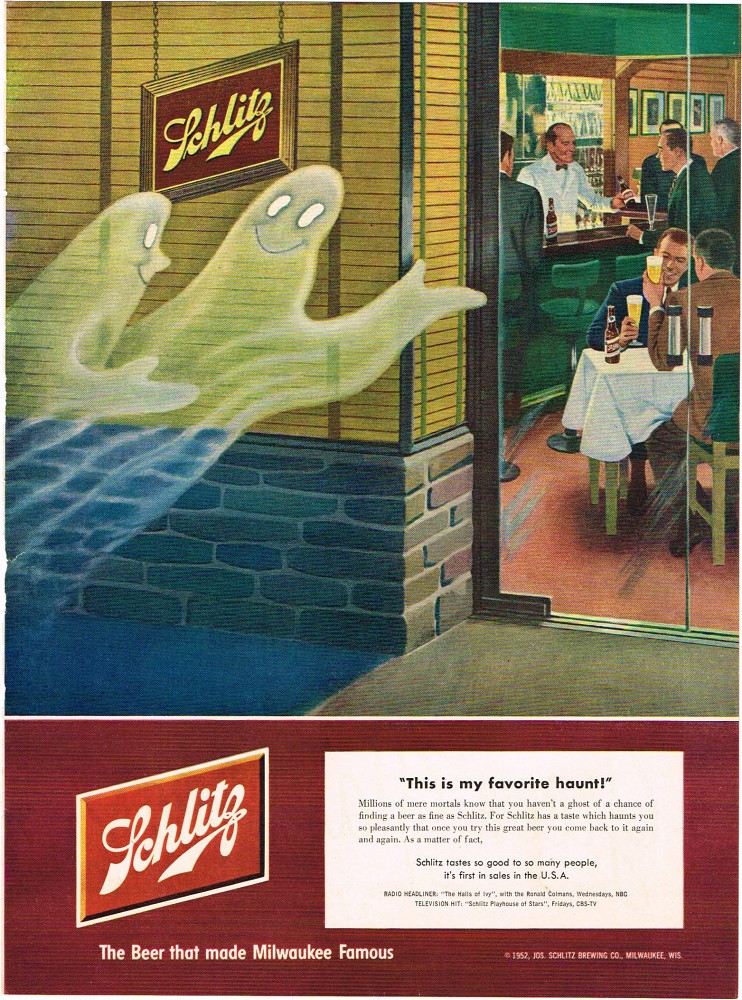

Sunday’s ad is for Schlitz, from 1952. In this ad, two ghosts are checking out their favorite haunts. Which, of course, is a bar. How could anyone’s favorite haunt not be a bar? Happy almost Halloween.

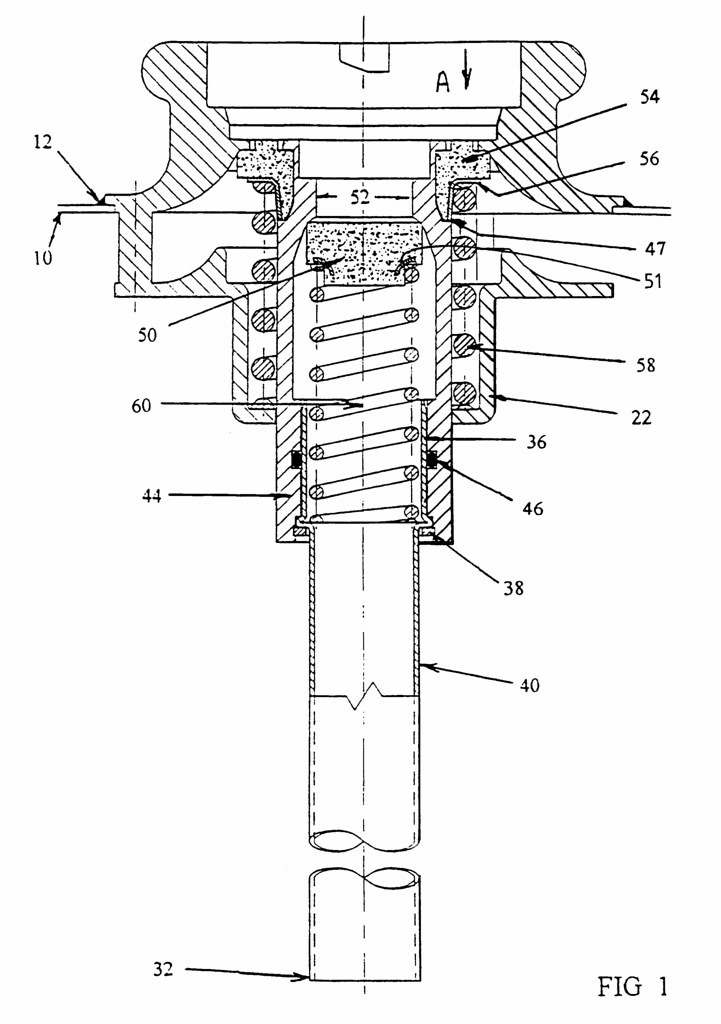
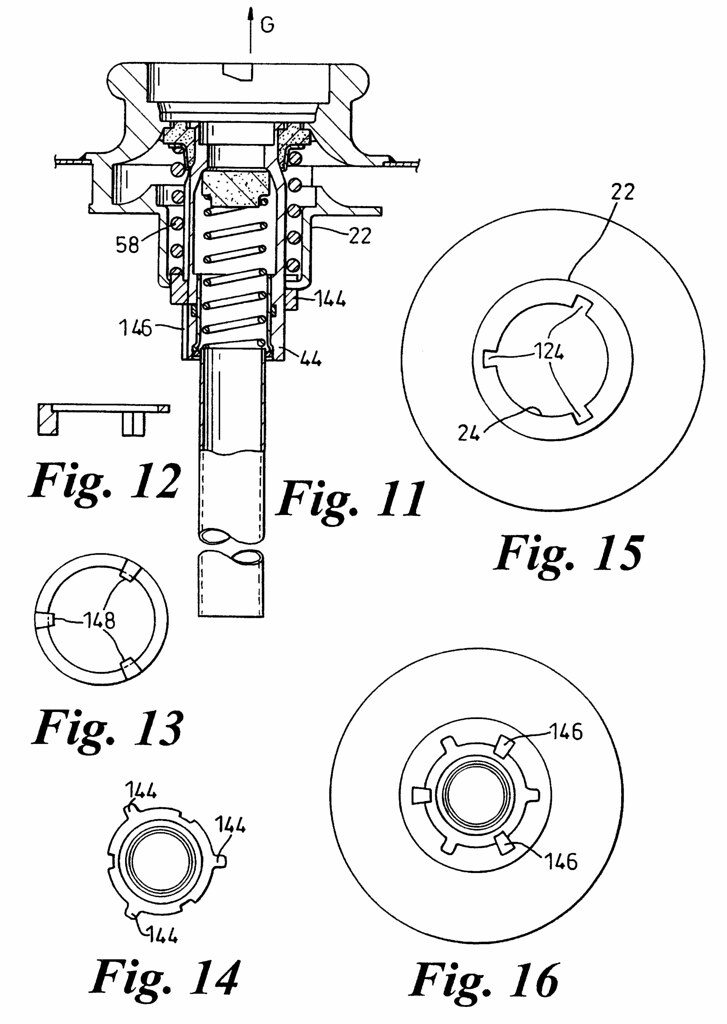
Today in 2010, US Patent 6308869 B1 was issued, an invention of Kenneth Leonard Simpson, for his “Keg and Keg Fitting For Dispensing Liquids Under Pressure.” Here’s the Abstract:
A keg for dispensing beer or other liquids under pressure is provided with a neckless spear arrangement. The spear comprises a body intended to be welded permanently to the keg with all parts of the spear assembled through that body. When so assembled escape is prevented so that in the event of interference by any unqualified person there is no risk of the spear being ejected as a missile.
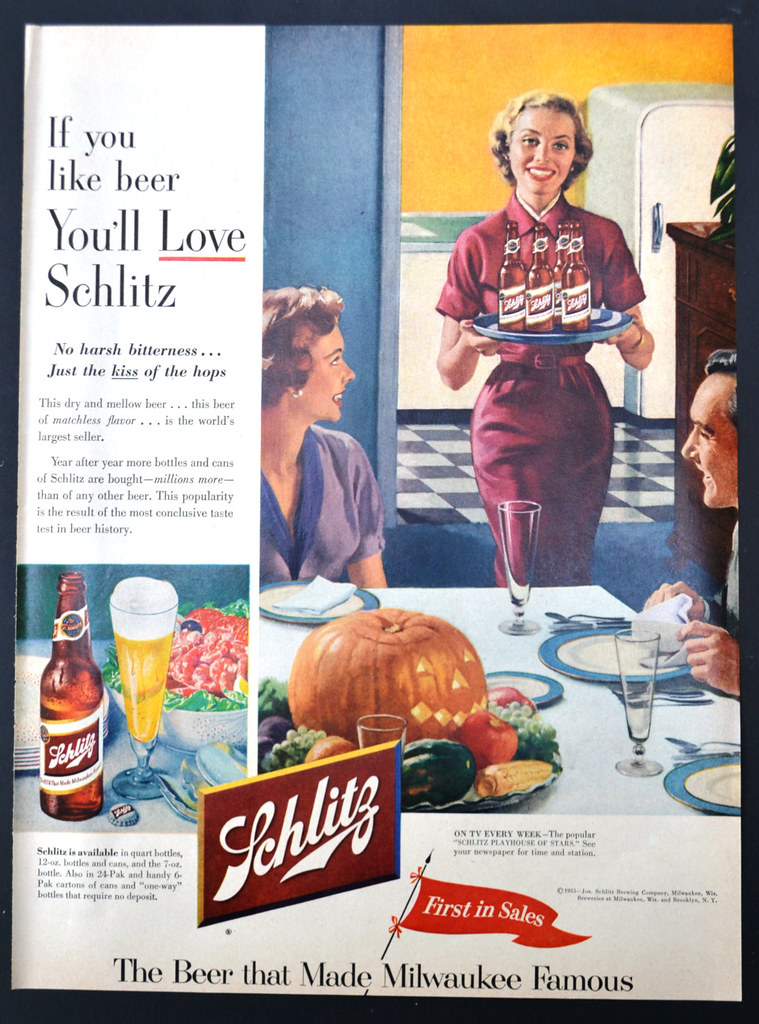
Saturday’s ad is for Schlitz, from 1953. In this ad, dinner is being served, and it’s obvious what time of the year it is given the harvest centerpiece on the table that includes a jack-o-lantern pumpkin. But what I love is that somewhat scary expression on the woman’s face delivering a tray of beer bottles to the table. Maybe I”m reading too much into it, but her face seems to be saying “look, I’ve been cooking all day long, maybe you could at least get off your ass and serve the beer, dear.”
Today in 1881, US Patent 240778 A was issued, an invention of Henry Shlaudeman, for his “Refrigerator Building For Fermenting and Storing Beer.” There’s no Abstract, although in the description it includes these claims:
My invention relates to the construction of a refrigerator building for fermenting and storing beer and other liquids, having its fermenting-tubs above the ice, and provided with windows for the admission of fresh air, and of an intermediate room which contains the body of ice between the fermenting-room and storeroom, said ice body being facilitated for both purposes.
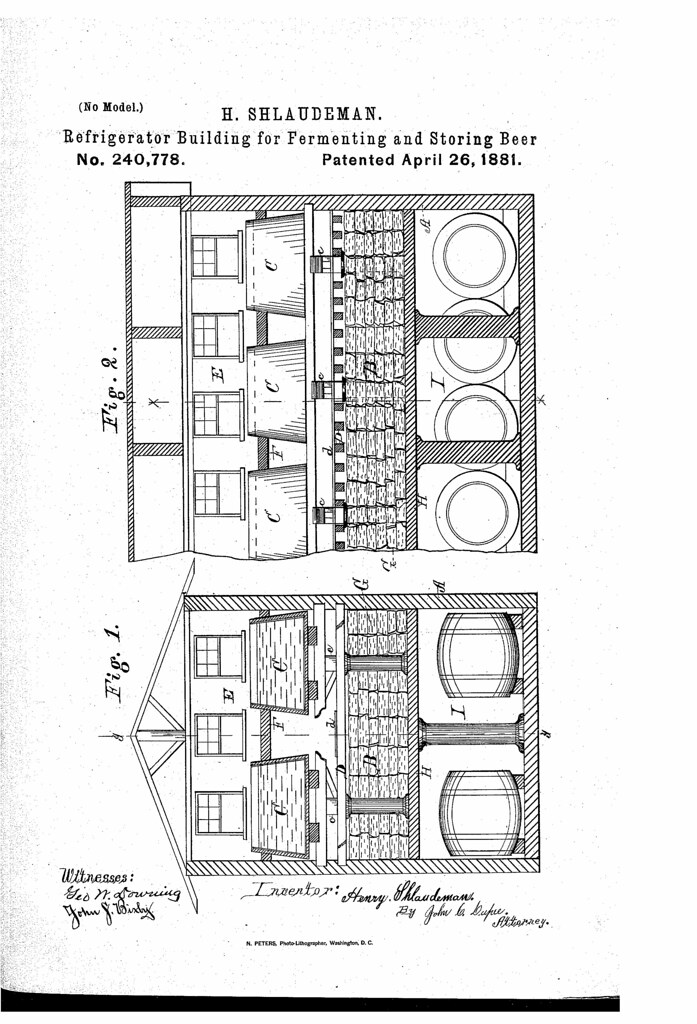
Friday’s ad is for Schlitz, from 1957. In this ad, part of their Schlitzerland series, there’s a costume party going on, where Schlitz is being served and then people start singing. Coincidence? I don’t think so. Personally, my favorite costume is the accordion player.
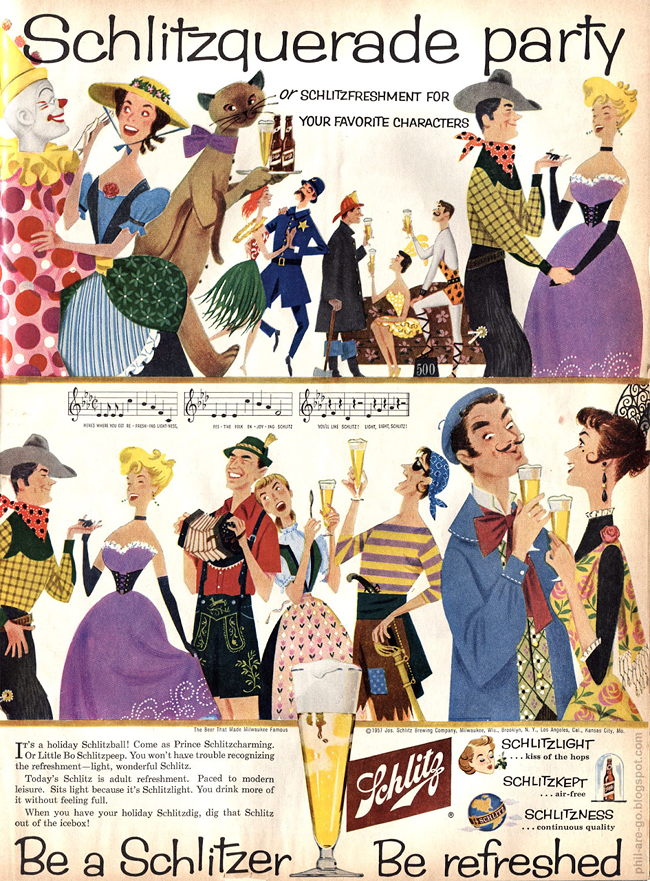

I was unaware of the Ballmer Peak (named for Microsoft’s 30th employee and former CEO Steve Ballmer) until today, but it’s an interesting idea, although there are some who believe it just may be an elaborate joke. In a nutshell, it’s the idea “that having a BAC in the 0.129% – 0.138% range can improve your cognitive abilities,” and it’s supposedly an effective technique to help with computer programming. Another way it’s been described is that “alcohol improves cognitive ability, up to a point,” and that it’s apparently a variation of the Yerkes–Dodson law, which says “that performance increases with physiological or mental arousal, but only up to a point.” xkcd described it with this cartoon:
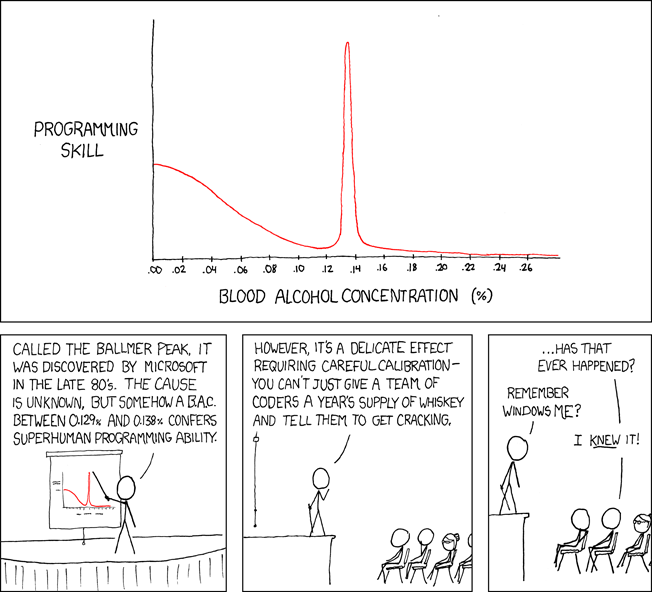
Obviously, it may sound like bunk, but there has been earlier evidence of Creativity & Beer and also Caffeine Vs. Alcohol: Which One Better Enhances Creativity?. There’s also a lot of anecdotal evidence that alcohol can trigger creativity and/or create the conditions for new types of thinking to occur if in that sweet spot of not too drunk, and not too sober. Certainly there’s a rich historical record of books and songs created by writers and composers who were under the influence. And there was a great Bill Hicks bit about how if you think there are no positive aspects to drugs, he suggests burning all of the music that you love, because so many of the musicians who wrote it were “really fucking high.” Naturally, Bill put it much better than I ever could:
“You see, I think drugs have done some good things for us. I really do. And if you don’t believe drugs have done good things for us, do me a favor. Go home tonight. Take all your albums, all your tapes and all your CDs and burn them. ‘Cause you know what, the musicians that made all that great music that’s enhanced your lives throughout the years were rrreal fucking high on drugs. The Beatles were so fucking high they let Ringo sing a few tunes.”
Recently, however, there was an article in the Observer whose headline was “The Ballmer Peak Is Real, Study Says.”
A recent study at the University of Illinois tested the creative problem solving ability of a group of men who were given vodka cranberry and snacks and asked to solve brain teasers. The results were starkly different for the tispy group, which had a blood alcohol concentration level of 0.075, versus the control group:
Astonishingly, those in the drinking group averaged nine correct questions to the six answers correct by the non-drinking group. It also took drunk men 11.5 seconds to answer a question, whereas non-drunk men needed 15.2 seconds to think. Both groups had comparable results on a similar exam before the alcohol consumption began.
The study notes that the Ballmer Peak effect was present for creative problem solving but not for working memory.
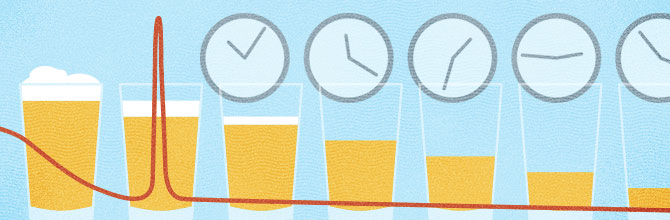
Also, on the skeptics forum on Stack Exchange, someone asked if the Balmer Peak was real, and one of the answers posted was this:
[An] article by Norlander [link no longer working] specifically studies the relationship between moderate alcohol consumption (1.0ml/kg body weight) and creativity. According to my very rough calculations, this would correspond to a BAC in the range of 0.12–0.14 for a 73kg human. The paper concludes
…modest alcohol consumption inhibits aspects of creativity based mainly on the secondary process (preparation, certain parts of illumination, and verification), and disinhibits those based mainly on the primary process (incubation, certain parts of illumination, and restitution).
In other words, moderate alcohol consumption does improve certain types of creative thinking, while inhibiting other types of creative thinking. Since the skills required for computer programming are solely cognitive in nature (discounting the motor skills required to type, of course), and given that creativity is a large part of computer programming, it is at least plausible that one might gain some amount of improvement from alcohol consumption.
There have also been studies on the relationship between alcohol consumption and creative output. That study examined 34 well known, heavy drinking, 20th century writers, artists, and composers/performers. It concludes:
Analysis of this information yielded a number of interesting findings. Alcohol use proved detrimental to productivity in over 75% of the sample, especially in the latter phases of their drinking careers. However, it appeared to provide direct benefit for about 9% of the sample, indirect benefit for 50% and no appreciable effect for 40% at different times in their lives. Creative activity, conversely, can also affect drinking behavior, leading, for instance, to increased alcohol consumption in over 30% of the sample. Because of the complexities of this relationship, no simplistic conclusions are possible.
So for a small portion of people there was a notable increase in creative output as a result of alcohol intake. It does appear that the study did not control for the quantity of alcohol intake, though, so this may not be directly applicable to the Ballmer Peak.
The best study I was able to find on the subject was by Lapp, Collins, and Izzo. They gave subjects vodka tonics of varying strengths (by varying the ratio of tonic to vodka), some of which did not even contain any alcohol. The subjects believed that they were drinking a standard-strength vodka tonic. The subjects then were asked to perform a number of cognitively and creatively challenging tasks. Here is what they conclude:
The present results support the idea that creative people probably gain inspiration from consuming alcohol …, but show that this effect may be due to the expected rather than the pharmacological effects of the drug. … A convergence of evidence supported the idea that creativity is enhanced (at least in some aspects) by the expected effects of alcohol.
In other words, alcohol can improve certain aspects of one’s cognitive ability, but this effect is not likely due to any pharmacological process (i.e., it is often sufficient to merely believe that one is drinking alcohol in order to achieve the same benefit).
And remember: The Ballmer Peak, as it is currently understood, is but a two dimensional projection of what in reality is a higher dimensional space, vi&.
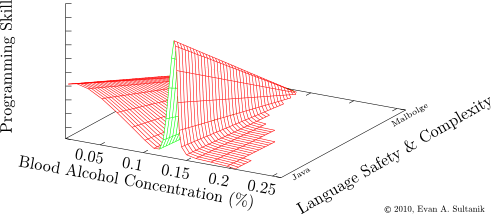
The Ballmer Peak-a-Thon even has a Ballmer Calculator you can use to determine how much to drink to reach maximum effectiveness.
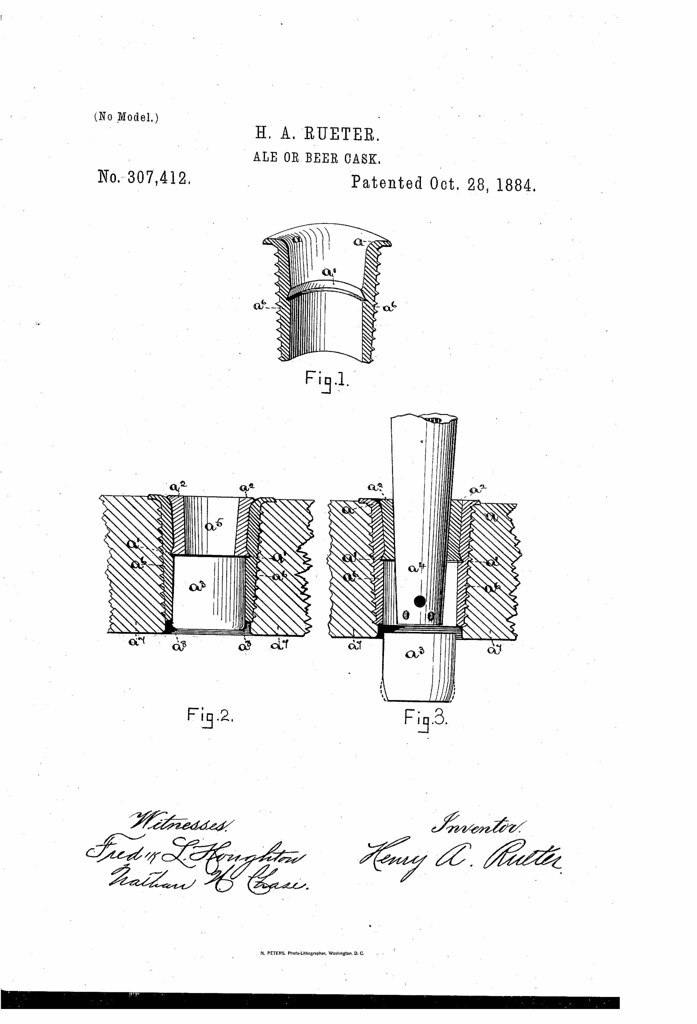
Today in 1884, US Patent 307412 A was issued, an invention of Henry A. Rueter, for his “Ale or Beer Cask.” There’s no Abstract, although in the description it includes these claims:
My invention relates to the tap-hole bushing and the stopper and packing used in it; and it consists in the form given to the inside of the tap-hole bushing, and in the use of a stopper to close the tap-hole, which fills about half the length of the bushing at the inner end thereof, and a plug which fills about half the length of the bushing at the outer end, having a central chamber through it to receive the entering end of the faucet, which will form a packing around the faucet between it and the bushing when the faucet is driven in to its place.
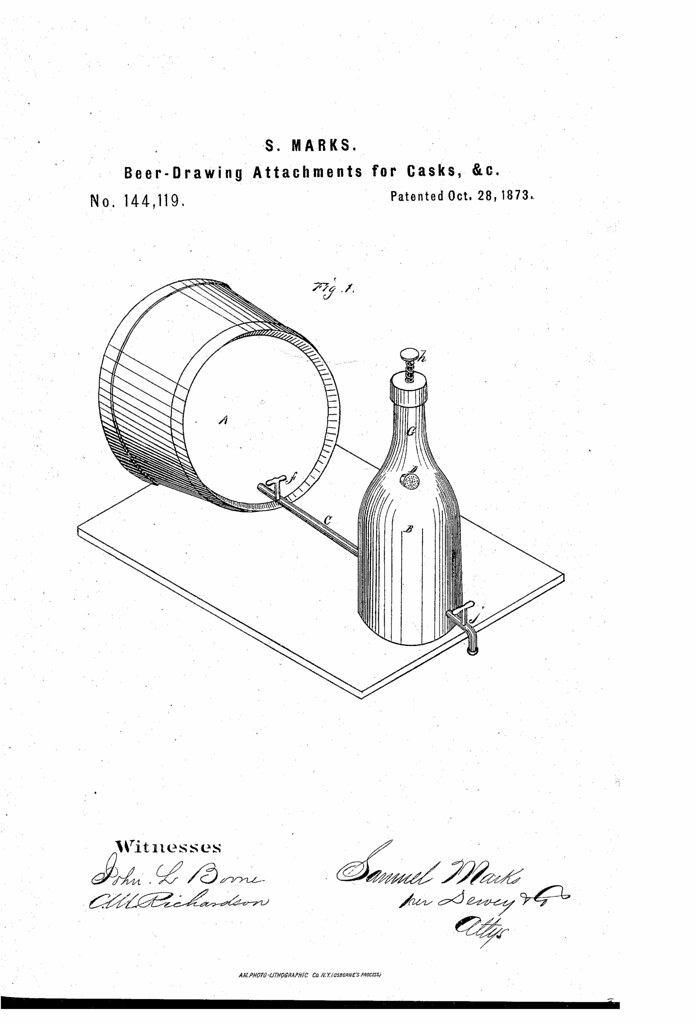
Today in 1873, US Patent 144119 A was issued, an invention of Samuel Marks, for his “Improvement in Beer-Drawing Attachments for Casks.” There’s no Abstract, although in the description it includes these claims:
The object of my invention is to provide an attachment to a cask or other vessel by means of which beer, ale, or porter, under a pressure of gas, can be drawn into glasses, bottles, or other vessels without the usual excess of foam, but regulated by the operation from brisk sprinkling to any extent of foam desired; and it consists of a receptacle having a controllable valve and a porous plug in it, arranged between the keg and the point of drawing the beer, whereby I am enabled to allow the escape of more or less of the gas from a small quantity of the beer in said receptacle.
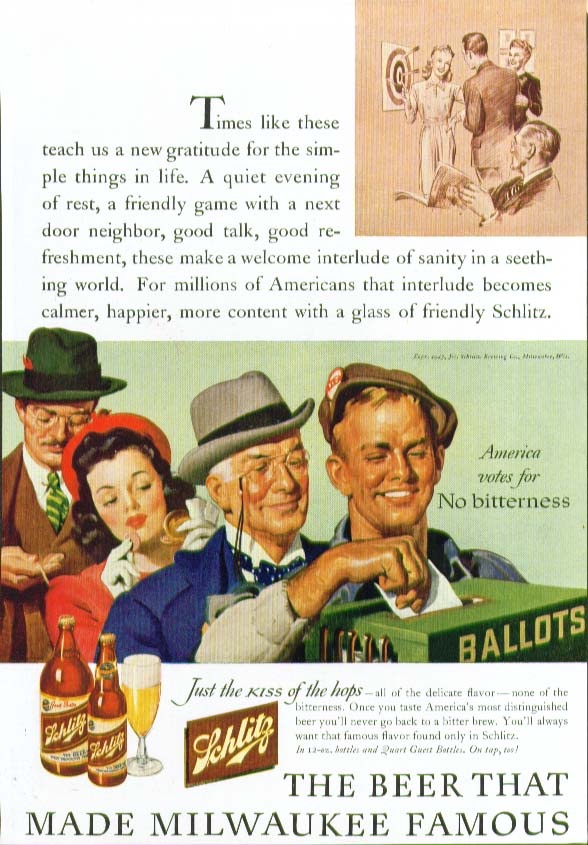
Thursday’s ad is for Schlitz, from the 1943. In this ad, showing four very diverse citizens at the ballot box, claims “America Votes For No Bitterness.” Maybe in 1943, but not in 2016, where bitterness reigns supreme, both in our IPAs and also in our elections. I actually had to unfriend someone on Facebook today for the first time ever for going full wacko on me over politics. There’s only a dozen days until the election, and I for one can’t wait until it’s all over.

I’m a huge fan of the self-driving technology. I can’t wait until the first driverless cars go on the market; I’ll be one of the first in lone to but one, if I can. Not only will it improve traffic, curb (my) road rage, and allow greater alcohol consumption outside the home, it will also have the added benefit of making organizations like MADD and Alcohol Justice obsolete (which is why I believe they’re not pushing for this technology more). So as we get one step closer to eradicating drunk driving, I think it’s appropriate that the first commercial delivery of goods via a self-driving truck was essentially a beer run.
So a few days ago, the start-up company Otto announced that their first successful test run took place last week in Colorado, when a truck using their technology delivered 200 cases of Budweiser from their brewery in Fort Collins to Colorado Spring, about 120 miles away. Much like an airplane pilot, a drive manually drove it onto the highway and then engaged the autopilot which drove the truck the rest of the way to its destination. The drive hopped in the back to relax and was on hand the entire journey in case anything needed his attention.
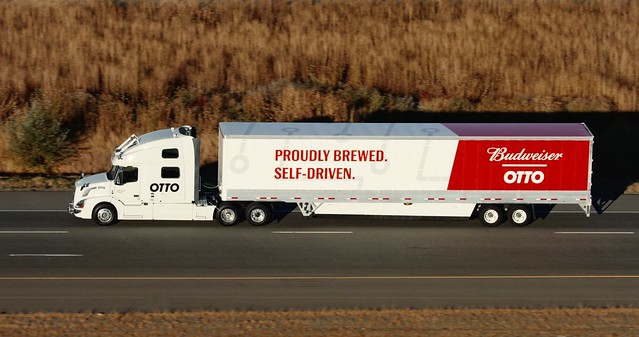
Otto itself posted the story on its blog three days ago, and it’s been picked up all over the country, including by the New York Times, CNBC, Tree Hugger and Mashable
The company itself was founded earlier this year, in January, and subsequently bought by Uber for $680 million in August. But it’s pretty impressive that they’ve gone from zero to successful commercial test in such a short time. According to various reports, several other car companies are working on similar technologies, too, so maybe a self-driving world might actually happen in my lifetime. That would be awesome.
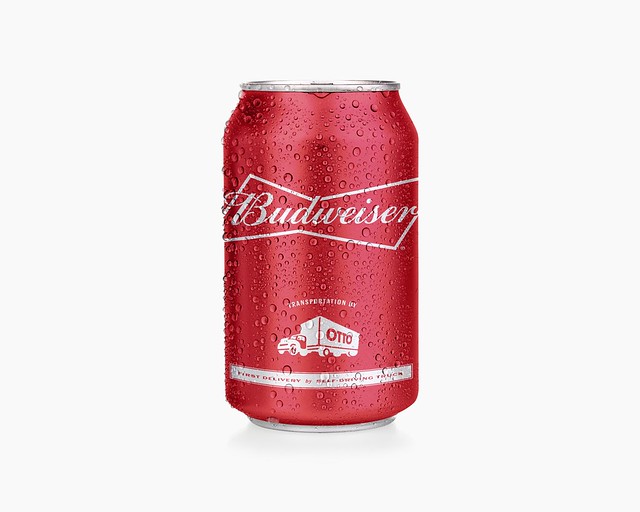
ABI even created commemorative beer cans to mark the beer run.
Here’s a video of the story:
And Wired also has a video of the truck in action, and explains a bit about how it actually works.