Brookston Beer Bulletin

Jay R. Brooks on Beer

  • Home
  • About
  • Editorial
  • Birthdays
  • Art & Beer

Socialize

  • Dribbble
  • Email
  • Facebook
  • Flickr
  • GitHub
  • Instagram
  • LinkedIn
  • Pinterest
  • RSS
  • Twitter
  • YouTube

Powered by Genesis

Beer In Ads #1881: Home Movies

April 14, 2016 By Jay Brooks


Thursday’s ad is entitled Home Movies, and the illustration was done in 1948 by Stevan Dohanos. It’s #12 in a series entitled “Home Life in America,” also known as the Beer Belongs series of ads that the United States Brewers Foundation ran from 1945 to 1956. In this ad, a group of people are settling in to watch some home movies, which is probably why they need the beer. This was people did before VHS tapes, not to mention the internet. But what’s with the green-skinned portrait hanging on the wall? Modern art or are they secretly an alien family?
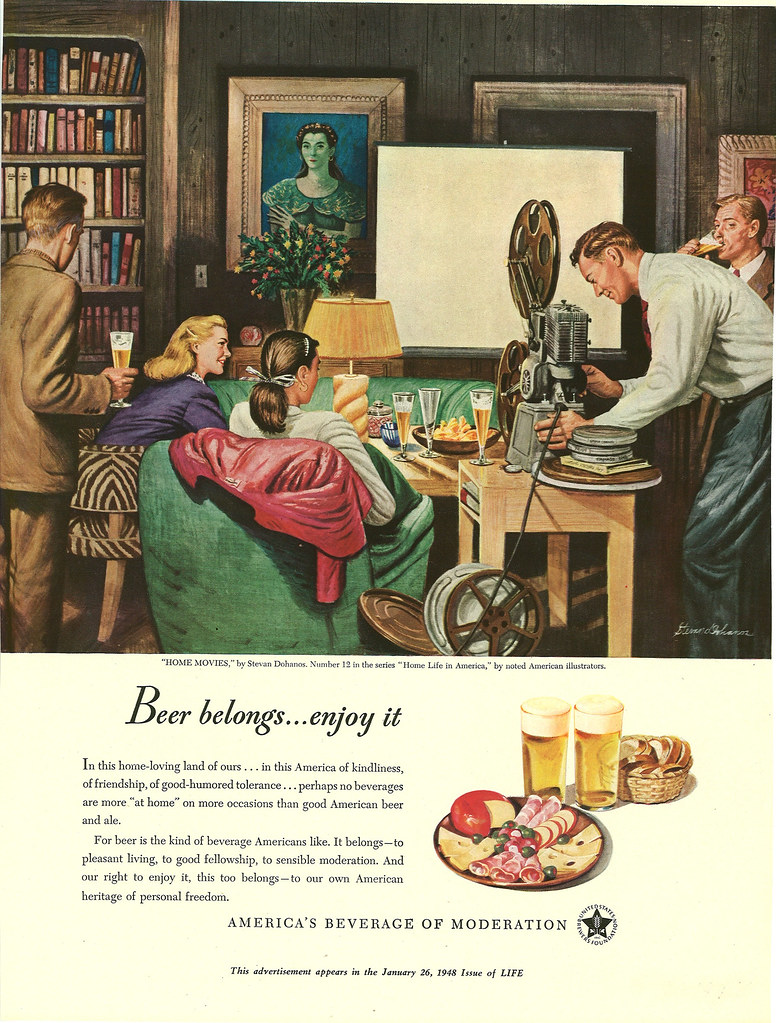
012. Home Movies by Stevan Dohanos, 1948

Filed Under: Art & Beer, Beers, Just For Fun Tagged With: Advertising, History

Patent No. DE202014002381U1: New Type Of Beer-Tasting Glass

April 14, 2016 By Jay Brooks

patent-logo
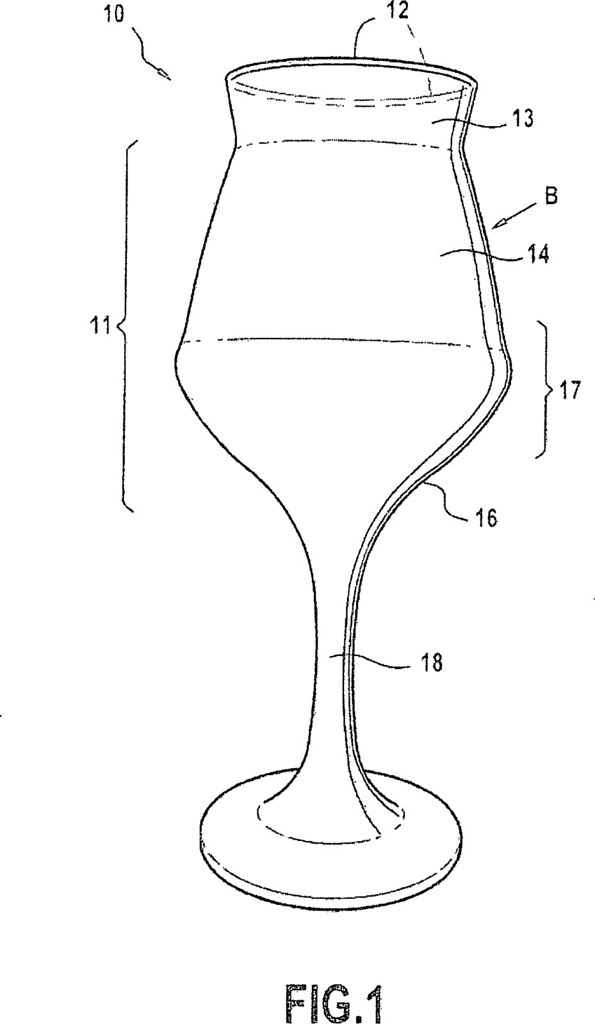
Today in 1979, German Patent DE 202014002381 U1 was issued, an invention of Vetreria Di Borgonovo S.P.A., for his “New Type of Beer-Tasting Glass.” Here’s the Abstract, translated from German:

Glass (10), namely thought to try out of beer (B) comprising:
– A receiving body (11) for receiving the consumer to cast into the glass beer (B), and
– A lower handle (18) for supporting and for manual handling of the glass,
wherein the receiving body (11) in turn comprises:
– An upper edge (12) having a rounded shape;
– An upper part (13), adjacent to the upper edge (12) and having an outwardly divergent flared shape;
– A central part (14), adjacent to the upper part (13) and having a bottom up to inwardly converging flared shape, and
– A circular lower part (16), which adjoins the central part (14) and with this at the bottom of the receiving body (11) of the glass (10) has a bulge (17);
wherein the glass (10) is adapted to allow a consumer who used to drink beer (B) the glass (10) both fully perceive the flavor characteristics and flavors of the drink and its visual characteristics, namely foam, to improve.

DE202014002381U1_0002

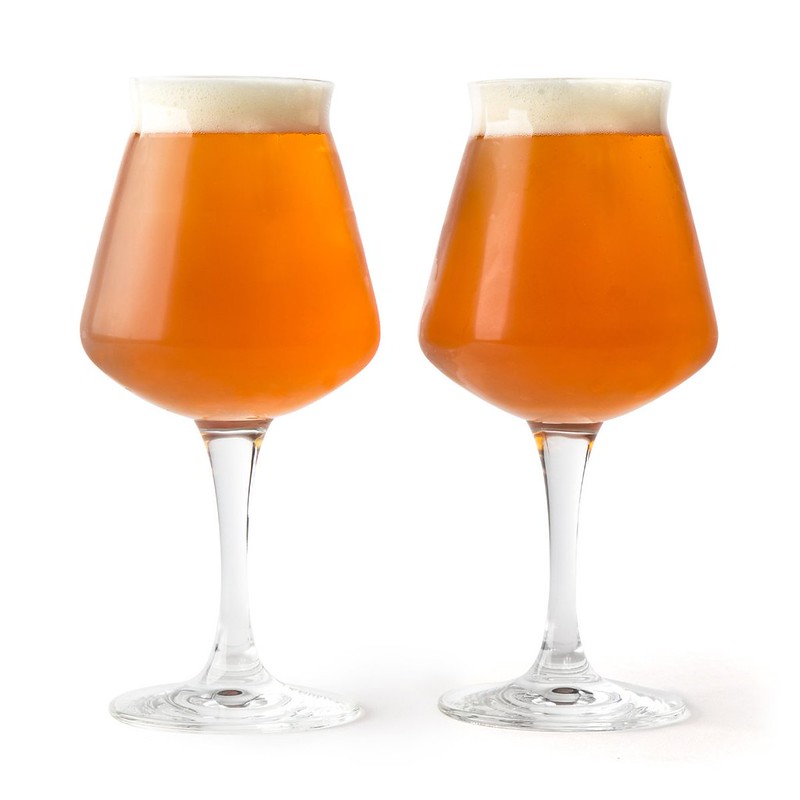
I think this is the Italian-designed glass that’s called a TeKu, and it certainly resembles the commemerative glass that the BA gave out at the Craft Brewers Conference in Portland last year.
teku-2
teka-glasses

Filed Under: Beers, Just For Fun, Politics & Law, Related Pleasures Tagged With: Glassware, History, Law, Patent

Patent No. 3505946A: Apparatus For Reconstituting Concentrated Wort

April 14, 2016 By Jay Brooks

patent-logo
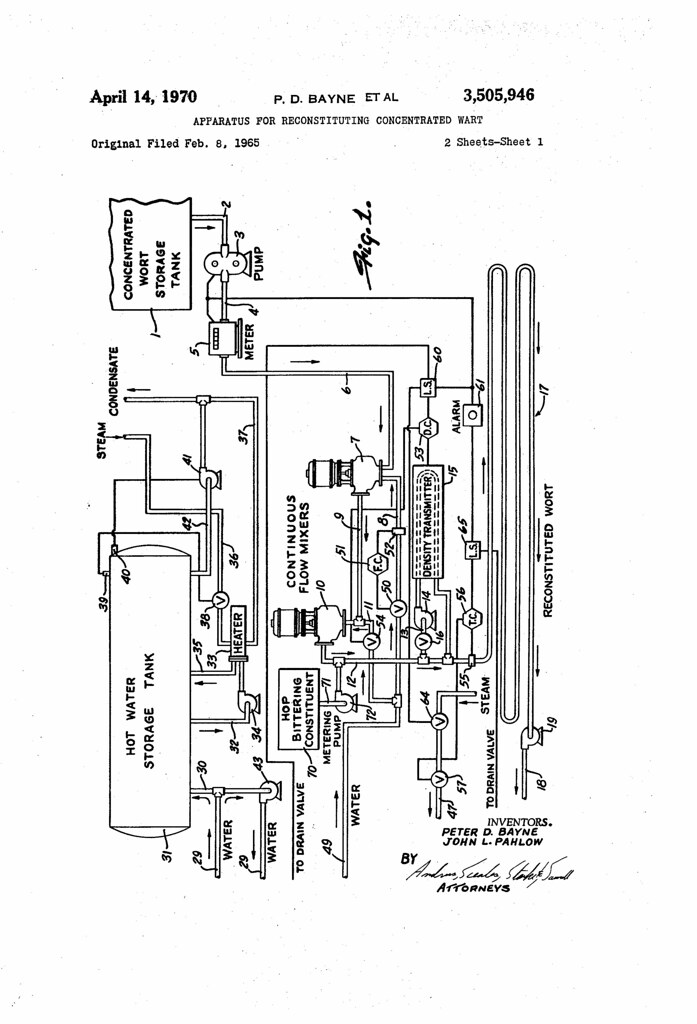
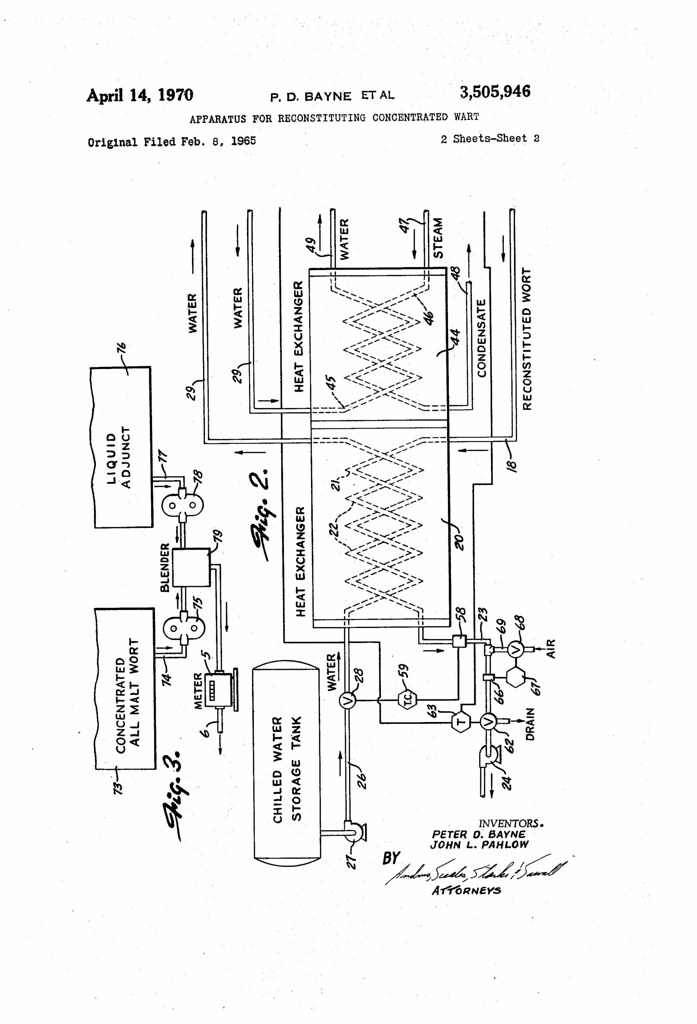
Today in 1979, US Patent 3505946 A was issued, an invention of Peter D. Bayne and John L. Pahlow, assigned to Schlitz Brewing Co., for his “Apparatus For Reconstituting Concentrated Wort.” There’s no Abstract, although in the description it includes this summary:

This invention relates to a process of brewing and more particularly to a process and apparatus for reconstituting concentrated brewers wort.

Wort concentration has great potential and can offer advantages by increasing the production efficiency of existing plants, increasing production volume without a corresponding increase in capital expenditure and providing a simplification of both production processes and control of product uniformity without sacrificing quality of product.

More specifically, concentrated wort provides several distinct advantages. Brewhouse equipment generally works at peak capacity for only a few months of the year. By concentrating wort during off season periods a more efficient use of the facility results so that the brewhouse equipment can be used more efficiently throughout the year.

In addition, concentrated wort can be shipped to distant points where it can be reconstituted, fermented, finished in plants which can be built at relatively low cost because they do not require the expensive grain handling and brewhouse equipment. Moreover, weight savings can be realized by shipping the wort concentrate as opposed to shipping malt and raw grains required for conventional brewing.

A system of wort concentration and reconstitution has outstanding potential in conjunction with a continuous or accumulated batch fermenting system. Wort concentrate is stable in storage and the concentrate can be metered into the present system in the desired flow rate, reconstituted, and then passed directly into the continuous fermenting system without storage. Using the reconstituting system of the invention in conjunction with a con tinuous fermentation process averts the necessity of holding the reconstituted wort at temperatures and under conditions which might create microbiological growth. Moreover, combining the reconstituting system with a continuous fermentation system completely eliminates the necessity of large storage tanks and chillers for maintaining a supply of wort for fermentation and provides a substantial cost saving in plant and equipment design over that of conventional systems.

The concept of wort concentration provides an alternate approach to the problems that some brewers have attempted to solve by freeze concentration of beer. Wort concentrate, because it does not contain alcohol, does not present the legal ramifications which accompany freeze concentrated beer.

The present invention is directed to a continuous, high capacity process for reconstituting concentrated wort. The wort is reconstituted without color gain, loss of hop bitter or alteration of flavor. According to the invention, concentrated wort at a temperature of from 60 to F., but preferably under and having a solids content of 80% is continuously pumped from a storage tank and/or shipping containers and passed into a mixing system. Deionized water, or filtered mains water, depending upon the purity of the water, is introduced into a mixer at a constant flow rate and is mixed with the stream of concentrated wort to partially reconstitute or dilute the wort. In some cases, particularly in high capacity installations, a second mixer in series may be employed and a second stream of either deionized water or filtered mains water is introduced into the second mixer down stream from the first mixer. This second or breakdown stream of water is continuously introduced at a variable flow rate and mixed with the partially reconstituted wort to complete the reconstitution to the fermentation gravity.

US3505946-0
US3505946-1

Filed Under: Beers, Just For Fun, Politics & Law, Related Pleasures Tagged With: History, Law, Patent, Science of Brewing, Wort

Patent No. 1092999A: Metallic Keg

April 14, 2016 By Jay Brooks

patent-logo
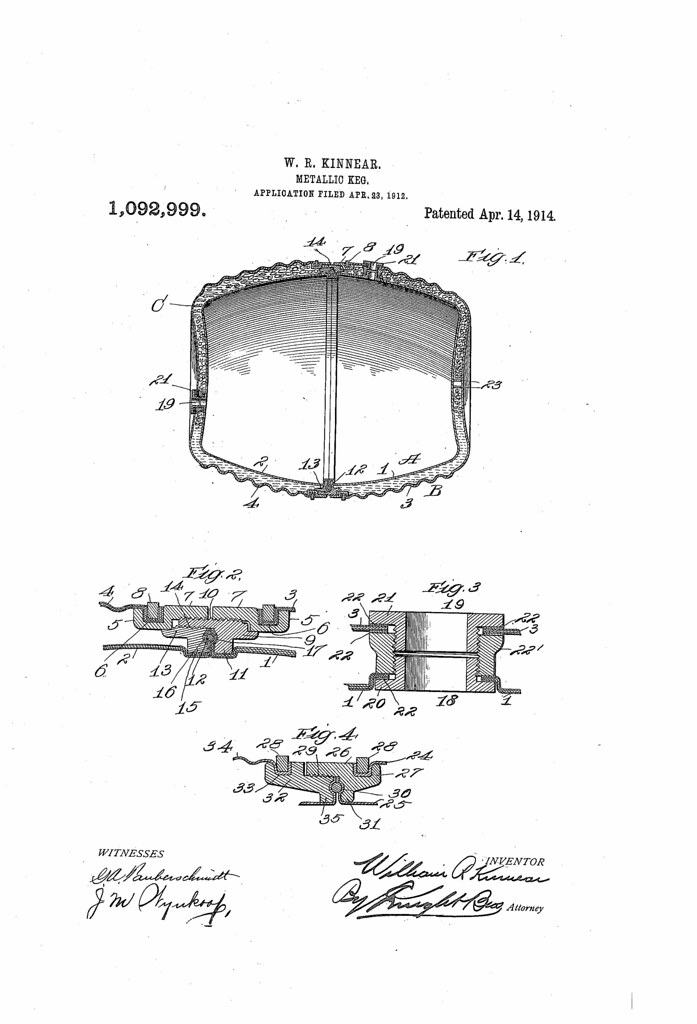
Today in 1914, US Patent 1092999 A was issued, an invention of William R. Kinnear, for his “Metallic Keg.” There’s no Abstract, although in the description it includes this summary:

The object of my invention is to provide a beer keg with an inner and an outer shell, each shell being made in two pieces and joined together at the center with a liquid proof joint, the inner shell being enameled on the inside and the outside; the connection joining the two sections of each shell being such that the shells may readily be taken apart and examined, and if the enamel should in any way become defective, the inner shell can be removed from the outer and re-enameled.

A further object of my invention is to provide a liquid shock absorber and a nonconductor in the space between the inner and outer shells, which distributes any shock which may be given to the keg throughout the entire area of the absorber and thus protects the inner shell from said shocks and preserves the enamel intact, the non-conductor preventing the passage of heat.

A further object of my invention is to construct the joint between the sections of each shell in such manner that the securing means is in the space between the two shells, so that the inner face of the inner shell presents an unbroken enameled surface; and with these and other objects in view, my invention consists of the parts and. combination of parts as will be hereinafter more fully pointed out.

US1092999-0

Filed Under: Beers, Just For Fun, Politics & Law, Related Pleasures Tagged With: History, Kegs, Law, Patent

Beer In Ads #1880: After A Day In The Snow

April 13, 2016 By Jay Brooks


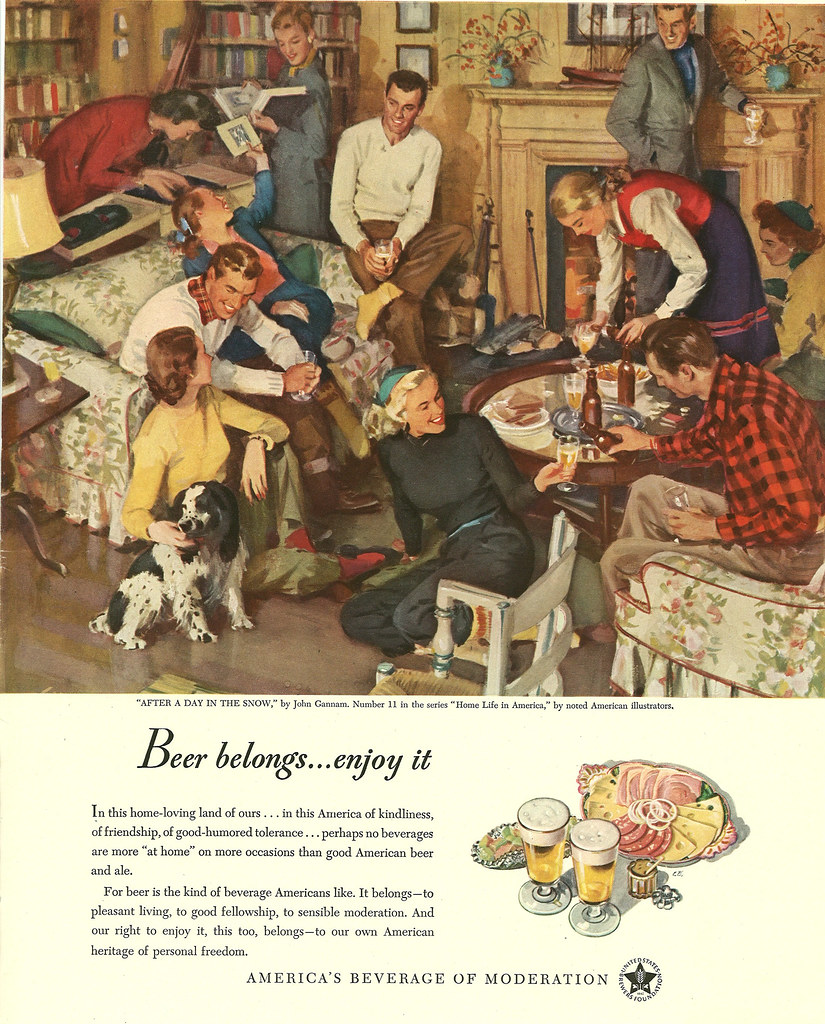
Wednesday’s ad is entitled After a Day in the Snow, and the illustration was done in 1947 by John Gannam. It’s #11 in a series entitled “Home Life in America,” also known as the Beer Belongs series of ads that the United States Brewers Foundation ran from 1945 to 1956. In this ad, a group of eleven people are crowded into a living room, all busy and doing something. Maybe it’s just me, but after a day in the snow I’d want to take a nap. They seem way too peppy. Must be the beer.

011. After a Day in the Snow by John Gannam, 1947

Filed Under: Art & Beer, Beers, Just For Fun Tagged With: Advertising, History

Patent No. EP1295845B1: Safe Device For A Double Valve Arrangement For Beer Keg

April 13, 2016 By Jay Brooks

patent-logo
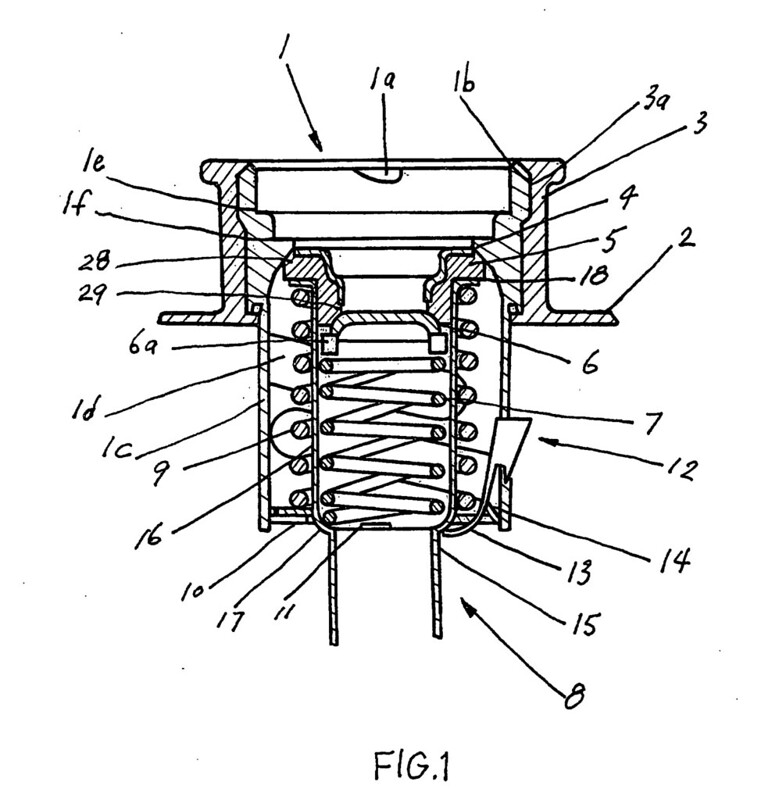
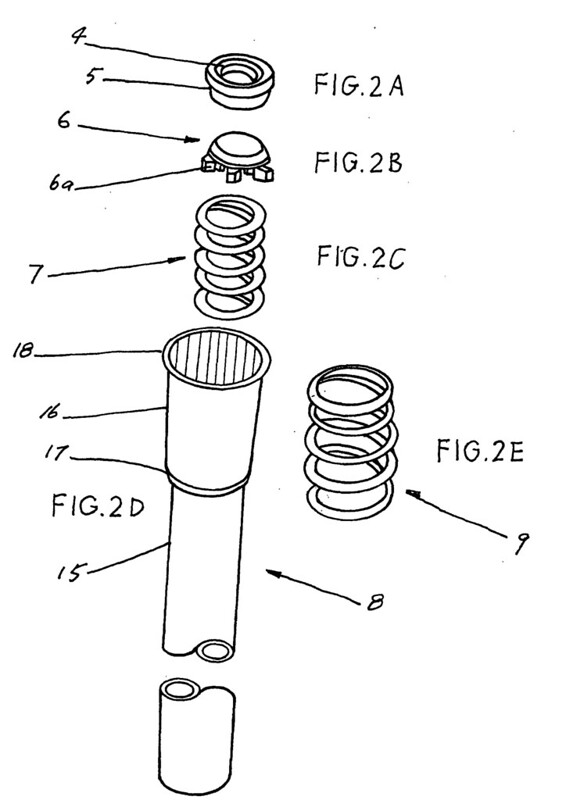
Today in 2005, US Patent EP 1295845 B1 was issued, an invention of Chang Kung-Chien, for his “Safe Device For a Double Valve Arrangement For Beer Keg.” There’s no Abstract, although in the description it includes this summary:

This invention relates to a double valve arrangement used for a pressurized beer keg, said arrangement comprises a safety device in order to prevent a valve body popped out of the keg under pressure causing unintended personal injury, or when the dismount is handled by somebody who is unauthorized to do so.

1295845-00360001

1295845-00370001

Filed Under: Beers, Just For Fun, Politics & Law, Related Pleasures Tagged With: History, Kegs, Law, Patent

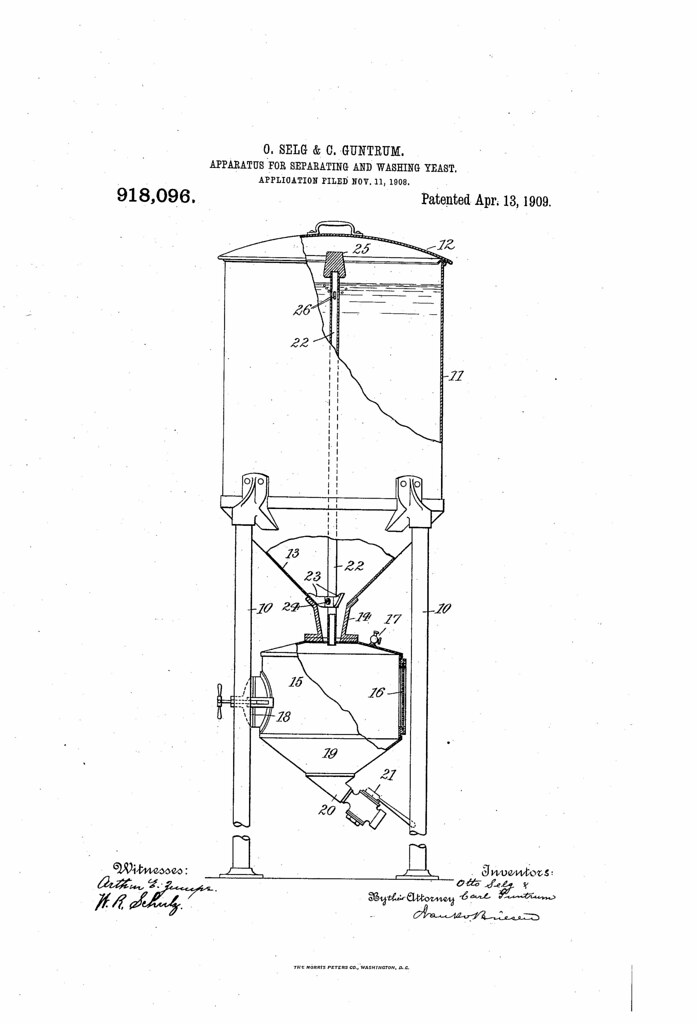
Patent No. 918096A: Apparatus For Separating And Washing Yeast

April 13, 2016 By Jay Brooks

patent-logo
Today in 1909, US Patent 918096 A was issued, an invention of Otto Selg and Carl Guntrum, assigned to Selg Brewery Apparatus Co., for their “Apparatus For Separating and Washing Yeast.” There’s no Abstract, although in the description it includes this summary:

This invention relates to improved means for washing yeast and separating the lighter particles and impure matter from the pure heavy particles in a quick, simple and efficient manner.

US918096-0

Filed Under: Beers, Just For Fun, Politics & Law, Related Pleasures Tagged With: Brewing Equipment, History, Law, Patent, Yeast

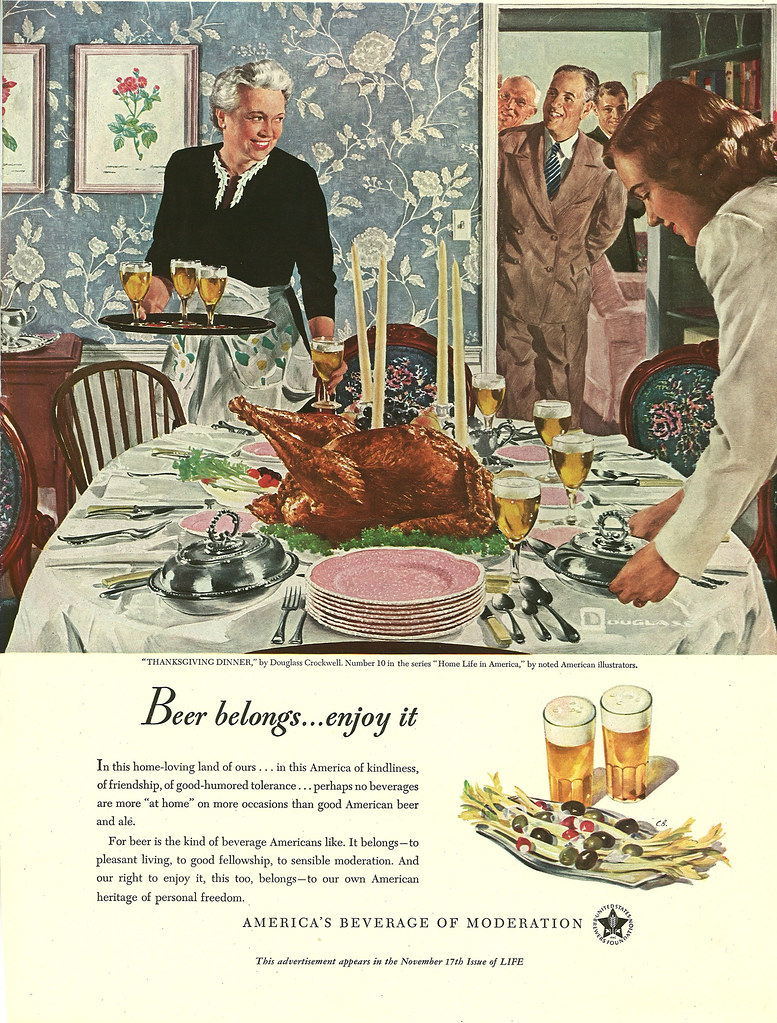
Beer In Ads #1879: Thanksgiving Dinner

April 12, 2016 By Jay Brooks


Tuesday’s ad is entitled Thanksgiving Dinner, and the illustration was done in 1947 by Douglass Crockwell. It’s #10 in a series entitled “Home Life in America,” also known as the Beer Belongs series of ads that the United States Brewers Foundation ran from 1945 to 1956. In this ad, a picture perfect Thanksgiving turkey is on the dinner table, but the it’s not complete. People wait in the wings to be seated until the most important job is done. The matriarch of the family is putting beer glasses down at each place setting, the final touch, before the holiday meal can begin. Just like at my house.

010. Thanksgiving Dinner by Douglass Crockwell, 1947

Filed Under: Art & Beer, Beers, Food & Beer, Just For Fun Tagged With: Advertising, Food, History, Holidays

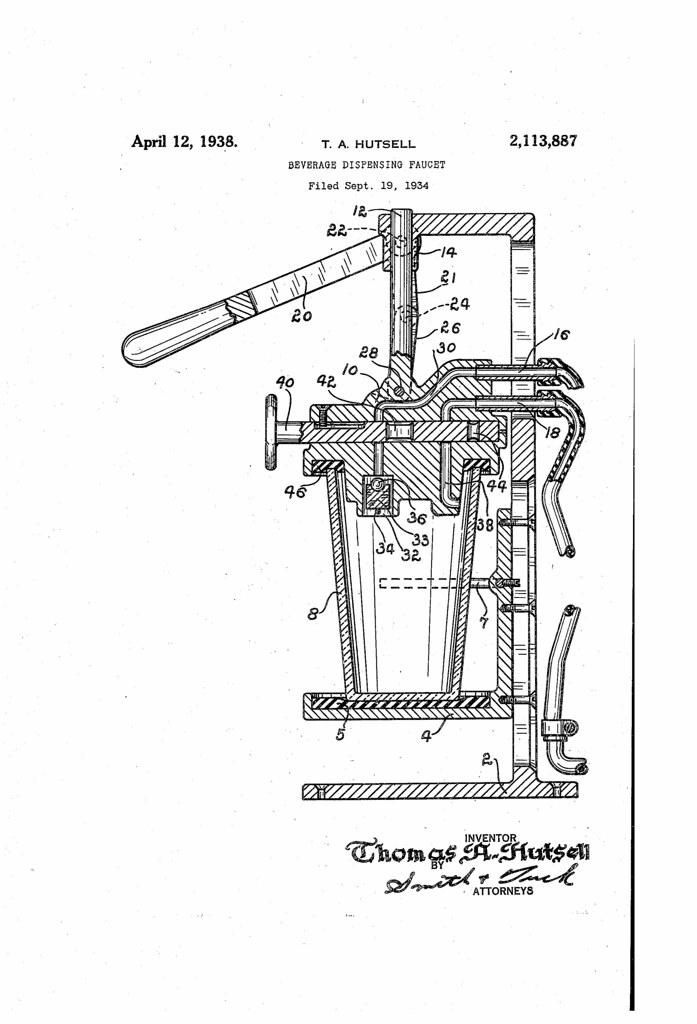
Patent No. 2113887A: Beverage Dispensing Faucet

April 12, 2016 By Jay Brooks

patent-logo
Today in 1938, US Patent 2113887 A was issued, an invention of Thomas A. Hutsell, for his “Beverage Dispensing Faucet.” There’s no Abstract, although in the description it includes this summary:

My present invention relates to a method for the dispensing and measuring of effervescent or gas-charged liquids. A particular adaptation of my method lends itself particularly well to the dispensing of draft beer. Consequently for the sake of clearness of description I prefer to explain my method as employed in the dispensing of beer, it will be understood, it is believed, that any gas-containing or gas-producing liquid could be dispensed in a similar manner.

US2113887-0

Filed Under: Beers, Just For Fun, Politics & Law, Related Pleasures Tagged With: History, Kegs, Law, Patent

NBWA Brewery Count Over 4,800

April 12, 2016 By Jay Brooks

nbwa
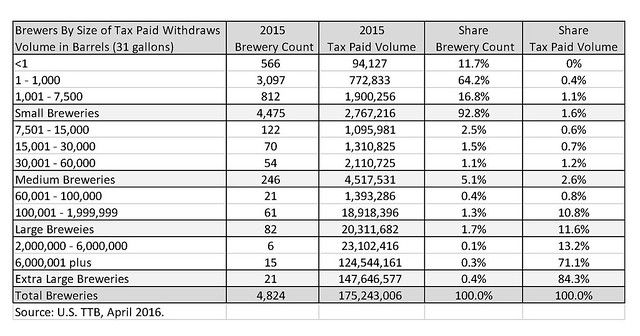
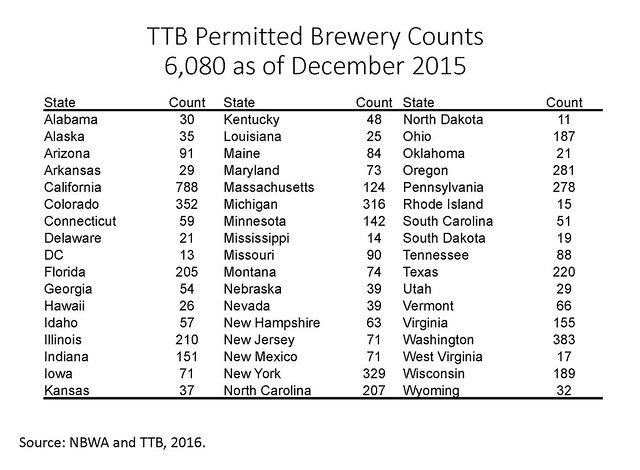
Some very interesting analysis from the NBWA, and their economist Lester Jones, about the number of breweries in America. Lester’s analysis uses slightly different metrics from the TTB and doesn’t define craft breweries as narrowly as the BA, and also the TTB doesn’t distinguish exactly what mat beverages are being made, if they’re licensed as a brewery then they’re included in the data. Those difference in calculating show the NBWA’s number for how many breweries there in America is 4,824, or over 550 more. But even more remarkable is that based on the number of “permitted breweries on record” at the TTB by the end of last year, that number could swell beyond 6,000, which seems absolutely crazy. The number is California alone, at 788, is just shy of 800. Sheesh!

Here’s the entire analysis below since the whole summary is worth reading:

Each year, the NBWA requests data from the TTB on tax paid withdraw volumes by size of brewery. Once again, this year’s TTB data provides some interesting brewing industry insights into the dynamics of the U.S. brewing industry. This data also is helpful for us to supplement the Brewers Association data on overall independent craft beer growth and brewery count. According to the BA, craft brewer volumes grew by 13 percent to 24.5 million barrels in 2015. The BA also reported 4,269 total operating breweries for 2015. As with all statistics, how the numbers are collected and reported can vary across organizations. In our industry, the numbers also change quickly.

As of April 2016, the U.S. domestic brewing industry had 4,824 reporting breweries according to the TTB. As with the BA’s brewery count of 4,269, this number is expected to change as additional new brewers are counted that may not yet have been fully recognized and/or reported by either the TTB or the BA data. The data presented below is for all types of malt beverage manufacturers and recognizes only the individual facility, not the ownership or control group.

Highlights from the 2015 TTB brewery count data include:

  1. The small brewer group (making less than 7,500 barrels) accounted for less than 2 percent of all domestic volumes yet accounted for 93 percent of all breweries. The smallest of this group has 566 breweries reporting less than one barrel of production each in 2015. These super small brewers can thank the contracting brewing industry for helping them sell almost 100,000 barrels – a figure well beyond their reported production capacity.
    The medium brewer group (making between 7,501 and 60,000 barrels) is a much smaller group consisting of 246 breweries, but these few breweries account for 1.6 times more volume than the 4,475 breweries in the small brewer group.
  2. The large brewer group consists of only 82 breweries making between 60,001 and 1.9 million barrels. This is a unique group within the industry as they pay the mixed rate federal excise tax of $7 for the first 60,000 barrels and $18 on each barrel over 60,001. While a much smaller group of only 82 breweries, they collectively produce more than four times the amount of beer as the medium brewer group. The large brewer group also has the largest range of production volumes and saw the fewest number of new entrants (17 breweries) into its ranks in 2015.
  3. Finally, we get the extra-large group. This is a group of only 21 breweries that produce more than 84 percent of all domestic beer – more than five times the amount made by all 4,803 combined. The closing of the MillerCoors brewery in Eden, North Carolina, will reduce this class of brewers by one in future reports and will take a significant-sized brewery offline for the first time in many years.
  4. The industry added around 1,500 new breweries in 2015 – that is equivalent to four new breweries a day entering the marketplace. As a highly capital-intensive business, starting small is the name of the game. Growing a beer brand takes a long time, and economies of scale are earned over decades. The largest U.S. breweries have been in operation for decades, and economies of scale should help maintain the beer volumes even in the face of declining per capita beer consumption.
  5. With more than 6,000 permitted breweries on record at the end of CY 2015, 2016 is set to be an even more competitive year for the brewing industry. Just as economies of scale drive the brewing side of the industry, logistical expertise and local market insights drive the efficiencies inherent in beer distributor networks. Working together and maximizing their comparative advantages, brewers, distributors and retailers will deliver unprecedented choice and value to American beer consumers in 2016.

Brewery counts by size 2015_Page_1

Brewery counts by size 2015_Page_2

Filed Under: Beers, Breweries, Just For Fun, News, Politics & Law, Related Pleasures Tagged With: Business, Distributors, Economics, Statistics

« Previous Page
Next Page »

Find Something

Northern California Breweries

Please consider purchasing my latest book, California Breweries North, available from Amazon, or ask for it at your local bookstore.

Recent Comments

  • Bob Paolino on Beer Birthday: Grant Johnston
  • Gambrinus on Historic Beer Birthday: A.J. Houghton
  • Ernie Dewing on Historic Beer Birthday: Charles William Bergner 
  • Steve 'Pudgy' De Rose on Historic Beer Birthday: Jacob Schmidt
  • Jay Brooks on Beer Birthday: Bill Owens

Recent Posts

  • Historic Beer Birthday: Bernard “Toots” Shor May 6, 2026
  • Historic Beer Birthday: Jacob F. Kuhn May 6, 2026
  • Beer In Ads #5242: Tell Your Paw To Ask Hochgreves To Send A Case Of Their Bock Beer May 5, 2026
  • Historic Beer Birthday: Louis von Schwanenfluegel May 5, 2026
  • Beer Birthday: Bill Covaleski May 5, 2026

BBB Archives

Feedback

Head Quarter
This site is hosted and maintained by H25Q.dev. Any questions or comments for the webmaster can be directed here.