Brookston Beer Bulletin

Jay R. Brooks on Beer

  • Home
  • About
  • Editorial
  • Birthdays
  • Art & Beer

Socialize

  • Dribbble
  • Email
  • Facebook
  • Flickr
  • GitHub
  • Instagram
  • LinkedIn
  • Pinterest
  • RSS
  • Twitter
  • YouTube

Powered by Genesis

Patent No. 1489442A: Process Of Making Duplicate Packages Of Hops

April 8, 2015 By Jay Brooks

patent-logo
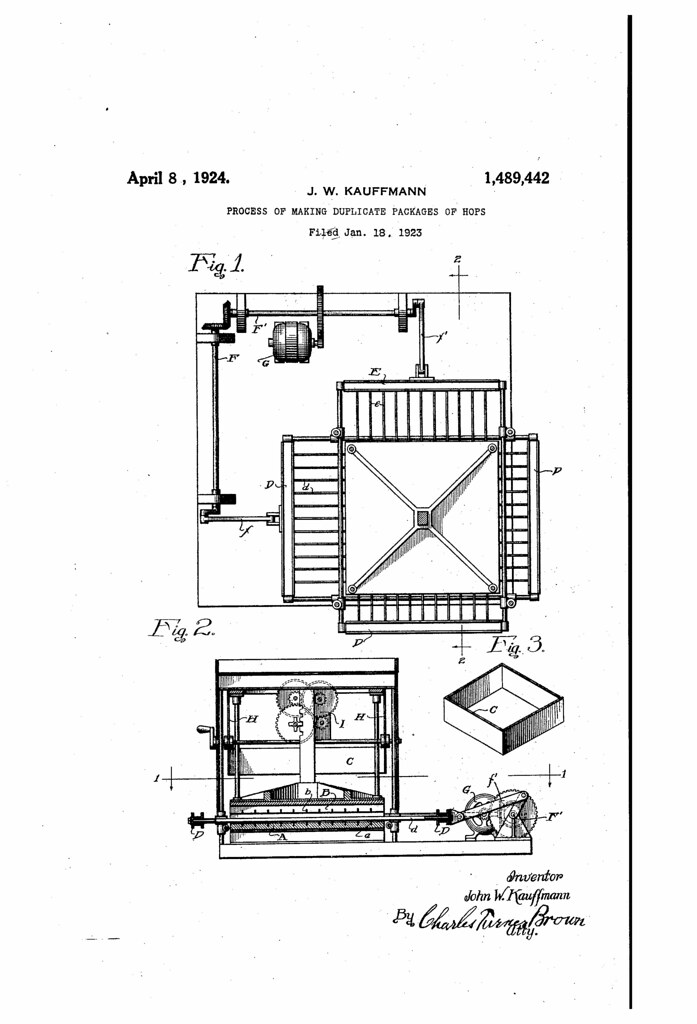
Today in 1924, US Patent 1489442 A was issued, an invention of John W. Kauffmann, for his “Process of Making Duplicate Packages of Hops.” There’s no Abstract, but in the description it’s stated that he’s “invented new and useful Improvements in Processes of Making Duplicate Packages of Hops, which has for its object to render the process, more expeditions and considerably cheaper than has heretofore been done.” More specifically:

In making a large number of hop packages of equal weight, it is; necessary to open’ a bale of pressed hops, to take a given quantity, by weight, therefrom, to subject said quantity to pressure, and then to separate the unit obtained thereby into a plurality. of units, each of which is placed into a container, and this has hitherto been effected by subjecting the hops after the removal thereof from the bale to a considerably greater pressure than tliez same are subjected In the process which I employ and seek to secure by these Letters Patent I do not have to subject the hops to any greater pressure than the same are subjected to in baling them, and I can make a large number of hop packages of equal weight and size a single operation of the process. In carrying out this process I make a machine which is sufficiently illustrated in the drawing accompanying and forming a part hereof to enable a description of the process which is herein set forth to be understood by one skilled in the art.
US1489442-0

Filed Under: Beers, Just For Fun, Politics & Law, Related Pleasures Tagged With: History, Hops, Law, Patent

Beer In Ads #1518: Time For A Break!

April 7, 2015 By Jay Brooks


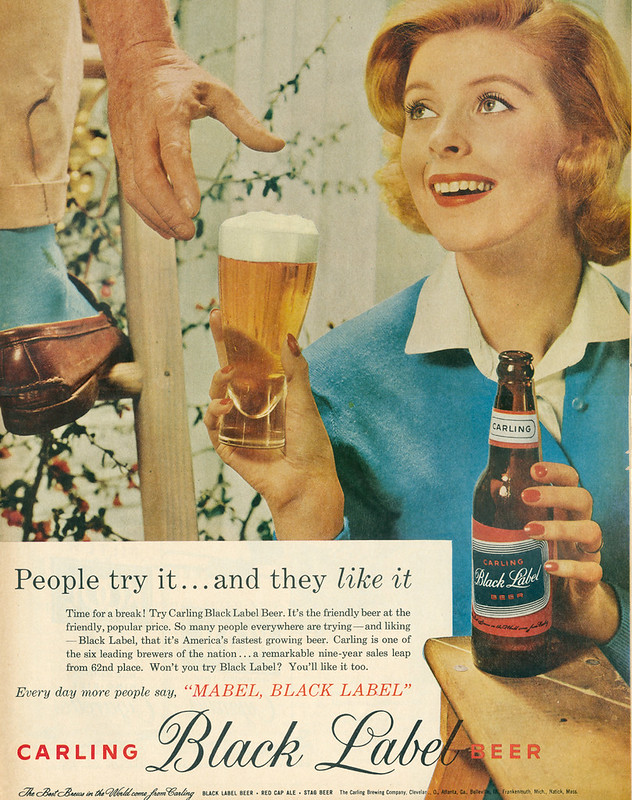
Tuesday’s ad is for Carling Black Label, from 1958. It was during the “Mabel, Black Label” period of time, but was from a different ad campaign with the tagline “People try it … and they like it.” A couple — I assume they’re a couple since they’re wearing coordinated outfits; his socks match her sweater — is working in their garden. I don’t know what he’s doing up on that ladder, but he’s staying up there to take a break, and his wife is handing him a beer. Staying up on the ladder doesn’t seem like much of a break, or is that just me?

Carling-1958-ladder

Filed Under: Art & Beer, Beers Tagged With: Advertising, History

Patent No. D197919S: Beer Bottle

April 7, 2015 By Jay Brooks

patent-logo
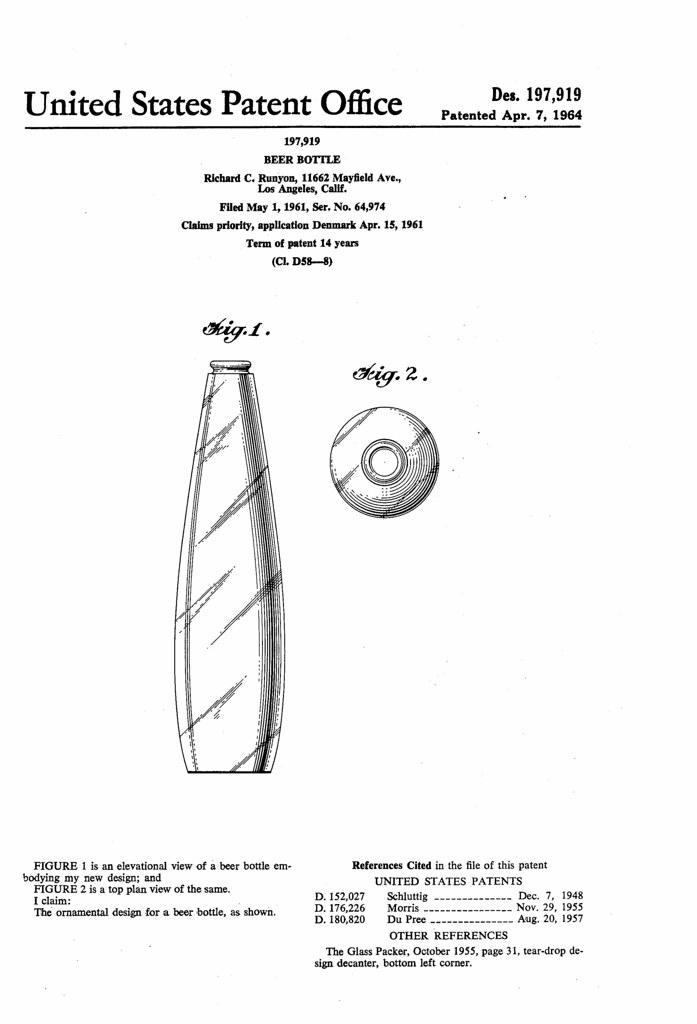
Today in 1964, US Patent D197919 S was issued, an invention of Richard C. Runyon, for his “Beer Bottle.” There’s no Abstract, and there’s really noting whatsoever apart from the “elevational view of a beer bottle.”
USD197919

Filed Under: Beers, Just For Fun, Politics & Law, Related Pleasures Tagged With: Bottles, History, Law, Patent

Patent No. 3128188A: Beer Lagering Process

April 7, 2015 By Jay Brooks

patent-logo
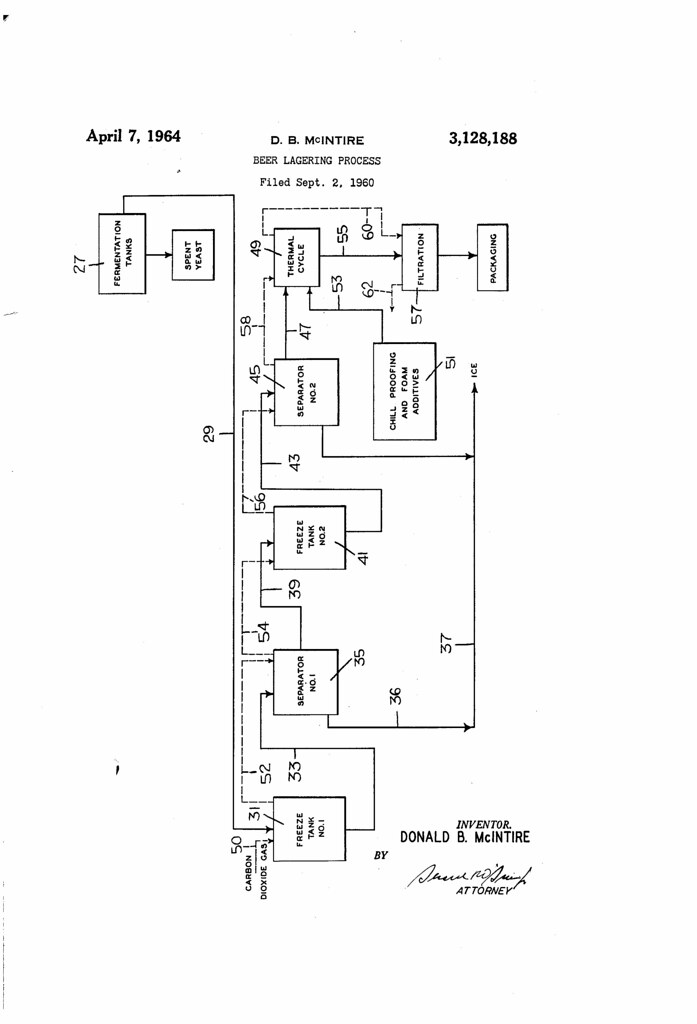
Today in 1964, US Patent 3128188 A was issued, an invention of Donald B. McIntire, assigned to the Union Carbide Corp., for his “Beer Lagering Process.” There’s no Abstract, but here’s how it’s described. “The main object of the present invention to provide a process for producing lagered beer without storing the beer.” I think what I’m most curious about is what interest a company like Union Carbide would have in holding a patent for making lager beer? The process is described in great detail as the description continues.

In accordance with the present invention, there is provided a process for lagering ruh beer comprising freezing water from the ruh beer so as to produce a slurry of concentrated beer, ice, and other solids; and removing the ice and other solids from the concentrated beer, while maintaining the beer in a substantially inert atmosphere throughout all process steps. Thus, the inventive process produces concentrated, lagered beer by freeze concentrating ruh beer.

Another novel and important feature of the present invention resides in the removal of calcium oxalate from the lagered beer product. Calcium oxalate is usually formed during normal brewing processes, and it is well established in the brewing literature that this compound is an extremely undesirable constituent of conventional beer. The oxalate normally plates out in processing tanks and lines, forming beer stone and resulting in a complex cleaning problem. Calcium oxalate also contributes to haze and offensive avors in beer and is generally considered to contribute to the highly undesirable phenomenon known as gushing Oxalates are also undesirable from a nutritional standpoint, since an excess of oxalates in the body is one factor which reduces the absorption of calcium from the intestine. While conventional beer always contains a substantial portion of oxalate, both the lagered beer concentrate formed by the present invention and the reconstituted product contain negligible amounts of oxalate because the calcium oxalate is precipitated out during the freezing step, and then subsequently removed from the concentrated beer along with the ice and other solids. Thus, not only is the expensive and time-consuming storage process eliminated by the inventive process, but the quality of the final product is unexpectedly and significantly improved.

In addition to, and possibly as a result of, the removal of calcium oxalate, the process of the present invention improves the flavor and haze stability of the resultant beer product. Indeed, beer produced by diluting the novel 3,128,188 Patented Apr. 7, 1964 ICC l concentrate ‘appears to be superior in flavor and clarity not only to other reconstituted concentrates, but also to fresh, high-quality draft beer, even though the concentrate and/or the reconstituted product may be as much as a year old. Because of its inherent bacteriological stability, the stabilized beer concentrate may be stored for long periods without the deterioration in flavor, clarity, and uniformity which conventional lagered beer, even when pasteurized, always suffers.

Although the inventive process can theoretically be used to produce lagered beer of any desired concentration, concentration above about five-fold, i.e., a concentrate possessing one-fifth the volume of the beer as originally fermented, usually results in deterioration of the desirable qualities of the product. Accordingly, less than five-fold volume concentrations are deemed preferable.

US3128188-0

Filed Under: Beers, Breweries, Just For Fun, Politics & Law, Related Pleasures Tagged With: Brewing Equipment, History, Law, Patent, Science of Brewing

Patent No. 1092538A: Beer And Hops Separator

April 7, 2015 By Jay Brooks

patent-logo
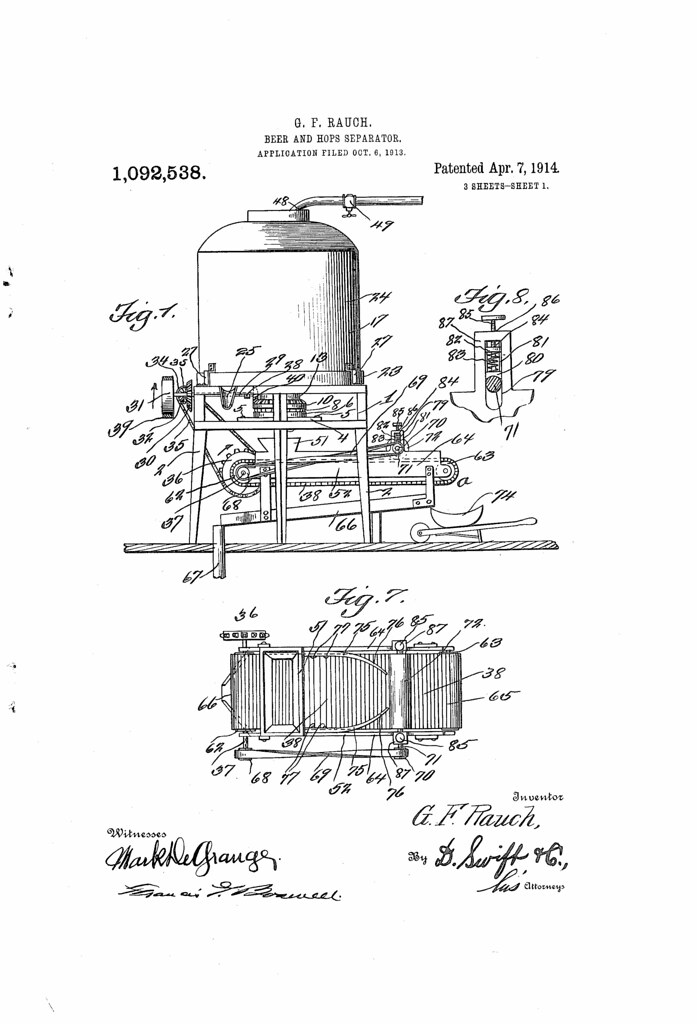
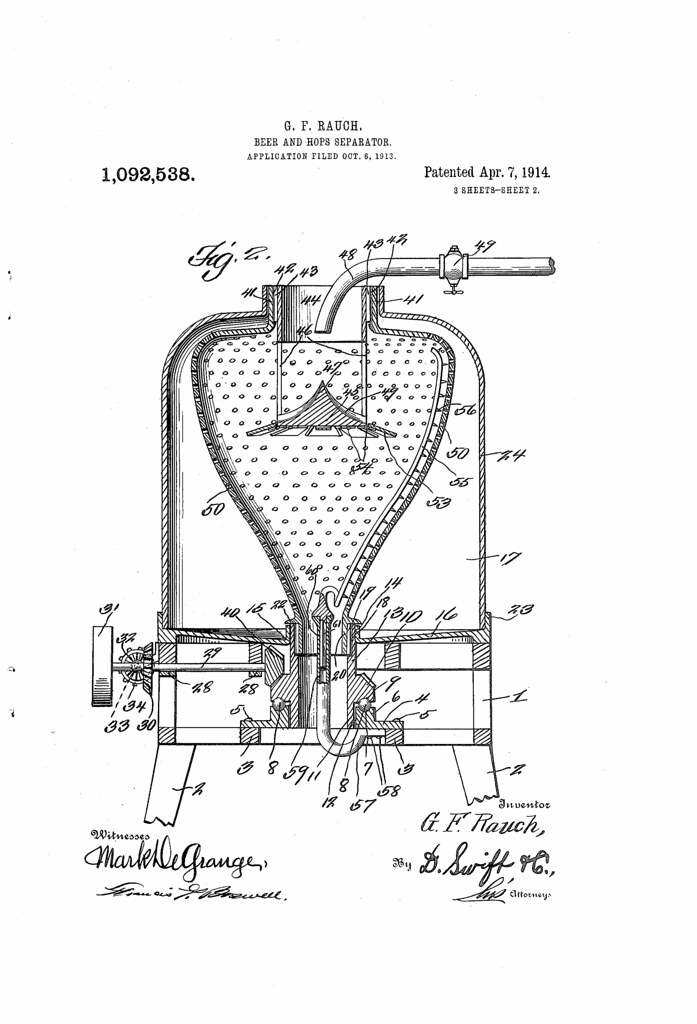
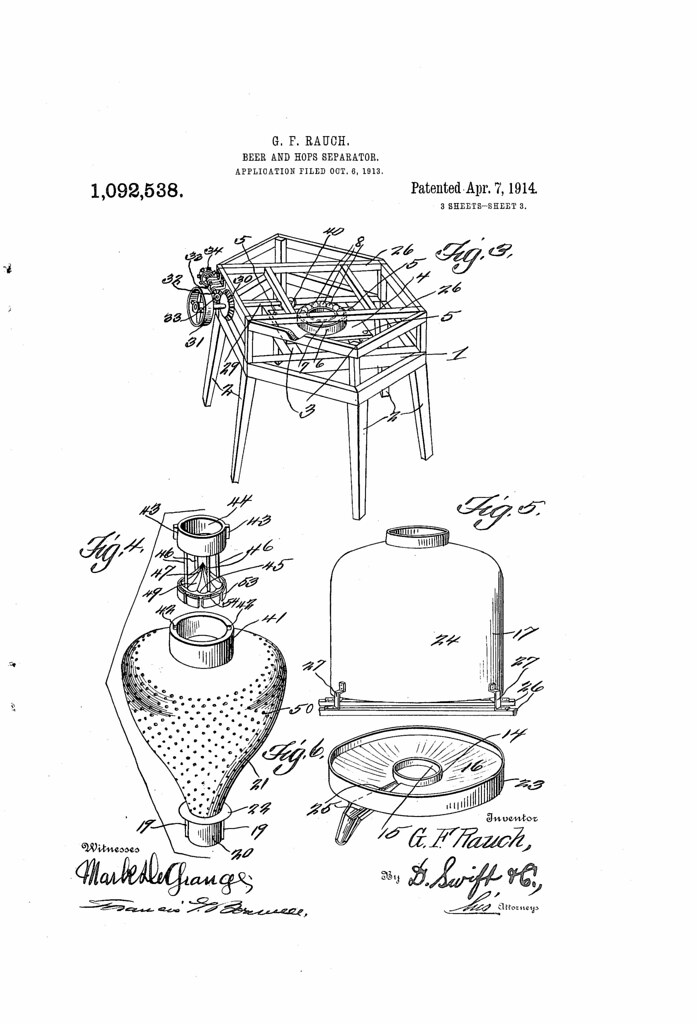
Today in 1914, US Patent 1092538 A was issued, an invention of George F. Rauch, for his “Beer and Hops Separator.” There’s no Abstract, but here’s how it’s described. “This invention relates to the art of brewing, and particularly to a new and useful separator, for separating the beer and hops.” Apparently it has several features:

One of the features of the invention is the provision of a receptacle in which a revoluble pear-shaped screen is, mounted, having a distributor or splasher for swirling or splashing the fluid or combination of beer and hops against the inner circumference of the pear-shaped screen.

Another feature of the invention is the provision of a plurality of agitator wings carried by the distributer or splasher, which wings owing to the centrifugal force swing outwardly, so as to splash the fluid or combination of hops and beer against the inner circumference of the pear shaped revoluble screen, the beer passing through the perforations of the screen, while the hops pass centrally down through the screen.

Another feature of the invention is the provision of a stationaryv supported rake pear-shaped or conical screen, to prevent the hops from adhering or clinging to the inner circumference of the pear-shaped screen. In other words. the hops that may hang to the inner surface of the creen are raked or combed ofi as the screen revolves.

The beer that percolates through the perforations of the pear-shaped screen deposits and is carried oil by a spout. The hops pass centrally down through the screen.

Another feature of the invention is the provision of a conveyor disposed beneath the outlet of the screen to receive the hops, which are conveyed to and under a yieldably mounted pressure roller, so as to squeeze any further beer that may remain with the hops as they leave the screen.

US1092538-0
US1092538-1
US1092538-2

Filed Under: Beers, Breweries, Just For Fun, Politics & Law, Related Pleasures Tagged With: Brewing Equipment, History, Hops, Law, Patent, Science of Brewing

Beer In Ads #1517: Make It Yours

April 6, 2015 By Jay Brooks


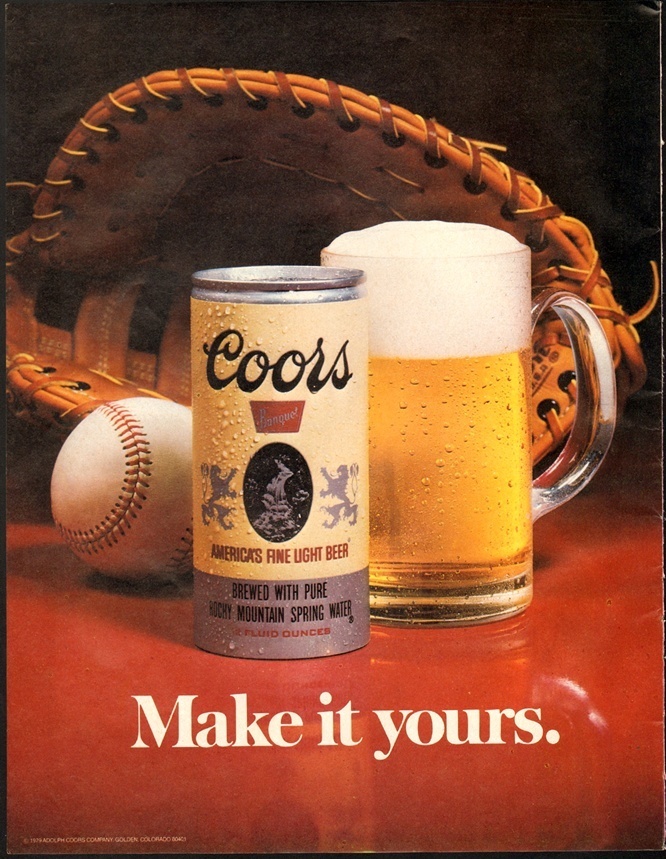
Monday’s ad is for Coors, from 1979. Today, of course, was opening day for baseball. This Coors Banquet Beer ad is pretty simple, a baseball, a baseball glove and a can of beer poured into a mug. Beer and baseball, what better simple pleasures on a spring day could there be?

Coors-1979-baseball

Filed Under: Art & Beer, Beers Tagged With: Advertising, Coors, History

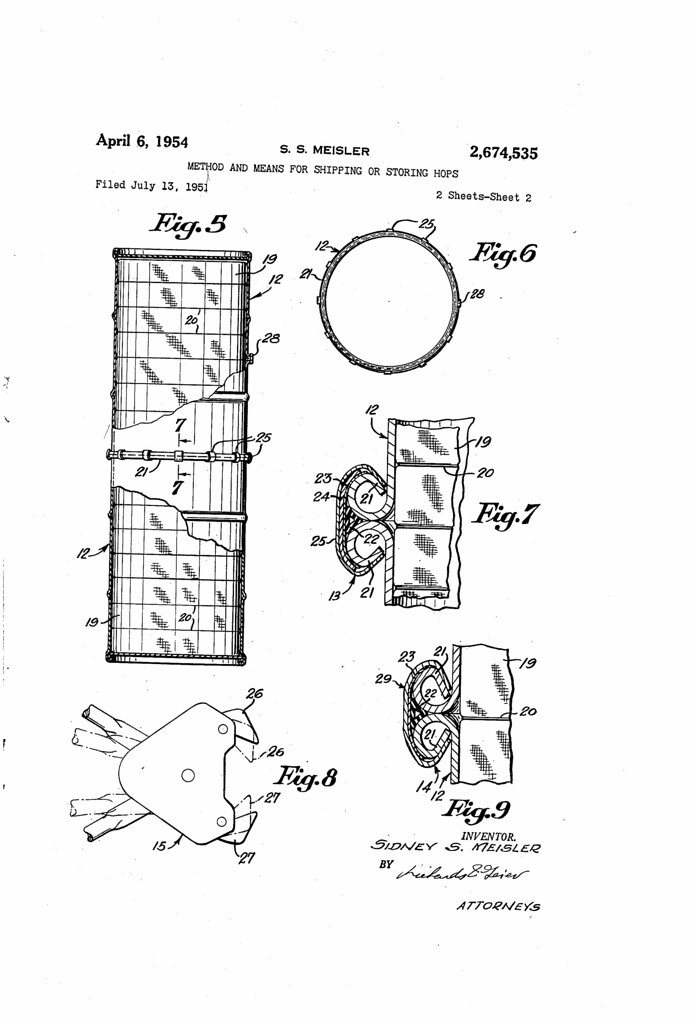
Patent No. 2674535A: Method And Means For Shipping Or Storing Hops

April 6, 2015 By Jay Brooks

patent-logo
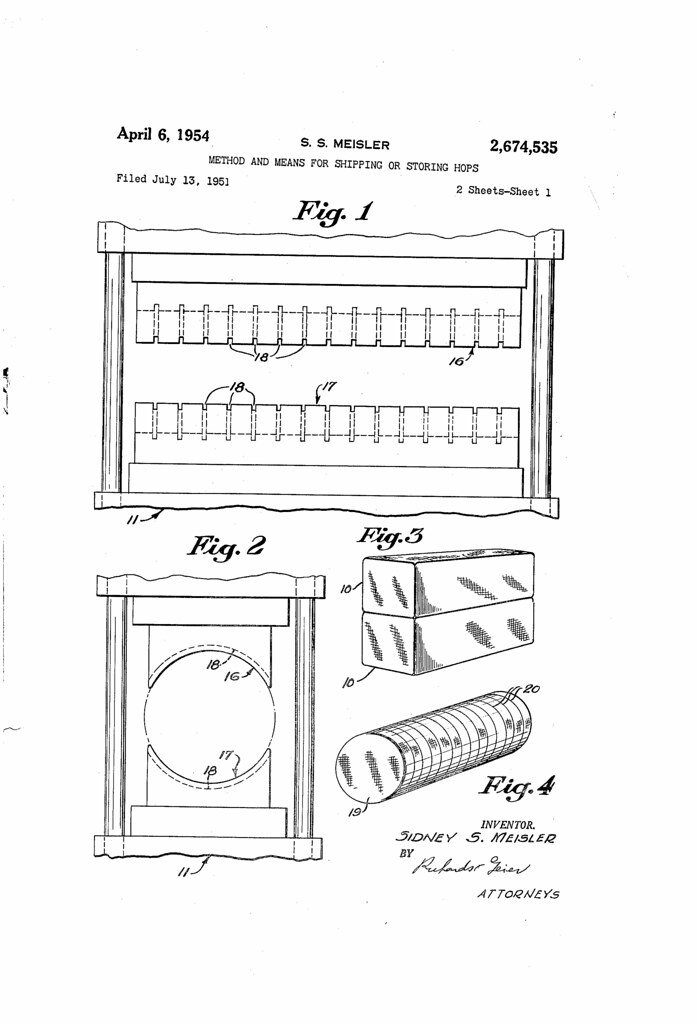
Today in 1954, US Patent 2674535 A was issued, an invention of Sidney S. Meisler, for his “Method and Means For Shipping or Storing Hops.” There’s no Abstract, but here’s how it’s described. “It is an object of the instant invention to provide better packing which will be impervious to Weather, negligent handling, and poor storing in the holds of ships where other cargos may contaminate the hops with odors, moisture, acids, etc., the hops being easily damaged. Another object is to conserve material in the shipment of hops.”
US2674535-0
US2674535-1

Filed Under: Beers, Breweries, Just For Fun, Politics & Law, Related Pleasures Tagged With: History, Hops, Law, Patent

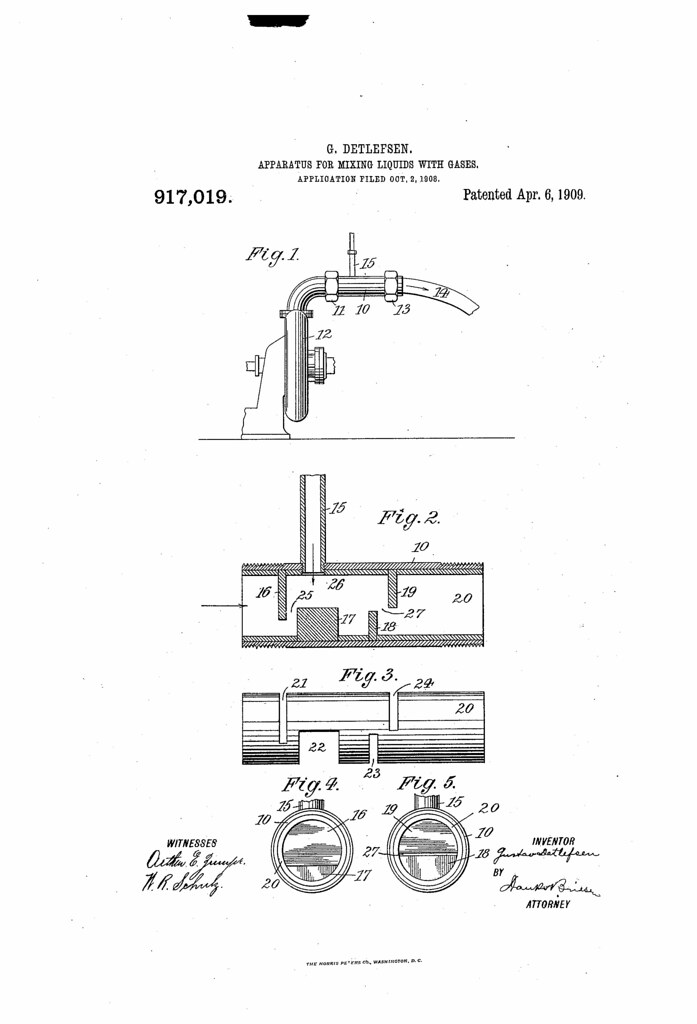
Patent No. 917019A: Apparatus For Mixing Liquids With Gases

April 6, 2015 By Jay Brooks

patent-logo
Today in 1909, US Patent 917019 A was issued, an invention of Gustav Detlefsen, for his “Apparatus for Mixing Liquids with Gases.” There’s no Abstract, but here’s how it’s described. “This invention relates to an improved apparatus for mixing liquids with gases, the device being more particularly designed to charging beer with carbonic acid gas while the beer flows from the chip cask to the racking apparatus. The construction is such that the liquid is thoroughly agitated while being charged with the gas, so that an intimate mixture is obtained.”
US917019-0

Filed Under: Beers, Breweries, Just For Fun, Politics & Law, Related Pleasures Tagged With: Brewing Equipment, History, Law, Patent, Science of Brewing

The World’s Oldest Bars

April 6, 2015 By Jay Brooks

pub-sign
Several years ago, prompted by another website’s relatively poor attempt to create a list of the oldest bars in America, I took their list of ten apart and created my own list of America’s Oldest Bars. That original list in the intervening years has taken on a life of it’s own, and continues to be updated as new entries are discovered by people all over the country. The current list of The Oldest Bars In America is now on a separate page and has 122 American bars on the list, all dating from before 1900, which became my arbitrary cut-off date.

Bucket List Bars, the website for a book of historic American bars, recently posted their choices for the 5 Oldest Bars in the World. Here’s their original list:

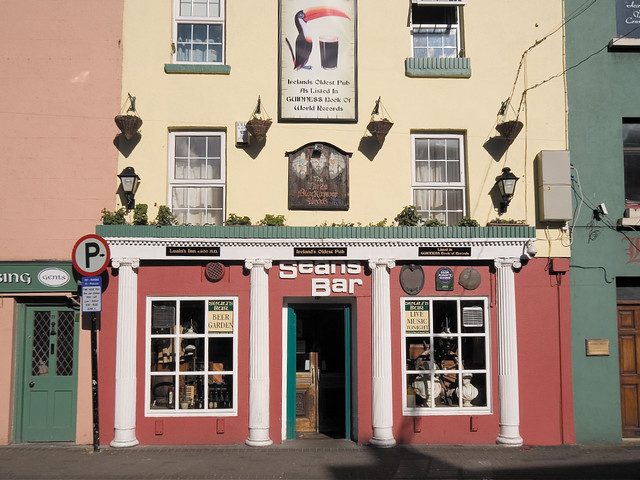
  1. Sean’s Bar; Athlone, Ireland (900 CE)
  2. The Bingley Arms; Bardsey, North Leeds, England (953 CE)
  3. Ye Olde Trip to Jerusalem; Nottingham, England (1189 CE)
  4. Brazen Head; Dublin, Ireland (1198 CE)
  5. Ye Olde Man & Scythe; Bolton, England (1251 CE)

This time around, I had no reason to disagree with the list, but having been working on an American version off and on for the last seven years did make me curious. So I figured I’d start doing a little research of my own and see what I might find. One thing I’m finding with my initial searches is that even more than with strictly American bars, is that how you define a bar is very important in determining whether it should be on the list. Go back far enough in history, and how we think of a bar changes quite a bit, with the earliest examples of what became known as bars being inns or taverns along well-traveled trade routes. Some were monasteries where people stopped on their journeys, and others might have been simply common gathering places. Many more may not have started as bars, and some even were things totally different from anything to do with serving alcohol, such as private homes, or buildings housing completely different businesses, even for a time. Still others had the original building destroyed and rebuilt, in some cases multiple times. Should they still be on this list? Is being a bar consistently the entire time a requirement, or should it be? Some started as bars, were converted to other uses, only to be bars again in the present.

Another problem is that record-keeping was nearly non-existent when you go back far enough, and even what records do exist are not exactly persuasive. Suffice it to say there are massive problems in compiling such a list, because no matter what is listed, some one could easily take issue with it, depending on how they decide to look at it, or define what is a bar. Is it a bar, pub (public house), ale house, beer house, inn, tavern, saloon, lounge, canteen, rathskeller, watering hole or what have you?

So for now, at least, I’ve been very loose with what belongs, and what might not, just to get things started. While some think the Cave Bar in Jordan may be the oldest, it’s hard to know. Was it really always a bar? When it first started being a gathering place for people in the first century, would we think of that as a bar? And if not, when would we start considering it to be a bar, as it undoubtedly is today? I’ve tried to restrict the list to bars that opened before 1800, though for some countries where there are a lot even for those dates, I’ve only listed the oldest examples, or ones that were for other reasons I found interesting or controversial. Some are listed with newer dates only because those were the oldest I could find for that country, and I wanted to list one, at least eventually, for most nations. And obviously, I’m using where they’re located today, and not worrying about what their geographic area’s political affiliation was when they opened, just to keep such a complicated question a little bit simpler.

As before, if you know of any others that should be on this list, please do let me know by posting a comment or sending me an e-mail. Please understand that this is the beginning of a work in progress and try to keep the astonished “how could you have missed …” shock and admonishments to a minimum. I have just one rule: don’t be a dick. I know this is a hornet’s nest, but it’s meant to be fun. This is just the starting place. My American list has grown and been whittled down countless times in the seven years I’ve maintained it, so I expect this will be no different. Please, enjoy responsibly.

The Oldest Bars in the World

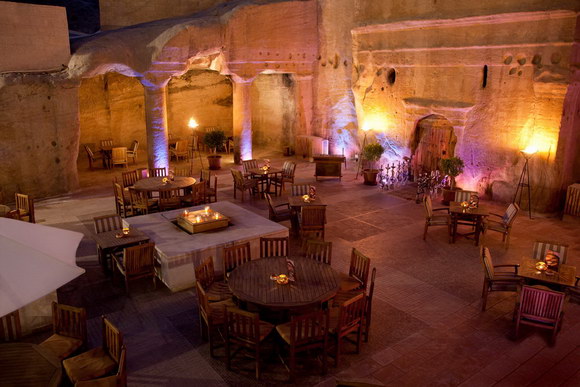
  1. Cave Bar; Wadi Musa, Petra, Jordan (c. 1st century BCE)
  2. The Old Ferryboat Inn; Holywell, Cambridgeshire, England (560 CE)
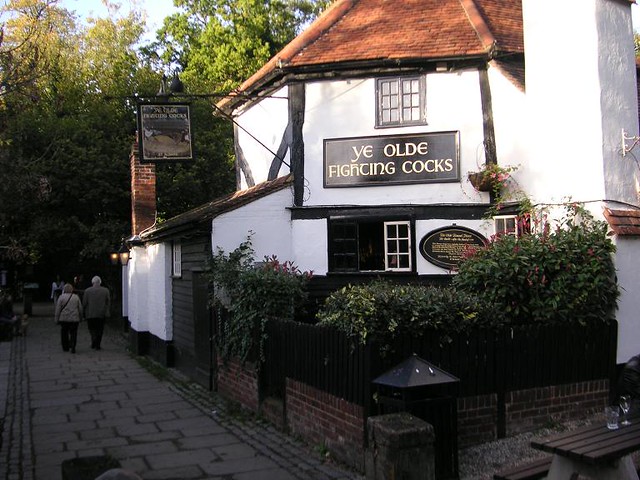
  3. Ye Olde Fighting Cocks; St. Albans, Hertfordshire, England (c. 793 CE) [ Wikipedia ] [Note: A sign on the pub also states that the building was originally a monastery, then a Medieval Pigeon house, before being rebuilt in 1600 after the flood of 1599]
  4. St. Peter Stiftskeller; Salzburg, Austria (803 CE) [considered oldest restaurant in Europe]
  5. Sean’s Bar; Athlone, Ireland (900 CE)
  6. The Porch House; Stow-on-the-Wold, England (947 CE) [Note: Considered an Inn, rather than a bar]
  7. The Bingley Arms; Bardsey, North Leeds, England (953 CE; at least once source claims 905 CE)
  8. The Royal Standard of England; Beaconsfield, England (1086)
  9. The Skirrid Inn; Abergavenny, Wales (1110)
  10. Zum Riesen; Miltenberg, Germany (est. c. 1150; other sources say 1314 or 1411) [ Wikipedia ]
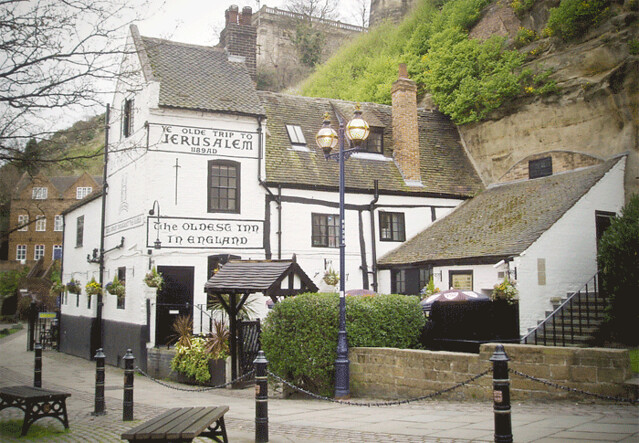
  11. Ye Olde Trip to Jerusalem; Nottingham, England (1189) [ Wikipedia ]
  12. Brazen Head; Dublin, Ireland (1198)
  13. La Reserve de Quasimodo; Paris, France (c. 1200s)
  14. The White Hart Inn; London, England (1216)
  15. Café Den Turk; Ghent, Belgium (1228)
  16. Ye Olde Salutation Inn; Nottingham, England (1240) [ Wikipedia ]
  17. Adam and Eve; Norwich, England (1241 or 1249)
  18. The Bear Inn; Oxford, England (1242)
  19. Ye Olde Man & Scythe; Bolton, England (1251) [ Wikipedia ]
  20. Piwnica Swidnicka; Wroclaw, Poland (1275)
  21. Bratwursthäusle Nürnberg; Nürnberg, Germany (1313)
  22. Brauhaus Sion; Cologne, Germany (1318)
  23. Kyteler’s Inn; Kilkenny, Ireland (1324)
  24. Haus zum Rüden Zürich; Zurich, Switzerland (1348)
  25. Zum Weinberg; Wismar, Germany (1354)
  26. The Sheep Heid Inn; Edinburgh, Scotland (1360)
  27. De Draak; Bergen op Zoom, The Netherlands (c. 1397)
  28. Old Ferry Boat; Holywell, St. Ives, England (c. 1400)
  29. Zum Franziskaner; Stockholm, Sweden (1421)
  30. The Red Lion (f.k.a. Hopping Hall); Westminster, London, England (c. 1434; current pub dates to 1733, remodeled in 1896)
  31. Al Brindisi; Ferrara, Italy (1435)
  32. The Bell; Nottingham, England (1437)
  33. Zice Gastuz; Loce, Slovenia (1467)
  34. De Waag; Doesburg, The Netherlands (1478)
  35. U Fleku; Prague, Czech Republic (1499)
  36. The Nags Head; Burntwood, England (c. 16th century)
  37. Herberg Vlissinghe; Bruges, Belgium (1515)
  38. The Prospect of Whitby (f.k.a. the Devil’s Tavern); Wapping, London, England (1520)
  39. Sternbräu; Salzburg, Austria (1542)
  40. Ye Olde Mitre Tavern; Holborn, England (1546)
  41. The Mayflower; Rotherhithe Village, London, England (1550)
  42. Quinten Matsijs; Antwerp, Belgium (1565)
  43. Na Slamniku; Prague, Czech Republic (1570)
  44. The Grapes; Limehouse, London, England (1583)
  45. Spaniards Inn; Hampstead, London, England (1585)
  46. Hofbräuhaus; Munich, Germany (1589)
  47. Seven Stars; Holborn, London, England (1602; though more likely 1680)
  48. Café Karpershoek; Amsterdam, The Netherlands (1606)
  49. Hatchet Inn; Bristol, England (1606)
  50. Anchor Bankside; Southwark, London, England (c. 1665; rebuilt after fires in 1750 & 1876)
  51. Ye Olde Cheshire Cheese; London, England (1667)
  52. Ye Olde Watling; London, England (1668)
  53. El Rinconcillo; Seville, Spain (1670)
  54. Ye Olde Bell Tavern; London, England (1670)
  55. White Horse Tavern; Newport, Rhode Island, USA (1673)
  56. The George Inn; Southwark, London, England (1677)
  57. The Clachan Inn; Drymen, Scotland (1734)
  58. The Split Crow; Halifax, Nova Scotia, Canada (1749) [Note: The bar has moved a couple of times & also changed names, so depending on definitions may not count as Canada’s oldest]
  59. Antico Caffe Greco; Rome, Italy (1760)
  60. L’Auberge Saint-Gabriel; Montreal, Quebec, Canada (1769)
  61. Lamb & Flag; Covent Garden, London, England (1772)
  62. Olde Angel Inn; Niagra-on-the-Lake, Ontario, Canada (1789)
  63. Prince George Hotel; Kingston, Ontario, Canada (c. 1809; though more likely 1820)
  64. Mitre Tavern; Melbourne, Australia (1835)
  65. Kamiya Bar; Tokyo, Japan (1880) [billed as oldest Western-style bar]
  66. Bar Luiz; Rio de Janeiro, Brazil (1887)
  67. Hussong’s Cantina; Ensenada, Baja, Mexico (1892) [ Wikipedia ]

Cave-Bar-outside-view
The Cave Bar in Petra, Jordan. The world’s oldest bar? Or not.

AYD43X
Sean’s Bar in Atholone, Ireland, may have a better case, dating from 900 CE.

Ye_Olde_Fighting_Cocks
Then there’s the Ye Olde Fighting Cocks, which looks promising until you discover that it was originally a monastery, then was used as a Medieval Pigeon house, before being rebuilt in 1600 after being destroyed in the flood of 1599.

Ye_Olde_Trip_to_Jerusalem
And while Ye Olde Trip to Jerusalem is probably not, as is claimed on the side of the building, “The Oldest Inn In England,” I love the way it looks. It just has the I’m-really-old look that you want in an ancient bar.

Filed Under: Beers, Just For Fun, Related Pleasures Tagged With: Bars, History, Pubs

Patent No. 580104A: Apparatus For Manufacturing Beer Or Ale

April 6, 2015 By Jay Brooks

patent-logo
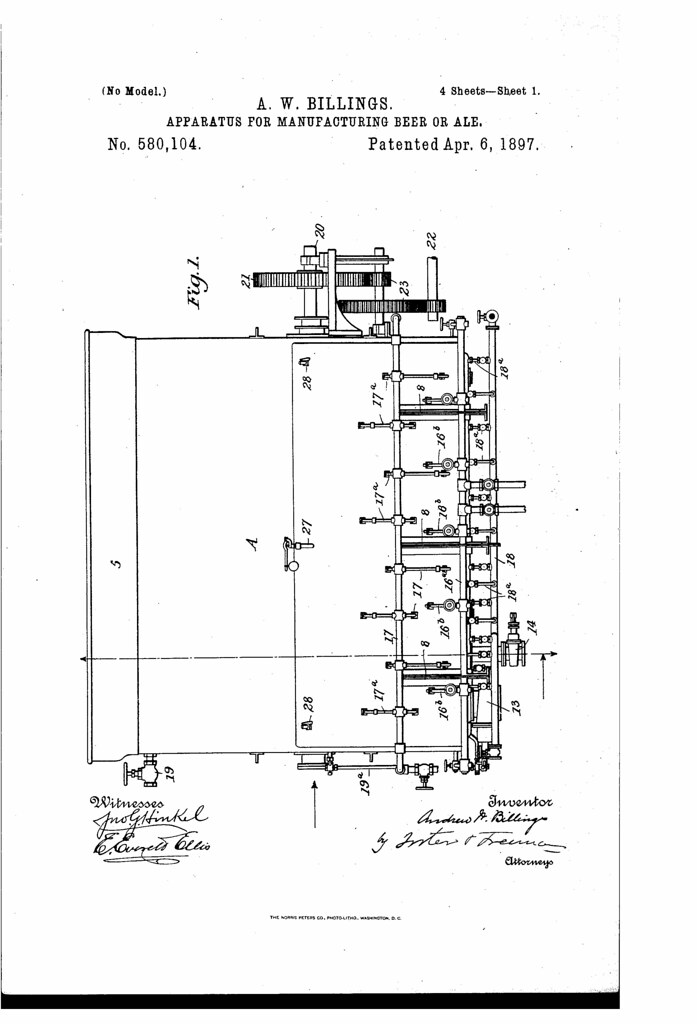
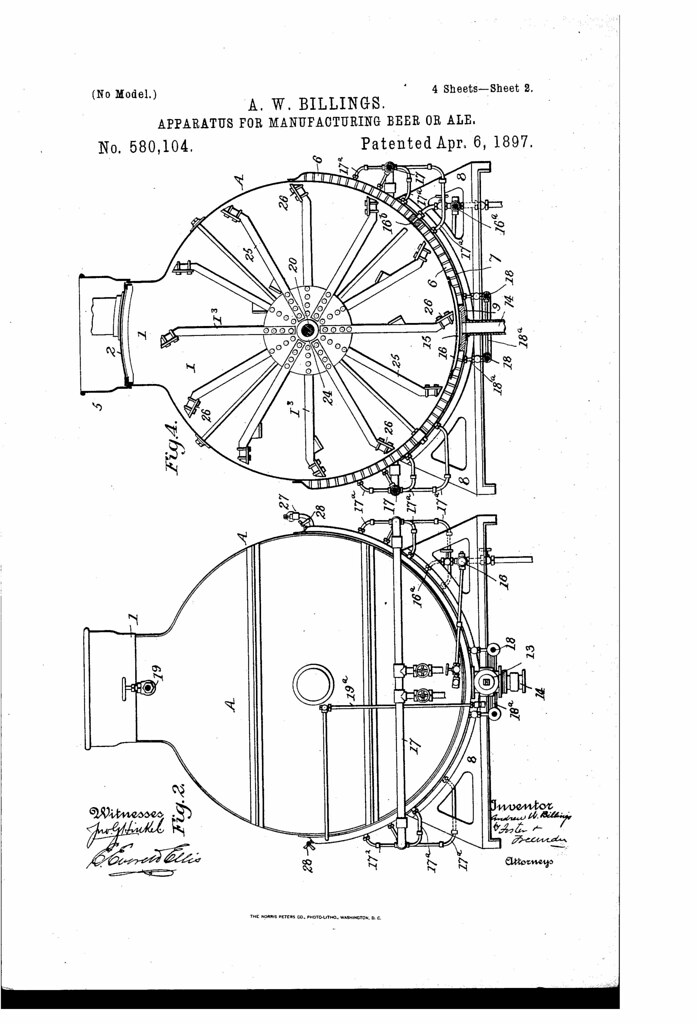
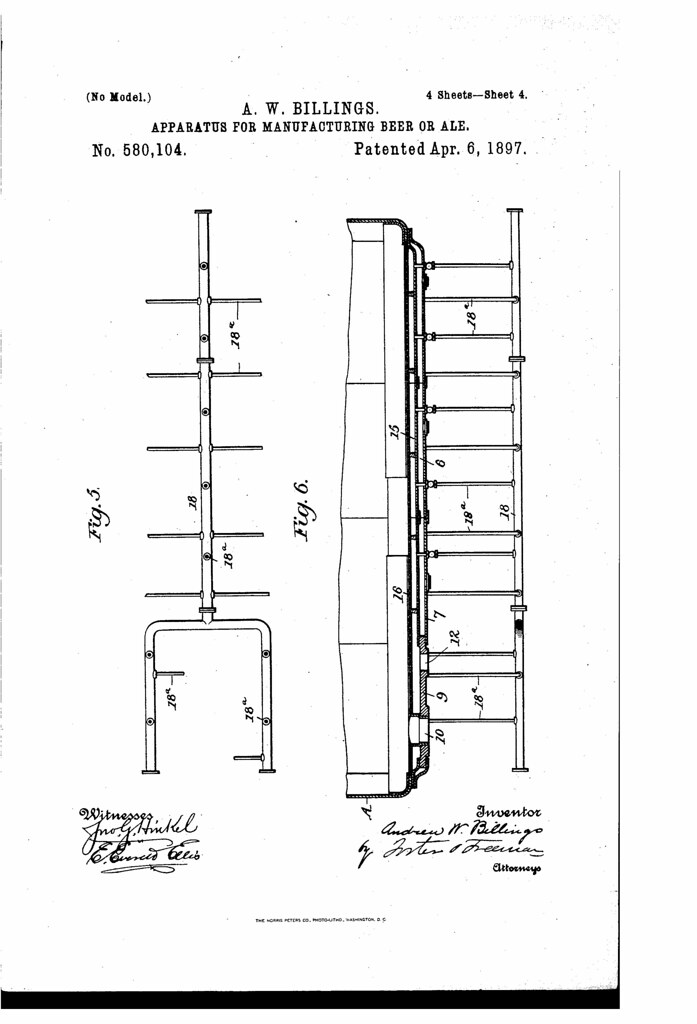
Today in 1897, US Patent 580104 A was issued, an invention of Andrew Worthington Billings, for his “Apparatus for Manufacturing Beer or Ale.” There’s no Abstract, but here’s how it’s described. “It is the object of the invention to provide an apparatus by the use of which malt liquors may be manufactured in a simpler, quicker, and less expensive manner than heretofore and to effect the aeration of wort in the same apparatus in which the mashing and boiling take place. A further object of the invention is to insure the perfect sterilization of the air used in the aeration of the wort and to regulate the flow of such air in the manner hereinafter more particularly pointed out.”

US580104-0
US580104-1
US580104-2
US580104-3

Filed Under: Beers, Breweries, Just For Fun, Politics & Law, Related Pleasures Tagged With: Brewing Equipment, History, Law, Patent, Science of Brewing

« Previous Page
Next Page »

Find Something

Northern California Breweries

Please consider purchasing my latest book, California Breweries North, available from Amazon, or ask for it at your local bookstore.

Recent Comments

  • Bob Paolino on Beer Birthday: Grant Johnston
  • Gambrinus on Historic Beer Birthday: A.J. Houghton
  • Ernie Dewing on Historic Beer Birthday: Charles William Bergner 
  • Steve 'Pudgy' De Rose on Historic Beer Birthday: Jacob Schmidt
  • Jay Brooks on Beer Birthday: Bill Owens

Recent Posts

  • Beer In Ads #5235: The Buck Is Loose! April 29, 2026
  • Historic Beer Birthday: Robert Cain April 29, 2026
  • Historic Beer Birthday: Philip Jacob Ebling Jr. April 29, 2026
  • Beer Birthday: Tom Riley April 29, 2026
  • Historic Beer Birthday: Matthew Vassar April 29, 2026

BBB Archives

Feedback

Head Quarter
This site is hosted and maintained by H25Q.dev. Any questions or comments for the webmaster can be directed here.