Brookston Beer Bulletin

Jay R. Brooks on Beer

  • Home
  • About
  • Editorial
  • Birthdays
  • Art & Beer

Socialize

  • Dribbble
  • Email
  • Facebook
  • Flickr
  • GitHub
  • Instagram
  • LinkedIn
  • Pinterest
  • RSS
  • Twitter
  • YouTube

Powered by Genesis

The California Drought: Almonds, Water (And Beer)

April 10, 2015 By Jay Brooks

almonds
You probably noticed that California is living under severe drought conditions, especially since governor Jerry Brown recently imposed restrictions on our water use. One of the frequent industries to bear the brunt of blame is, of course, agriculture, which uses a lot of water to feed the country. But more specifically, a lot of blame has come down on almonds with stories in the Chronicle, the Guardian and even Slate declaring 10 Percent of California’s Water Goes to Almond Farming, among many others. I haven’t paid too much attention to that, mostly for the selfish reason that I’m not much of a fan of almonds, and couldn’t care less if they stopped growing them.

Gizmodo has an interesting article suggesting that all that stuff about almonds was hooey entitled Seriously, Stop Demonizing Almonds. In a persuasive piece, it’s revealed that “Almonds might take 10 percent of the state’s water, but as the same report notes, they’re generating about 15 percent of the state’s total farming value and almost 25 percent of the agricultural exports from the state.” Of course, I’m no expert on these things, but I encourage you to read it and decide for yourself.

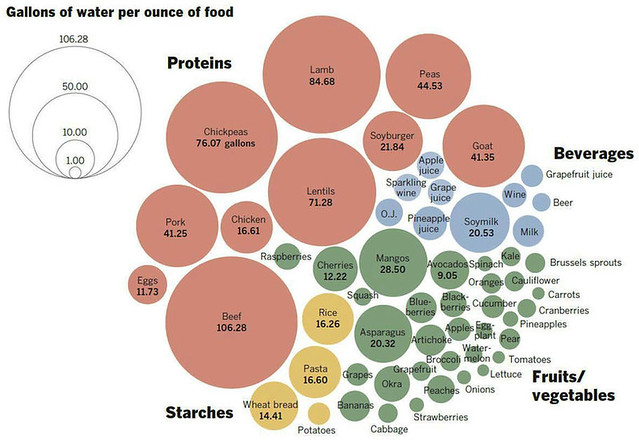
But I actually bring this up for wholly non-almond related reasons. Something in the article caught my attention, which is the chart below. It’s an infographic which originally was published in the L.A. Times, which the Gizmodo author, Alissa Walker, characterizes as a “very misguided infographic of “water-hungry foods.” The title indicates it shows the relative amount of water used to make the finished product, “Gallons of water per ounce of food.”
gallons-water-per-oz-food

But look where beer is on the chart. Beverages are in blue. Soymilk looks like it uses the most, but apparently there was an error that’s now been corrected, and it’s actually pineapple juice that’s the biggest water hog, using 6.36 gallons per ounce of juice. Compared to all the drinks listed, beer looks to be the most efficient, and the interactive portions of the chart on the L.A. Times website indicates that beer uses 1.96 gallons to produce one ounce of beer. But even that seems high.

A bunch of years ago I wrote a feature article for All About Beer entitled It Ain’t Easy Bein’ Green: The Greening of America’s Breweries, that examined the steps breweries were taking to lighten their burden on the planet, not just with water, but all sorts of things. One thing I learned was that brewing used roughly a 10-to-1 ratio of water, meaning they use 10 gallons for every gallon of beer. At that time, I also found. “Examining smart ways to conserve water, several breweries have reduced that ratio to four or five-to-one and Uinta Brewery from Utah has gotten it down to 3-to-1.” More recently, the Brewers Association’s Water and Wastewater: Treatment/Volume Reduction Manual claims that the average is now more like 7-to-1 gallons, with a few breweries actually below 3-to-1. Two years ago, Environmental Leader reported that MillerCoors managed to get their ratio of water use down to “3.82 barrels of water per barrel of beer.”

But even staying with a ratio of 10-to-1 for ease of math, this seems egregiously high. Converting the L.A. Times figure of 1.96 gallons to 1 ounce figure to ounces, it becomes 250.88 ounces of water per ounce of beer, or a 251-to-1 ratio, or 25 times reality, and undoubtedly more.

So where did this figure come from? All the Times reveals about its methodology is this. “Totals were converted to U.S. gallons per ounce (weight). Beverage values were additionally converted into fluid ounces using the USDA National Nutrient Database for Standard Reference.” But that doesn’t really tell us where they got the numbers they’re basing this on. It doesn’t really tell us anything. But one thing seems clear, breweries are relatively efficient in their water use, much more so than is being reported during the California drought. And that brings us back to a statement U.S. Davis professor Charlie Bamforth recently made, which seems even more relevant in light of this. “When in drought, drink more beer.”

Filed Under: Beers, Editorial, News, Politics & Law, Related Pleasures Tagged With: California, Food, Water

Patent No. 4915959A: Decarboxylation Of Acetolactate To Diacetyl, Enzymatic Reduction To Acetoin

April 10, 2015 By Jay Brooks

patent-logo
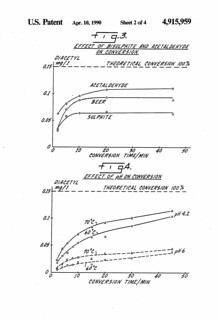
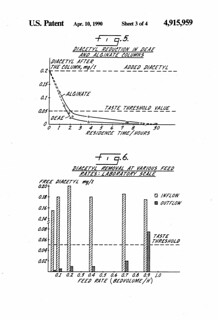
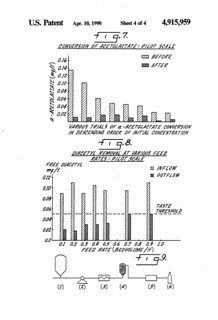
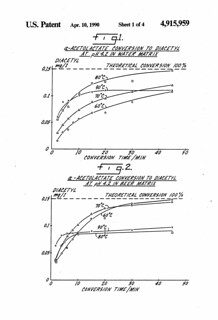
Today in 1990, US Patent 4915959 A was issued, an invention of Esko Pajunen, Veijo Makinen, Heikki O. Lommi, and Markku S. Loisa, for their “Method for the Continuous Maturation of Fermented Beer” or the “Decarboxylation of Acetolactate to Diacetyl, Enzymatic Reduction to Acetoin.” Here’s the Abstract:

Beer is fermented by the use of yeast and after fermentation the yeast is removed and the maturation or lagering of the beer is accomplished by a continuous maturation process which involves heat treating the beer to convert all or substantially all the alpha acetolactate and other diacetyl precursors present to diacetyl, cooling the beer, and feeding the heat treated fermented beer through a reaction column packed with immobilized yeast cells at a flow rate which effects the conversion of said diacetyl to acetoin in order to lower the concentration of said diacetyl to levels which do not result in tastes normally considered unacceptable for a beer.

US4915959-1 US4915959-2

US4915959-3 US4915959-4

Filed Under: Beers, Breweries, Just For Fun, Politics & Law, Related Pleasures Tagged With: History, Law, Patent, Science of Brewing

Let’s Grab A Beer

April 10, 2015 By Jay Brooks

lets-grab-a-beer
Show of hands: who remembers “Here’s to Beer,” the somewhat lackluster attempt by Anheuser-Busch to teach consumers more about beer eight years ago? No? Let me refresh your memory. The original idea in 2005 was to have all of the major breweries work together to promote beer as an industry, rather than promote any one brand, sort of like the Beer Belongs campaign by a brewers trade group in the late 1940s and 1950s. Unfortunately, trust was not strong among the competing larger breweries and none signed on, fearing A-B would run the show and control the message for their own benefit. So A-B decided to go it alone, and launched a consumer website in 2006 called Here’s to Beer. If you click on the link, it still works, but it’s not that first attempt anymore. Before it launched there were press releases and media talking about it, including me in Here’s To Beer — Here’s to Making it Appear Relevant and Appealing. A few days later the website went live and I did an initial review of it, which was not overwhelmingly positive. A year later I started questioning if Here’s to Beer was dead with R.I.P. Here’s to Beer? But it turned out that the reports of its demise had been premature, and a month later Phase 2 launched with an updated website. That website, which used to be “herestobeer.com” changed to “htbeerconnoisseur.com” and that’s the one that is still online, although it doesn’t appear to have been updated in quite some time, if ever. The copyright information at the bottom of the home page is dated 2009, and attributed to “Here’s to Beer, Inc.” which you won’t be surprised to learn is located at 1 Busch Place, Saint Louis,” the headquarters for Anheuser-Busch InBev. So Phase 2 was about as successful as the first attempt, and quietly faded away.

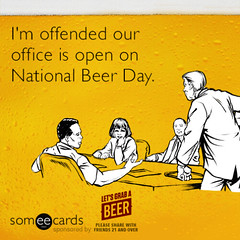
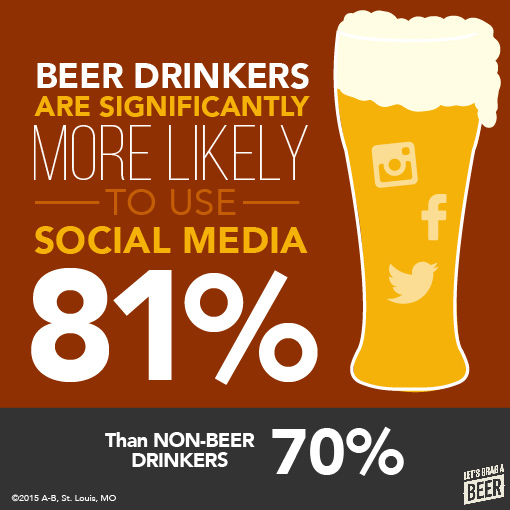
So this past Tuesday, on “National Beer Day,” you may have seen some of these graphics making the rounds on Twitter, Facebook and other social media. I know I retweeted a couple of them.

lgab-offended lgab-national-day

It turns out they’re part of a new effort by ABI, this time called “Leg’s Grab a Beer.” Apparently Beer Marketer’s Insights first reported on it, but I saw it on AdAge, in an article entitled Let’s Grab a Beer… With A-B InBev: Brewer Tries Unbranded Beer Image Campaign. The idea, this time around, according to Julia Mize, ABI VP of Beer Category + Community, is wanting “consumers to understand all the different varieties that are available with beer for different occasions.” Which is much more possible now that they acquired several more smaller breweries outright.

But her subsequent statement is really hilarious: “[W]e wanted to do it in a non-branded way so that we make sure we are connecting with the consumers and it’s not forced. It’s not marketing. Our intention here is to just have a resource that is relevant and fun and celebrates beer.” That reminds me of something Bill Hicks said about marketing, “they’re going for the anti-marketing dollar.” Essentially they’re marketing by not marketing, a tactic more prevalent in our more media-savvy present. And while I’m certainly not against a little education, this seems more like a Tumblr than any real effort at that. The plan apparently is for the “site [to] include a combination of original and aggregated content, ranging from ‘deep reads about the past, present and future of beer’ to colorful charts and graphics,” although at least for now there’s a lot more of the latter. Some of the “deep reads” include such titles as “7 Beer GIFs that Will Make Your Mouth Water” and a photograph of “Women demonstrating against Prohibition 1932.” It’s not exactly heady stuff they’re tackling so far.

Here’s to Beer, for all its faults, at least tried to educate consumers. This latest attempt seems more intended to entertain, not that there’s anything wrong with that.

The National Beer Day cards were done, apparently, in partnership with Some E-Cards. Sadly, it doesn’t look like you can make your own cards using the beer background. That’s a shame, it would have been fun to make some.

There’s definitely some interesting things being shared, but edumacation it ain’t. The other problem I see is something that seems to happen frequently to these sorts of efforts. There was a flurry of posts to the Let’s Grab a Beer Tumblr (might as well call it what it is) but then nothing new since Tuesday, three days ago. That’s a long time for a tumblr to not be updated. I have several, and make an effort to post something at least once a day, while many others post new content far more often than that. But Here’s to Beer suffered from the same problem: infrequent updates gave little reason to return to the site with any frequency. If you can absorb everything there in a few minutes and then there’s nothing new posted, why would anyone become a regular visitor?

Web

It’s somewhat obvious why they’re doing this, as one of their own posts makes clear. So if beer drinkers are using social media more often, why wouldn’t they realize you have to keep up with the pace of that social media? If they really want something like this to work, they need at least a dedicated person working on this 24/7. That’s what makes a successful Tumblr.

Midway through the AdAge article, the author suggests it’s branding at the heart of this move.

But there is also an inherent fear in industry circles about the so-called “wineification” [how I hate that word!] of beer. This refers to placing emphasis on beer styles, versus brands. For instance, if more people walk into bars and ask for a “wheat beer,” rather than a Shock Top or Blue Moon, brands become less valuable. And good branding equals profits.

“They are facing the ultimate challenge here of trying to promote a category that really lives through its brands,” said one industry executive, speaking on the condition of anonymity. “So how do you celebrate beer without making it a commodity? The value of the industry is in the equity of the brands.”

I have to take issue with her definition of “wineification,” saying it means “placing emphasis on beer styles, versus brands.” I don’t think that’s it at all. Nobody walks into a wine bar and says “give me a Chardonnay” or “oh, anything red will be fine.” The term generally has been used to suggest that beer is trying to be fancy, or be marketed more like wine, and is usually used derisively (at least by me). I think people do look to drink a particular type of beer they’re in the mood for or for some other reason just want at a particular time, but it’s been a long time (at least a decade or more, I’d guess) since most people would sit down at a bar and ask the bartender for whatever “pale ale,” or perhaps more popularly an “IPA, they have on tap. Brands still matter a great deal, as the spate of recent high profile trademark disputes among brewers should make abundantly clear to anyone paying attention.

But the rest is an interesting insight. Branding is how all of the big brewers made their fortunes, especially when most beer tasted about the same. In effect, all beer was commodified for a long time, which is why advertising, marketing and branding became so important for the success of the big beer companies. It was no accident that year after year, A-B outspent their competition in ad dollars per barrel by a wide margin. I haven’t seen those figures since InBev took control of A-B, but certainly that was the case up until that transition.

Now that smaller breweries have essentially uncommodified beer by offering a wide range of beers that don’t all resemble or taste like one another, big brewers are left asking themselves what to do now. “So how do you celebrate beer without making it a commodity? The value of the industry is in the equity of the brands.” In some ways that, anonymous executive is still engaging in old beer thinking, using the framework of how the industry used to be constituted. One could argue it still is since 90% of beer is of that single, commodified type — American lager — but it’s nowhere near as universal as when I was a kid. And I think even small beer’s 10% slice of the total beer pie is enough to have at least changed many, if not most, people’s perception of it, even if they choose to still buy the big brewer’s beers. Even the loyal customers still buying the bland American beers know about Yuengling, or Samuel Adams, or Sierra Nevada, or New Belgium, or Lagunitas. What the big brewers bought with decades of blanket advertising was not just blind loyalty, but habit. And habits are harder to shake, because they’re no longer conscious decisions.

So I’m unequivocally in favor of beer education for everyone. We’ve known since the beginning of flavorful beer’s rise that education was the path to winning over more beer drinkers. In order to appreciate it, you have to know something about it. That may not be necessary to simply drink it and enjoy it, but to appreciate what you’re tasting, you do have to know a little more.

I think music once again provides a useful analogy. You don’t need to know anything about music theory or composition to love the Allegro con brio first movement to Beethoven’s 5th symphony in C minor, or Gershwin’s Rhapsody in Blue. But if you do, the experience is much richer because you understand what they were doing differently than their predecessors and how they were expressing musical ideas. The history of music is all about rules, and breaking them. Baroque music was very orderly and followed strict rules for its composition, then innovative composers broke those rules and created the classical music period, which in turn had its rules broken by romantic composers, and so on. Each time there was push back from the status quo before the new music became the next established form.

I think we’re seeing something similar with beer, too, as traditional rules have been broken, but are often respected, too. Innovation is simply trying something a little different or even going back to something that hasn’t been done for a long time, or mixing the two, or doing something old in a new way. It doesn’t have to mean something particularly snooty or high falootin’ as we so often seem to think. It’s just how change occurs. It’s trying to find something you can call your own that a brewery can sell and make their reputation. Few breweries, if any, will do that making the same thing as everybody else is. That’s how we got in the mess we were in by 1980 in the first place. So we should expect breweries to try something new, with 3,000 of them they almost have to experiment to find a niche, or their place in the market. Some will undoubtedly work better than others, and some will ultimately fail while others succeed. That’s the natural order of things. That’s healthy competition, with breweries competing on taste or what people are willing to support and buy.

I think I’ve veered off quite a bit from where I started with this, rambling on about some unrelated ideas, but the takeaway is that education matters — “Just Say Know™” is my catchphrase — but this may not be the best way to engage more people to learn about beer. Still, I’m up for whatever. Let’s grab a beer.

Filed Under: Beers, Breweries, Editorial, Related Pleasures Tagged With: Advertising, Anheuser-Busch InBev, Big Brewers, Business, Education, Marketing, Websites

Patent No. 518137A: Apparatus For Dispensing Beer

April 10, 2015 By Jay Brooks

patent-logo
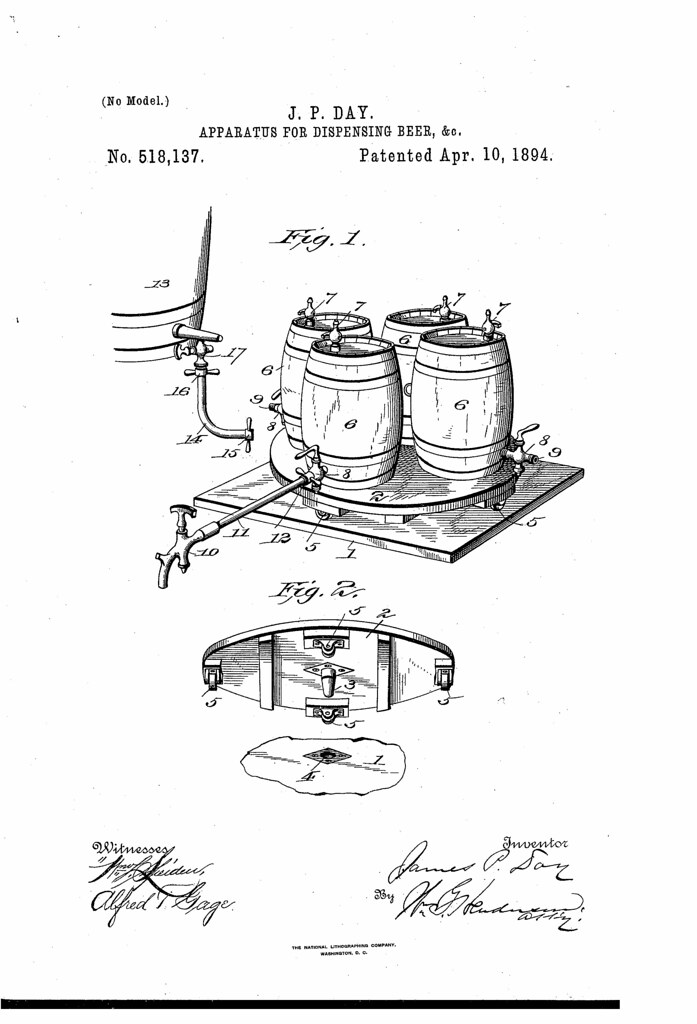
Today in 1894, US Patent 518137 A was issued, an invention of James P. Day, for his “Apparatus for Dispensing Beer.” There’s no Abstract, but the description states that the “invention has reference to [an] apparatus for dispensing liquids, particularly those which are charged with an effervescent gas, and is designed more especially for the dispensing of beer.” Here was the goal:

It has primarily for its object to preserve the freshness of the beer and to keep it palatable and wholesome whereby the reputation of the brewery where the beer, is made is maintained for brewing a high grade of beer and the sales of the retailer are increased so far as the same can be done by establishing a reputation for furnishing fresh and palatable beer to the consumer.

US518137-0

Filed Under: Beers, Just For Fun, Politics & Law, Related Pleasures Tagged With: History, Kegs, Law, Patent

Beer In Ads #1520: The Choicest Product Of The Brewers’ Art

April 9, 2015 By Jay Brooks


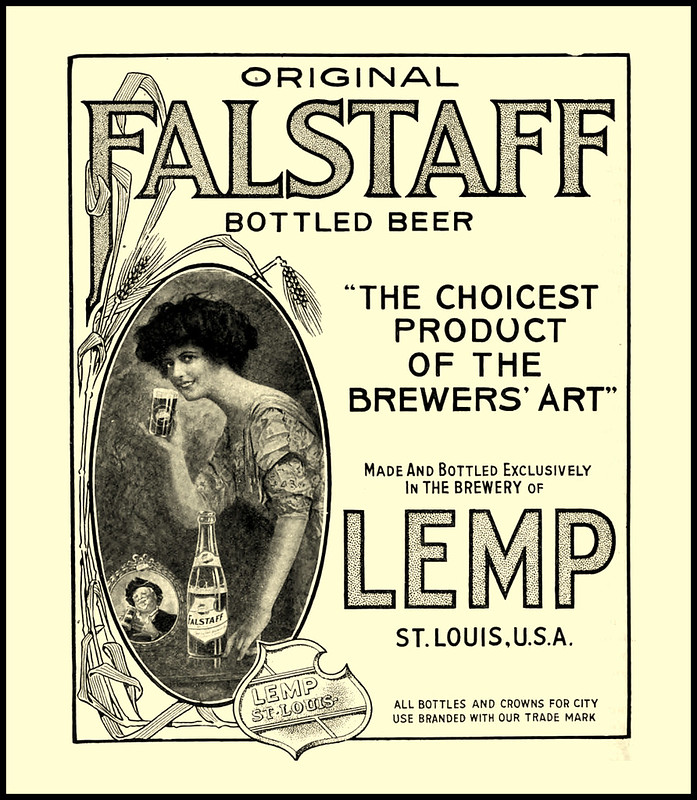
Thursday’s ad is for the Lemp Brewery of St. Louis, from 1912, and specifically their original Falstaff bottled beer. I especially love the expression of the model in the inset picture, she’s a peach, but it almost looks like she’s taunting us. And that inset picture has its own inset picture, a portrait presumably of the Shakespearean character Falstaff. Or it may be a framed photo of Falstaff on the table. Either way, he’s there there, even though he’s not exactly much of a role model, usually described as being “fat, vain, boastful, and [a] cowardly knight, he spends most of his time drinking at the Boar’s Head Inn with petty criminals.”

Falstaff-1912

Filed Under: Art & Beer, Beers Tagged With: Advertising, History

Patent No. 2196193A: Method Of Aging Alcoholic Liquors

April 9, 2015 By Jay Brooks

patent-logo
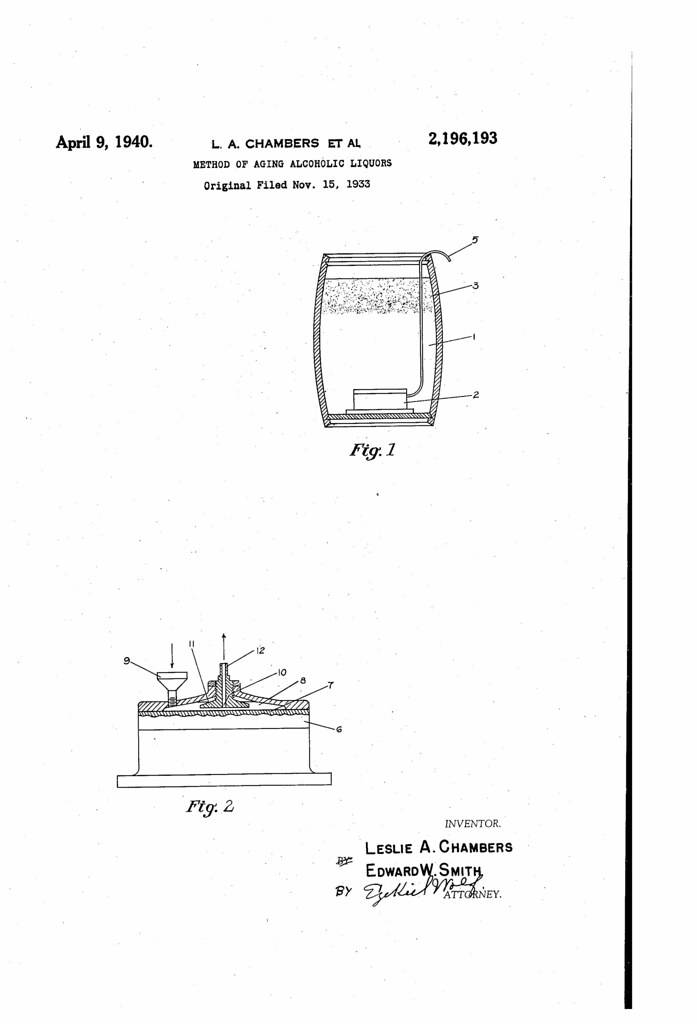
Today in 1940, US Patent 2196193 A was issued, an invention of Leslie A. Chambers and Edward W. Smith, for their “Method of Aging Alcoholic Liquors.” There’s no Abstract, but the description claims that the “present invention relates to the application of vibratory energy, particularly at supersonic frequencies, to the aging of alcoholic liquors used as beverages, stimulants, etc., for human consumption as, for instance, whiskies, brandies, rums, liqueurs, and to some extent to the so-called lighter or undistilled liquors as wines, cider and champagne and also beer and ale.” That seems like a strange idea to me, but who knows? The application mentions using an oscillator. It must have been too successful, or we’d be using oscillators to age all our beers. It’s certainly an interesting read to hear some of the ideas circa 1940 about aging alcohol.

US2196193-0

Filed Under: Beers, Just For Fun, Politics & Law, Related Pleasures Tagged With: Barrels, History, Law, Patent

Patent No. 850070A: Beer-Tapper

April 9, 2015 By Jay Brooks

patent-logo
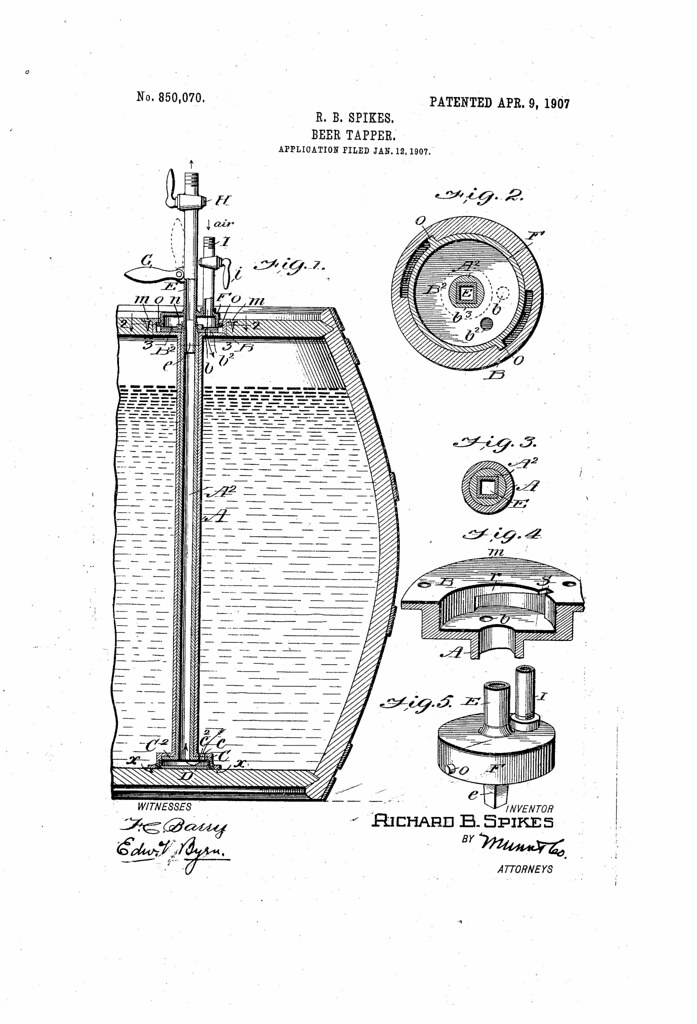
Today in 1907, US Patent 850070 A was issued, an invention of Richard B Spikes, for his “Beer-Tapper.” There’s no Abstract, but here’s what the description claims. “My invention relates to that class of devices known ‘beer-tappers,’ which in the nature of appliances for opening and dispensing beer from the keg or barrel. Such devices have heretofore been employed which simultaneously opened an outlet for beer and an interior air.”

US850070-0

Filed Under: Beers, Just For Fun, Politics & Law, Related Pleasures Tagged With: History, Kegs, Law, Patent

Beer In Ads #1519: A Friend You Can Depend On

April 8, 2015 By Jay Brooks


Wednesday’s ad is for Griesedieck Bros. Brewery, from 1939. It’s a bit of a dull ad, and that background is a sickly yellow color. Although I do love that the beer is not just mellow, but double-mellow. It’s “made mellow in the brewing, kept mellow by the removal of air in the bottle.” The ad copy just keeps getting better, which at least partly makes up for the lousy graphics. “It’s always first for thirst, always right for real refreshment.” Just saying the brewery’s name — if you can even pronounce it — is “the passport to pleasure.”

Griesedieck-Bros-Brewery-1939

Filed Under: Art & Beer, Beers Tagged With: Advertising, History, Missouri, St. Louis

Patent No. 4197321A: Process For Brewing Beer And Treating Spent Grains

April 8, 2015 By Jay Brooks

patent-logo
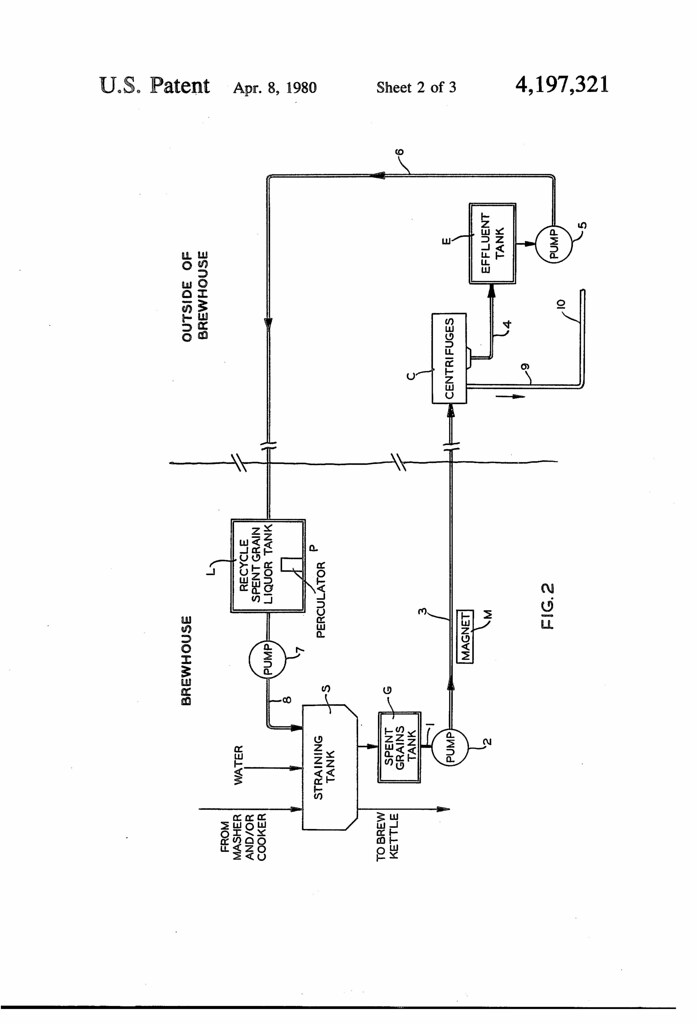
Today in 1980, US Patent 4197321 A was issued, an invention of Gustav W. Chyba and John H. Dokos, assigned to Anheuser-Busch, Incorporated, for their “Process for Brewing Beer and Treating Spent Grains.” Here’s the Abstract:

In the brewing of beer, spent grain at about 90% moisture from a straining tank having no internal rotating rake is collected and pumped to a centrifuge which reduces the moisture of the spent grain to about 70% and provides spent grain liquor of about 2.0 to 4.5% or more of total solids. The spent grain liquor is stored in a tank at 165° F. to 170° F. and held until it is used up to 50% of the sparge liquid for a subsequent brew in the straining tank. The spent grains at about 70% moisture are directed to a large holding tank. Nutritious brewery waste streams are added thereby increasing the nutritional value.

US4197321-1
US4197321-2
US4197321-2

Filed Under: Beers, Breweries, Just For Fun, Politics & Law, Related Pleasures Tagged With: Brewing Equipment, History, Law, Patent, Science of Brewing

Where Do The Moderate Drinking Guidelines Come From?

April 8, 2015 By Jay Brooks

cdc
For as long as I can remember, the recommended daily allowance to remain within moderate drinking guidelines has been one drink for a woman and two for a man. With the USDA’s new 2015 Dietary Guidelines open for comment, Modern Drunkard magazine, through their Brutal Hammer news blog, attempted to discover where those longstanding “2 for a man/1 for a woman” (2m/1w) guidelines came from, and wrote up their efforts in The CDC Is Stonewalling Us. In some ways it’s a silly piece, hinging on the CDC’s website comment apparatus not working, but the overriding question is sound. While the rest of the document about the Dietary Guidelines is heavily footnoted, with numerous references to the basis for their recommendations, the 2m/1w guidelines is suspiciously and conspicuously absent of any underlying scientific support.

Nowhere is it apparent how they came to that determination. No footnotes, no citations of scientific studies, not a damn bit of evidence to support it. Granted, my bourbon binoculars (the classier version of beer goggles, but they see deep into the truth of things) can only take in so much information at a time, but I couldn’t find a shred of reasoning for these arbitrary numbers.

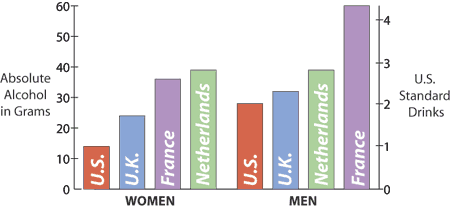
I’d never thought about that before, but it’s a valid question. Where did they come up with that? And it’s not an unimportant one. The guidelines for defining moderate consumption are not the same worldwide, and in fact vary widely.

For example, Professor David J. Hanson at the State University of New York notes. “The fact that alcohol consumption guidelines are arbitrary is demonstrated by the wide variance in maximum limits recommended around the world. For example Poland’s recommended limit is 12.5 units per week whereas Australia’s is 35. Indeed, much research finds better health and greater longevity associated with drinking above the recommended guidelines published by most countries.” To contrast the U.S. guidelines, “Canada recommends that men on average consume no more than three drinks per day, five days per week, for a total of 15 drinks per week. For women it recommends, on average, no more than two drinks per day, five days per week, for a total of 10 drinks per week.”

standard-drinks-graph

A British examination of 27 European nation’s guidelines found “a remarkable lack of agreement about what constitutes harmful or excessive alcohol consumption on a daily basis, a weekly basis and when driving, with no consensus about the ratios of consumption guidelines for men and women.” Hanson concluded. “Thus, it appears that the differences in recommended guidelines are not based solely on the scientific medical evidence, but on cultural and political considerations. That is, the guidelines are highly arbitrary.”

And in some cases, capricious, as well. It was revealed in 2007, twenty years after the guidelines for the UK had been set in stone in 1987, that they were simply made up. One committee member who’d worked on the guidelines remembered that they were simply “plucked out of the air” and had “no basis in science” whatsoever, which I detailed at the time in Target: Alcohol. Without a clear basis on which our own guidelines were arrived upon, how can we be certain ours are any less fabricated inventions?

The other issue that’s never adequately addressed is the split for men and women. Supposedly, it’s because “Women tend to be smaller, but also have different body compositions and different metabolic enzymes.” But we know that weight matters. It’s how we figure out how much an individual can drink before they’ll be drunk or at least reach a specific blood alcohol level, because the rates are fairly precise when accounting for weight plus intake. So why do we ignore that simple knowledge with the guidelines? There are, of course, plenty of small, light men as well as many heavier women. It’s just a reality that people are diverse.

The International Center for Alcohol Policies or ICAP, somewhat disingenuously claims that the “Recommendations are based on scientific data regarding drinking levels at which risk increases,” yet never reveals where this “scientific data” comes from. And the fact that the guidelines vary widely from country to country would seem to suggest otherwise. Because if there was hard scientific data it would be the same everywhere, and the guidelines would not vary by as much as they do.

The closest thing I can find in the U.S. is at the Recommended Alcohol Questions on the NIH and NIAAA website states that the guidelines are “based on recent epidemiological studies on alcohol intake and risks which have demonstrated that for estimating risk of mortality, morbidity (including injuries) and other problems including drunk driving and social harms.” But then where are the citations for these epidemiological studies, and how could they possibly quantify such subjective issues as “social harms.” Quick answer: they can’t, not and remain purely scientific as the guidelines really should be.

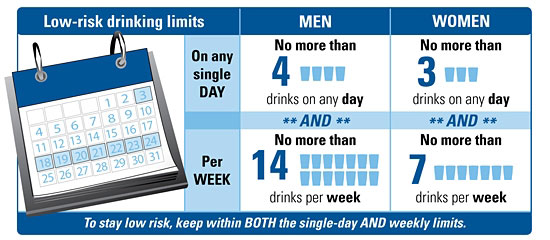
I had never stopped to question the 2m/1w guidelines before, and it appears neither did almost anyone else. While there are plenty of citations for many aspects of the dietary guidelines, when it comes to alcohol, the government suddenly goes silent. But it doesn’t seem like too much to ask that the scientific basis for them be revealed and transparent. I’m not even arguing against them, and have always thought they were somewhat reasonable, especially in their current incarnation with the addition of the weekly limits. But we really should be able to see how they were arrived at, and what science, if any, they were based on.

graphic_lowriskdrinkinglevels

Filed Under: Beers, Editorial, Politics & Law Tagged With: Anti-Alcohol, Government, Health & Beer, International, Prohibitionists, United States

« Previous Page
Next Page »

Find Something

Northern California Breweries

Please consider purchasing my latest book, California Breweries North, available from Amazon, or ask for it at your local bookstore.

Recent Comments

  • Bob Paolino on Beer Birthday: Grant Johnston
  • Gambrinus on Historic Beer Birthday: A.J. Houghton
  • Ernie Dewing on Historic Beer Birthday: Charles William Bergner 
  • Steve 'Pudgy' De Rose on Historic Beer Birthday: Jacob Schmidt
  • Jay Brooks on Beer Birthday: Bill Owens

Recent Posts

  • Beer In Ads #5235: The Buck Is Loose! April 29, 2026
  • Historic Beer Birthday: Robert Cain April 29, 2026
  • Historic Beer Birthday: Philip Jacob Ebling Jr. April 29, 2026
  • Beer Birthday: Tom Riley April 29, 2026
  • Historic Beer Birthday: Matthew Vassar April 29, 2026

BBB Archives

Feedback

Head Quarter
This site is hosted and maintained by H25Q.dev. Any questions or comments for the webmaster can be directed here.