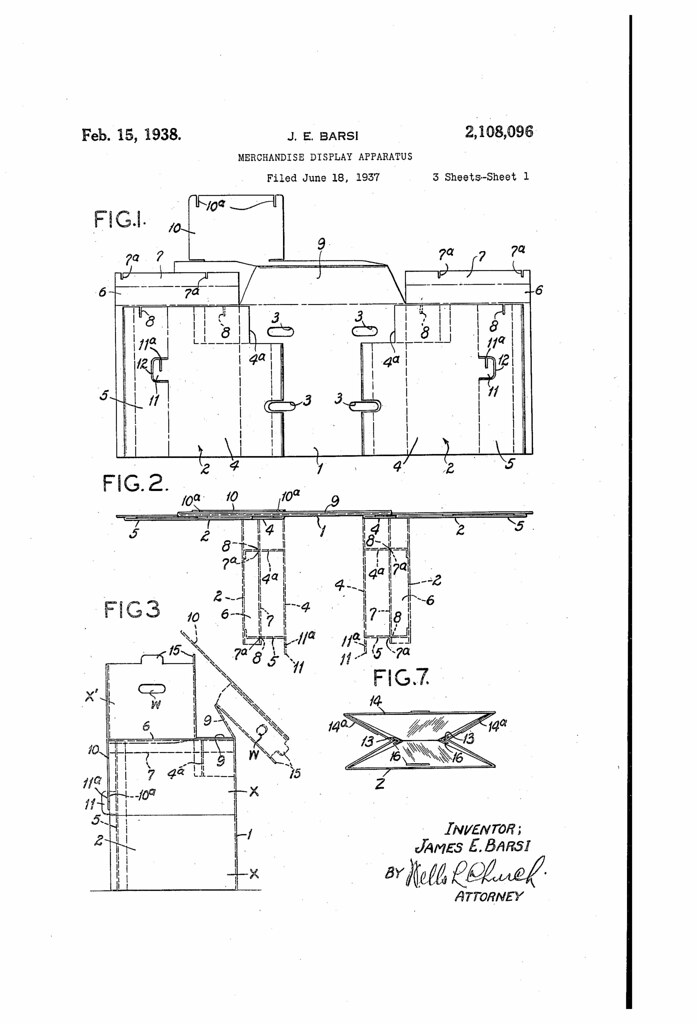
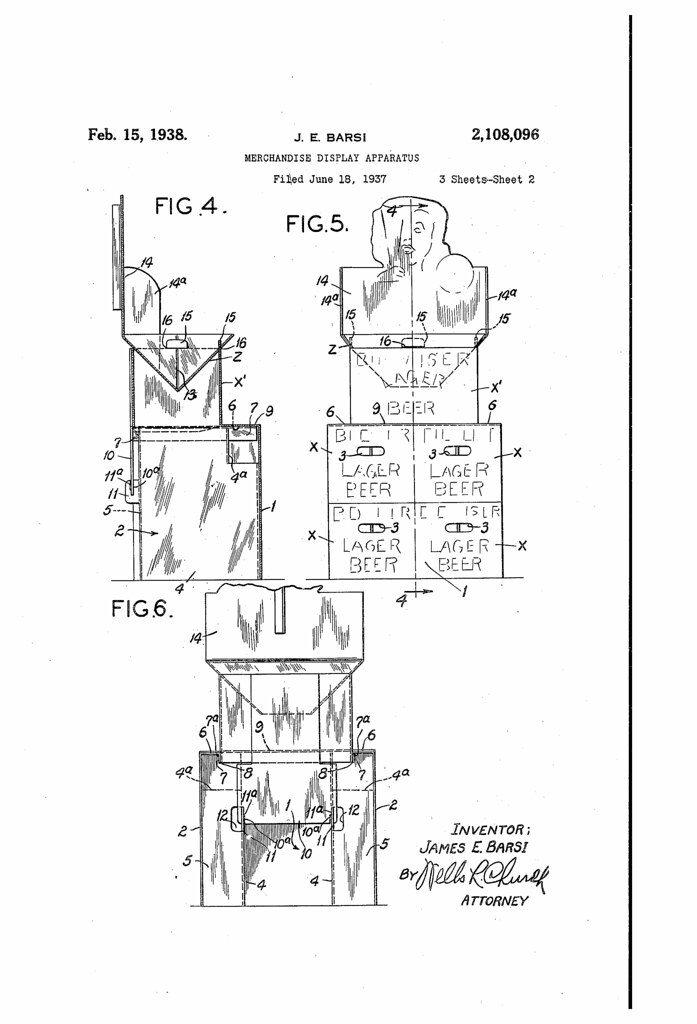
Today in 1938, US Patent 2108096 A was issued, an invention of James E. Barsi, assigned to Anheuser-Busch, for his “Merchandise Display Apparatus.” There’s no Abstract, but the application states that “this invention relates to apparatus of the kind that are used for advertising and displaying merchandise and has for its main object to provide an advertising and/or display apparatus that is of attractive appearance and of such construction that, in addition to holding a plurality of samples of the advertised product in such a way that said samples may be easily handled and inspected by the public, it will also display in an attractive manner other articles or packages containing material that is particularly adapted for use in connection with the advertised product. For example, if the apparatus is intended to be used primarily to advertise a certain brand of beer, it will be equipped with a tray or equivalent part for holding a plurality of bottles or cans of beer and it will also be equipped with a shelf or equivalent part for sustaining packages of various kinds of food that are frequently served With beer, such for example, as pickles, olives, cheese, sausage, crackers, etc.”

The (Big) Companies Who Actually Make Your Beer

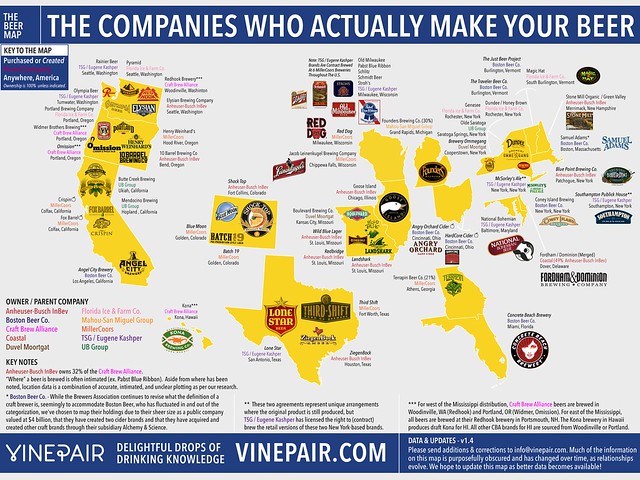
Here’s yet another look at the changing landscape of brewery ownerships, this time from Vinepair, and while they primarily write about wine, they also must tacitly accept the well-trodden wisdom that “it takes a lot of beer to make great wine,” since they do occasionally tackle beer. Last week, the posted their “Map: The Companies Who Actually Make Your Beer.” It’s restricted to ten of the largest companies who own multiple breweries and, to their credit, it’s been updated four times so far, meaning they’re doing their best to get it right, which given its complexity, not to mention who often it’s changing, is no easy task.
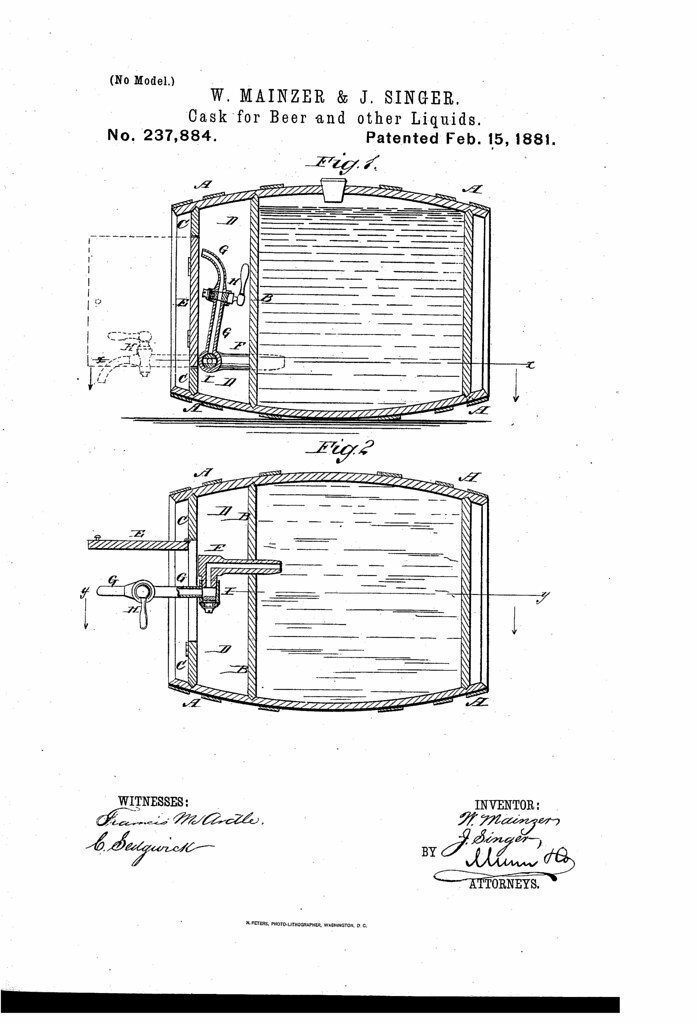
Patent No. 237884A: Cask For Beer And Other Liquids
Today in 1881, US Patent 237884 A was issued, an invention of William Mainzer and John Singer, for their “Cask for Beer and Other Liquids.” There’s no Abstract, but the application states that “the object of this invention is to furnish casks for holding beer and other liquids, so constructed that they can be safely handled and transported without detaching the faucets, and can thus be furnished to the consumer with faucets applied ready for use, and can be returned to be refilled without detaching the faucets.”
Beer In Ads #1466: To My Ballantine

Saturday’s ad is for Ballantine, from 1948. A simple Valentine’s Day ad with a great play on words with the title: “To My Ballantine” and showing a woman cutting out a red heart and leaving the three-ring Ballantine logo as the scraps. Those have got to be the longest scissors I’ve ever seen. They look more like garden shears. But nice and simple, with a great illustration in the center. Happy Valentine’s Day.

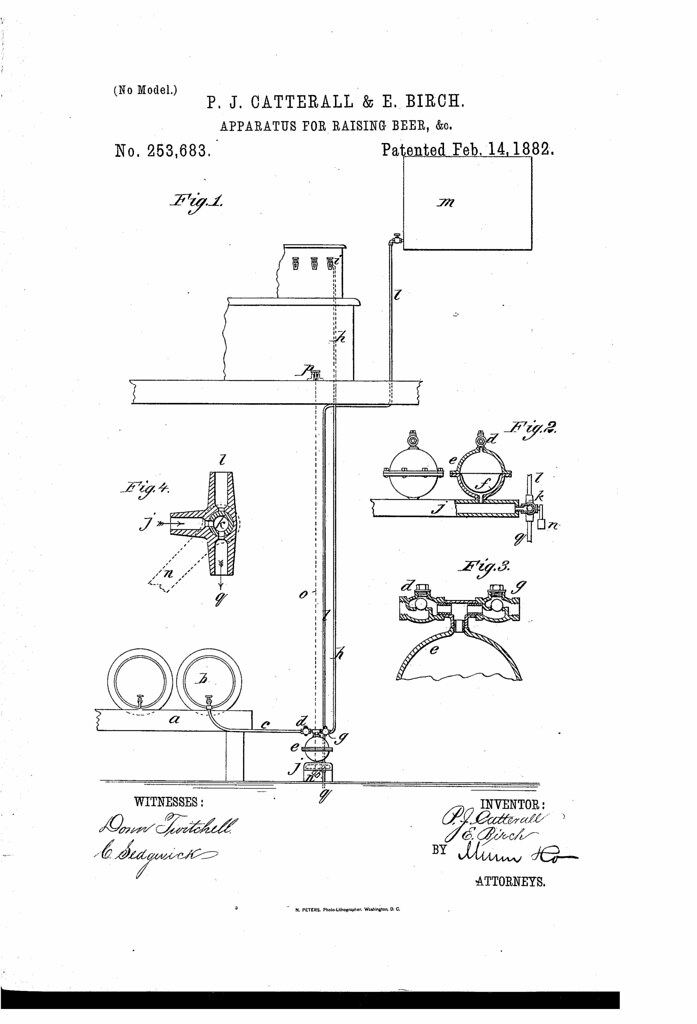
Patent No. 253683A: Apparatus For Raising Beer
Today in 1882, US Patent 253683 A was issued, an invention of Peter J. Catterall and Edward Birch, from Manchester, England, for their “Apparatus for Raising Beer.” There’s no Abstract, but the application states their “invention relates to apparatus for raising valves, through one of which the liquid is admitted to the chamber, and through the other the liquid is forced to the bar or delivery-tap” and there “is a section of the three-way tap that admits and discharges the water used to raise the beer or other liquid.”
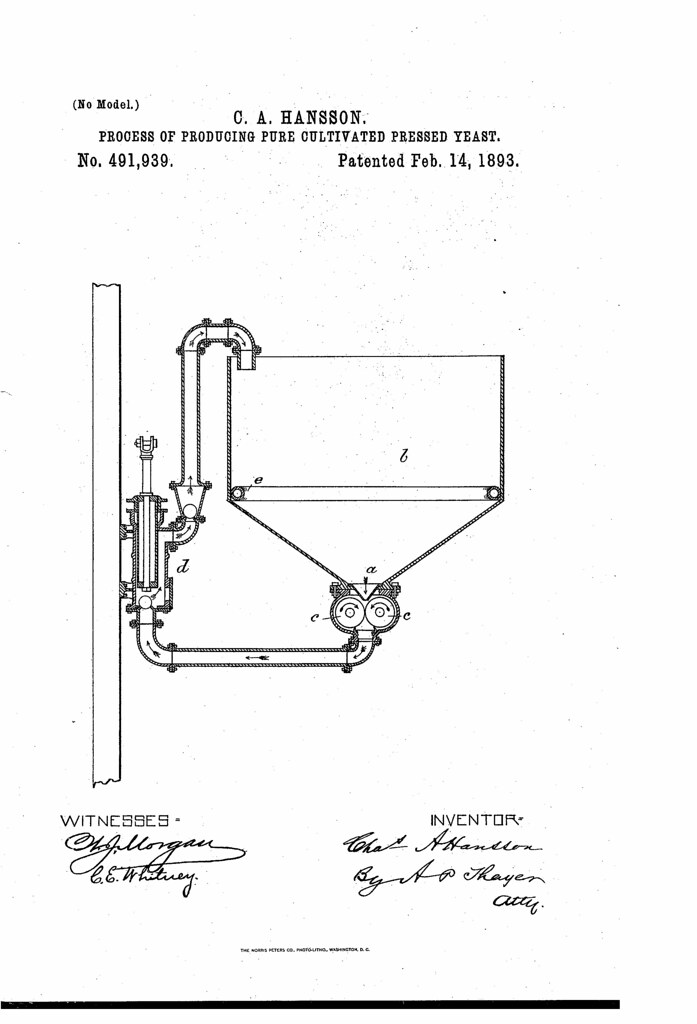
Patent No. 491939A: Process Of Producing Pure Cultivated Pressed Yeast
Today in 1893, US Patent 491939 A was issued, an invention of Charles A. Hansson, for his “Process of Producing Pure Cultivated Pressed Yeast.” There’s no Abstract, but the application begins by stating that he’s “invented certain new and useful Improvements in Processes of Producing Pure Cultivated, Pressed Yeast, of which the following is a specification.”
For the production of a pure cultivated pressed yeast it is necessary to have the fluid out of which the yeast is to receive its nourishment free as far as possible from foreign ferments and bacteria, that is sterilized.
According to methods heretofore used in the manufacture of yeast the sterilizing of this fluid could not have been effected to any advantage because, as the theories now existing indicate, the pepsin and not the lactic acid (the latter serving merely as a mediator) acts as a converter of the albumin into peptones, and as the pepsin contained in the grain is insufficient to transform all albuminoids in the mash into peptones, a comparatively small part of it was so transformed, and the greater part would, consequently, during the process of sterilizing, coagulate and thus be rendered insoluble, that is useless as nourishment for the yeast plant. To overcome this difliculty I make use of an additional increment of pepsin, by adding to the mash, a reinforcing quantity of pepsin and by leaving the mash under the influence thereof, together with some inorganic acid, (when necessary) and at a temperature most favorable for the pepsin, whereby much more of the albumin contained in the raw material is transformed into peptones, and I acquire a fluid which may be submitted to heating sufficiently for sterilizing with but little or no detrimental coagulation of albumin. Through the heating process I am enabled to procure a fluid sufficiently sterilized and thereby practically prepared for a pure cultivated yeast.
Having the fermenting tub covered and introducing into the fluid by mechanical means, sterilized air favorable for the development of the yeast, I avoid its infection which would take place should the fermentation be carried out in the usual way.
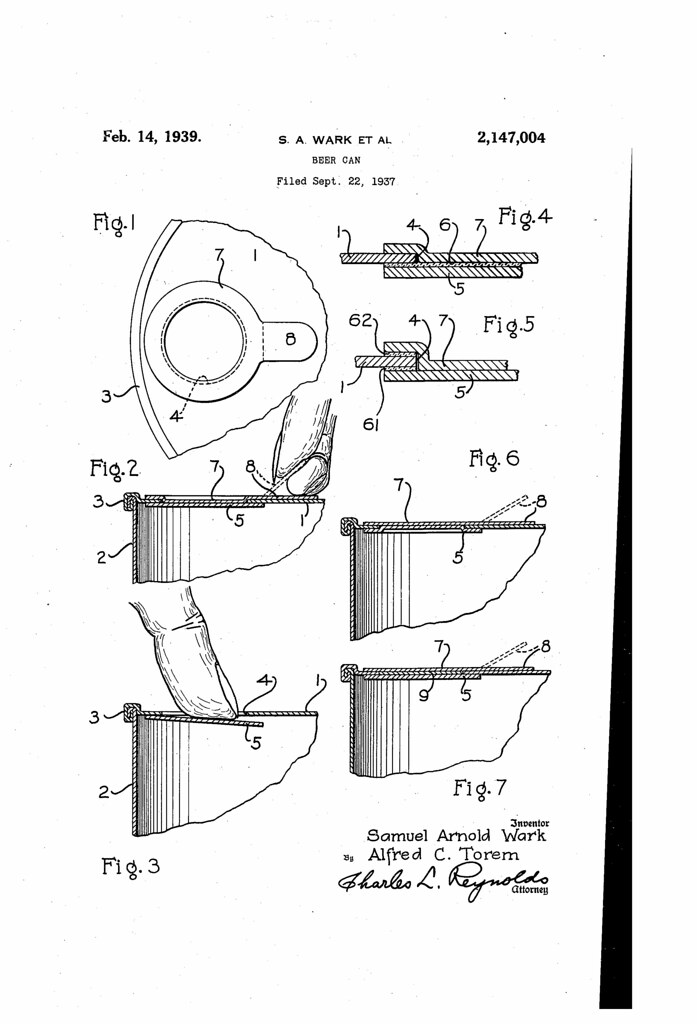
Patent No. 2147004A: Beer Can
Today in 1939, US Patent 2147004 A was issued, an invention of Samuel Arnold Wark and Alfred C. Torem, for their “Beer Can.” There’s no Abstract, but this is just four years after the introduction of beer cans, and this is one of the more inscrutable applications I’ve read with statements like the “drawing is intended as informative rather than restrictive.” It also says simply that their “invention relates fluids under pressure are to be held, designed as a can for beer.” The rest doesn’t seem to be as informative, or well-written or even flow like many others. But it looks more like modern cans that the cans from the late 1930s.
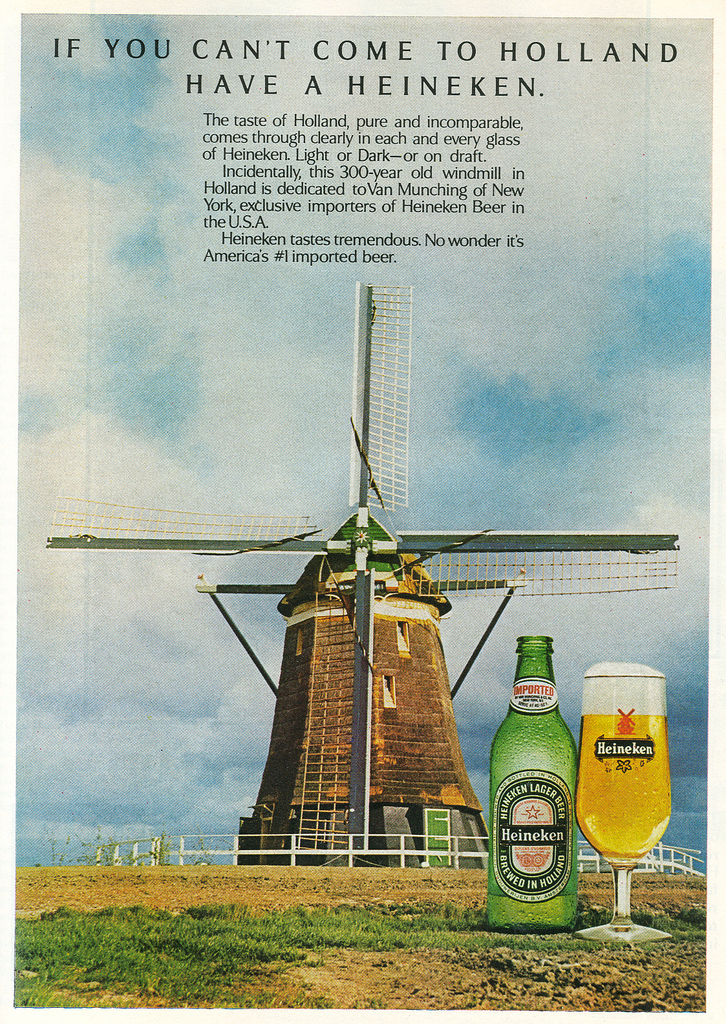
Beer In Ads #1465: If You Can’t Come To Holland …
Friday’s ad is for Heineken, from 1977. In the year I graduated from high school, Heineken was considered “the good stuff” by my step-father’s friends and relatives, which in retrospect is rather sad and indicative of the state of beer at that time. This is also at a time when Holland seemed mysterious, and people really didn’t know much about the European nation. So using such cliched images in their ads like tulips and windmills probably made sense, but looks really dated now. Even the beer glass has a windmill on it.
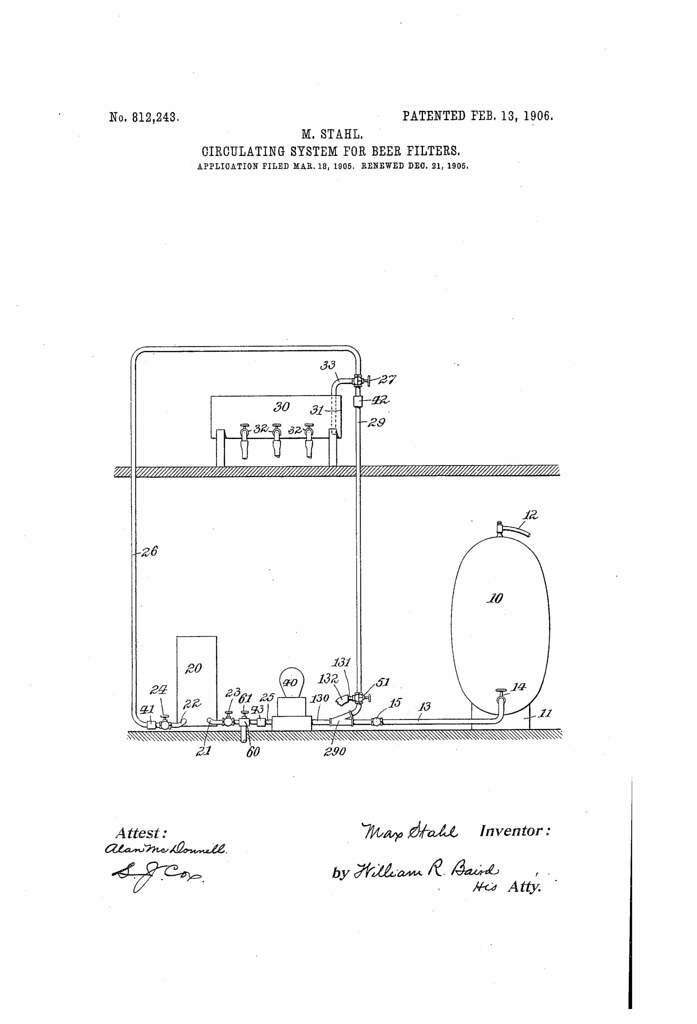
Patent No. 812243A: Circulating System For Beer-Filters
Today in 1906, US Patent 812243 A was issued, an invention of Max Stahl, for his “Circulating System for Beer-Filters.” There’s no Abstract, but Stahl describes his invention as an improvement over then-current systems, saying his “invention aims to and does overcome the losses and disadvantages [mentioned earlier in the description], and in brief it consists of providing means whereby the column of beer can be switched off the racking-bench and continuously returned to the filter until stable relations are secured and the beer no longer runs cloudy or contains fibers of filter mass.”
Patent No. 272261A: Beer-Mug
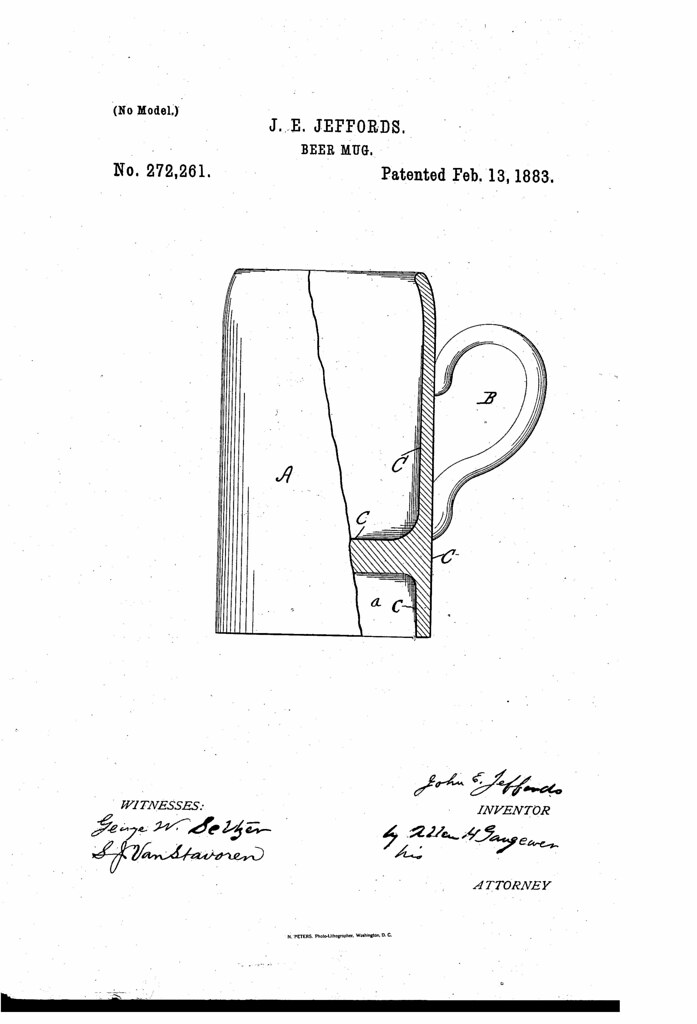
Today in 1883, US Patent 272261 A was issued, an invention of John E. Jeffords, for his “Beer-Mug.” There’s no Abstract, but Jeffords describes his invention as and its purpose “to provide a neat and a cheap form of mug, which is readily cleansed and not easily broken,” adding that it “consists of a beer-mug made of suitable porous material, glazed.”