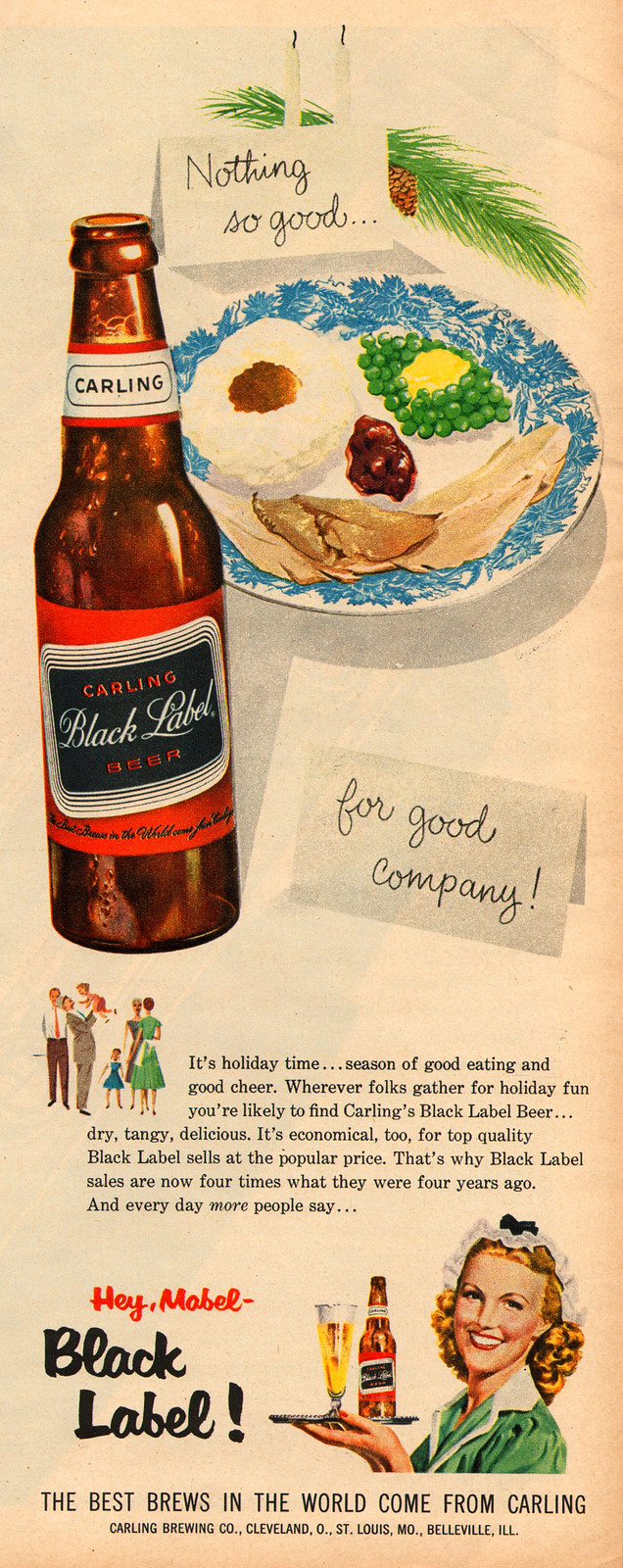
Monday’s holiday ad is for Carling Black Label, from 1955, during the “Hey, Mabel” years. “It’s holiday time … season of good eating and good cheer.” Can’t argue with that.

Monday’s holiday ad is for Carling Black Label, from 1955, during the “Hey, Mabel” years. “It’s holiday time … season of good eating and good cheer.” Can’t argue with that.
Today is the birthday of Diocletian, who was born in the year 244 C.E. He was a Roman Emperor, whose reign lasted from 284 to 305. During his time in charge and before, runaway inflation was a growing problem, which caused him to put a cap on prices in 301 C.E. Known as the “Ēdictum Dē Pretiīs Rērum Vēnālium” or Edict on Maximum Prices or occasionally the Edict of Diocletian, it set the maximum prices allowed on a variety of commodities, goods and services.
For example, a sextarius (roughly 500 ml, or about a pint) of Egyptian Beer had a maximum price of 2 Denarii. A Denarius was a common coin in Ancient Rome, beginning around 211 B.C. E. during the Second Punic War, becoming “the most common coin produced for circulation. The word denarius is derived from the Latin dēnī “containing ten”, as its value was 10 asses (later “retarrifed at sixteen asses”). It is the origin of several modern words such as the currency name dinar and the Italian common noun for money: denaro.”
Prsumably because it was better, the same amount of Gallic or Pannonian Beer had a maximum price set of 4 Denarii. Pannonia was a Roman province in the northern part of the empire, and was located in “present-day western Hungary, eastern Austria, northern Croatia, north-western Serbia, northern Slovenia, western Slovakia and northern Bosnia and Herzegovina.” Gaul was the area that is modern-day France.
Egyptian beer was sometimes translated as “Zythus” and at least another translation lists the Gallic or Pannonian Beer as “beer called Camus.” These other translations also list something called “Barley wine of Attica” with a hefty maximum price of 24 Denarii. Attica was the area around and including Athens in Greece. I have no idea if that was anything like our modern barley wine, and I can find no other mention of it in a quick search.
Another translation done in 1876 by an Edward Young, entitled “Labor in Europe and America: A Special Report on the Rates of Wages, the Cost of Subsistence and the Condition of the Working Classes” converted the Denarii prices to the then nearest American equivalent, which the author supposed was one-half cent to the Denarius. Using that scheme, the Egyptian beer would have been 7 cents, the Zythus, or Gallic or Pannonian Beer would have been 14 cents, and the barley wine of Attica 84 cents. Adjusting for inflation 138 years, in 2014 prices the maximum prices for a pint of our three beers would be $1.56, $3.11 and $18.67, which would be pretty expensive, even for 16 oz. of barley wine. But overall, those prices seem pretty decent. Salutaria!
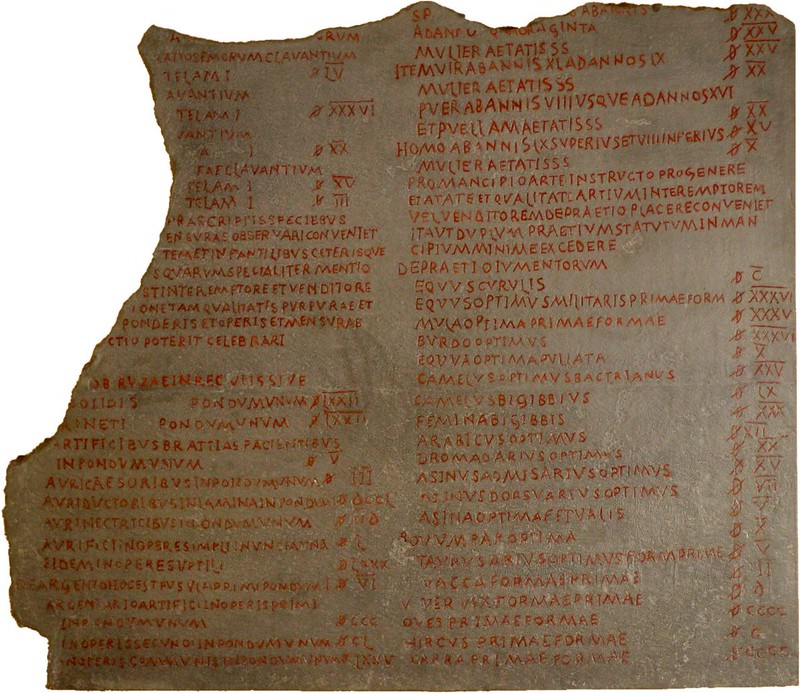
A fragment of the Edict on Maximum Prices, on display in Berlin.
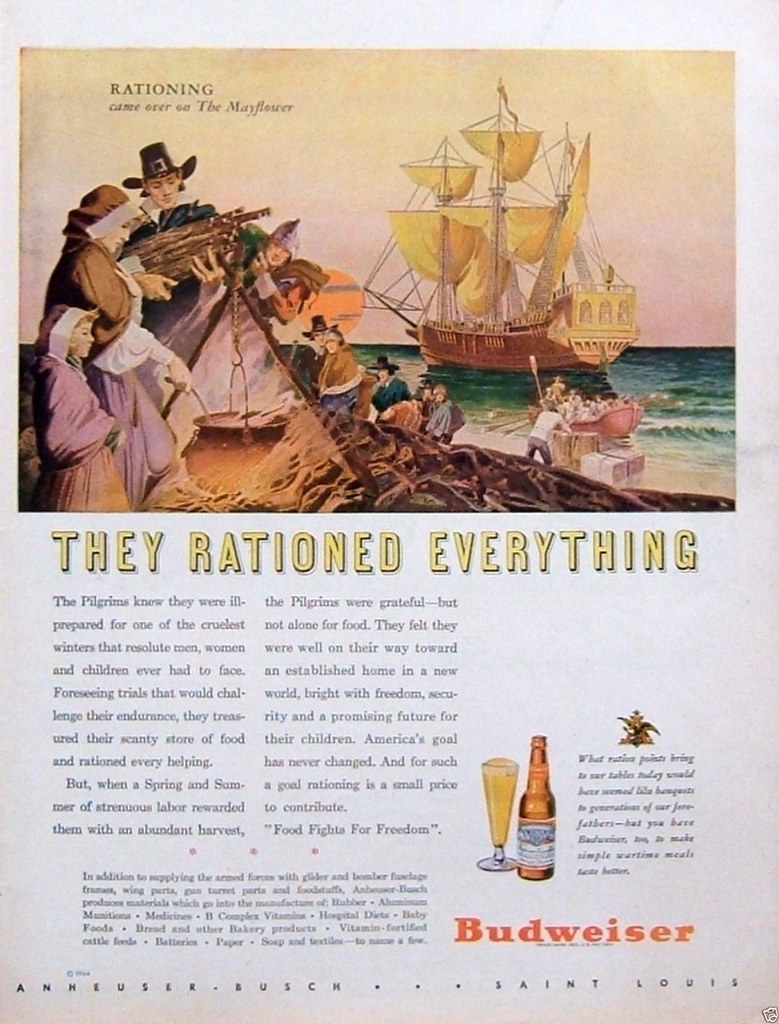
Sunday’s ad is for Budweiser, from 1944. Since the pilgrims traditionally landed today at Plymouth Rock, in 1620, and established a colony there, this ad by Budweiser during World War II contrasts that event with wartime rationing that was going on through the Second World War. Rationing feels so remote to us, but my mother was a “General” in the scrap metal army, or something like that, because my grandfather was a mechanic and that allowed her to amass a lot of scrap metal, apparently. I have a newspaper clipping reporting on her “promotion.”
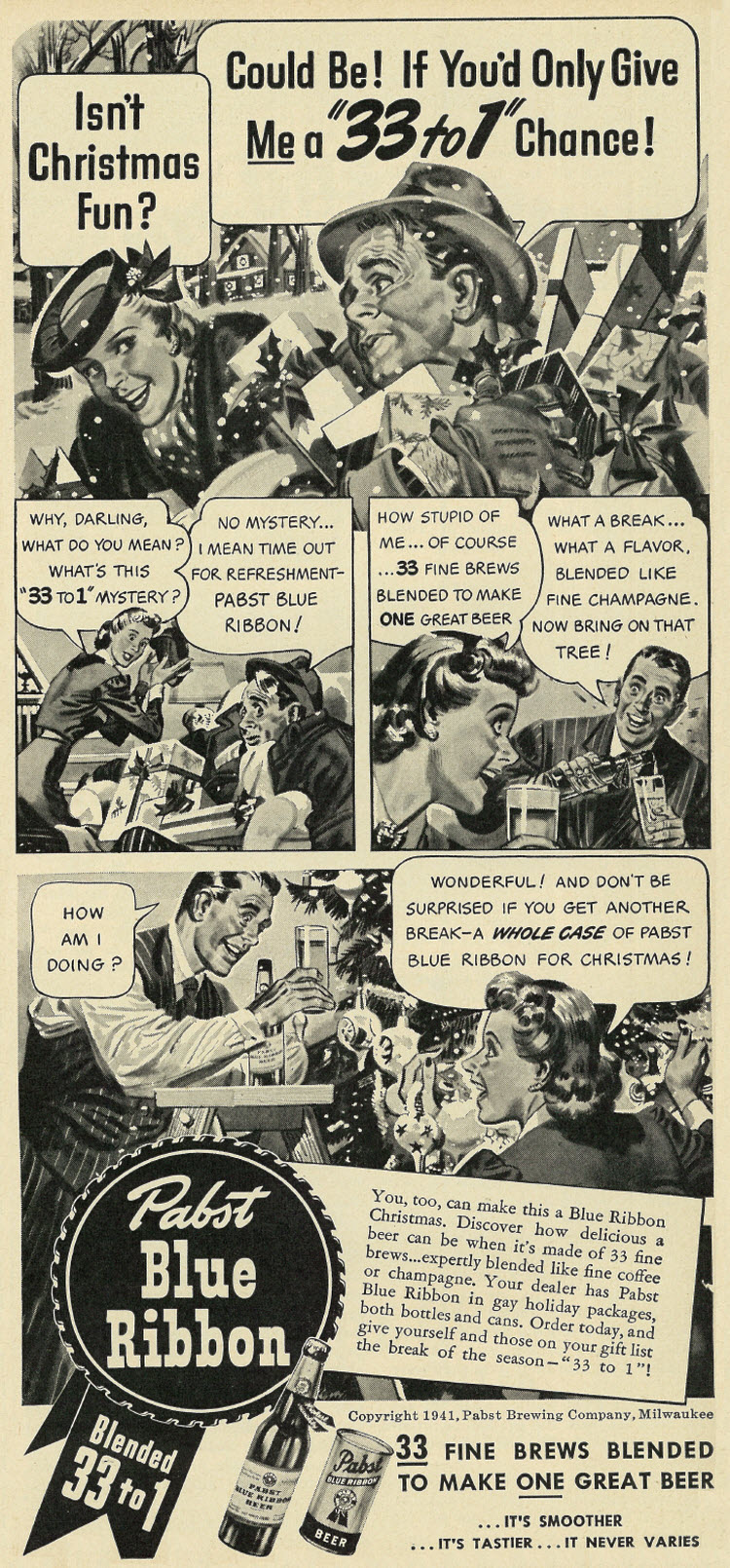
Saturday’s holiday ad is for Pabst Blue Ribbon, from 1941. “Isn’t Christmas Fun?” A frazzled husband responds. “Could Be! If You’d Only Give Me A “33 to 1″ Chance!” Eventually his wife understands, and he enjoys a beer before turning into a decorating demon, prompting her to suggest he may be getting a whole case of PBRs on Christmas Day.
Friday’s holiday ad is for Blatz, from 1952. According to the ad, while many things have changed in the last century (or more), some things have remained the same, including beer and the use of predatory mistletoe. Who uses such a long ribbon to position it directly above the intended victim’s head? And is it just me, or is the ad showing the backwards slide of women’s rights? The 19th century picture depicts a couple courting, but on somewhat equal footing, sitting side by side on a couch. By contrast, the 20th century (albeit the 1950s) shows the woman standing, serving her beau, as a good woman of that decade was supposed to. I’m not sure I’d call that progress.

Thursday’s holiday ad is for Pabst Blue Ribbon, from 1935. According to the ad, during the Yuletide season “It’s time for Pabst.” Happy Holidays!

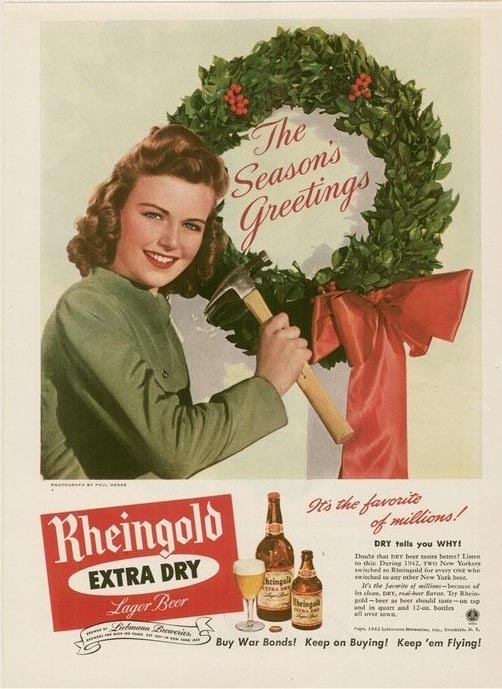
Wednesday’s ad is for Rheingold Beer, from 1943, and features Miss Rheingold from that year, Sonia Gover. Holding a hammer in her hand, she’s presumably just hung the wreath. Nice job. Was “The Season’s Greetings” already painted on the wall?
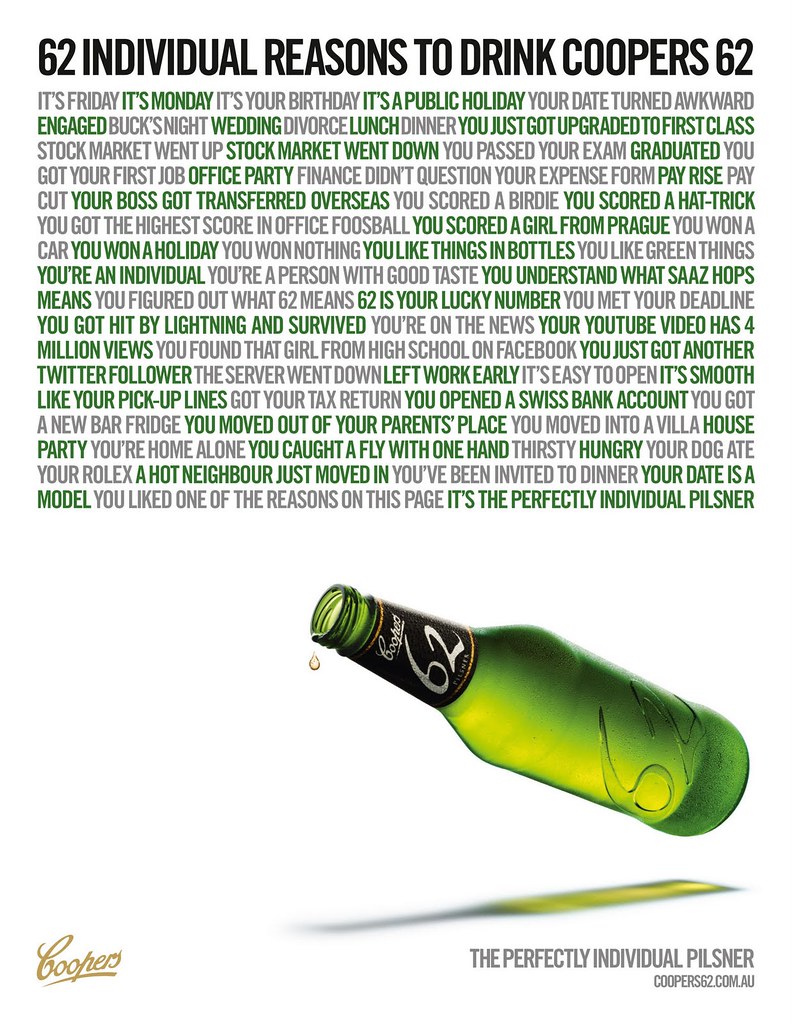
Tuesday’s ad is for the Coopers 62, from 2011. Although it’s a newer ad, given that I post my own reasons to drink for any given day, this ad certainly spoke to me, despite most of the reasons being fairly pedestrian. But in a sense, that was the point, that any reason was good enough to drink this Australian beer. Whether that’s true, I couldn’t tell you. I like their sparkling ale, but they don’t strike me as a pilsner brewery.

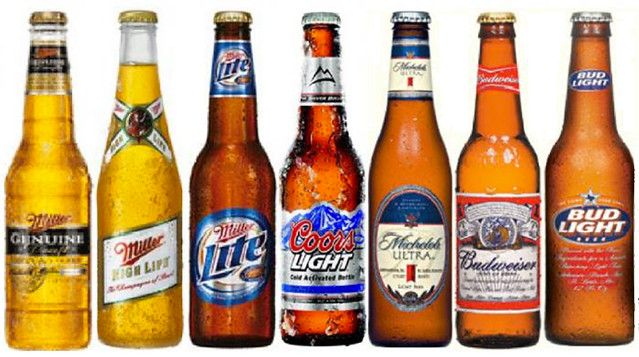
For the last several years, sales of some of the major beer brands have been slipping, and not just the sub-premiums or secondary packages but even once mighty flagships. 24/7 Wall Street has a new list of some of these brands, characterized as Beers Americans No Longer Drink. Using data from Beer Marketer’s Insights, here are seven brands that have lost significant sales, at least 20%, between 2013 and 2008. The negative number following the name is how much sales are down in that six-year period.
Some additional analysis and reasons for the decline, according to 24/7 Wall St:
Another key factor in the weakening sales has been price dynamics. “Beer prices were increased more aggressively over the last five years than wine and spirits,” Shepard said. Many people in the industry believe that, as a result, some customers replaced buying beer with the now relatively less expensive wines and spirits, he explained.
Several other products were also gaining at the expense of big brand-name beers, Shepard noted. While some customers have been moving to wine and spirits, others were switching to imported beer, particularly Mexican imports. Indeed, in the five years through 2013, shipments of Mexican brands Dos Equis and Modelo Especial more-than doubled. Similarly, he added, “Some [drinkers] are moving to craft [beer]. Clearly, there’s been a trade-up in the industry.”
Craft beers have largely bucked the overall downtrend in beer sales. From 2008 to 2013, shipments of craft beer rose by 80.1% to a total of more than 16 million barrels, or 7.6% of the U.S. beer market. While the craft beer category now outsells Budweiser, it remains a relatively niche market. For comparison, the nation’s top-selling brand, Bud Light, shipped 38 million barrels in 2013, accounting for 18% of all beer shipped.
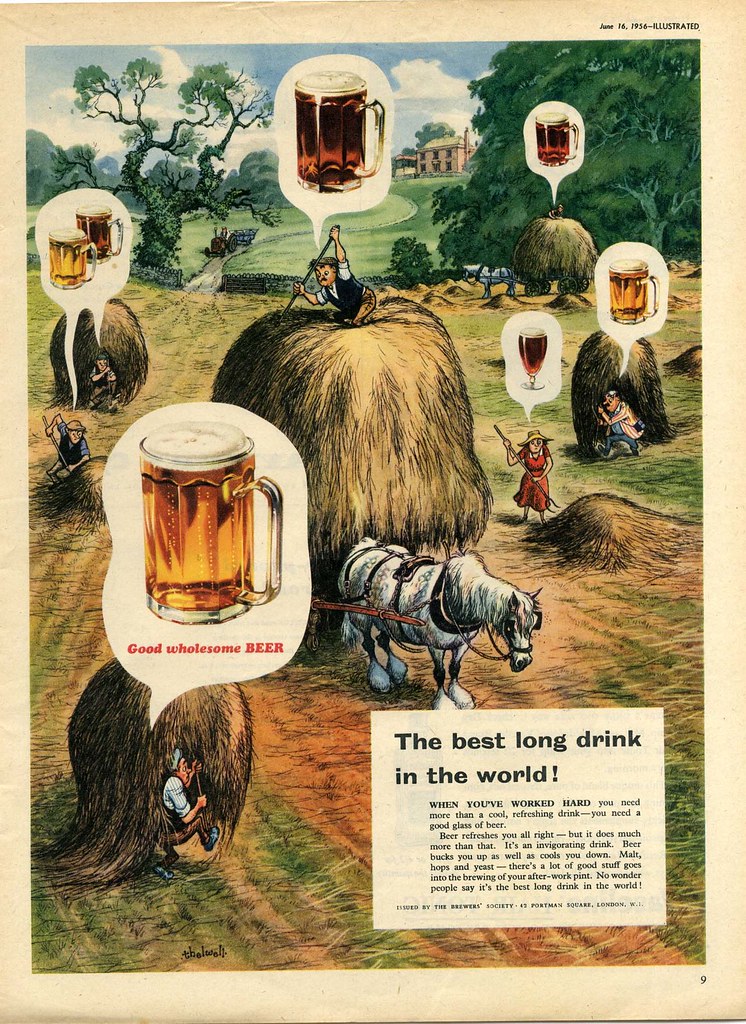
Monday’s ad is for the Brewers’ Society, from 1956. Similar to the ads in America by the United States Brewers Foundation that ran around the same time, the British ads used taglines like “Good Wholesome BEER” and “The best long drink in the world!” After working in the fields all day, making giant hay bales, who wouldn’t be dreaming of a pint of beery goodness? But I love the way they put it. “Beer refreshes you all right — but it does much more than that. It’s an invigorating drink. Beer bucks you up as well as cools you down.”