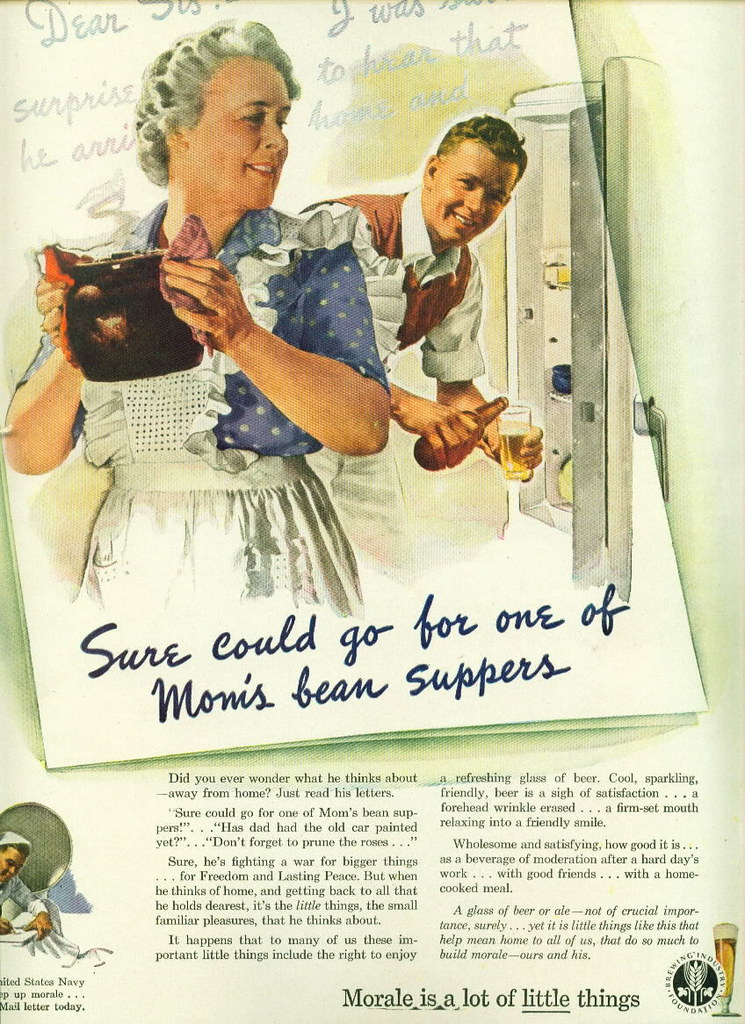
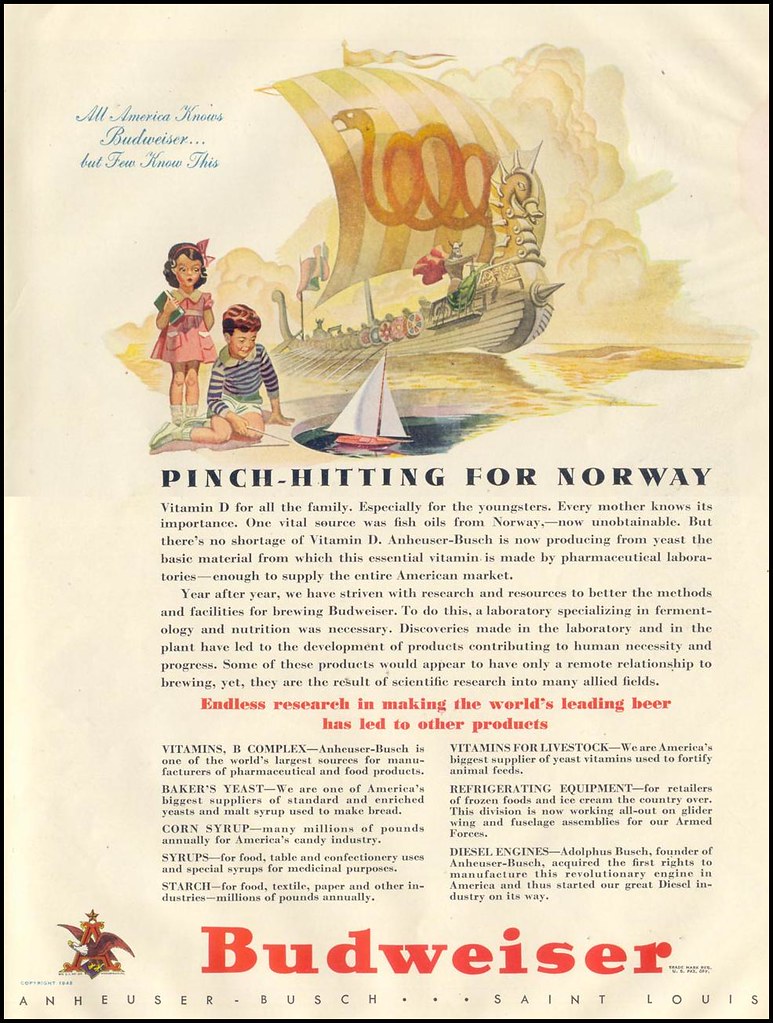
Wednesday’s New Year’s ad is for Guinness, from 1935. A glass of Guinness every day, that’s all they ask. I suppose there’s worse ways to spend a year.

By Jay Brooks
By Jay Brooks
![]()
Prosit Neujahr, or Happy New Year, from an old German postcard circa 1916. Wishing you and yours a very good 2014.

By Jay Brooks

This year I decided to feature a new video about beer each day. Today’s beer video is from 1952 and was sponsored by the United States Brewers Foundation. The ten-minute film, As We Like It, is a fun little overview of beer’s history and its positive aspects.
By Jay Brooks
By Jay Brooks

Today’s, and indeed this year’s, final infographic is entitled Beer, Ale or Brewski? Created by Dragon Search Marketing, it shows the most common terms used to refer to beer by people using social media, and the popularity of each of them. I set out at the beginning of 2013 to see if I could post a new infographic every day, and it turned out to be easier than I anticipated. Certainly, they ranged in quality quite a bit. Some were truly epic while others were filled with errors, somewhat unattractive or even truly awful. Oh, well. It was fun. Happy 2013 everybody. See you next year, wehn I’m sure you’ll be able to find me drinking a beer, an ale or even a brewski.
By Jay Brooks

Here’s one story you won’t likely see spread by Alcohol Justice or any of the other prohibitionist organizations. Since 1975, the National Institute on Drug Abuse (NIDA), a division of the National Institutes of Health (NIH), has done a survey of “drug, alcohol, and cigarette use and related attitudes among adolescent students nationwide.” This year, “45,449 students from 395 public and private schools participated” in the annual Monitoring the Future survey, which is conducted by the University of Michigan.
This year’s findings, at least in regards to alcohol, are encouraging, according to the survey’s authors, as detailed in their Monitoring the Future Survey, Monitoring the Future Survey, Overview of Findings 2013.
5-year trends continue to show significant decreases in alcohol use among all grades and across nearly all prevalence periods. For example, from 2008 to 2013, current use of alcohol declined from 15.9% to 10.2% among 8th graders, from 28.8% to 25.7% among 10th graders, and from 43.1% to 39.2% among 12th graders. From 2012 to 2013, decreases were observed in binge use of alcohol (defined as five or more drinks in a row in the last 2 weeks) among 10th graders, with a 5-year trend showing a significant decrease in all three grades.
That, in fact, has been the trend over the past few years.

They’re more concerned about the use of prescription drugs among our nation’s youth, along with pot and smoking tobacco in a hookah, all of which are on the rise. But I don’t hear the prohibitionists trying to remove prescription drugs from the marketplace on the off chance kids could get their hands on them. I haven’t heard them trying to restrict Viagra or other legal drug ads because kids might see them, or restrict the displays and shelves of drugs because the kiddies might walk by and see them, and in seeing them they would undoubtedly want them, not being able to help themselves. It sounds silly doesn’t it, but that’s the general argument the prohibitionists use to argue against beer ads and beer on store shelves where children might see them.
But while they’ve been incessantly claiming beer ads make kids start drinking and responsibility efforts by the alcohol companies don’t work and all of us in the beer world are the spawn of satan, kids have been drinking less and less, year after year. You’d think that it would be cause for celebration by the groups that are working tirelessly to punish the alcohol companies for their wickedness and claim to want to put a stop to underage drinking. But that might put a dent in their fundraising efforts, so that, I believe, is why you’ll never see a positive story from a prohibitionist organization.
By Jay Brooks

Today’s infographic is a chart showing beer and food pairings for a variety of basic beer types and 21 different dishes.

Click here to see the chart full size.
By Jay Brooks
By Jay Brooks

With only two days left in the year of the infographic, I have a few more left to fit in before the year ends. Today’s second one is entitled Who is the Craft Beer Drinker?. It was created by SteadyServ Technologies, makers of a “mobile, SaaS-based inventory and order management system for the beer industry.”

Click here to see the infographic full size.
By Jay Brooks

While I don’t think too much about what I post on Twitter, lots of companies do think about their Twitter frequency, content, timing, etc. How much is the right amount? How much is too much? Organizations should, and usually do, give this careful consideration. Last year, Track Social conducted a study to determine the sweet spot entitled Optimizing Twitter Engagement – Part 2: How Frequently to Tweet. They determined that 2-5 tweets per day is best to get a response from your followers. Less than that and they forget about you, more than that and they start to tune out. Looking at my own Twitterstream, I tend to tweet 4-6 times a day, usually no more than 10; though sometimes I tweet more when I’m traveling.
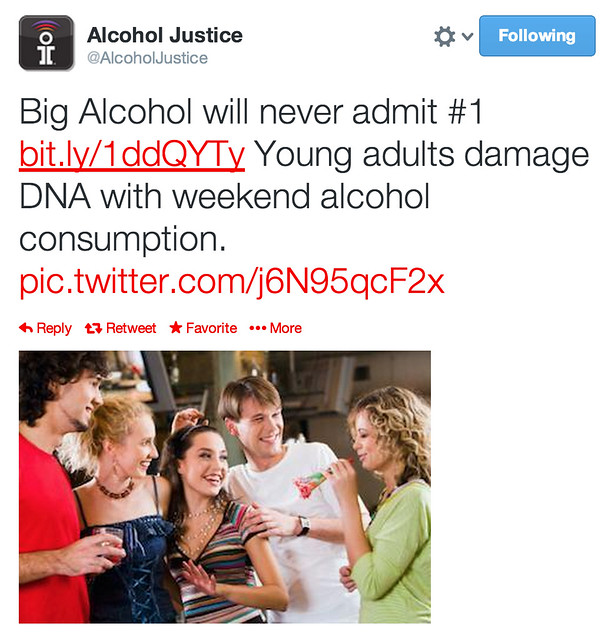
Lately, I’ve been noticing that I see an awful lot of tweets from the prohibitionists at Alcohol Justice, usually with a great deal of repetition. I started noticing that I keep seeing the same twitpic day after day, the same plea for money day after day and the same propaganda day after day. For example, recently I was annoyed by one of their tweets, and considered doing a post about it, but then changed my mind. But I noticed I saw it again, and then again, and then again today. It turns out they first tweeted the one below every single day since December 17, which was the first time, until today. That’s fourteen times in two weeks. Exactly the same every time, as below. They could change the wording, change it up, make it at least appear fresh, but nope, they just retweet it over and over again, as is.

What originally annoyed me is that clicking on the link takes you to a story, Watchdog Group Slams Alcohol “Social Responsibility” Campaigns. The “watchdog” doing the slamming is none other than Alcohol Justice. So in effect, every day they’re saying hey, look at this information about what a watchdog group is saying as if it’s from an objective, unbiased source. But what they’re really saying is: “hey check out this study by us that we got someone else to post without questioning anything.” It feels dishonest at best. There’s nothing about it that’s not slimy and self-referential, more of the circle jerk of prohibitionist propaganda. They could have tweeted that there’s a story about their own study or something to the effect that here’s an article by one of our own, or at least own the information. But that would be honest, something the watchdog holding big alcohol accountable has a hard time doing themselves.
But as this sank in, I also noticed I’ve been seeing lots of repetition. Beating a dead horse seems to be part of the S.O.P., a policy decision. As far as the amount of tweets, looking at the last ten days, Alcohol Justice tweeted 369 times, not including RT’s. That’s an average of almost 37 tweets per day. As of 2:30 p.m. PST, they’ve tweeted 70 times today! That would push the average to nearly forty tweets per day.
Beyond the insane number, it’s the repetition that’s so amazing. There appears to be a calculated policy of tweeting the exact same tweets every day for weeks on end. Just seeing the same graphics tweeted every day makes that point. Take a cursory glance down their twitterstream and you’ll see the same photo and language over and over and over again. The graphic for this tweet is a bottle of Absolut in a rainbow pattern and the text “Absolut Pride,” making me wonder if perhaps they’re also subtly trying to appeal to homophobics, too. Otherwise, what was the point of choosing that particular ad to use in a post about social responsibility? Personally, I like this colorful neon beer bottle sign better. But then, I generally prefer beer.

And then there’s donations, pleas for which are seemingly never-ending. During the month of December, so far, they’ve asked followers for money 57 times, or an average of almost twice a day.
The amount of redundancy in the average day’s Twitter feed by Alcohol Justice reminds me of an old Monty Python bit with a government agency called the “Department of Redundancy Department.” Can their nearly 16,000 followers really welcome that much repetition in the information they’re sending out on a daily basis? Or can it be possible they think so little of those followers that they believe that they need to keep telling them the same things over and again in the hopes that it sinks in eventually?