Brookston Beer Bulletin

Jay R. Brooks on Beer

  • Home
  • About
  • Editorial
  • Birthdays
  • Art & Beer

Socialize

  • Dribbble
  • Email
  • Facebook
  • Flickr
  • GitHub
  • Instagram
  • LinkedIn
  • Pinterest
  • RSS
  • Twitter
  • YouTube

Powered by Genesis

Get Ready … For Oktoberfest

September 26, 2013 By Jay Brooks

oktoberfest-banner
Today’s infographic is yet another poster about Oktoberfest, which began five days ago in Munich, Germany. This one is called Get Ready … For Oktoberfest and was created by Wimdu, a house and apartment rental website.

OktoberfestCOM
CLick here to see the infographic full size.

Filed Under: Beers, Breweries, Events, Just For Fun Tagged With: Infographics, Oktoberfest

Beer In Ads #984: Stronger Bolder Taste Really Means Business!

September 25, 2013 By Jay Brooks


Wednesday’s ad is for Ballantine, from 1968. I just watched the James Bond film “Thunderball” with my son this weekend, and this dark drawing of the scuba diver reminds me a bit of it, as if they’re invoking the idea or romance of James Bond to sell Ballantine. Thunderball came out in 1965, and was the most popular Bond film to date, so it’s possible, I suppose. But that tagline, “Stronger Bolder Taste Really Means Business!,” it seems to be mixing too many ideas, and just doesn’t roll off the tongue. And then there’s that other tagline at the bottom of the ad. “Ballantine Ale XXX has a taste you can feel.” Hmm, taste you can feel?

Ballantine-scuba-1968

Filed Under: Art & Beer, Beers Tagged With: Advertising, Ballantine, History

How Alcohol Effects Moods In Males & Females

September 25, 2013 By Jay Brooks

moods
I’m not quite sure what to make of this study, which looked into the issues of “how does alcohol consumption affect anger, sadness, and happiness?” and “how do anger, sadness, and happiness affect alcohol consumption?” Alcohol, Moods and Male-Female Differences was published by the Rand corporation, and was conducted by the Psychiatry Department at the University of Vermont. Essentially they surveyed less than 300 heavy drinkers to make their findings. Here’s the abstract:

AIMS: The goal of this study was to better understand the predictive relationship in both directions between negative (anger, sadness) and positive (happiness) moods and alcohol consumption using daily process data among heavy drinkers. METHODS: Longitudinal daily reports of moods, alcohol use and other covariates such as level of stress were assessed over 180 days using interactive voice response telephone technology. Participants were heavy drinkers (majority meeting criteria for alcohol dependence at baseline) recruited through their primary care provider. The sample included 246 (166 men, 80 women) mostly Caucasian adults. Longitudinal statistical models were used to explore the varying associations between number of alcoholic drinks and mood scores the next day and vice versa with gender as a moderator. RESULTS: Increased alcohol use significantly predicted decreased happiness the next day (P < 0.005), more strongly for females than males. Increased anger predicted higher average alcohol use the next day for males only (P < 0.005). CONCLUSION: This daily process study challenges the notion that alcohol use enhances positive mood for both males and females. Our findings also suggest a strong association between anger and alcohol use that is specific to males. Thus, discussions about the effects of drinking on one’s feeling of happiness may be beneficial for males and females as well as anger interventions may be especially beneficial for heavy-drinking males.

Their overall bullet point conclusions? “Increased alcohol use dampens a positive mood the next day, especially for women. Increased anger causes men to drink more.”

In the full text, they go through an interesting history of similar studies examining emotions and alcohol use. Curiously, this study was published earlier this year, but the actual participants were first recruited between 2000 and 2003, and they were monitored for 30 days. What took place in the intervening decade, I’m not sure, and it doesn’t seemed to be explained in the article, though perhaps I’m missing something. It certainly couldn’t have taken ten years to analyze the data.

They begin a discussion in the text with this. “While it is generally accepted that moods and alcohol use are associated, the current body of literature reports contradictory findings with regard to the directionality and strength of the association.” What follows is, at least, an honest presentation of what they did, the limitations of how they conducted the study and some conclusions they were able to draw. For example:

Contrary to our first hypothesis that increased alcohol consumption would predict lower levels of anger and sadness and higher levels of happiness the next day, we found no association between total number of drinks and next day anger or sadness. Surprisingly, we found that as the total number of drinks increased, average scores for next day happiness decreased.

Likewise, “increased happiness was related to increased alcohol use the next day, while increased sadness was related to decreased alcohol use the next day.”

male-female-moods
Click here to see the chart full size.

So overall, their results seemed to indicate clear differences between how men and women react to the use of alcohol, and more so not during drinking, but the next day.

It is often assumed that alcohol use helps moderate emotions, yet the results of this study do not support the theory that alcohol enhances positive mood or dampens negative mood. On the contrary, these results suggest that an increase in alcohol use dampens next day happiness, a topic that can be explored in primary care brief interventions, and does not have a significant effect on next day anger or sadness. Our results do support the theory that negative mood (specifically anger) predicts alcohol use. In particular, males seem to react to increases in anger by increasing their alcohol use the next day while females do not.

Based on my own experience, I think it’s more likely that different people react to alcohol differently. Some people do indeed have their mood positively effected by drinking, while for others it acts as a depressant. Some can control their drinking, while a small minority aren’t able to, whether due to physical dependency or emotional or psychological, I can’t say. But in any sample of 240 or so people, you’re going to find some whose moods improve and some whose do not. If you’ve been around enough people drinking, that just seems like common sense.

Filed Under: Beers, Editorial, News, Related Pleasures Tagged With: Statistics

How To Survive Oktoberfest

September 25, 2013 By Jay Brooks

oktoberfest-banner
Today’s infographic is still another poster about Oktoberfest, which began four days ago in Munich, Germany. This one is called How To Survive Oktoberfest with Your Liver Intact and was created by Accredited Online Colleges. It features a brief history of Oktoberfest and some tips for navigating the festival.

how-to-survive-oktoberfest
Click here to see the infographic full size.

Filed Under: Beers, Events, Just For Fun Tagged With: Beer Festivals, Germany, Infographics, Oktoberfest

Beer In Ads #983: The Goodness Of Malt In Fondue

September 24, 2013 By Jay Brooks


Tuesday’s ad is for the Barley and Malt Institute, from 1959. This is the fourth ad I have from the now defunct trade group for barley growers. In this one a feminine hand is adding beer to a fondue pot, while a man is stirring it and holding up the “OK” sign, presumably to indicate there’s enough beer in the mix. And that tagline, “Fun-Flavors your creative cookery;” I’m not even sure that quite makes sense. But cheese and beer? Now those are some fun flavors.

barleymalt59rarebit

Filed Under: Art & Beer, Beers Tagged With: Advertising, History, Malt

Everything Old Is New Again: Non-Stop Fermentation

September 24, 2013 By Jay Brooks

fermenter-conical
I just stumbled upon this interesting article from May in Phys.Org entitled More sustainable way to brew beer: Non-stop fermentation saves resources. It details efforts by researchers at the Technische Universität München to develop “a fermentation process that takes place in stages over a number of interconnected tanks. The tank system can be operated continuously over a period of several months, which leads to an energy reduction. The new method also promises significant resource efficiency gains.”

non-stop-fermenters

They talk about the advantages of such a system. “With this new process, yeast and other sedimented substances can be fractionized and re-used if required, and “unlike the conventional system[s], the brewers can fill and empty the tanks continuously from the top part of the tanks. The bottom connection of the tank can hence be used to discharge yeast cells and other particles.”

Lead researcher, Konrad Müller-Auffermann explains how “Continuous operation makes the fermentation plant more efficient. ‘This new method reduces the incidence of energy peaks, so that breweries will be able to save on electricity. In addition, less beer will be lost — and breweries can save water and cleaning detergents.'”

non-stop-ferment

So far, so good. It sounds interesting, but here’s where they lost me. “Brewers have been juggling with the dream of turning the classical batch fermentation into a continuous process for over 100 years. In all this time, however, no one has managed to develop a widely applied industrial concept.”

Um, maybe somebody with more technical expertise can explain this to me, but New Zealanders (and possibly the Australians) have been using what they call “continuous fermentation” since 1953, and at least one brewery is still using it today. I did a sidebar about Continuous Fermentation for All About Beer magazine in 2008.

One of New Zealand’s most interesting contributions to brewing sciences is the process known as continuous fermentation. This process was patented in 1953 by Morton Coutts, whose family had been involved in brewing since the 19th century. His father founded the Waitemata Brewery, which eventually become DB Breweries.

Essentially, Coutts created a “wort stabilization process” that made the wort more consistent and clear, and then separated the main functions of the yeast into two stages. In the first, yeast grew, and in the second, it fermented. By splitting these two functions, Coutts created a “continuous flow,” so brewers could continually add raw materials to the first stage, and draw off a steady supply of finished beer from the second thus allowing the brewery to run constantly.

It also shortened the brewing process by as much as several weeks. Recognizing the economic advantages to continuous fermentation, Lion and DB worked together jointly to develop a practical way to use the method in a commercial brewery, opening the world’s first continuous fermentation brewery in 1957 in Palmerston North, a town in the south central part of the North Island.

Continuous fermentation works best in a brewery making only one style of beer, because it’s difficult to stop the process and start up again with a new beer. As a result, Lion largely abandoned continuous fermentation in the 1980s in order to brew a wider variety of styles, while DB continues to use the method, as do several other large breweries around the world, such as Guinness.

The University of Aukland’s Business History Project has a good overview on Morton Coutts, father of continuous fermentation. You can also read more at Alcohol Fuels and Ken & Dot’s Allsorts.

cf

So nothing against the German effort at non-stop fermentation. It looks interesting and innovative. But it doesn’t seem all that different from continuous fermentation that was invented sixty years ago. Maybe there’s a subtle or technical difference I’m missing, but they don’t even mention being aware of it when they insist people have been trying to figure out this problem for over a century, which seems a little strange. So while they’re understandably excited about their discovery, I wish they’d acknowledge Coutts. Or am I missing something?

Filed Under: Breweries, Editorial, Just For Fun, Related Pleasures Tagged With: Germany, New Zealand, Science of Brewing

The Great American Beer Fest Rap

September 24, 2013 By Jay Brooks

gabf-2012
This is a pretty funny video, JDirty and BIG Trox — GABF “Great American Beer Fest Rap”, made at last year’s Great American Beer Festival, which Charlie Papazian just tweeted. Enjoy.

Filed Under: Beers, Breweries, Events, Just For Fun Tagged With: GABF, Humor, Music, Video

Oktoberfest, By The Numbers

September 24, 2013 By Jay Brooks

oktoberfest-banner
Today’s infographic is yet another poster about Oktoberfest, which began three days ago in Munich, Germany. This one is called the Oktoberfest, By The Numbers and was created by Julie Teninbaum for United Airlines’ Hemispheres.

untitled
Click here to see the poster full size.

Filed Under: Beers, Just For Fun Tagged With: Beer Festivals, Germany, Infographics, Oktoberfest

Per Capita Beer Consumption By State

September 24, 2013 By Jay Brooks

fish-drinking
Business Insider/Thrillist had an item not to long ago about per capita beer consumption by state, though they unceremoniously titled it The States That Guzzle The Most Beer. The data is based on information from the Beer Institute’s “Shipments of Malt Beverages and Per Capita Consumption by State 2012.” Business Insider made the statement that “the more unassuming states tended to out-booze their brethren, proving once again that you should always look out for the quiet ones silently pounding ales in the corner.” But whenever you look at per capita data, it always favors the less-populated states, and so doesn’t seem like a particularly accurate or meaningful measure of anything. It’s fun to see, but I don’t think you can draw too many grand conclusions from it. Here, for example, is the top ten.

  1. North Dakota
  2. New Hampshire
  3. Montana
  4. South Dakota
  5. Wisconsin
  6. Nevada
  7. Vermont
  8. Nebraska
  9. Texas
  10. Maine

Not surprisingly, Utah drinks the least, per capita, but the fact that New York and New Jersey are in the bottom five should tell you everything you need to know about how meaningless consumption by per capita can be. California, the most populous state, and with twice the number of breweries as any other state, ranks 44th, very near the bottom. Here’s the bottom five.

  1. Maryland
  2. New York
  3. New Jersey
  4. Connecticut
  5. Utah

Filed Under: Beers, Breweries, Related Pleasures Tagged With: Statistics, United States

Beer In Ads #982: Tailgating

September 23, 2013 By Jay Brooks


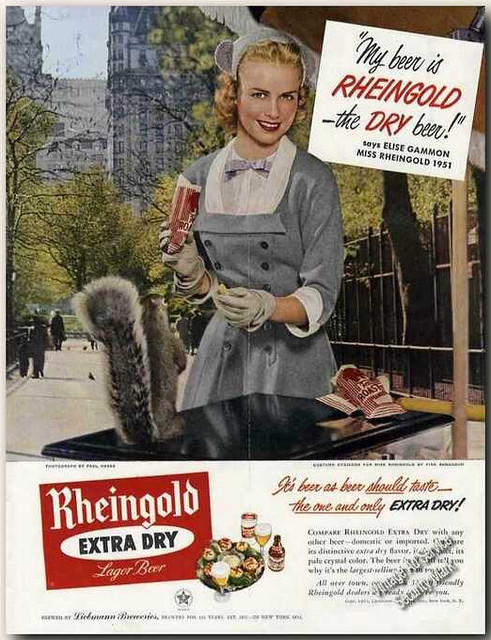
Monday’s ad is for Rheingold Beer, from 1958, and features Miss Rheingold from that year, Madelyn Darrow. It looks like she’s attending the most civilized tailgate party in the history of mankind.

Rheingold-1958

Filed Under: Art & Beer, Beers Tagged With: Advertising, History

« Previous Page
Next Page »

Find Something

Northern California Breweries

Please consider purchasing my latest book, California Breweries North, available from Amazon, or ask for it at your local bookstore.

Recent Comments

  • Bob Paolino on Beer Birthday: Grant Johnston
  • Gambrinus on Historic Beer Birthday: A.J. Houghton
  • Ernie Dewing on Historic Beer Birthday: Charles William Bergner 
  • Steve 'Pudgy' De Rose on Historic Beer Birthday: Jacob Schmidt
  • Jay Brooks on Beer Birthday: Bill Owens

Recent Posts

  • Beer In Ads #5240: Rieker’s Bock Beer Is Now On The Market May 3, 2026
  • Historic Beer Birthday: Herman Adolph Schalk May 3, 2026
  • Beer In Ads #5239: The National Drink May 2, 2026
  • Beer Birthday: Anders Kissmeyer May 2, 2026
  • Beer Birthday: Bruce Paton May 2, 2026

BBB Archives

Feedback

Head Quarter
This site is hosted and maintained by H25Q.dev. Any questions or comments for the webmaster can be directed here.