Brookston Beer Bulletin

Jay R. Brooks on Beer

  • Home
  • About
  • Editorial
  • Birthdays
  • Art & Beer

Socialize

  • Dribbble
  • Email
  • Facebook
  • Flickr
  • GitHub
  • Instagram
  • LinkedIn
  • Pinterest
  • RSS
  • Twitter
  • YouTube

Powered by Genesis

Beer In Ads #435: Schlitz For Income Taxes

August 26, 2011 By Jay Brooks


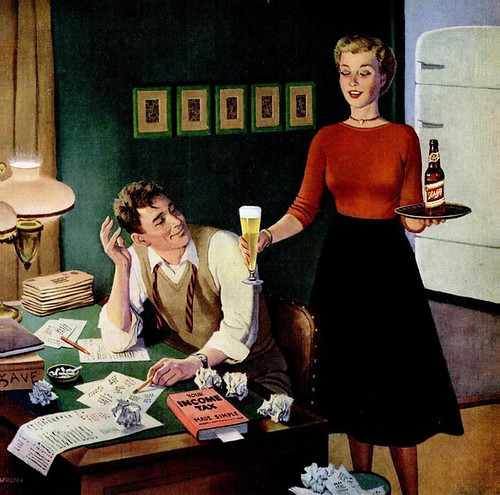
Friday’s ad is a third one for Schlitz, again from 1952, and it shows another housewife bringing a Schlitz to another husband, though this time instead of reading the newspaper, he’s doing his taxes. I’m sure that will help reduce the number of crumpled pieces of paper.
Schlitz-1952-taxes

Filed Under: Art & Beer, Beers Tagged With: Advertising, History, Schlitz

Brazilian Brewer Nominated For “Man Of The Year”

August 26, 2011 By Jay Brooks

brazil
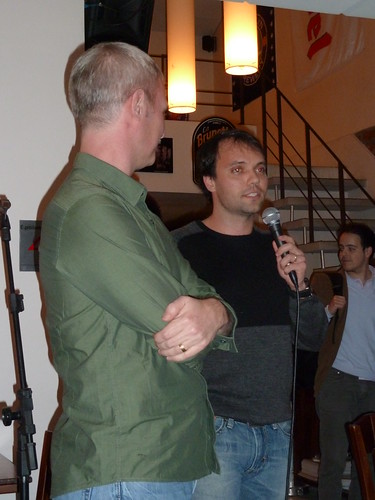
One of the brewers I met during my trip to South America earlier this year for the South Beer Cup was Alexandre Bazzo, owner and brewmaster of Micro Cervejaria Bamberg in Votorantim, Brazil. Bazzo studied brewing in Germany and his brewery consistently makes some of the finest German-style beers I’ve had outside of Bavaria, which is all the more impressive given the scarcity of ingredients in South America. In fact, every Bamberg Bier I’ve tried has been top notch. Plus, he’s a terrific person who is very passionate about his beer.

P1040750
Alex, with Stephen Beaumont, speaking at a beer dinner Melograno in Sao Paulo this May.

A prominent magazine in Brazil, Alfa, has a contest online, asking people to vote for Brazil’s Man of the Year 2011. There are about 50 people nominated, and the list includes a number of famous people (in Brazil), including formers presidents, artists, and athletes, but only one brewer. Bazzo’s currently in second place, so he could actually win this thing. I think it would send a fun message that a brewer could be declared “Man of the Year.”

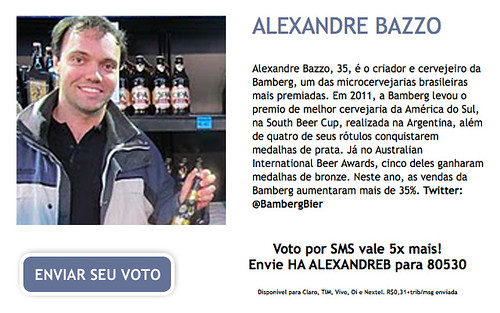
It appears that anyone can vote — I did — and you don’t have to register or anything. Just go to the contest page at Alfa Magazine. There you’ll see a roster of small icons for each of the nominees. Alex is on the top row, second from the right. Just click on the “Alexandre Bazzo” square and a pop-up window will appear, it looks just like below. Just click on “ENVIAR SEU VOTO” to vote for Alex.

bazzo-bio

Below is the translation for the voting pop-up page:

Bazzo Alexander, 35, is the founder and brewer of Bamberg, one of Brazil’s most award-winning microbrews. In 2011, Bamberg took the award for best brewer in South America, at the South Beer Cup, held in Argentina, and four of their labels won silver medals. In the Australian International Beer Awards, five of them won bronze medals. This year, sales of Bamberg increased more than 35%. Twitter: @BambergBier.

bamberg-bier

Filed Under: Breweries, Just For Fun, News, Related Pleasures Tagged With: Brazil, Contest, South America

Beer In Ads #434: The Schlitz Puppy

August 25, 2011 By Jay Brooks


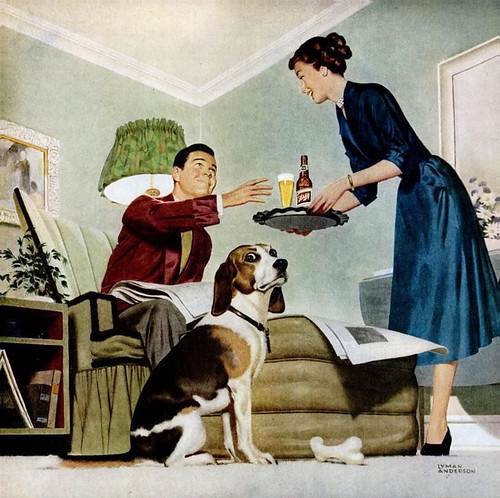
Thursday’s ad is for Schlitz, also from 1952, and it shows another housewife bringing a Schlitz to another newspaper-reading husband. But for reasons unknown, the puppy in the foreground is giving us quite a look. What do you think his expression is trying to convey? I’m stumped.

Schlitz-1952-puppy

Filed Under: Art & Beer, Beers Tagged With: Advertising, History, Schlitz

Did Lager Yeast Come From Patagonia?

August 25, 2011 By Jay Brooks

yeast-cell
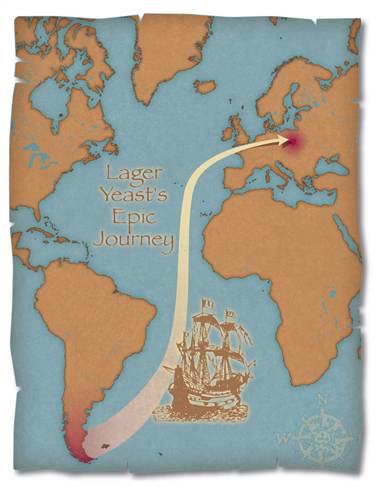
You probably saw this little item, it’s been all over the interwebs over the last few days, about a group of eight scientists positing that a newly discovered yeast strain, dubbed Saccharomyces eubayanus, may have hitched a ride from Patagonia, in South America, to Europe where it got busy with local yeasts there — notably Saccharomyces cerevisiae — to form the yeast we know today as lager yeast, or Saccharomyces pastorianus (a.k.a. Saccharomyces carlsbergensis).

The academic paper, to be published in the August edition of the journal Proceedings of the National Academy of Sciences of the United States of America (or PNAS), goes by the rather dry title, Microbe domestication and the identification of the wild genetic stock of lager-brewing yeast. The Abstract summarizes the paper:

Domestication of plants and animals promoted humanity’s transition from nomadic to sedentary lifestyles, demographic expansion, and the emergence of civilizations. In contrast to the well-documented successes of crop and livestock breeding, processes of microbe domestication remain obscure, despite the importance of microbes to the production of food, beverages, and biofuels. Lager-beer, first brewed in the 15th century, employs an allotetraploid hybrid yeast, Saccharomyces pastorianus (syn. Saccharomyces carlsbergensis), a domesticated species created by the fusion of a Saccharomyces cerevisiae ale-yeast with an unknown cryotolerant Saccharomyces species. We report the isolation of that species and designate it Saccharomyces eubayanus sp. nov. because of its resemblance to Saccharomyces bayanus (a complex hybrid of S. eubayanus, Saccharomyces uvarum, and S. cerevisiae found only in the brewing environment). Individuals from populations of S. eubayanus and its sister species, S. uvarum, exist in apparent sympatry in Nothofagus (Southern beech) forests in Patagonia, but are isolated genetically through intrinsic postzygotic barriers, and ecologically through host-preference. The draft genome sequence of S. eubayanus is 99.5% identical to the non-S. cerevisiae portion of the S. pastorianus genome sequence and suggests specific changes in sugar and sulfite metabolism that were crucial for domestication in the lager-brewing environment. This study shows that combining microbial ecology with comparative genomics facilitates the discovery and preservation of wild genetic stocks of domesticated microbes to trace their history, identify genetic changes, and suggest paths to further industrial improvement.

Mainstream media, picking up the story, has sensationalized it, looking for the human angle. For example the L.A. Times compared the discovery to finding the evolutionary missing link, titling their piece Scientists find lager beer’s missing link — in Patagonia. Essentially, they detail the scientists’ five-year quest to answer the question of where lager yeast originated, and how it came to be. The answer, according to the new paper, is a newly found strain of yeast discovered in the forests of Argentina’s Patagonia region. The wild yeast was named Saccharomyces eubayanus, and it was found living on beech trees.

According to the Times’ report:

Their best bet is that centuries ago, S. eubayanus somehow found its way to Europe and hybridized with the domestic yeast used to brew ale, creating an organism that can ferment at the lower temperatures used to make lager.

Geneticists have known since the 1980s that the yeast brewers use to make lager, S. pastorianus, was a hybrid of two yeast species: S. cerevisiae — used to make ales, wine and bread — and some other, unidentified organism.

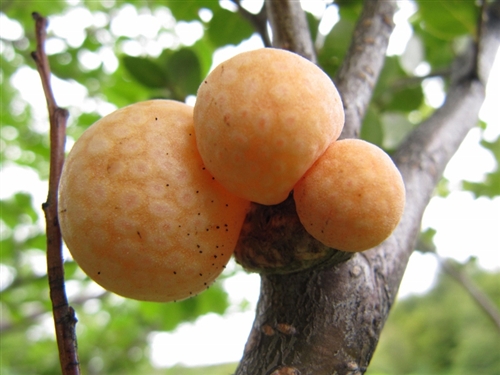
Then one of the eight, Diego Libkind, a professor at the Institute for Biodiversity and Environment Research in Bariloche, Argentina, discovered sugar-rich galls on southern beech trees in Patagonia. Yeast were drawn to the galls like a moth to a flame, and had been used by native populations to make a fermented beverage. The yeast in the galls was sent to the University of Colorado, who analyzed the genome, finding that it was 99.5% identical to lager yeast. They named the new yeast Saccharomyces eubayanus, presumably because of its similarity to Saccharomyces bayanus, a yeast commonly used to make cider and wine. Said Stanford geneticist Gavin Sherlock, quoted in the L.A. Times: “The DNA evidence is strong.”

yeast-gall-2

Naturally, Sherlock, and many others have been wondering how Saccharomyces eubayanus hitched a ride to Bavaria at a time when there was no known contact between the two parts of the world, separated by an ocean and some 8,000 miles. The article also states that “Lager was invented in the 1400s,” though my memory is that European brewers were using lager yeast well before that, and it was the lagering process was developed in the 1400s, but perhaps I’m not remembering that correctly.

lager-yeast-maps

In an interesting development surrounding this debate, U. Penn biomolecular archeologist, Patrick McGovern (author of Uncorking the Past), weighed in with his thoughts at the MSNBC article about this story, Beer mystery solved! Yeast ID’d. Here’s what McGovern had to say, as summarized by author John Roach:

Assuming the genetics work is correct, he said he is “troubled by how this newly discovered wild yeast strain made it into Bavaria in the 1500s.”

For one, he noted, Germans, and especially Bavarians, were not involved in the European exploration of Patagonia at the time. So, if the yeast somehow hitched a ride back to Europe via trade with the English, Spanish, and Portuguese, how did it get to Bavaria?

“Perhaps, some Patagonian beech was used to make a wine barrel that was then transported to Bavaria and subsequently inoculated a batch of beer there?” he asked. “Seems unlikely.”

He said a more likely scenario is that galls in the oak forests of southern Germany also harbored S. eubayanus, at least until it was out competed by the more ubiquitous S. cerevisiae.

“If true, then the use of European oak in making beer barrels and especially processing vats, which could harbor the yeast, might better explain the Bavarian ‘discovery’ of lager in the 1500s,” he said.

Nevertheless, he added, history and archaeology are full of surprises.

“Nowhere is this more true than of the seemingly miraculous process of fermentation and the key role of alcohol in human culture and life itself on this planet,” he said.

“This article has begun to unravel the complicated heritage and life history of the fermentation yeasts, and will hopefully stimulate more research to see whether the Patagonian hypothesis proves correct.”

Diplomatically put, because as everyone admits, the find in South America may not be the exclusive area where Saccharomyces eubayanus lives, just the first place it’s been found. The human history portion of this story doesn’t seem to quite fit at this point, but it’s certainly a compelling story and it will be interesting to see how it continues to develop.

yeast-gall-1

Filed Under: Beers, Editorial, News Tagged With: Archeology, Argentina, Europe, Germany, History, South America, Yeast

Beer In Ads #433: Schlitz For A Bonnet

August 24, 2011 By Jay Brooks


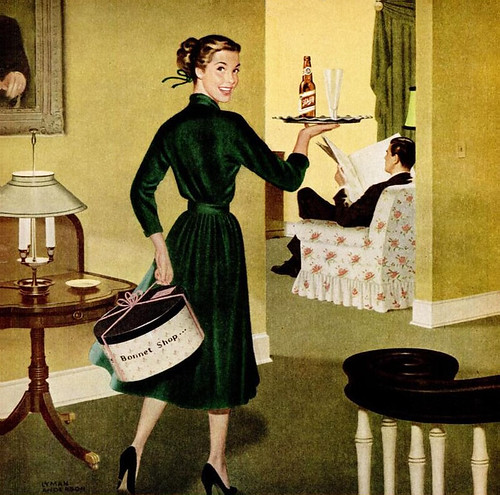
Wednesday’s ad is also for Schlitz, from 1952, and it shows a devious housewife bringing a Schlitz to her newspaper-reading husband. She’s glancing back at us with a knowing smile as she prepares to soften the blow of the new chapeau she’s just bought at the “Bonnet Shop” by serving him a beer. Nice.

Schlitz-1952-bonnet

Filed Under: Art & Beer, Beers Tagged With: Advertising, History, Schlitz

Beer Bottle Dominoes

August 24, 2011 By Jay Brooks

dominoes
At least a dozen people have e-mailed me a link to this video, so I bow to the will of the people and share it with the remaining couple of people who may not yet have seen it. It’s a simple idea, using beer bottles (and some liquor bottles, too) in place of dominoes, but is fairly well executed. Enjoy.

Filed Under: Beers, Just For Fun Tagged With: Bottles, Humor, Video

Beer In Ads #432: Schlitz Is An Adventure

August 23, 2011 By Jay Brooks


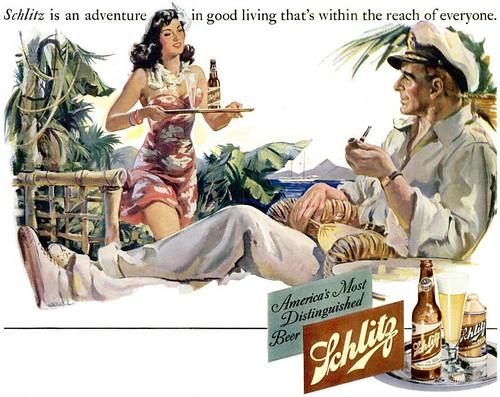
Tuesday’s ad is another Schlitz ad, this one from 1941, presumably before we entered World War 2 that December. In the ad, a man in a captain’s hat lounges on a tropic island as a native beauty arrives with a tray containing a bottle of Schlitz and a glass. You can see a ship anchored offshore in the distance. The tagline is awesome: “Schlitz is in an adventure in good living that’s within the reach of everyone.”

Schlitz-1941-tahiti

Filed Under: Art & Beer, Beers Tagged With: Advertising, History, Schlitz

Canned Pop Culture

August 23, 2011 By Jay Brooks

pop-culture-can
Here’s another fun design project by Minnesota illustrator David Schwen. It’s a poster depicting nine beer cans representing characters from across varying pop cultures. The identity of some of the cans are fairly obvious while others were inscrutably unknown to me, presumably because I’ve become more old curmudgeon and less with-it-hipster (though to be fair I was happily never one of the cool kids). I can say with certainty I knew 6 of 9 — itself a pop reference — or one-third of them right off the bat. Two more I figured out, more or less, and the remaining one I never got, though now that I know it, it makes sense. Think you know them all? Leave a comment identifying all nine.

pop-culture-cans
You can even buy a print of the poster in five different sizes at Society 6.

Filed Under: Art & Beer, Food & Beer Tagged With: Cans, Humor

Next Session Explores Whether You Can Judge A Beer By Its Cover

August 23, 2011 By Jay Brooks

session-the
Our 55th Session takes a look at Label, Coaster and Cap Art. Our host, Curtis Taylor at Hop Head Said …, expounds on his topic Label, Coaster and Cap Art, and describes how to participate:

On September 2, bloggers from around the world will converge at HopHeadSaid to write about the fabulous world of beer art found on coasters, labels and caps. I am guessing that I am not so different from other beer enthusiasts – I like to collect beer labels, bottle caps and coasters. I think they are perfect souvenirs from beer travels or drinking sessions. Judging by the size of my collection you could say that I have had many enjoyable drinking sessions over the years!

Now it is time to dig through your stash and share your favorite label, coaster or cap art.

Posting Directions:

  1. Choose your favorite label, coaster or cap art.
  2. Scan, download or take a picture of your label, coaster or cap art.
  3. Write a paragraph that explains your affinity to your entry. Your explanation can be as shallow as or as deep as you want.
  4. If the brewery name or beer name is obscured be sure to label your entry to give credit where credit is due.
  5. Please limit your entries to commercial examples. Homebrew labels will be a topic for another session.
  6. Extra karma points will be awarded to those who write about two or more categories (label, coaster or cap art).
  7. Post your blog entry on or before Friday, September 2, 2001 and e-mail your link to curtis [at] hopheadsaid [dot] com.
  8. Alternate posting method: Post your picture and explanation on my HopHeadSaid Facebook page and I will copy your post to the “official” location.
  9. I will collect the entries throughout the day and post them on this page: The Session: Label, Coaster and Cap Art.

They say you can’t judge a book by its cover, but what about a beer by its label, crown or coaster? Let us know what you think for the next Session on Friday, September 2.

Filed Under: Art & Beer, Beers, The Session Tagged With: Beer Labels, Breweriana, Coasters, Crowns

Beerstrology Sign: Virgo

August 23, 2011 By Jay Brooks

zodiac
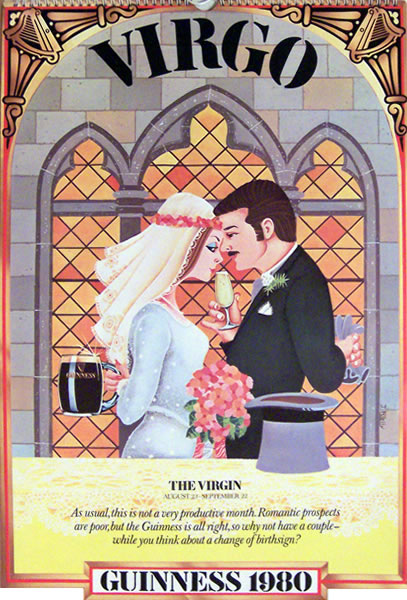
While I don’t put any stock in astrology, in 1980 Guinness put out a calendar with each month representing one of the zodiac signs, and I thought it would be fun to share these throughout the year.

Virgo, the virgin or maiden, is from August 23-September 23. To learn more, see:

  • Astrology Online
  • Universal Psychic Guild
  • Wikipedia
  • Zodiac Signs

Guinness-zodiac-08-virgo

Filed Under: Art & Beer, Just For Fun Tagged With: Beerstrology, Guinness

« Previous Page
Next Page »

Find Something

Northern California Breweries

Please consider purchasing my latest book, California Breweries North, available from Amazon, or ask for it at your local bookstore.

Recent Comments

  • Bob Paolino on Beer Birthday: Grant Johnston
  • Gambrinus on Historic Beer Birthday: A.J. Houghton
  • Ernie Dewing on Historic Beer Birthday: Charles William Bergner 
  • Steve 'Pudgy' De Rose on Historic Beer Birthday: Jacob Schmidt
  • Jay Brooks on Beer Birthday: Bill Owens

Recent Posts

  • Beer In Ads #5203: Now’s The Time To Say … Blitz Weinhard Bock For Me! April 3, 2026
  • Beer Birthday: Dave Bonighton April 3, 2026
  • Historic Beer Birthday: Frederick Hinckel Jr. April 3, 2026
  • Beer In Ads #5202: The Bock Beer Time Is Near, And It Comes But Once A Year April 3, 2026
  • Historic Beer Birthday: Henry Pierre Heineken April 3, 2026

BBB Archives

Feedback

Head Quarter
This site is hosted and maintained by H25Q.dev. Any questions or comments for the webmaster can be directed here.