Brookston Beer Bulletin

Jay R. Brooks on Beer

  • Home
  • About
  • Editorial
  • Birthdays
  • Art & Beer

Socialize

  • Dribbble
  • Email
  • Facebook
  • Flickr
  • GitHub
  • Instagram
  • LinkedIn
  • Pinterest
  • RSS
  • Twitter
  • YouTube

Powered by Genesis

Beer In Art #123: Anthony Picone’s Beer Illustrations

April 17, 2011 By Jay Brooks

art-beer
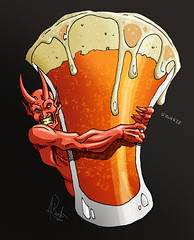
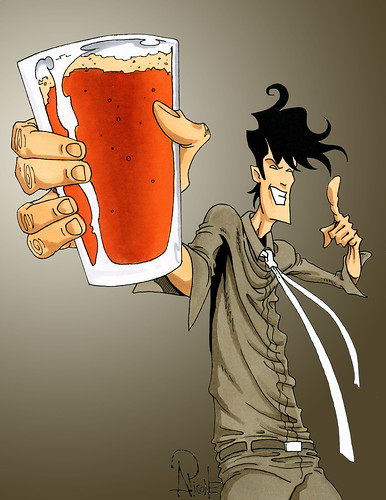
This week’s works of art are by Brooklyn illustrator Anthony Picone, whose art can be found on his blog Ant Stuff. This first one is called “Red Beer.”
picone-red-beer

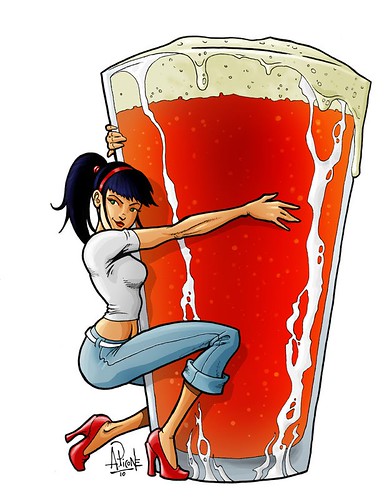
This second one was created for Houston Beer Week.
picone-sexy-beer

And I like the Beer Turtle, similar to the Iroquois creation myth where the world rode on the back of a giant turtle.
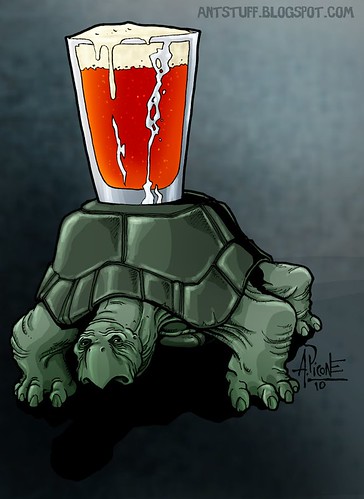
picone-beer-turtle

Forgivable Sin shows Jesus and Satan sharing a beer. See beer can solve any problem. Good and evil? Have a beer.
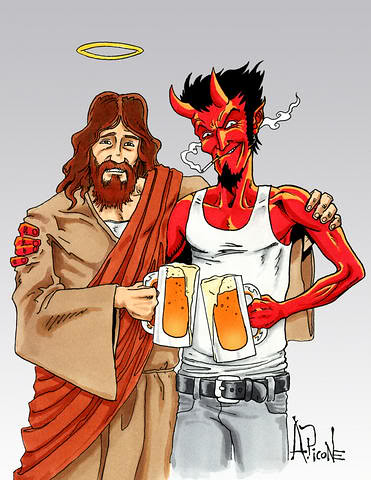
picone-forgivable-sin

Here’s Tiki Beer and Viking with a Beer.
picone-tikibeer picone-beer-viking

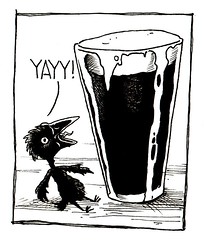
And Tin Man Beer along with Bird Beer.
picone-tinbeer picone-birdbeer

And Picone seems to have a thing for showing pint glasses affection.
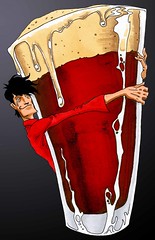
picone-beerhug picone-squeeze

And finally, here’s some Hot Pints.

picone-hot-pints

That’s honestly a small sample of his beer-themed work. He also draws a lot of zombies, monsters, and assorted characters, all of which can be seen at his Antstuff blog.

Filed Under: Art & Beer, Beers Tagged With: New York

The Brain and Alcohol Research Project

April 17, 2011 By Jay Brooks

trinity-college
Trinity College, in Hartford, Connecticut, at the end of March released some preliminary results after three years of a five-year study entitled the Brain and Alcohol Research Project. In a press release entitled What Students’ Brains Have Told Us about the Effects of Binge Drinking, they revealed the following:

Young adults who binge drink tend to perform worse in class than normally would have been expected, but only in the first year of college. After that, drinking to excess produces no discernible difference in academic performance.

So the obvious takeaway from that is that during a student’s first year away from home and away from parental rule, young adults tend to go a little wild that first year but then settle down into academic life for the remaining three years of their four-year college experience. They may not stop drinking, but they figure out how to hit the books, too. It seems rather predictable when you think about, especially when there’s virtually no alcohol education prior to college and in some states even parents are forbidden from educating their own children about drinking.

But it also seems to fly in the face of the neo-prohibitionist hue and cry about underage drinking being as bad for student performance as believed. And undoubtedly the worst of it is because it’s underground as a result of the minimum age being 21 instead of a more reasonable 18.

Also known as BARCS (for Brain and Alcohol Research with College Students), the project is “a large-scale longitudinal study that includes more than 2,000 college students from diverse backgrounds, set out to definitively address previously unanswered questions such as: Can heavy drinking in college affect brain structure and grades? If so, is it related to the overall amount of alcohol consumed or more to consumption patterns, such as binging and blackouts? Why is it that many students drink heavily in college but only a minority goes on to have alcohol problems after college? Are all adolescents affected equally by alcohol in terms of possible effects on brain and risk for later alcohol abuse? Is there a way to identify the people who will be longer-term problem drinkers?”

Unfortunately, I believe they begin with a failed premise. The study defines binge drinking “as a pattern of drinking that raises a person’s blood alcohol content to 0.08 percent or above.” That means drinking enough to be considered drunk at the lowest BAC allowed in most jurisdictions is the same as binge drinking. It’s amazing how what it means to binge drink keeps getting lower and lower, presumably in an effort to make the perceived problem seem increasingly worse. But this greater incidence of binge drinking is due entirely to continually redefining its meaning. Equating binge drinking with merely being drunk (under the legal definition) removes any distinction between the two and renders it meaningless.

Filed Under: Editorial, News, Politics & Law Tagged With: Prohibitionists, Statistics

Guinness Ad #64: When The Sun Says ‘Morning Gone’

April 16, 2011 By Jay Brooks

guinness-toucan
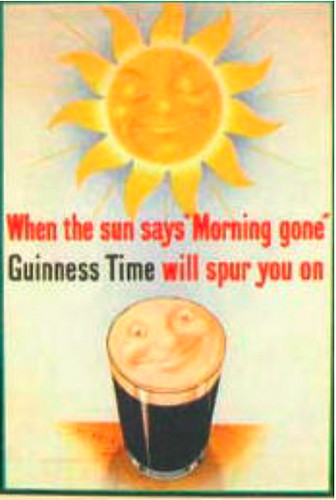
Our 64th Guinness ad shows the sun beating down on a glass of Guinness, and this delightful bit of text: “When the sun says ‘Morning gone’ Guinness Time will spur you on.” [Note: this artwork is from a coaster, which is why it’s so poor looking. If anyone has better artwork, please be so kind as to send it my way. Thanks.]

Guinness-morning-gone

Filed Under: Art & Beer, Beers Tagged With: Advertising, Guinness, History

Thirty Percent Of Americans Drink Once A Week

April 16, 2011 By Jay Brooks

harris-poll
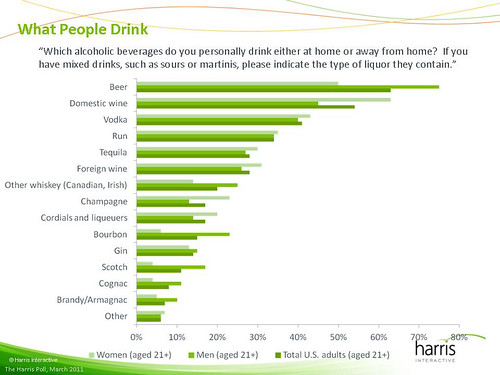
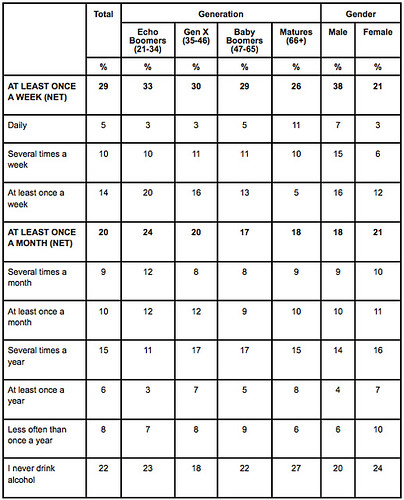
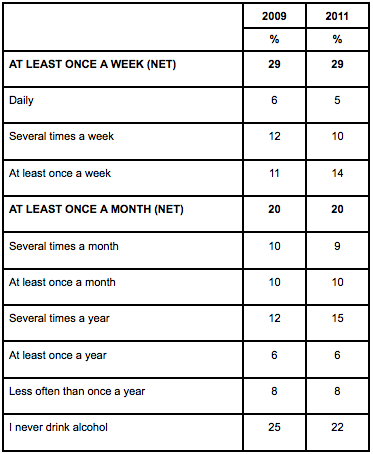
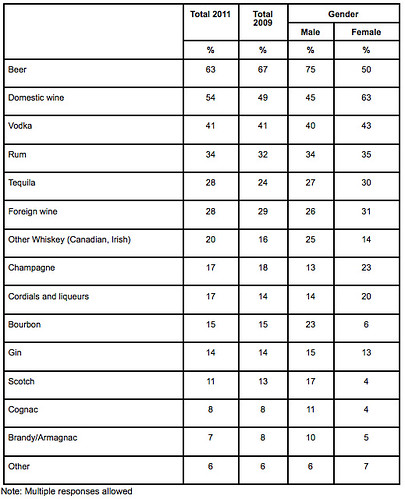
A Harris Poll conducted in March of this year concluded that Three in Ten Americans Drink Alcohol at Least Once a Week. The poll, conducted by Harris Interactive, surveyed 2,379 adults between March 7 and 14, 2011. Not surprisingly, beer continues to be the most popular alcoholic beverage, followed by American wine and vodka. And men still drink beer more than women “75% vs. 50%.”

Harris-What_People_Drink-2011

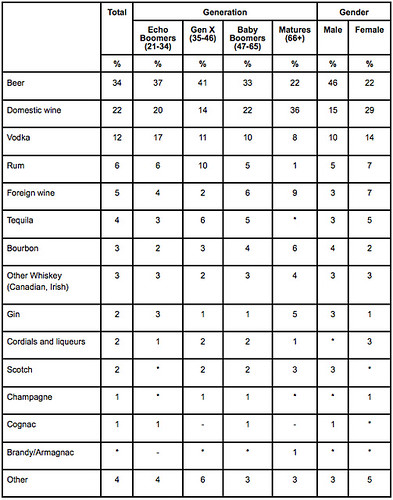
Here are some other findings from the poll:

Question 1: “How often do you drink alcohol, including beer or wine?”

Harris-2001-1

Question 2: “How often do you drink alcohol, including beer or wine?”

Harris-2001-2

Question 3: “Which alcoholic beverages do you personally drink either at home or away from home? If you have mixed drinks, such as sours or martinis, please indicate the type of liquor they contain.”

Harris-2001-3

Question 4: “Although you may drink several types of alcoholic beverages, which one type would you say you drink most often?”

Harris-2001-4

Naturally, I have a couple of quibbles:

  1. Why did they separate out domestic and foreign wine, but not domestic and foreign beer?
  2. “It’s probably not surprising that men and women have different drinking preferences.” Maybe, but isn’t this something of a self-perpetuating prophecy? I know plenty of women who love beer and find wine too sweet. I also know women who claim to find beer too bitter but drink their weight in coffee. I can’t help but wonder if we keep reinforcing this by asking the question, and people respond with the answer they think is the case, which ends up making it real when maybe it’s not.
  3. “According to many doctors and medical studies, a glass of wine is good for one’s health. And even beyond wine, a drink, as long as it’s in moderation, is something that people shouldn’t be afraid of having.” Goddammit, why does this one persist, that “wine” is good for you but the rest are not? By omission, the statement implies that beer and other alcohol is not “good for one’s health” or at a minimum not “as” good which infuriates me. And adding the qualifying statement that “beyond wine” it’s okay to drink the other alcoholic drinks “as long as it’s in moderation” likewise implies that it’s healthful to drink as much wine as you like. How can they be so detail-oriented about the statistics involved in polling, and so ignorant in their statements of analysis? Sheesh.

Filed Under: Beers, Editorial, News Tagged With: Poll, Statistics, United States

Toronado Blunch 2011 Recap

April 16, 2011 By Jay Brooks

toronado sean-paxton
Last Sunday, the annual Toronado Belgian Beer Lunch took place, with the food again being done by Sean Paxton, the Homebrew Chef. The Belgian lunch — or Blunch, as I’ve taken to calling it — began promptly at 11:30 a.m. and went until nearly 5:30 p.m. Now that’s slow food, but really with twelve courses the pacing was just right. I had the pleasure of being seated at a table with Toronado owner Dave Keene, the beer chef Bruce Paton, and my favorite ne’er do well, Dave Suurballe. Here’s a recap of the meal.

2011 Toronado Blunch

P1030858
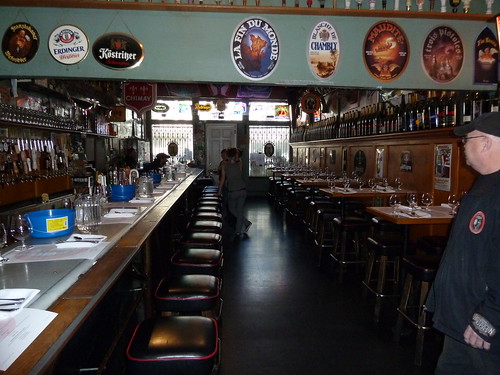
Before the Blunch began.

Pre-Lunch Reception:

P1030862
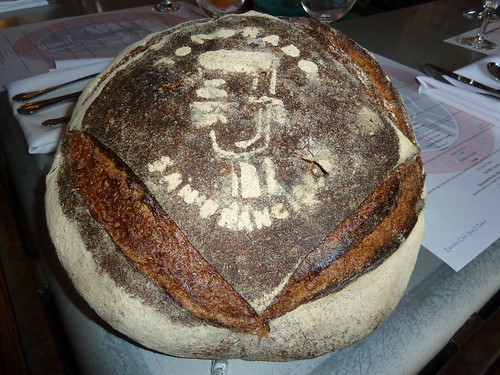
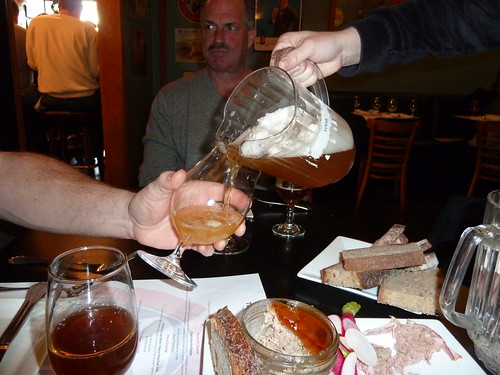
Handmade Toronado bread.

P1030864
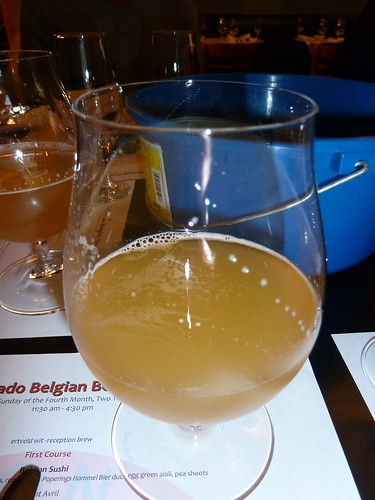
Beer #1: Van Steenberge Ertveld’s Wit

First Course

P1030868
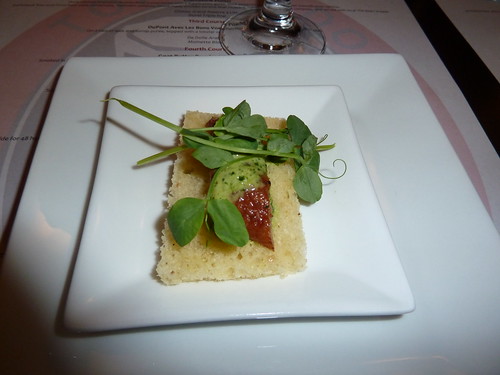
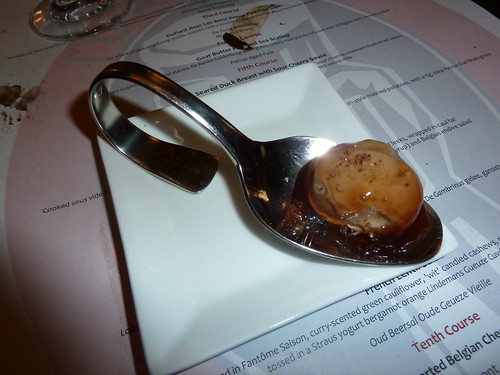
Belgian Sushi: Wit-flavored brioche infused with foie gras, roasted eel, Poperings Hommel Bier duck egg green aioli, pea shoots

Paired with DuPont Avril

Second Course

P1030870
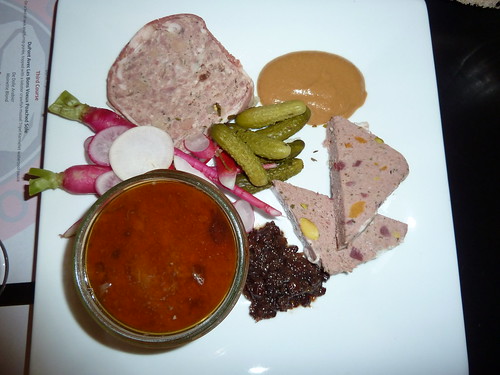
Charcuturie Platter: Duck rillettes braised in Russian River Consecration with a Supplication gelee, duck pistachio apricot infused with Sanctification terrine, pork/duck liver and Orval beer pâté, cornichons, heirloom radishes, house-made Goulden Carolus Noel mustard, currant & Consecration compote

P1030872
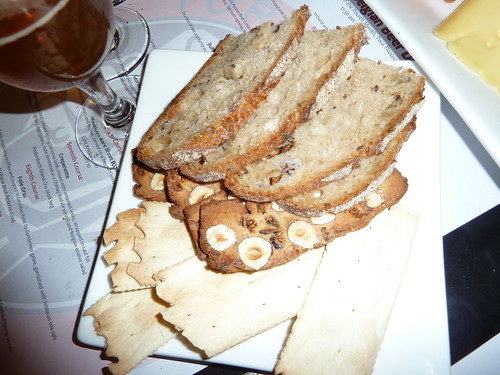
Served with local The Bejkr breads

P1030875
Paired with Chimay Grand Reserve 3 Liter and Duvel Triple Hop

Third Course

P1030877
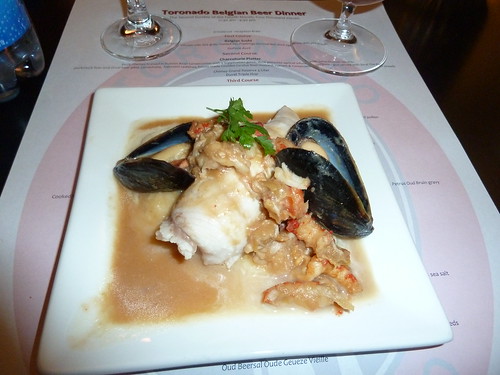
DuPont Avec Les Bons Voeux Poached Sole: On a bed of leek and turnip purée, topped with a lobster crawfish mussel Tripel Karmeliet waterzooi sauce

Paired with De Dolle Arabier and Moinette Blond

Fourth Course

P1030879
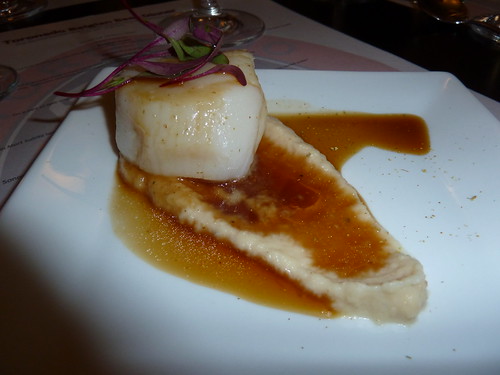
Goat Butter Poached Sea Scallop: Smoked in Mort Subite lambic barrel staves, De Ranke Guldenburg demi glaze, celery root purée infused with Affligem Noel, fennel pollen

Paired with Petrus Aged Pale

Fifth Course

P1030885
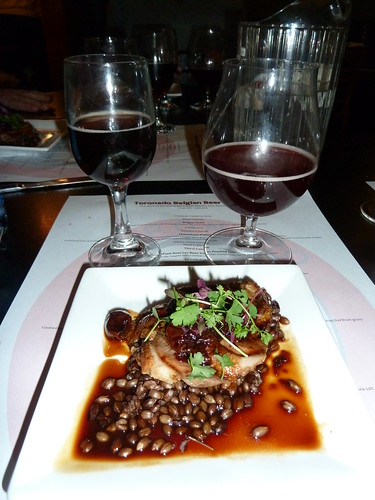
Seared Duck Breast with Sour Cherry Sauce: Sonoma County duck breasts cooked sous vide with shallots, thyme, with a dried sour cherries Hannsen Oude Kriek sauce on a bed of black barley simmer in Delirium Noel and TCHO cocoa nibs

Paired with Bocker Cuvee De Jacobins and Drie Fonteinen Oude Kriek

P1030887
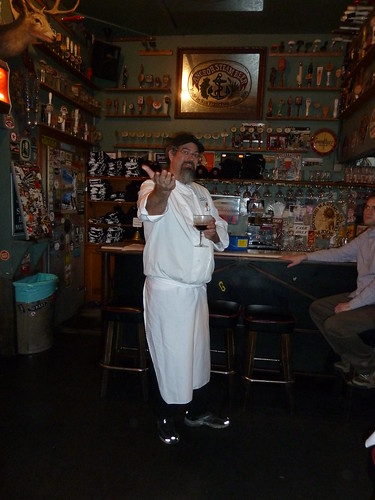
The Homebrew Chef, Sean Paxton.

Sixth Course

P1030893
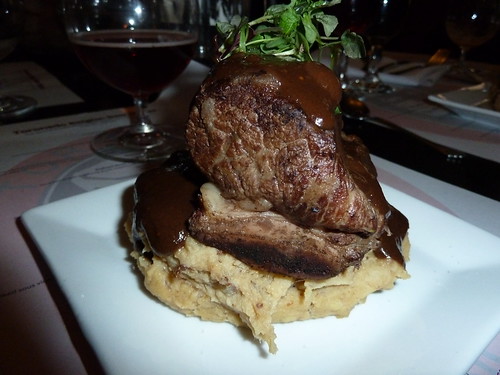
Medium Rare Short Ribs: Cooked sous vide for 48 hours in Rochefort 8, caramelized shallots and thyme, served on a bed of Flemish-style mashed potatoes, with a fig, date Petrus Oud Bruin gravy

Paired with Echt Kriekenbier and Rochefort 10

Seventh Course

P1030894
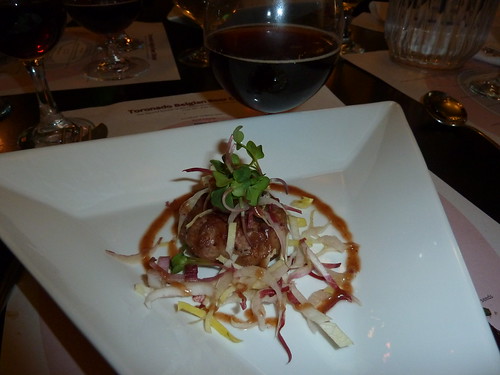
Crepenette: Westmalle Dubbel infused Spring Sonoma lamb, mixed with creamed leeks, wrapped in caul fat topped with a sirop de Liége (pears, date simmered in a Chimay Red ale syrup) and Belgian endive salad

Paired with Rodenbach Grand Cru 2008 keg

Eighth Course

P1030905
Foie Gras: Lobes of foie gras poached in Boon Kriek, made into truffles and coated in Cantillon Rosé De Gambrinus gelee, garnished with hibiscus sea salt

Paired with Malheur Brut Reserve 2006

Ninth Course

P1030908
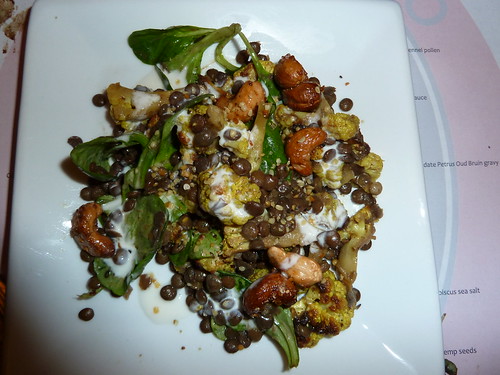
French Lentil Salad: Lentils simmered in Fantôme Saison, curry-scented green cauliflower, ‘wit’ candied cashews, mâche greens and toasted hemp seeds tossed in a Straus yogurt bergamot orange Lindemans Gueuze Cuvée René dressing

Paired with Oud Beersal Oude Geueze Vieille

Tenth Course

P1030909
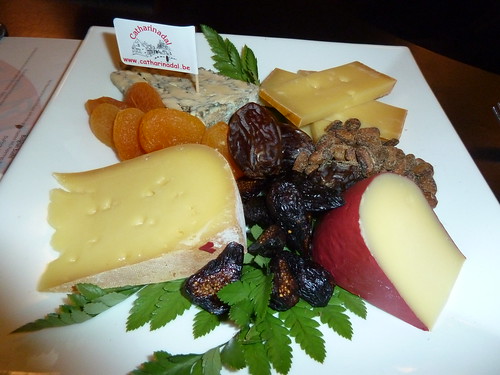
Assorted Belgian Cheeses: Grevenbroecker, Wavreumont, “St. Maure,” Charmoix, Meikaas, and Kriek Washed Fromage served with pomegranate Supplication honey, the Bejkr Biologlque bread, hazelnut fig crackers, dried fruit, honey blood orange peel candied pistachios

P1030910
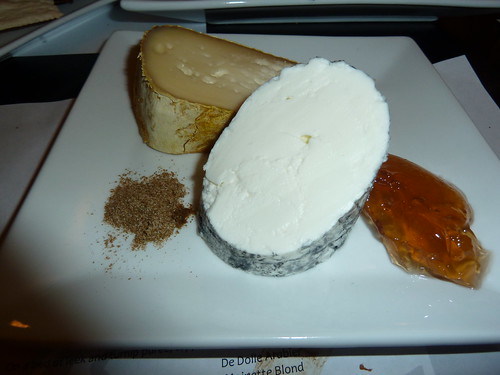
Cheese Plate #2

P1030912
Paired with Liefmans Cuvee Brut and Orval, along with the bread and crackers.

Eleventh Course

P1030916
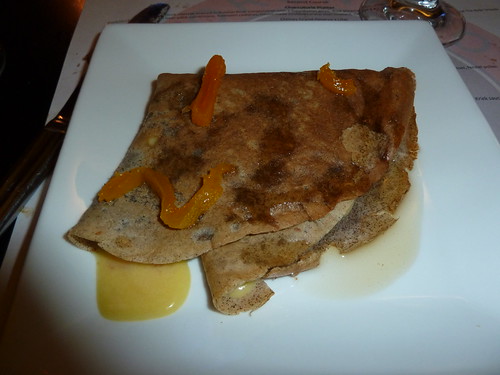
Crêpe: Boon Oude Geuze Mariage Parfait beer curd, Hanssens Oudbeitje rhubarb jam, Westmalle Tripel chamomile syrup wrapped in a Sara Buckwheat Ale crepe

Paired with De Struise T’sjeeses

Twelfth Course

P1030920
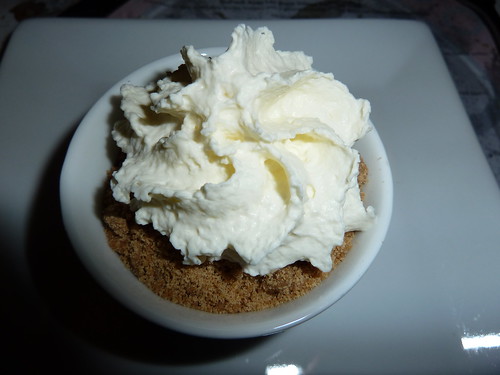
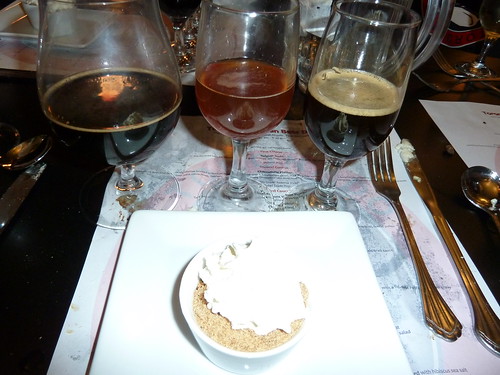
Chocolate Pot de Crème Deconstructed Pie: Speculoos cookie crust, Belgian dark chocolate infused custard, Chantilly cream

P1030922
Paired with De Struise Pannepot 2007, Scaldis Noel 1998 Magnums and De Struise Black Albert 2009, beers 18 through 20.

Okay, well that didn’t suck. Another spectacular meal. Thanks Sean and Dave.

Filed Under: Beers, Events, Food & Beer, Just For Fun Tagged With: Cheese, Food, Photo Gallery

Beer In Ads #349: Schlitz, Memories Of A Kiss

April 15, 2011 By Jay Brooks

ad-billboard
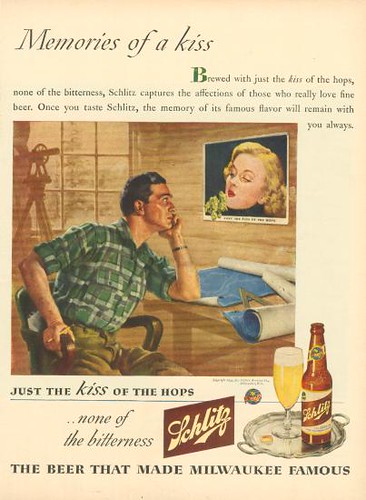
Friday’s ad is for Schlitz, playing on one of their earlier ads. An architect or draftsman stares longingly at the older ad on his wall, instead of working on the blueprints on the desk in front of him. The original ad was their iconic slogan “Just the kiss of hops” so for this ad it’s “Memories of a kiss.”

schlitz-kiss-memories

Filed Under: Art & Beer, Beers Tagged With: Advertising, History, Schlitz

Cheese Buying Time

April 15, 2011 By Jay Brooks

cheese
A gentle reminder that there are exactly three weeks until the next Session a.k.a. The Great Online Beer & Cheese-Off. Now would be a perfect time to pick up three cheeses for the tasting, try them, and start thinking about what beers might work best with them. Here are the cheeses to be on the lookout for:

1. Maytag Blue

cheese-maytag-blue

Maytag Blue or another blue cheese.

2. Widmer 1-Year Aged Cheddar

cheese-widmer

Widmer Cellars one-year old aged cheddar or another one-year aged cheddar cheese.

3. Cypress Grove Humboldt Fog

cheese-cypress-grove

Humboldt Fog from Cypress Grove Chevre or another goat cheese.

It’s easier to participate then my long-winded explanation. Just eat cheese, drink beer and write about it. On Friday, May 6.

Filed Under: Beers, Events, Just For Fun, The Session Tagged With: Announcements, Cheese

Beer In Ads #348: Miller’s High Life On The Farm

April 14, 2011 By Jay Brooks

ad-billboard
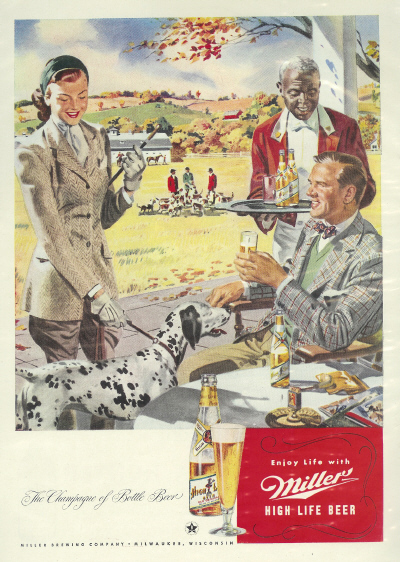
Thursday’s ad is for Miller High Life, showing a time capsule of a scene on what appears to be a farm. But one of those genteel farms of yesteryear. There’s a horse stable in the background, and in the field there’s a groups of dogs and three people who look ready for an English-style fox hunt. The foreground shows a butler serving a couple some Miller High Life on a tray, though the bottles on the table are still over half full. And I thought dalmatians were not good at hunting (too high strung), but then maybe that’s why the woman is holding the dog.
miller-horse-farm

Filed Under: Art & Beer, Beers Tagged With: Advertising, History, Miller Brewing

Your Brain On Beer

April 14, 2011 By Jay Brooks

brain-2
A new study conducted at the Waggoner Center for Alcohol and Addiction Research at The University of Texas at Austin appears to indicate that alcohol actually helps your memory, at least at the synapse level; that “alcohol primes certain areas of our brain to learn and remember better.” The new study, published in the April 6 edition of the Journal of Neuroscience, is a mouthful, entitled Previous Ethanol Experience Enhances Synaptic Plasticity of NMDA Receptors in the Ventral Tegmental Area. And the Abstract isn’t much clearer:

Alcohol addiction (alcoholism) is one of the most prevalent substance abuse disorders worldwide. Addiction is thought to arise, in part, from a maladaptive learning process in which enduring memories of drug experiences are formed. However, alcohol (ethanol) generally interferes with synaptic plasticity mechanisms in the CNS and thus impairs various types of learning and memory. Therefore, it is unclear how powerful memories associated with alcohol experience are formed during the development of alcoholism. Here, using brain slice electrophysiology in mice, we show that repeated in vivo ethanol exposure (2 g/kg, i.p., three times daily for 7 d) causes increased susceptibility to the induction of long-term potentiation (LTP) of NMDA receptor (NMDAR)-mediated transmission in mesolimbic dopamine neurons, a form of synaptic plasticity that may drive the learning of stimuli associated with rewards, including drugs of abuse. Enhancement of NMDAR plasticity results from an increase in the potency of inositol 1,4,5-trisphosphate (IP3) in producing facilitation of action potential-evoked Ca2+ signals, which is critical for LTP induction. This increase in IP3 effect, which lasts for a week but not a month after ethanol withdrawal, occurs through a protein kinase A (PKA)-dependent mechanism. Corticotropin-releasing factor, a stress-related neuropeptide implicated in alcoholism and other addictions, further amplifies the PKA-mediated increase in IP3 effect in ethanol-treated mice. Finally, we found that ethanol-treated mice display enhanced place conditioning induced by the psychostimulant cocaine. These data suggest that repeated ethanol experience may promote the formation of drug-associated memories by enhancing synaptic plasticity of NMDARs in dopamine neurons.

Professor Hitoshi Morikawa, who wrote the paper, is slightly less jargon-laden and impenetrable on the University’s website, where he more generally lays out the goals of his research:

This lab specifically focuses on the dopaminergic neurons in the ventral midbrain. They are activated by the perception and expectation of rewards. Therefore, the dopaminergic projections from the midbrain to the limbic structures constitute an endogenous reward circuit. Behaviors that lead to the enhancement of dopamine release in this brain reward circuit tend to be repeated (reinforced). Addictive drugs induce stronger stimulation of dopaminergic transmission than almost any natural reinforcers (food, sex, etc). Thus, drugs are repeatedly used (abused) in vulnerable individuals, which will lead to plastic changes in the reward circuit.

The amount and temporal profile of dopamine release is controlled by the firing pattern of dopamine neurons, which is determined by the interaction of their intrinsic membrane properties and the afferent inputs they receive from other neurons. Accordingly, we make detailed analyses of the influence of addictive drugs on membrane ionic conductances and neurotransmitter inputs of dopamine neurons, and investigate the resulting alteration in the firing pattern. We use brain slices because they retain intact synaptic connections that are necessary for these studies. Brain slices are obtained from drug-naïve animals and animals that are chronically treated with drugs to elucidate the plastic changes induced by repeated exposure to drugs in vivo. Technically, we perform patch clamp electrophysiological recordings combined with confocal fluorescent imaging of intracellular ions. These methods will allow us to delineate the cellular events that determine the excitability of neurons with a preciseness that could not be attained by other conventional techniques. Therefore, this lab offers an ideal system to link the behavior of certain types of central neurons to that of a whole organism.

But a science news website, Physog.com has the most understandable account of the study, and what it means.

Essentially, and somewhat confusingly, the study shows that while common view that too much alcohol can be bad for memory retention and learning, that how your brain reacts to it is more complicated than that.

“Usually, when we talk about learning and memory, we’re talking about conscious memory,” says Morikawa, whose results were published last month in The Journal of Neuroscience. “Alcohol diminishes our ability to hold on to pieces of information like your colleague’s name, or the definition of a word, or where you parked your car this morning. But our subconscious is learning and remembering too, and alcohol may actually increase our capacity to learn, or ‘conditionability,’ at that level.”
So while short terms losses may occur, long term gains in subconscious memory may also be taking place. “Morikawa’s study found that repeated ethanol exposure enhances synaptic plasticity in a key area in the brain, [and] is further evidence toward an emerging consensus in the neuroscience community that drug and alcohol addiction is fundamentally a learning and memory disorder.”
When we drink alcohol (or shoot up heroin, or snort cocaine, or take methamphetamines), our subconscious is learning to consume more. But it doesn’t stop there. We become more receptive to forming subsconscious memories and habits with respect to food, music, even people and social situations.

In an important sense, says Morikawa, alcoholics aren’t addicted to the experience of pleasure or relief they get from drinking alcohol. They’re addicted to the constellation of environmental, behavioral and physiological cues that are reinforced when alcohol triggers the release of dopamine in the brain.

“People commonly think of dopamine as a happy transmitter, or a pleasure transmitter, but more accurately it’s a learning transmitter,” says Morikawa. “It strengthens those synapses that are active when dopamine is released.”

Alcohol, in this model, is the enabler. It hijacks the dopaminergic system, and it tells our brain that what we’re doing at that moment is rewarding (and thus worth repeating).

Among the things we learn is that drinking alcohol is rewarding. We also learn that going to the bar, chatting with friends, eating certain foods and listening to certain kinds of music are rewarding. The more often we do these things while drinking, and the more dopamine that gets released, the more “potentiated” the various synapses become and the more we crave the set of experiences and associations that orbit around the alcohol use.

Between that, and new research from the University of Michigan that may have identified a gene — the GABRA2 — that increases the risk of alcoholism in certain individuals, it seems clear that there are environmental and genetic factors that make some people more susceptible to becoming unable to drink responsibly, along with the obvious psychological factors, too. But what that also suggests is that alcoholism is more like a food allergy insofar as it does not effect everyone in the same way, and in fact the vast majority of people who do consume alcohol are able to do so responsibly and in moderation, which also allows them to take advantage of the many health benefits of drinking in moderation. Contrary to neo-prohibitionist propaganda, not everyone becomes an alcoholic with the first sip they take. Most, in fact, not only don’t, but never do, yet the anti-alcohol contingency tends to treat alcohol as a toxic substance that is dangerous to everyone equally or that everyone has the potential to become an alcoholic. I just don’t think that’s true. And the science seems to bearing that out. And because of all the beer I’ve consumed, I can remember all that, too. Thank you, beer.

Filed Under: Editorial, News, Politics & Law Tagged With: Science, Statistics

Beer In Ads #347: Our Third President Was Our First Spaghetti Maker

April 13, 2011 By Jay Brooks

ad-billboard
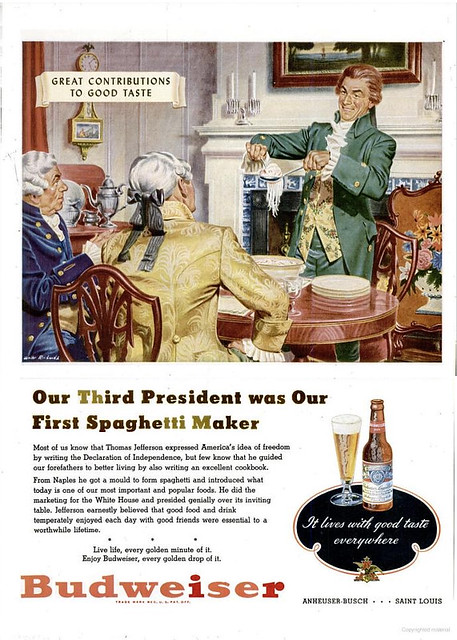
Wednesday’s ad is a 1948 ad for Budweiser featuring our third President, Thomas Jefferson, whose birthday is also today. He was born April 13, 1743. According to the Bud ad, he also introduced spaghetti to America. Let’s say I’m skeptical. Here’s the text:

From Naples he got a mould to form spaghetti and introduced what is one of our most important and popular foods. He did the marketing for the White House and presided genially over its inviting table. Jefferson earnestly believed that good food and drink temperately enjoyed each day with good friends were essential to a worthwhile lifetime.

I love the slogan at the bottom of the ad:

Live life, every golden minute of it.
Enjoy Budweiser, every golden drop of it.

The illustration is also priceless, showing a smiling redheaded Jefferson spinning spaghetti on a spoon, showing his two guests, in full wigs, how it’s done. And I thought it was Chef Boyardee.

Bud-Tom-Jefferson-1948

Interestingly, my initial skepticism turned out to be right. According to a great article by Corby Kummer on the origins of Pasta in The Atlantic:

Thomas Jefferson is credited with introducing dried pasta without egg to America, but, like the Marco Polo legend, this is a romantic fiction. He did take notes on the manufacturing process during a trip to Naples and even commissioned a friend in Italy to buy him a “maccarony machine.” He shipped himself two cases of pasta in 1789. By 1798 a Frenchman had opened what may have been the first American pasta factory, in Philadelphia, and it was a success. Upper-class Americans also bought pasta imported from Sicily, which had snob appeal.

Filed Under: Art & Beer, Beers, Food & Beer Tagged With: Advertising, Budweiser, Food, History

« Previous Page
Next Page »

Find Something

Northern California Breweries

Please consider purchasing my latest book, California Breweries North, available from Amazon, or ask for it at your local bookstore.

Recent Comments

  • Bob Paolino on Beer Birthday: Grant Johnston
  • Gambrinus on Historic Beer Birthday: A.J. Houghton
  • Ernie Dewing on Historic Beer Birthday: Charles William Bergner 
  • Steve 'Pudgy' De Rose on Historic Beer Birthday: Jacob Schmidt
  • Jay Brooks on Beer Birthday: Bill Owens

Recent Posts

  • Beer In Ads #5222: O’Keefe’s Bock Beer April 15, 2026
  • Historic Beer Birthday: George Schmitt April 14, 2026
  • Beer In Ads #5221: Bowler Brothers’ Bock April 14, 2026
  • Historic Beer Birthday: George W. Bashford April 14, 2026
  • Beer In Ads #5220: Hello People! I Am The Centlivre Bock Beer Goat April 13, 2026

BBB Archives

Feedback

Head Quarter
This site is hosted and maintained by H25Q.dev. Any questions or comments for the webmaster can be directed here.