Brookston Beer Bulletin

Jay R. Brooks on Beer

  • Home
  • About
  • Editorial
  • Birthdays
  • Art & Beer

Socialize

  • Dribbble
  • Email
  • Facebook
  • Flickr
  • GitHub
  • Instagram
  • LinkedIn
  • Pinterest
  • RSS
  • Twitter
  • YouTube

Powered by Genesis

Patent No. EP0668347B1: Pan For Boiling Wort During Beer Production

July 7, 2015 By Jay Brooks

patent-logo
Today in 1999, US Patent EP 0668347 B1 was issued, an invention of Martin Widhopf, assigned to Anton Steinecker Entwicklungs GmbH, for his “Pan For Boiling Wort During Beer Production.” There’s no Abstract, although in the description it includes this summary:

A wort kettle for boiling wort for brewing, comprising a vapor escape pipe and a vapor compressor, wherein vapor can escape to the outside via said vapor escape pipe during heating of said wort kettle and can be diverted by means of a shut-off device via said vapor compressor during boiling, characterized in that said shut-off device is formed by a surge tank which is arranged in the flow direction of said vapor in said vapor escape pipe after a branch towards said vapor compressor.


Filed Under: Beers, Breweries, Just For Fun, Politics & Law, Related Pleasures Tagged With: Brewing Equipment, History, Law, Patent, Science of Brewing, Wort

Patent No. 4277505A: Process For The Malting Of Grain

July 7, 2015 By Jay Brooks

patent-logo
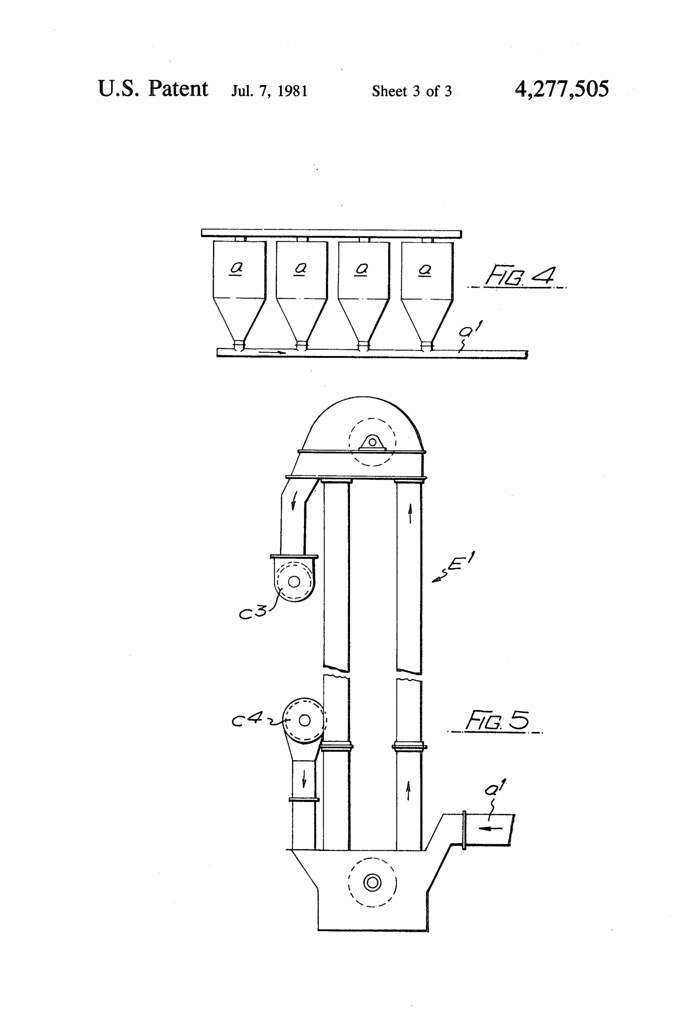
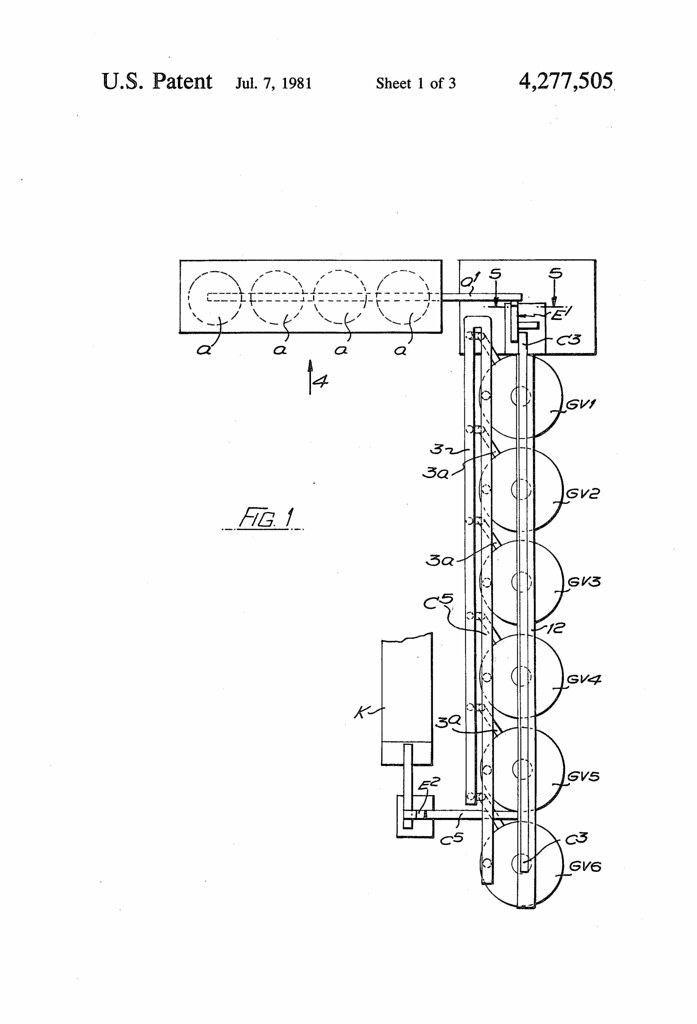
Today in 1981, US Patent 4277505 A was issued, an invention of Simon B. Simpson, for his “Process for the Malting of Grain.” Here’s the Abstract:

Germination of cereal grain in malting is carried out by passing steeped grain to and through a series of six closed spaced discrete vessels in succession. The grain is maintained in each vessel for about a day and in each vessel is subjected to an upward flow of humidified at temperated air. The grain is turned either in a vessel or through transference to the next vessel. Transference from one vessel to the other is carried out by discharging the grain from each vessel along a lower conveyor to an elevator which raises the grain to an upper conveyor that discharges the grain down into the next vessel. Grain leaves the last vessel of the series as green malt and then passes to a malt kiln where it is dried to a desired moisture level.

Untitled

Filed Under: Beers, Just For Fun, Politics & Law, Related Pleasures Tagged With: barley, Brewing Equipment, History, Law, Malt, Patent

Patent No. 2893870A: Hopping Of Beer

July 7, 2015 By Jay Brooks

patent-logo
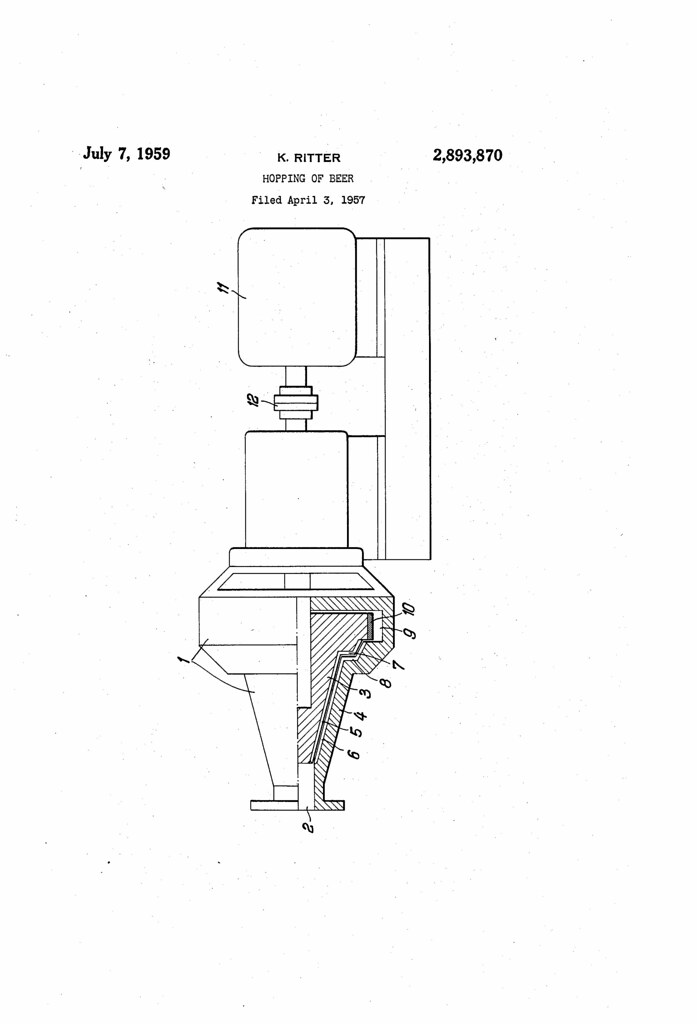
Today in 1959, US Patent 2893870 A was issued, an invention of Kurt Ritter, for his “Hopping of Beer.” There’s no Abstract, although in the description it includes this summary:

The invention relates to improvements in beer brewing and more particularly to an improved method of hopping beer.

The brewing of beer comprises generally the following steps: Ground malt is mashed with water, and the obtained malt solution (first wort) is freed from the malt residues (spent grains). Subsequently, the wort is boiled with addition of the required amount of hops and then separated from the spent hops and fermented with yeast. The hops are generally added as such or in coarsely disintegrated state to the Wort.

Said procedure has the drawback that, on boiling, only about one-third to one-fourth of the bitter principle (resins), contained in the hops, passes into the wort; in addition, a certain amount of the resins, e.g. about 3 to 7 percent, is lost in further processing (fermentation and storage) by precipitation.

So far, attempts to eliminate said drawbacks have not met with satisfactory results. Recently, it has been proposed to extract the resins by subjecting the hops in water or aqueous solutions to ultrasonic irradiation and to introduce the thus obtained resin extract into the boiling wort instead of hopping with natural hops. Said method, however, must be carried out with expensive and delicate devices, the operation of which requires high energy cost, and which are therefore uneconomical for commercial purposes. The preparation of such resin extracts by means of ultrasonic irradiation takes considerable time, for instance 1 to 2 hours and more. During this prolonged treatment, undesired side reactions may take place which may affect the brewing process, for instance with respect to the uniformly fine and pleasant taste of the produced beer.

It is a principal object of the invention to provide a simple, reliable, and economic hopping procedure.

It is another object of the invention to provide a method by which the required amount of hops is considerably reduced and nonetheless a beer of uniform excellent quality and taste is produced.

Untitled

Filed Under: Beers, Breweries, Just For Fun, Politics & Law, Related Pleasures Tagged With: Brewing Equipment, History, Hops, Law, Patent

Patent No. 733284A: Process Of Converting Wort Into Beer

July 7, 2015 By Jay Brooks

patent-logo
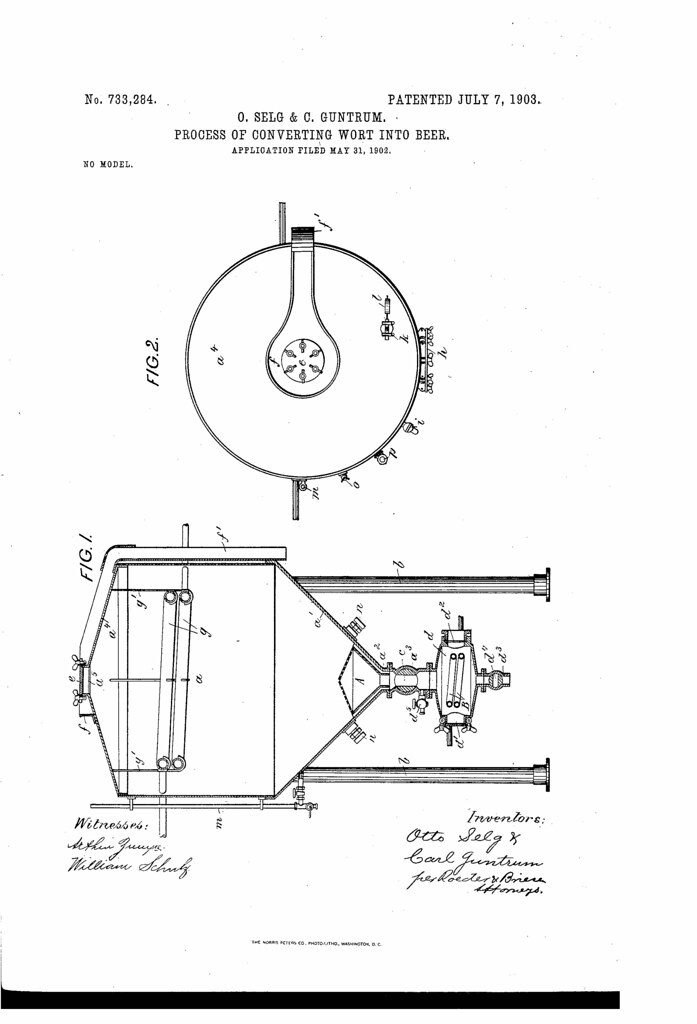
Today in 1903, US Patent 733284 A was issued, an invention of Otto Selg and Carl Guntrum, for their “Process of Converting Wort into Beer.” There’s no Abstract, although in the description it includes this summary:

This invention relates to an improved continuous process of converting wort into beer or other fermented liquid in a single apparatus and in such a manner that the beer is first thoroughly fermented and clarified before being impregnated with the carbonic acid gas. In this way the process is accelerated and a better product is obtained.

Untitled

Filed Under: Beers, Breweries, Just For Fun, Politics & Law, Related Pleasures Tagged With: Brewing Equipment, History, Law, Patent, Science of Brewing

Patent No. 2085879A: Bottle Capping Machine

July 6, 2015 By Jay Brooks

patent-logo
Today in 1937, US Patent 2085879 A was issued, an invention of Edward N. Trump, for his “Bottle Capping Machine.” There’s no Abstract, although in the description it includes this summary:

This invention relates to new and useful improvements in a bottle capping machine and pertains more particularly to an apparatus for applying hooded or over-all caps to the head of milk bottles or the like. The caps are pre-formed in one piece, preferably from a sheet of light, strong and non-corrosive metal having a high degree of ductility, malleability and tenacity, such for example, as tissue aluminum of about the thickness of the cellulose product commonly known as Cellophane or of thin tinfoil, and which is capable of. being easily molded by pressure under atmospheric temperature to conform to the its form under ordinary usage.

Untitled

Filed Under: Beers, Breweries, Just For Fun, Politics & Law, Related Pleasures Tagged With: Bottles, Brewing Equipment, Crowns, History, Law, Patent

Patent No. 2513765A: Mashing And Lautering Apparatus For Brewing

July 4, 2015 By Jay Brooks

patent-logo
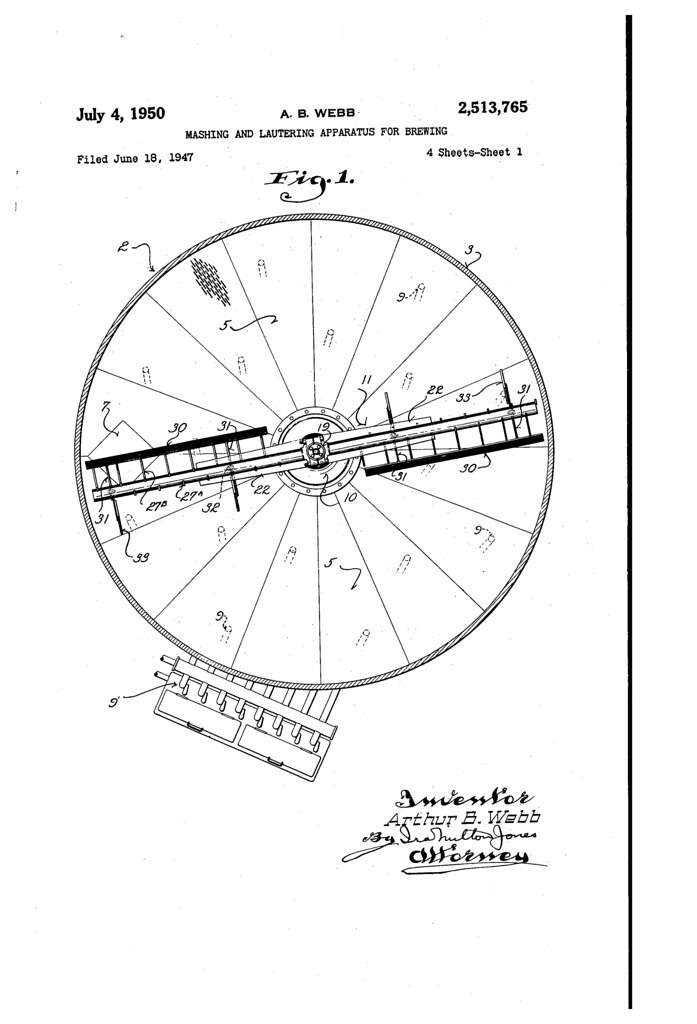
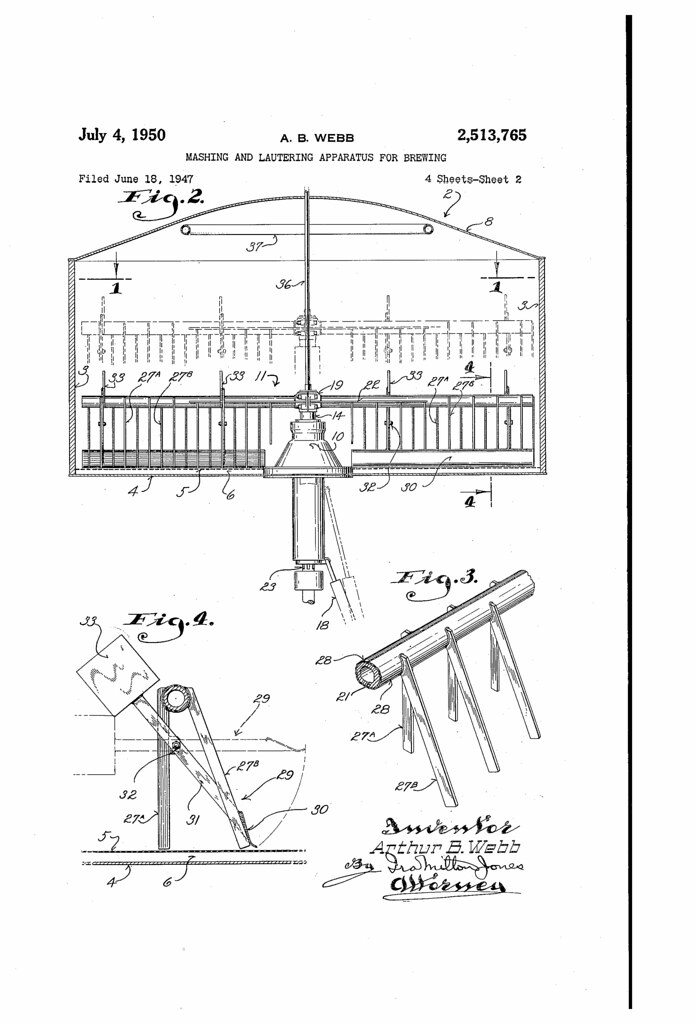
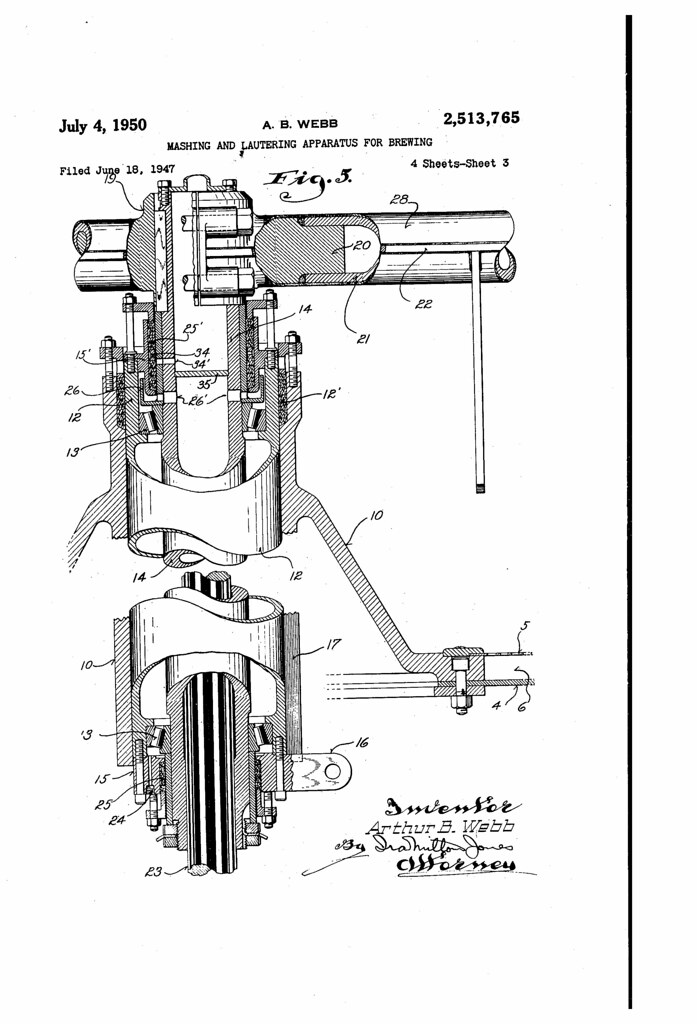
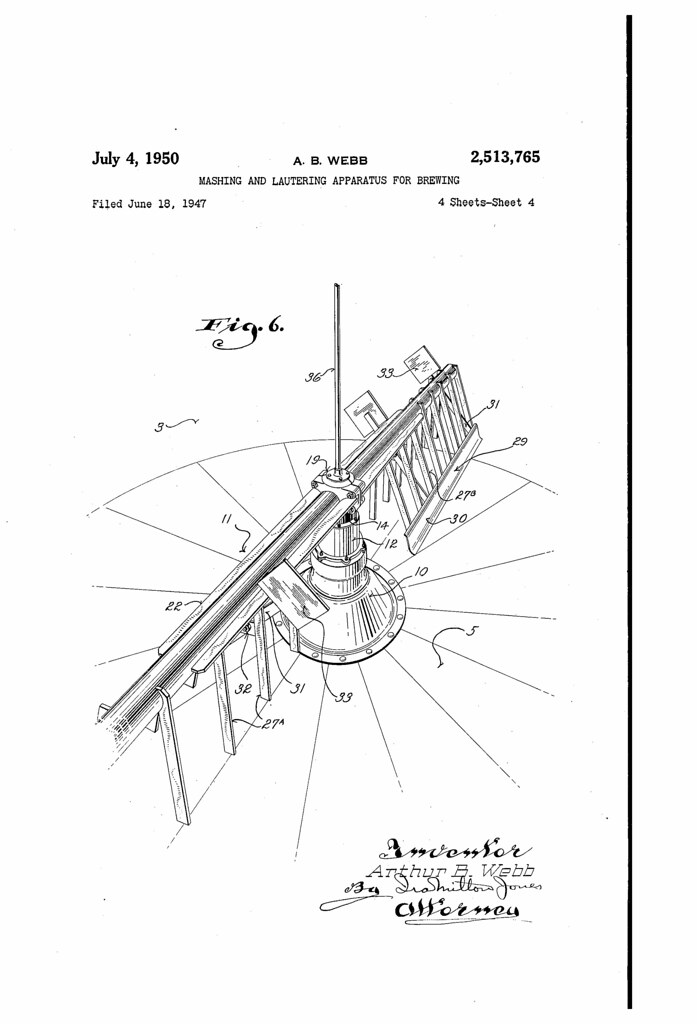
Today in 1950, US Patent 2513765 A was issued, an invention of Arthur B. Webb, assigned to the Cream City Boiler Company, for his “Mashing and Lautering Apparatus For Brewing.” There’s no Abstract, although in the description it includes this summary:

This invention relates to mashing and lautering equipment for use in brewing, and has as its general purpose to provide a combination mash and lauter tub or tank of simplified and improved construction.

Although this invention is primarily concerned with the construction of the aufhack or agitator which keeps the mash suitably agitated during mashing and lautering, and the plow or scraper by which the spent grain is swept out of the tank at the completion of the lautering off period, it will be advantageous to briefly outline the steps followed in mashing and lautering.

The mashing operation consists in cooking the grain in water to convert its starch content into sugar. This may be done in a separate tank, or as contemplated by the present invention the mashing and lautering may be done in the same tank.

Lautering is the drawing off of the extract or liquor from the bottom of the tank. During this procedure the mass is gently agitated, and towards the end of the lautering off, sparging water is sprayed over the contents to flush out all possible extract from the grain. At the completion of the lautering’ and sparging when all of the extract has been drawn off, the spent grain is discharged from the tank through a trapdoor in its bottom. I

In the lautering 01f of the extract the bottom layer of the mass serves as a filter bed. Hence, it is extremely important that this bottom layer be left undisturbed. If it is broken or disturbed, the extract being lautered off becomes turbid. Such breaking of the bottom filter layer thus entails long periods of quiescence to allow the turbidity producing particles to settle out and enable the bed to reform.

Satisfactory lautering, therefore, poses two difficult problems. To assure flushing all the extract from the mash, it is essential that the sparging water reach all portions thereof, and this requires having the aufhack or agitator blades reach down into the mass as far as possible. On the other hand the bottom layer which serves as a filter bed must not be disturbed. It thus follows that the extent to which the agitator blades can be lowered bears a relationship to the spacing between adjacent blades, for blades that are spaced far apart can be brought down closer to the bottom without breaking the bottom layer than blades that are spaced closer together past the desired wide spacing between adjacent blades has been achieved by increasing the number of radial arms-which carry the blades and, of course, staggering their radial distances from the axis of rotation so that the circular paths defined by the blades in operation are quite close together although the distance between adjacent blades is much greater. This obvious solution to the problem of effecting increased spacing between adjacent blades entailed the objection of having the inside of the tank cluttered up with mechanism.

As a result cleaning the tank became a tedious task. In such cleaning, the segmental screen sections which form the false bottom of the tank have to be lifted and are generally set up against the side wall of the tank. Inasmuch as these sections are quite large the presence of three (3) or more agitator arms inside the tank became a source of much inconvenience and irritation. Practically every time a screen section was lifted the agitator had to be moved.

With this objection in mind, the present invention has as one of its objects to provide an improved aufhack or agitator wherein only a single pair of arms carries all of the agitator blades, but in a manner spacing the operating portions of the blades and particularly the lower ends thereof far enough apart to preclude breaking the bottom filter layer, even though the blades are lowered to within a short distance from the false bottom.

As can be readily appreciated, the agitator blades in cutting through the relatively compacted mass, leave circular channels in their wake which if not closed allow the sparging water to by-pass portions of the mass with the result that all the portions of the grain are not flushed as effectively as desirable. Hence, it is another object of this invention to provide means for closing up the circular channels cut into the mass by the blades as they sweep around the tank.

More particularly it is an object of this invention to provide a novel trowel member adapted to ride upon the surface of the mass in a position trailing the agitator blades so as to close the circular channels formed by the blades.

Another object of this invention is to utilize the same structure for effecting the desired troweling action to also plow or scrape the spent grain into the discharge opening at the completion of the lautering off step and also serve as a mixing agitator during the mashing operation.

Another object of this invention is to so mount and arrange the combination plow and trowel structure that upon rotation of the agitator so that the top of the pedestal is submerged in the tank contents, the matter of providing adequate lubrication for the working parts without danger of having the lubricant seep out into the tank contents has always presented a problem.

Untitled


Filed Under: Beers, Breweries, Just For Fun, Politics & Law, Related Pleasures Tagged With: Brewing Equipment, History, Law, Patent, Science of Brewing

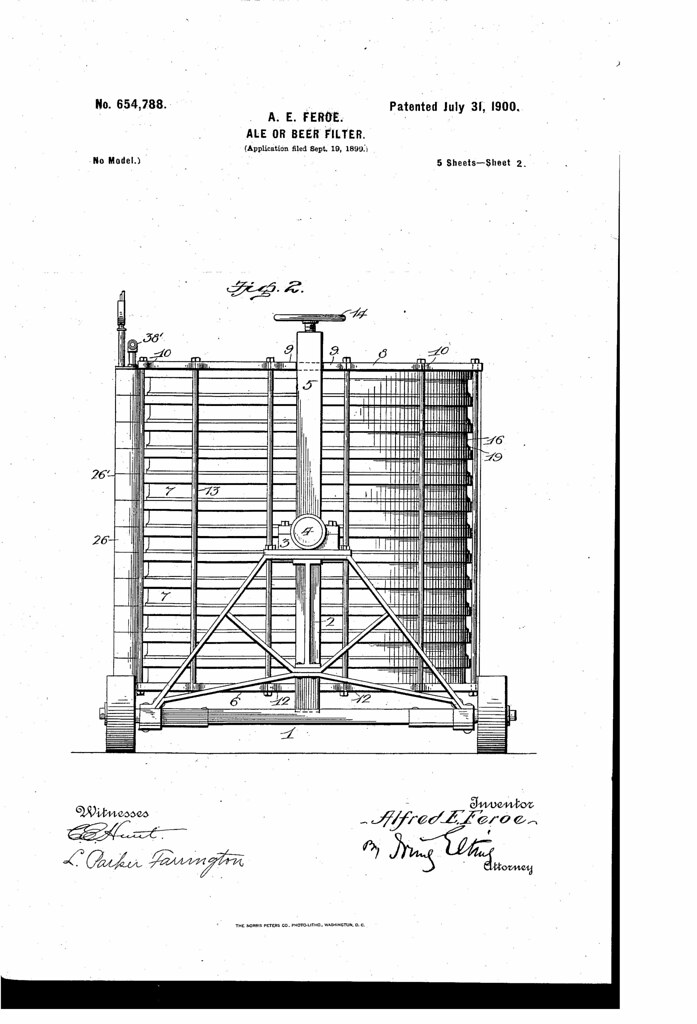
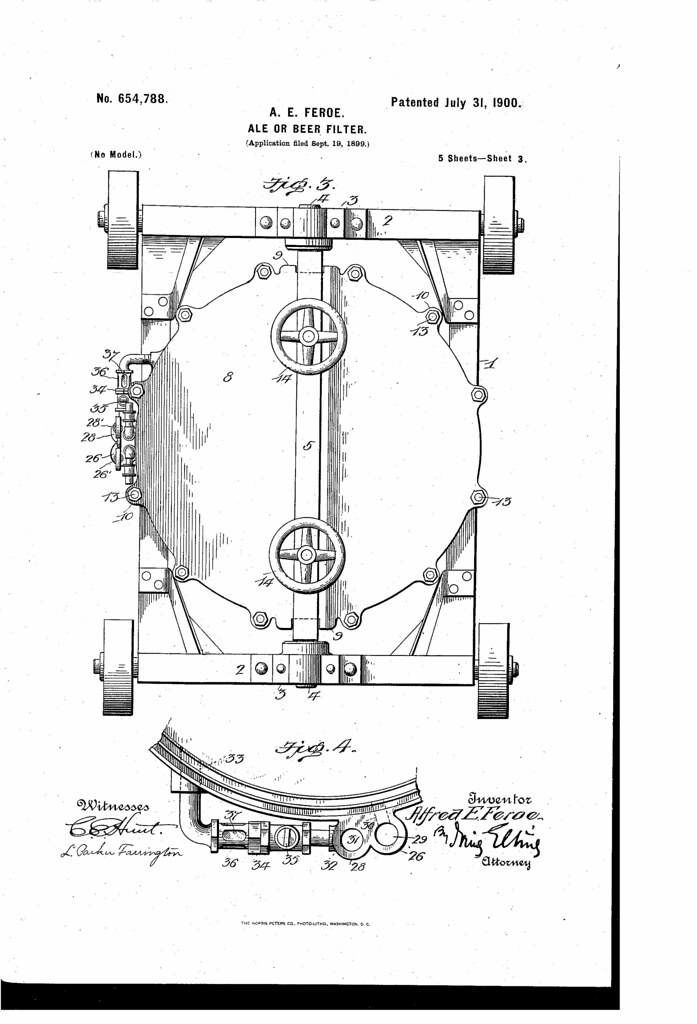
Patent No. 654788A: Ale Or Beer Filter

July 3, 2015 By Jay Brooks

patent-logo
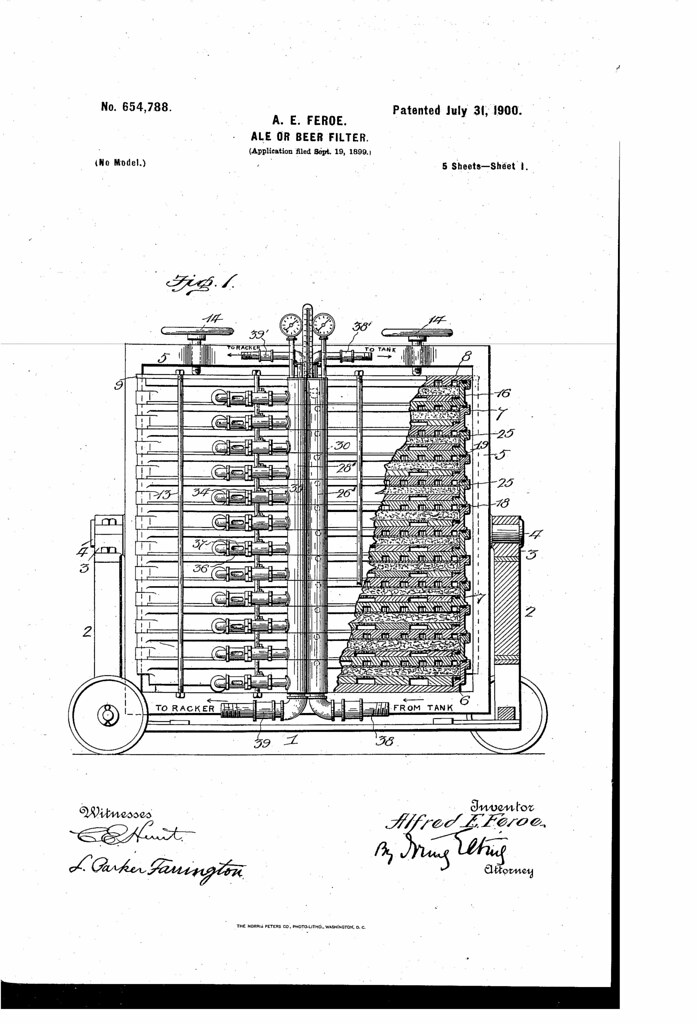
Today in 1900, US Patent 654788 A was issued, an invention of Alfred E. Feroe, for his “Ale or Beer Filter.” There’s no Abstract, although in the description it includes this summary:

My invention relates to an improved ale and beer filter for brewery use.

The object of my improvement is to provide a device of a very large capacity, simple in construction, strong, durable, and efficient in operation, and of as few parts as is consistent with perfect work.-

To attain these ends the invention comprises a series of filter-sections which when put together form a series of compartments. Each compartment has inlet and outlet passages and means for filtration and is a complete filter in itself.

Untitled


Filed Under: Beers, Breweries, Just For Fun, Politics & Law, Related Pleasures Tagged With: Brewing Equipment, History, Law, Patent, Science of Brewing

Patent No. 1232098A: Process Of Leaching Out Hops

July 3, 2015 By Jay Brooks

patent-logo
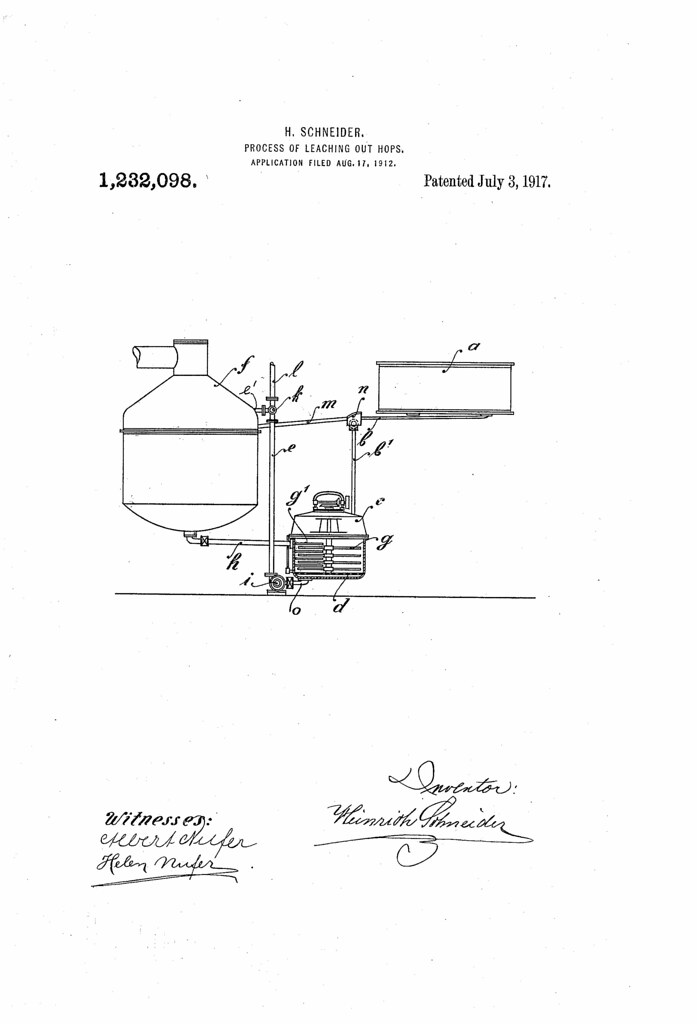
Today in 1917, US Patent 1232098 A was issued, an invention of Heinrich Schneider, for his “Process Of Leaching Out Hops.” There’s no Abstract, although in the description it includes this summary:

The object of the present invention is a process of leaching hops in a hop extracting apparatus provided with a strainer and stirring device, but passing the wort and after-wort through the hops on their way between the refining vat and the copper.

Untitled

Filed Under: Beers, Breweries, Just For Fun, Politics & Law, Related Pleasures Tagged With: Brewing Equipment, History, Hops, Law, Patent

Patent No. 2006450A: Capping Machine

July 2, 2015 By Jay Brooks

patent-logo
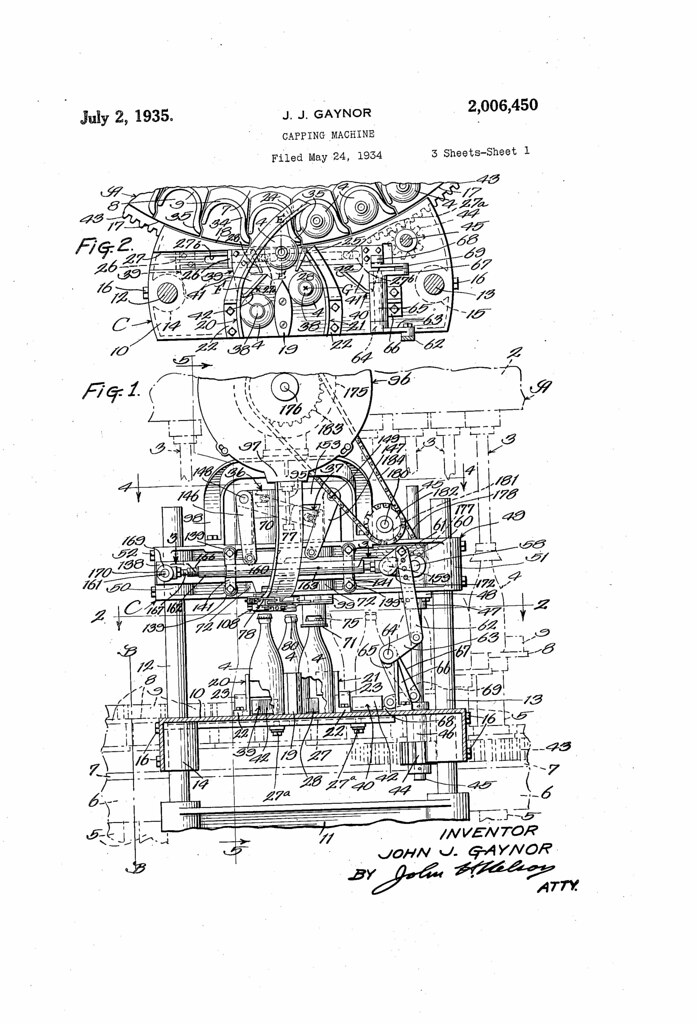
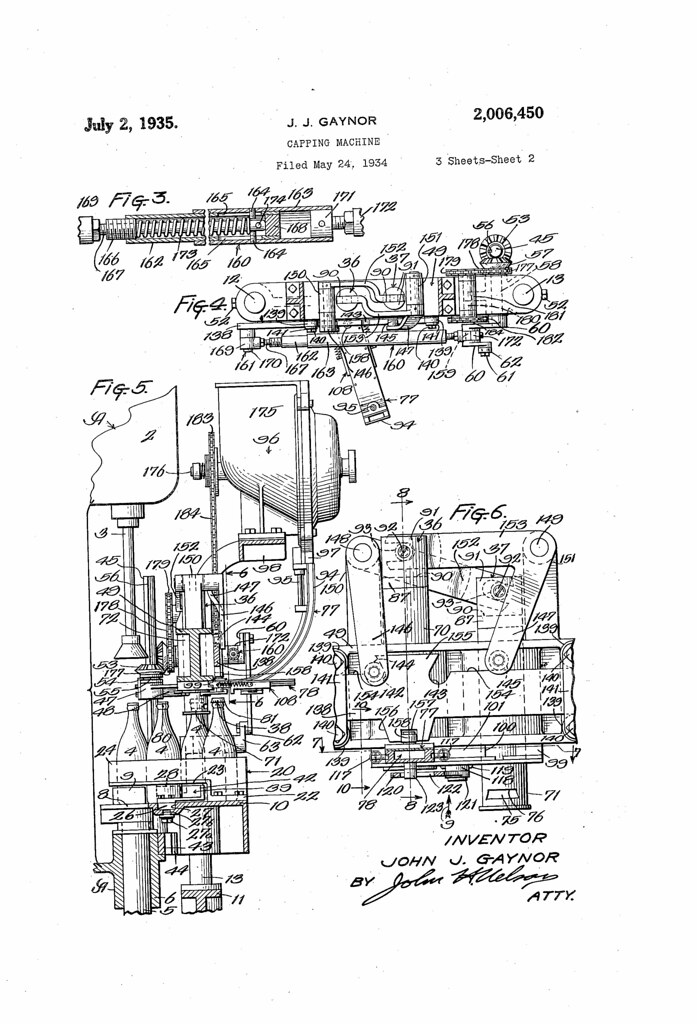
Today in 1935, US Patent 2006450 A was issued, an invention of John J. Gaynor, for his “Capping Machine.” There’s no Abstract, although in the description it includes this summary:

This invention relates to capping machines, or more particularly to bottle crowners of the double head type.

One of the objects of the invention is to provide such a machine of the simplest construction with a minimum number of actuating parts so as to promote compactness, and at the same time insuring reliability and effectiveness in operation; and whereby the caps as applied to containers by both capping heads will be uniform.

Another object of the invention is to provide such a capping machine that can be closely arranged in cooperative relation with the container conveying means of a rotary type container filling machine, so that the containers will be capped shortly after being transferred to the capping heads of the capping machine alternately. The type of filling machine referred to includes a circular rotating container conveyor having peripherally arranged vertically reciprocal container supports in which the containers are placed to be raised into filling heads which depend from the circular liquid supply tanks placed above the conveyor and connected to rotate therewith. As a rule the tank is of greater diameter than the conveyor, which relation of parts presents the problem in arranging the capping mechanism in close cooperative relation with the conveyor.

Untitled

Filed Under: Beers, Breweries, Just For Fun, Politics & Law, Related Pleasures Tagged With: Brewing Equipment, History, Law, Packaging, Patent, Science of Brewing

Patent No. 732350A: Brew House Apparatus Equipment

June 30, 2015 By Jay Brooks

patent-logo
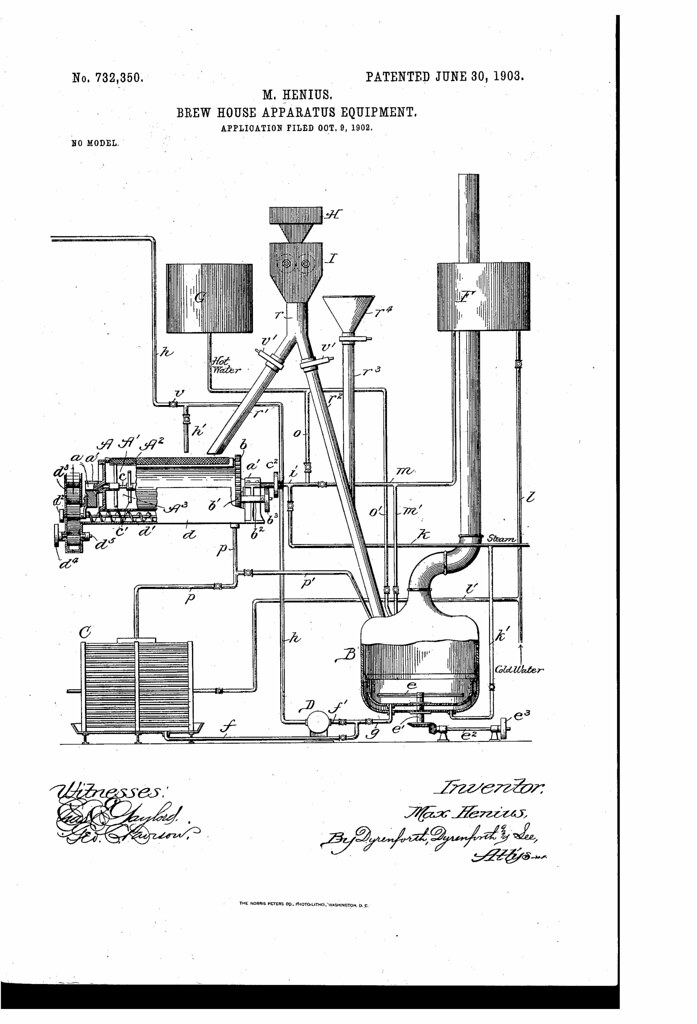
Today in 1903, US Patent 732350 A was issued, an invention of Max Henius, for his “Brew House Apparatus Equipment.” There’s no Abstract, although in the description it includes this summary:

My invention relates to an improvement in the equipment of apparatus employed in the department of a brewery known as the brewhouse, which is devoted to the operation of producing the wort by practicing the several generally-stated steps of making the mash, drawing off and hopping and boiling the resultant wort, separating the hopped wort from the hops, and finally cooling the hopped wort preparatory to pumping it into the fermentation-vat.

Hitherto the equipment employed in the manufacture of the wort in the brew-house has involved a multiplicity of apparatus, which has rendered not only the installation of the plant in the matter of building and apparatus but also the maintenance and operation very expensive.

The object of my improvement is to simplify the apparatus equipment for a brewhouse by reducing to the minimum the number of apparatuses for practicing the several necessary steps in wort manufacture by adapting a number of the comparatively few apparatuses provided to perform each several of the steps of the process Where hitherto a separate apparatus was in most or at least some instances required for the practice of each separate step.

Untitled

Filed Under: Beers, Breweries, Just For Fun, Politics & Law, Related Pleasures Tagged With: Brewing Equipment, History, Law, Patent, Science of Brewing

« Previous Page
Next Page »

Find Something

Northern California Breweries

Please consider purchasing my latest book, California Breweries North, available from Amazon, or ask for it at your local bookstore.

Recent Comments

  • Ernie Dewing on Historic Beer Birthday: Charles William Bergner 
  • Steve 'Pudgy' De Rose on Historic Beer Birthday: Jacob Schmidt
  • Jay Brooks on Beer Birthday: Bill Owens
  • Steve 'Pudgy' De Rose on Beer Birthday: Charles Finkel
  • Steve 'Pudgy' De Rose on Beer Birthday: Bill Owens

Recent Posts

  • Beer In Ads #5182: Full ‘O Pep … And Rarin’ To Go! January 25, 2026
  • Historic Beer Birthday: Robert Burns January 25, 2026
  • Historic Beer Birthday: Christian Heuser January 25, 2026
  • Historic Beer Birthday: Jacob Knecht January 25, 2026
  • Beer In Ads #5181: Turn Winter Into Spring January 24, 2026

BBB Archives

Feedback

Head Quarter
This site is hosted and maintained by H25Q.dev. Any questions or comments for the webmaster can be directed here.