Brookston Beer Bulletin

Jay R. Brooks on Beer

  • Home
  • About
  • Editorial
  • Birthdays
  • Art & Beer

Socialize

  • Dribbble
  • Email
  • Facebook
  • Flickr
  • GitHub
  • Instagram
  • LinkedIn
  • Pinterest
  • RSS
  • Twitter
  • YouTube

Powered by Genesis

MillerCoors’ Tenth & Blake Buys Crispin Cider

February 6, 2012 By Jay Brooks

tenth-blake
Amid recent rumors, the Tenth and Blake Beer Company, the craft-and-import division MillerCoors created last year, announced today that they’re purchasing Crispin Cider, which includes both the Crispin and Fox Barrel hard cider brands.
Crispin-Cider

From the press release:

Minneapolis-based Crispin sold its first cases on St. Crispin’s Day, October 25, 2008. The company grew approximately 200 percent in 2011, outpacing the overall cider category’s 26 percent growth during the same period, and is already the No. 3 producer of cider in the U.S.

“Our vision is to accelerate our portfolio expansion within the world’s most exciting beer market. With cider’s explosion in the U.S., we were looking at the best way to participate in that growth,” said Tenth and Blake President and CEO Tom Cardella. “As we explored the category, Crispin stood out, not only because they were the most progressive and innovative producer, but also because we shared great personal chemistry. In addition to the best cider portfolio in the business, we love their energy, creativity and unsurpassed innovation capability. They make us an even better company right away.”

The deal includes Crispin’s affiliate, Fox Barrel Cider Company.

“We’re thrilled to be part of the Tenth and Blake family,” said Joe Heron, Crispin’s CEO. “We’ve always had very ambitious plans, and we’re proud of what we’re achieving with great products and an unrivaled creativity that mirrors the inspirational American craft-beer ethos. Tenth and Blake provides us the capability to scale up at the same pace as our increasingly accelerating demand in the U.S. and beyond.”

Crispin Cider Company produces European-style natural hard apple ciders using fermented unpasteurized fresh-pressed apple juice in Original, Light and Brut varietals, as well as additional unfiltered Artisanal Reserves — Honey Crisp, Lansdowne, The Saint and Cho-tokkyu, and also imports a classic English Dry Cider, Crispin Browns Lane.

Crispin affiliate, Fox Barrel Cider Company, is dedicated to the production of superior pure pear ciders, using fermented unpasteurized fresh-pressed pear juice. Available in Pacific Pear, Blackberry Pear and Apricot Pear varietals and additional unfiltered Cidery Reserves — Ginger & Blackcurrant and Rhubarb & Elderberry.

Crispin will be run as an independent division of Tenth and Blake.
Basic CMYK

In addition to these two cider brands, Tenth and Blake also controls the following brands: “Blue Moon Brewing Co. at the Sandlot in Denver, Jacob Leinenkugel Brewing Co. in Chippewa Falls, Wis., 10th Street Brewery in Milwaukee, AC Golden in Golden, Colorado, Birra Peroni in Rome and Plzeňský Prazdroj (Pilsner Urquell) in Pilsen, Czech Republic. Tenth and Blake beers include Blue Moon Belgian White, Leinenkugel’s Honey Weiss, George Killian’s Irish Red, Batch 19, Henry Weinhard’s IPA, Colorado Native, Pilsner Urquell, Peroni Nastro Azzurro and Grolsch.”

Filed Under: Breweries, News Tagged With: Business, Cider, MillerCoors, Press Release

Spirits Still Gaining On Beer’s Market Share

February 1, 2012 By Jay Brooks

spirits-wine-beer
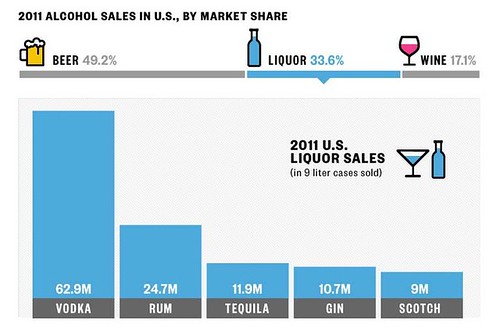
The Distilled Spirits Council, a trade organization for producers of distilled spirits, just released their annual report on how spirits are doing relative to the other alcoholic beverages. Vodka continues to lead the spirits parade, with rum in second and tequila in third.

alcohol-sales-2011

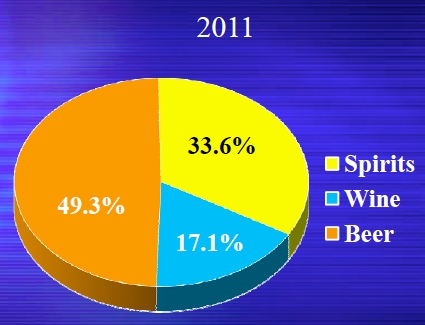
While beer continues to be the most popular adult beverage, spirits once again took market share from beer, which was up 4% by sales in 2011 over 2010. According to their figures, beer currently enjoys 49.3% of the alcohol market, with spirits having 33.6% and wine 17.1%. [Note: I can’t account for the 0.1% difference in the two charts. They’re supposedly taken from the same source, though the one below is directly from the Distilled Spirits Council.]

spirits-wine-beer-2011

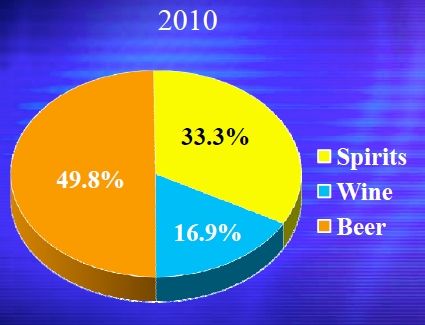
While 49.3% sounds pretty good, the year before it was 49.8%

spirits-wine-beer-2010

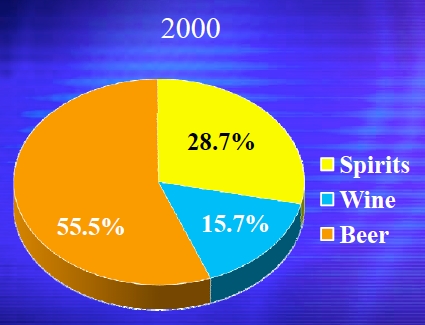
And in 2000, only 11 years ago, it was 55.5%, meaning beer has lost 6.2% marketshare in just over a decade. Hey, beer people; you’re just not pulling your weight. Drink a few more beers tonight. A can (or bottle or pint) a day, that’s all we ask.

spirits-wine-beer-2000

Filed Under: Beers, News, Related Pleasures Tagged With: Business, Craft Spirits, Statistics

Big Changes At A-B InBev

January 23, 2012 By Jay Brooks

ab-inbev
Wow, there’s a lot going over at Anheuser-Busch InBev, and besides the slip in sales of their core brands. Last week, rumors abounded that ABI was planning to roll out some version of 100% Share of Mind, which had been the “unofficial” policy until a few years ago, when it became unworkable. I wrote about it four years ago as it started to wane in Losing Their Share of Mind, and you can get the history and background of the policy there, assuming you’re unfamiliar with it. In a nutshell, A-B insisted that their distributors focus ONLY on A-B and A-B-related brands, and there were ways they had for dealing with those distributors that didn’t toe the line. And it worked well enough while A-B brands were selling well, but when they began to slip, it became harder to enforce and harder for distributors to remain profitable without taking on non-A-B brands, especially craft brands.

According to Beer Business Daily, ABI “is again turning up the leverage with Sales Opportunity Teams starting next week.” Apparently “Sales Opportunity Teams” (SOT) is the new buzzword for it this time around. They continued:

The SOTs, which A-B chief Dave Peacock has repeatedly said are not punitive in nature, will certainly be uncomfortable for distributors with growing competing brands in the house, as they try to explain this or that competing display or tap handle on the floor.

It’s got to be even harder this time, with craft beer riding a wave, with great growth, higher rings and consequently more profits. Sell less, make more. Hard to walk away from that, but of course having the best-selling brands is also pretty attractive, too. So what’s a distributor to do?

Today, the other shoe dropped, as Anheuser-Busch President Dave Peacock — and the last of the pre-InBev top executives — resigned effective today. According to ProBrewer

Peacock was one of the few remaining high-level holdovers who had stayed with the company after it was acquired in 2008 by InBev. He was only one of two non-Busch family members to hold the title of CEO.

Peacock is well liked by wholesalers and is known as reasonable, fair and an advocate for the second tier. The latest pressure on wholesalers by InBevAB may certainly have prompted Peacocks departure.

Peacock began his career at A-B in 1992 and was promoted to president in 2008 in the wake of the acquisition after serving as VP-marketing since late 2007. Many U.S. executives departed after the InBev takeover, but Peacock was handpicked by the new owners to lead the U.S. operation.

Harry Schuhmacher, in his Beer Business Daily, broke the news this morning, calling it “a watershed moment in the history of A-B since its acquisition by InBev.”

Coincidence? Hard to imagine the two developments are completely unrelated, especially since Beer Business Daily, presumably working from a press release, states he’s leaving “to spend more time with his family and pursue other business interests.” I’m always more than a little suspicious when that’s the official reason for leaving, as it so often is in circumstances like this one.

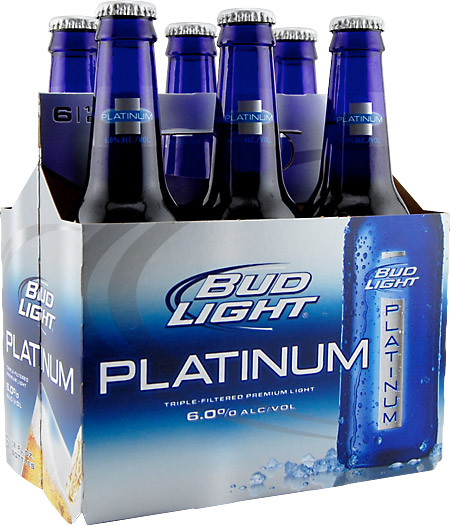
Peacock is succeeded by Luiz Fernando Edmond, who until today was the Zone President of North America. Oh, and Bud Light Platinum is coming soon, in the cobalt blue bottle, and should be on store shelves as early as this week. They’re calling it a “game changer,” but I tend to think these other two developments will change the beer landscape far more than a Bud Light line extension.

bud-light-platinum-sixer

Filed Under: Breweries, Editorial, News Tagged With: Anheuser-Busch InBev, Big Brewers, Business

Paper or Plastic & Beer

January 18, 2012 By Jay Brooks

paper-or-plastic
Here’s an odd little story from Virginia, sent in by an alert reader (thanks Jeff). In many places, there’s a growing debate about plastic bags, paper bags or no bags at the grocery store. In Virginia, there currently is no law regarding them, but that hasn’t stopped stores all along the southeastern coast of Virginia — an area known as Hampton Roads — from insisting that customers get a plastic bag, if they’re buying beer, that is. It’s not the law, of course, as confirmed by Kathleen Shaw, a spokeswoman for the state Department of Alcoholic Beverage Control.

According to a story in the local Daily Press, apparently “[c]ashiers are either erroneously told by their employer that Virginia requires them to bag alcohol or they mistakenly equate store policy to state law. Either way, beer is bagged at nearly every supermarket and convenience store in Hampton Roads.” As the article, entitled The ABCs of plastic bags and beer shopping in Virginia, points out, in many places outside the area, stores are actually prohibited from using plastic bags, while still others champion their use.

But whether you think plastic, paper or your own bag is the way to go at the grocery store, that’s not what caught my eye. It’s the notion that it’s “beer” that has to be covered before it leaves the store. As for why that might be the case, multiple 7-11 franchise owner Raj Gupta, had this to say: “it’s convenient for the customer [and] it deters customers from drinking alcohol in the store parking lot.” Uh-huh. Whether it’s more “convenient” is debatable, and a bit beside the point if it’s mandatory at all of his stores. And as for deterring customers from ripping open the thin plastic bag and starting to drink in the parking lot, I can’t believe placing the six-pack into a bag is really going to do much good. Gupta certainly doesn’t care about the environment, as he also states. “If they don’t want the bag, they can throw it out in the trash can when they leave the store.” And then start drinking it, one presumes, which is what he was claiming the bag prevented.

But since those reasons are as flimsy as the plastic the bags are made out of, it seems more likely it’s his third reason why “he requires cashiers to bag six-packs, bottles of wine, and single cans and bottles of alcohol.” And it’s a doozy. “[I]t prevents minors from seeing people carrying alcohol.” Holy crime wave, Batman, thank goodness Gupta’s on the scene. We wouldn’t want the little kiddies “seeing people carrying alcohol.” Goodness knows what untold harm that might cause. He doesn’t mind selling alcohol, but he doesn’t want children seeing it. If parents bring their children into his stores, do employees have to cover the kid’s eyes? Or is alcohol on a shelf safe; it’s only dangerous when an adult is carrying it? Or when it’s outside the sanctuary of the store.

Yes, I’m making fun of him, but only because he deserves it. Yes, he’s free to run his stores any way he sees fit, just as anyone is free to not shop at any of his stores. But it points out a deeper issue, which is that he has some weird, unhealthy issues with alcohol. They’re obviously deep enough that he believes that children seeing adults carrying alcohol is such a problem that he’d make it his “company policy” to avoid it happening. As I pointed out, not enough of an issue that he’d voluntarily stop selling alcohol, but still. Why that might be, I can’t fathom, but I’m curious enough to want to know. It has to have something to with the way alcohol is demonized by certain factions of our society. It has to have something to do with our society only hearing one side of the story, with neo-prohibitionist groups spreading their biased propaganda, and doing everything in their power to prevent anyone else from having their say, telling the opposite side of that tale. How else to explain a businessman who sells alcohol believing it’s in his best interests to make sure that children don’t get the idea that people buy alcohol. What possible benefit could he derive from that “company policy?” Frankly, I’m stumped. I can’t think of one reason that’s not fanatical, based on erroneous information or just plain looney.

Filed Under: Beers, Editorial, News, Politics & Law Tagged With: Anti-Alcohol, Business, Virginia

Coors Light: Now The Avis Of Beers

January 14, 2012 By Jay Brooks

coors-light
I’m not exactly sure why this appears to be such big news, but it seems to be everywhere. Beer Marketer’s Insights is reporting that, based upon estimated numbers for 2011, Coors Light has overtaken Budweiser to become the 2nd best-selling beer in America. According to the report, “[t]his is the first time in almost 20 years, since 1993, that AB didn’t have top 2 brands.” But I note that according to IRI data, Miller Lite held the #2 spot at least as recently as 2007. Though to be fair, it’s true that Bud Light and Budweiser have enjoyed the top two spots, if off and on, for quite some time.

But the story isn’t so much about Coors Light being up (they were, but only 0.8%). What’s more interesting is that Budweiser was down 4.6%, which had more to do with the switch in positions. InBev seems to be struggling with the A-B core brands ever since they took over Anheuser-Busch. It can’t help that they’ve laid off countless employes, bullied suppliers and lost a great deal of goodwill through their cost-cutting way of doing business. They don’t seem to have the same relationship with consumers that the company did when it was run by the Busch family. And while the big breweries are losing ground to craft beer overall, ABI seems to losing more. So it makes sense that another brand would pick up the slack, catapulting Coors Light into the number two position, a spot Avis once upon a time used to great effect in their advertising. Maybe we’ll see Coors do something similar. “Coors Light is No. 2 in beer. We try harder.“

Filed Under: Beers, Breweries, Just For Fun, News Tagged With: Big Brewers, Business, Coors, Statistics

Yuengling Becomes Biggest American Brewery

January 13, 2012 By Jay Brooks

yuengling-eagle
According to new estimated beer sales data for 2011 from Beer Marketer’s Insights, Yuengling Brewery in Pottsville, Pennsylvania has now eclipsed the Boston Beer Co. (makers of Samuel Adams) to become the biggest American brewery. Yuengling’s area newspaper, the Lehigh Valley’s The Morning Call, had the story this morning. The numbers shake out like this:

Yuengling sold 2.5 million barrels of beer in 2011, up 17 percent from the previous year, according to Beer Marketer’s Insights in Suffern, N.Y., a magazine that tracks the beer industry. Boston Beer sold 2.4 million barrels in 2011, the magazine estimated.

Boston Beer, a public company, has yet to release final sales for 2011. Beer Marketer’s Insights based its estimate on Boston Beer sales in the first three quarters and the company’s own sales forecast for the fourth quarter.

Even if Boston Beer had a surprisingly good fourth quarter, it wouldn’t close the gap with Yuengling, said Eric Shepard, editor of Beer Marketer’s Insights.

The Morning Call also created the chart below to illustrate the shift in sales between the two companies over the last five years.

yuengling-vs-boston-beer-2010

Filed Under: Breweries, News Tagged With: Business, Statistics, United States

Brewing Up: WSJ Beer Sales Infographic

December 29, 2011 By Jay Brooks

wall-street-journal
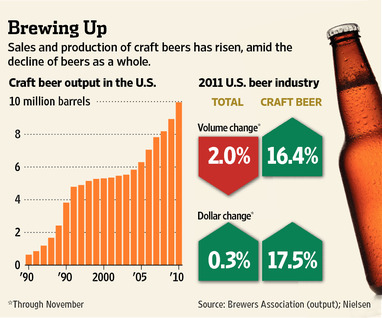
The Wall Street Journal, through their WSJ News Graphics twitter feed, posted the following graphic on TwitPic, showing yearly beer sales through November 2011.

wsj-brewing-up-2011

This data is from Nielsen and the Brewers Association. A couple of weeks ago I posted similar numbers, but with data from Symphony IRI, in Beer Sales By Style Through Thanksgiving. According to Nielsen’s data, total beer volume was down 2%, while craft beer was up 16.4%. By dollars, total beer was up just 0.3%, while craft beer was up 17.5%. Nice.

Filed Under: Breweries, News Tagged With: Business, Mainstream Coverage, Statistics

Mission Rock Cafe To Become Brewery In 2012

December 27, 2011 By Jay Brooks

MoMos
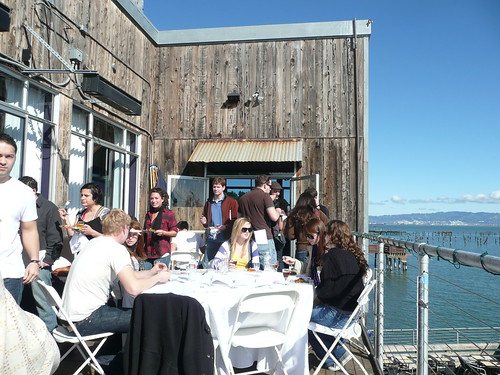
Yet another new brewery is apparently coming to San Francisco next year. According to the San Francisco Chronicle and SF Weekly, the Mission Rock Cafe, in China Basin not to far from the stadium where the Giants play, will soon become a brewery. Local publican Peter Osborne, who currently owns MoMo’s, Pete’s Tavern and Pedro’s Cantina, will take over the waterside restaurant on January 1. He’ll then start renovating it with an eye toward re-opening it sometime during the summer as Mission Rock Brewery and Oyster Bar.

On on the deck at Kelly's Mission Rock
On the deck at Mission Rock Cafe during the Beerunch there during SF Beer Week in 2010.

Filed Under: Breweries, News Tagged With: Business, California, San Francisco

Ownership Of Beer Brands & Varieties 2010

December 18, 2011 By Jay Brooks

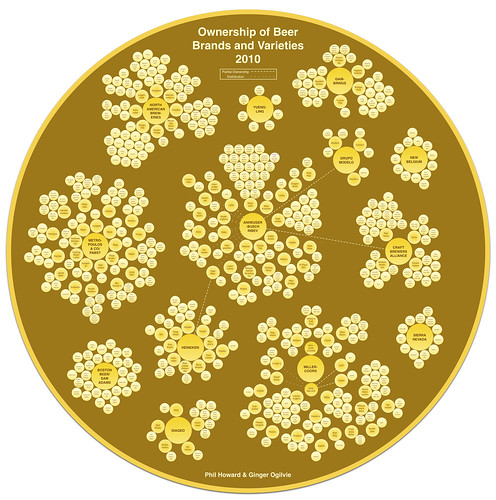
bubble-chart
A couple of years ago, shortly after Anat Baron released her film Beer Wars, people kept asking her which big beer companies owned which beer brands. In December 2009, she put together a list of Who owns what? That inspired to me took take a closer look myself, and that produced my own list, The Bigs Brewers’ Brands. At the time, I had hoped to keep it current, but that’s proved too time-consuming a task and it hasn’t been updated since December 4, 2009.

Now Philip H. Howard, an assistant professor at Michigan State University, in the Department of Community, Agriculture, Recreation and Resource Studies, has created an infographic on the Concentration in the US Beer Industry. The bubble chart seeks to show the major companies selling beer in the U.S. — domestic and imports — and also uses different lines to show arrangements of distribution and partial ownership, where applicable.

BeerOwnership
You can see more detail on the full size image, which can be seen here. You can also zoom in using Zoom.It. Howards also notes “that the graphic above focuses on the top 13 firms, and excludes varieties of malt liquor and non-alcoholic beers.”

His write-up also includes the following:

AB InBev owns, co-owns or distributes more than 36 brands, for example, while MillerCoors controls at least 24 more. MillerCoors also brews Metropoulos & Company’s products under contract (thus the company that controls Pabst and 21 other brands is a “virtual” beer company).

Increasing Concentration after World War II

In 1959 the 10th largest brewery in the country (Pabst) acquired the 18th largest brewery (Blatz), resulting in a combined national market share of 4.5%. Seven years later the US Supreme Court reversed the merger, noting that:

If not stopped, this decline in the number of separate competitors and this rise in the share of the market controlled by the larger beer manufacturers are bound to lead to greater and greater concentration of the beer industry into fewer and fewer hands. [Justice Hugo Black in U.S. v. PABST BREWING CO., 384 U.S. 546 (1966)].

Today, just two firms control more than three-quarters of all sales.
market-share-2010

Howard also quotes Stephen G. Hannaford, writing in 2007, in Market Domination!: The Impact of Industry Consolidation on Competition, Innovation and Consumer Choice. “The beer industry is not only dominated by two firms, it is dominated by a small number of varieties — just six account for more than half of all sales. The result is an ‘oligopoly within the oligopoly'” Howard demonstrates this relationship with another chart.

beershare-2010
You can also explore this one better by using Zoom.It.

Filed Under: Beers, Breweries, Just For Fun Tagged With: Big Brewers, Business, Statistics

Mills River, North Carolina On The Short List For New Sierra Nevada Brewery

December 16, 2011 By Jay Brooks

sierra-nevada
After Sierra Nevada Brewing‘s plans to build a brewery in Black Mountain, North Carolina fell through, they set their sites on the nearby town of Mills River as one possible location they’re considering. According to Blue Ridge Now, the Mills River location “is now among a ‘handful’ of possible locations for California-based Sierra Nevada to build a second facility.” (And thanks to Win Bassett for the tip.) Sierra Nevada owner Ken Grossman was in North Carolina Thursday and was reportedly pleased by the “welcome reception” he received. He told Blue Ridge Now in a telephone interview:

“We like the community; we like the culture in the area and the focus on craft beer, and a vibrant craft (beer) community is certainly an appealing draw,” Grossman said. “The water is good; we’ve been well-received in the area — certainly a welcome reception helps, not that we haven’t been welcomed everywhere we’ve looked.”

“Logistically, it fits,” he said. “We began discussing the project five years ago but put it on the back burner a couple of times as we agonized over the concept of starting from scratch and building a second plant. But it really makes sense for us from an economic standpoint and a carbon footprint standpoint as far as shipping, as our Eastern markets have continued to see double-digit growth for a number of years.”

Apparently Brian Grossman, Ken’s son, would be relocating to run the Eastern Sierra Nevada operations, wherever it turns out to be.

UPDATE: Miles J. sent me a link to a similar story about Sierra nevada’s search foran East Coast location for a brewery that ran in today’s ChicoER.

Filed Under: Breweries, News Tagged With: Business, California, North Carolina

« Previous Page
Next Page »

Find Something

Northern California Breweries

Please consider purchasing my latest book, California Breweries North, available from Amazon, or ask for it at your local bookstore.

Recent Comments

  • Bob Paolino on Beer Birthday: Grant Johnston
  • Gambrinus on Historic Beer Birthday: A.J. Houghton
  • Ernie Dewing on Historic Beer Birthday: Charles William Bergner 
  • Steve 'Pudgy' De Rose on Historic Beer Birthday: Jacob Schmidt
  • Jay Brooks on Beer Birthday: Bill Owens

Recent Posts

  • Historic Beer Birthday: Conrad Pfeiffer March 7, 2026
  • Beer In Ads #5148: Ach Himmel Mr. Goat March 6, 2026
  • Historic Beer Birthday: Conrad Windisch March 6, 2026
  • Historic Beer Birthday: Samuel Wainwright March 6, 2026
  • Beer In Ads #5147: Frankenmuth Is Michigan’s Largest Selling Bock March 6, 2026

BBB Archives

Feedback

Head Quarter
This site is hosted and maintained by H25Q.dev. Any questions or comments for the webmaster can be directed here.