Brookston Beer Bulletin

Jay R. Brooks on Beer

  • Home
  • About
  • Editorial
  • Birthdays
  • Art & Beer

Socialize

  • Dribbble
  • Email
  • Facebook
  • Flickr
  • GitHub
  • Instagram
  • LinkedIn
  • Pinterest
  • RSS
  • Twitter
  • YouTube

Powered by Genesis

Heineken Redesigns Bottles, Reduces Number Of Sizes

December 7, 2010 By Jay Brooks

heineken
Heineken announced at the beginning of December that next year they’ll be launching redesigned bottles and cans along with a big reduction in the number of sizes they’ll be selling worldwide. The packaging redesign is cosmetic, but the package size reduction is more worrying.

According to the press release, “[t]he restyling aims to streamline the visual identity and make the brand even more consistent and recognizable in all 170 markets worldwide where Heineken can be enjoyed. The new bottle will come in five different volume sizes and will be available in Western Europe at the beginning of 2011 and across the rest of the world by 2012.”

While I realize that packaging, brand identity, etc. are very important, I still can’t help but laugh at some of the language and the way in which the new packaging design is framed. For example, check out this description:

The new bottle, replacing the XLN (extra long neck) and Heineken shortneck packaging, is introduced in two versions: embossed and standard. The new design features a unique curved embossment on the neck and back, which not only looks good, but also adds a pleasing to-the-touch feel, whilst a distinctive embossed mark acts as a stamp of quality and authenticity. Additionally, the new shape makes it look proud while enhancing the premium positioning of the bottle.

Yes, nothing says quality like a “pleasing to-the-touch feel” except perhaps the actual taste of the beer. How “proud” the new bottle looks. Huh? The “embossments,” made by using “strategically placed indents and tactile ink” somehow add “to the overall drinking experience.” Hilarious. Nothing makes me enjoy my beer more than having little raised spots on my bottle to hold on to. Of course, I always pour my beer into a glass, but I’m weird that way. No worries, a newly redesigned glass “features an embossed curve on the side, adding a pleasant feeling when held.” So they got us glass-drinkers covered, too. Whew.

But all this attention paid to their “revolutionary tactile ink” just cracks me up, and is indicative of why the big brewers are stagnating. They continue to focus on marketing and ignore what’s really important: how their beer tastes. Undoubtedly, marketing is going to keep them huge for a long time to come, but slowly it is having an effect. So this “revolutionary ink, created by a series of small raised dots on the surface of the can, gives the consumer a better feeling in the hand, enhanced grip and allows the brand to appear more refreshing and recognizable.” Nothing like an “enhanced grip” to make the beer “appear more refreshing.” I’m certainly interested in how that process works. How exactly does my grip on the beer bottle give the beer inside “the power to restore freshness, vitality, energy, etc.,” which is the definition of refreshing. That’s some pretty impressive osmosis.
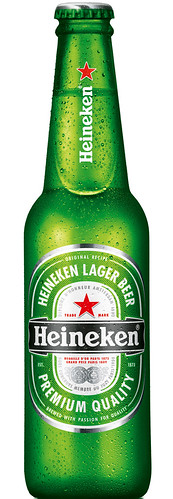
Heineken_K2_Bottle_Embossed
The new “magic” embossed Heineken bottle.

But snarkiness aside, the real news is that Heineken will be reducing the number of package sizes they offer worldwide “from fifteen to five bottles sizes.” I understand any company’s reasons for reducing the number of items they sell, to a point at least. As they concede, it’s being done to achieve “greater efficiencies in the supply chain.” And it may not mean anything, but then again I can see at least one possible scenario that could play out. If Heineken cuts two-thirds of its package sizes, it’s not too hard to imagine the other international beer companies doing likewise. With the vast majority of glass manufacturer sales going to just a few companies, most likely they’d simply discontinue making the package sizes that Heineken and the others abandon. That would make those other ten bottles sizes unavailable for smaller breweries, too, or at least prohibitively expensive. Maybe that’s a stretch, but at a minimum I think it at least bears watching.

The changes will start early next year, first in Western Europe, and then the rest of the world over the balance of the year.
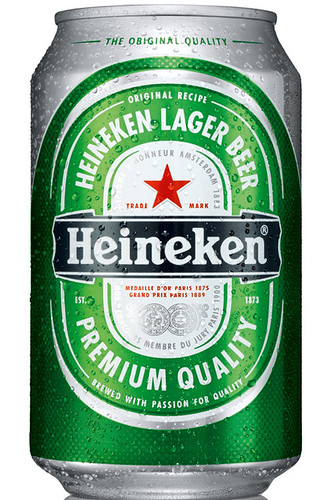
Heineken_Can_Tactile
The new can with “tactile ink.”

Filed Under: Breweries, News Tagged With: Big Brewers, Bottles, Business, Cans, Heineken, International, Packaging

The Myths Of 24-Hour Drinking

December 4, 2010 By Jay Brooks

open-24-hours
The BBC’s home editor, Mark Easton, had an interesting editorial a few days ago about The Myths Of 24-Hour Drinking in which he writes about the effects of the UK’s Licensing Act 2003, which among other changes to the laws concerning alcohol, opened up the possibility of some drinking establishments staying open 24 hours. Proponents hoped it would create jobs and more business and opponents were certain longer hours in the pub would create more drunks. Neither happened, of course, and it’s an interesting read, including all the usual heated comments.

Filed Under: Beers, Editorial Tagged With: Business, Prohibitionists, UK

Gordon Biersch & Rock Bottom Merge

November 15, 2010 By Jay Brooks

gordon-biersch rock-bottom
Wow, this is big news in the world of brewpubs. The headline reads “Rock Bottom Restaurants and Gordon Biersch Brewery Restaurant Group Combine to Become CraftWorks Restaurants and Breweries, Inc.” Both Gordon Biersch and Rock Bottom were two of the largest brewpub chains in the country. Their combined size, including the Old Chicago chain, will be nearly 200 locations nationwide.

Here’s the press release:

Centerbridge Capital Partners, L.P. and its related entities (“Centerbridge”), formed CraftWorks Restaurants & Breweries, Inc. (“CraftWorks”) by closing on concurrent acquisitions of Rock Bottom Restaurants, Inc. (“Rock Bottom”) and Gordon Biersch Brewery Restaurant Group, Inc. (“Gordon Biersch”) today. The companies will operate as subsidiaries of CraftWorks and will retain their brands. The combined business becomes the nation’s leading operator and franchisor of brewery and craft beer-focused casual dining restaurants with nearly 200 owned and franchised locations across the United States. CraftWorks’ primary concepts include Old Chicago, Rock Bottom and Gordon Biersch.

CraftWorks is led by Frank Day and Allen Corey. Frank Day, founder of Rock Bottom, serves as Chairman of the Board and brings over 45 years of restaurant experience to the newly formed company. Allen Corey, an original investor and 13 year CEO of Gordon Biersch, is the President and CEO of CraftWorks and brings over 18 years of restaurant experience to the position.

Regarding the formation of CraftWorks, Frank Day stated, “This merger marks a new era for both Rock Bottom and Gordon Biersch and I am very excited about the growth potential that the future holds for CraftWorks.”

“Gordon Biersch, Old Chicago and Rock Bottom are differentiated casual dining concepts with strong guest loyalty, high energy atmospheres and a high quality offering of craft beer and made-from-scratch food,” stated Jason Mozingo, a Managing Director at Centerbridge. “We are excited by the prospect of partnering with the management teams to strengthen the long-term operating performance of the business and position it for growth.”

Mr. Corey said, “I am honored to have the opportunity to lead the combined company. There is a long-standing relationship between Rock Bottom and Gordon Biersch which will facilitate a smooth and efficient integration of the two businesses. With the help of our new financial sponsor, Centerbridge, we look forward to a successful future as the nation’s leading brewery and craft beer-focused casual dining restaurant operator.”

Gordon Biersch Brewery Restaurant Group, Inc was formerly majority owned by Hancock Park Associates. Rock Bottom Restaurants, Inc. was owned by founder Frank Day and his investment group.

Duff & Phelps Securities, LLC, an affiliate of Duff & Phelps LLC (NYSE: DUF), and North Point acted as the exclusive financial advisors to Rock Bottom and Gordon Biersch, respectively, in connection with this transaction. Faegre & Benson and Miller Martin acted as legal advisors to Rock Bottom and Gordon Biersch, respectively.

Centerbridge was advised by Weil, Gotshal & Manges. Duff & Phelps Securities, LLC, also advised CraftWorks on the acquisition of Gordon Biersch. Wells Fargo and GE Capital were joint-lead arrangers for a $150 million credit facility to support the transaction.

There are no plans for re-branding or closing any units at this time.

About CraftWorks

CraftWorks Restaurants & Breweries, Inc., through its three principal operating units, Old Chicago, Gordon Biersch and Rock Bottom, is the nation’s leading operator and franchisor of craft beer-focused casual dining and brewery restaurants with nearly 200 owned and franchised locations across the United States. CraftWorks also operates strong regional brands, including ChopHouse and Big River and maintains intellectual property rights to the Boulder Beer, Inc. microbrewery. The company maintains dual headquarters in Chattanooga, TN and Louisville, CO. For additional information, please visit www.craftworksrestaurants.com

The new CraftWorks website gives the following information on their homepage:

CraftWorks Restaurants and Breweries proudly serves the finest in craft beer and made-from-scratch creative cuisine. With nearly 200 restaurants operating under 14 different brands, we employ close to 12,000 people in serving approximately 80,000 guests each day. Our restaurants range from traditional casual dining concepts to fine dining white tablecloth establishments.

Our largest brands include Old Chicago, Gordon Biersch Brewery Restaurants and Rock Bottom Restaurant Breweries. With over 70 of our locations featuring fresh brewed beer on-site, we are the world’s leading operator of brewery restaurants.

Our breadth across the nation ranges from the most densely populated urban centers such as Los Angeles, Chicago and Washington D.C. to more rural locations such as Killeen, Texas and Fargo, North Dakota. Regardless of concept or location, our guests have come to know us for unique, made-from-scratch food, craft beer and unbeatable service. Our Loyalty Programs are amongst the largest and most popular in the restaurant industry with over half a million active members enjoying such rewards as personalized Brewer Dinners, specialty merchandise and fantasy vacation trips.

Filed Under: Breweries, News Tagged With: Brewpubs, Business, Restaurants

Bloomberg TV To Feature Jim Koch & Oceanside Ale Works

November 3, 2010 By Jay Brooks

bloomberg-tv
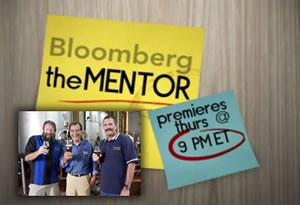
Bloomberg Television is debuting new show tomorrow entitled The Mentor, in which experienced, successful businesspeople visit ones in the same field just starting out in order to help them along. In the first show, which airs tomorrow, Boston Beer Co. founder Jim Koch travels to Oceanside, California to help out the guys at Oceanside Ale Works.

From the press release:

This Thursday, November 4th, 2010 at 9:00 PM/ET, Bloomberg Television will debut “Bloomberg The Mentor,” an original new series that features top CEOs mentoring small business owners across America.

Every entrepreneur hopes to strike it big, but the reality is that 80% of small businesses fail within the first 18 months. What if entrepreneurs from around the U.S. had the chance to get real-life advice from some of America’s best-known CEOs? This season, “Bloomberg The Mentor” tests that concept with four small businesses.

In the series premiere, Jim Koch, founder and chairman of The Boston Beer Company, the largest independently owned American craft brewery and brewer of award-winning Samuel Adams beers, brings his national business expertise to a pair of budding brewers at Oceanside Ale Works in California.

Mark Purciel, a former teacher, and Scott Thomas, a firefighter, initially started brewing hand-crafted ales as a hobby. In 2005, the duo co-founded Oceanside Ale Works, one of the only manual brew houses in the nation. Now, Purciel and Thomas dream of transforming their passion for beer into a nation-wide business. But without significant management experience, how can Purciel and Thomas make the right decisions about scaling their business and finding a way to increase sales and distribution?

During the episode, the unconventional entrepreneurs wing it through a sales meeting with LA nightclub impresario Sam Nazarian before finally meeting their ultimate mentor, Jim Koch, who offers the brewers some tough advice on next steps for their business.

TheMentor

I confess I didn’t realize that our cable company carried the Bloomberg channel, but it does. To check if it’s available where you live, they have a handy page where you plug in your zip code to see if you get the station.

Here’s a trailer for the Oceanside Ale Works show:

And this is a trailer for the show, The Mentor, itself:

Filed Under: Breweries, Events, News Tagged With: Business, TV, Video

Yuengling To Buy Former Coors Brewery In Memphis

October 14, 2010 By Jay Brooks

yuengling-eagle
The Wall Street Journal is reporting that Yuengling Brewery of Pottsville, Pennsylvania is close to finalizing a deal to purchase the brewery in Memphis, Tennessee formerly owned by Coors. Yuengling has signed a letter of intent to buy the brewery for an undisclosed amount and the deal is expected to close in a few weeks. This will be Yuengling’s fourth brewery, as they currently own and operate three breweries, two in Pennsylvania and one in Florida.

The brewery was originally built by Schlitz in 1971 and then Stroh’s operated it for a time before selling it to Coors, where they brewed their Blue Moon line of stealth micros, along with Zima and Keystone. MillerCoors shut it down in 2006 and I seem to recall there were some labor disputes there, too. Then later that same year it was sold for $9 million and it became the Hardy Bottling Co..

Filed Under: Breweries, News Tagged With: Business, Pennsylvania, Tennessee

Napa Smith Brewery Sold

September 20, 2010 By Jay Brooks

napa-smith
The Napa Smith Brewery of Napa, California has been sold to Pelican Brands, an alcohol brand management company from Indiana. According to the CSBA, the “purchase includes seven acres of land and 50,000 sq.ft. of production, warehousing and office space.” Pelican Brands plans to make Napa Smith beer available nationwide over the next year.

Brewmaster Don Barkley, who worked for America’s first modern craft brewery, New Albion, and also founded Mendocino Brewing, will be remaining with the brewery.

It appears that Pelican Brands has ambitious plans for the brand. J. Smoke Wallin, Chairman & CEO of Pelican Brands, said, “It is our belief that while a few will become regional brands, a very select few will become national brands. In a press release, the company stated that Napa Smith will be available nationwide by mid 2011.

“In the past three months alone, Napa Smith, through Pelican’s platform, has expanded into eight new states. Pelican Brands will provide the growth capital needed for further expansion. Napa’s winemakers made the Napa Valley into a global name and destination. We are proud to continue this tradition by bringing beer — brewed with the same level of quality and attention to detail — to discerning consumers everywhere.”

Filed Under: Breweries, News Tagged With: Business, California, Northern California

Session #43: The New Kids

September 3, 2010 By Jay Brooks

grand-opening-ribbon
Our 43rd Session is all about the new. Hosted by Carla Companion, better know as The Beer Babe, she’s tackling The New Kids, by which she means the many, many new breweries that have started up in the last couple of years.

Here’s how she explains it:

Picture yourself starting school, on a cool, crisp September day. Only, you’re not as excited as you usually are because you’re starting at a new school. No one knows who you are, groups of friends are already established, and you have nightmares about getting lost in the hallways trying to find your next class. How will you ever fit in?…

In some ways, there may be a beer-world parallel to this experience: new craft breweries joining an established beer community, or even tougher, breaking into a non-craft beer town.
….

With the astounding growth of the number of craft breweries this year, chances are there’s a new one in development, or has just started out in your area. My challenge to you is to seek out a new brewery and think about ways in which they could be welcomed into the existing beer community. How does their beer compare to the craft beer scene in your area? Are they doing anything in a new/exciting way? What advice, as a beer consumer, would you give to these new breweries?

Take this opportunity to say hello to the new neighbors in your area. Maybe its a nanobrewery that came to a festival for the first time that you vowed to “check out” later. Maybe it’s a new local beer on a shelf on the corner store that you hadn’t seen before. Dig deeper and tell us a story about the “new kids on the block.” I look forward to welcoming them to the neighborhood!

session_logo_all_text_200

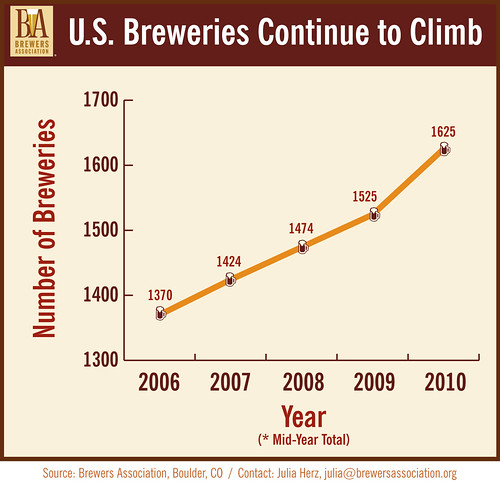
She’s certainly right about the sheer number of new breweries. It defies logic, the economy and conventional wisdom about both. At every measure, at a time when most businesses are flat at best, the number of craft breweries continues to rise. In the past four years, over 250 new breweries have opened. How awesome is that? According to the BA’s wonderful brewery detective Erin Glass, roughly one new brewery is now opening every day, with more on the way. Last year, 110 new breweries opened, but in just the first six months of 2010, 155 have opened. According to a July report by the BA, Director Paul Gatza speculated that there could conceivably be 250 new brewery openings by the time the apple drops on Times Square signaling the end of this year.

And according to Gatza, “[i]t isn’t just an increasing number of nanobreweries, either. [Though frankly, I love the trend of Nano- and Pico-breweries.] We are seeing strong growth in the traditional brewery openings—you know, a business plan for a microbrewery or brewpub that gets out of the planning phase and into operation.”

And last year, Erin was tracking about 260 brewery project at various stages of development. Today the number she’s following is 389. Could we hit 2,000 breweries in America in the next few years? It sure seems possible, even inevitable. Imagine what might happen if (or when, trying to sound hopeful) the economy turns around.

Mid Year Graph

Fourteen years ago, in 1996, it felt like we’d hit a wall. After a number of years of remarkable growth, more breweries began to close than were opening. The numbers looked bleak. The Craft Brewers Conference was a far more somber — dare I say sober — affair than it had been in earlier in that decade. But then things began to turn around. Slow but steady growth began in the late 1990s and has not only continued from that time, but even picked up speed.

Given the increases in market share by craft breweries, in both volume but especially dollars — and now a sharp increase in brewery openings over the last few years — it seems clear we’re in the midst of a new wave of craft beer. Like the the first wave, craft is again the subject of media attention, is increasingly taken seriously by the business world and is being targeted more vigorously by the big beer companies.

It certainly feels like this may be our time. Twenty years ago, microbreweries were mostly alone in promoting the idea of artisanal products. Today there’s artisanal cheese, bread, coffee, charcuterie, beef, chicken, pastries, ice cream and on and on, not to mention organic farming, with its produce and fruit. The world has caught on and caught up. More and more people just get it now, and increasingly each year’s newly minted 21-year olds that add to the percentage of craft beer drinkers in greater numbers. It will be interesting to see how the next few decades play out as time squeezes out the older mainstream beer drinkers in favor of younger generations who came of age in a world where craft beer was already established.

open-neon

And those same generations are and will also responsible for a whole new group of brewers and brewery owners, too, as we’re starting to see right now. Large or small or really small, what a fun time to be drinking craft beer.

Filed Under: Breweries, The Session Tagged With: Business

FMB vs. PAB

September 2, 2010 By Jay Brooks

alcopop
Did I miss a meeting? The malt beverages that are flavored with something else — fruit, essence of liquor or whatever — have been called by many names. Alcopop is always the one that first leaps to mind, even though that’s supposedly a derogatory term. Why? Apparently adding “pop” makes it for the kiddies, something the watchdogs can’t abide. Because anything that’s meant to be fun for adults but just might also possibly appeal to kids is strictly verboten in their addled minds. Of course, people have been calling beer “barley pop” for decades, if not longer, so I don’t see why it’s such a big deal. It’s like the seasonal beers with Santa Claus on the labels they find so offensive, as if adults aren’t allowed to like St. Nick, too.

Other names they’ve been called include FABs (Flavored Alcoholic Beverage), FMBs (Flavored Malt Beverage), Malternatives and RTD (Ready To Drink), at least in Australia and New Zealand. Sadly, thanks to the anti-alcohol bunch, the industry never uses the fun term Alcopops lest anyone be accused of actually having fun with them. Personally, I’ll keeping calling them Alcopops because I see nothing wrong with that name. I say we take it back. They’re alcoholic and they’re sweet, alco and pop. So what?

In the business world, Alcopops are, or at least were, usually referred to as FMBs, or Flavored Malt Beverages. Though a pretty bland name, it at least fairly describes what they are: malt-based beverages that have been flavored with something.

But in looking through the SymphonyIRI charts for the previous post, I kept noticing a line for PABs. What on earth are PABs, I wondered? How could I possibly have missed an entire new category? It turns out PABs are an abbreviation for yet another new term for Alcopops. A highly unscientific Google search reveals the term’s been around at least since 2007, though mentions of PABs increase dramatically in 2008-2009.

But PAB might be the worst one of all. It stands for “Progressive Adult Beverages.” So yes, they’re beverages and they’re meant for adults, obviously. But what the hell is progressive about them? I suppose it’s no worse than premium or sub-premium, but at least that’s a quality. Even if I laugh at its inaccuracy, premium at least describes where it fits in a hierarchy. Progressive? That’s about as meaningless a name as you could attach to a drink or class of drinks.

And let me stop you before you start. I know this is a silly or stupid or whatever thing to get worked up about. But bear in mind I’m a writer, a language geek, a word nerd and I do believe words have power. What we call things does make a difference. That’s why corporations pay huge sums to come up with new product names, testing them in focus groups, getting the graphics just so, trying to invoke the right response they want from potential customers.

To me, they’ll always be Alcopops.

Filed Under: Editorial, Related Pleasures Tagged With: Business

More Craft Beer Sales Data

September 2, 2010 By Jay Brooks

SymphonyIRI
Last week I shared some of the highlights from the Brewers Association‘s bi-monthly Power Hour session that Ray Daniels tweeted about throughout the hour, whose topic was “Craft Brewing & Mid-Year Category Sales Review.” As a BA member, I also was able to look at the presentation after the fact and — with the Brewers Association’s permission — thought I’d share some more of the interesting statistics that SymphonyIRI revealed during their presentation.

During the First Half of 2010 …

  • Craft showed double-digit growth in all five types of stores that IRI tracks: Grocery (up 11.9% vol./13.2% $), Drug Stores (24.5%/25.3%), Convenience Stores (11.1%/13.3%), Liquor Stores (24.2%
    /20.9%) and Big Box Stores (33.3%/34.1%)
  • Craft 6-pack cans were up 80% and 12-packs were up 49.4%
  • 7 of the Top 15 new brands were Alcopops
  • Craft is up 13.2% $ vs. total beers sales up only 0.1%
  • Total Beer Sales minus Craft was down -1.0%
  • The #1 craft brand was Sierra Nevada Pale Ale, slightly edging out Samuel Adams Boston Lager.
  • The craft mix is more diversified; the top 10 craft brands account for 41% of the craft total, whereas the top 10 imports account for 68% and the top 10 macro brands 73.5%.
  • California, by volume, sold more beer than any other state, and in fact sold nearly twice as much as the next highest state, which was Washington.
  • Craft has a more than 20% market share of three key markets:
    1. Portland, Oregon (29.9%)
    2. Seattle/Tacoma, Washington (24%)
    3. San Francisco/Oakland, California (20.3%)

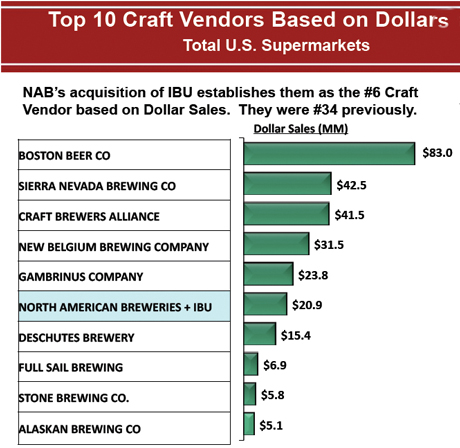
And here’s a couple of graphs. The first shows the top ten craft brewing companies, with craft being defined more broadly by SymphonyIRI than the BA’s definition. Significantly, it shows that the purchase of Magic Hat/Pyramid/Portland breweries by North American Breweries catapulted them from #34 to #6.

IRI-1H-2010-1

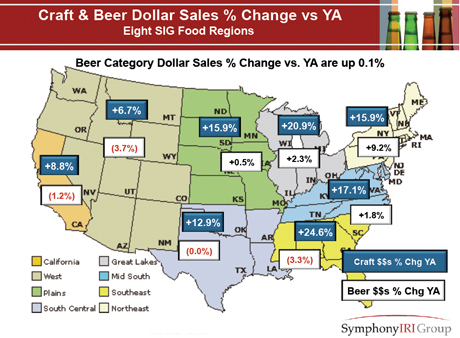
The second compares sales by dollars between craft beer (in blue) and macro brands (in white) and divided by region of the country. The Southeast (24.6%) followed by the Great Lakes states (20.9%) experienced the greatest growth over last year. The big breweries saw their sales dip the most in the West (excluding California, at -3.7%) followed by the Southeast (-3.3%). Big brands actually had pretty good growth (9.2%) in the Northeast, though craft in that region was 15.9%, making it the third-highest region (along with the Plains states).

IRI-1H-2010-2

Filed Under: Beers, Breweries Tagged With: Business, Statistics

Brewers Association Power Hour Reveals New Craft Numbers

August 26, 2010 By Jay Brooks

ba
If you’re a member of the Brewers Association, a trade organization for small breweries, you have the opportunity to listen in on the bi-monthly Power Hour, an on-line, interactive teleconference series. This morning’s topic was “Craft Brewing & Mid-Year Category Sales Review.” I didn’t listen in to this one, but happily Ray Daniels, he of the Cicerone program, was kind enough to tweet a number of the statistics quoted in the talk by Dan Wandel, with the Symphony IRI Group, and better still, Todd Alstrom, posted Ray’s tweets on Beer Advocate where they can live forever instead of being lost in the ether. Below is just a few of the more interesting tidbits.

  • First half of 2010 sales data — Craft volume up 11.9%!
  • Symphony IRI Group show craft beer being 8.7% of the total beer market in H1 2010
  • Sales of craft beer 22 oz bottles up 28% in 2010 vs. 2009 in supermarkets.
  • 3 of top 10 new brands are IPAs
  • 8 of the top 15 new craft brands this year are IPAs.
  • What recession? First half craft sales showing best growth of any year since 2007.
  • Top 10 major brewer brands DOWN more than 5 million cases so far this year.
  • 511 craft beer UPCs (products) being sold in California.
  • More households in the US now purchasing craft beer versus a year ago—better than any other segment.
  • Dan Wandel from SIG says craft beer the “shining star” of US beer market, on track for 6th (I think he said) year of >10% growth.

You can see the rest of Ray Daniels’ tweets here. Thanks again to Todd for saving me the trouble of having to go back and grab Ray’s tweets individually.

Filed Under: Breweries, Editorial, News Tagged With: Business, Statistics

« Previous Page
Next Page »

Find Something

Northern California Breweries

Please consider purchasing my latest book, California Breweries North, available from Amazon, or ask for it at your local bookstore.

Recent Comments

  • Bob Paolino on Beer Birthday: Grant Johnston
  • Gambrinus on Historic Beer Birthday: A.J. Houghton
  • Ernie Dewing on Historic Beer Birthday: Charles William Bergner 
  • Steve 'Pudgy' De Rose on Historic Beer Birthday: Jacob Schmidt
  • Jay Brooks on Beer Birthday: Bill Owens

Recent Posts

  • Historic Beer Birthday: John J. Saltzmann March 7, 2026
  • Beer In Ads #5149: Winter Brewed For Summer Flavor! March 7, 2026
  • Historic Beer Birthday: Conrad Pfeiffer March 7, 2026
  • Beer In Ads #5148: Ach Himmel Mr. Goat March 6, 2026
  • Historic Beer Birthday: Conrad Windisch March 6, 2026

BBB Archives

Feedback

Head Quarter
This site is hosted and maintained by H25Q.dev. Any questions or comments for the webmaster can be directed here.