Brookston Beer Bulletin

Jay R. Brooks on Beer

  • Home
  • About
  • Editorial
  • Birthdays
  • Art & Beer

Socialize

  • Dribbble
  • Email
  • Facebook
  • Flickr
  • GitHub
  • Instagram
  • LinkedIn
  • Pinterest
  • RSS
  • Twitter
  • YouTube

Powered by Genesis

Fifty-Year Old Coors Found in California Dessert

November 22, 2006 By Jay Brooks

This was an odd little story out of Tennessee about some hikers who found a case of Coors that’s fifty-years old in the California dessert near San Diego, at the scene of a famous train wreck known as the “Coors Wreck.” The television station’s website, WBIR Channel 10, includes a link to a video report. In the report they show them opening and pouring out the contents of the beer. It’s interesting to see how it looks after being exposed to harsh temperatures for a half century. One odd thing in the story, however, is the interviewee seems to imply that the find was not made all that recently so I’m not exactly sure what made it news now. Anyway, it’s still fun to see it opened.

A fifty-year old can of Coors.

Filed Under: Just For Fun, News Tagged With: California, History, Strange But True

The Lost Abbey and Brewer’s Blogs

November 20, 2006 By Jay Brooks

I got an e-mail from Tomme Arthur yesterday, letting the cat out of the bag, so to speak, on his Brewer’s Blog. I don’t think he was planning on it being a secret, but it is just getting started. From the few posts there so far, it looks like it should evolve into a fascinating peek into Tomme’s mind and the work and thinking that goes into running a brewery and building a brand. If you love his beers — and you’d be a fool not to — you will undoubtedly enjoy his musings, as well. I’m looking forward to following along.

Although blogging may take time away from his Washoe practice which, as Dave Keene can tell you, he clearly needs (yes, that sound you heard is the gauntlet being thrown down for a rematch).

This is a good trend, I think, of commercial brewers having their own blogs to let their customers behind the curtain to see how the process goes of working at, building or running a brewery. There are now several professional brewers with a brewer’s blog. Below is a list of the ones I know of. If you know of any others, please let me know as I think it’s high time I added a new category of links just for them.
 

Brewer’s Blogs

  • Nico Freccia & Shaun O’Sullivan’s The Beer Guys (21st Amendment)
  • Tom Baker’s Brewer Confessions (Heavyweight) [Note: may be closed]
  • Dave Yarrington’s Brewer’s Notes (Smuttynose)
  • Fal Allen’s Brewing in Singapore
  • Fred Bueltmann’s Bringing Beer to the People
  • Matt Van Wyk & Andrew Mason’s Flossmoor Station Blog
  • Stone Brewing’s Greg’s vBlog
  • Chad Kennedy’s Laurelwood Live
  • Tomme Arthur’s Brewer’s Blog (The Lost Abbey)
  • Laurelwood’s New Brewery Project
  • All the Brewers at Saint Arnold’s Brewhouse Blog

Filed Under: Just For Fun Tagged With: California, Southern California, Websites

Rodger’s Jolly Rodger Times Seven

November 17, 2006 By Jay Brooks

Wednesday night, Drake’s Brewing had a fun little event at the Toronado called Seven Different Jolly’s, where they had seven different versions of their holiday beer, Jolly Rodger, from four different years. The recipe changes from year to year, and in ’05 they did two different styles, plus two years some of the beer was aged in wood, which accounts for why there were seven different beers. Both of Drake’s brewers, Rodger Davis and Melissa Myers, were on hand. I had the kids in tow since my S.O. was in Florida for the week, which meant I couldn’t stay all night, and as a consequence my notes are rather brief. But it was a very fun tasting.

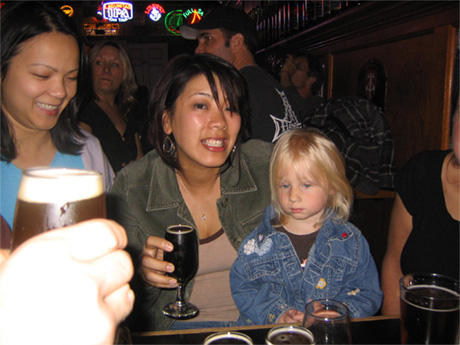
The 21A Gals were kind enough to mind my daughter Alice, who had just woken up from a nap.

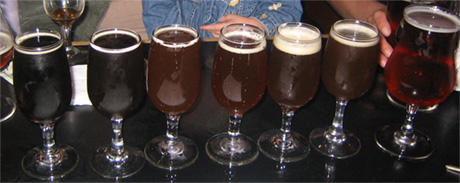
The seven Jolly Rodgers, in order from left to right the way we tasted them.

Rodger tasted me, and fellow beer scribe William Brand of the Oakland Tribune, on all seven of the beers. [the descriptions in the gray boxes are the ones provided by Drake’s.]
 

2003
A Scotch Ale. Based on the early 1800’s way of taxing ales, where more Shillings were charged to higher gravity ales, this would be considered ”120 Shilling” Ale. Big and malty from the addition of roasted barley this beer is balanced with two hop additions of East Kent Golding. The beer was then fermented at 50°F to keep the ester formation low so the malt would shine through. 9%ABV 30 IBUs

First up was the oldest of the gang, the 2003 version, a strong ale which was reminiscent of an imperial something, and though I hesitate to say it, over time the flavor seems to have migrated toward stout-like characteristics, no doubt from the roasted barley. Time also seems to have given it oak-like qualities though Rodger assures me it’s never touched wood. Regardless, it has very complex flavors and tastes nothing like I remember it three years ago.

2003 Barrel Aged
In the early 1800’s Scottish brewers would transfer their ales to barrels where they would condition for up to two years. Often these beers would sour over time from bacteria in the barrels. The 2003 Scotch Ale was placed into a Brandy barrel for 18 months. This version has a slight sourness to it but is quite complex with the many different wine-like aromas that come at you. 11% ABV 30 IBU’s

The scotch ale has become much more sour during it’s stay at casa leño, almost on the order of a Flemish sour. It has also added additional complexity, if that’s possible, and has a grittier mouthfeel.

2004
An American-style Red Ale. Think of it as a dark IPA. After 2003’s version we found the need to get back into a hoppy style but wanted to create a beer that had a firm malt backbone as well. Roasted barley lends a nice mahogany color as well as a nice roasted malt flavor. Hops: Horizon, Chinook and Centennial. 9.5% ABV 70 IBUs

Time has, as is be expected, muted the hop character and brought out the malt complexity. The alcohol also comes through loud and clear.

2005-A
An Imperial IPA. This is a very big beer. Crystal malt lends a nice ruby red backdrop to an onslaught of hops. How many pounds of different kinds of hops can you throw at a beer and still make it somewhat drinkable? It turns out a lot! Hops: Horizon, Simcoe, Cascade and Columbus. 11.5% ABV 80 IBU’s

This is still quite the hop bomb, and the Simcoe character is immediately apparent and dominant. It’s tasting surprisingly fresh, though the spicy hop oils scorch the tongue going down.

2005-B
An Old Ale. For our 15th Anniversary we decided to brew two different versions of Jolly Rodger, one a hop bomb and the other would be Roger Lind’s original recipe from 1990. So we broke out his original brew sheet and used his ingredients and threw our own brewing techniques at it. What we ended up with is a well-balanced ale that is lightly hopped with Galena, East Kent Goldings and Willamette hops. 9.5%ABV 40 IBU’s

I don’t have much in the way of notes for this beer. It tasted good, but reminded me a bit more of a barleywine than a true old ale, probably because it was at the upper end of alcohol content for the style. Of course, the two are related styles.

2005-B Barrel Aged
This is the Old Ale that was placed into an Apple Brandy barrel for 12 months. The first few months of aging, the beer was dominated by a green apple aroma with much of it slipping in to the flavor. Over time that has taken a backseat to the French oak the barrel is made of with apple Brandy notes reminding you what the barrels past was. 11%ABV 40 IBU’s

The Brandy barrel gave this beer sharper, almost biting flavors, and big fruity esters. The wood does indeed shine through, as does the increased alcohol.
 

Rodger with this year’s Jolly Rodger.
 

2006
An Imperial IPA. We have discovered that if hops are not used in the Jolly Rodger these days, then people become enraged. So here we go with another hop bomb. This one stems from a conversation with Pat McIlhenney (owner/brewer of Alpine Brewing) when he mentioned that he used a whopping two pounds of dry hops per barrel in his outstanding Duet beer. Most of our Imperial IPAs were about one pound per barrel! So what the hell, let’s see what that will do to one of our beers. Thanks for the advice Pat! This one REALLY goes to eleven!! Hops: Warrior, Simcoe, Summit, and Amarillo. 11%ABV 70 IBU’s

Rodger told me he used only a little of the new Summit hop, but its signature oniony aromas was the first thing I noticed in this beer. It is another hop bomb, very aromatic and only slightly restrained by the malt. I expect time will soften the hops and bring out the 2-row malt. He’ll also be doing another batch (which will be designated 2006-B) of the Jolly Rodger shortly and will substitute the Summit with Ahtanum hops.


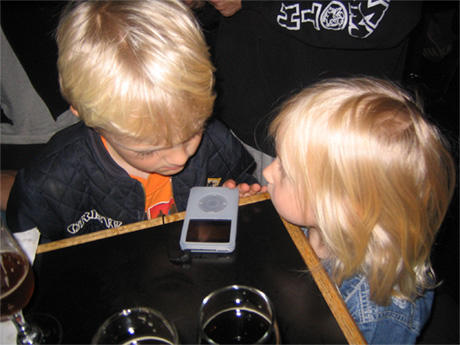
Porter and Alice kept happily occupied watching Star Wars on a friend’s iPod, while we tasted the beers.

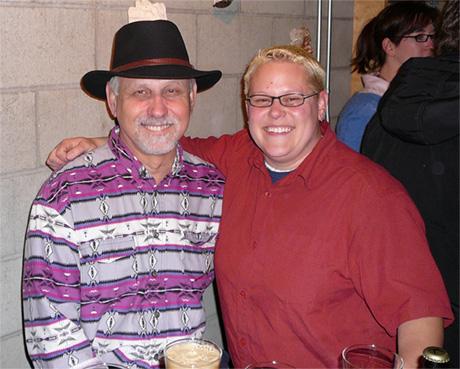
Rodger looking more jolly than usual, a welcome sight. It must be the just married glow.

Filed Under: Events Tagged With: Bay Area, California, Other Events, San Francisco, Seasonal Release

Got Wood?

November 13, 2006 By Jay Brooks

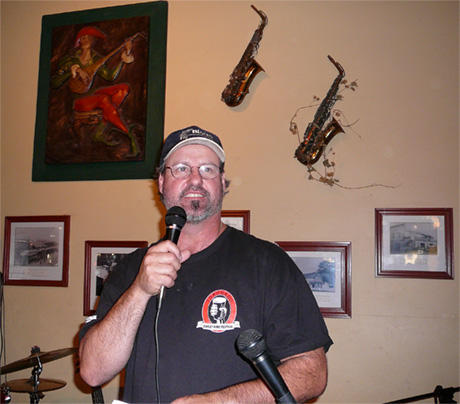
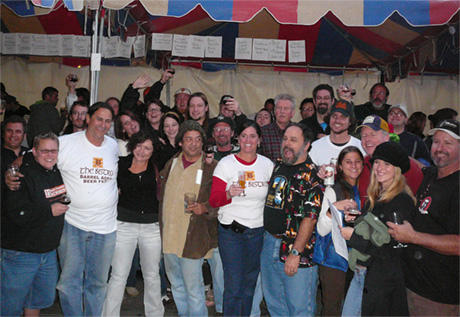
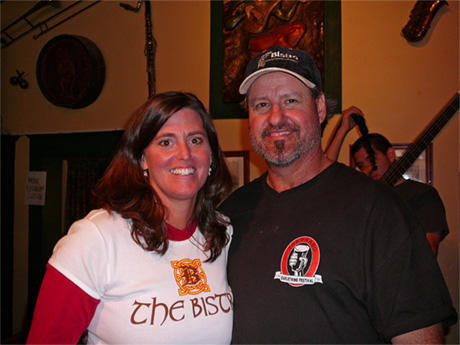
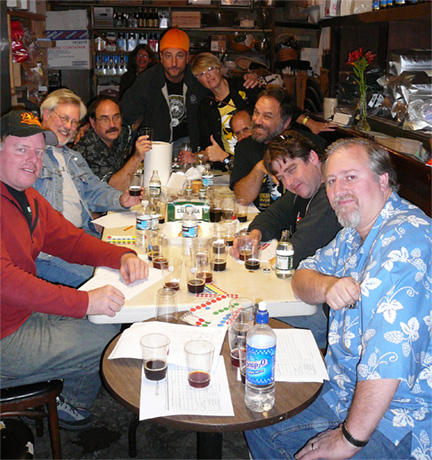
Saturday was the first-ever beer festival for wood-aged beers in the west. It was held at the Bistro in Hayward, California and they were pouring about 42 different beers who had in common only that they’d been aged on some type of wood barrel. At one time, of course, all beer was stored in wooden barrels and the cooper was just as important to the brewing of beer as anyone else. Eventually stainless steel overtook wood as the vessel of choice for beer, and indeed it has many advantages, one of which is that it doesn’t impart anything to change the flavor of the beer. But that is precisely the point of the new wood-aged beers, and how they change the beer is what is so exciting about this trend. Brewers are learning through experimentation what works best and in general barrel-aged beers gain enormous complexity from their time in the wood, and what type of wood and/or what was in the barrel before the beer transforms the beer into a whole new experience. The most common used barrels once contained bourbon, scotch, wine, port or brandy. And these residual flavors, in addition to the wood itself, are also apparent in the finished beer.

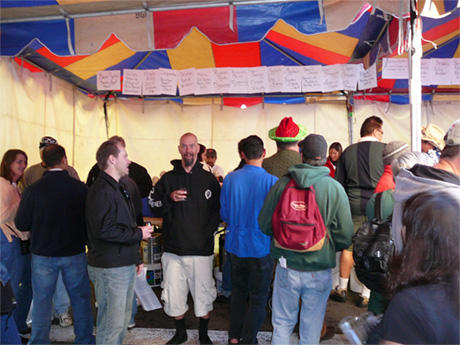
The scene outside under the tent at the Barrel Aged Beer festival, with Rodger Davis from Drake’s making faces at me.

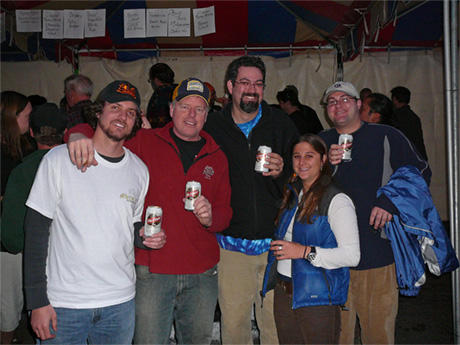
Here’s something you don’t see everyday, Falstaff beer in cans.

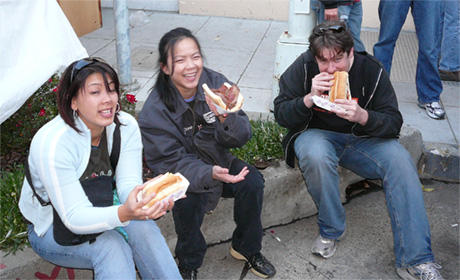
The 21st Amendment Girls enjoy some yummy Tri-Tip sandwiches (oh, and Steve, too).

Bistro co-owner Vic Kralj announced the winners.

The first barrel aged fest was very well-attended, boding well for another one next year. The weather was decidedly cool for the Bay Area, which made it perfect for enjoying big, strong beers.

Our hosts, Bistro owners Cynthia and Vic Kralj.

Judging the four categories of beers kept us sequestered in the cellar for five grueling, delicious hours. Because all the beers have in common is being aged on wood, it was very difficult to choose among so many diverse, but deserving beers. There were very lively discussions every step of the way. Rumor has it one of the other judges wanted to “kick my ass” afterward, so I know I must be doing something right. What a blast!

Filed Under: Events, News Tagged With: Bay Area, California, Festivals, Photo Gallery

Bistro Barrel Aged Beer Festival Winners

November 13, 2006 By Jay Brooks

Port Brewing’s Old(er) Viscosity was chosen Grand Champion at the 1st and (hopefully) annual Barrel Aged Beer Festival Saturday at the Bistro in Hayward, California. The full list of winners is below.


Category 1: Sour Beers

  • 1st Place: Depuration (Russian River Brewing)
  • Runner-Up: La Folie (New Belgium Brewing)


Category 2: Wine Barrel Beers

  • 1st Place: Blue Frog 5th Anniversary Scotch Ale (Blue Frog Brewing)
  • 2nd Place: Angel’s Share (The Lost Abbey)
  • 3rd Place: Old Stock 2005 (North Coast Brewing)


Category 3: Wood Barrel Beers (New Wood)

  • 1st Place: Ukranian Imperial Stout (Glacier Brewhouse)
  • 2nd Place: Firestone-Walker 10 (Firestone Walker Brewing)
  • 3rd Place: Barrel of Monkeys (Devil’s Canyon Brewing)


Category 4: Bourbon Barrel Beers

  • 1st Place: Old(er) Viscosity (Port Brewing)
  • 2nd Place: Firestone-Walker Parabola (Firestone Walker Brewing)
  • 3rd Place: Bigfoot on Wood (Sierra Nevada Brewing)

Filed Under: Events, News Tagged With: Awards, Bay Area, California, Festivals

Rising Up in the Valley

November 12, 2006 By Jay Brooks

Steve Altimari and the gang at Stockton’s Valley Brewing took delivery yesterday of the grain silo from the old Stone Brewery in San Marcos. Stone recently moved into a new facility in nearby Escondido and Valley needed somewhere to store their malt. Steve’s young son, Cassidy, upon seeing the new silo asked his Dad. “When can I take a ride in the new submarine?” It’s great to see Valley Brewing doing so well, Steve has been making a wide array of delicious beers for some time now. His beers deserve to be more well known.

Steve Altimari in front of Valley Brewing’s new grain silo. If you look closely, you can still see the Stone logo on it.

Filed Under: News Tagged With: California, Northern California

No Fish: The Dogfish Head Beer Dinner

November 12, 2006 By Jay Brooks

The latest beer dinner from beer chef Bruce Paton took place Friday evening at the Cathedral Hill Hotel in San Francisco. The delicious four-course dinner was paired with the beers of Dogfish Head Brewing from Milton, Delaware. Owner Sam Calagione was at the dinner to talk about his beers. Another great night with beer and food.

Sam Calagione tells the assembled crowd or over 80 people about his philosophy of brewing and about each of the five beers poured Friday night. There was no fish on the menu, however, and instead we enjoyed poached foie gras with caviar, duck parsnip nodle pho with charred ginger broth, and angus short ribs with lobster medallions.

Table-mates Vinnie and Natalie Cilurzo from Russian River Brewing.

And Justin and Daniella from the Brewing Network.

The dessert was a delicious Ginger Scented Banana Custard with Citrus Caramel Sauce paired with Dogfish Head’s newest historical beer, Chateau Jiahu, a beer based on a 9,000 beverage discovered in pottery jars found in the Neolithic villiage of Jiahu in Northern China. It was determined to be a mixed fermented beverage of rice, honey and fruit.

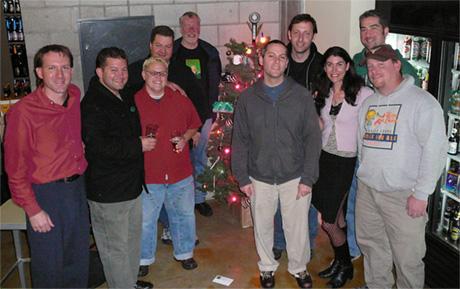
Brewers and beer people at the Dogfish Head dinner.

Sam Calagione and beer chef Bruce Paton, our hosts for the evening.

The next beer dinner should be sometime in January. Watch for more details here or on Bruce Paton’s website, the Beer Chef.

Filed Under: Events, Food & Beer Tagged With: California, Eastern States, Photo Gallery, San Francisco

Fermenting a Book Signing

November 8, 2006 By Jay Brooks

Chris O’Brien, author of Fermenting Revolution, will be doing a book signing at The Book Shop in Hayward, California from 2:20-3:30 p.m. this Saturday, November 11. The Book Shop is located at 1007 B Street, right next door to The Bistro, who is hosting a Barrel Aged Beer Festival the same day from 11 a.m. until 5:00 p.m. Chris will have a reading and sign books for an hour or so, and then join us next door at the festival for a lively discussion of beer culture.

I’m looking forward to meeting Chris in person. Now that I’ve gotten my review copy of his new book and looked over the table of contents, it seems even more interesting. I can’t wait to read it. This is just one more good reason to come out to the Barrel Aged Beer Festival, not that you probably needed one. It should be a great time all by itself, but now you can tell people you’re going to a book reading and sound more like a normal, well-rounded person. At least that’s my plan.


Filed Under: Uncategorized Tagged With: Announcements, Bay Area, Beer Books, California

Anchor Christmas Ale Released

November 6, 2006 By Jay Brooks

The 32nd release of Anchor’s “Our Special Ale,” the official name of their annual Christmas Ale, takes place today and the seasonal beer will be available through January. The traditional date for the release of Anchor’s Christmas Ale was always the Monday before Thanksgiving, making it one of latest releases for the holidays. However, demand for the beer and requests from wholesalers and retailers led them to move back the release date to early November. While I’m generally not a fan of the expansion of the Christmas season to November 1, and some instances even before, this is one case where I can make an exception. Having this beer available even a few weeks longer is definitely a good thing!

From the press release:

The brewers of Anchor Steam® Beer are proud to announce the release of our thirty-second annual “Christmas Ale.”

Every year since 1975 the brewers at Anchor have brewed a distinctive and unique “Christmas Ale,” which is available from early November to mid-January. The Ale’s recipe is different every year—as is the tree on the label—but the intent with which we offer it remains the same: joy and celebration of the newness of life. Since ancient times, trees have symbolized the winter solstice when the earth, with its seasons, appears born anew.

This year’s featured tree is the Fagus sylvatica, more commonly known as the European Beech.

Filed Under: Beers, Breweries Tagged With: California, Press Release, San Francisco, Seasonal Release

What’s That Smell? Fermentation or Incompetence?

November 3, 2006 By Jay Brooks

newspaper
The “smell of fermentation?” More like the smell of incompetence, as respected wine writer Thom Elkjer bumbles wildly through a new beer article in today’s San Francisco Chronicle, apparently angling to become the Sergeant Schultz of beer. His first impression upon entering the Russian River Brewery is the stainless steel tanks and the “smell of fermentation.” When I read his article, the only scent I get is of his ignorance.

The article is titled Artisan brewers thrive in the Wine Country and in it he profiles Russian River Brewing Co. of Santa Rosa and Anderson Valley Brewing Co. of Boonville, and also talks more generally about craft beer in the Bay Area.

He begins by sampling Russian River Brewing’s wonderfully complex Damnation and spits out the sample into the floor drain, thus missing half the beer’s flavor! That’s only the first outrage in what I believe quite possibly may be the most ignorant piece of writing on the subject of beer that I’ve read all year. I’m glad that the Chronicle is once more writing about beer after Linda Murphy, the one wine writer that knew something about it, left in August. But there are so many mistakes and insults in Elkjer’s feature article that I almost feel embarrassed for him. And the Chronicle likewise should feel embarrassed for doing such a disservice to its many beer-loving readers.

There are so many things to call attention to in the article that I could spend all day on it, but I’ll confine myself to just a few and leave it to others to discover the rest.

He claims that early craft brewers originally “went into the commercial business to make a fresh, draft version of their favorite bottled import.” But most early craft brewers made a pale ale or amber ale as their flagship beer, while a majority of imports were still lagers. To be sure there were some pale ales — Bass Ale springs to mind — but they were a relative minority. Imports certainly “inspired” many early brewers, but for a variety of reasons making ales was a much more cost effective way to start a microbrewery in those days.

Elkjer goes on to describe “stout and ale” as some of the “time-honored categories” to describe “their beers — just as winemakers do.” I’m pretty sure wines are usually described by the primary grape or the region (appellation) they come from. Wouldn’t that mean that Sierra Nevada Pale Ale should be called “Cascade Ale.” And when did ale and stout become distinct categories? They’re not, of course, and I can’t even bring myself to insult my readers by explaining this.

After reporting how Vinnie Cilurzo is embracing Brettanomyces to create many of Russian River’s bolder beers, unlike winemakers who generally hate the stuff, he says its odor reminds “most people of barnyard manure.” So is he saying Vinnie’s beer using that yeast tastes or smells “shitty?” I think the more common description of Brett is “horse blanket” or similar allusions and while I accept that many people find it off-putting, I’ve never considered scatological descriptors. I think that’s a little insulting, frankly.

Elkjer next explains that Russian River is not the only brewer making this type of beer, and mentions Tomme Arthur, too, before dropping this bombshell. “There are, for example, more than 400 different beers made at Belgium’s Trappist monasteries.” Wow, that’s a lot of different beers made at a grand total of seven — count ’em — seven Trappist breweries in the world (6 in Belgium, 1 in The Netherlands). Some very simple fact-checking would likely have revealed this error, but it suggests a lack of follow-up or research, along with a careless disregard for the subject matter.

The author then talks about the history of hops in northern California’s past, explaining how hops were once “roasted” throughout the region. I don’t know what they did with the hops after they roasted them — assuming they didn’t catch on fire — because they’d be all but useless in making beer. While I can’t say some hop pellets have never been put in a frying pan for a few seconds to get some different qualities out of the hops in dry-hopping by some eccentric brewer, generally speaking nobody in their right mind roasts hops. There are far better and safer ways to get roasted flavors in your beer. But to Thom, “[r]oasted hops are one of the two essential ingredients in most beer (the other is malted barley).” I’m not sure what happened to the yeast and water, perhaps they’re not as essential?

And apparently it’s not just beer that Elkjer is ignorant about, he’s not so hot at math, either. In discussing the alcohol (a.b.v.) in Russian River’s beers, he claims Deification at 6.35% is “around twice the average of mass-produced beers.” Budweiser weighs in at 4.9%. You do the math, does that add up? He later refers to a 5.5% beer as a “session beer,” which he also defines as a beer to drink “during a long meal.” I didn’t realize “length of meal time” was one of the criteria you should use in choosing the right beer pairing for your dinner.

Later, he reveals the target demographic for “session beers” are “women as well as immigrants” and that’s who microbreweries are focusing on appealing to. Now, do female immigrants want a beer that’s twice as low-alcohol since they’re both “women as well as immigrants” or are they just twice as likely to want one? It’s amazing how dismissive and insulting that sounds, but frankly that’s how the whole things strikes me. This just seems to be written by someone who all but hates what he’s writing about.

But there’s more condescension around the next corner where Elkjer writes off brewpub food as “simple, hearty and well matched with the beverages,” implying, of course that the “beverages” are simple, too. Oh, and if you spend the entire day drinking beer, by all means learn from the adults, your betters, and, as Elkjer suggests, “do what the wine tasters do: rent a limousine or choose a designated driver.” Thanks Thom, that would never have occurred to me, what a thoughtful suggestion. We beer folk are such simple people, we sure do need your sophisticated guidance, by golly.

Elkjer ends his article, at least online (in the paper I believe it’s probably a sidebar), with a list and short description of wine country craft breweries, though curiously he omits Dempsey’s in Petaluma, among others. Here are just a couple of his comments:

Bear Republic has “a goofy gift shop.”

Calistoga Inn Restaurant & Brewery is a “real restaurant that happens to make 400 barrels of beer.” So the other brewpub restaurants aren’t “real?”

Now apparently Thom Elkjer is a very well-respected wine writer who writes for numerous wine magazines and newspapers, including, according to his biography on WineCountry.com, “Wine Spectator, Wine Enthusiast, Wine Country Living, VINE Napa Valley, and WINE.” He’s also written several books about wine. But from some simple searching, I can’t find another instance where he’s written about beer before and, if that’s true, boy does it show. But as some of my own critics have pointed out, the fault lies more properly with the editors, the publication handing out the assignment rather than the author. And that certainly may be true to a certain extent. Because I, too, would probably not turn down an assignment that paid well in a prominent publication, even if they asked me to write about something outside my area of expertise. But I also would have done a lot of research, fact-checked the piece to death, and asked people who did know the subject to look at it first. I would have gone over it with a fine tooth comb if for no other reason than simply to not embarrass myself and also insure that it wasn’t the last assignment I ever got from the publication.

Elkjer’s piece, on the other hand, is so riddled with simple, laughable errors and insulting, dismissive rhetoric that I’m truly perplexed that his article moved from the editor’s desk to the copy editor and on the printing press without somebody noticing something might be amiss. I know these are busy people. I know they have deadlines. I know they don’t know jack about beer. But how do you miss insulting “women and immigrants” by reinforcing stereotypes and suggesting they both prefer low-alcohol beers. I need look no farther than my own wife to know how wrong that stereotype is. And by now isn’t it fairly common knowledge that while wine tasters spit out the samples, beer aficionados do not?

This is or should be, I think, a source of much embarassment to the San Francisco Chronicle. Their newspaper is smack dab in the middle of one the most exciting places on Earth for craft brewing, where there are countless innovations taking place right under their noses. Yet the largest news organization in the Bay Area remains blissfully ignorant of what’s going on all around them, or even that it’s going on at all. More and more people are discovering craft beer in all its wonderfully varied diversity despite the Chronicle’s best efforts to keep their readers in the dark. And that may be the saddest commentary of all.

Filed Under: Editorial, Food & Beer, News Tagged With: Bay Area, California, Mainstream Coverage, Northern California

« Previous Page
Next Page »

Find Something

Northern California Breweries

Please consider purchasing my latest book, California Breweries North, available from Amazon, or ask for it at your local bookstore.

Recent Comments

  • Ernie Dewing on Historic Beer Birthday: Charles William Bergner 
  • Steve 'Pudgy' De Rose on Historic Beer Birthday: Jacob Schmidt
  • Jay Brooks on Beer Birthday: Bill Owens
  • Steve 'Pudgy' De Rose on Beer Birthday: Charles Finkel
  • Steve 'Pudgy' De Rose on Beer Birthday: Bill Owens

Recent Posts

  • Historic Beer Birthday: John Goetz January 28, 2026
  • Beer Birthday: Jean-Marie Rock January 28, 2026
  • Beer In Ads #5184: The “B”s Are Here, Bruton Bock Beer January 27, 2026
  • Beer Birthday: Logan Plant January 27, 2026
  • Historic Beer Birthday: William Tunis Ryerson January 27, 2026

BBB Archives

Feedback

Head Quarter
This site is hosted and maintained by H25Q.dev. Any questions or comments for the webmaster can be directed here.