Brookston Beer Bulletin

Jay R. Brooks on Beer

  • Home
  • About
  • Editorial
  • Birthdays
  • Art & Beer

Socialize

  • Dribbble
  • Email
  • Facebook
  • Flickr
  • GitHub
  • Instagram
  • LinkedIn
  • Pinterest
  • RSS
  • Twitter
  • YouTube

Powered by Genesis

Historic Beer Birthday: Ludwig Thoma

January 21, 2021 By Jay Brooks

Today is the birthday of Ludwig Thoma (January 21, 1867-August 26, 1921). If his name is not familiar to you, that’s not a surprise. He was a German author, publisher and editor, who gained popularity through his partially exaggerated description of everyday Bavarian life,” but he’s largely unknown outside of his native Germany.

One of his best-known works is Der Münchner im Himmel (or The Municher in Heaven), which in 1962 was made into a short animated cartoon directed by Walter Reiner for BR, the German equivalent of PBS. And it was based on Ludwig Thoma’s story of the same name.

Here’s a description of the story, translated by Google, so you can make sense of the cartoon since it’s in German:

Alois Hingerl, clerk no. 172 from Munich Central Station, goes to heaven. Peter reveals to him the heavenly house rules: “Rejoice and sing Hallelujah”. The “Angel Aloisius” is not particularly impressed by this, especially since he is supposed to get “heavenly manna” instead of the Munich beer. Angry, he sits down on a cloud to rejoice and sing hallelujah. It sounds like the hair of the heavenly ones stand on end. The good Lord has an understanding and instructs Aloisius to convey the divine inspirations to the Bavarian government. He also sends it to Munich with a corresponding letter. When the “Angel Aloisius” steps back on Munich soil, and when he finally – following an old custom – ends up in the Hofbräuhaus again, he forgets the divine mandate and the Bavarian State Government with a “Maß” and another Maß …

This account of the original story is from the German Wikipedia page about Der Münchner im Himmel, translated by Google:

The short story is about Alois Hingerl, clerk number 172 at Munich Central Station . This one does a job with such a hurry that he from the blow falls taken to the ground and dies. Two angels drag him laboriously to heaven , where he is given his otherworldly name “Angel Aloisius” by Peter , a harp and a cloud on which, according to the “heavenly house rules”, he is to rejoice and sing Hosanna according to a fixed schedule . When he asked when he would finally get something to drink, Peter replied to Aloisius with the words: “You will get your manna.”

In view of the prospect of manna instead of the beer he loves, Aloisius suspects something bad, at the same time there will be fights with a heavenly red shandy angel, his hated competition on earth. Frustrated, he begins to rejoice on his cloud. When a “spiritualized angel” flying past answers his request for “am Schmaizla” (a pinch of snuff ) with an incomprehensible, lisped “Hosanna!”, His anger rises, whereupon Aloisius begins to rant and curse, which also changes in his way rejoicing is reflected. Through his scolding, cursing and loud rejoicing (“ Ha-ha-lä-lä-lu-u-uh – – Himmi Lord God – Erdäpfi – Saggerament – – lu – uuu – iah!“) God becomes aware of him. After a brief appraisal of the delinquent and consultation with Peter, he comes after the words “Aha! A Munich resident! ”To the conclusion that Aloisius is of no use for heaven. That is why he has a different task: He is supposed to convey divine advice to the Bavarian government (in the original from Thoma the Bavarian State Minister of the Interior for Church and School Affairs Anton von Wehner ); as a result, the Munich resident comes to Munich a few times a week and the dear soul has its peace.

Alois is very happy about this assignment, takes divine advice and flies away. As usual, he first goes to the Hofbräuhaus with his message , where he orders one beer after the other, then forgets his order and sits there to this day. Meanwhile, the Bavarian government (or the Bavarian Minister of Education) is still waiting for divine advice (or divine inspiration).

Below are some images of Aloisius from various sources. As far as I can tell, he remains a well-known literary figure throughout Germany.

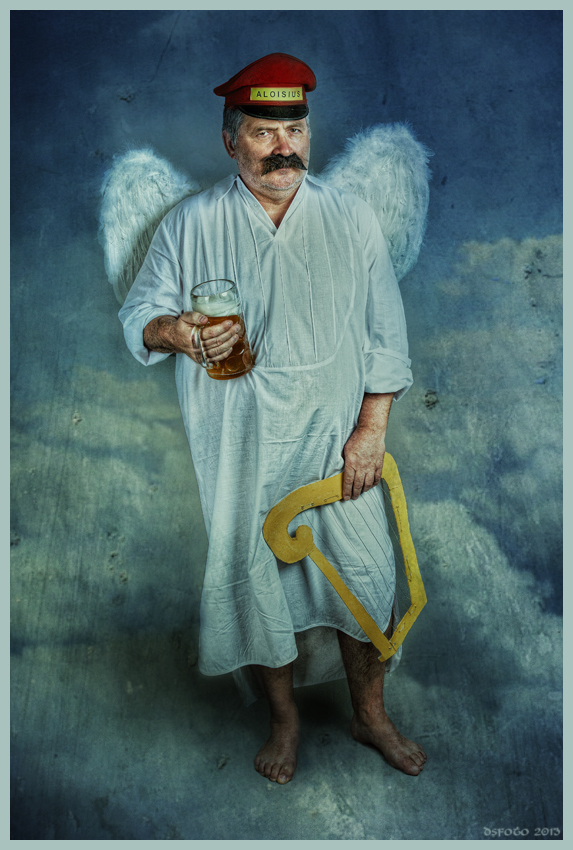
Inside the Hofbrauhaus Oktoberfest tent.
I can’t tell if this is a photograph or painting.

Filed Under: Beers, Birthdays, Just For Fun, Related Pleasures Tagged With: Animation, Cartoons, Germany, History, Literature

Beer In Ads #3488: Oktoberfest 2020

October 4, 2020 By Jay Brooks

Sunday’s ad is for the Munich Oktoberfest, for 2020, which is only taking place virtually this year, and ended today. From the late 1800s until the 1970s, poster art really came into its own, and in Europe a lot of really cool posters, many of them for breweries, were produced. This poster is for the Munich Oktoberfest, which began September 19 and ran through today, October 4. Last year I posted all of the posters from 1952-2019, so I thought I’d add the official poster for this year to the archive. This poster was created by German artist Peter Ulrich.

Filed Under: Art & Beer, Beers Tagged With: Advertising, Germany, History, Oktoberfest

Beer In Ads #3447: Bière Phénix Cyclists

August 22, 2020 By Jay Brooks

Saturday’s ad is for Bière Phénix, from the 1920s. From the late 1800s until the 1980s, poster art really came into its own, and in Europe a lot of really cool posters, many of them for breweries, were produced. I’ve been posting vintage European posters all last year and will continue to do so in 2020. This poster was created for Brasserie du Phénix, which was founded in 1886 in Marseille, which is located in the Bouches-du-Rhône area in the Provence-Alpes-Côte d’Azur region of southern France. A brewery had been on the same site since 1821, and a new one was rebuilt in 1872, and 14 years later it was bought by a new owner, who called it the Brasserie et Malterie du Phénix. They later changed their name to the Brasserie de la Valentine, and today it is owned by the Heineken Group. This poster was created by German artist Adolfo Hohenstein.

Filed Under: Art & Beer, Beers Tagged With: Advertising, France, Germany, History

Bavarian Beer Riots

May 1, 2020 By Jay Brooks

Beginning May 1, 1844, and lasting until May 5, the Beer Riots in Bavaria took place after King Ludwig I of Bavaria decreed a tax on beer. It was due to the rising cost of ingredients and raised the price of a beer by the equivalent of a penny.

Several thousand angry citizens stormed the breweries on the evening of May 1st. The authorities replied with repression, the decree of the Munich police director of May 4, 1844 states:

“The mines in the inns are not tolerated at all from 6 a.m. to 11 a.m. and in the afternoons only as long as no excesses are committed. In the event of excesses, the inns are cleared by the armed forces and the guests are exposed to the danger of being arrested. ”

The police director had not, however, counted on the local Army soldiers’ thirst for beer. These refused to act against the insurgents, and King Ludwig I had to reduce the beer price back to the old price. Order was only restored after the King decreed a 10% reduction in the price of beer. Ludwig I only remained King for 4 more years, when he abdicated following the Revolutions of 1848, and his son, Maximilian II, took his place.

Friedrich Engels, who is most famous for having developed Marxist theory along with Karl Marx, wrote a short article for The Northern Star newspaper a few weeks after the incident.

The Bavarian Beer is the most celebrated of all kinds of this drink brewed in Germany, and, of course, the Bavarians are much addicted to its consumption in rather large quantities. The government laid a new duty of about 100s. ad valorem on beer, and in consequence of this an outbreak occurred, which lasted for more than four days. The working men assembled in large masses, paraded through the streets, assailed the public houses, smashing the windows, breaking the furniture, and destroying everything in their reach, in order to take revenge for the enhanced price of their favourite drink. The military was called in, but a regiment of horse-guards, when commanded to mount on horseback, refused to do so. The police, being, as everywhere, obnoxious to the people, were severely beaten and ill-treated by the rioters, and every station formerly occupied by police-officers had to be occupied by soldiers, who, being upon good terms with the people, were considered less hostile and showed an evident reluctance to interfere. They only did interfere when the palace of the King was attacked, and then merely took up such a position as was sufficient to keep the rioters back. On the second evening (the 2nd of May) the King, in whose family a marriage had just been celebrated, and who for this reason had many illustrious visitors at his court, visited the theatre; but when, after the first act, a crowd assembled before the theatre and threatened to attack it, every one left the house to see what the matter was, and His Majesty, with his illustrious visitors, was obliged to follow them, or else he would have been left alone in his place. The French papers assert that the King on this occasion ordered the military stationed before the theatre to fire upon the people, and that the soldiers refused. The German papers do not mention this, as may be expected from their being published under censorship; but as the French papers are sometimes rather ill-informed about foreign matters, we cannot vouch for the truth of their assertion. From all this, however, it appears that the Poet King (Ludwig, King of Bavaria, is the author of three volumes of unreadable Poems, of a Traveller’s Guide to one of his public buildings &c. &c.) has been in a very awkward position during these outbreaks. In Munich, a town full of soldiers and police, the seat of a royal court, a riot lasts four days, notwithstanding all the array of the military, – and at last the rioters force their object. The King restored tranquillity by an ordinance, reducing the price of the quart of beer from ten kreutzers (3¼ denarius) to nine kreutzers (3d). If the people once know they can frighten the government out of their taxing system, they will soon learn that it will be as easy to frighten them as far as regards more serious matters.

Filed Under: Beers, Just For Fun, Politics & Law, Related Pleasures Tagged With: Bavaria, Germany, History, Politics

Beer In Ads #3317: Löwenbräu Maibock

April 11, 2020 By Jay Brooks

Saturday’s ad is for Löwenbräu Maibock, from the 1950s. From the late 1800s until the 1980s, poster art really came into its own, and in Europe a lot of really cool posters, many of them for breweries, were produced. I’ve been posting vintage European posters all last year and will continue to do so in 2020. This poster was created for Löwenbräu Brewery, which was located in Munich, Germany. The brewery was founded as early as 1383, although today is owned by ABInBev. The artist who created this poster was German artist Julius Diez.

Filed Under: Art & Beer, Beers Tagged With: Advertising, Germany, History

Beer In Ads #3300: Dortmunder Ritter Bier

March 25, 2020 By Jay Brooks

Wednesday’s ad is for Dortmunder Ritter Bier, from 1952. From the late 1800s until the 1980s, poster art really came into its own, and in Europe a lot of really cool posters, many of them for breweries, were produced. I’ve been posting vintage European posters all last year and will continue to do so in 2020. This poster was created for Dortmunder Ritter-Brauerei, which was located in Dortmund, which is in northwestern Germany, though more central. It was founded in 1889 and closed in 2005. This poster was created by German artist Helga Tiemann.

Filed Under: Art & Beer, Beers Tagged With: Advertising, Germany, History

Beer In Ads #3256: Wissembourg Beer Jester

February 11, 2020 By Jay Brooks

This image has an empty alt attribute; its file name is 3993724870_6a0224e391.jpg

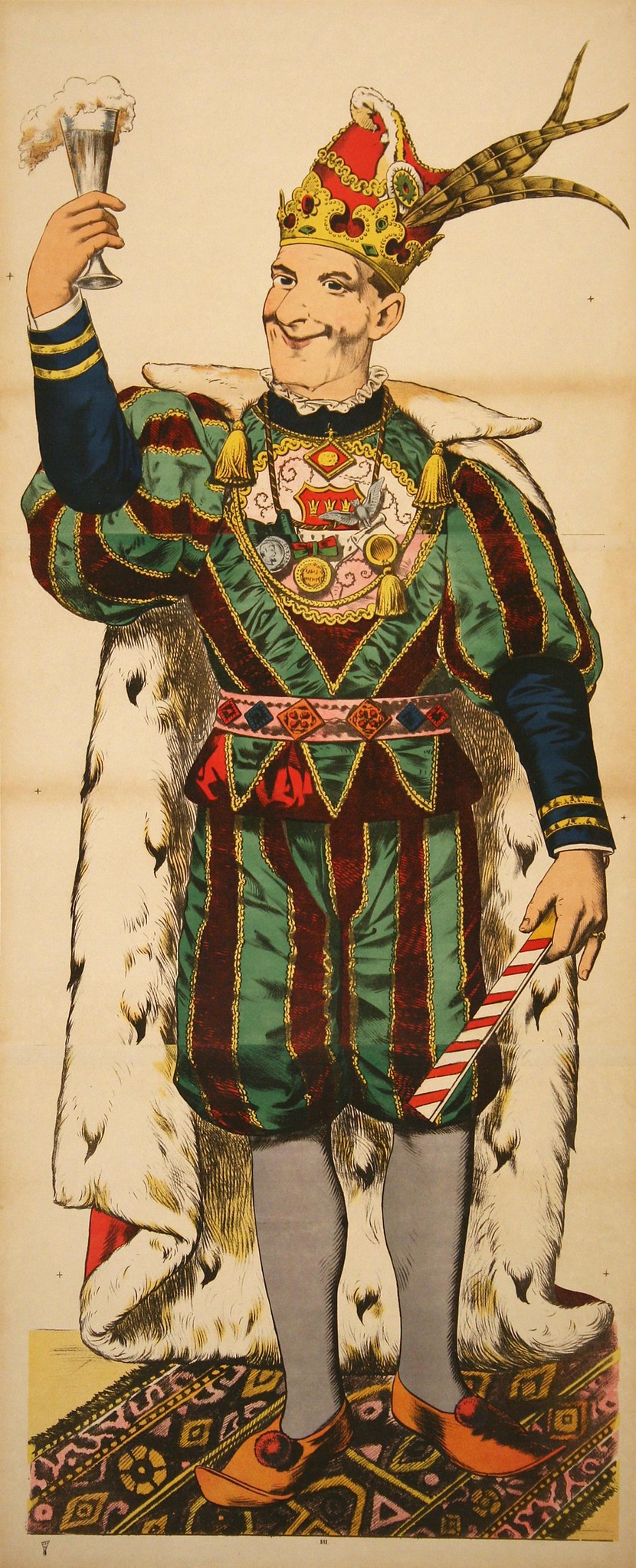
Tuesday’s ad is for a Wissembourg Beer Jester, or King, from 1880. From the late 1800s until the 1980s, poster art really came into its own, and in Europe a lot of really cool posters, many of them for breweries, were produced. I’ve been posting vintage European posters all last year, and will continue to do so in 2020. This poster was part of a series in which “[t]he joyful King celebrates the German way — with beer, of course!” One auction site describes the series as follows. “This poster was created by the C. Burckardt printing firm, and is part of a larger series of posters that were produced during the 1880s and 1890s. The company was based in the Alsatian town of Wissembourg, along the French border with Germany, and was also known for their cutout puppets, puzzles for children, educational charts, and religious depictions. These posters were created during a time that the Alsace region belonged to Germany, when the town was still called Weissenburg. All posters in this series have been printed via stone lithography, in multiple panels.” They claim he’s a king, but his grin says jester, to me.

Wissembourg-beer-jester-1880

Filed Under: Art & Beer, Beers Tagged With: Advertising, France, Germany, History

Beer In Ads #3250: Meistertrunk

February 5, 2020 By Jay Brooks

This image has an empty alt attribute; its file name is 3993724870_6a0224e391.jpg

Wednesday’s ad is for Meistertrunk, from 1930. From the late 1800s until the 1980s, poster art really came into its own, and in Europe a lot of really cool posters, many of them for breweries, were produced. I’ve been posting vintage European posters all last year, and will continue to do so in 2020. This poster was for Kronenbrauerei, or Kronen Privatbrauerei Dortmund, which is located in Dortmund, Germany. It “was one of the oldest breweries in Westphalia and has its headquarters at the Old Market in Dortmund. The company was able to look back on more than 550 years of brewing tradition and was family-owned from 1729 until 1996.” It was acquired by Dortmunder Actien Brauerei in 1996, and today is part of the Radeberger Group. The poster was created by German artist and architect Siegmund Suchodolski.

Meistertrunk-1930

Filed Under: Art & Beer, Beers Tagged With: Advertising, Germany, History

Beer In Ads #3247: Gesundheit

February 2, 2020 By Jay Brooks

This image has an empty alt attribute; its file name is 3993724870_6a0224e391.jpg

Sunday’s ad is for Geraer Schwarzbier, from the 1930s. From the late 1800s until the 1980s, poster art really came into its own, and in Europe a lot of really cool posters, many of them for breweries, were produced. I’ve been posting vintage European posters all last year, and will continue to do so in 2020. This poster was for Riebeck-Brauerei Gera of what today is Leipzig, Germany. I’m not sure who created the poster, but I love that it’s “Ärztlich Empfohlen,” which means “medically recommended.”

Gesundheit

Filed Under: Art & Beer, Beers Tagged With: Advertising, Germany, History

Beer In Ads #3246: Erichbrauerei

February 1, 2020 By Jay Brooks

This image has an empty alt attribute; its file name is 3993724870_6a0224e391.jpg

Saturday’s ad is for Erichbrauerei, from 1922. From the late 1800s until the 1980s, poster art really came into its own, and in Europe a lot of really cool posters, many of them for breweries, were produced. I’ve been posting vintage European posters all last year, and will continue to do so in 2020. This poster was for Erichbrauerei of Erlangen, Germany. It was created by German poster artist, a pioneer of the Sachplakat style, Ludwig Hohlwein.

Erlangen-1730

Filed Under: Art & Beer, Beers Tagged With: Advertising, Germany, History

« Previous Page
Next Page »

Find Something

Northern California Breweries

Please consider purchasing my latest book, California Breweries North, available from Amazon, or ask for it at your local bookstore.

Recent Comments

  • Bob Paolino on Beer Birthday: Grant Johnston
  • Gambrinus on Historic Beer Birthday: A.J. Houghton
  • Ernie Dewing on Historic Beer Birthday: Charles William Bergner 
  • Steve 'Pudgy' De Rose on Historic Beer Birthday: Jacob Schmidt
  • Jay Brooks on Beer Birthday: Bill Owens

Recent Posts

  • Beer In Ads #5153: Roll In A Barrel Of Spring! March 9, 2026
  • Beer In Ads #5152: A Message From Over The Sea About Genuine Bock Beer March 8, 2026
  • Beer In Ads #5151: March Is Bock Beer Time March 8, 2026
  • Beer In Ads #5150: The Best Of Bocks Comes To Town! March 7, 2026
  • Historic Beer Birthday: John J. Saltzmann March 7, 2026

BBB Archives

Feedback

Head Quarter
This site is hosted and maintained by H25Q.dev. Any questions or comments for the webmaster can be directed here.