Prosit Neujahr, or Happy New Year, from an old German postcard circa 1916. Wishing you and yours a very good 2014.
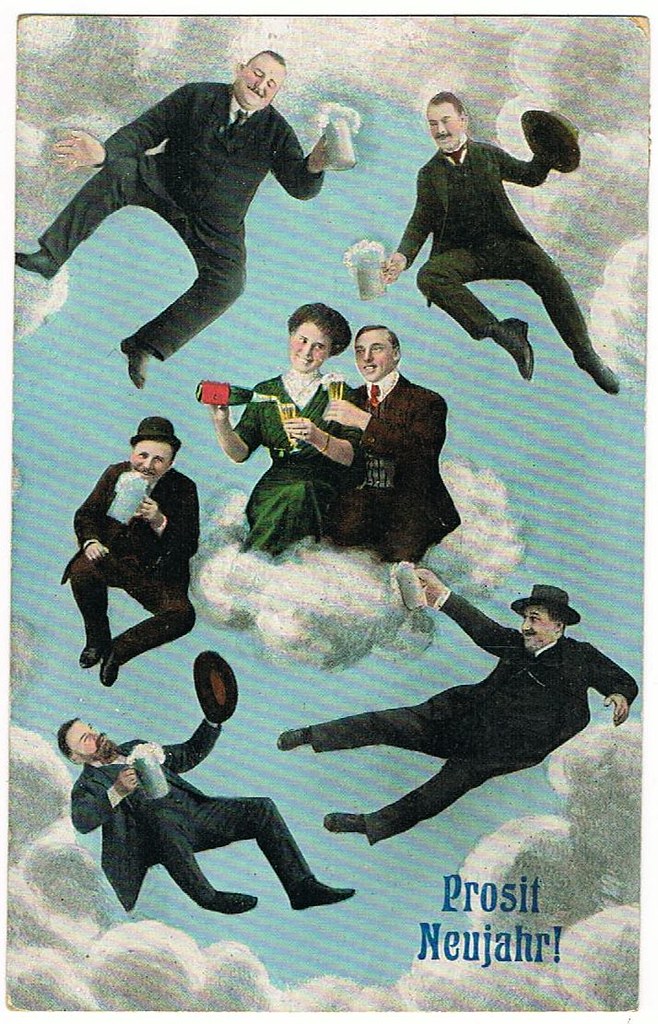

Prosit Neujahr, or Happy New Year, from an old German postcard circa 1916. Wishing you and yours a very good 2014.

Today’s infographic is still another poster about Oktoberfest, which began seven days ago in Munich, Germany. This one is called Oktoberfest Facts and was created by Easy Jet Holidays, a travel website.
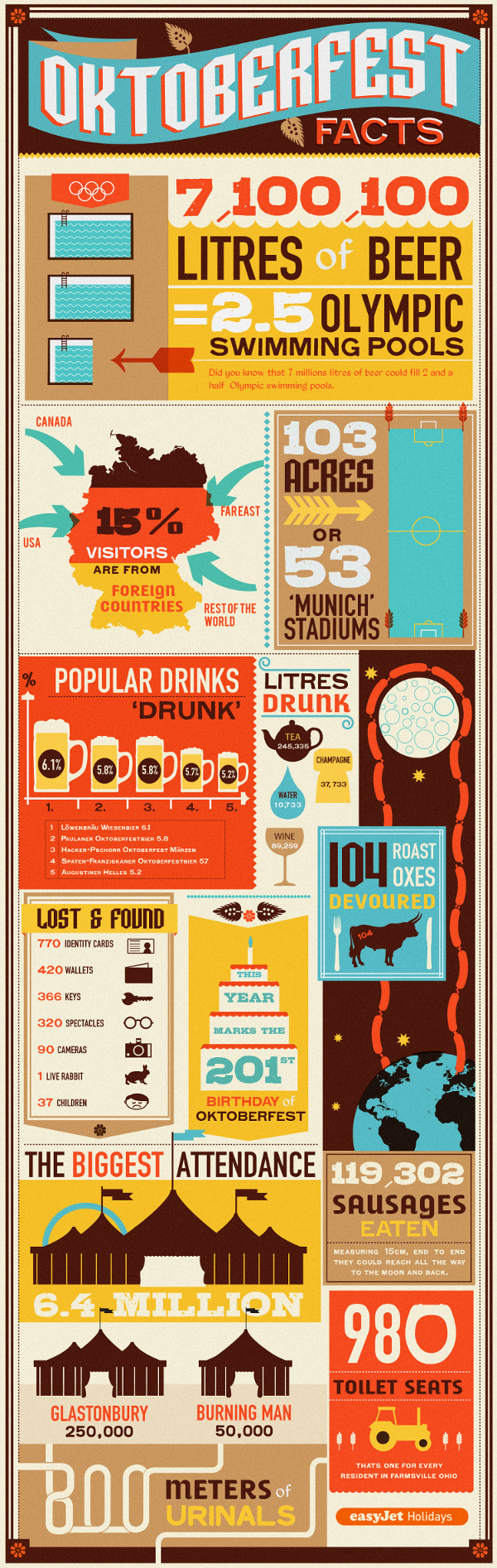
CLick here to see the infographic full size.
Today’s infographic is still another poster about Oktoberfest, which began four days ago in Munich, Germany. This one is called How To Survive Oktoberfest with Your Liver Intact and was created by Accredited Online Colleges. It features a brief history of Oktoberfest and some tips for navigating the festival.

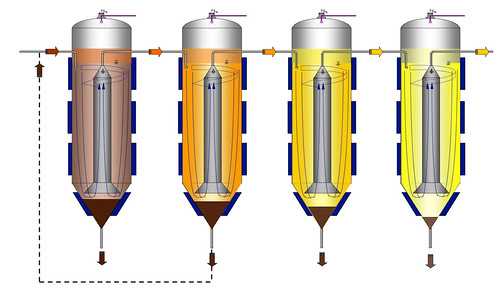
I just stumbled upon this interesting article from May in Phys.Org entitled More sustainable way to brew beer: Non-stop fermentation saves resources. It details efforts by researchers at the Technische Universität München to develop “a fermentation process that takes place in stages over a number of interconnected tanks. The tank system can be operated continuously over a period of several months, which leads to an energy reduction. The new method also promises significant resource efficiency gains.”
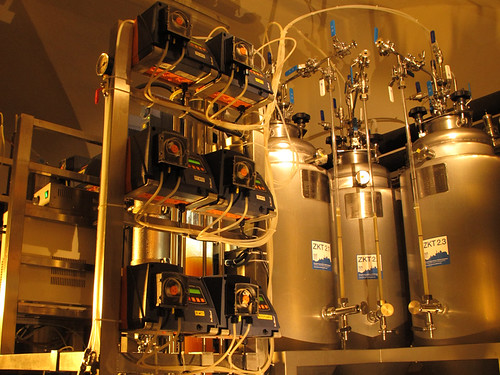
They talk about the advantages of such a system. “With this new process, yeast and other sedimented substances can be fractionized and re-used if required, and “unlike the conventional system[s], the brewers can fill and empty the tanks continuously from the top part of the tanks. The bottom connection of the tank can hence be used to discharge yeast cells and other particles.”
Lead researcher, Konrad Müller-Auffermann explains how “Continuous operation makes the fermentation plant more efficient. ‘This new method reduces the incidence of energy peaks, so that breweries will be able to save on electricity. In addition, less beer will be lost — and breweries can save water and cleaning detergents.'”
So far, so good. It sounds interesting, but here’s where they lost me. “Brewers have been juggling with the dream of turning the classical batch fermentation into a continuous process for over 100 years. In all this time, however, no one has managed to develop a widely applied industrial concept.”
Um, maybe somebody with more technical expertise can explain this to me, but New Zealanders (and possibly the Australians) have been using what they call “continuous fermentation” since 1953, and at least one brewery is still using it today. I did a sidebar about Continuous Fermentation for All About Beer magazine in 2008.
One of New Zealand’s most interesting contributions to brewing sciences is the process known as continuous fermentation. This process was patented in 1953 by Morton Coutts, whose family had been involved in brewing since the 19th century. His father founded the Waitemata Brewery, which eventually become DB Breweries.
Essentially, Coutts created a “wort stabilization process” that made the wort more consistent and clear, and then separated the main functions of the yeast into two stages. In the first, yeast grew, and in the second, it fermented. By splitting these two functions, Coutts created a “continuous flow,” so brewers could continually add raw materials to the first stage, and draw off a steady supply of finished beer from the second thus allowing the brewery to run constantly.
It also shortened the brewing process by as much as several weeks. Recognizing the economic advantages to continuous fermentation, Lion and DB worked together jointly to develop a practical way to use the method in a commercial brewery, opening the world’s first continuous fermentation brewery in 1957 in Palmerston North, a town in the south central part of the North Island.
Continuous fermentation works best in a brewery making only one style of beer, because it’s difficult to stop the process and start up again with a new beer. As a result, Lion largely abandoned continuous fermentation in the 1980s in order to brew a wider variety of styles, while DB continues to use the method, as do several other large breweries around the world, such as Guinness.
The University of Aukland’s Business History Project has a good overview on Morton Coutts, father of continuous fermentation. You can also read more at Alcohol Fuels and Ken & Dot’s Allsorts.
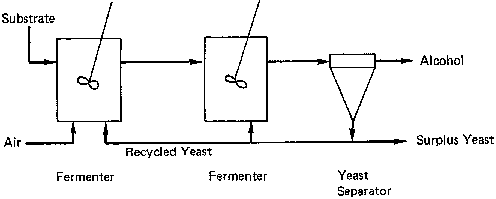
So nothing against the German effort at non-stop fermentation. It looks interesting and innovative. But it doesn’t seem all that different from continuous fermentation that was invented sixty years ago. Maybe there’s a subtle or technical difference I’m missing, but they don’t even mention being aware of it when they insist people have been trying to figure out this problem for over a century, which seems a little strange. So while they’re understandably excited about their discovery, I wish they’d acknowledge Coutts. Or am I missing something?
Today’s infographic is yet another poster about Oktoberfest, which began three days ago in Munich, Germany. This one is called the Oktoberfest, By The Numbers and was created by Julie Teninbaum for United Airlines’ Hemispheres.
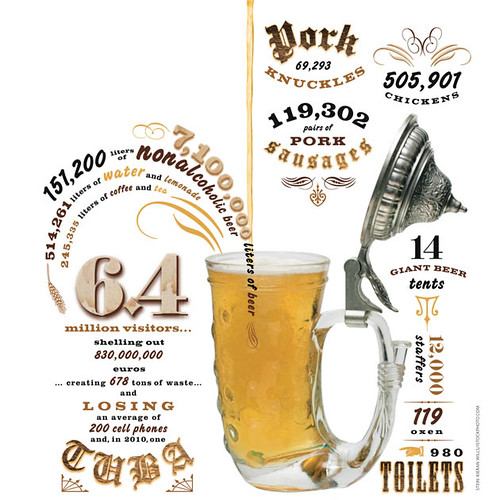
Click here to see the poster full size.
Today’s infographic is another poster about Oktoberfest, which began two days ago in Munich, Germany. This one is called the Down-Low on Oktoberfest and was created by Travel Insurance, which is an “online resource for travelers and people looking for more information on travel insurance.”

Click here to see the poster full size.
Today’s infographic is a poster with various factoids about Oktoberfest, which began yesterday in Munich, Germany. It was created by a Russian website for last year’s festival.
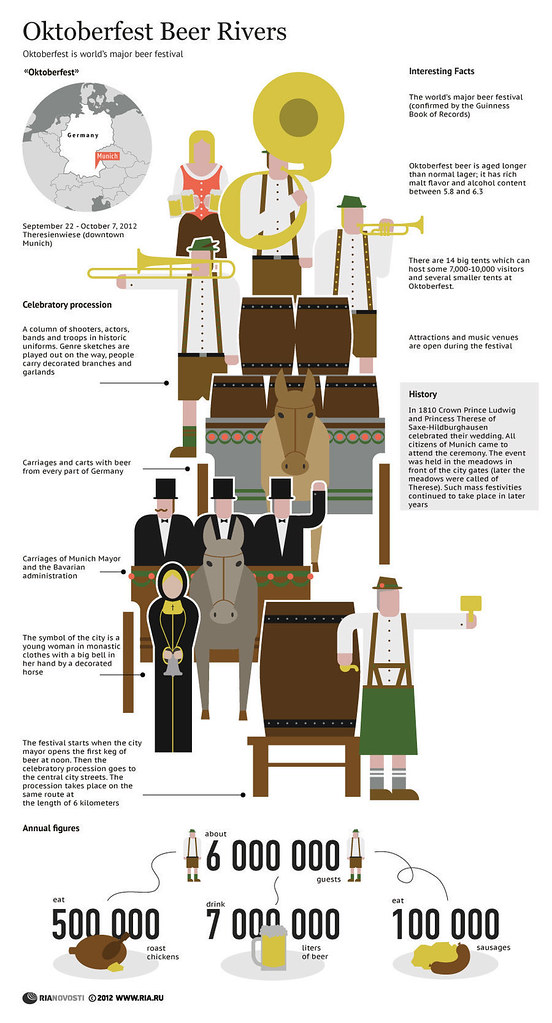
Click here to see the poster full size.
Today’s infographic is a poster entitled “O Zapft Is!” and showed various factoids about Oktoberfest, which begins today in Munich, Germany. It was created by Visible, a social media monitor company.

Click here to see the poster full size.

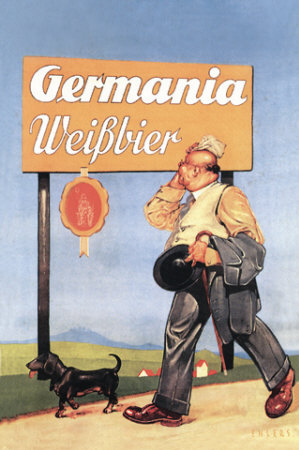
Thursday’s ad is for, as far as I can tell, German Weissbier, showing a great illustration of an exhausted, hot — and presumably thirsty — man walking with his wiener dog toward, or into, Germany. WHo knows how long he’s been walking, but certainly long enough that he even took off his jacket.
Monday’s ad is a German one, from 1880, though I don’t know for what brewery it’s advertising. Heute in German means “today” so it’s telling customer, presumably, that bock is available right now. Though honestly, it would appear the man in the ad has had quite enough already.