Friday’s ad is from around 1910 for a Germany brewery, Bergschloss. It’s for their Berschloss Bock and was painted by an artist by the name of Riemery.

By Jay Brooks

Friday’s ad is from around 1910 for a Germany brewery, Bergschloss. It’s for their Berschloss Bock and was painted by an artist by the name of Riemery.

By Jay Brooks

Tuesday’s ad is for a German brewery — I think — Pilse Etzer, so it says, is the best bottled beer. The woman in the red circle, however, looks like Dutch.

By Jay Brooks

Monday’s ad is unusual insofar as its for a beer brewed in a village that no longer exists. Adelshoffen used to be in the Lower Rhine region of Germany. The most famous beer they made was Adelscott, which was launched in 1982. Heineken acquired the brewery through Fischer in 1996 and closed the brewery in 2000.

By Jay Brooks

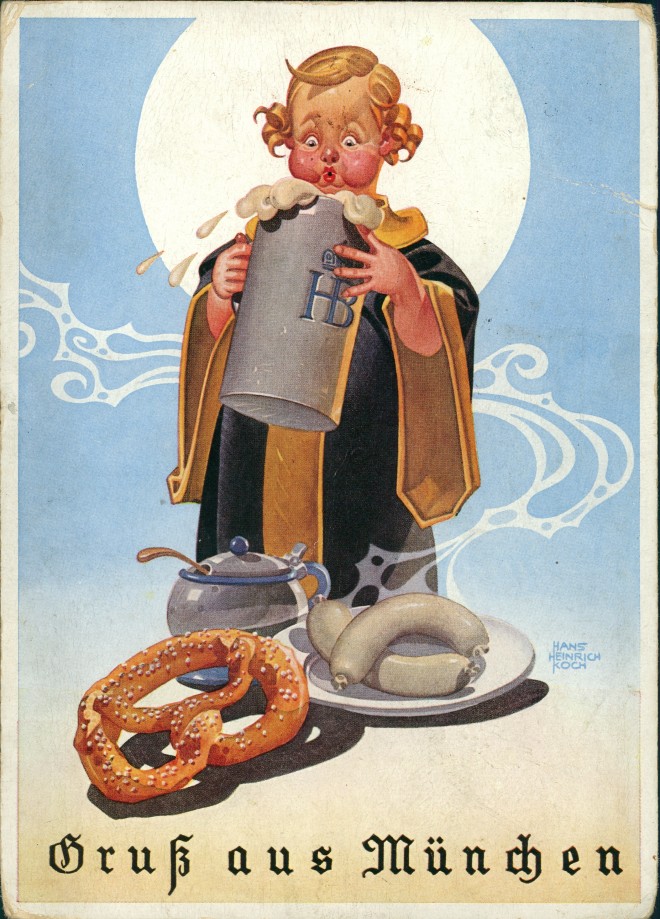
Friday’s ad is for the German brewery Spaten from either 1924 of 1933 (accounts differ). It’s by the famous German poster artist Ludwig Hohlwein. I love the stylized server and just the timeless quality of the art.

As far as beer is concerned, Hohlwein is probably best know for creating the artwork of the monk used in the label for Franziskaner Weissbier.

By Jay Brooks

Our 42nd Session is hosted by Derrick Peterman, from Ramblings of a Beer Runner. He’s chosen “A Special Place, A Special Beer” as his topic, which Derrick describes geographically, as follows:
The Session provides a unique opportunity to explore this connection between the beer in our glasses and the place it comes from with perspectives from all over the world.
So I ask for this 42nd Session that you write about a special place in your life, and a beer or brewery that connects you to that place. It can be the beer from your childhood home, a place you once lived, your current hometown, a memorable vacation you once took, or a place you’ve always wanted to go to but never had the chance. Please take a few moments to think about the how the beer connects you to this place, and share this with us. Of course, the definition of “place” is rather open ended, and in some cases, highly debatable, so it will be interesting to see the responses on what constitutes a place.

This was actually a simpler question than I expected, once I stopped to think about it. For me, I believe the most special place to have a beer, any beer, is at the source. The place where it was created — the brewery — I always find is my favorite place to try their beer, especially for the first time. Plus, in certain places the brewery has beers available that can’t be found anywhere else.
A number of years ago, for example, I visited the Radeberger Brauerei just outside Dresden, Germany. Their pilsner is one of the best in the world, at least in my opinion. But even better is the unfiltered zwickel version that they have only at the brewery. To be fair, they also used to sell it at one bar in downtown Dresden but last I heard a flood had closed it.
I love drinking beer at home, at the bar, at the restaurant — okay, anywhere — but not quite as much as in the brewery itself. That’s hallowed ground, in a sense. I’m not really a “ticker,” so I have no idea how many breweries I’ve visited over the years but it’s certainly a fair number. And they’re almost always where I’ve had the most memorable experiences. I don’t know if it’s the setting — I do love the feeling of being in a brewery — or being with the brewer, or some other intangible, but I inevitably get the sense that that’s the beer’s home. And things just always taste better when they’re home.
By Jay Brooks

Monday’s ad is for an unknown beer, created by Paul Gusset in 1956. Since today is the summer solstice, the poster reminded me of summer itself. Happy summer.

By Jay Brooks

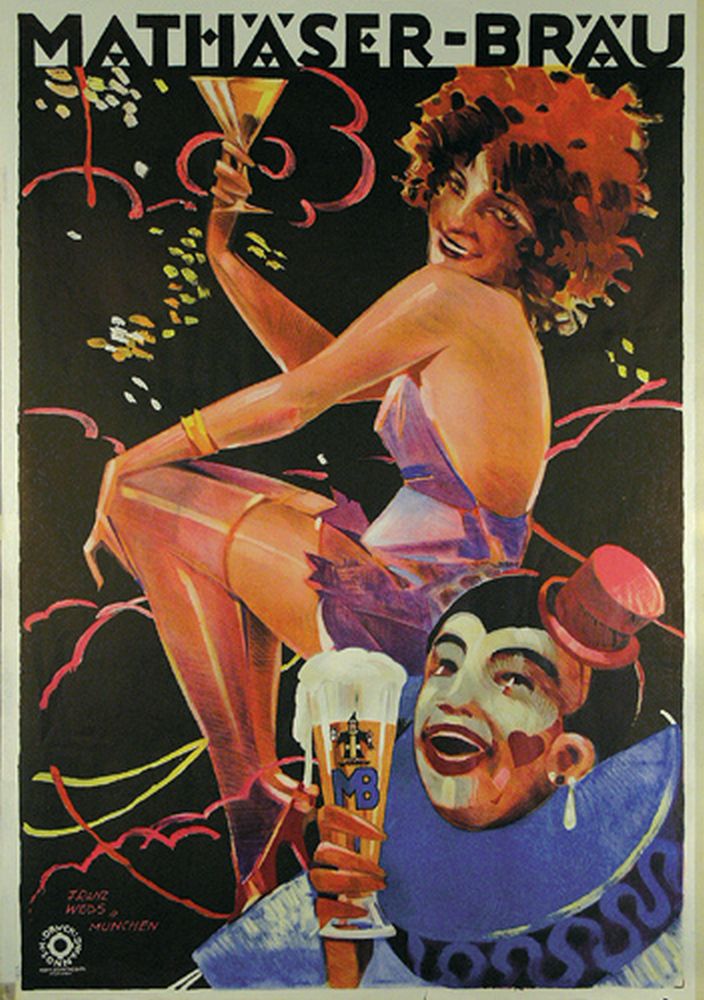
Monday’s ad is for Lowenbrau, a Munich brewery. Today is the day Munich was founded in 1158. It could be from the 1960s or 70s, but my money’s on the Seventies. Showing both kinds — country and western, alright light and dark — the ad features the tagline. “Now that you’ve seen the light …. try the dark.” But really, they’re actually trying to sell the glasses.
By Jay Brooks

Wednesday’s ad is for a German brewery, Berliner Schlossbrauerei, and their brand Bärenbier, or Bear Beer. The slogan, “bringt gute Laúne!,” translates as “brings a good mood.” Ah, I miss the days when you could use a teddy bear in an …. what, there never was such a time in America, was there?
By Jay Brooks

After Samuel Adams’ Utopias and the 31% Schorschbräu, the folks at BrewDog beat them both last fall when they came out with Tactical Nuclear Penguin, at 32%. Then Schorschbräu answered back with a 40% version. In February, BrewDog launched Sink the Bismark, again over-taking their German rivals with the 41% hop bomb.

Schorschbräu has now created a 43% Version, and is again — at least for now — the world’s strongest beer. Gizmag has a nice recap of the whole story.

By Jay Brooks

Today’s work of art is by one the most famous artists to ever paint: Peter Paul Rubens. Rubens “was a prolific seventeenth-century Flemish Baroque painter, and a proponent of an extravagant Baroque style that emphasized movement, color, and sensuality. He is well-known for his Counter-Reformation altarpieces, portraits, landscapes, and history paintings of mythological and allegorical subjects.” Today’s painting was done toward the end of his life, around 1635-38, though others believe he may have started it much earlier in 1620, but then returned to it later. It’s known as the Village Fête, and sometimes as the Village Wedding.

The paintings hangs in the Louvre, which describes it as follows:
The picture, painted late in the artist’s life, around 1635-38, is manifestly neo-Bruegelian in inspiration. The pig’s snout poking out of the sty on the right is an ancient symbol of gluttony (gula). According to those who date the picture in the 1620s, the landscape was painted before the figures, which are in Rubens’ late lyrical style.
This monumental picture, also called the Village Wedding, is in the northern tradition of depictions of village fêtes. Pioneered by Pieter Bruegel, the enormous popularity of this genre contributed to the renown of the Flemish School. These compositions often had a moral message, denouncing the baseness of the human condition by showing it in all its excesses. However, even though a pig’s snout — a symbol of gluttony — can be seen poking out of the sty in the foreground, denouncing vices was not Rubens’ main preoccupation.
While there’s dancing going on on the right half of the painting, the lower left is consumed with drinking beer. You can see it better in the detail of the painting below.

You can see all of Ruben’s works online at the Complete Works or Peter Paul Rubens. There’s also a biography on Wikipedia, and more information at the Web Museum, the Art Archive , ArtCyclopedia and Olga’s Gallery.