Brookston Beer Bulletin

Jay R. Brooks on Beer

  • Home
  • About
  • Editorial
  • Birthdays
  • Art & Beer

Socialize

  • Dribbble
  • Email
  • Facebook
  • Flickr
  • GitHub
  • Instagram
  • LinkedIn
  • Pinterest
  • RSS
  • Twitter
  • YouTube

Powered by Genesis

American Barley Wine

January 4, 2016 By Jay Brooks

typology
In support of my newly hatched scheme to have a monthly discussion about different types of beer, Typology Tuesday, I offer the first style guide for American Barley Wine, which will be our first beer for January 2016.

wine-of-beer

American Barley Wine

American Barley Wine is one of my favorite styles, and I really miss the days when I judged it for the Toronado Barleywine Festival in San Francisco. Several times I’ve had the pleasure of judging barley wine at both the World Beer Cup and GABF, especially one year when my table did three rounds of barley wine in a row, including the final medal round. That table included Rich Norgrove, from Bear Republic, and George Reisch, from Anheuser-Busch. I love the complexity of barley wines, which make them great sipping, sharing beers. I think of it as one of the quintessential winter beers.

What follows is information about barley wines, collected from a variety of sources. If you know of any additional resources about this type of beer, please let me know.

History

Usually the strongest ale offered by a brewery, often associated with the winter or holiday season and vintage-dated. As with many American craft beer styles, derived from English examples but using American ingredients and featuring a much more forward hop profile. One of the first American craft beer versions was Anchor Old Foghorn, first brewed in 1975. Sierra Nevada Bigfoot, first brewed in 1983, set the standard for the hop-forward style of today. The story goes that when Sierra Nevada first sent Bigfoot out for lab analysis, the lab called and said, “your barleywine is too bitter” – to which Sierra Nevada replied, “thank you.” (BJCP1)

bass-no-1-barley-wine

Origin: usa, from unitedkingdom

am-barley-wine8

A Comparison of Style Ranges

SourceSRMABVO.G.F.G.IBU
BJCP1 (22C) American10-198-12%1.080-1.1201.016-1.03050-100
Brewery DB11-228.4-12%Varies1.024-1.02860-100
GABF2 (89B) American11-188.5-12.2%1.090-1.1201.024-1.02860-100
Periodic Table7 (64)14-228.4-12.2%1.085-1.1201.024-1.03250-100
WBC6 (81A) American-Style11-188.5-12.2%1.090-1.1201.024-1.02860-100

Yeast

 Ale
 
 
 Belgian
 Brettanomyces
 Lactobacillus
 Pediococcus
 Other

BJCP Description: 22C. American Barleywine1

Overall Impression: A well-hopped American interpretation of the richest and strongest of the English ales. The hop character should be evident throughout, but does not have to be unbalanced. The alcohol strength and hop bitterness often combine to leave a very long finish.

Aroma: Hop character moderate to assertive and often showcases citrusy, fruity, or resiny New World varieties (although other varieties, such as floral, earthy or spicy English varieties or a blend of varieties, may be used). Rich maltiness, with a character that may be sweet, caramelly, bready, or fairly neutral. Low to moderately-strong fruity esters and alcohol aromatics. However, the intensity of aromatics often subsides with age. Hops tend to be nearly equal to malt in the aroma, with alcohol and esters far behind.

Color Range


Appearance: Color may range from light amber to medium copper; may rarely be as dark as light brown. Often has ruby highlights. Moderately-low to large off-white to light tan head; may have low head retention. May be cloudy with chill haze at cooler temperatures, but generally clears to good to brilliant clarity as it warms. The color may appear to have great depth, as if viewed through a thick glass lens. High alcohol and viscosity may be visible in “legs” when beer is swirled in a glass.

Flavor: Strong, rich malt flavor with a noticeable hop flavor and bitterness in the balance. Moderately-low to moderately high malty sweetness on the palate, although the finish may be somewhat sweet to quite dry (depending on aging). Hop bitterness may range from moderately strong to aggressive. While strongly malty, the balance should always seem bitter. Moderate to high hop flavor (any variety, but often showing a range of New World hop characteristics). Low to moderate fruity esters. Noticeable alcohol presence, but well-integrated. Flavors will smooth out and decline over time, but any oxidized character should be muted (and generally be masked by the hop character). May have some bready or caramelly malt flavors, but these should not be high; roasted or burnt malt flavors are inappropriate.

Mouthfeel: Full-bodied and chewy, with a velvety, luscious texture (although the body may decline with long conditioning). Alcohol warmth should be noticeable but smooth. Should not be syrupy and under-attenuated. Carbonation may be low to moderate, depending on age and conditioning.

Characteristic Ingredients: Well-modified pale malt should form the backbone of the grist. Some specialty or character malts may be used. Dark malts should be used with great restraint, if at all, as most of the color arises from a lengthy boil. New World hops are common, although any varieties can be used in quantity. Generally uses an attenuative American ale yeast.

Style Comparison: The American version of the Barleywine tends to have a greater emphasis on hop bitterness, flavor and aroma than the English Barleywine, and often features American hop varieties. Typically paler than the darker English Barleywines (and lacking in the deeper malt flavors) but darker than the golden English Barleywines. Differs from a Double IPA in that the hops are not extreme, the malt is more forward, and the body is fuller and often richer. An American Barleywine typically has more residual sweetness than a Double IPA, which affects the overall drinkability (sipping vs. drinking).

GABF/World Beer Cup Description

American Barley Wines are amber to deep red/copper-garnet. Chill haze is allowable at cold temperatures. Fruity-ester aroma is often high. Caramel and/or toffee malt aromas are often present. Hop aroma is medium to very high. High residual malty sweetness, often containing a caramel and/or toffee flavors is present. Hop flavor is medium to very high. American type hops are often used but not necessary for this style. Hop bitterness is high. Complexity of alcohols is evident. Fruity-ester flavor is often high. Very low levels of diacetyl may be acceptable. Body is full. Characters indicating oxidation, such as vinous (sometimes sherry-like) aromas and/or flavors, are not generally acceptable in American-style barley wine ales, however if a low level of age-induced oxidation character harmonizes and enhances the overall experience this can be regarded favorably.

american-barley-wine-1864

Glassware

pint-glass-2 snifter
Pint Glass (or Becker, Nonic, Tumbler), Snifter3

Food Pairing

cheese-variety creme-brulee dark-chocolate cake-chocolate steak_meat
Cheese (sharp; Blue, Cheddar, pungent; Gorgonzola, Limburger) General (Dessert, Digestive)3
Crème brûlée, Oxtail4
Dark Chocolate, Strong Blue Cheeses5

Seasonality & Temperature

Season:
season-winter
Winter
Serving:
temp-50-55
50-55° F
Storage:
temp-45-50
45-50° F
Beer 101:
Beer101-barley-wine
Barley Wine

64A-barley-wine

Links About Barley Wine

  • About.com
  • All About Beer’s Profile
  • All About Beer’s Stylistically Speaking by K. Florian Klemp
  • Beer Advocate
  • BJCP 2008 Online (19C)
  • Brewery DB
  • Brew Your Own, by Terry Foster
  • CraftBeer.com
  • GotBeer.com
  • Michael Jackson’s Beer Styles
  • Rate Beer
  • Wikipedia

Further Reading

bp-barley-wine

  • Barley Wine: History, Brewing Techniques and Recipes
  • Chapter 11 of Amber Gold & Black, by Martyn Cornell
  • Page 191 of The Beer Bible, by Jeff Alworth
  • Page 119 of The Essentials of Beer Style, by Fred Eckhardt
  • No. 64 on The Periodic Table of Beer Styles
  • Page 152 of What the Hell am I Drinking?, by Don Russell

Commercial Examples of Barley Wine

Avery Hog Heaven Barleywine, Anchor Old Foghorn, Great Divide Old Ruffian, Rogue Old Crustacean, Sierra Nevada Bigfoot, Victory Old Horizontal1

anchor-old-foghorn SierraNevada-Bigfoot-six

Top 10 Examples

Beer Advocate

  1. A Deal With The Devil / Anchorage Brewing
  2. Great / Alpine Beer
  3. Bourbon Barrel Aged Hi-Fi Rye / Flossmoor Station
  4. Brewer’s Reserve Bourbon Barrel Barleywine / Central Waters Brewing
  5. Gratitude / East End Brewing
  6. AleSmith Old Numbskull – Barrel Aged / AleSmith Brewing
  7. Helldorado / Firestone Walker Brewing
  8. Blunderbuss Barleywine / Cambridge Brewing
  9. Tröegs Flying Mouflan (Bourbon Barrel Aged) / Tröegs Brewing
  10. Twisted Trace / Minneapolis Town Hall Brewery

Rate Beer

  1. Dragoon Lazarus
  2. North Coast Old Stock Cellar Reserve Brandy Barrel
  3. Lost Abbey The Angels Share – Bourbon Barrel
  4. AleSmith Old Numbskull – Bourbon Barrel Aged
  5. Goose Island Bourbon County Barleywine
  6. Emelisse White Label Barley Wine (Heaven Hill BA)
  7. Lost Abbey The Angels Share Grand Cru
  8. Firestone Walker Sucaba
  9. Three Floyds Behemoth Barleywine
  10. Hair of the Dog Fred from the Wood

art-barleywine

Key to Sources

1 = BJCP 2015
2 = GABF 2014
3 = Beer Advocate
4 = Garrett Oliver’s Brewmaster’s Table
5 = Brewers Association / CraftBeer.com
6 = World Beer Cup Guidelines 2016
7 = The Periodic Table of Beer Styles 2001
8 = GotBeer.com

Filed Under: Beers, Typology Tagged With: Beer Styles, History, Reference

Patent No. 3227557A: Continuous Fermentation Process With Sedimentable Microorganisms

January 4, 2016 By Jay Brooks

patent-logo
Today in 1966, US Patent 3227557 A was issued, an invention of Michael Edward Ash, assigned to Guinness Son & Co. Ltd., for his “Continuous Fermentation Process with Sedimentable Microorganisms.” There’s no Abstract, although in the description it includes this summary:

This invention relates in general to continuous fermentation systems of the kind in which liquid suspensions comprising a dispersion of said fermentable micro-organisms in a liquid substrate of relatively lower specific gravity, are caused to flow through a fermenting vessel or series of vessels.

More specifically, the invention is concerned with a method and apparatus for controlling the relative degree of concentration of micro-organism in substrate as between any two or all of the stages: inflow, vessel and outflow.

In particular, the invention has been developed for use in connection with the continuous fermentation of Erewers wort in a chemostat system.

The invention is however believed to be applicable to any microbiological process in which a sedimentable micro-organism is operated in a nutrient liquid, and is in the form of a mechanical dispersion in liquid nutrient of relatively lower specific gravity, so that in the absence of turbulence, the micro-organism tends to settle at the bottom of the vessel.

It has already been proposed continuously to ferment Brewers wort or other ferment-able substrate in a plurality of sequentially arranged stirred or unstirred vessels, and to separate the fermenting micro-organism (yeast) from the fermented product (beer) by settlement in a separate vessel or in a part of the final fermentation vessel separated from a stirred region by a baffle.

US3227557-0

Filed Under: Beers, Breweries, Just For Fun, Politics & Law, Related Pleasures Tagged With: Brewing Equipment, Guinness, History, Law, Patent, Science of Brewing

Beer In Ads #1779: Bock Lowenbrau Munchen

January 3, 2016 By Jay Brooks


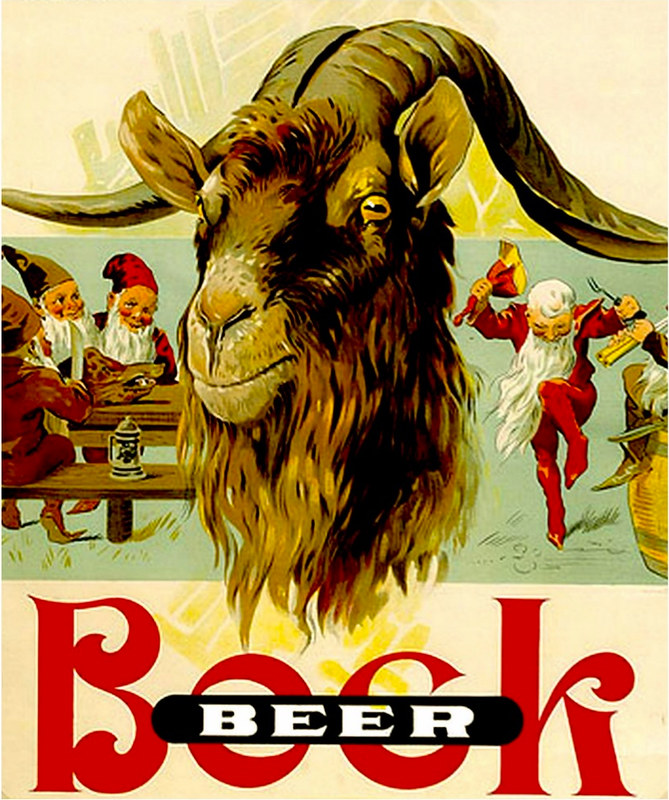
Sunday’s ad is for Löwenbräu Bock, though again I’m not sure when the ad is originally from. The beer from Löwenbräu München is no longer made, and the brewery is currently owned by Anheuser-Busch InBev. But it’s another beautiful ad for Bock, featuring another really cool got. It looks like I’m on a roll this week with Bock ads, just like the goat on the barrel.

German-Bock

Filed Under: Art & Beer, Beers Tagged With: Advertising, Germany, History

Patent No. 489388A: Attachment For Bar-Room Counters

January 3, 2016 By Jay Brooks

patent-logo
Today in 1893, US Patent 489388 A was issued, an invention of John McNaney, for his “Attachment for Bar-Room Counters.” There’s no Abstract, although in the description it includes this summary:

My invention relates to improvements in attachments for bar room counters; and it consists in the construction and arrangement of parts which will be fully described hereinafter and particularly referred to in the claims.

The object of my invention is to provide an attachment for counters of bar rooms, which comprises a trough or gutter that is placed upon the floor of the room immediately at the lower front edge of the counter to receive tobacco, spit, beer and other slop which occurs in a bar room, and to provide a hollow foot piece which is capable of a partial rotation and provided with a slot through which water can flow into the said trough for cleaning it out, and be turned with the slot down to dislodge all slop accumulated in the said pipe, and to connect this hollow foot piece or rail with a water main or with a tank, whereby the trough and the pipe can be flushed or cleaned by a flow of water under the control of the bar tender.

US489388-0

Filed Under: Beers, Just For Fun, Politics & Law, Related Pleasures Tagged With: Bars, History, Law, Patent

Beer In Ads #1778: Pabst Bock

January 2, 2016 By Jay Brooks


Saturday’s ad is for Pabst Bock, though I’m not sure when the ad is originally from. AT least one source says 1871 (and it certainly looks like it could be that old) but they appear to have used it for many years on signs and posters and some reproductions are as late as the 1950s. At any rate, it’s easy to see why. It’s a pretty awesome illustration of a goat.

pabst-bock

Filed Under: Art & Beer, Beers Tagged With: Advertising, History, Pabst

Patent No. 2536927A: Hop-Picking Machine

January 2, 2016 By Jay Brooks

patent-logo
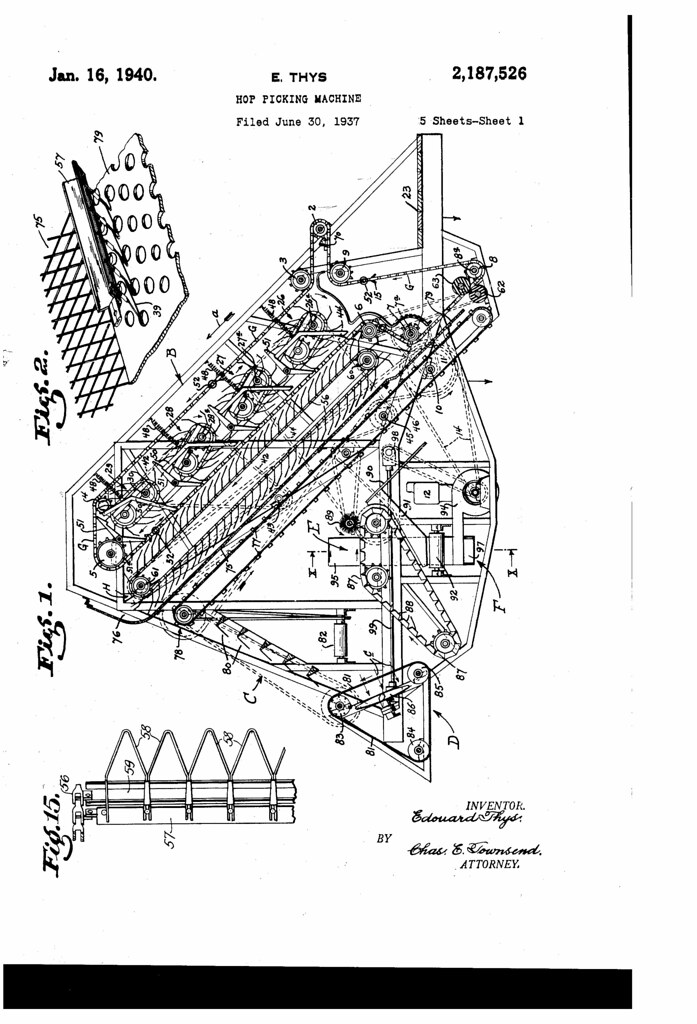
Today in 1951, US Patent 2536927 A was issued, an invention of Porter E. Griswold, for his “Hop-Picking Machine.” There’s no Abstract, although in the description it includes this summary:

My invention relates to a machine especially designed for use in the hop-picking industry for stemming hop clusters.

Hops are generally grown on trellises from sixteen to twenty feet high, the vines being trained over these trellises. In picking by machinery, the vine stalks are out about four feet from the ground and passed through the hop-picking machine, the hops being removed mechanically from the vines during the traverse of the latter through the machine. Some of the hops are removed from the vine -in the form of clusters or bouquets, such clusters having more or less of the stems or small branches, which are undesirable in the finished product, and it is necessary to pull these clusters apart to free the hops from this trash.

The object of the present invention is to design a simple, practical machine of large capacity for this work..

The invention consists of the parts and the construction and combination of parts as hereinafter more fully described and claimed, having reference to the accompanying drawings, in which Figure 1 is a plan view of the invention, one-half of the outer casing being broken away to show the inner stemming centrifugal cone. Fig. 2 is a side elevation in partial section of the invention. Fig. 3 is a detail of the cooperating series of outer and inner, or stationary and movable, pickers.

US2536927-0
US2536927-1

Filed Under: Beers, Just For Fun, Politics & Law, Related Pleasures Tagged With: Brewing Equipment, History, Hops, Law, Patent

Patent No. 1013505A: Hop-Cluster Stemmer

January 2, 2016 By Jay Brooks

patent-logo
Today in 1912, US Patent 1013505 A was issued, an invention of George E Miller, for his “Hop-Cluster Stemmer.” There’s no Abstract, although in the description it includes this summary:

My invention relates to a machine especially designed for use in the hop-picking industry for stemming hop clusters.

Hops are generally grown on trellises from sixteen to twenty feet high, the vines being trained over these trellises. In picking by machinery, the vine stalks are out about four feet from the ground and passed through the hop-picking machine, the hops being removed mechanically from the vines during the traverse of the latter through the machine. Some of the hops are removed from the vine -in the form of clusters or bouquets, such clusters having more or less of the stems or small branches, which are undesirable in the finished product, and it is necessary to pull these clusters apart to free the hops from this trash.

The object of the present invention is to design a simple, practical machine of large capacity for this work..

The invention consists of the parts and the construction and combination of parts as hereinafter more fully described and claimed, having reference to the accompanying drawings, in which Figure 1 is a plan view of the invention, one-half of the outer casing being broken away to show the inner stemming centrifugal cone. Fig. 2 is a side elevation in partial section of the invention. Fig. 3 is a detail of the cooperating series of outer and inner, or stationary and movable, pickers.

US3071403-0

Filed Under: Beers, Just For Fun, Politics & Law, Related Pleasures Tagged With: Brewing Equipment, History, Hops, Law, Patent

Beer In Ads #1777: Sterk Brouwerij Verschueren Sint-Niklaas

January 1, 2016 By Jay Brooks


Friday’s ad is for Sterk Brouwerij, from 1935. It was illustrated by Swiss artist Léo Marfurt. I think it’s a Belgian brewery, but I’m not actually sure and haven’t been able to find anything more about “Sterk Brouwerij Verschueren Sint-Niklaas.” I know that “Saint Nicholas” suggests it may be a Christmas beer, but apart from that nada. Still, it’s a pretty cool illustration.

Marfurt-Sterk-Brouwerij-1935

Filed Under: Art & Beer, Beers Tagged With: Advertising, History

Patent No. 3071403A: Crowned Bottle Rejection Pin For Bottle Pick Up Apparatus

January 1, 2016 By Jay Brooks

patent-logo
Today in 1963, US Patent 3071403A was issued, an invention of William J. Hohenstein and Helmut W. Preu, assigned to Schaefer Brewing Co., for their “Crowned Bottle Rejection Pin For Bottle Pick Up Apparatus.” There’s no Abstract, although in the description it includes this summary:

The present invention relates to a crowned bottle rejection pin for use on apparatus which picks up empty bottles for moving them from place to place.

A conventional apparatus for removing empty bottles, such as beer bottles or the like, from cases for transferring them to a conveyer for movement into a washing machine, has a plurality of heads thereon which have an expandable rubber sleeve within them. The heads are connected to a source of compressed air so that when the heads are lowered over the tops of the bottles in a case of empty bottles, the compressed air is fed to the heads and it expands the rubber sleeves around the tops of the bottles. The apparatus is then operated to lift the empty bottles from the case or the like and move them to a conveyer.

It often occurs, however, that caps or crowns will be placed on the tops of the bottles after they are empty, and when the heads on the bottle removing apparatus move down around the tops of the empty bottles, they will pick up the crown as well as the empty bottle and transport it to the conveyer to the washing machine. The crown will remain on the bottle in the washing machine and prevent a brush spindle which cleans the inside of the bottle as well as the rinsing tube from entering the bottle. This malfunction results in the spindles and rinse tubes being bent out of shape, requiring a thirty to fifty minute shutdown of the machine to replace the bent parts.

It is an object of the present invention to provide a pin which can be placed within the heads on the bottle removing apparatus which will prevent the head from picking up an empty bottle which has a crown thereon, yet which will not prevent the head from picking up a bottle without such a crown thereon.

US3071403-0

Filed Under: Beers, Breweries, Just For Fun, Politics & Law, Related Pleasures Tagged With: Bottles, Brewing Equipment, History, Law, Packaging, Patent, Science of Brewing

Patent No. 3071469A: Process In The Manufacture Of Beer

January 1, 2016 By Jay Brooks

patent-logo
Today in 1963, US Patent 2226813 A was issued, an invention of Erik Krabbe and Kenneth W. Wendt, assigned to Miller Brewing, for his “Process in the Manufacture of Beer and the Like.” There’s no Abstract, although in the description it includes this summary:

The present invention relates to an improved process and apparatus for the manufacture of beer and the like and includes among its objects the provision of improved apparatus for aging and finishing of beer and fermented beverages, and of improved procedures for accomplishing the same.

The present invention contemplates a number of embodiments, including installations for the conversion of existing tank storage facilities to a system of continuous flow aging and without undue modification thereof. Other embodiments provide disclosures of relatively more economical construction for use in new installations, and which provide similar desirable results in the end product.

US3071469-0
US3071469-1
US3071469-2
US3071469-3

Filed Under: Beers, Breweries, Just For Fun, Politics & Law, Related Pleasures Tagged With: Brewing Equipment, History, Law, Patent, Science of Brewing

« Previous Page
Next Page »

Find Something

Northern California Breweries

Please consider purchasing my latest book, California Breweries North, available from Amazon, or ask for it at your local bookstore.

Recent Comments

  • Bob Paolino on Beer Birthday: Grant Johnston
  • Gambrinus on Historic Beer Birthday: A.J. Houghton
  • Ernie Dewing on Historic Beer Birthday: Charles William Bergner 
  • Steve 'Pudgy' De Rose on Historic Beer Birthday: Jacob Schmidt
  • Jay Brooks on Beer Birthday: Bill Owens

Recent Posts

  • Historic Beer Birthday: Carl Funke August 22, 2026
  • Historic Beer Birthday: Benedict Sigg August 22, 2026
  • Beer In Ads #5327: Bock Bier, A Oldbairisch Dirndl Un a luschdiger Bua August 21, 2026
  • Historic Beer Birthday: Christian Diehl August 21, 2026
  • Beer Birthday: Zambo August 21, 2026

BBB Archives

Feedback

Head Quarter
This site is hosted and maintained by H25Q.dev. Any questions or comments for the webmaster can be directed here.