Today’s infographic is part 3 of a four-part series on the History of Addiction. The third part covers the period after World War Two through 1980.


Beer In Ads #1039: Blatz Under The Mistletoe

Wednesday’s ad is for Blatz Beer, from 1945. It’s a simple ad showing an attractive woman glancing up at some mistletoe hanging above her, with an expectant expression on her face. But what I love in this ad is at the bottom, what is perhaps the best approach to not being the best-selling beer since Avis declared themselves to be number 2, insisting “we try harder.” Blatz marketed themselves as “Fast Becoming America’s Favorite.” Quite a lot of wiggle room in that one.

History of Addiction Pt. 2: The Industrial Revolution
Today’s infographic is part 2 of a four-part series on the History of Addiction. The second part covers the Industrial Revolution, from the 18th century through just before World War II. Tomorrow, part 3.

Click here to see the infographic full size.
I’m The Guy Antique Pinbacks

The other day while searching for an image of Pike’s Pale for my Lady Eve post, I happened upon a webpage of antique pinbacks, where Mark Lansdown displays his awesome collection of “vintage comic pinbacks from the 1890s to the 1950s.” What is a pinback? A pinback, or pin-back button, is one of those small buttons with a pucture or slogan on it that people wear on their short or on a hat. It’s fastened with a pin that’s in the back, and that’s why it’s called a pinback. Frankly, I’d always just called them buttons, but this is apparently the more official name for them. Over the years, they’ve been used for almost any promotional idea you could name. Political buttons, of course, but also for many others, for business, issue advocacy or just for fun. When I was younger, and lived back East, I used to frequent yard sales, flea markets and antique shows and amassed a show box full of antique pinbacks without really trying. That, and I used to work in the record business (back when there still were records) and buttons were a common feature of the music landscape. But because they’re relatively inexpensive, lots of people collect them seriously, and you can find out more at pinbacks.com, Legacy Americana or Buttonpalooza. Or read a short history at Zippy Pins or People Power Press.
So, the “I’m the Guy” series of pinbacks were created in the 1910s as a promotion for Hassan Cigarettes, who apparently created many different pinback series over the late 19th and early 20th centuries. The pinbacks were used as promotional giveaways or premiums when people bought their cigarettes. According to one source, the “I’m the Guy” phrase was coined by the famous humorist Rube Goldberg circa 1910. Apparently, “this was a stock saying by a character in a comic strip Goldberg drew. The phrase became very popular, and Goldberg elaborated it over time. He was even co-author of a song entitled ‘I’m the Guy,’ whose lyrics were largely comprised of variations on this catchphrase.” You can see tons more of the I’m the Guy pinbacks, but three of them were decidedly beer-themed and are displayed below. Enjoy.

I’m the Guy That Put the Ale in Yale

I’m the Guy That Put the Beer in Munich

I’m the Guy That Put the Bud in Budweiser
Beer In Ads #1038: Felicidades
Tuesday’s ad is for Cerveza Polar, from some time after the 1940s, since that’s when production began for the Polar brand in Venezuela. This ad appears to be for the Cuban market, so it may be pre-Castro since I doubt there were many beer ads after 1959 … or Christmas, for that matter.

History of Addiction Pt.1: The Bronze & Iron Ages
Today’s infographic is part 1 of a four-part series on the History of Addiction. The first part covers the Bronze and Iron Ages, from the beginning of civilization through the 18th century. Tomorrow, part 2.

Click here to see the infographic full size.
Beer In Ads #1037: In America’s Tradition-Rich East
Monday’s ad is for Miller High Life, from the 1950s. Even though I grew up in the “tradition-rich East” Commonwealth of Pennsylvania, having been in California for almost thirty years I’m a tad offended at Miller’s implication that there’s no traditions out West. But given that odd holiday spread that the lady in red is putting out, I’m not so sure about her having a “special touch of gracious elegance.”

The Lady Eve: What’s The Difference Between Beer & Ale?

My good friend Pete Slosberg sent me this gem, from the classic film The Lady Eve, written and directed by Preston Sturges. The 1941 screwball comedy starred Henry Fonda and Barbara Stanwyck. I remember seeing it when I was a kid (I watched a lot of old movies late at night when I was young) but I certainly don’t remember this beery exchange. One of the main characters is Charles Pike, played by Henry Fonda, and in the story he’s the heir to the Pike Brewing Co. fortune, maker’s of Pike’s Pale, “The Ale That Won For Yale.”

The clip below is about four minutes long, but the conversation doesn’t steer to beer until around the 2:00 minute mark, and lasts for just over a minute.
I’ve also transcribed their beery dialogue from The Lady Eve below. Enjoy.
Stanwyck: “I thought you were in the beer business.”
Fonda: “Beer? … Ale!”
Stanwyck: “What’s the difference?”
Fonda: “Between beer and ale?”
Stanwyck: “Yes.”
Fonda: “My father’d burst a blood vessel if he heard you say that. There’s a big difference. Ale’s sort of fermented on the top or something, and beer’s fermented on the bottom; or maybe it’s the other way around. There’s no similarity at all. [pauses] See the trouble with being descended from a brewer, no matter how long ago he brewed it, or whatever you call it, you’re supposed to know all about something you don’t give a hoot about. [pauses again] It’s funny to be here kneeling at your feet, talking about beer. You see, I don’t like beer. Bock beer, lager beer or steam beer.”
Stanwyck: “Don’t you?”
Fonda: “I do not, and I don’t like pale ale, brown ale, nut brown ale, porter or stout, which makes me ill just to think about it. [hiccups] Excuse me. [pauses again] It was enough so that everybody called me ‘Hopsy’ ever since I was six-years old … Hopsy Pike.”
Stanwyck: “Hello, Hopsy.”
Fonda: “Make it Charlie, will you?”
Stanwyck: [laughs] “Alright, but there’s something kinda cute about Hopsy. And when you got older I could call you Popsy. Hopsy Popsy.”
Fonda: “That’s all I’d need.”

What’s In A Pipe?

Here’s a curious artifact from the 1842 Temperance Almanac, and a great example of why the prohibitionists were as nutty then was they are today. They saw, and see, evil and vice everywhere, with any single one not unto itself, but instead having to lead to more ruin and debauchery. While today we know that smoking isn’t the best choice you can make, in the mid-1800s it was considered a fairly benign pursuit, and in fact remained so well into my lifetime. I recall staying up with my psychotic stepfather, a chain-smoker, to watch the last television commercial air before midnight on New Year’s Day when they became forbidden on January 2, 1971. I’ve never been a cigarette smoker, though I used to enjoy the occasional cigar from time to time. The one thing I dislike more than smoking is obnoxious non-smokers, especially ex-smokers. But even the most ardent anti-tobacco advocate would have to admit that puffing on a pipe will not with absolute certainty lead to drinking alcohol. There’s no causation. That some people do both is, at best, a coincidence brought upon by the obvious fact that many people smoke (especially in 1842) and many people drink. But there are surely enough examples in everyone’s own experience to render such a blanket statement untenable. But for prohibitionists, it gets even weirder.

So, as Sigmund Freud would later say, “sometimes a pipe is just a pipe.” Just don’t expect a prohibitionist to believe it. Instead, if you smoke a pipe, you won’t be able to help yourself, it will cause you to drink and get drunk. According to 1842 prohibitionist logic, “smoking induces intoxication” — meaning it will actually “bring about, produce, or cause” you to drink. But that’s not where it ends, get drunk and that in turn “induces bile,” which is “a bitter, alkaline, yellow or greenish liquid, secreted by the liver, that aids in absorption and digestion, especially of fats.” That, in turn, “induces jaundice” — “yellow discoloration of the skin, whites of the eyes, etc., due to an increase of bile pigments in the blood, often symptomatic of certain diseases, as hepatitis” followed inevitably and inexplicably by “dropsy,” which is “an infectious disease of fishes, characterized by a swollen, spongelike body and protruding scales, caused by a variety of the bacterium Pseudomonas punctata.” Yeah, that seems likely. But wait, it gets even worse. That fish disease you can’t help but contract “terminates in death.” So definitely enjoy that tobacco. Or as they conclude. “Put that in your pipe and smoke it.” I’m willing to bet you can find modern prohibitionists who still believe it’s true, or that at least once you take a drink your life is over and can only fall into abject ruin.
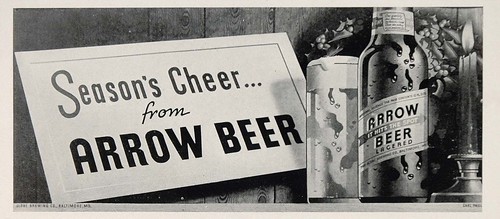
Beer In Ads #1036: Season’s Cheer … From Arrow Beer
Friday’s ad is for Arrow Beer, from 1946. A holiday billboard ad for the Baltimore brewer, the original Globe Brewing Co., whose tagline was “It Hits the Spot.”