Brookston Beer Bulletin

Jay R. Brooks on Beer

  • Home
  • About
  • Editorial
  • Birthdays
  • Art & Beer

Socialize

  • Dribbble
  • Email
  • Facebook
  • Flickr
  • GitHub
  • Instagram
  • LinkedIn
  • Pinterest
  • RSS
  • Twitter
  • YouTube

Powered by Genesis

Historic Beer Birthday: Axel Heiberg

March 16, 2025 By Jay Brooks

ringnes
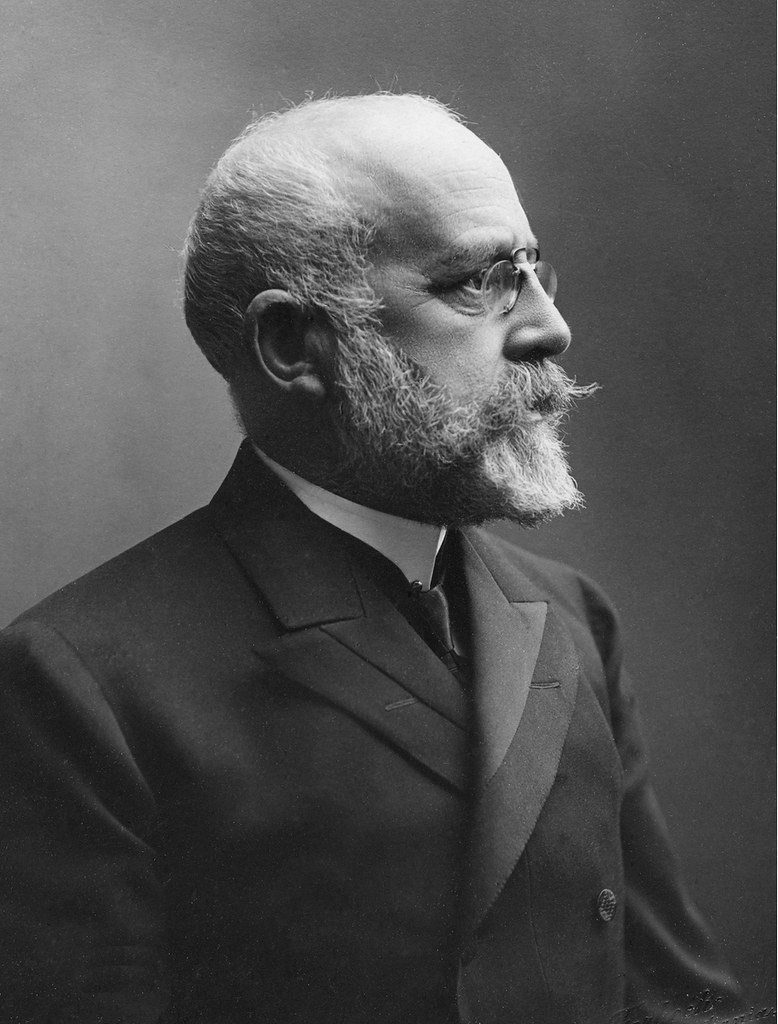
Today is the birthday of Axel Heiberg (March 16, 1848-September 4, 1932). He was born in Kristiania, Norway. Throughout his life, he “was a Norwegian diplomat, financier and patron.” And most importantly, he “financed the creation of the Ringnes brewery in 1876 together with the brothers Amund Ringnes (brewer) and Ellef Ringnes (administrator and salesman).” The Ringes remained family owned until 1978, and today is part of the Carlsberg Group, and remains the largest brewery in Norway.
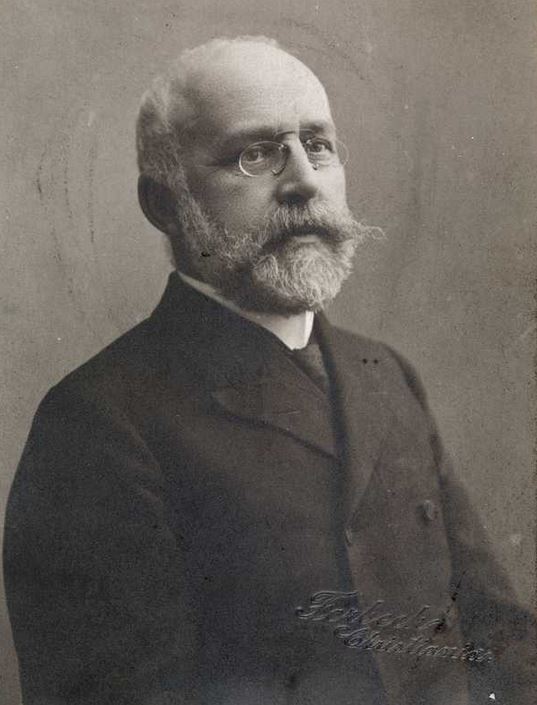
AxelHeiberg
Here’s his biography from Wikipedia:

He was married to Ragnhild Meyer, daughter of Thorvald Meyer. They had one child, Ingeborg, who married N. O. Young Fearnley.

Heiberg studied abroad and, after a period as Norwegian consul in China, returned to Norway, where he financed the creation of the Ringnes brewery in 1876 together with the brothers Amund Ringnes (brewer) and Ellef Ringnes (administrator and salesman).

Together with the shipowner Thomas Fearnley, the brewery sponsored the polar expeditions of Fridtjof Nansen and Otto Sverdrup, and funded the construction of the exploration vessel Fram. This led to Heiberg’s name being given to Axel Heiberg Island in Canada, the Axel Heiberg Glacier in Antarctica, and the Geiberg Islands in Siberia.

In 1878 Heiberg was one of the founders of the rowing club Christiania RK. Later he founded the “Consul Axel Heiberg and Manufacturer Hans B. Fasmer Fund” (in 1915 transferred to the Fridtjof Nansen Fund). In 1898 he was one of the founders of the Norwegian Forestry Society, and was chairman until 1923. He also funded the statues of Henrik Ibsen and Bjørnstjerne Bjørnson outside the National Theater in Oslo.
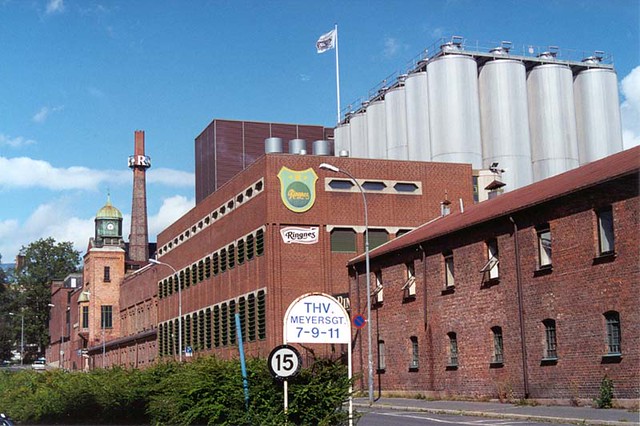
Ringnes-Brewery

This longer biography is from the Norwegian Biographical Encyclopedia, translated into English using Google Translate:

Axel Heiberg was one of the great patrons and supported as well sportsliv as science and art. He is especially known for its support of Nansen, Sverdrup and Amundsen’s polar expeditions. He was also a pioneer in forest management.

Heiberg grew up in Christiania and took school graduation 1867. He immediately started his business career in the US cotton company Wm. M. Tunne & Co. in Savannah, Georgia. Experience The foundation was then extended by two years in the East, as the correspondent of Russell & Co. in Hong Kong and Norwegian-Swedish vice-consul and consular secretary in Shanghai from 1870 to 1872.

Back in Christiania autumn 1872 Heiberg co-owner of several industrial enterprises, including Ringnes brewery, which he founded in 1877 together with his brothers Amund and Ellef Ringnes. He gave Norwegian sports funding, and he himself was active as a rower, sailor, skier and hunter; he was chairman of Christiania Roklub 1882-84 and founded the first Norwegian Kennel Club (Christiania molars). He was also one of the initiators of Huseby gutters, the predecessor to Holmenkollen.

The Fridtjof Nansen’s expedition across Greenland from 1888 to 1889 started Heiberg’s great interest in the polar regions. Along with Thomas Fearnley and Ellef Ringnes he formed the “corresponding line” that enabled Nansen first Fram 1893-96, and he supported the expedition with large amounts. In connection with the Nansen and Fram’s return to Norway in August 1896, he was with the founding of Fridtjof Nansen Foundation for Science Fund Promoting with a contribution of 50,000 crowns. From 1899 he was parliamentary elected member of the board of the Fund. Together with Amund and Ellef Ringnes he bore all the expenses of Otto Sverdrup’s second Fram 1898-1902 to the islands north of Canada, and he also gave financial support to Roald Amundsen’s expeditions with Gjøa in the Northwest from 1903 to 1906 and to the South Pole from 1910 to 1912. Axel Heiberg islands off Siberia, Axel Heiberg Island in Canada and Axel Heiberg Glacier in Antarctica was named after him by the grateful polar farers.

Also Norwegian art and intellectual life benefited consul Heiberg give generous support. He bought many works of art, and in 1899 he poured National statues of Ibsen and Bjornson, which currently stands in front of the entrance. 1906-1910 he was a member of the board of the Museum of Applied Arts.

It can today be discussed on Axel Heiberg is best known for its polar interest or for his great commitment to the Norwegian forests. The latter did enough biggest impression at the time, when he made forest case to a folkesak. He bought the farm Strand in Lyngdal in Numedal to hunting farm and ran it until a model with ia trenching and reforestation from 1888. Norwegian Forestry Society was founded in 1898 on his initiative, and he was the company’s chairman for 25 years. Under mindset “a forest-rich Norway is a mægtig Norway” organized Skogselskapet in his formannstid county forestry companies, courses, nurseries, etc., and put in place measures for children and young people to encourage interest in silviculture. A basic principle was that no generation should reap without also saw and planting. He rendered great financial contribution also to this case. He was a member of Videnskabps-Society in Christiania (now Norwegian Academy of Science and Letters) from 1897 and was an honorary member of both this and the Forestry Company.

Axel Heiberg was appointed a Knight of the Order of St. Olav in 1896, Commander 1900 and was awarded the Grand Cross 1908. 1923 he received Norway’s highest civilian honor, Borgerdådsmedaljen in gold. Christian Gierløff described him as “a Gloger, bold and generous figure, saa Norwegian as some of Snorre”. He was buried in the Grove of Honor at Our Savior’s cemetery in Oslo.
axel-heiberg

And here’s a short history of the brewery, from the tourism site, Go Norway:

Ringnes is Norway´s largest brewery company with approximately 1,200 employees. The company is owned by “Carlsberg Group”, the world´s fourth largest brewery group. We deliver beer, soda and water to the entire Norwegian beverage market and we are proud of our many strong brands!

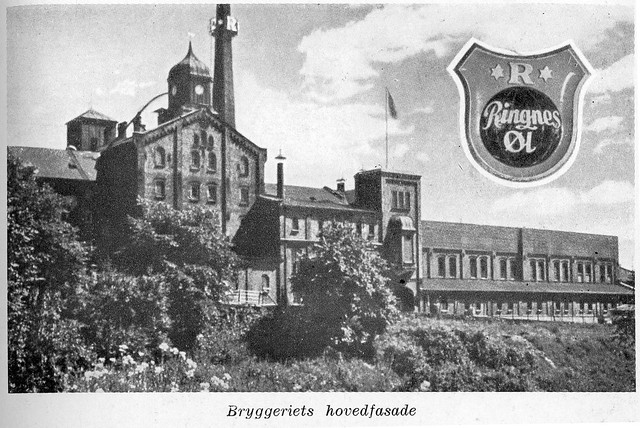
Ringnes brewery was established in 1876 by brothers Amund Ringnes and Ellef, who came from Ringnes Gard. Amund was brewer, Ellef administrator and salesman, and Axel Heiberg was the financier behind now. 28 November 1877 could Amund Ringnes put the first brewed, thus starting what has now been 130 years of brewing history. Ringnes-brothers stood centrally among those who did Fridtjof Nansen and Otto Sverdrup “Fram” – Finished possible. A lasting memory of this is the three islands in the northernmost Canada (west of Greenland), as Sverdrup named after the brewery´s founders, Axel Heiberg Island, Amund Ringnes Island and Ellef Ringnes Island.
rignes-brewery-photo

Filed Under: Birthdays, Just For Fun Tagged With: Business, History, Norway

Historic Beer Birthday: William Peter Sr.

March 16, 2025 By Jay Brooks

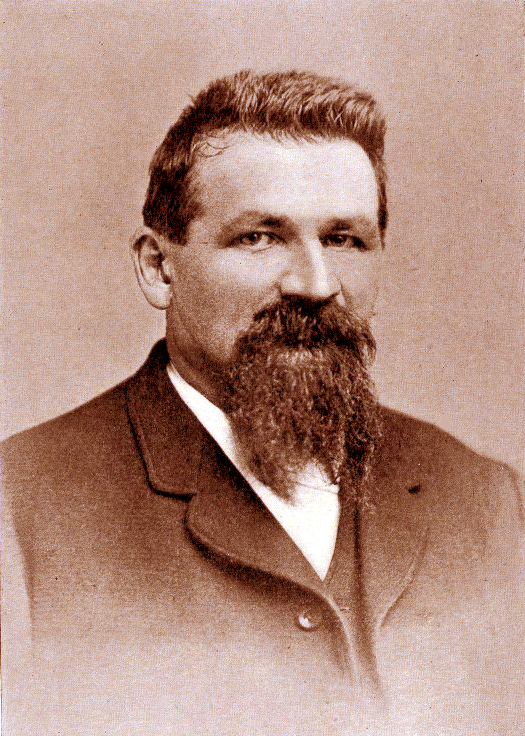
william-peter
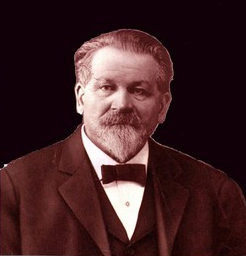
Today is the birthday of William Peter Sr. (March 16, 1832-June 10, 1918) who was born Wilhelm Jacob Peter in Baden-Württemberg, Germany, but anglicized his first name after coming to America in 1850. He worked at other breweries in both New York and Cincinnati before opening his own brewery in 1859, in what was then Union Hill, New Jersey, but today is Union City.

william-peter-sr
Here’s his obituary from the Western Brewer from January 1918:

william-peter-obit
wpeter-sr
And here’s another obituary from Find-a-Grave:

William Peter, founder of the great beer brewing plant of The William Peter Brewing Company Incorporated, of Union Hill now Union City, New Jersey, fled from Achern, Baden, Germany, where he was born, March 16, 1832, to escape the persecution he would have been subjected to as the son of one of the leaders of the Revolution of 1848-1849, against Prussian domination. He fled from Germany while serving his apprenticeship in the brewing trade. He then set sail to America with his mother Maria Antonia (Hof)Peter, four sisters and brother-in-law Max Frech, on the sailing vessel Gallia and arrived in New York on September 14, 1850. He then started a brewery in 1859 in West New York, New Jersey then moved to Union Hill, New Jersey. He developed his business rapidly and became the “best by test” beer in the country. He also had talent for painting, hundreds of landscapes and pictures in still life adorned his studio and the picture gallery of his home. The artist Max Eglau was his master, he had seen sketches and urged Mr. Peter to take up the brush in place of the pencil. William Peter died in 1918 and at that time had the largest funeral in New Jersey history, every famous brewer attended. William Peter married three times, his third wife having been Mrs. Sophia (Vogel) Bertram. Her daughter by her first husband married August Peter his son, his second wife was Mrs. Caroline (Appeli) Ohlenschlager and his first wife was Magdalena (Jaeger).

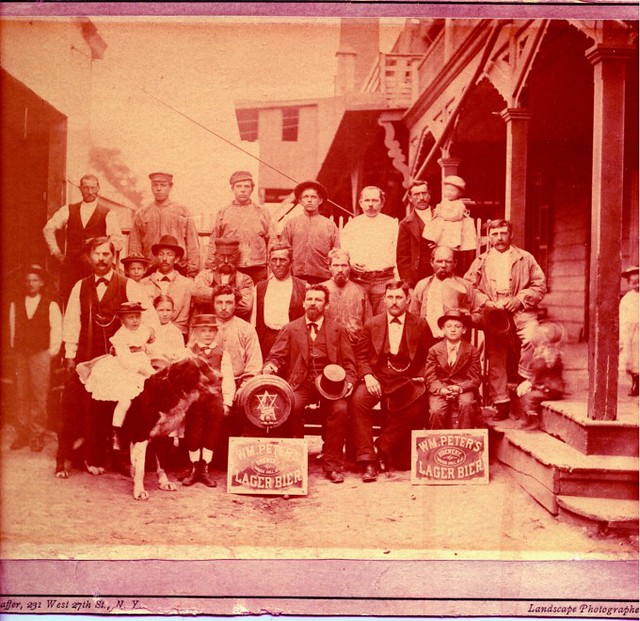
wm-peter-lager-biew
The brewery workers with William Peter in the center of the first row, with possible his son to the right (his left).

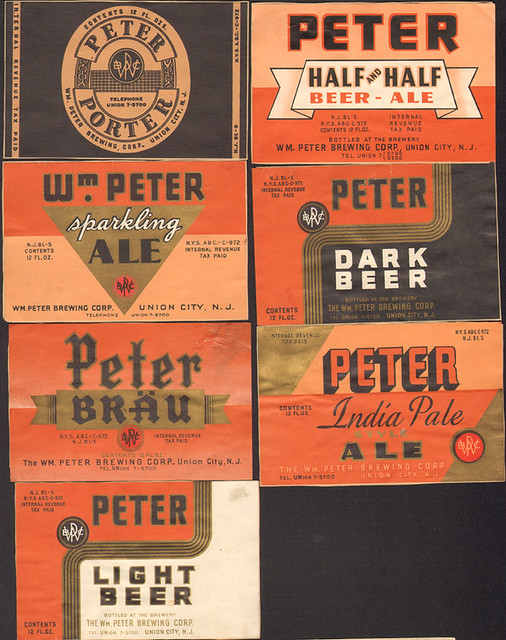
wmpeter-beerlabels
And here are some labels from the brewery.
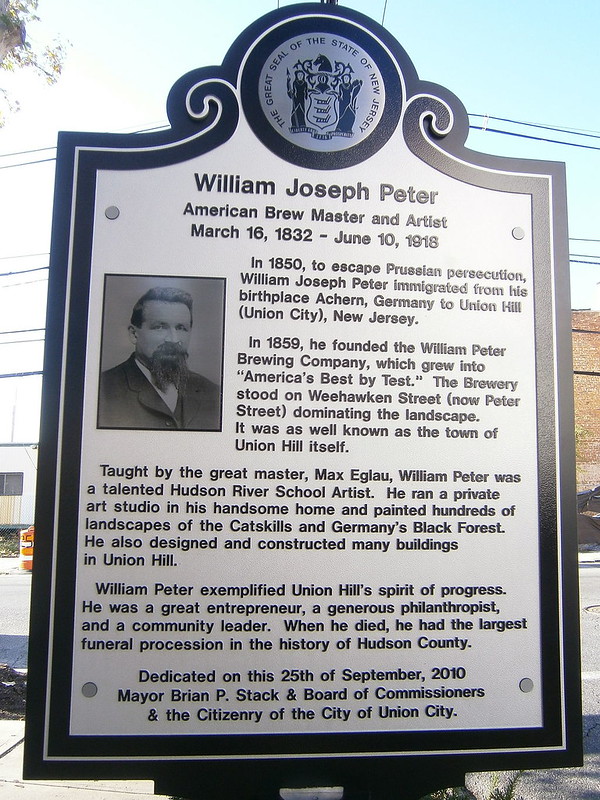
Outside the library in Weehawken, New Jersey there’s a historical marker for William Peter that was put up in 2010.

William_Peter_historical_marker-Hudson_Ave_&_Peter_Street-Union_City

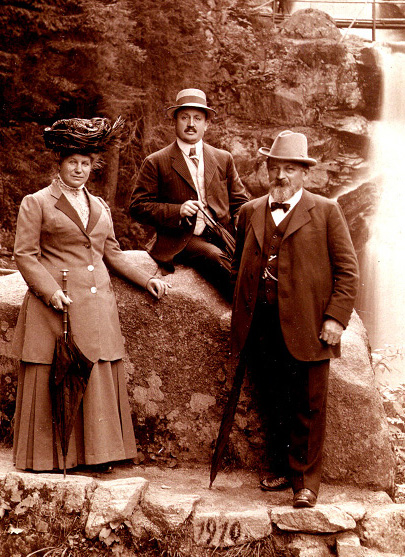
will-peter-and-family
This is presumably Peter with his son, William Peter Jr., though I don’t which of his three wives this might be. It was taken in 1910.
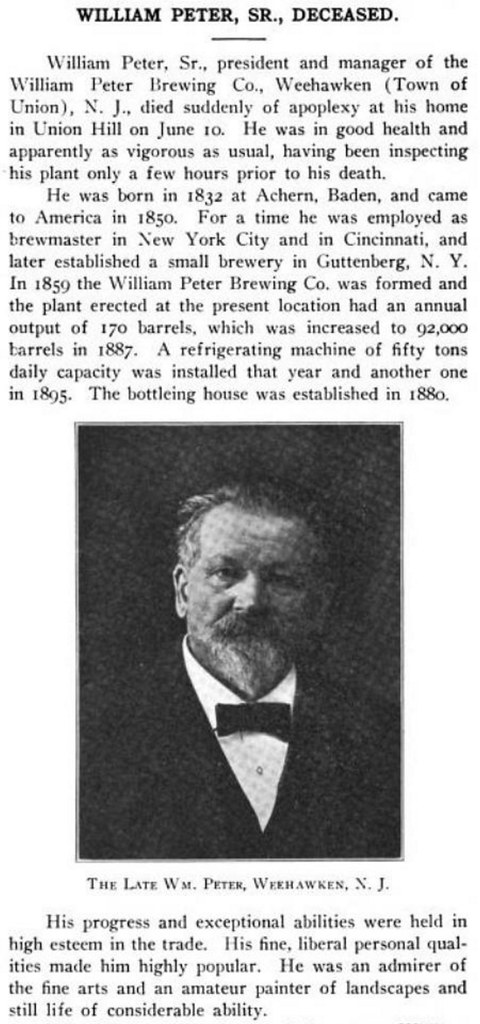
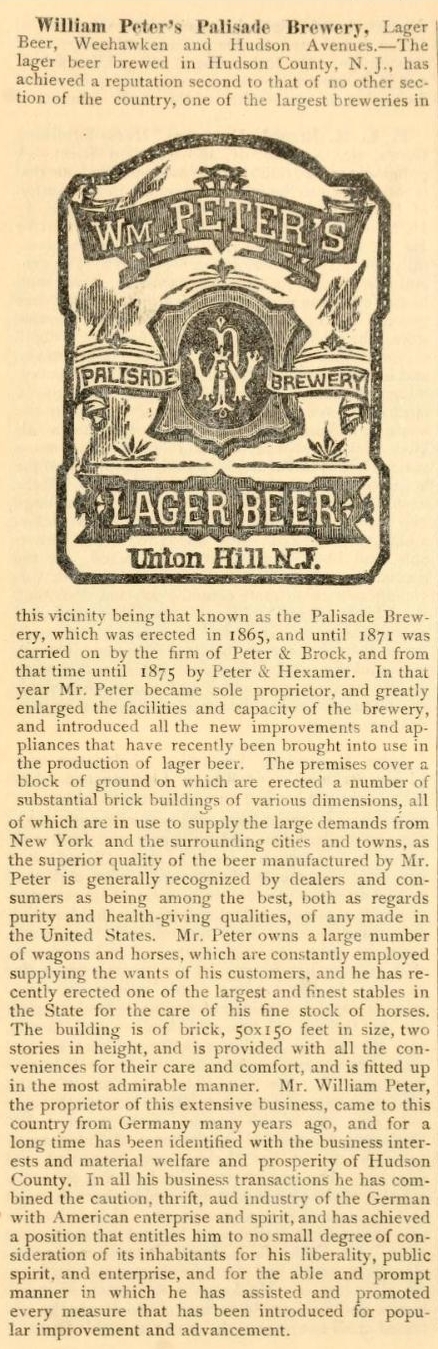
And this clipping is from a book on New Jersey from around the turn of the last century.

peter-clipping
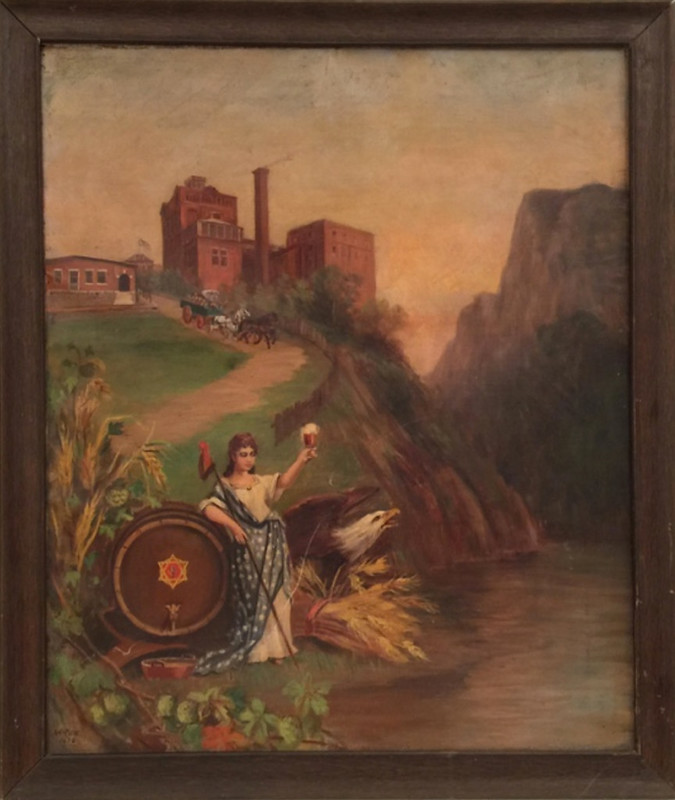
And lastly, William Peter was also apparently a prolific fine artist who painted numerous oil paintings. This one he did in 1898 of his brewery.

william-peter-painting

Filed Under: Birthdays, Just For Fun Tagged With: History, New Jersey

Beer In Ads #4910: Acme Bock Beer

March 15, 2025 By Jay Brooks

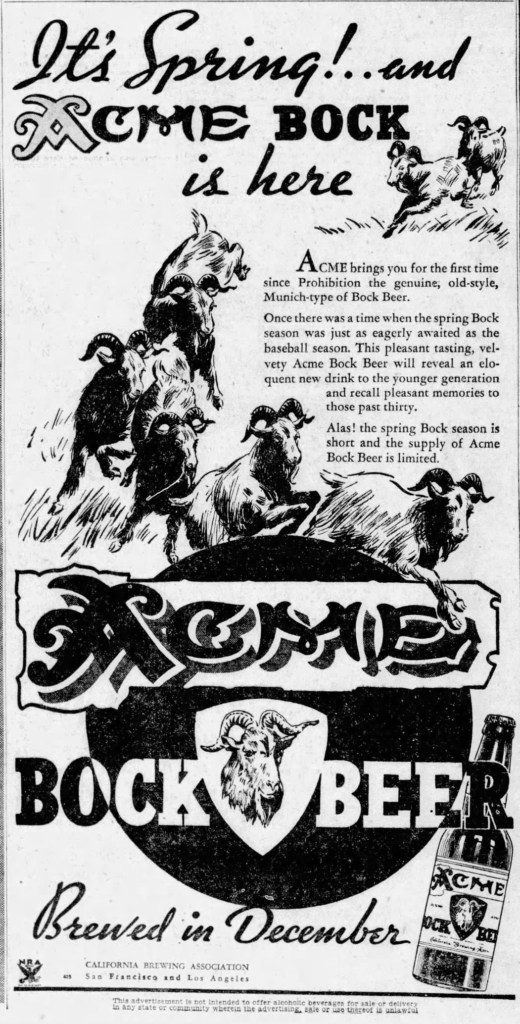
Last year I decided to concentrate on Bock ads. Bock, of course, originated in Germany, in the town of Einbeck. Because many 19th century American breweries were founded by German immigrants, they offered a bock at certain times of the year, be it Spring, Easter, Lent, Christmas, or what have you. In a sense they were some of the first seasonal beers. “The style was later adopted in Bavaria by Munich brewers in the 17th century. Due to their Bavarian accent, citizens of Munich pronounced ‘Einbeck’ as ‘ein Bock’ (a billy goat), and thus the beer became known as ‘Bock.’ A goat often appears on bottle labels.” And presumably because they were special releases, many breweries went all out promoting them with beautiful artwork on posters and other advertising.

Saturday’s ad is for Acme Bock Beer and was published March 15, 1934. The brewery was the Acme Brewing Co. of San Francisco, California, which was originally founded in 1907, though they also opened a location in the Los Angeles area. Today the brand is opened by North Coast Brewing. This ad ran in the Oregonian of Portland, Oregon, for the first release of bock beer since Prohibition was repealed the previous year.

Filed Under: Art & Beer, Beers, Breweries, Just For Fun Tagged With: Advertising, Bock, California, History

Historic Beer Birthday: George Ehret Ruppert

March 15, 2025 By Jay Brooks

Jacob-Ruppert
Today is the birthday of George Ehret Ruppert (March 15, 1875-November 5, 1948). He was the grandson of Jacob Ruppert Sr. and the brother of Jacob Ruppert Jr.. They both ran the family brewery, although his brother was the one in the spotlight and devoted more of his time to their ownership of the New York Yankees. George was more focused on the brewery business, and even when his brother died, appointed the GM to run the Yankees and continued to manage the Ruppert brewery.

George-Ehret-Ruppert
This is his obituary from Find-a-Grave:

George Ehret Ruppert, 3rd generation American brewer, was the son of Jacob & Anna Gillig-Ruppert and the grandson of Franz & Wilhelmina Zindel-Ruppert. His Bavarian-born grandparents established New York’s Turtle Bay Brewery and his father founded the Jacob Ruppert Brewing Co. His famous brother, Congressman Col. Jacob Ruppert Jr., was founder, president & owner of the NY Yankees. George graduated Columbia Law School in 1899 whereupon he quickly joined his father and brother at the brewery. While working in the family business he attended the Wallerstein Brewing Academy. He became brewery secretary in 1910, VP in 1915 and executive secretary & director in 1921. In 1939 he succeeded his brother as president and in 1945 became CEO. George was active in many Catholic charities and once had an audience with Pope Pius XI in 1936. The paradox of George Ruppert’s life was that the more important he became the further he slipped into the media background. As his elder brother, Jacob Jr., devoted more of his time to his NY Yankee baseball team, the burden of directing the Ruppert Brewery became more George’s personal responsibility. Yet George seemed to prefer to labor in obscurity. At his brother’s death in 1939, George could have obtained for himself the headlines that often carried the name of his brother. Yet, he declined the post in favor of Gen. Mgr. Ed Barrow, explaining that he was doing so in the best interests of the Yankees and the brewery. George married twice: Emma Josephine Schwartz (1877-1919) and Pearl B. Jackson (1889-1957).

George-ruppert

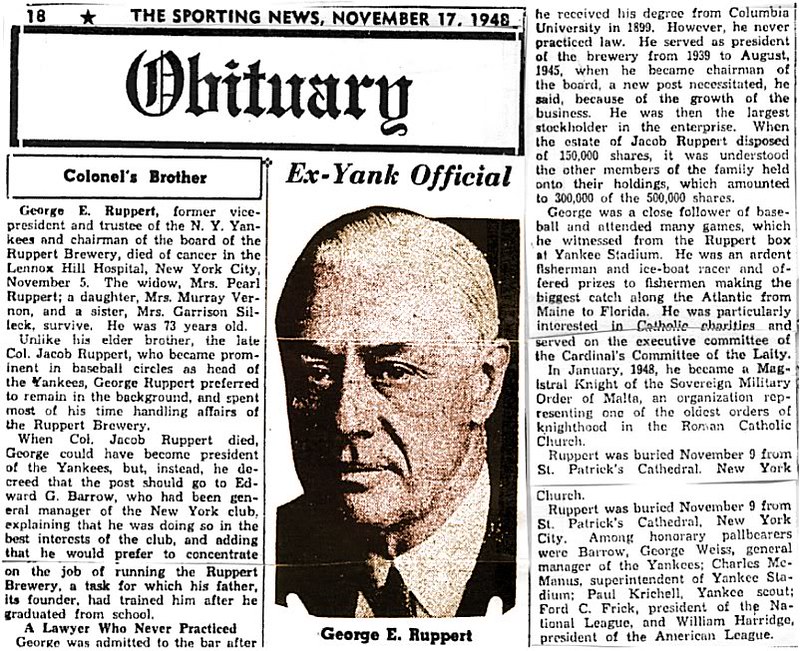
And here’s his obituary, from The Sporting News:

geo-e-ruppert-obit

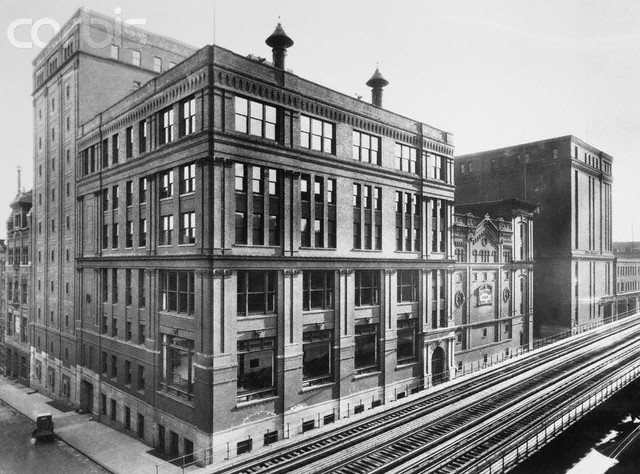
U206217ACME
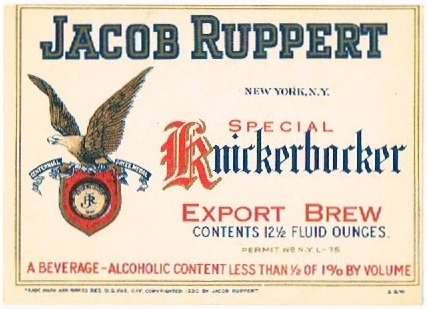
The Jacob Ruppert Brewery around 1932.

Special-Knickerbocker-Export-Brew-Labels-Jacob-Ruppert--pre-Prohibition-

Filed Under: Birthdays, Just For Fun Tagged With: History, New York

Historic Beer Birthday: Robert Meinrad Juerze

March 15, 2025 By Jay Brooks

gerke
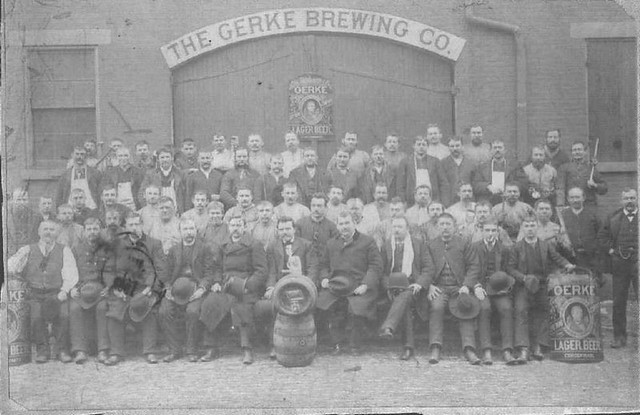
Today is the birthday of Robert Meinrad Juerze (March 15, 1847-?). In 1889, he was named president of the Gerke Brewing Co., in Cincinnati, Ohio. Unfortunately, that’s it for the information I could find about Juerze. No bio, no photos, just a line in an old trade magazine that included his birthdate.

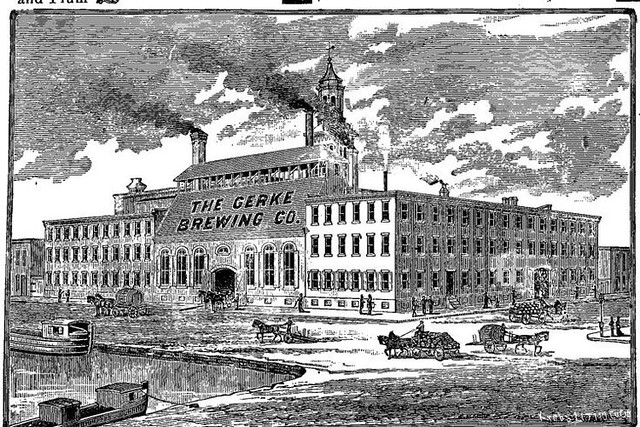
The Eagle Brewery in Cincinnati, Ohio, which was known by various names names, such as the Schaller & Schiff Brewery and later the Schaller-Gerke Brewery and finally the Gerke Brewing Co. Here’s a timeline from the Queen City Chapter’s page, entitled Cincinnati Brewing History-Preprohibition 1811-1919.

Gerke-bc

The first brewery on this corner was the Eagle Brewery from 1854 to 1866, owned by Joseph Schaller and Johann Schiff. In 1866, Schiff left the company and John Gerke joined in. The name was changed to Schaller & Gerke, Eagle Brewery and they continued together until 1882. The Schallers left the business then to purchase the Main Street Brewery and after the death of his father John, George Gerke continued the business at Canal and Plum Streets.

gerkebrewery_1

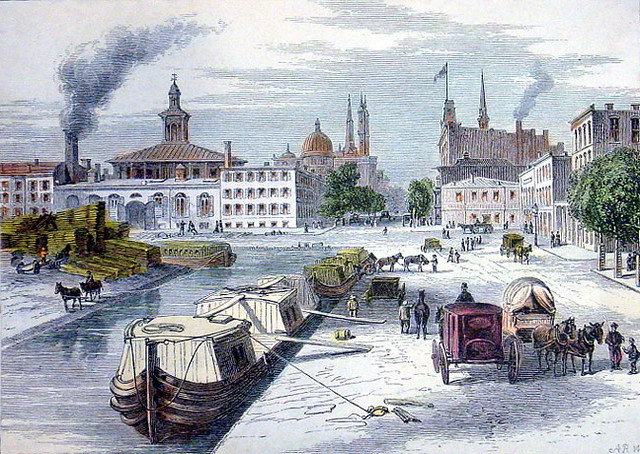
Founded in 1854 as the Eagle Brewery closer to the Ohio River, Joseph Schaller and John Gerke built a new brewery at the bend of the Miami and Erie Canal in 1866. Beer was brewed there until 1910.

gerkebrewery_4

The brewery equipment was sold at auction October 15, 1913.

Gerke-Brewing

Filed Under: Birthdays, Breweries, Just For Fun Tagged With: History, Ohio

Historic Beer Birthday: Louis Burger

March 15, 2025 By Jay Brooks

burger
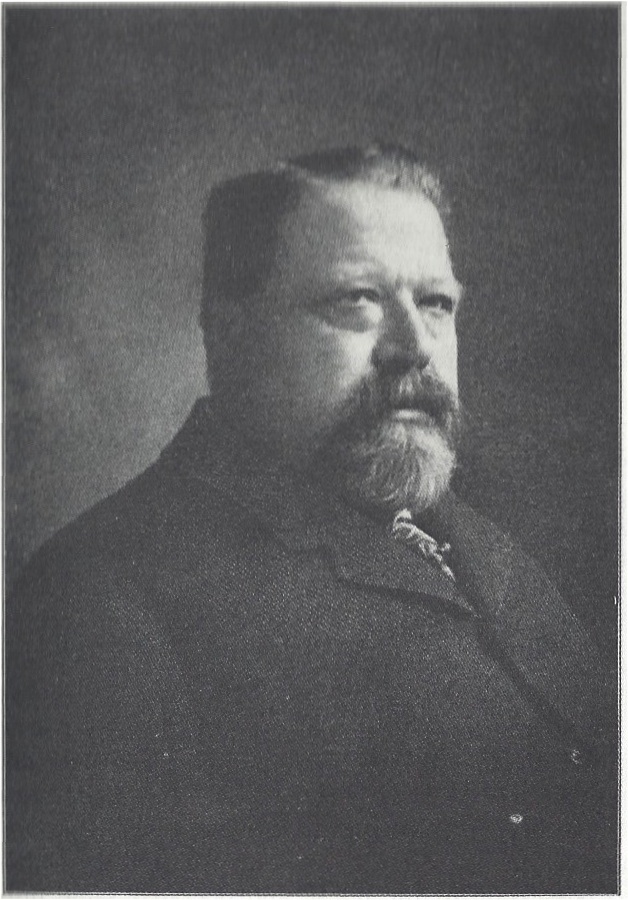
Today is the birthday of Louis Burger (March 15, 1842-February 13, 1901). He was born in Wurtemburg, Germany (though another source says Heilbrunn, Bavaria), but moved to America in 1863, when he was 21, and settled in Cincinnati, Ohio, A few years later, in 1879, he started working in the malting business, but shortly thereafter he formed a partnership with his brother Charles and co-founded the Burger Brewing Co. It became one of the more successful breweries in Cincinnati, and survived prohibition, but in 1973, announcing its closure, Hudepohl Brewing bought the brand.

Louis-Burger

Here’s a short biography, containing some conflicting information, from Find-a-Grave:

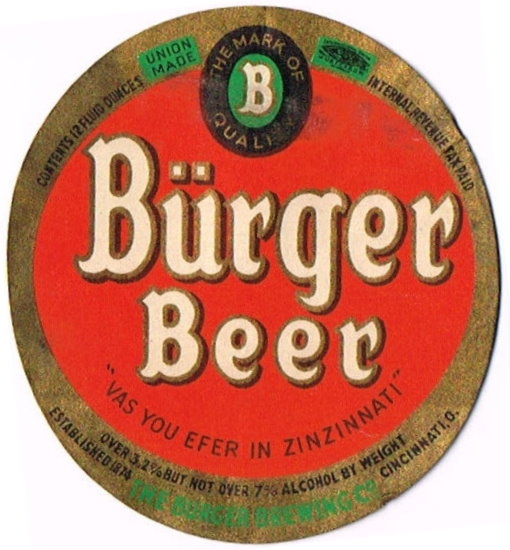
Beer Baron. A native of Germany, he emigrated to America and settled in Cincinnati, Ohio. In 1874, he established the Burger Brewing Company and operated the brewery until his death in 1901 when he was 67 years old. The brewery continued as such until it closed for good in 1973, minus the prohibition years from 1919 through 1933.

Burger-Beer-Labels-Burger-Brewing-Co

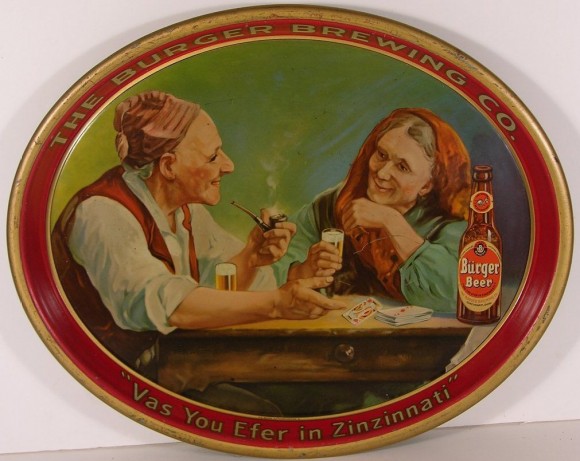
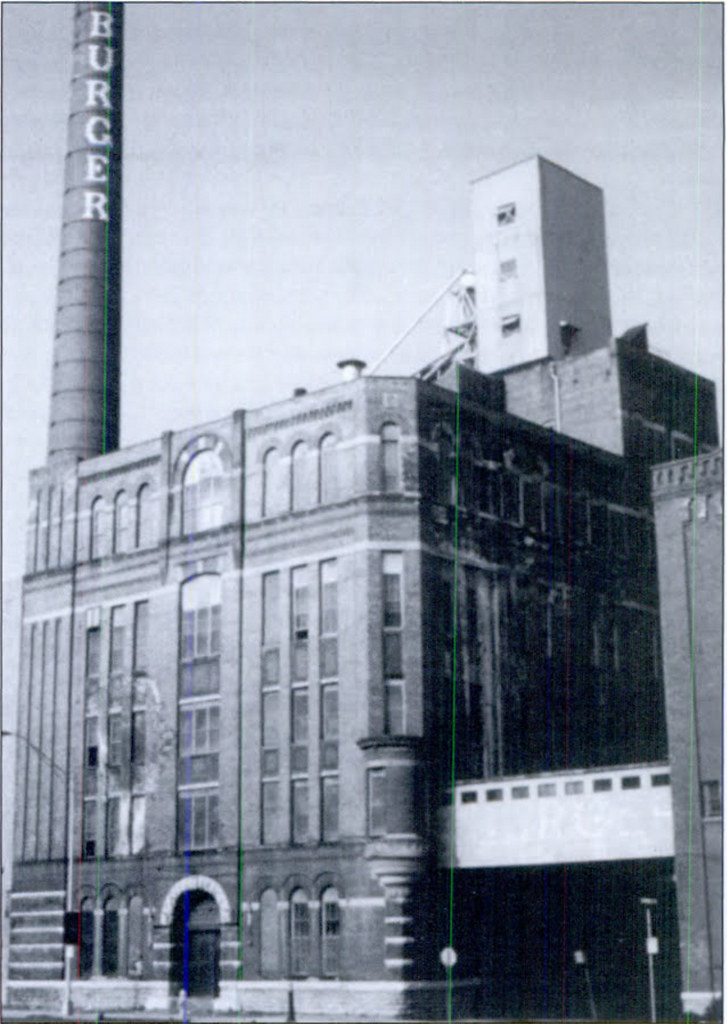
Given its early success, there’s a surprising lack of information about the brewery’s history before prohibition, even in books on Cincinnati’s brewing history. Why that might be seems unclear, but certainly part of the problem is that burger is not only a common name, but also shares its name with a popular sandwich, making searching more difficult.

burger-tray

Cincinnati-Burger-Brau-Beer-Labels-Burger-Brewing-Company

burger-brewery-1934

burger-beer-tempting

Filed Under: Birthdays, Just For Fun Tagged With: History, Ohio

Beer In Ads #4909: It’s The Smile Of Springtime!

March 14, 2025 By Jay Brooks

Last year I decided to concentrate on Bock ads. Bock, of course, originated in Germany, in the town of Einbeck. Because many 19th century American breweries were founded by German immigrants, they offered a bock at certain times of the year, be it Spring, Easter, Lent, Christmas, or what have you. In a sense they were some of the first seasonal beers. “The style was later adopted in Bavaria by Munich brewers in the 17th century. Due to their Bavarian accent, citizens of Munich pronounced ‘Einbeck’ as ‘ein Bock’ (a billy goat), and thus the beer became known as ‘Bock.’ A goat often appears on bottle labels.” And presumably because they were special releases, many breweries went all out promoting them with beautiful artwork on posters and other advertising.

Friday’s ad is for Acme Bock Beer and was published March 14, 1940. The brewery was the Acme Brewing Co. of San Francisco, California, which was originally founded in 1907, though they also opened a location in the Los Angeles area. Today the brand is opened by North Coast Brewing. This ad ran in the Palo Verde Valley Times of Blythe, California, two days before the release of that year’s seasonal bock.

Filed Under: Art & Beer, Beers, Breweries, Just For Fun Tagged With: Advertising, Bock, History

Historic Beer Birthday: Anthony J. McGowan

March 14, 2025 By Jay Brooks

new_york
Today is the birthday of Anthony J. McGowan (March 14, 1869-1932). McGowan was born in Ireland but came to America as a teenager, settling in Buffalo. New York, where he worked for and then owned his own tavern. He married Delia Maloney, and they together they had ten children, four sons and six daughters.

anthony-j-mcgowan
Part of his story is told in Rushing the Growler: A History of Brewing and Drinking in Buffalo, by Stepehen R. Powell. In Chapter III: Was Buffalo the Saloon Capitol of the World?, there’s this:

The Life History of A.J. McGowan

Born on the 14th of March- 1869- of Irish parents, at a little town called Grey Grove in the parish of Kilmihil County Clare Ireland.
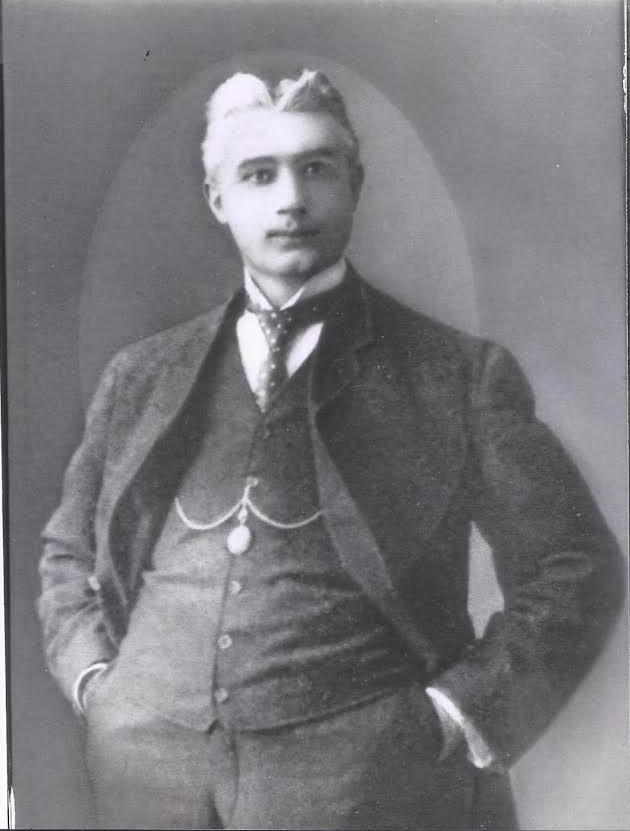
Immigrated from that dear little country at the age of sixteen years and one month. and set sail for my adopted country on the good ship named the City of Chicago on the 19th day of May-1886-arrived at the harbor of NY several days later and was taken into old Castle Garden and remained there for a few hours until a friend called and took me out of there, and what a relief. He was in the liquor business in Brooklyn and naturally the first thing he done was take me in to a restaurant for a good dinner on the N. end of the Brooklyn Bridge… So we arrived at his place of business and stayed there for about one hour… he took me back to the saloon with him. He kept introducing me to all his customers as they came in… Near here (Buffalo) is where life started after a few days in NY I decided to make the trip to Buffalo, the grandest city in the world and after a few days I arrived at the old Erie Rail Road at Exchange and Michigan St. and was met at the station by a policeman named John Pyne who was known by all the tuff characters from Buffalo to San Francisco and he took me to my brothers home at Fulton and Chicago St. and after 2 weeks rest I applied for a job to Mr. Cunningham as a scooper better known now as grain forwarding.

I appealed to Mr. Kennedy for a job who at that time had charge of all the freight coming into the Port of Buffalo. Worked at that line for a few months and things started to get quiet on the water front and one afternoon we were sitting on a tow board at the end of the in Bound freight house and in a general conversation he asked me how I’d like a job bartending. I said anything would be better than what we were doing at the present time. With the result I started the next morning tending bar at-19-Main St. which at that time was one of the most prominent parts of Buffalo. [end of excerpt]

Later, Anthony J. McGowan was to become the manager of James Kennedy’s Seabreaze Hotel on “The Island” off the foot of Main St. In 1897, he opened his own tavern at 206 Elk Street near the corner of Smith St. Mr. McGowan quickly became involved in local politics, becoming Democratic General Committeeman in the First Ward shortly after his arrival Buffalo. His rise into local politics continued in 1908, when he was appointed to the Department of Markets by then Mayor J.N. Adam and served as assistant superintendent in charge of the Elk Street market for 31 years. He later worked in the same capacity at the Black Rock Market after the Elk St. market closed in 1939. McGowan’s life in Buffalo shows us a personal side of one of Buffalo’s most diverse industries.”

Buffao-st-pats-1915
McGowan, who was presumably a prominent member of Buffalo society, at least in Irish quarters, marched in the city’s St. Patrick’s Day parades. In this photo, from the 1915 parade, he’s marked as #1. There’s more about the parade at the Buffalo News.

While unrelated, a book that was recommended to me by beer writer Michael Jackson was The Last Fine Time, by Verlyn Klinkenborg. It’s a fictional account of a family in the restaurant and bar business over several generations in Buffalo, New York.

Filed Under: Birthdays, Just For Fun Tagged With: Bars, History, New York

Beer In Ads #4908: It’s My Kind Of Bock

March 13, 2025 By Jay Brooks

Last year I decided to concentrate on Bock ads. Bock, of course, originated in Germany, in the town of Einbeck. Because many 19th century American breweries were founded by German immigrants, they offered a bock at certain times of the year, be it Spring, Easter, Lent, Christmas, or what have you. In a sense they were some of the first seasonal beers. “The style was later adopted in Bavaria by Munich brewers in the 17th century. Due to their Bavarian accent, citizens of Munich pronounced ‘Einbeck’ as ‘ein Bock’ (a billy goat), and thus the beer became known as ‘Bock.’ A goat often appears on bottle labels.” And presumably because they were special releases, many breweries went all out promoting them with beautiful artwork on posters and other advertising.

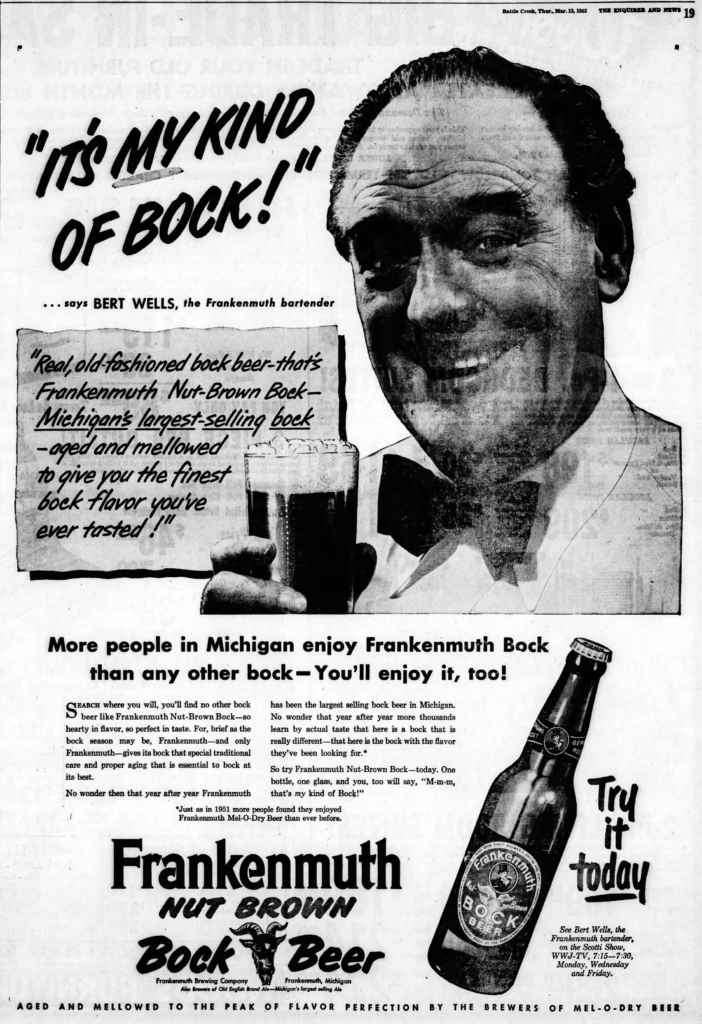
Thursday’s ad is for Frankenmuth Nut Brown Bock Beer and was published March 13, 1952. The brewery was the Frankenmuth Brewing Co. of Frankenmuth, Michigan, which was originally founded in 1862 by Martin Heubisch and Wilhelm Knaust. It has closed and re-opened a couple of times, and is still around today as a craft brewery known as the Frankenmuth Brewery. It’s interesting that they referred to their bock as a “nut brown bock beer,” which is a new one on me. But at least it was a favorite of local bartender Bert Wells, who exclaimed “It’s My Kind of Bock!”

Filed Under: Art & Beer, Beers, Breweries, Just For Fun Tagged With: Advertising, Bock, History, Michigan

Historic Beer Birthday: John Taylor

March 13, 2025 By Jay Brooks

john-taylor
Today is the birthday of John Taylor (March 13, 1790-September 13, 1863). He was born in England, but came to American with his family when he was just three years old, settling eventually in Albany, New York. He initially went into the candle-making business with his father, but in 1822 switched to brewing and opened the Lancelot Fiddler Brewery, renaming the John Taylor Brewery a few years later, and adding “and Sons” around 1844, before closing for good in 1905.

Albany chronicles, a history of the city arranged chronologically.

Here’s a short biography from the History of the county of Albany, N. Y., published in 1886:

John Taylor, Mayor 1848-49, was born in Durham, England, March 1790 and died in Albany September 31, 1863. He migrated to Brooklyn with his father when a mere infant, and to Albany in 1793. He engaged in the business of a tallow-chandler with his father when he was seventeen years old, and before he was twenty-three he had been burned out four times. Then his fortunes changed. He began to make money about 1813 as an army contractor. In 1822 he became a brewer, and from this business realized an ample fortune. He had branches in Boston and New York later, conducted by his sons. He gave freely of his wealth to the poor, and to all objects that promised to benefit the city. He became a great reader, and accumulated a larger larger and more valuable than any in the city in his time. He gained great popularity and wealth at the same time by a steady course of industry, enterprise, integrity, philanthropy and virtue. Taylor’s Brewery is still occupied [1886] at 133 Broadway.
taylor-imperial-xx-ales

And this portion of What Was Albany Ale? from the Albany Ale Project, by Alan McLeod and Craig Gravina, discussed John Taylor and his brewery:

Albany’s 150 years of Dutch family breweries established the city as a well-known brewing center. At this time, the first advertisements for “Albany Ale” began to appear as a euphemistic term for the best beer—of any kind—brewed in Albany. The completion of the Erie Canal in 1825 and an Albany brewer named John Taylor would soon change that perception.

John Taylor & Sons’ Taylor opened his first brewery in the early 1820s and second larger one in 1831. A savvy businessman, Taylor saw the opportunity to exploit New York’s new water highway. Albany’s access to the Hudson River and position at the terminus of the Erie Canal afforded it a monopoly on the distribution of beer. Raw materials for beer making could be brought east to Albany via the Canal, and Taylor, in-turn could export his beer south, down the Hudson River to the port of New York. From there the beer could shipped anywhere in the world. By the 1850s Taylor had built the largest brewery in the country in Albany, capable of producing 200,000 barrels of beer a year. Taylor began advertising a double X ale, which would become his flagship beer, that he dubbed “Imperial Albany XX Ale.” As the demand for this double X strength ale grew, so did the number of breweries in the city—seventeen by the mid-1860s—almost all of them producing some kind of XX strength Albany Ale. No longer was Albany Ale a euphemism; it had become a specific thing.

And Craig, for Session 56, wrote Thanks to John Taylor – the Original American Big Boy, which goes into more detail.

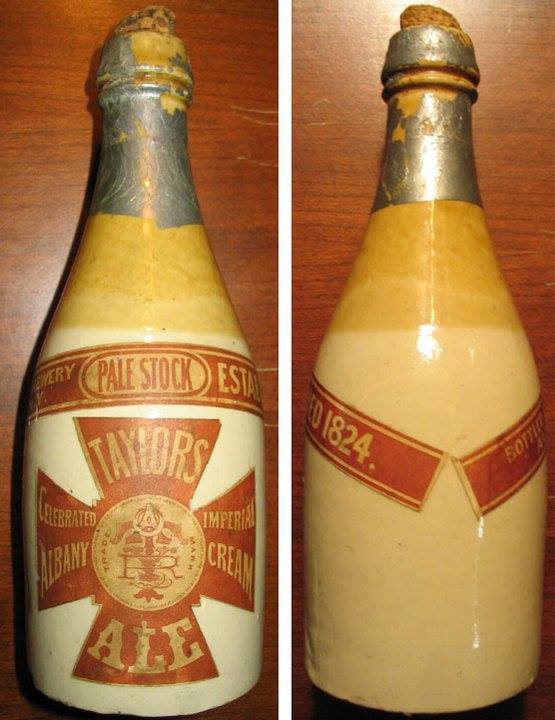
taylors-ale

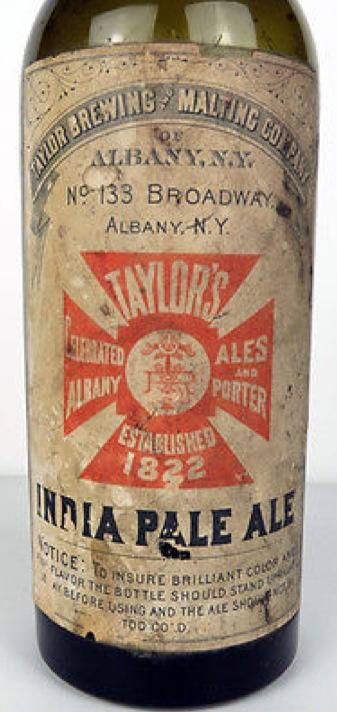
taylors-ipa

Filed Under: Birthdays, Breweries Tagged With: England, History, New York

« Previous Page
Next Page »

Find Something

Northern California Breweries

Please consider purchasing my latest book, California Breweries North, available from Amazon, or ask for it at your local bookstore.

Recent Comments

  • Bob Paolino on Beer Birthday: Grant Johnston
  • Gambrinus on Historic Beer Birthday: A.J. Houghton
  • Ernie Dewing on Historic Beer Birthday: Charles William Bergner 
  • Steve 'Pudgy' De Rose on Historic Beer Birthday: Jacob Schmidt
  • Jay Brooks on Beer Birthday: Bill Owens

Recent Posts

  • Beer In Ads #5138: The Event Of The Year: Jax Bock Beer March 2, 2026
  • Historic Beer Birthday: Anthony Durkin March 1, 2026
  • Historic Beer Birthday: Adam Sander March 1, 2026
  • Beer In Ads #5138: Flower City Bock Beer March 1, 2026
  • Historic Beer Birthday: Regina Wauters March 1, 2026

BBB Archives

Feedback

Head Quarter
This site is hosted and maintained by H25Q.dev. Any questions or comments for the webmaster can be directed here.