Brookston Beer Bulletin

Jay R. Brooks on Beer

  • Home
  • About
  • Editorial
  • Birthdays
  • Art & Beer

Socialize

  • Dribbble
  • Email
  • Facebook
  • Flickr
  • GitHub
  • Instagram
  • LinkedIn
  • Pinterest
  • RSS
  • Twitter
  • YouTube

Powered by Genesis

Beer In Ads #5196: Happy Days Are Here Again

February 8, 2026 By Jay Brooks Leave a Comment

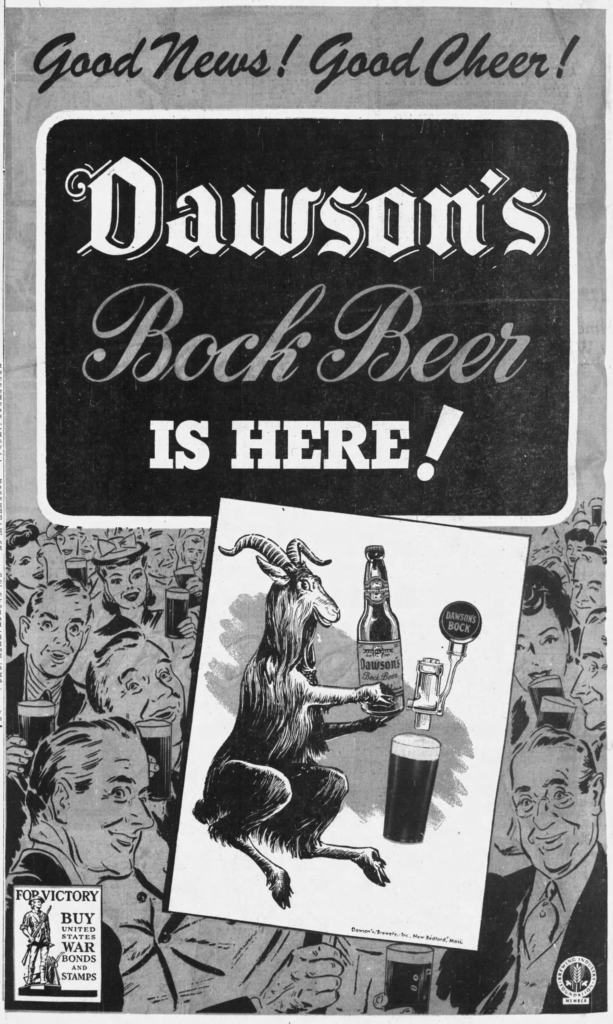
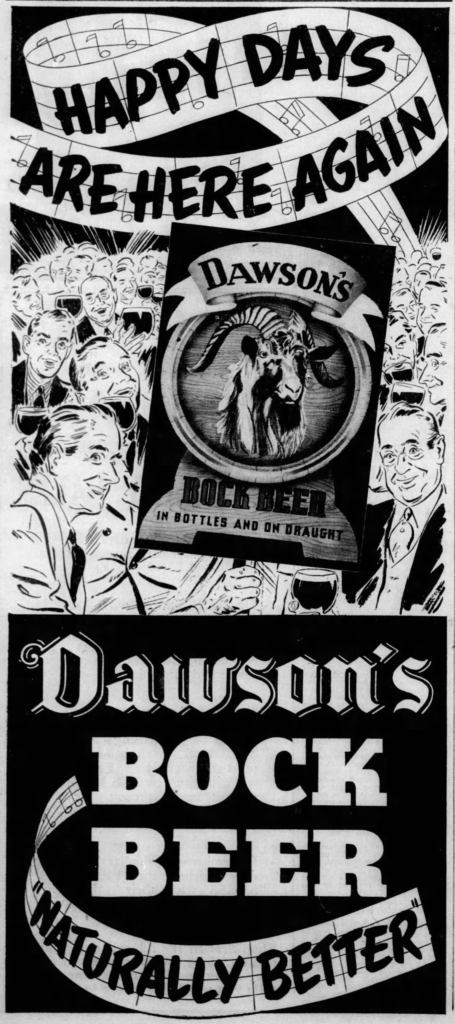
Two years ago I decided to concentrate on Bock ads for awhile. Bock, of course, may have originated in Germany, in the town of Einbeck. Because many 19th century American breweries were founded by German immigrants, they offered a bock at certain times of the year, be it Spring, Easter, Lent, Christmas, or what have you. In a sense they were some of the first seasonal beers. “The style was later adopted in Bavaria by Munich brewers in the 17th century. Due to their Bavarian accent, citizens of Munich pronounced ‘Einbeck’ as ‘ein Bock’ (a billy goat), and thus the beer became known as ‘Bock.’ A goat often appears on bottle labels.” And presumably because they were special releases, many breweries went all out promoting them with beautiful artwork on posters and other advertising.

Sunday’s ad is for Dawson’s Bock Beer, which was published on February 8, 1940.  This one was for Dawson’s Brewery, of New Bedford, Massachusetts and was founded in 1899. This ad ran in The Boston Globe, of Boston, Massachusetts.

Filed Under: Art & Beer, Beers, Breweries, Just For Fun Tagged With: Advertising, Bock, History, Massachusetts

Historic Beer Birthday: A.J. Houghton

February 8, 2026 By Jay Brooks Leave a Comment

Today is the birthday of Andrew Jackson Houghton (February 8, 1830-September 24, 1892). He was born in Readsboro, Vermont, and moved to the Jamaica Plain area of Boston where he founded the A.J. Houghton & Co. Brewery with John A. Kohl in 1870. They bought the Christian Jutz brewery, which had been built in 1857, but moved production across the street. It was also known as the Vienna Brewery at various points of its history, before closing for good in 1918 when Prohibition went into effect.

This is a history of the brewery from 100 Years of Brewing:

This account is from Boston’s Lost Breweries:

Located at Station and Halleck Streets, it was active from 1870 to 1918. It occupies the site of the old Christian Jutz brewery built in 1857. The Vienna Brewery had originally been located across the street where it was owned by Messrs. Houghton and Cole [sic] of Maine and Vermont. They bought the Christian Jutz property and moved their main operations across the street, converting their original property to a stable to house their several transport horses. Here they produced Vienna Lager from a German recipe. The lighter German and Austrian Lager beers came into favor in the 1850’s and 60’s displacing the heavier English/Irish Ales. Besides Vienna Lager, they made Pavonia Lager Beer, Vienna Old Time Lager and Rockland Ale.

The Jamaica Plain Historical Society on the A.J. Houghton Brewery.

“A.J. Houghton & Co. “Vienna” Brewery. Located at Station and Halleck Streets, it was active from 1870 to 1918. It occupies the site of the old Christian Jutz brewery built in 1857.“The Vienna Brewery had originally been located across the street where it was owned by Messrs. Houghton and Cole of Maine and Vermont. They bought the Christian Jutz property and moved their main operations across the street, converting their original property to a stable to house their several transport horses. (This must be where Jeremiah Walsh worked.) Here they produced Vienna Lager from a German recipe. The lighter German and Austrian Lager beers came into favor in the 1850’s and 60’s displacing the heavier English/Irish Ales. Besides Vienna Lager, they made Pavonia Lager Beer, Vienna Old Time Lager and Rockland Ale.“This is the only landmark brewery in Boston, having been protected by the Boston Landmarks Commission, despite its poor condition. It had a five story main brewing building with a large cupola, an office building, three storage buildings, a coopering or barrel-making building, and a power plant. It was a beautiful building with brick used for architectural features instead of stonework or terra cotta. The sweeping arches are built of brick while the sills and parts of the arches are granite. The floor joists are supported by architectural ironwork. The exterior “X” shaped elements on the sides of the buildings are iron brick-ties that support the brick bearing-walls and were common design features at that time. They were often connected by long interior iron rods, spanning between the walls, to help hold the structure together under the floor loads of several stories.“The main brewing buildings had robust hoists and pumps to lift the grains and water up to the top floor to begin the brewing process. Gravity would then take the brew down to the various levels and processes below. This, then, was a “vertical” brewery. When pumping technology improved, the vertical process was discontinued in favor of the “horizontal” brewery with lower buildings and other efficiencies. This brewery closed when Prohibition arrived in 1919 and it never reopened on a full-scale basis.”

Filed Under: Birthdays, Breweries, Just For Fun Tagged With: Massachusetts, Vermont

Beer Birthday: Tom Acitelli

February 7, 2026 By Jay Brooks 1 Comment

hop-cones-and-beer
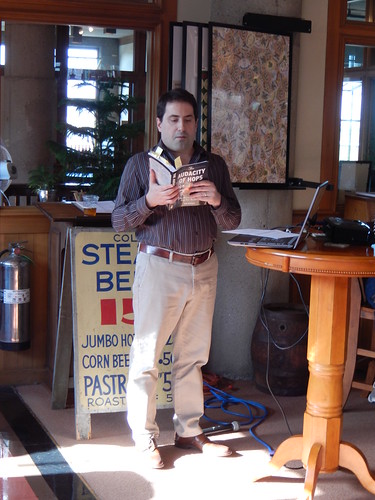
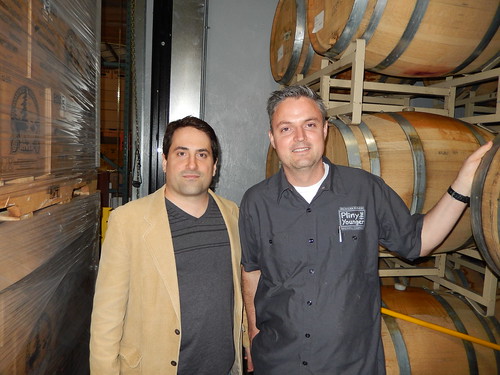
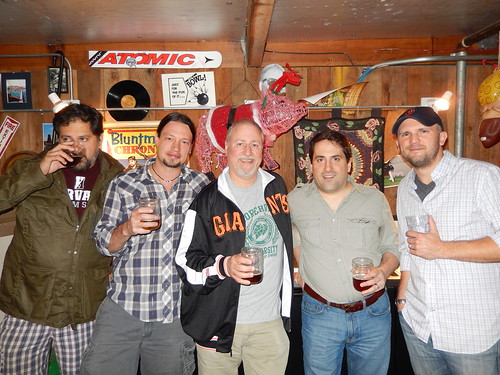
Today is the 49th birthday of Tom Acitelli, author of the wonderful history of craft beer, The Audacity of Hops. Tom reached out to me while he was working on his book, and we’ve been friends ever since. More recently, he wrote “Pilsner: How the Beer of Kings Changed the World.” He’s a great new addition to the cadre of writers chronicling the beer industry these days. Join me in wishing Tom a very happy birthday.

DSCN0275
Tom reading selections from his book at Anchor Brewery.
DSCN0309
Tom and Vinnie Cilurzo during a visit to the Russian River production brewery.
DSCN0320
At Lagunitas for Tom’s book release party several years ago, with Joe Tucker, Jeremy Marshall, me, Tom and Ken Weaver.

Filed Under: Birthdays, Just For Fun Tagged With: Massachusetts

Beer In Ads #5187: Hampden Bock Beer

January 30, 2026 By Jay Brooks

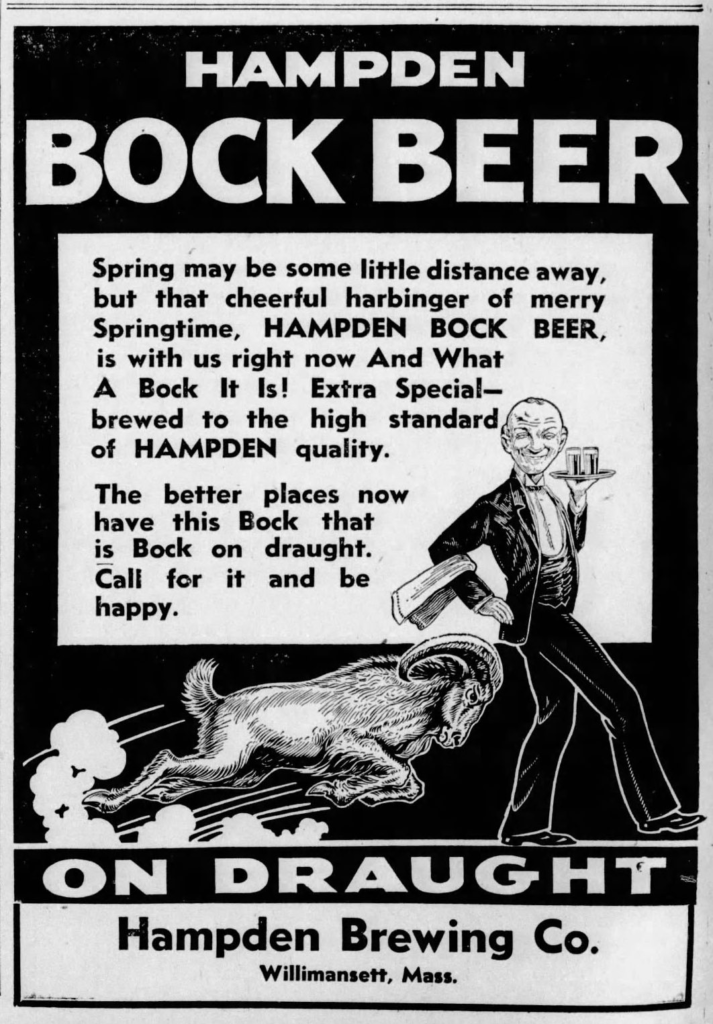
Two years ago I decided to concentrate on Bock ads for awhile. Bock, of course, may have originated in Germany, in the town of Einbeck. Because many 19th century American breweries were founded by German immigrants, they offered a bock at certain times of the year, be it Spring, Easter, Lent, Christmas, or what have you. In a sense they were some of the first seasonal beers. “The style was later adopted in Bavaria by Munich brewers in the 17th century. Due to their Bavarian accent, citizens of Munich pronounced ‘Einbeck’ as ‘ein Bock’ (a billy goat), and thus the beer became known as ‘Bock.’ A goat often appears on bottle labels.” And presumably because they were special releases, many breweries went all out promoting them with beautiful artwork on posters and other advertising.

Friday’s ad is for Hampden Bock Beer, which was published on January 30, 1935. This ad was for the Hampden Brewing Co., of Willmansett, Massachusetts, which was originally founded in 1878 by William Brierly, although he only owned it for one year. It then a few new owners, and different names, before being known as Hampden in 1890, which remained in the name until 1962, but after that had another series of owners before closing in 1974. This ad ran in The Morning Union, also of Springfield, Massachusetts.

Filed Under: Art & Beer, Beers, Breweries, Just For Fun Tagged With: Advertising, Bock, History, Massachusetts

Beer Birthday: Todd Alström

January 10, 2026 By Jay Brooks

ba-square
Today is the 57th birthday of Todd Alström, co-founder of Beer Advocate. With his brother Jason, Todd has created one of the killer apps of the beer world online and the only monthly beer magazine. Though we only run into one another from time to time, we always have a good time. We also shared a week in Bavaria on a press junket in 2007, and had a terrific fry crawl in Boston a number of years ago, before he relocated to Denver, and more recently to Helsinki, Finland. Join me in wishing Todd a very happy birthday.

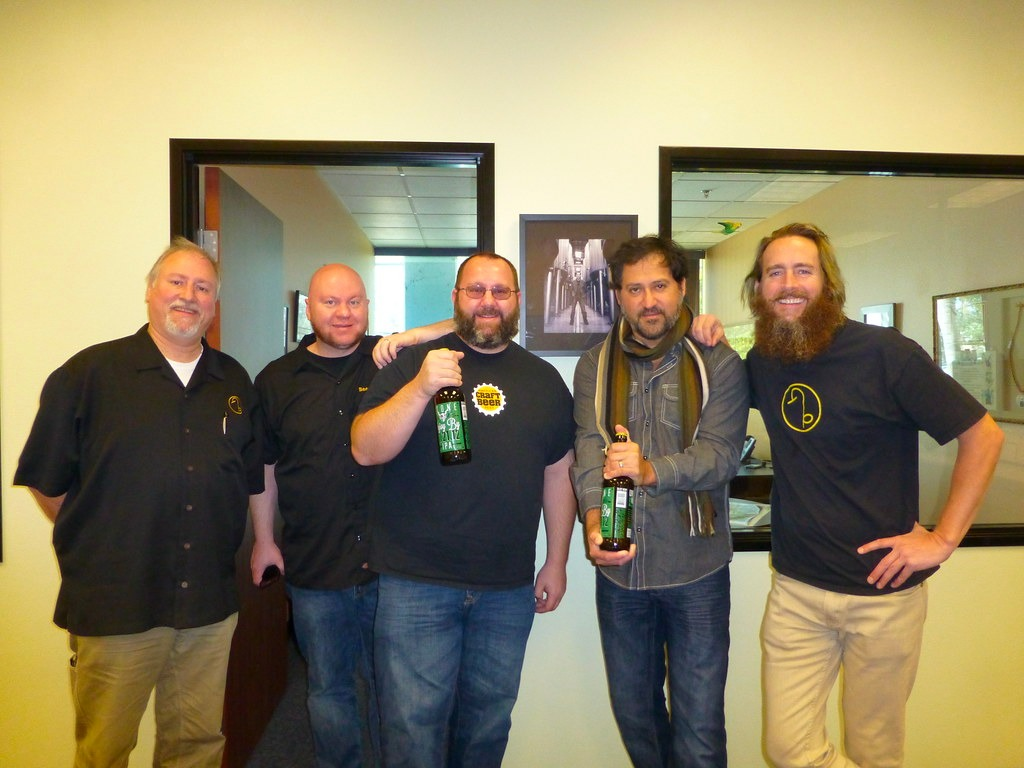
Me, Todd, Jason Alström, Joe Tucker and Greg Koch showing off our sample bottles of Enjoy By 12.21.12 in San Diego several Decembers ago.
gabf08-11
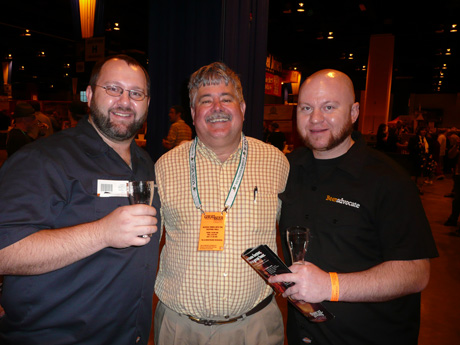
Todd (at right), with brother Jason and Jaime Jurado, head brewer from Gambrinus, at the 2008 GABF.
faust-39
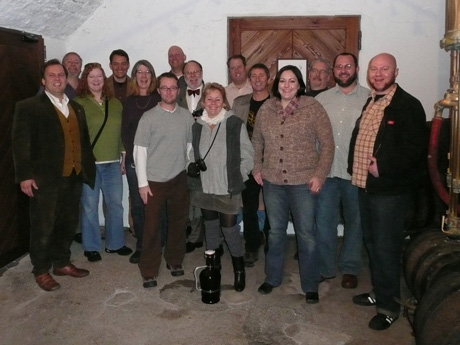
During a trip to Bavaria in 2007, the gang of twelve plus three at the Faust Brauerei in Miltenberg, Germany. From left: Cornelius Faust, me, Lisa Morrison, Johannes Faust, Julie Bradford, Andy Crouch, Peter Reid, Horst Dornbusch, Jeannine Marois, Harry Schumacher, Tony Forder, Candice Alström, Don Russell, Jason Alström and Todd Alström.
royce-12
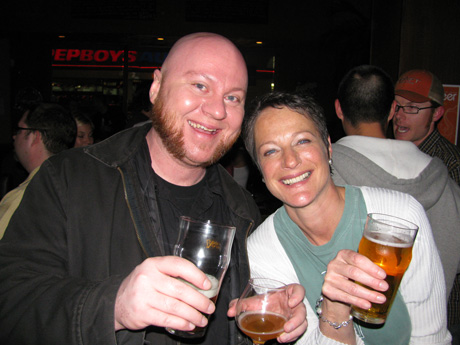
Todd with Rhonda Kallman at the Blue Palm in L.A., after the premiere of Beer Wars.
Greg Koch (from Stone), Todd, Joe Tucker, and Jason Alström.

Filed Under: Birthdays, Just For Fun Tagged With: Colorado, Denver, Massachusetts, Websites

Historic Beer Birthday: James W. Kenney

January 2, 2026 By Jay Brooks

american-boston
Today is the birthday of James W. Kenney (January 2, 1845-?). He was born in Ireland, but followed his older brother to Boston when he was eighteen, in 1863. He was involved in starting and running several different breweries in Boston over the span of his life, starting with the Armory Brewery in 1877. Then he opened the Park Brewery, the Union Brewing Co. and finally was involved in the American Brewing Co., plus he bought the Rockland Brewery at one point. It also seems like he was involved in the Kenney & Ballou Brewery, but I wasn’t able to confirm that one. Suffice it to say, he was a busy, industrious person, involved in a lot of Boston breweries.

James-W-Kenney
Kenney-100yrs-1
Kenney-100yrs-2

The_philosopher

Here’s a short biography from “Important Men of 1913”

Kenney, James W., born near Derry, Ireland, Jan. 2, 1845, and educated in the national schools of his native land. Came to Boston, 1863, and was placed in charge of a large grocery conducted by his brother. Became master brewer in a large brewery. In 1877 started Amory Brewery; 1881 Park Brewery; 1893 organized Union Brewing Co. Was mainly instrumental in organizing the American Brewing Co.; member of directors’ board two years. Large owner and operator in real estate, with interests in railroads, gas companies, banks, newspapers, etc. President, director and vice-president of Federal Trust Co.; director Mass. Bonding and Insurance Co. and Fauntleroy Hall Association of Roxbury; member of American Irish Historical Society and of numerous social and benevolent organizations. Married, April 24, 1876, Ellen Frances Rorke, of Roxbury. Residence: 234 Seaver St., Roxbury, Mass.

Bohemian-Beer-Labels-American-Brewing-Co-of-Boston

Norman Miller’s “Boston Beer: A History of Brewing in the Hub,” has a few paragraphs on several of Kenney’s businesses.

Kenney-BosBeer-1
Kenney-BosBeer-2
Kenney-BosBeer-3
Kenney-BosBeer-4

Here’s a rundown of his breweries:

Armory Brewing Co., 71 Amory Street: 1877-1902

This was his first brewery, but it was only known by that name until 1880, and I think he may have then sold it to a Mr. Robinson, who called it the Robinson Brewing Co., although some accounts indicate it was called the Rockland Brewery, which was his nickname. Their flagship was Elmo Ale, named for Robinson’s son, and not for the beloved Sesame Street Muppet. Other sources seem to suggest it was then bought back by Kenney at some point.

Park Brewery, 94 Terrace Street: 1881-1918

park

Four years later he opened the Park Brewery, which apparently produced only Irish Ales.

American Brewing Co., 249-249A Heath Street: 1891-1918

This was a larger brewery than his other ventures, and he was merely one of the investors in the business, and was on the Board of Directors, though he did hired all Jamaica Plain brewmasters. Apparently it survived the dry years by operating a “laundry” (wink, wink). After repeal, the Haffenreffer family bought it and used it briefly as a second brewery, before closing for good in 1934.

abc

The Jamaica Plain Gazette described their neighborhood American Brewing Co.:

The most “handsome” of all the remaining Boston breweries, the American Brewing Company was active from 1891 to 1918, and then again from 1933-34. Owned by James W. Kenney, who also owned the nearby Park and Union breweries, the Queen Anne style building stands out architecturally with beautiful granite arches and a distinctive rounded corner, topped by a turret.

Historically, one of the most unique features of this brewery was the “customer” room in the basement. Customers were entertained here in a room with walls, ceiling and floor painted with German drinking slogans, flowers and other reminders of the source of the Lager recipes.

The Jamaica Plain Historical Society has even more information on it in their piece about Boston’s Lost Breweries:

The brewmasters were Gottlieb, Gustav and Gottlieb F. Rothfuss, all of Jamaica Plain.

This is undoubtedly the most handsome of all the remaining breweries in Boston and once can see at a glance the pride the owners had in the place, the process and the product. The architect was Frederick Footman of Cambridge. It was built in three phases, with the oldest part on the left, the second one with the American Brewing Company name came next and then the third wing with the beautiful granite arches and terra cotta heads which was the office complex emblazoned with the initials ABC. The granite was probably either Chelmsford or the slightly grayer Quincy.

Still visible in the main, or brewing, building is the large overhead access shaft where the malted barley and water were lifted to the top floor with hoists and pumps. The barley was stored in cedar-lined rooms in the top two stories of the main building to prevent insect infestation. The brewing process was started there as the grain was cooked. The cooked mash then flowed to the floor below where the grain was removed as waste and hops and other ingredients were added to the residual brew, along with the yeast that triggered the fermentation that produced the alcohol. The final product was then stored in temperature-controlled areas at the lowest level. Also still visible in the lower level is the capped wellhead that had delivered countless thousands of gallons of pure Mission Hill spring water to the process.

A wonderful touch of the spirit of the times is the “customer” room in the basement. Customers were entertained here in a room with walls, ceiling and floor painted with German drinking slogans, flowers and other reminders of the source of the Lager recipes. The offices had beautiful arched, semi-circular windows with stained glass. The tower is rounded and has a clock fixed at seven and five, the workers’ starting and quitting times. It also has granite carriage blocks to protect carriage wheels from breaking if too tight a turn were attempted when entering or exiting.

During Prohibition it was used as a laundry. After 1934, Mr. Haffenreffer used it for a time as a second brewery. Most recently it was used by a fine arts crating and shipping company, the Fine Arts Express Co. It is presently being converted to housing units.

american-brewing-co
The American Brewing Co.

Union Brewery, 103 Terrace Street: 1893-1911

union

Next was the Union Brewery, this time to brew German Lager beer exclusively. Here’s a brief description of the Union Brewery from the Jamaica Plain Historical Society, detailing it in Boston’s Lost Breweries:

The Stony Brook culvert sits very close to the surface of Terrace Street, the home of two very productive breweries. The Union Brewery, active from 1893 to 1911, was located at 103 Terrace Street. It produced only German Lager beer. It had a large six story, arched, main building and two smaller buildings housing a stable and a powerhouse. The two smaller buildings and the mural-decorated smokestack, which now also does duty as a cell phone tower remain. The former stable is now Mississippi’s Restaurant.

While for those breweries, it’s certain they were owned by James Kenney, I’m less sure about a couple of others. From either 1878-1880 or 1898-1903 (sources differ) there was a Kenney & Ballou Brewery. It’s seems at least like that James Kenney may have been the Kenney in the name, although it could have been his older brother Neil Kenney, who James worked for when he first arrive in America. That seems even more plausible when you look another brewery founded in 1874, the Shawmont Brewery. In 1877, it became known as the Neil Kenney Brewery, but in 1884 it changed names again, this time to the James W. Kenney Brewery. It apparently closed in 1888, but it appears pretty clear that he and his brother worked together on one, if not both of these breweries. Unfortunately, except for listings in Breweriana databases, I couldn’t find any information whatsoever about either brewery, and they’re not mentioned in any accounts I found of Kenney, either.

Filed Under: Birthdays, Breweries, Just For Fun Tagged With: Boston, History, Ireland, Massachusetts

Historic Beer Birthday: John A. White

December 27, 2025 By Jay Brooks

berkshire-assn
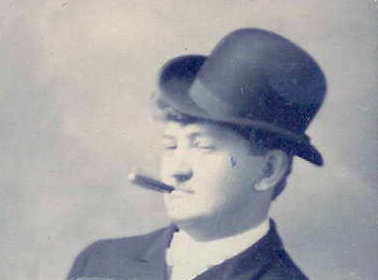
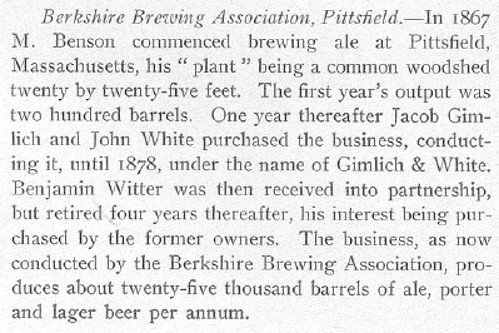
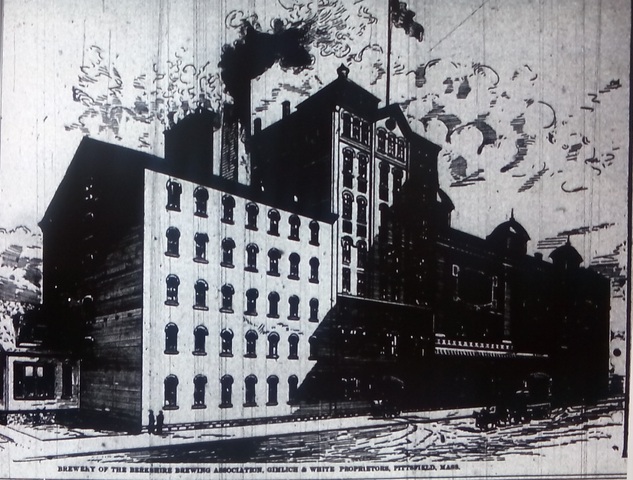
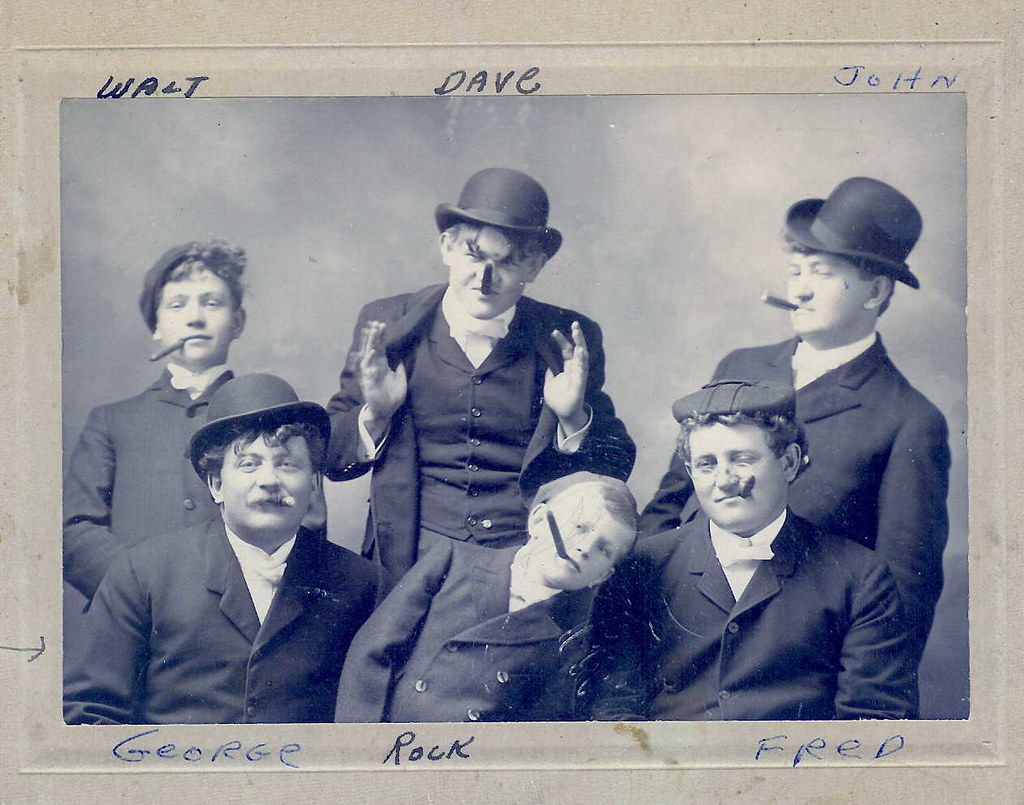
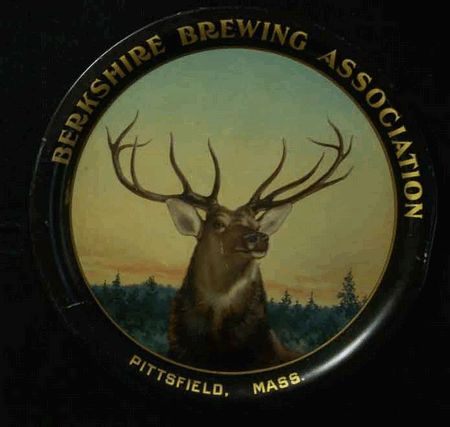
Today is the birthday of John A. White (December 27, 1839-December 17, 1916). He was born and educated in Hesse-Cassell, Germany, but came to the United States in 1856, when he was sixteen. When the Civil War began, he joined up and served with distinction for four years, participating in the battles of Gettysburg, Chancellorsville and Bull Run. After the war, he returned to baking, but a year later relocated to Pittsfield, Massachusetts and bought the M. Benson Brewery, along with Jacob Gimlich, which they called Gimlich & White, and which later became known as the Berkshire Brewing Association. It was closed by Prohibition in 1918, and never reopened after repeal.

john-a-white-portrait

Here’s White’s obituary from the American Brewers’ Review:

john-a-white-bio-1
john-a-white

john-a-white-bio-2

john-a-white-wedding
White and his wife Rachel Gimlich on their wedding day. She was the sister of White’s brewery business partner, Jacob Gimlich.

This is a short history of the brewery from 100 Years of Brewing:

berkshire-brewing-assn-100yrs
berkshire-brewery-pittsfield

Here’s a story of the brewery from the website iBerkshires.com:

One can only wonder what John White and Jacob Gimlich would have thought as federal officers poured 15,000 gallons of locally crafted beer into the sewer on an early May morning in 1922.

Gimlich and his brother-in-law White had first purchased a small brewery on Columbus Street in 1868 from Michael Benson. First called simply “Jacob Gimlich & John White,” the business began at an output of just six barrels a day, but would grow to be a major manufacturer in the West Side Pittsfield neighborhood.

Both men had immigrated to the country from Germany in their youth, and both served tours in the Civil War. Gimlich worked briefly for the Taconic Woolen Mills before going into the beer business with his sister Rachel’s husband.

By 1880, operating as Gimlich, White & Co., the brewers erected a much larger facility in a five-story brick building measuring 40 by 80 feet. The expanded plant employed from 15 to 20 men and was shipping about 16,000 barrels a year.

Gimlich and White built houses directly across the road from their plant on John Street, and as their fortunes grew became increasingly prominent members of the community. Gimlich in particular became enmeshed in a variety of financial and civic affairs. From 1884-1885, he served as the city’s representative in the Legislature, and was one of the organizers and directors of City Savings Bank. Gimlich likewise served on the board of the Berkshire Loan and Trust Co. and of the Co-Operative Bank, was a past chancellor of the local lodge, Knights of Pythias, and member of the Grand Lodge of Massachusetts and of the local Sons of Veterans.

“Pittsfield has been pleased with the success of Gimlich & White and they are counted among the town’s leading, liberal, and most public spirited citizens,” states one Pittsfield Sun editorial of the time.

By the early 1890s the torch was being passed to the next generation, with sons David Gimlich along with Fred and George White taking on more leadership of the company when it reincorporated as Berkshire Brewing Association in 1892. An additional four-story building was added, with the brewing complex now taking up the full block along Columbus Avenue between Onota and John Street to Gilbert Avenue.

bba3

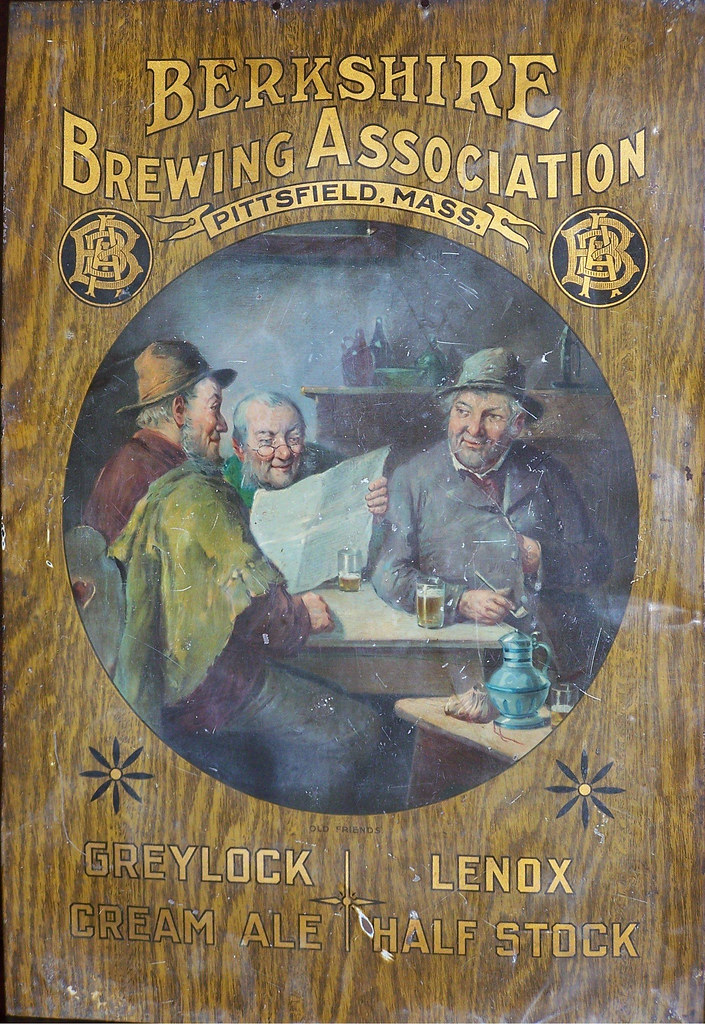
Among Berkshire Brewing’s most popular products were Mannheimer Lager Beer, Berkshire Pure Malt Extract, Lenox Half Stock Ale, and Berkshire Pale Ale, considered to be one of the finest India pale ales then on the market. The plant also churned out bottled mineral waters, ginger ale and other soft drinks.

The elder Gimlich and White passed away in 1912 and 1916, respectively, but the enterprise they founded continued to see steady growth. The only brewery of the kind within 50 miles of Pittsfield, Berkshire Brewing Association had something of a monopoly in the region, along with a thriving distribution throughout the east coast as far south as the Carolinas. At its peak, it employed 150 workers and put out 75,000 to 100,000 barrels worth of beer annually. Records indicate between 1910 and 1920, Berkshire Brewing Association paid $1 million in federal taxes, in addition to state and local taxes and fees, including $1,200 a year for a brewer’s license and $800 for an annual bottling license.

The company was not without its occasional hiccups, such as a lengthy strike in the fall of 1911 by the Pittsfield Brewers Union, culminating in the reinstatement of a dismissed employee.

Real crisis came at the end of the decade, as increasing restrictions on alcohol grew into total national prohibition. They first ceased brewing beer temporarily in December 1918, after a directive from the National Food Administration following the passage of the the Wartime Prohibition Act. Even after the passage of the Volstead Act the following fall, BBA voted to remain in business, focusing on bottled soft drinks while hoping the ban to be a brief legislative phase.

They also continued to brew beer, as did several major brewers throughout the country at first, seeing the government’s lack of resources tasked to enforce the rule. Finally in spring 1922, federal officers arrived to turn off the taps, disposing of 15,000 gallons worth and estimated $15,000 to $20,000 at the time.

Ironically, the company waited it out until nearly the end of the failed domestic policy, the board of directors voting to close down in January 1929.

The brewery building was dismantled soon after; for a time, the Siegel Furniture Co. operated out of the former bottling building, which later became the Warehouse Furniture Co. In 1975, this, too, was cleared as the land passed to the Pittsfield Housing Authority, which developed the Christopher Arms housing project that occupies the former site of the brewery today.

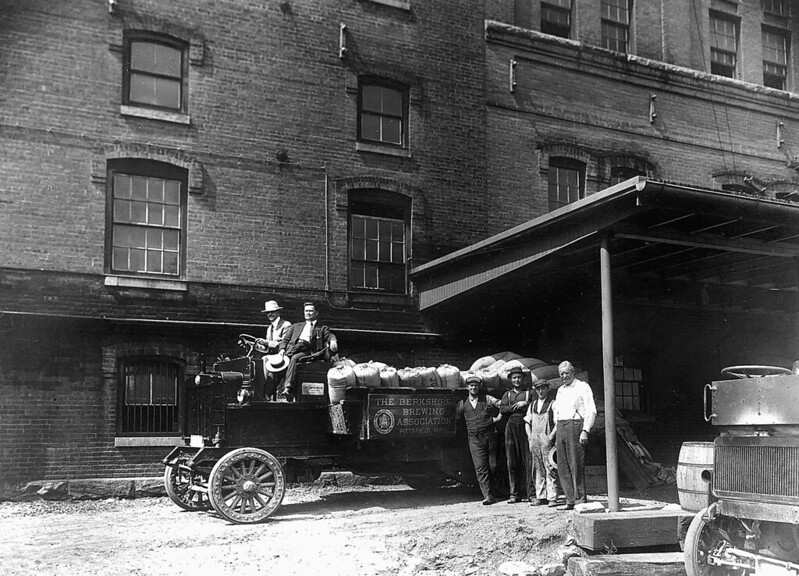
berkshire-beer-truckA brewery delivery truck around 1905.

berkshire-then-and-now

berkshire-brewing-sign

berkshire-assn

Filed Under: Birthdays, Breweries, Just For Fun Tagged With: Germany, History, Massachusetts

Historic Beer Birthday: John Roessle

December 23, 2025 By Jay Brooks

Today is the birthday of John Roessle (December 23, 1808-October 3, 1873). He emigrated from Germany at fifteen, eventually settling in Boston, where he founded the John Roessle Brewery in 1846. It was one of the earliest lager breweries in the country, though they also used the name New England Brewing Co. from 1890 through prohibition. After repeal they became known as the Haffenreffer & Co., presumably having been bought by the Haffenreffer Brewery, which was also located in Boston, before closing in 1951. There’s not personal information I could find out about Roessle, though there’s plenty on his brewery.

And here’s his obituary from the Boston Evening Transcript in 1873:

And this is another account of Roeselle’s passing:

And this was written by Gregg Smith in 1997 for Yankee Brew News:

For centuries businesses have heralded any aspect of a product that can distance it from the competition. Location, processes, raw materials, and packaging have all been used to project an appealing cachet. Lacking those, they often resort to adjectives such as: quality, purity, tradition, best, finest, and preferred. But among all ways to boast a product none works better than the simple proclamation: First!

Brewer John Roessle became a “first” when he established a small brewery at 60 Pynchon street in Roxbury. It earned him a spot in New England beer history because from its opening in 1846 Roessle devoted production exclusively to brewing a new beer style that was capturing America’s taste.

Originating in Germany, the yeast for this beer arrived in the US only shortly before Roessle began construction of his brewery. It produced a distinctively clean beer with a crisp after taste unavailable in the much fruitier ale family of beer. This characteristic signature was the by-product of a lengthy, cold fermentation and so Germans simply named it after their word for storage – lager. The significance of the date not only made Roessle a pioneer of lager in the Northeast, it placed him among the first in the country to brew this style.

In those early days Roessle’s brewery had a maximum capacity of only 300 barrels, but despite its small size it had advantages over ale breweries. First, its flagship beer “Taffel” quickly became a favorite of Boston’s German population. More importantly, Roessle wasn’t burdened with the expense of distribution; enthusiastic and loyal customers bought every drop from the brewery’s door. It didn’t take long for Roessle to capitalize on the brand’s popularity by expanding the brewery. In fact, each time production increased sales rose equally.

Through four decades Roessle personally managed the business, then at his death in 1885 ownership was assumed by son John Roessle Jr. who directed operations for 11 more years. This wasn’t the brewery’s only father and son team. For over twenty years Robert Leiber carried out the duties of head brewer and when he died in 1890 the brew kettle was turned over to his son Albert. The fathers and sons of Roessle brewing performed so well the brewery was admired in the community, but not in the way they imagined.

During the 1890s breweries became the favorite investment of syndicates, and Roessle’s reputation made it one of Boston’s most attractive takeover targets. Among those noting the company’s impressive record was the New England Brewing Company, which presented John Roessle Jr. an offer substantial enough to make him sell. That same year they acquired the Haffenreffer brewery and two years later the Suffolk Brewing Company, and shifted the business address to 1250 Columbus Avenue, Boston. Despite consolidating, the continuing popularity of the Roessle brand prompted the new owners to preserve the name, and as the century turned the facility hit an annual production figure of 65,000 barrels.

For more than 20 years the syndicate reaped the profits of the Roessle’s name, as the beer slowly captured more of the Boston market. By 1918 the brewery was growing outmoded and badly needed a modernization. Then the unimaginable happened–Prohibition. At its onset, the syndicate closed the Roessle plant. It lay slowly decaying, becoming more obsolete with each day of prohibition’s 14 year lock out.

When repeal came they considered it too inefficient for further operation and the only plant they reopened was that of Haffenreffer. Once a darling of the city, the doors were shut forever, but no one will ever again claim the title of New England’s first.

Filed Under: Birthdays, Breweries, Just For Fun Tagged With: Germany, History, Massachusetts

Beer In Ads #5144: Here’s Pickwick’s Holiday Gift To Bock Beer Lovers

December 18, 2025 By Jay Brooks

Last year I decided to concentrate on Bock ads for awhile. Bock, of course, may have originated in Germany, in the town of Einbeck. Because many 19th century American breweries were founded by German immigrants, they offered a bock at certain times of the year, be it Spring, Easter, Lent, Christmas, or what have you. In a sense they were some of the first seasonal beers. “The style was later adopted in Bavaria by Munich brewers in the 17th century. Due to their Bavarian accent, citizens of Munich pronounced ‘Einbeck’ as ‘ein Bock’ (a billy goat), and thus the beer became known as ‘Bock.’ A goat often appears on bottle labels.” And presumably because they were special releases, many breweries went all out promoting them with beautiful artwork on posters and other advertising.

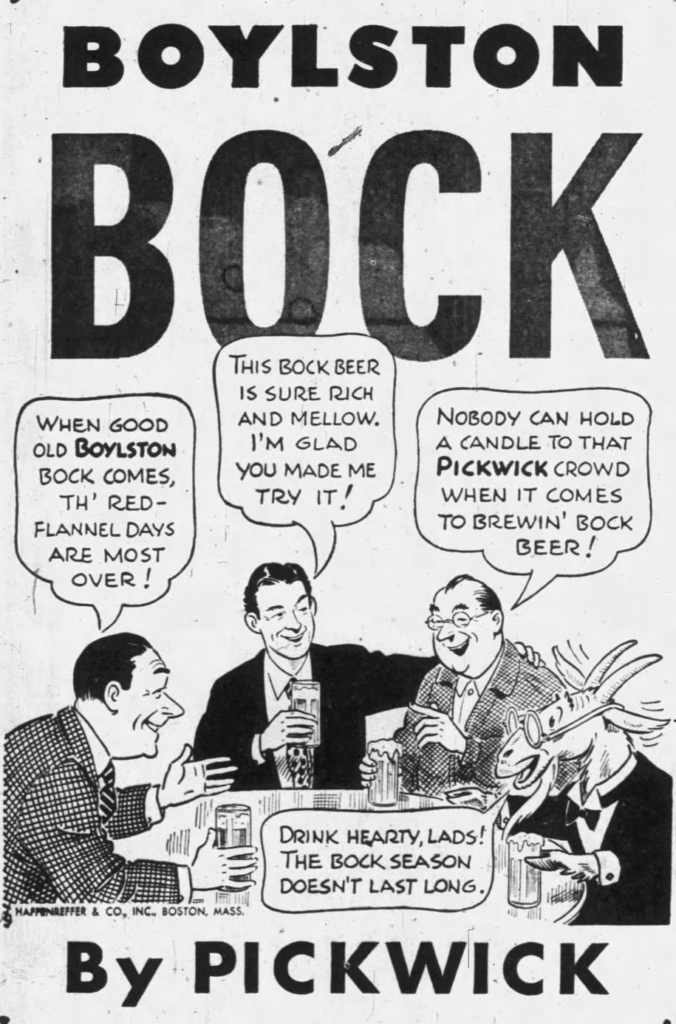
Thursday’s ad is for Pickwick Bock Beer, which was published on December 18, 1953. The brewery was the Haffenreffer Brewery of Boston, Massachusetts, which was originally founded in 1870. It was located in the Jamaica Plain area of Boston, and today the site of the brewery is where the Boston Beer Co. operates one of its breweries. This ad ran in The Morning Union of Springfield, Massachusetts.

Filed Under: Art & Beer, Beers, Breweries, Just For Fun Tagged With: Advertising, Bock, History, Massachusetts

Beer In Ads #5143: Like Bluebirds In The Christmas Tree Bock … Beer Is Here

December 17, 2025 By Jay Brooks

Last year I decided to concentrate on Bock ads for awhile. Bock, of course, may have originated in Germany, in the town of Einbeck. Because many 19th century American breweries were founded by German immigrants, they offered a bock at certain times of the year, be it Spring, Easter, Lent, Christmas, or what have you. In a sense they were some of the first seasonal beers. “The style was later adopted in Bavaria by Munich brewers in the 17th century. Due to their Bavarian accent, citizens of Munich pronounced ‘Einbeck’ as ‘ein Bock’ (a billy goat), and thus the beer became known as ‘Bock.’ A goat often appears on bottle labels.” And presumably because they were special releases, many breweries went all out promoting them with beautiful artwork on posters and other advertising.

Wednesday’s ad is for Pickwick Bock Beer, which was published on December 17, 1953. The brewery was the Haffenreffer Brewery of Boston, Massachusetts, which was originally founded in 1870. It was located in the Jamaica Plain area of Boston, and today the site of the brewery is where the Boston Beer Co. operates one of its breweries. This ad ran in The Boston Globe of Boston, Massachusetts.

Filed Under: Art & Beer, Beers, Breweries, Just For Fun Tagged With: Advertising, Bock, History, Massachusetts

Next Page »

Find Something

Northern California Breweries

Please consider purchasing my latest book, California Breweries North, available from Amazon, or ask for it at your local bookstore.

Recent Comments

  • Ernie Dewing on Historic Beer Birthday: Charles William Bergner 
  • Steve 'Pudgy' De Rose on Historic Beer Birthday: Jacob Schmidt
  • Jay Brooks on Beer Birthday: Bill Owens
  • Steve 'Pudgy' De Rose on Beer Birthday: Charles Finkel
  • Steve 'Pudgy' De Rose on Beer Birthday: Bill Owens

Recent Posts

  • Beer In Ads #5201: Metzger’s Bock Beer February 13, 2026
  • Historic Beer Birthday: Mary of Burgundy February 13, 2026
  • Historic Beer Birthday: Henry C. Haefner Jr. February 13, 2026
  • Beer Birthday: Bruce Joseph February 13, 2026
  • Beer In Ads #5200: Now Is The Time To Enjoy … Stroh’s Bock Beer February 12, 2026

BBB Archives

Feedback

Head Quarter
This site is hosted and maintained by H25Q.dev. Any questions or comments for the webmaster can be directed here.