Brookston Beer Bulletin

Jay R. Brooks on Beer

  • Home
  • About
  • Editorial
  • Birthdays
  • Art & Beer

Socialize

  • Dribbble
  • Email
  • Facebook
  • Flickr
  • GitHub
  • Instagram
  • LinkedIn
  • Pinterest
  • RSS
  • Twitter
  • YouTube

Powered by Genesis

Patent No. 57381A: Improvement In Hop-Vine Supports

August 21, 2015 By Jay Brooks

patent-logo
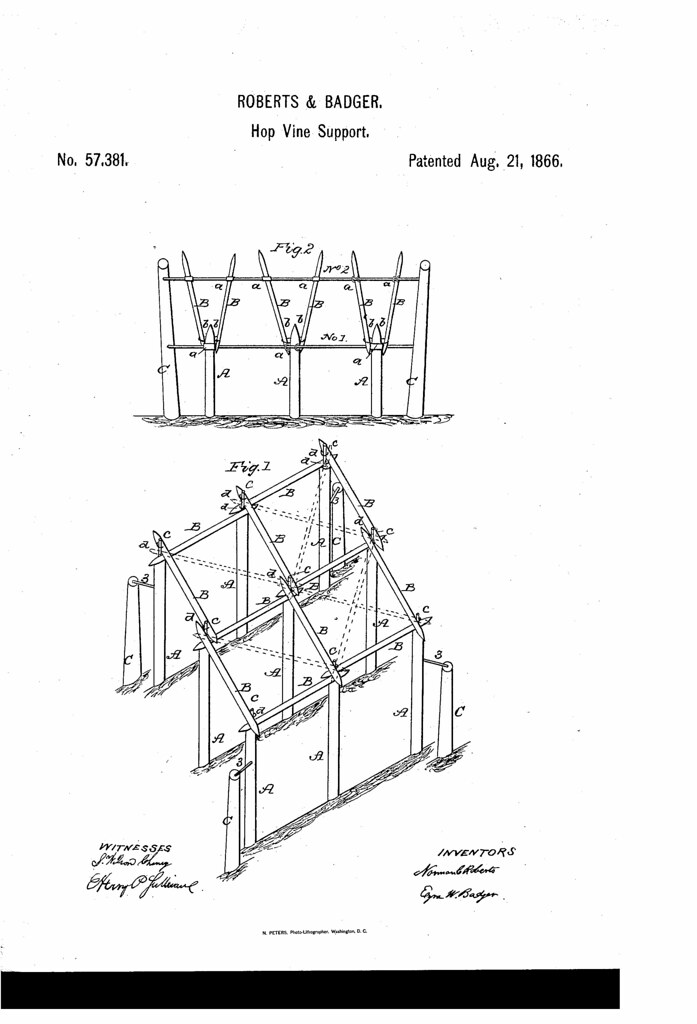
Today in 1866, US Patent 57381 A was issued, an invention of Norman C. Roberts and Ezra V. Badger, for their “Improvement in Hop-Vine Supports.” There’s no Abstract, although in the description it includes this summary:

[We] have invented a new and Improved Mode of Constructing Hop-Rods, to be used in the culture of hops, which we call Portable Sectional Hop-Rods and we do hereby declare that the following is a full, clear, and exact description of the said invention, reference being had to the accompanying drawings, and to the letters of reference marked thereon, in which- Figure 1 is a perspective view of a hop-yard with the upper section or rods placed horizontal. Fig. 2 is a view of the same with the upper section or rods placed on an angle.

The nature of our invention consists in setting one rod in each hill of hops, and of having other rods or sections suitably connected and supported either horizontally or at any desired angle, by which we are enabled to save a great amount of expense in the raising of hops.
Untitled

Filed Under: Beers, Just For Fun, Politics & Law, Related Pleasures Tagged With: History, Hops, Law, Patent

Patent No. 7258887B2: Preparation Of Light Stable Hops

August 21, 2015 By Jay Brooks

patent-logo
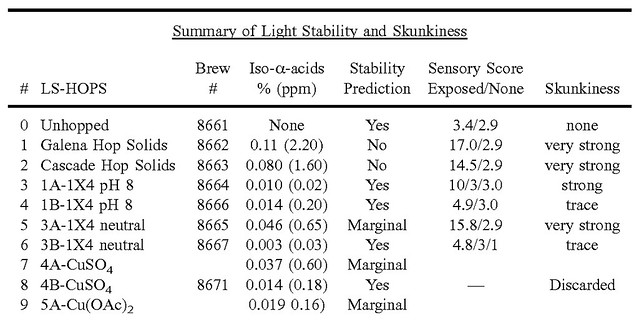
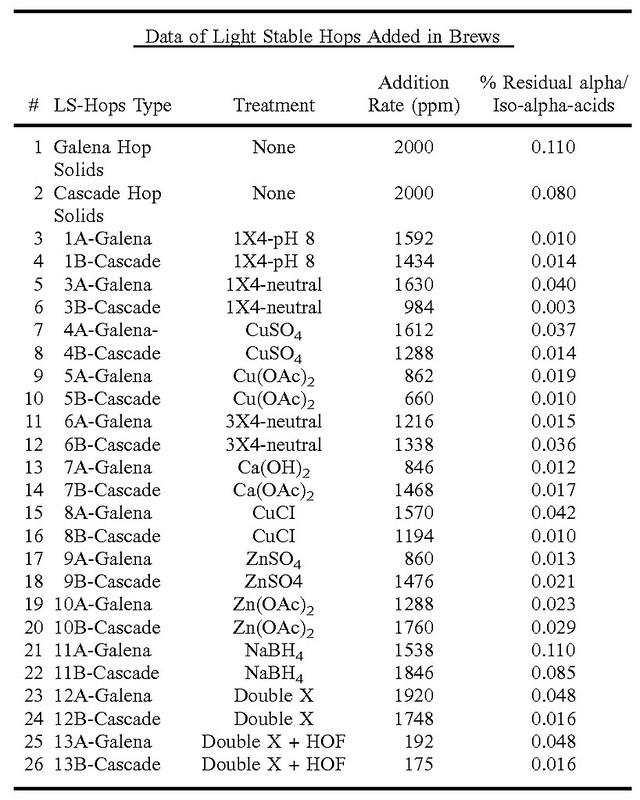
Today in 2007, US Patent 7258887 B2 was issued, an invention of Patrick L. Ting, Henry Goldstein, Aki A. Murakami, Michael VanSanford, Jay R. Refling, John R. Seabrooks, and David S. Ryder, assigned to Miller Brewing Company, for their “Preparation of Light Stable Hops.” Here’s the Abstract:

Disclosed are methods for the production of light stable hops, useful for the brewing of beer or ale to be stored in clear or green glass containers, which beer or ale will not develop objectionable flavor as a result of exposure to light. Light stable hops are prepared by double extraction of liquid/supercritical CO2 extracted hop solids with ethanol to remove alpha/iso-alpha-acids. Such alpha/iso-alpha-acids may be further removed from the ethanol extraction liquor obtained in the double extraction process by subjecting such liquor to an ion exchange medium, or precipitation by a metal ion, heavy metal ion, or alkali metal ion, to provide an alpha/iso-alpha-acid is free extraction liquor which may be added to the light stable hops residue obtained in the initial double extraction process.

Wanting to continue using their distinctive clear bottle for Miller High Life, at least since 1962, Miller started coming with preparations to make certain hops less subject to becoming lightstruck. In 1962, they patented a Anactinic malt product and hop extract therefor and since then at least eight newer patents improves aspects of the same idea.
Untitled
Untitled

Filed Under: Beers, Breweries, Just For Fun, Politics & Law, Related Pleasures Tagged With: History, Hops, Law, Patent, Science of Brewing

Patent No. WO1993016167A1: Concentrated Beer Flavor Product

August 19, 2015 By Jay Brooks

patent-logo
Today in 1993, US Patent WO 1993016167 A1 was issued, an invention of James Allan Doncheck, Bruce John Morton, Michael Rudolph Sfat, and Ann Christine Wege, assigned to Bio Tech Resources, for their “Concentrated Beer Flavor Product.” Here’s the Abstract:

A process for forming a beer flavored concentrate by germinating barely (e.g., in the presence of the enzyme promoting agent gibberellic acid) to produce a green malt of approximately 43 % moisture content that is heated in a closed container at 85° to 95 °C for 2 to 6 hours (i.e., raising the internal bed temperature to 70° to 89 °C for one half to 3 hours) to reduce amylolytic enzyme activity. By kiln drying in an opened container (e.g. at 50° to 65 °C for 12 to 18 hours) an amylolytic enzyme deficient green malt of 3.5 to 5.5 wt.% moisture content is produced. This dried malt when used to make a mash (e.g. upon grinding and the addition of brewing water) results in the preparation of a wort that when boiled and pitched with brewers yeast can be fermented by conventional methods. The fermented wot can be diluted with water to yield a malt beverage containing less than 0.5 volume % alcohol and less than 40 calories per 12 ounces or alternatively concentrated by vacuum evaporation, freeze concentration, spray-drying and/or freeze drying to produce an intense beer flavored product.

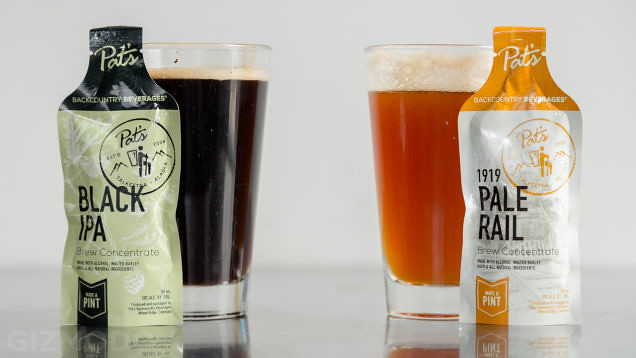
I’m not sure if it’s the same or not, but Pat’s Backcountry Beverages started offering something similar for sale recently, which Gizmodo tested in We Drank Beer Concentrate So You Don’t Have To.
pats-concentrate

Filed Under: Beers, Just For Fun, Politics & Law, Related Pleasures Tagged With: History, Law, Patent, Science of Brewing

Patent No. D46298S: Design For A Bottle-Opener

August 18, 2015 By Jay Brooks

patent-logo
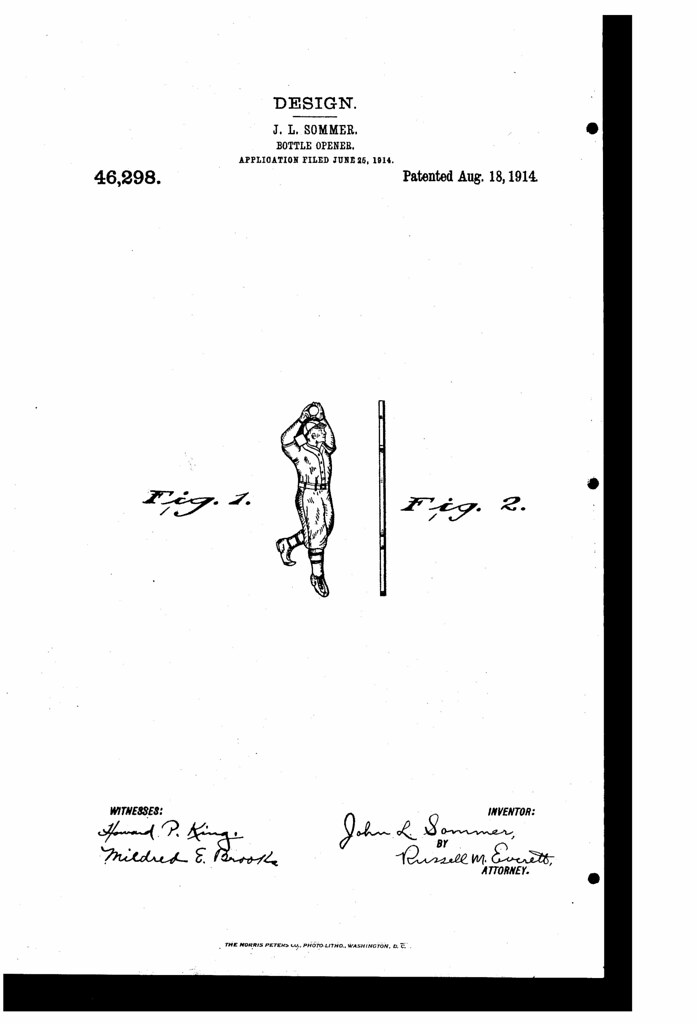
Today in 1914, US Patent D46298 S was issued, an invention of John L. Sommer, for his “Design for a Bottle-Opener.” There’s no Abstract, although in the description it includes this very short description, claiming that he has “invented a new, original and ornamental Design for a Bottle-Opener.” I bet you could make these today and they’d still be popular.
Untitled

Filed Under: Beers, Just For Fun, Politics & Law, Related Pleasures Tagged With: gadgets, History, Law, Packaging, Patent

Patent No. PP20227P3: Hop Plant Named ‘Super Galena’

August 18, 2015 By Jay Brooks

patent-logo
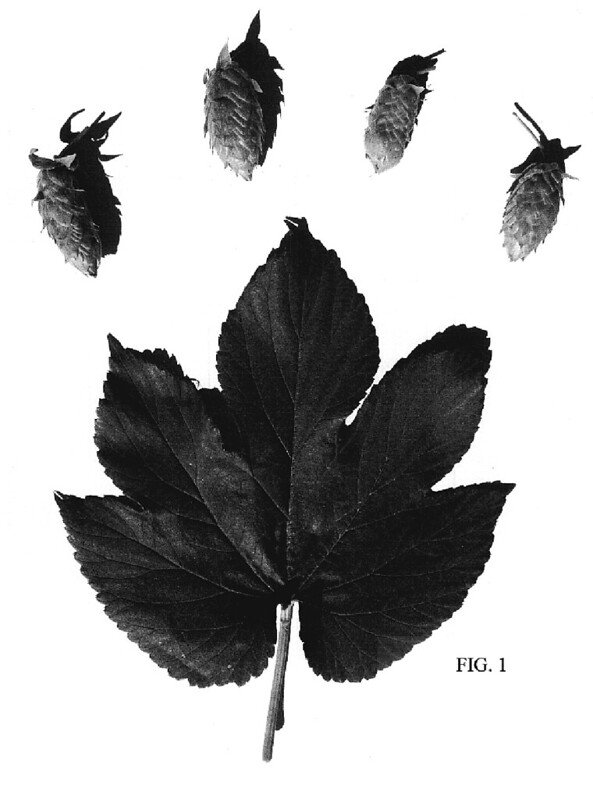
Today in 2009, US Patent PP20227 P3 was issued, an invention of Roger D. Jeske and Joe Brulotte, assigned to S.S. Steiner, Inc., for their “Hop Plant Named ‘Super Galena.'” Here’s the Abstract:

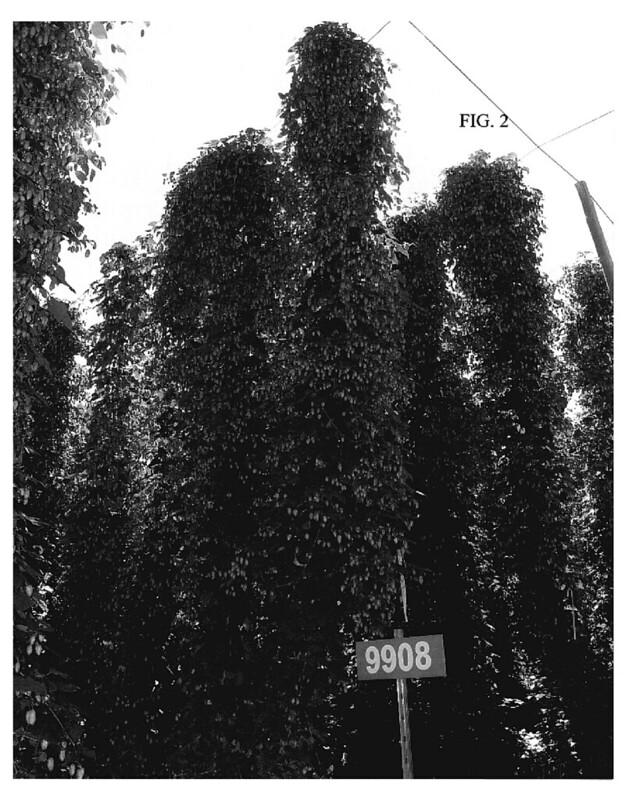
A novel variety of hop, Humulus lupulus L., named “Super Galena” is disclosed. “Super Galena” has relatively high contents of bitter acids, beta-acids, total oil, and humulene, and a moderate, pleasant aroma. “Super Galena” is comparable to Galena in its aroma and bitterness profile but offers a substantially higher yield and complete resistance to hop powdery mildew strains found in Washington, United States. The new variety was discovered among the progeny of a sexual cross made in 1998 in Yakima, Wash., United States and has been asexually reproduced and assessed in field plots in Prosser, Wash., United States.

Untitled
Untitled

Filed Under: Beers, Just For Fun, Politics & Law, Related Pleasures Tagged With: History, Hops, Law, Patent

Patent No. 2447122A: Hop Picking Machine

August 17, 2015 By Jay Brooks

patent-logo
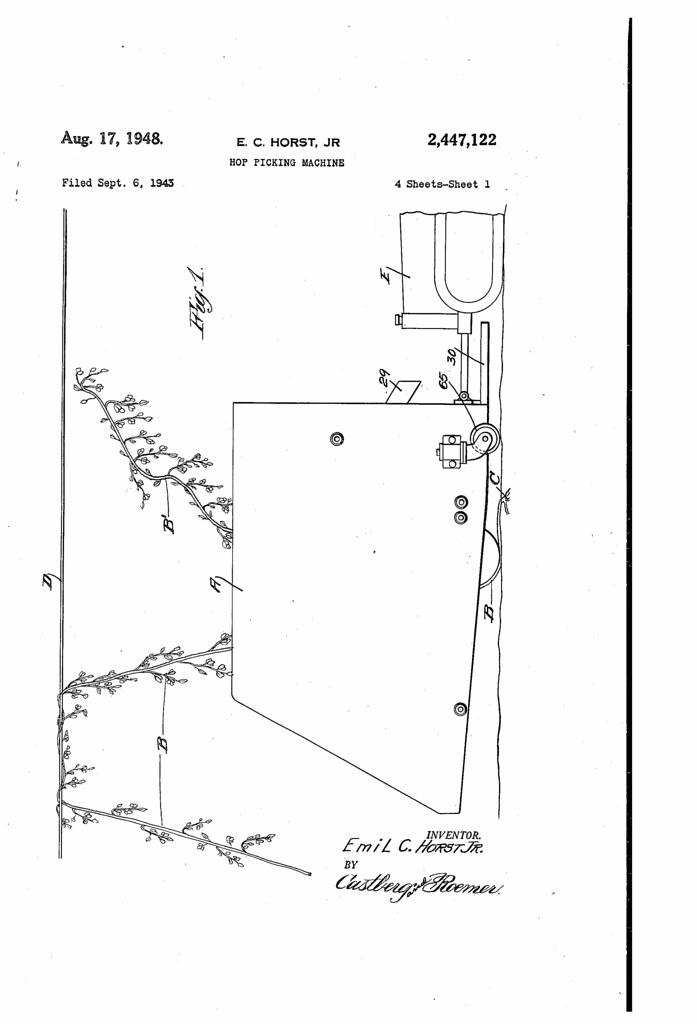
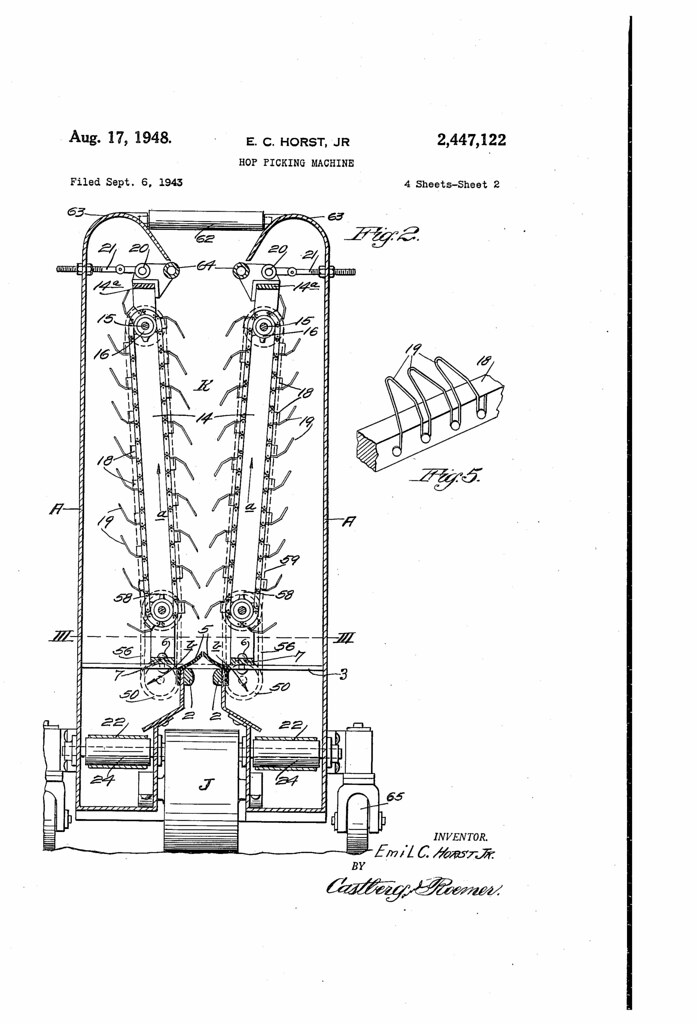
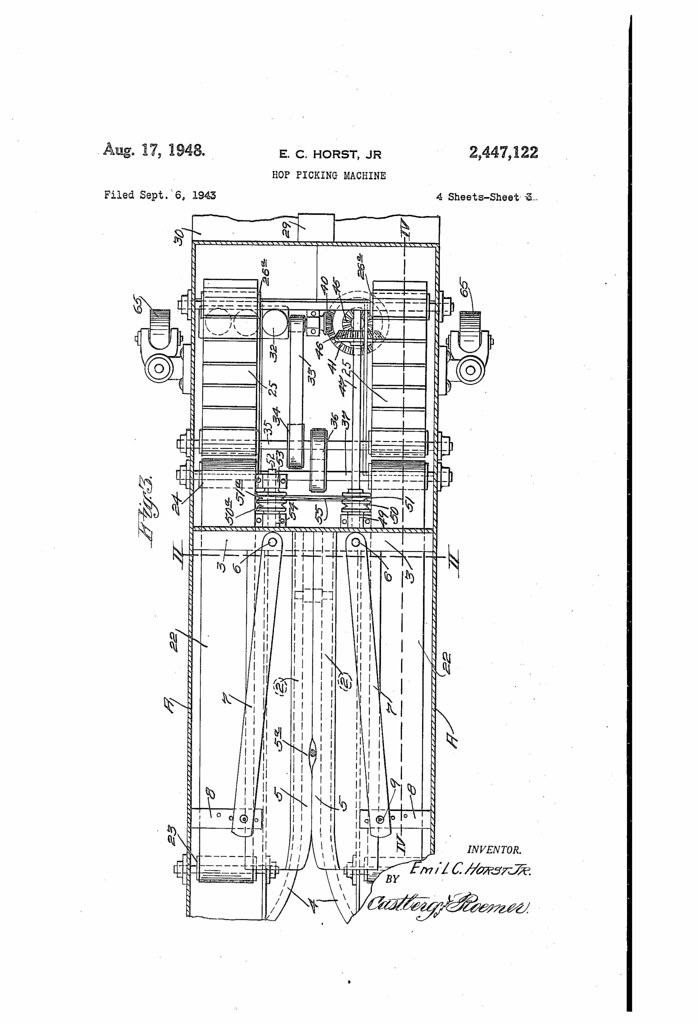
Today in 1948, US Patent 2447122 A was issued, an invention of Emil C. Horst Jr., for his “Hop Picking Machine.” There’s no Abstract, although in the description it includes this summary:

There are two types of hop picking machines in general use at the present time, to wit, a stationary and a portable type. Where stationary machines are used, the hop vines are cut ofi in the fields and loaded on trucks or wagons and hauled into the stationary machine where they are removed and attached to grasper bars which pull the hop vines between revolving drums or traveling belts equipped with V-shaped wire fingers which comb the vines and strip or remove the hops and most of the leaves. The picked hops and leaves are then delivered to separator belts where the leaves and stems and other foreign material are separated from the hops, and clean hop-s are finally obtained.

The portable type of machine operates in substantially the same manner, the principal difference being that the portable machine travels in the fields where the hops grow, and as the machine advances, the hop vines are cut down and attached directly to grasper bars which pull the vines through the machine with the result that the hops and leaves are stripped on and then delivered to separators to finally obtain the clean hops.

From the foregoing, it will be noted that whether a portable or stationary machine is employed, the hop vines must be cut off and attached to grasper bars in order to feed or pull them through the machines where the stripping operation takes place.

The object of the present invention is to provide a new method and machine whereby hops can be picked directly from the vines in the field without the necessity of cutting the vines free from the plant or root from which they grow; to provide a portable machine which straddles and travels along a row of hop vines and as it travels, combs the hop vines in an upward direction thereby more efficiently removing the which can singly and in clusters generally beneath the leaves and arms of the hop Vines; and further, to provide a machine in which grasper bars together with associated mechanism is entirely eliminated and the machine proper very materially simplified, this being accomplished by providing a roller which rolls over the stalk the vine and with sufficient traction to pull the vine downwardly through the combing or picking fingers of the machine as the machine advances.

Untitled
Untitled
Untitled
Untitled

Filed Under: Beers, Just For Fun, Politics & Law, Related Pleasures Tagged With: History, Hops, Law, Patent

Patent No. 166742A: Improvement In Beer-Refrigerators

August 17, 2015 By Jay Brooks

patent-logo
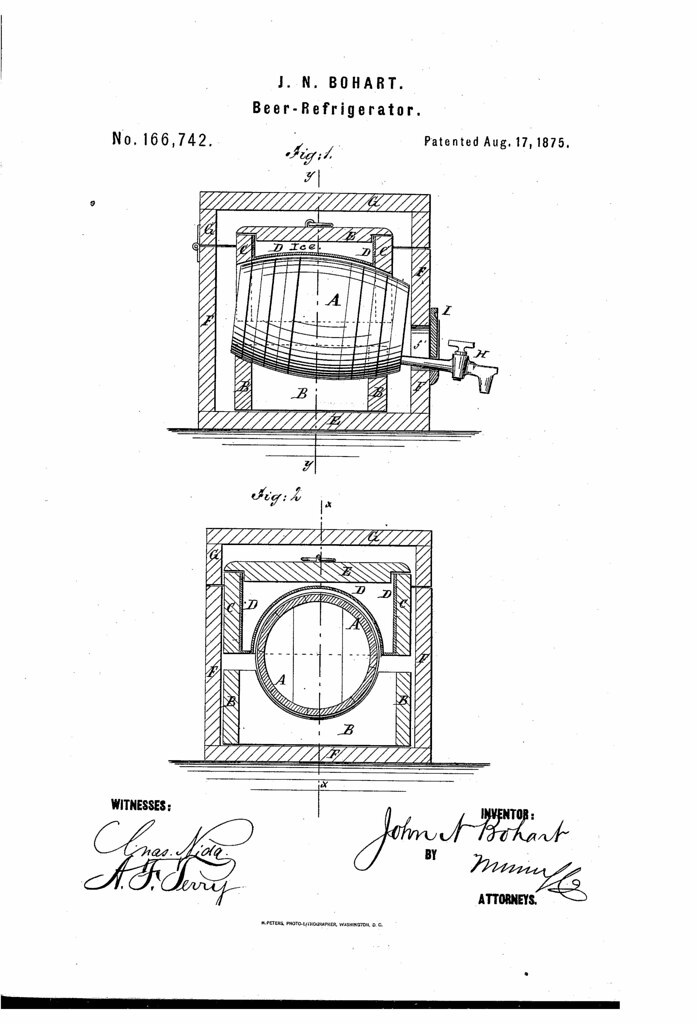
Today in 1875, US Patent 166742 A was issued, an invention of John K. Bohaet, for his “Improvement in Beer-Refrigerators.” There’s no Abstract, although in the description it includes this summary:

The object of this invention is to furnish an improved refrigerator for cooling lager-beer in the keg, and which shall be so constructed as to cool the beer quickly, and keep it cool for a long time with a small quantity of ice, and which shall be simple in construction, convenient in use, and very compact, requiring but little space. The invention consists in the beer-refrigerator formed of the skid, the ice-box, and the outer box or case, constructed as hereinafter fully described, to adapt it to receive a beer-keg, as set forth.

US166742-0

Filed Under: Beers, Just For Fun, Politics & Law, Related Pleasures Tagged With: History, Kegs, Law, Patent

Patent No. 3266263A: Concentration Of Aqueous Solutions By Crystallization With Sonic Defoaming

August 16, 2015 By Jay Brooks

patent-logo
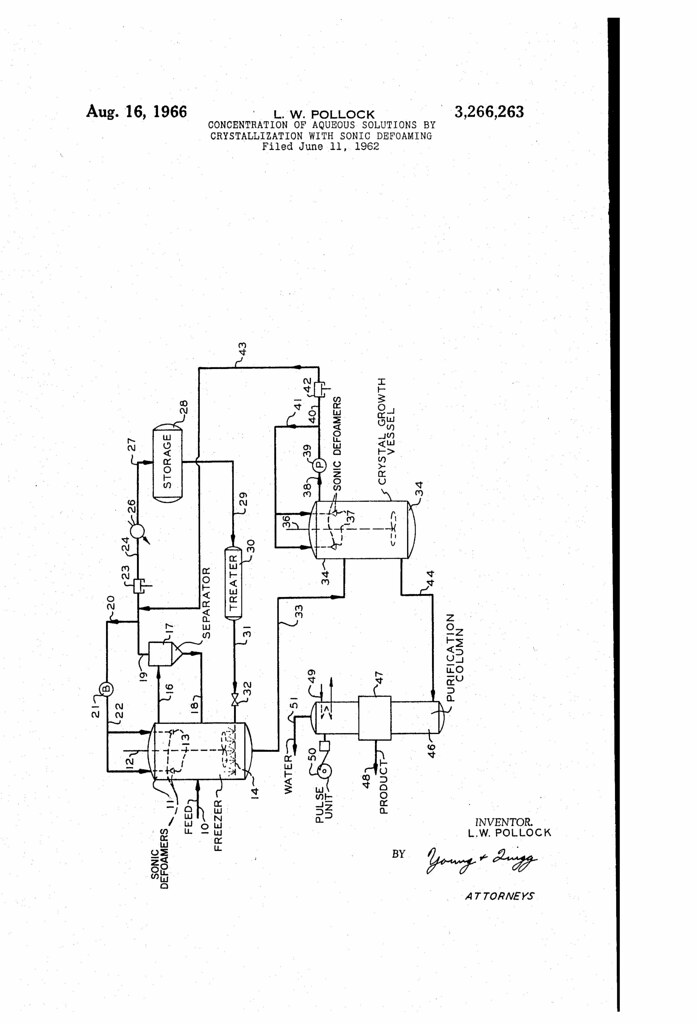
Today in 1966, US Patent 3266263 A was issued, an invention of Lyle W. Pollock, for his “Concentration of Aqueous Solutions by Crystallization with Sonic Defoaming.” There’s no Abstract, although in the description it includes this summary:

Conventionally, aqueous solutions can be concentrated by crystallization involving chilling the aqueous solution to form ice crystals with subsequent separation of the ice crystals from the mother liquor. This method as `applied to the concentration of food products has become commercially acceptable as it can be carried out without damaging the taste of the food product. In this respect, concentration by crystallization represents a considerable improvement over evaporative processes which rely upon heat and/or extremely low pressure. The removal of water by evaporation also results in the removal of much of the essential oils and esters, many of which are not recoverable, so that the concentrated product can never be restored to its original freshness and flavor. Concentration by crystallization can be employed to advantage in the processing of such food products and beverages as milk, fruit juices, vegetable juices, vinegar, beer, wine, liquors and the like.

A method of concentrating by crystallization involves chilling the aqueous solution in a chiller to form a slurry of ice crystals and mother liquor and then forcing the resulting slurry into a crystal purification column such as described in the patent to Schmidt, Re. 23,810, and the patent to R. W. Thomas, 2,854,494, and comprising an elongated confined concentration zone. The crystals are moved in a compact mass into a body of crystal melt which is formed by heating the crystals in a downstream portion of the concentration zone. A portion of the crystal melt is displaced back into the advancing crystal mass. The purification column includes an upstream liquid removal zone, a middle reflux zone and a downstream melting zone. Mother liquor is removed from the crystals in the liquid removal zone and the crystals :are melted in the melting zone.

In the chilling step, a scraped-surface stainless steel chiller is conventionally employed. The scraped-surface stainless steel chiller represents a major investment cost and an overall major process expense. It would be desirable, therefore, to eliminate the scraped-surface chiller and thus substantially `reduce the process cost of concentrating aqueous solutions by crystallization.

The inventive process can be employed to advantage in the processing of such food products and beverages as milk, fruit juices, vegetable juices, vinegar, beer, wine, liquors, and the like. The inventive process is particularly applicable to the concentration of beer as the beer 3,266,263 Patented August 16, 1966 ICC withdrawn from the fermenters usually contains 1 to 2 volumes of carbon dioxide at standard temperature and pressure (60 F. and l atmosphere) per volume of liquid beer. Therefore, contacting the 4beer with carbon dioxide does not involve the introduction of a new component to the beer.

The invention will hereinafter be described as applied specifically to the concentration of beer, although it is the temperature of the beer feed is lowered to form a slurry of ice crystals. The temperature within freezer 11 can range from about 0 to 32 F. and the pressure can range from about to 50 p.s.i.g, The weight ratio of liquid carbon dioxide to beer passed to freezer 11 can range from about 1:2 to about 2: 1.

Freezer 11 is provided with a means for mixing 12 the carbon dioxide and beer feed streams. In order to prevent foaming, conventional sonic defoamers 13 are employed. Reference is made to lChemical Week, May 6, 1961, page 52, for a discussion of the effectiveness of sonic defoamers as applied to the beer industry.

Untitled

Filed Under: Beers, Breweries, Just For Fun, Politics & Law, Related Pleasures Tagged With: History, Law, Patent, Science of Brewing

Patent No. 4042142A: Beer Keg Cooling Container

August 16, 2015 By Jay Brooks

patent-logo
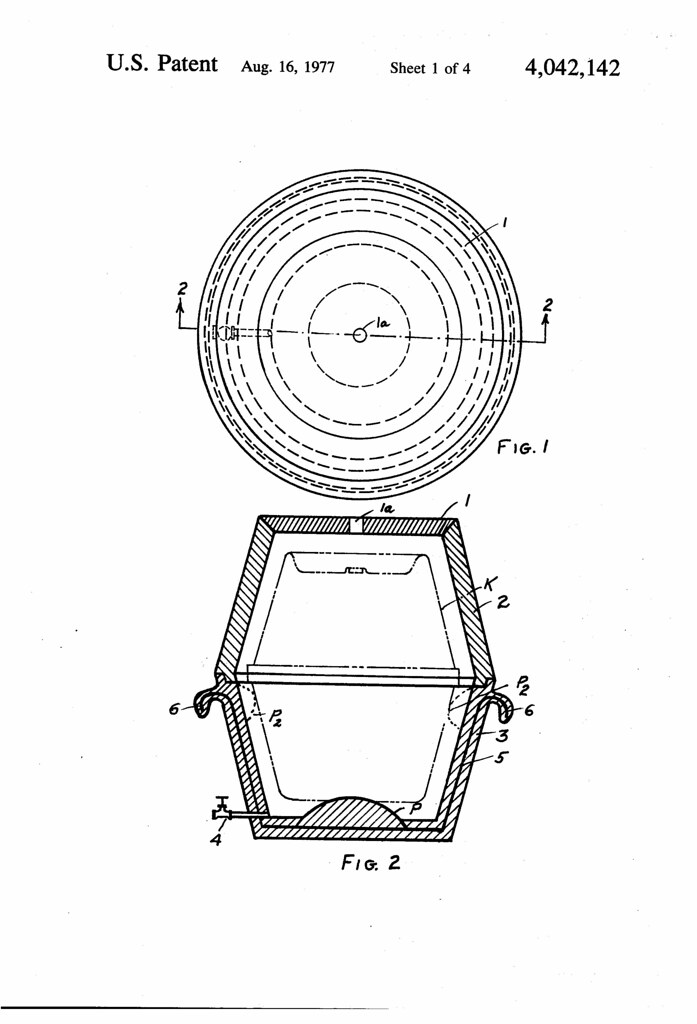
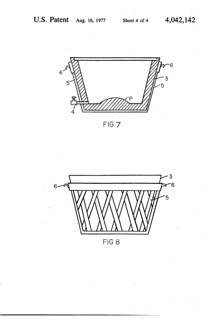
Today in 1977, US Patent 4042142 A was issued, an invention of Robert W. Ruano, for his “Beer Keg Cooling Container.” Here’s the Abstract:

A beer keg container of insulating material, such as styrofoam, subdivided into three parts, a lid with a hole through which the shaft of the tap extends, an upper half, and a bottom half, which halves are detachably connected by an interlocking joint. The bottom half is reinforced with a wire basket having handles to facilitate carrying of the insulating container and enclosed beer keg. The diameter of the beer keg is smaller and spaced from the inner diameter of the container so that the space there between may be packed with ice cubes or crushed ice to keep the beer keg cold.

Untitled

Untitled Untitled

Filed Under: Beers, Just For Fun, Politics & Law, Related Pleasures Tagged With: History, Kegs, Law, Patent

Patent No. 503168A: Brewing Process

August 15, 2015 By Jay Brooks

patent-logo
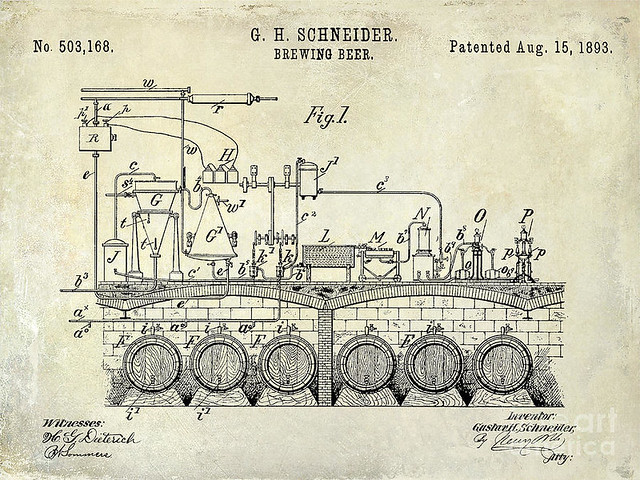
Today in 1893, US Patent 503168 A was issued, an invention of Gustav Hermann Schneider (a.k.a. G.H. Schneider), of Hamburg, Germany, for his “Brewing Process.” There’s no Abstract, although in the description it includes this summary:

My invention has relation to the art of brewing beer from the wort, and it has for its object the provision of means whereby a product is obtained whose nutritive properties are materially increased, that is not as liable to secondary fermentation and that will keep in good condition for a longer time than beer brewed in the usual way.

One of the advantages of my invention lies in the fact that the fermentation may be interrupted at any time, thereby enabling the brewer to vary the percentage of alcohol in the beer, according to requirements, and consequently preserve to the beer a larger percentage of extracts than has been possible heretofore.

A further advantage of my invention consists in obviating the cellar storage otherwise necessary, and in cheapening considerably the production of beer, notwithstanding that a product is obtained of a taste far more cess.

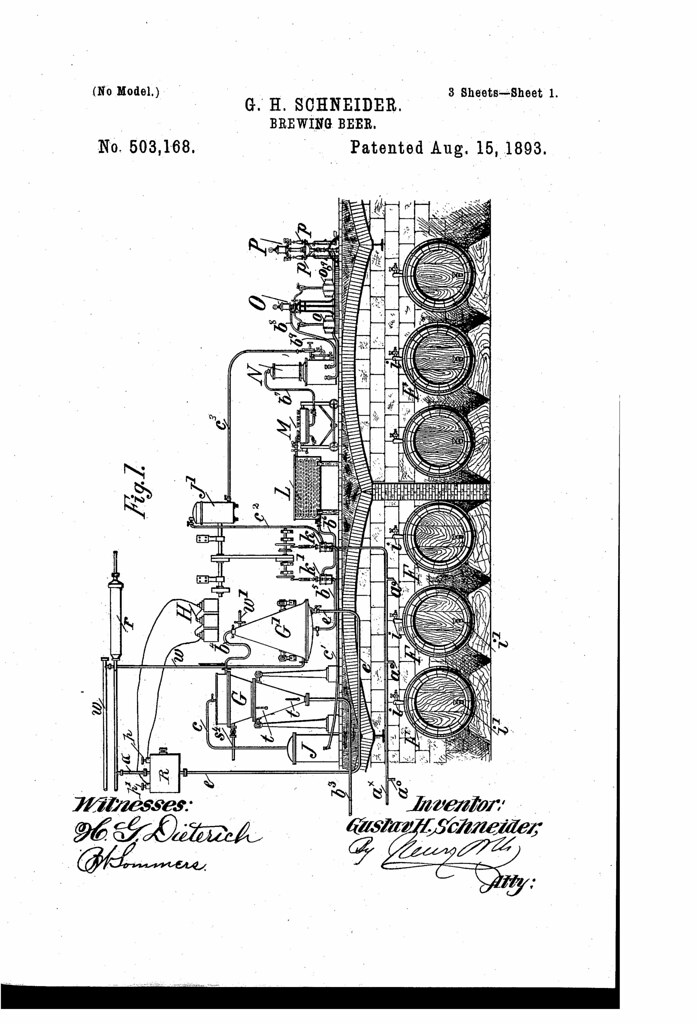
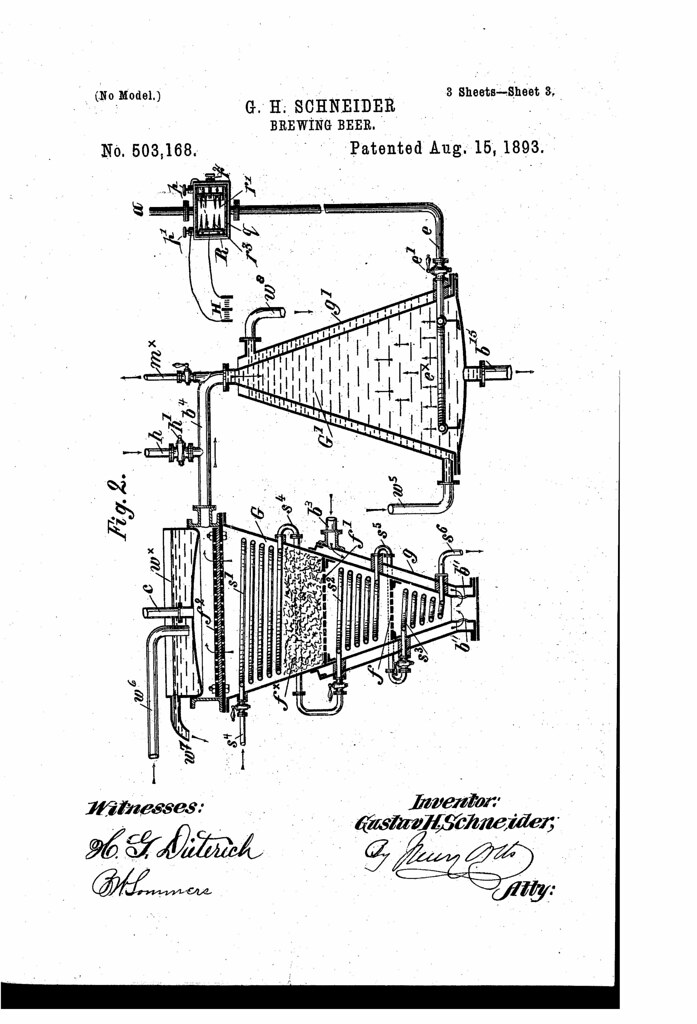
I attain these objects by adding hops to the wort, boiling the same by means of steam under pressure, cooling the boiled wort, filtering, and subjecting the filtered wort to a yeast fermentation, pasteurizing the fermented liquid by means of heat, cooling it down, and aerating it by means of ozonized air,and finally charging the sterilized liquid with carbonic acid, when the beer will be ready for storage, these operations, and the storage being successively carried out under exclusion of ambient atmospheric air, the liquid being forced through the various apparatuses, and finally to the receiver, by means of sterilized air. But that my invention may be fully understood, l will describe the same in detail, reference being had to the accompanying drawings, in which- Figures 1 and l show in side elevation a plant by means of which my invention may be carried out, and Fig. 2 is a sectional elevation of my improved pasteurizing and aerating apparatus.

Untitled

And here’s the original drawings filed with the patent application:

US503168-0
Untitled
Untitled

Filed Under: Beers, Breweries, Just For Fun, Politics & Law, Related Pleasures Tagged With: Brewing Equipment, History, Law, Patent, Science of Brewing

« Previous Page
Next Page »

Find Something

Northern California Breweries

Please consider purchasing my latest book, California Breweries North, available from Amazon, or ask for it at your local bookstore.

Recent Comments

  • Bob Paolino on Beer Birthday: Grant Johnston
  • Gambrinus on Historic Beer Birthday: A.J. Houghton
  • Ernie Dewing on Historic Beer Birthday: Charles William Bergner 
  • Steve 'Pudgy' De Rose on Historic Beer Birthday: Jacob Schmidt
  • Jay Brooks on Beer Birthday: Bill Owens

Recent Posts

  • Beer In Ads #5136: American Bock Beer Is Being Served Today! February 28, 2026
  • Historic Beer Birthday: James Younger February 28, 2026
  • Historic Beer Birthday: Joseph Metcalfe February 28, 2026
  • Beer In Ads #5135: What Record’s Bock Beer Is February 27, 2026
  • Historic Beer Birthday: Albert Braun February 27, 2026

BBB Archives

Feedback

Head Quarter
This site is hosted and maintained by H25Q.dev. Any questions or comments for the webmaster can be directed here.