Brookston Beer Bulletin

Jay R. Brooks on Beer

  • Home
  • About
  • Editorial
  • Birthdays
  • Art & Beer

Socialize

  • Dribbble
  • Email
  • Facebook
  • Flickr
  • GitHub
  • Instagram
  • LinkedIn
  • Pinterest
  • RSS
  • Twitter
  • YouTube

Powered by Genesis

Patent No. 4277505A: Process For The Malting Of Grain

July 7, 2015 By Jay Brooks

patent-logo
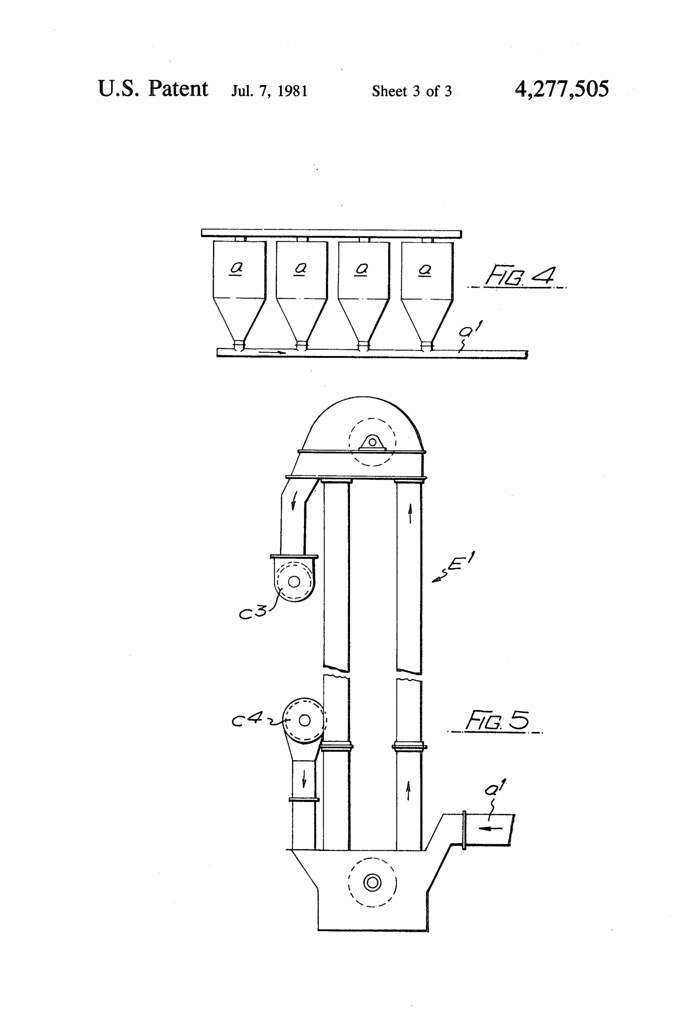
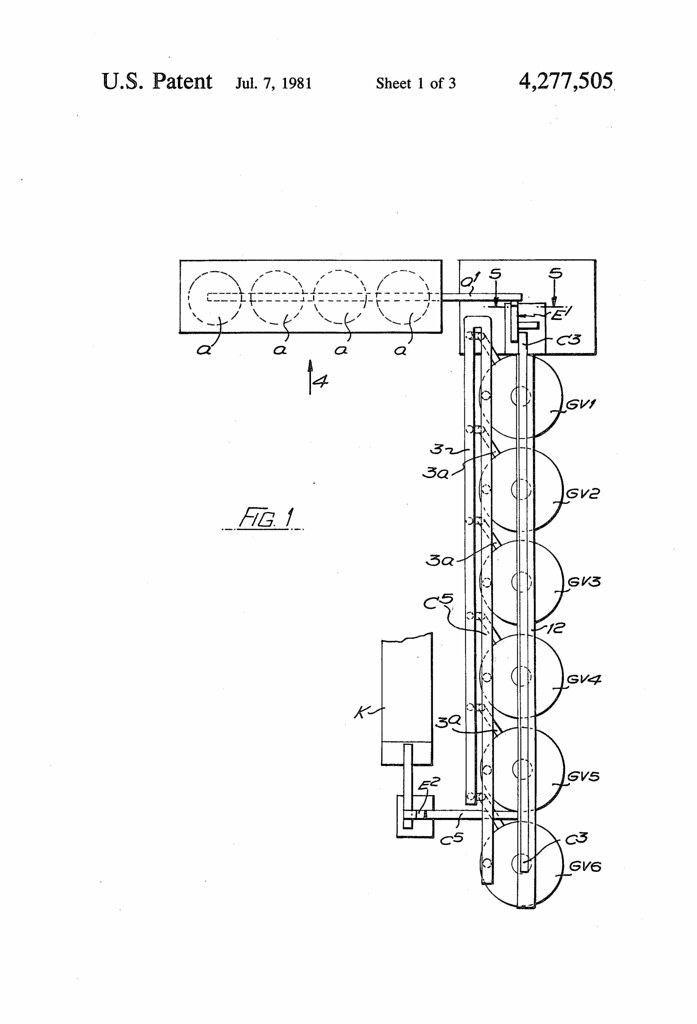
Today in 1981, US Patent 4277505 A was issued, an invention of Simon B. Simpson, for his “Process for the Malting of Grain.” Here’s the Abstract:

Germination of cereal grain in malting is carried out by passing steeped grain to and through a series of six closed spaced discrete vessels in succession. The grain is maintained in each vessel for about a day and in each vessel is subjected to an upward flow of humidified at temperated air. The grain is turned either in a vessel or through transference to the next vessel. Transference from one vessel to the other is carried out by discharging the grain from each vessel along a lower conveyor to an elevator which raises the grain to an upper conveyor that discharges the grain down into the next vessel. Grain leaves the last vessel of the series as green malt and then passes to a malt kiln where it is dried to a desired moisture level.
Untitled

Filed Under: Beers, Just For Fun, Politics & Law, Related Pleasures Tagged With: barley, Brewing Equipment, History, Law, Malt, Patent

Patent No. 2893870A: Hopping Of Beer

July 7, 2015 By Jay Brooks

patent-logo
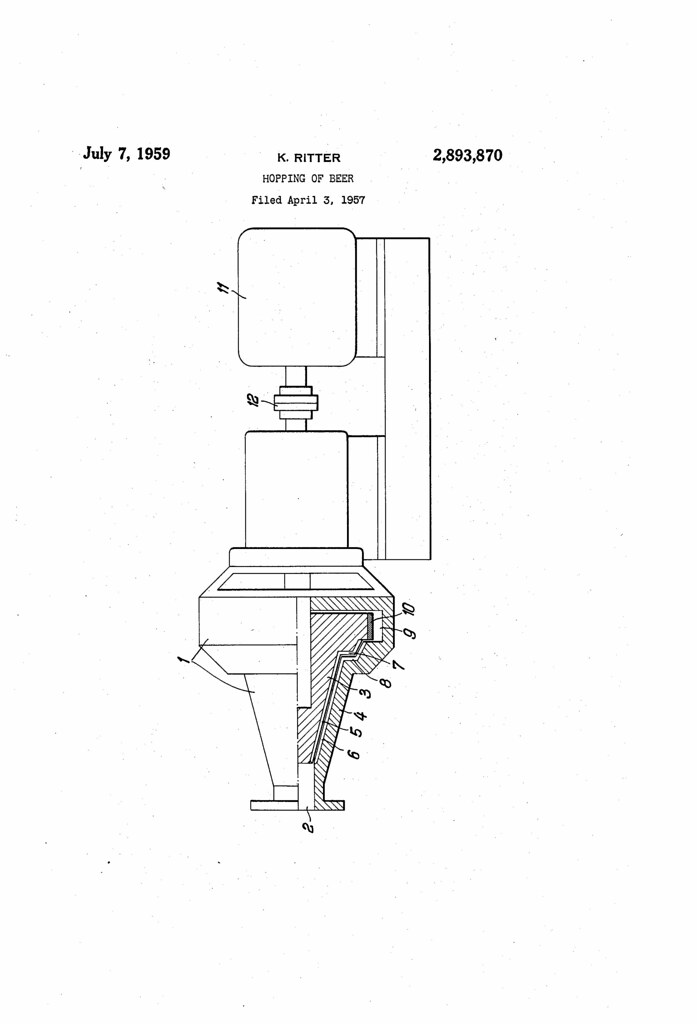
Today in 1959, US Patent 2893870 A was issued, an invention of Kurt Ritter, for his “Hopping of Beer.” There’s no Abstract, although in the description it includes this summary:

The invention relates to improvements in beer brewing and more particularly to an improved method of hopping beer.

The brewing of beer comprises generally the following steps: Ground malt is mashed with water, and the obtained malt solution (first wort) is freed from the malt residues (spent grains). Subsequently, the wort is boiled with addition of the required amount of hops and then separated from the spent hops and fermented with yeast. The hops are generally added as such or in coarsely disintegrated state to the Wort.

Said procedure has the drawback that, on boiling, only about one-third to one-fourth of the bitter principle (resins), contained in the hops, passes into the wort; in addition, a certain amount of the resins, e.g. about 3 to 7 percent, is lost in further processing (fermentation and storage) by precipitation.

So far, attempts to eliminate said drawbacks have not met with satisfactory results. Recently, it has been proposed to extract the resins by subjecting the hops in water or aqueous solutions to ultrasonic irradiation and to introduce the thus obtained resin extract into the boiling wort instead of hopping with natural hops. Said method, however, must be carried out with expensive and delicate devices, the operation of which requires high energy cost, and which are therefore uneconomical for commercial purposes. The preparation of such resin extracts by means of ultrasonic irradiation takes considerable time, for instance 1 to 2 hours and more. During this prolonged treatment, undesired side reactions may take place which may affect the brewing process, for instance with respect to the uniformly fine and pleasant taste of the produced beer.

It is a principal object of the invention to provide a simple, reliable, and economic hopping procedure.

It is another object of the invention to provide a method by which the required amount of hops is considerably reduced and nonetheless a beer of uniform excellent quality and taste is produced.

Untitled

Filed Under: Beers, Breweries, Just For Fun, Politics & Law, Related Pleasures Tagged With: Brewing Equipment, History, Hops, Law, Patent

Patent No. 733284A: Process Of Converting Wort Into Beer

July 7, 2015 By Jay Brooks

patent-logo
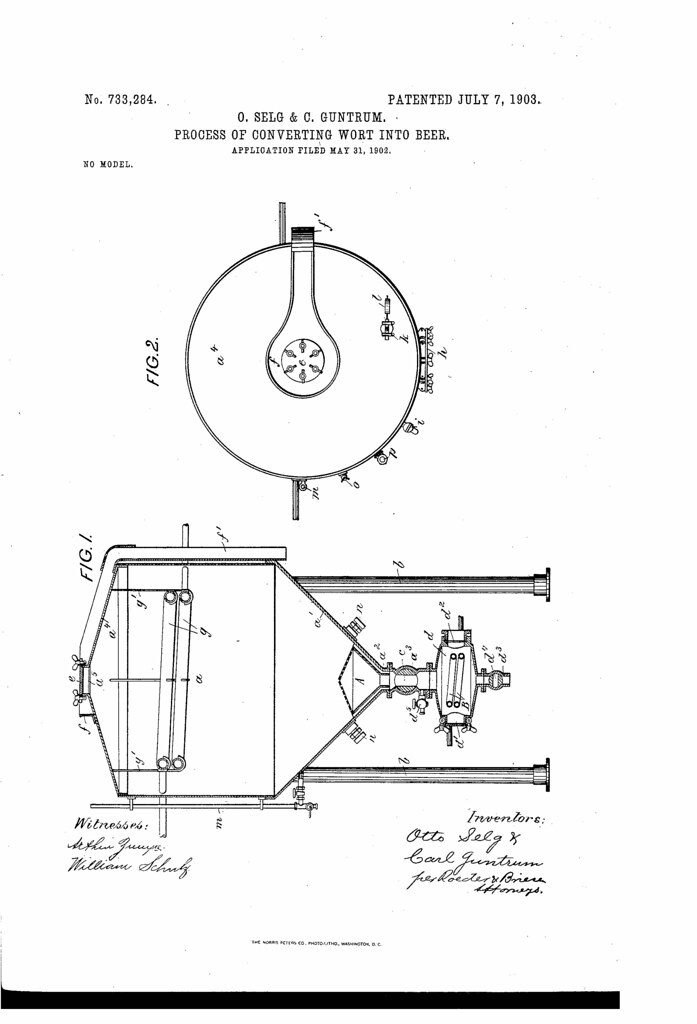
Today in 1903, US Patent 733284 A was issued, an invention of Otto Selg and Carl Guntrum, for their “Process of Converting Wort into Beer.” There’s no Abstract, although in the description it includes this summary:

This invention relates to an improved continuous process of converting wort into beer or other fermented liquid in a single apparatus and in such a manner that the beer is first thoroughly fermented and clarified before being impregnated with the carbonic acid gas. In this way the process is accelerated and a better product is obtained.

Untitled

Filed Under: Beers, Breweries, Just For Fun, Politics & Law, Related Pleasures Tagged With: Brewing Equipment, History, Law, Patent, Science of Brewing

Patent Nos. 3591057A & 3591058A: Tapping Device For Beer Kegs

July 6, 2015 By Jay Brooks

patent-logo
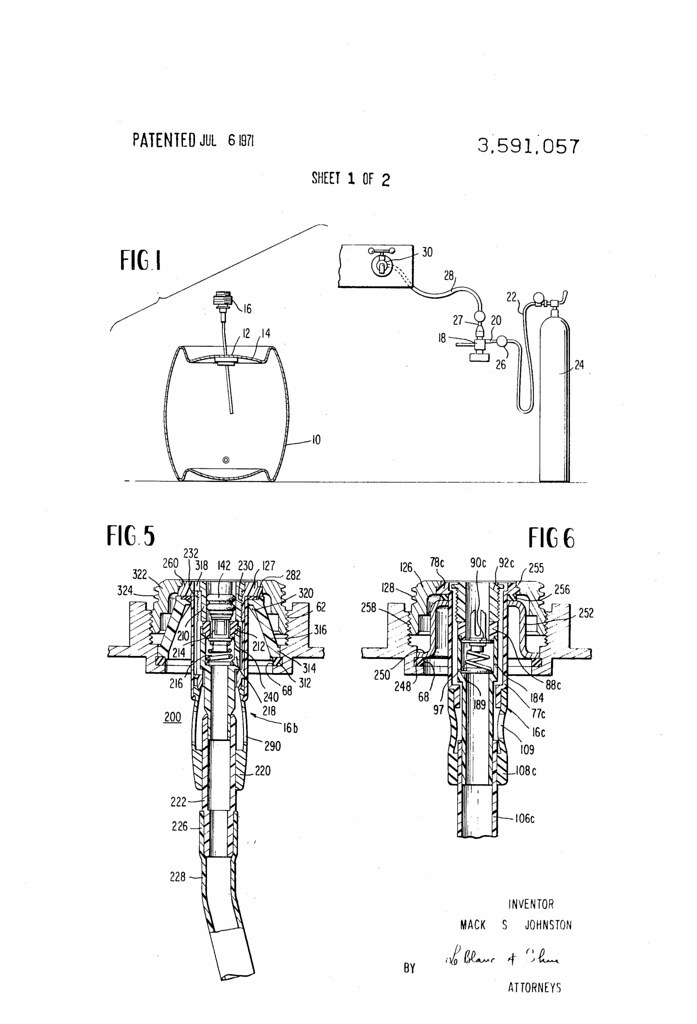
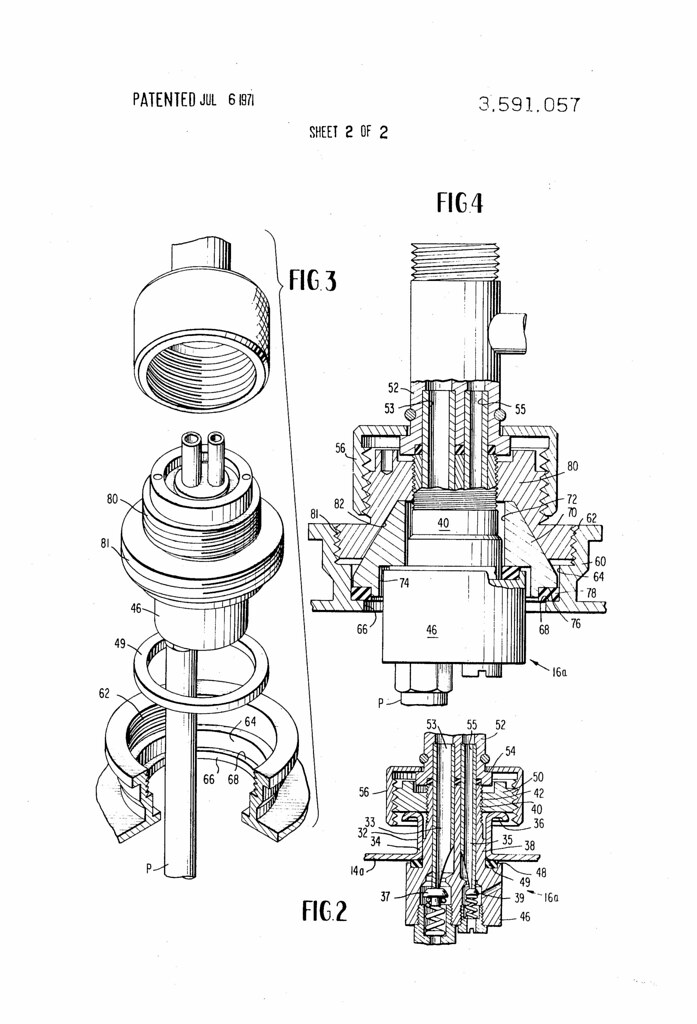
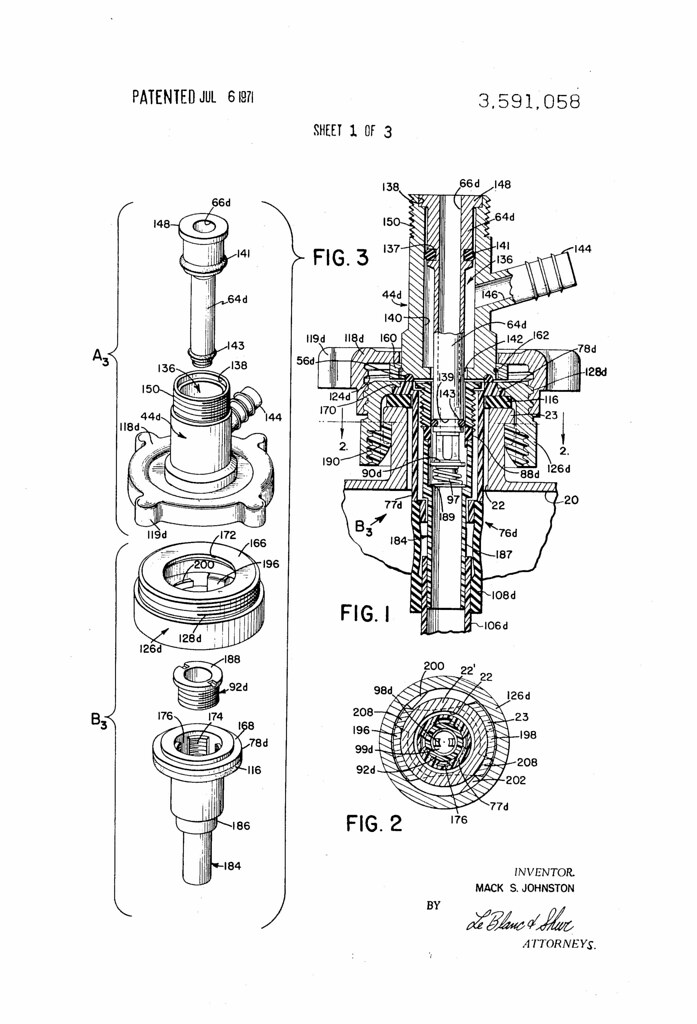
Today in 1971, both US Patent 3591057 A and US Patent 3591058 A was issued, both inventions of Mack S. Johnston, assigned to the Republic Corp., for his “Tapping Device For Beer Kegs and the Like.” There’s no Abstract, although in the description for the first one it includes this summary:

The present device comprises a keg tapping unit which is connected about a Peerless type keg opening by insertion through the side filling opening of the keg.

Untitled

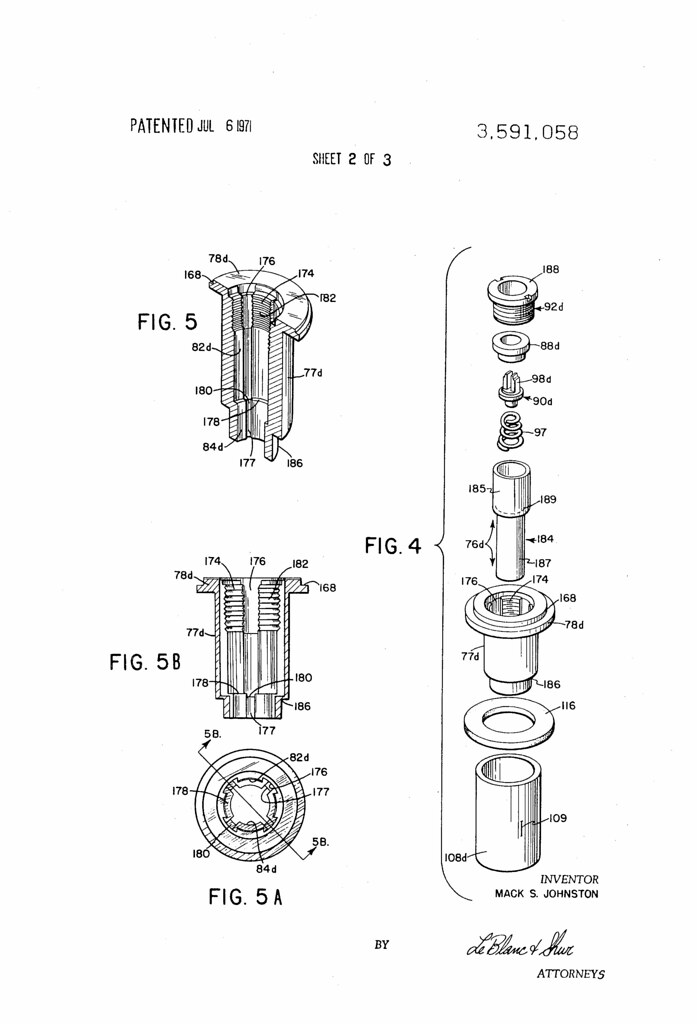
Similarly, for the second patent there’s also no Abstract, although in the description for it includes this summary:

The present invention relates to a new, improved tapping device for drawing fluid such as beer from containers such as beer kegs or barrels, using a gas to drive the fluid from the container. In particular, the invention relates to a new, improved tapping device usable with conventional beer kegs and comprising a subunit, called a “keg adapter, which constantly seals the keg, and a subunit, called a coupler, which is attached to the beer dispensing apparatus in a restaurant or tavern and is readily connected to the keg adapter so that the tapping device is automatically in operating condition.

Untitled

Filed Under: Beers, Just For Fun, Politics & Law, Related Pleasures Tagged With: History, Kegs, Law, Patent

Patent No. 2085879A: Bottle Capping Machine

July 6, 2015 By Jay Brooks

patent-logo
Today in 1937, US Patent 2085879 A was issued, an invention of Edward N. Trump, for his “Bottle Capping Machine.” There’s no Abstract, although in the description it includes this summary:

This invention relates to new and useful improvements in a bottle capping machine and pertains more particularly to an apparatus for applying hooded or over-all caps to the head of milk bottles or the like. The caps are pre-formed in one piece, preferably from a sheet of light, strong and non-corrosive metal having a high degree of ductility, malleability and tenacity, such for example, as tissue aluminum of about the thickness of the cellulose product commonly known as Cellophane or of thin tinfoil, and which is capable of. being easily molded by pressure under atmospheric temperature to conform to the its form under ordinary usage.

Untitled

Filed Under: Beers, Breweries, Just For Fun, Politics & Law, Related Pleasures Tagged With: Bottles, Brewing Equipment, Crowns, History, Law, Patent

Patent No. 3259265A: Reseal For Tab Opening Cans

July 5, 2015 By Jay Brooks

patent-logo
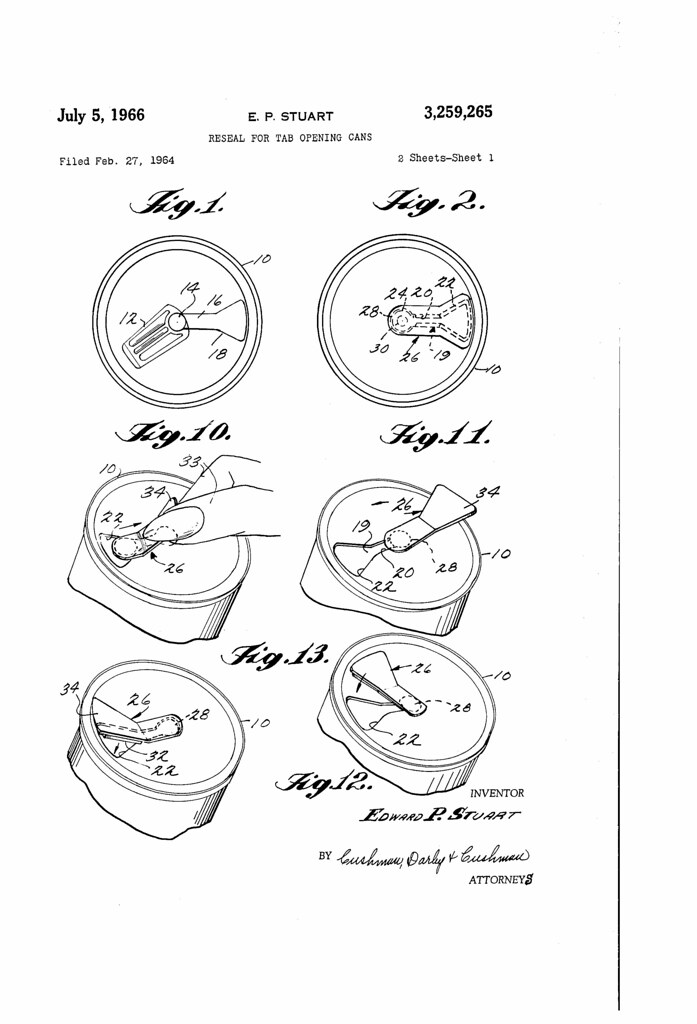
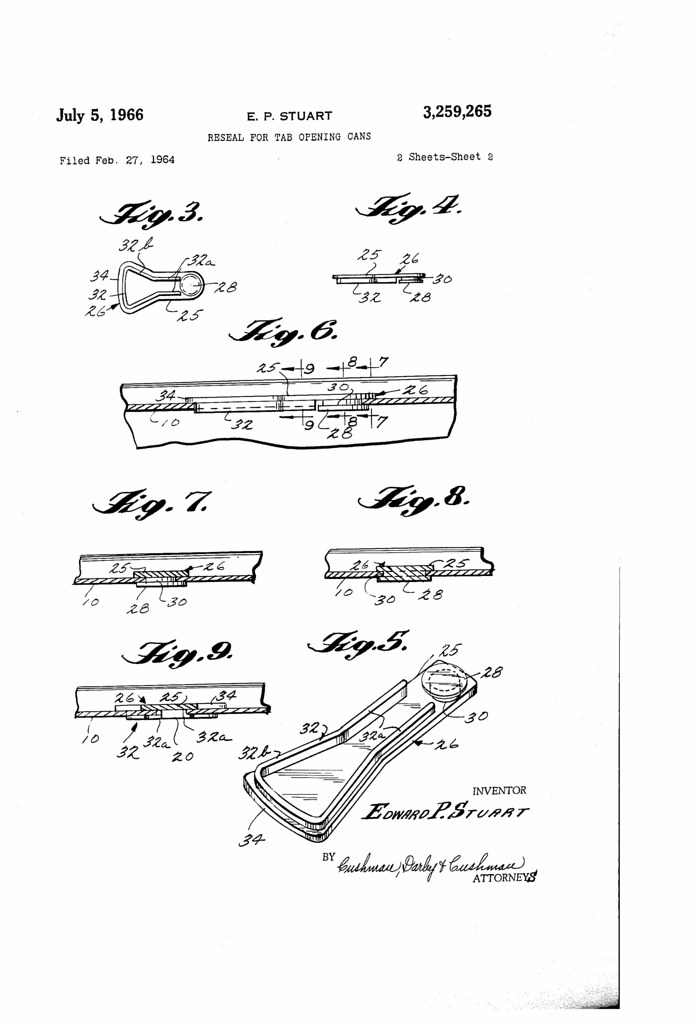
Today in 1966, US Patent 3259265 A was issued, an invention of Edward P Stuart, assigned to the Crown Cork & Seal Co., for their “Reseal for Tab Opening Cans.” There’s no Abstract, although in the description it includes this summary:

This invention relates to seals, and particularly to reseals for apertures or the like made in an end of a container such as the top of a can, and to a method of inserting such reseal.

In recent times, the tab opening type aluminum or other metal cans has become popular because of its ease of opening. As is well known, one need only pull on the tab to tear open the pre-indented area of the can top to obtain access to the contents of the can. While such cans have been employed in the beverage industry, particularly for beer, they have also been used for other commodities, which are more of the reusable type as opposed to those which are used and the containers then thrown away. As examples of the type of materials which might be only partially used initially and then used again at a later date, one may consider floor wax or flour. Limitation to such materials is not there intended, however, since any type of commodity may be used with the containers in question.

In between uses of the commodity, it is desirable to reseal the container, as by placing some sort of seal in the torn-out opening made for pouring purposes by pulling the tab off the can top. As is Well known, these pour openings are generally of keyhole shape in that they have an elongated or channel area with a larger aperture at one end near the edge of the container end. Generally, also, the opposite end of the elongated area has another aperture which is usually circular in form and slightly larger in diameter than the width of the channel which results from ripping out the rivet that held the pull tab to the can top.

It is the primary object of the present invention to provide a reseal for such a container pouring opening, along with a method of inserting that reseal.

It is another object of this invention to provide such a reseal which will remain in place at the portion thereof which seals the inner end of the channel, or the rivet aperture at the inner end of the channel, but has a snap fit as to the channel and pour aperture at the outer end of the channel.

Untitled

Filed Under: Beers, Just For Fun, Politics & Law, Related Pleasures Tagged With: can, History, Law, Patent

Patent No. PP8824P: Hop Plant Named “H87203-1”

July 5, 2015 By Jay Brooks

patent-logo
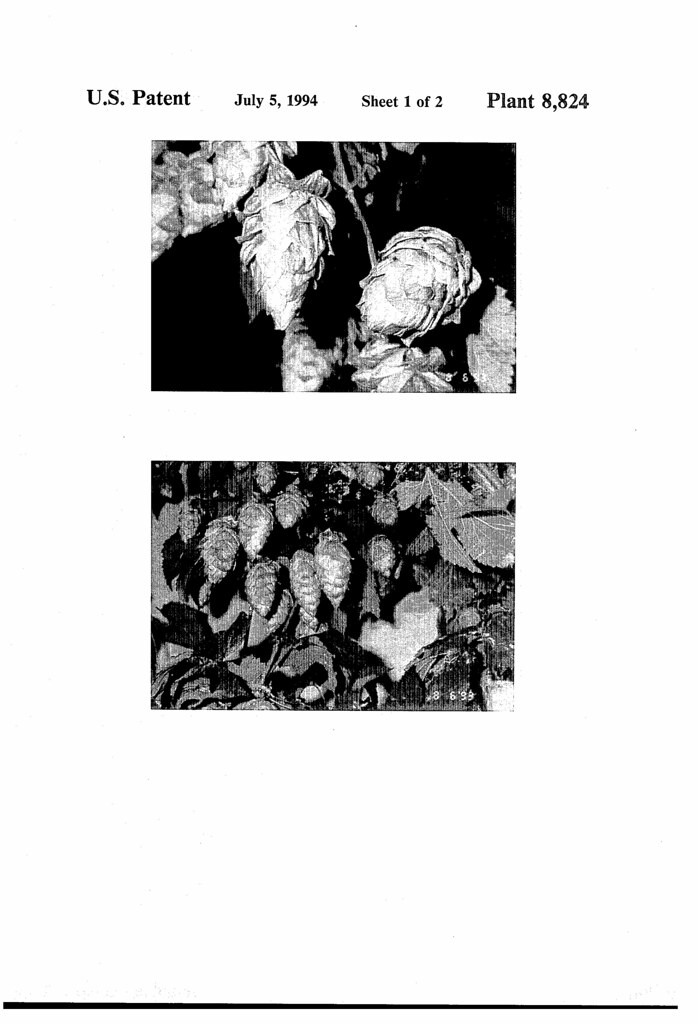
Today in 1994, US Patent PP8824 P was issued, an invention of Gene Probasco, assigned to John I. Haas, Inc., for his “Hop Plant Named ‘H87203-1.'” It’s almost identical to the previous patent for the hop plant named H87207-2. Here’s the Abstract for this one:

A new variety of hop plant (H87203-1) originating as the result of a controlled corss pollination between unpatented Galena female hop plant with unpatented John I. Haas, Inc. (Haas) male hop plant No. 833-53M, and unique particularly for its cones’ unusually high percentage of beta acids when compared to its female parent variety Galena (unpatented) and otherwise as herein described.

It’s been 21 years since this other hop variety was patented. Did it ever get its own name? Does anybody know?
Untitled

Filed Under: Beers, Just For Fun, Politics & Law, Related Pleasures Tagged With: History, Hops, Law, Patent

Patent No. PP8823P: Hop Plant Named “H87207-2”

July 5, 2015 By Jay Brooks

patent-logo
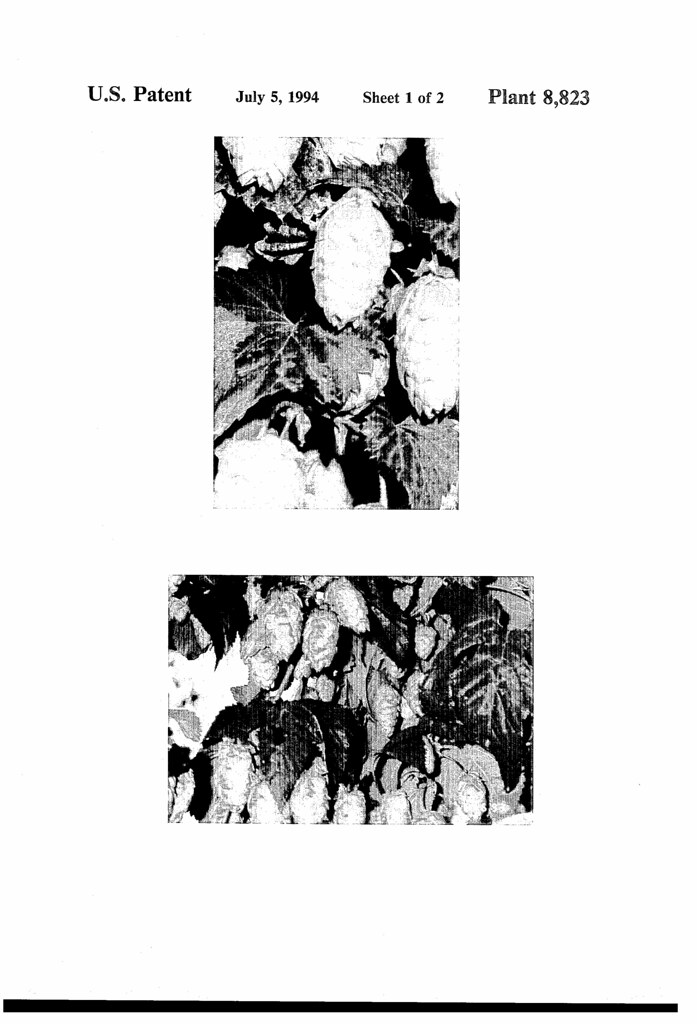
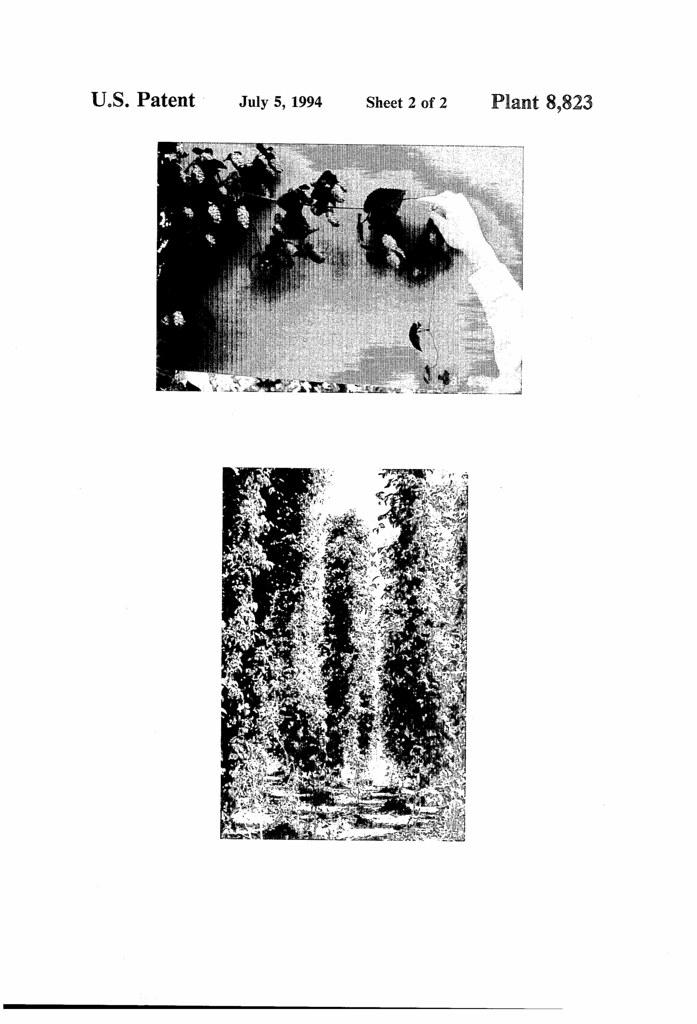
Today in 1994, US Patent PP8823 P was issued, an invention of Gene Probasco, assigned to John I. Haas, Inc., for his “Hop Plant Named ‘H87207-2.'” Here’s the Abstract:

A new variety of hop plant (H87207-2) originating as the result of a controlled cross pollination between unpatented Galena female hop plant with unpatented John I. Haas, Inc. (Haas) male hop plant No. 833-53M, and unique particularly for its cones’ unusually high percentage of beta acids when compared to its female parent variety Galena (unpatented) and otherwise as herein described.

It’s been 21 years since this hop variety was patented. Did it ever get its own name? Does anybody know?
Untitled

Filed Under: Beers, Just For Fun, Politics & Law, Related Pleasures Tagged With: History, Hops, Law, Patent

Patent No. 763973A: Bottle

July 5, 2015 By Jay Brooks

patent-logo
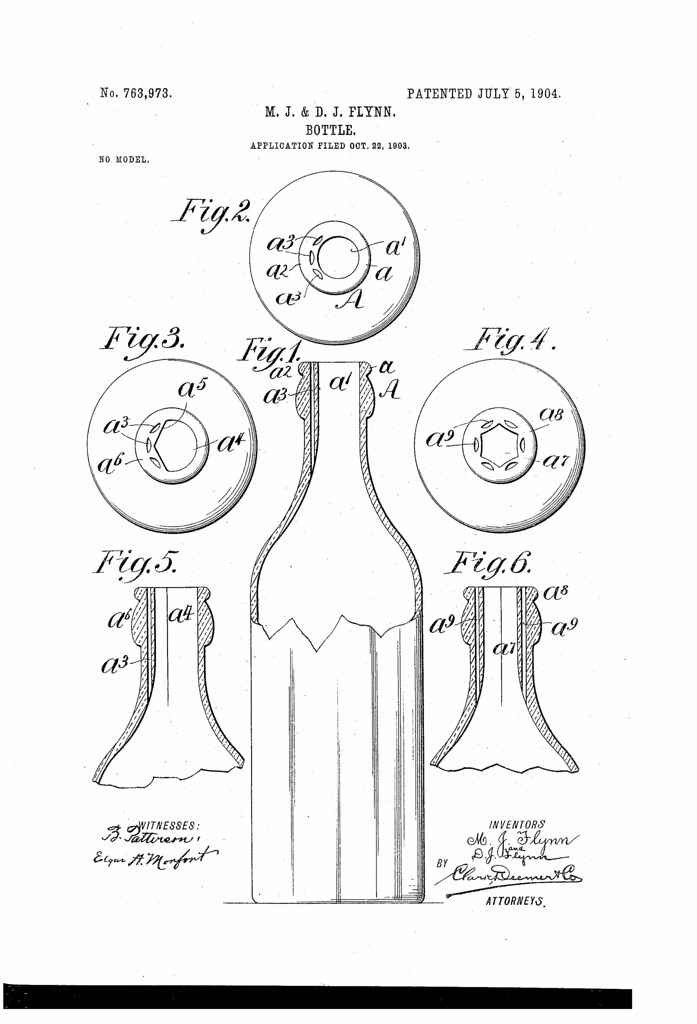
Today in 1904, US Patent 763973 A was issued, an invention of Michael Joseph Flynn and Dennis John Flynn, for their “Bottle.” There’s no Abstract, although in the description it includes this summary:

The subject of this invention is a bottle which while designed more particularly for containing beer and like beverages may be utilized for other liquids; and the principal object of the invention is to practically prevent to a considerable extent the improper reuse of the bottle.

With the above and other purposes in view the novel bottle comprises a mouth portion containing a main or pouring opening and a small auxiliary passage or passages, both the pouring-opening and the auxiliary passage or passages all being designed to be closed by a single metal cap having a crimped engaging flange, which type of cap is in vogue at the present time. In using my improved bottle upon the removal of the cap the liquid contents can be poured from the bottle through the main opening, the auxiliary passage or passages serving under such condition as a venting provision. Manifestly after such employment of the bottle it will be unserviceable for further use in connection with an ordinary cork, because when the latter is inserted within the main opening the open character of the auxiliary passage or passages will preclude the service of the bottle with carbonated or charged liquids, besides presenting the additional disadvantage of not completely closing the bottle. Corks of special shapes, including upper lateral flanges, might be resorted to; but such would add considerably to the expense and difficulty of using the bottle, and hence constitute obstacles that would ordinarily deter the improper reuse of the bottle.

Untitled

Filed Under: Beers, Just For Fun, Politics & Law, Related Pleasures Tagged With: Bottles, History, Law, Patent

Patent No. 4844932A: Separation Of Wort From Mash

July 4, 2015 By Jay Brooks

patent-logo
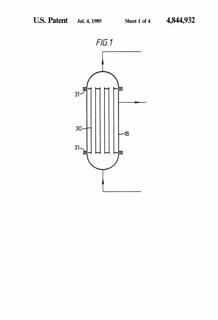
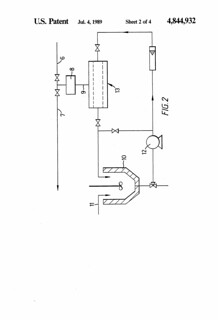
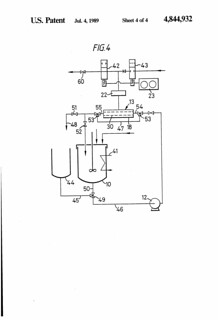
Today in 1989, US Patent 4844932 A was issued, an invention of Iyadh S. Daoud, assigned to The Brewing Research Foundation, for his “Separation of Wort From Mash.” Here’s the Abstract:

A barrier cross-flow separation method is used to separate wort from mash in beermaking. The separator medium is preferably a cylindrical element with an internal diameter of at least 20 mm and a pore size in a range of from 10 μm to 100 μm. High gravity wort is obtainable from a four-step separation process which can handle mash free of husk and including large amounts of cereal adjunct. The wort may be clarified in a subsequent filtering step.

Untitled

Filed Under: Beers, Breweries, Just For Fun, Politics & Law, Related Pleasures Tagged With: History, Law, Patent, Science of Brewing

« Previous Page
Next Page »

Find Something

Northern California Breweries

Please consider purchasing my latest book, California Breweries North, available from Amazon, or ask for it at your local bookstore.

Recent Comments

  • Bob Paolino on Beer Birthday: Grant Johnston
  • Gambrinus on Historic Beer Birthday: A.J. Houghton
  • Ernie Dewing on Historic Beer Birthday: Charles William Bergner 
  • Steve 'Pudgy' De Rose on Historic Beer Birthday: Jacob Schmidt
  • Jay Brooks on Beer Birthday: Bill Owens

Recent Posts

  • Beer In Ads #5137: Bock Is Back… Look For It March 1st February 28, 2026
  • Historic Beer Birthday: John Holme Ballantine February 28, 2026
  • American Craft Beer Hall of Fame: 2nd Year Inductees February 28, 2026
  • Beer Birthday: Jeff Bell February 28, 2026
  • Beer In Ads #5136: American Bock Beer Is Being Served Today! February 28, 2026

BBB Archives

Feedback

Head Quarter
This site is hosted and maintained by H25Q.dev. Any questions or comments for the webmaster can be directed here.