Brookston Beer Bulletin

Jay R. Brooks on Beer

  • Home
  • About
  • Editorial
  • Birthdays
  • Art & Beer

Socialize

  • Dribbble
  • Email
  • Facebook
  • Flickr
  • GitHub
  • Instagram
  • LinkedIn
  • Pinterest
  • RSS
  • Twitter
  • YouTube

Powered by Genesis

Oktoberfest 2012 Begins Today

September 22, 2012 By Jay Brooks

oktoberfest-band
Today at noon the mayor of Munich tapped the ceremonial keg to kick off Oktoberfest. The My Destination travel blog has created an interesting infographic (I confess I love these type of things) with the statistics of just how much food and drink was consumed at last year’s folk festival.

oktoberfest-infographic-2012

Filed Under: Beers, Events, Food & Beer, Just For Fun Tagged With: Germany, Statistics

Number Of UK Breweries Tops 1,000

September 12, 2012 By Jay Brooks

uk
Well this is a tidy bit of news. CAMRA is reporting that the number of breweries in the United Kingdom is now over 1,000 for the first time in over 70 years. Other tidbits include that there are “[t]wice as many brewers now in operation compared to a decade ago” and the “[n]umber of micro breweries have risen despite recession and pub closures,” something we’ve also experienced here in the U.S., too. You can read the full story in the Scotsman, but tonight I think an English beer may be in order.

Filed Under: Breweries, News Tagged With: CAMRA, Statistics, UK

Three Decades Of Beer Containers

August 29, 2012 By Jay Brooks

trending-chart
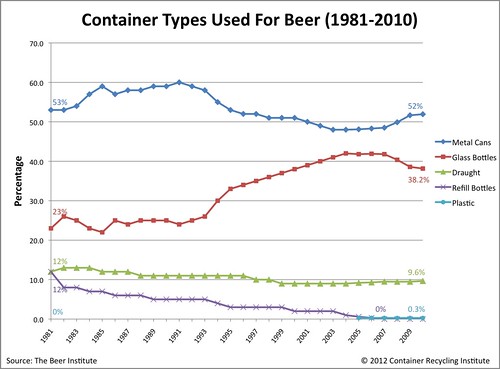
Here’s an interesting little snapshot of the various containers beer comes in over the last thirty years from the Container Recycling Institute. In Container Types Used For Beer in the U.S., 1981-2010 , they detail how beer in bottles have increased steadily 15% over that time and now make up almost 40% of how beer is sold. At the same time, draft beer has receded. Cans are still on top, but dipped significantly beginning in the 1990s, but in recent years have started to rebound.

beer-container-types-1981-2010

Filed Under: Beers, Just For Fun, Politics & Law, Related Pleasures Tagged With: Bottles, Cans, Draft Beer, Statistics, United States

More Mid-Year Brewery Numbers

August 21, 2012 By Jay Brooks

ba
Earlier this month the Brewers Association released the good news that Craft Beer Grows 14% In First Half Of 2012. That was through the end of June. I hate to keep crowing about the numbers, but it’s hard to ignore, especially having lived through the depressing late 90s when optimism for craft beer was at its nadir. Anyway, here’s where we are just a month later, as of July 31 of this year.

  • U.S. operating breweries is at 2,142, up from 2,126 at the end of June.
  • U.S. breweries in planning is at 1,303, up from 1,252 at the end of June.
  • There are 555 more breweries in planning than a year ago and 347 more operating U.S. breweries.

Crazy times.

Filed Under: Breweries, Just For Fun, News Tagged With: Brewers Association, Statistics

College Drinkers Are Happier & Cooler

August 21, 2012 By Jay Brooks

humor
This has just got to cheese off Alcohol Justice and the other neo-prohibitionist wingnuts, but Time magazine is reporting the results of a recent study that found the unpleasant truth that students who binge drink in college are actually happier and enjoy higher status among their peers. In Why College Binge Drinkers Are Happier, Have High Status, they began with a bang:

College binge drinkers say they’re happier with their social lives than those who don’t indulge — but it’s probably the boost in social status, not the booze itself that lifts their mood, according to new research presented at the annual meeting of the American Sociological Association.

“Binge drinking is a symbolic proxy for high status in college,” said study co-author Carolyn Hsu, an associate professor of sociology at Colgate University in a statement, noting that it’s what the wealthy, powerful and happy students on campus do.

The study found that rich white frat boys reported having the greatest social satisfaction at school and were considered the big men on campus by others. They were not only happier than students in low-status groups — women, minorities and people who were less financially well-off — but also more likely to binge drink. “Binge drinking then becomes associated with high status and the ‘cool’ students on campus,” said Hsu.

Low-status students in turn reported being happier if they binged than if they didn’t. Indeed, alcohol seemed to be the great social equalizer, bringing members of low-status groups to happiness levels similar to those of greater social power if they binged. “Students in all groups consistently liked college more when they participated in the campus’ binge drinking culture,” Hsu said.

The results are still preliminary, but it’s still notable for at least trying to better understand why binge drinking persists, despite endless efforts to curb it. Though to be fair, most of those efforts are misguided bludgeons like “just say no” and other ideas doomed to fail by neo-prohibitionist groups.

Other interesting tidbits included the fact that “the most stressed and highly anxious students were the least likely to binge, suggesting that the negative emotions that often drive alcoholism are not influencing many of these bingers.” And in a related study, it was found that College Men Who Post About Alcohol Have More Facebook Friends. In a way, it’s not surprising, as social status is pretty important at that age, possibly more important than at any other time. College students, often on their own for the first time in their young lives, trying to find themselves and become their own adults, have the added burden of having virtually no education regarding alcohol and having to obtain it through illegal means thanks to the anti-alcohol efforts of the past several decades. So when the study concludes “that the social advantages of binge drinking do not mitigate its negative consequences on health and academic performance,” I can only say, well, duh.

But it’s the final paragraph that contains the most important wisdom, totally lost on neo-prohibitionists and especially people who do not drink.

Surprisingly little research is conducted on the positive effects sought by drug users and what they actually achieve via their drug consumption; the assumption is that alcohol and other drugs are always bad and their users are irrational. But until more studies like this are conducted, prevention programs are unlikely to improve. We can’t prevent what we don’t understand.

Just say know.

Filed Under: Editorial, News, Politics & Law Tagged With: Science, Statistics

Why Is This News? Beer Beats Wine!

August 20, 2012 By Jay Brooks

beer-vs-wine
I never quite understand why this is even considered news at all? The L.A. Times is reporting that “Beer beats out wine as Americans’ booze of choice.” Their source for this so-called news is a new Gallup Poll entitled Majority in U.S. Drink Alcohol, Averaging Four Drinks a Week. But that’s not exactly news insofar as it’s been that way since the dawn of time, or thereabouts. The gallup poll is just a survey, of course, and prone to people’s prejudices and perceptions. So when they report that “Beer edges out wine by 39% to 35% as drinkers’ beverage of choice,” it’s hard not to laugh, and even harder to take it seriously. This is what people tell pollsters, and it’s pretty divorced from reality.

If you want a truer, more accurate picture of peoples’ tastes, look at what they buy. The World Health Organization, at their website, gives the following data, collected in 2005 (though it rarely changes by much):

Alcohol Consumption By Type:

  • Beer: 53%
  • Wine: 16%
  • Spirits: 31%

And the Ginley USDC 2010 reports that for 2009, the volume of alcohol sold in the U.S. — 3.3 billion cases — is divided as follows, giving beer an 85 share:

Alcohol Sales By Volume:

  • Beer: 85%
  • Wine: 6%
  • Spirits: 9%

And by retail dollars — a total $1.89 billion — beer still has a commanding lead:

Alcohol Sales By Dollars:

  • Beer: 52%
  • Wine: 14%
  • Spirits: 34%

It doesn’t really matter what people tell the voice on the other end of the phone when Gallup calls asking for peoples’ preferences, this is what they really drink. And while it does fluctuate over time, it’s been roughly like this as long as anybody can remember. Trying to turn it into something newsworthy takes a certain amount of opportunistic forgetfulness, ignorance and a willingness to ignore history.

And while somewhat petty, this also struck me in a way I couldn’t ignore, like someone slapped me. The author of the L.A. Times piece, Tiffany Hsu, refers to men as floozies, when she reports. “Men tend to be the biggest floozies, downing 6.2 drinks a week on average compared with 2.2 drinks for women.” Now I assume she owns a dictionary, and I was pretty sure what the definition of a floozy was. So after checking at least six dictionaries to confirm my suspicions — like it or not — a floozy is always described as a woman. It’s an old, archaic word you rarely hear these days, but it doesn’t mean someone who drinks too much, as she appears to believe.

There’s also other findings in the Gallup Poll results, part of their annual Consumption Habits poll, and some are interesting, if not altogether showing anything particularly novel or new. But toward the end of Gallup’s press release, they make this obnoxious statement in the conclusion, which they title “The Bottom Line.”

With drinking comes overdrinking, and despite possible reluctance by some respondents to admit problems, one in five drinkers — representing 14% of all U.S. adults — say they sometimes drink too much.

Okay, first of all, WTF! “With drinking comes overdrinking?” No it doesn’t. It’s hardly a fait accompli. Even by their own numbers, that’s twisted logic. 86% of the people polled say they don’t drink too much so one clearly does not follow from the other, now does it? And how about this for twisting; “one in five” is 20%, not even close to 14%. You can’t even say that’s rounding, it’s simply inflating the numbers. So much for even the illusion of accuracy.

And just the idea that one alcoholic beverage has “beat” the other is annoying, too. I may prefer beer, but as a cross-drinker — like most people, frankly — I don’t feel that they’re competing in an us vs. them kind of way. It seems only news outlets hungry for headlines pit the two against one another. The first sentence of the article is “Score one for beer.” What was the contest?

There are plenty of positive stories from the world of beer that mainstream media could be covering. As Garrett Oliver recently wrote in Food & Wine magazine, one of the Crimes Against Beer is its continuing lack of media coverage. Oliver writes. “The public is yearning for more knowledge about beer, and nobody’s giving it to them. Even though craft beer is more popular than wine in the US, every major newspaper has a wine column, and almost nobody has a beer column. What’s wrong with this picture?”

What’s wrong, indeed.

UPDATE: An interesting side discussion came out of my linking Garrett Oliver’s piece, Crimes Against Beer, in which he casually mentions that “craft beer is more popular than wine in the US.” I confess that when I first read that, I thought it couldn’t be correct, but since it wasn’t relevant to the broader point I was trying to make in this post, I didn’t dwell on it. Alan, from A Good Beer Blog, however, did, and used it as a launching point for his own post, Is All That Made Up Stuff A Problem With The Dialogue?. He also did a little digging this morning to get at the actual numbers, and between the two of us, here’s what we found. Alan looked at statistics gathered by the Brewers Association and the Wine Institute. He found that in 2011, there were 347 million cases of wine and 11,468,152 barrels of craft beer sold in the U.S. From that he concluded that craft beer volume is roughly one-third of wine. Being lazier than Alan, I looked at retail dollars from the same sources and saw that there was an “estimated $8.7 billion” in craft beer sales and $32.5 billion in U.S. wine sales. That works out to craft beer selling about 26.8% — just over one-quarter — of wine sales. So no matter how you slice it, craft beer sales are nowhere near that of wine sold in America. That number could be slightly higher, as my one quibble with this is that the Brewers Association definition of what it means to be a craft beer is fine for their purposes (which is membership-based) but is not practical in the real world where what makes a beer crafty is, to my mind at least, how it’s made and how it tastes. I do, for example, consider Blue Moon a craft beer. And that would change the numbers to some degree, but I suspect not enough to alter the fact that wine still outsells craft beer, at least for now.

Filed Under: Beers, Editorial, News, Politics & Law Tagged With: Mainstream Coverage, Poll, Statistics

Drinkers Half As Likely To Get Lou Gehrig’s Disease

August 13, 2012 By Jay Brooks

lou-gehrig
Though contracting ALS (or Amyotrophic Lateral Sclerosis) is relatively rare, according to a new Dutch study, your risk is cut in half if you drink moderately, when compared to abstainers. Better known, at least in North America, as Lou Gehrig’s Disease — since the New York Yankees first baseman famously contracted it in 1938 — the ABMRF is reporting about the new study. According to their information, the Risk of ALS Seen to be Lower in Drinkers than Abstainers. Their full article is below:

A Dutch population-based case-control study of the rare but devastating neurological disease amyotrophic lateral sclerosis (ALS) suggests that the risk of such disease is increased among smokers, as has been shown previously. However, surprisingly, the risk of ALS was seen to be markedly lower among consumers of alcohol than among abstainers.

The study conducted between 2006 and 2009 included surveying 494 patients with incident ALS, a large sample for the rare disease, and 1,599 controls. Investigators compared results with those from cohorts including patients with prevalent ALS and referral patients.

Results highlight the importance of lifestyle factors in the risk for ALS. Current smoking is associated with an increased risk of ALS and a worse prognosis. However, alcohol consumption is associated with a reduced risk of ALS, as the risk among drinkers was about one half that of non-drinkers.

You can see the abstract for the study itself, Smoking, Alcohol Consumption, and the Risk of Amyotrophic Lateral Sclerosis: A Population-based Study, at PubMed.

Filed Under: Beers, Editorial, News, Related Pleasures Tagged With: Health & Beer, Science, Statistics, The Netherlands

How Neo-Prohibitionists Target Alcohol

August 11, 2012 By Jay Brooks

target-alcohol
Mark Twain is generally credited with popularizing the phrase: “There are three kinds of lies: lies, damned lies and statistics.” He attributed it to British statesman Benjamin Disraeli, though most historians now dispute that. So even when speaking about lying, there were lies. Today’s neo-prohibitionists would be proud, lying with statistics is something they’ve finely honed into its own kind of science. If you haven’t read How To Lie With Statistics or the more recent Trust Us, We’re Experts!, they both provide great insights into just how it’s been done over the years, and continues to be done with alarming frequency.

Thanks to Jason K. for alerting me to this one, which in the news is being portrayed with the intentionally misleading How Alcohol Ads Target Kids. The story concerns a study sponsored by CAMY (the Center on Alcohol Marketing and Youth) — itself a bit of an anti-alcohol organization who receives funding from the king of the neo’s, the Robert Wood Johnson Foundation — that examined alcohol advertising in eleven magazines over a five-year period. The study itself was recently published in The Journal of Adolescent Health with the much less misleading title Risky Messages in Alcohol Advertising, 2003–2007: Results From Content Analysis.

When CAMY released a press release about the study, they re-titled it Alcohol Advertising Standards Violations Most Common in Magazines with Youthful Audiences — also not exactly accurate — and by the time it got to the media (who love alarming headlines) it became How Alcohol Ads Target Kids, which was picked up by such high profile websites as Yahoo News, Live Science and Business News Daily.

All of the news stories rely on the CAMY press release and not the study itself, which seems at least a little strange. So here’s the Abstract:

Purpose
To assess the content of alcohol advertising in youth-oriented U.S. magazines, with specific attention to subject matter pertaining to risk and sexual connotations and to youth exposure to these ads.

Methods
This study consisted of a content analysis of a census of 1,261 unique alcohol advertisements (“creatives”) recurring 2,638 times (“occurrences”) in 11 U.S. magazines with disproportionately youthful readerships between 2003 and 2007. Advertisements were assessed for content relevant to injury, overconsumption, addiction, and violations of industry guidelines (termed “risk” codes), as well as for sexism and sexual activity.

Results
During the 5-year study period, more than one-quarter of occurrences contained content pertaining to risk, sexism, or sexual activity. Problematic content was concentrated in a minority of brands, mainly beer and spirits brands. Those brands with higher youth-to-adult viewership ratios were significantly more likely to have a higher percentage of occurrences with addiction content and violations of industry guidelines. Ads with violations of industry guidelines were more likely to be found in magazines with higher youth readerships.

Conclusions
The prevalence of problematic content in magazine alcohol advertisements is concentrated in advertising for beer and spirits brands, and violations of industry guidelines and addiction content appear to increase with the size of youth readerships, suggesting that individuals aged <21 years may be more likely to see such problematic content than adults.

There’s a lot gobbledygook and psychobabble jargon in that, but happily the news reports picked up the additional information in the press release to help out those of us who can’t afford to pay to see the full article. The so-called “study” is not exactly scientific, despite the academic journal publication and pedigree, but suffers greatly from how it’s defined and how the ads were characterized — how those “risk codes” were applied. As the study was sponsored by a particular organization with an agenda, it’s hardly a surprise that the conclusions would support that agenda. After all, they bought and paid for it.

One of the premises is that the 11 magazines they examined were ones with a “substantial youth readership,” which is important since they’re claiming that alcohol companies are targeting kids and/or violating advertising standards. I’d love to know which magazines they targeted, but that information has not been made readily available, even though you’d think that with such a dire problem they’d want to warn parents which magazines not to let their impressionable young children read. Should we wonder why that is? What it really comes down to is how they define “substantial youth readership?” For the study, that meant at least 15% of the readership was estimated to be underage, which is presumably what they mean by “youth.” I think most people would be hard pressed to consider 15% of anything “substantial.” So right from the get go, the study seems flawed; unless of course your goal is to manufacture a particular conclusion.

They further claim that these ads “frequently showed alcohol being consumed in an irresponsible manner.” First of all, how you define what “irresponsible” means is at best very subjective and certainly prone to be interpreted differently by different people. One of the examples of what they mean is “showing alcohol consumption near or on bodies of water.” Since when is that the hallmark of irresponsible behavior? Beer can’t be consumed responsibly, or safely, if there’s water nearby? Seriously, WTF?

Other examples they give include “encouraging overconsumption and providing messages supportive of alcohol addiction.” But those are both so vague as to be almost meaningless, and very open to interpretation. They further suggest that “sexual connotations or sexual objectification” were seen in “nearly one in five ad occurrences.” Again, pretty vague and subjective, but beyond that, so what? Isn’t “sex sells” the number one rule of advertising? Even if true, is alcohol advertising the only group using sex to sell their product? Or is that tactic literally everywhere. I remember being shown in an advertising class during college how the word “sex” could be found in the hair of the colonel in Kentucky Friend Chicken advertising. Sex is everywhere. Shock, surprise? Hardly. It’s the reason we’re all here. If you go looking for it, you’re going to find it. And frankly, under the circumstances, finding less than 20% of the alcohol ads with sexual content seems positively rock bottom, and something that they should see as a positive, wouldn’t you think?

But despite such vagueness, CAMY is undaunted, and finds exactly what they’re looking for. CAMY director and study co-author David Jernigan makes this claim. “The bottom line here is that youth are getting hit repeatedly by ads for spirits and beer in magazines geared towards their age demographic.” He goes on. “As at least 14 studies have found that the more young people are exposed to alcohol advertising and marketing, the more likely they are to drink, or if already drinking, to drink more, this report should serve as a wake-up call to parents and everyone else concerned about the health of young people.”

But another similar study by CAMY done in 2010 found that Less Alcohol Advertising Makes No Difference. In that study — covering nearly the same period of time — they found that youth exposure to alcohol advertising in magazines fell by 48 percent, alcohol advertising placed in publications with under 21 audiences greater than 30 percent fell to almost nothing by 2008, and youth exposure in magazines with youth age 12-to-20 audience composition above 15 percent declined by 48.4 percent. So apparently with that no longer a problem, they instead turned their attention to magazines with a youth readership of less than 15%. That must be the problem. There has to be a problem, after all. Without problems, there can be no fund raising. There can be no clarion call to arms against the heathen drinkers and alcohol companies.

This is the modern era of non-profits. There always has to be a problem. Now matter how much progress their organization makes against whatever problem they believe exists — and they will crow about that progress — the problem persists ad infinitum. It has to. But this particular problem has already been disproved. In 2003, a “‘Federal Trade Commission report to Congress indicate[d] that its comprehensive investigation’ found no evidence of targeting underage consumers.” See Alcohol Ads Target Youth? for the full story. The media may call this “How Alcohol Ads Target Kids,” but I can’t help but see it as just the opposite. When you look closer, it seems to me more like “How Neo-Prohibitionists Target Alcohol.”

Filed Under: Editorial, News, Politics & Law Tagged With: Anti-Alcohol, Prohibitionists, Science, Statistics

America’s Geographic Beer Belly

August 10, 2012 By Jay Brooks

maps-usa
Here’s another interesting set of data from the curiously named Floating Sheep, this one regarding The Beer Belly of America. Essentially, what they did was “a simple comparison between grocery stores and bars.” They anticipated that they’d find more grocery stores than bars, and that did prove to be true. But they were surprised to find what they termed the “‘beer belly of America’ peeking out through the ‘t-shirt of data.'”
us_bars_100122
In this chart, the size of the green symbols represents the number of mentions of bars in the Google Maps directory. To see it full size, click here. Chicago, Illnois had the highest number.

In the chart below, yellow dots are area where they found more mentions of grocery stores and the red dots indicate where they found more bars. And while there are red dots … well, dotting the whole nation, there does seem to be a definite concentration of red from Wisconsin/Illinois west to Idaho. That’s the area they refer to as The Beer Belly of America.
us_bars_groceries_100122
To see it full size, click here.

They also compiled a list of each state and the number of bars per 10,000 people. I don’t know what it means that the top seven states were all within the The Beer Belly of America.

  1. North Dakota 6.54
  2. Montana 6.34
  3. Wisconsin 5.88
  4. South Dakota 4.73
  5. Iowa 3.73
  6. Nebraska 3.68
  7. Wyoming 3.4

I’m also not convinced that this type of per capita statistics are that useful. Because of economies of scale, it seems that states with less people always do better in per capita comparisons. The same thing happened when looking at per capita brewery distribution by state, with perhaps the exception of Oregon.

The final chart is similar to the first, but shows the number of bars “normalized” based on the average number of mentions for all locations. That means that where you see color are the places where there were mentions of bars exceeding the average. In this view, it’s easier to see where there are more bars, or at least more Google Maps mentions of them.
us_bars_ind_100127
To see it full size, click here.

Filed Under: Beers, Editorial, Just For Fun, News, Politics & Law Tagged With: Bars, Beer Stores, Statistics

Craft Beer Grows 14% In First Half Of 2012

August 6, 2012 By Jay Brooks

ba
More great news for craft beer. The Brewers Association announced today that dollar growth for craft beer is up 14% over the first half of this year. For the same period, volume was also up 12%.

From the press release:

“Generally, most craft brewers are continuing to see strong growth in production, sales, brewing capacity and employment, which is to be celebrated during challenged times for many of today’s small businesses,” said Paul Gatza, director, Brewers Association. “Plus it’s a fact that beer drinkers are responding to the quality and diversity created by small American brewing companies. India pale ales, seasonal beers, Belgian-inspired ales and a range of specialty beers are just a few of the beer styles that are growing rapidly.”

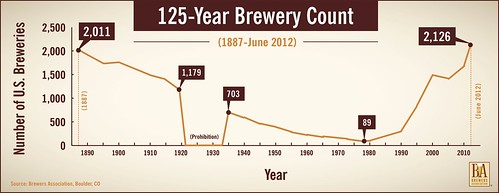
The other piece of great news is the rising number of breweries, with new ones opening seemingly every day. The American brewery count now stands at 2,126, representing 350 new brewery openings since June 2011!

125_Brewery_Count

More from the press release:

The BA also tracks breweries in planning as an indicator of potential new entrants into the craft category, and lists 1,252 breweries in planning today compared to 725 a year ago. Additionally, the count of craft brewers was at 2,075 as of June 30, 2012 showing that 97 percent of U.S. brewers are craft brewers.

“Beer-passionate Americans are opening breweries at a rate faster than at any time since the day Prohibition ended for the beverage of moderation,” Gatza added. “There is nearly a new brewery opening for every day of the year, benefiting beer lovers and communities in every area across the country.”

Filed Under: Breweries, News Tagged With: Brewers Association, Business, Statistics

« Previous Page
Next Page »

Find Something

Northern California Breweries

Please consider purchasing my latest book, California Breweries North, available from Amazon, or ask for it at your local bookstore.

Recent Comments

  • Ernie Dewing on Historic Beer Birthday: Charles William Bergner 
  • Steve 'Pudgy' De Rose on Historic Beer Birthday: Jacob Schmidt
  • Jay Brooks on Beer Birthday: Bill Owens
  • Steve 'Pudgy' De Rose on Beer Birthday: Charles Finkel
  • Steve 'Pudgy' De Rose on Beer Birthday: Bill Owens

Recent Posts

  • Beer In Ads #5204: Oh Brother! Griesedieck Bros. Genuine Premium Bock Beer Is Here! February 15, 2026
  • Historic Beer Birthday: Emil Resch February 15, 2026
  • Historic Beer Birthday: Philip Zang February 15, 2026
  • Beer In Ads #5203: Robert Portner’s Bock Beer February 15, 2026
  • Historic Beer Birthday: August Schell February 15, 2026

BBB Archives

Feedback

Head Quarter
This site is hosted and maintained by H25Q.dev. Any questions or comments for the webmaster can be directed here.