Brookston Beer Bulletin

Jay R. Brooks on Beer

  • Home
  • About
  • Editorial
  • Birthdays
  • Art & Beer

Socialize

  • Dribbble
  • Email
  • Facebook
  • Flickr
  • GitHub
  • Instagram
  • LinkedIn
  • Pinterest
  • RSS
  • Twitter
  • YouTube

Powered by Genesis

Top 50 Craft Breweries For 2011

April 17, 2012 By Jay Brooks

ba
The Brewers Association just announced the top 50 breweries in the U.S. based on sales, by volume, for 2011, which is listed below here. For the fifth year, they’ve also released a list of the top 50 craft breweries based on the new definition adopted by the Brewers Association a few years ago, and updated earlier this year. Here is the new craft brewery list:

  1. Boston Beer Co.; Boston MA
  2. Sierra Nevada Brewing; Chico CA
  3. New Belgium Brewing; Fort Collins CO
  4. Gambrinus Company; San Antonio TX
  5. Deschutes Brewery; Bend OR
  6. Matt Brewing; Utica NY
  7. Bell’s Brewery; Galesburg MI
  8. Harpoon Brewery; Boston, MA
  9. Lagunitas Brewing; Petaluma CA
  10. Boulevard Brewing; Kansas City MO
  11. Stone Brewing; Escondido CA
  12. Dogfish Head Craft Brewery; Lewes DE
  13. Brooklyn Brewery; Brooklyn NY
  14. Alaskan Brewing; Juneau AK
  15. Long Trail Brewing; Bridgewater Corners VT
  16. Shipyard Brewing; Portland ME
  17. Abita Brewing; New Orleans LA
  18. Great Lakes Brewing; Cleveland OH
  19. New Glarus Brewing; New Glarus WI
  20. Full Sail Brewing; Hood River OR
  21. Summit Brewing; Saint Paul MN
  22. Anchor Brewing; San Francisco CA
  23. Firestone Walker Brewing; Paso Robles CA
  24. Sweetwater Brewing; Atlanta GA
  25. Rogue Ales/Oregon Brewing; Newport OR
  26. Flying Dog Brewery; Frederick MD
  27. Victory Brewing; Downingtown PA
  28. CraftWorks Breweries & Restaurants (Gordon Biersch/Rock Bottom); Chattanooga TN/Louisville KY
  29. Oskar Blues Brewery; Longmont CO
  30. Odell Brewing; Fort Collins CO
  31. Stevens Point Brewing; Stevens Point WI
  32. Ninkasi Brewing; Eugene, OR
  33. BJs Restaurant & Brewery; Huntington Beach CA
  34. Blue Point Brewing; Patchogue NY
  35. Bear Republic Brewing; Cloverdale CA
  36. Lost Coast Brewery; Eureka CA
  37. Big Sky Brewing; Missoula MT
  38. North Coast Brewing; Fort Bragg CA
  39. The Saint Louis Brewery/Schlafly Bottleworks; St Louis MO
  40. Gordon Biersch Brewing; San Jose CA
  41. Breckenridge Brewery; Denver CO
  42. Founders Brewing; Grand Rapids MI
  43. Saint Arnold Brewing; Houston TX
  44. Karl Strauss Breweries; San Diego CA
  45. Real Ale Brewing; Blanco, TX
  46. Mac and Jack’s Brewery; Redmond WA
  47. Smuttynose Brewing; Portsmouth NH
  48. Utah Brewers Cooperative; Salt Lake City UT
  49. Left Hand Brewing; Longmont CO
  50. TIE: Anderson Valley Brewing; Boonville CA & Four Peaks Brewing; Tempe AZ

Five breweries are new to this year’s Top 50 Craft Breweries list; Anderson Valley, Founder’s, Four Peaks, Left Hand and Smuttynose. Here is this year’s press release.

I’ll have my annual annotated list shortly.

Filed Under: Breweries, News Tagged With: Statistics, United States

My Home County Healthiest In State Despite Higher Than Average Binge Drinking

April 3, 2012 By Jay Brooks

health
My family and I live just north of San Francisco, in Marin County. We moved here a number of years ago to be closer to my wife’s family, who live in Sonoma County. When she was working in San Francisco, Marin was in the middle of work and family, so it made sense. There’s a lot of good things to recommend here, though it is a very expensive place to live, and in fact a few years ago I saw that it was the third-most expensive county for real estate in the United States.

Our local newspaper, the Marin Independent Journal (or I.J.) — which in the interest of full disclosure is part of the Bay Area Newsgroup, the group I write my newspaper column for — had an interesting headline today about the health of Marin’s residents. In Marin County ranked healthiest county in state for third year in a row, despite residents’ love of alcohol, the author reports on a new study recently released by the neo-prohibitionist Robert Wood Johnson Foundation, along with the University of Wisconsin Population Health Institute. This is the third year of the survey, which ranks the health of America’s counties. For the third straight year Marin County was declared the most healthy California county. For an equal number of years, Marin also has the dubious distinction of a higher than average level of binge drinking.

The percentage of Marin residents who told the pollsters they had engaged in binge drinking within the past 30 days — 24 percent — exceeded the state average of 17 percent and the national benchmark of 8 percent. The survey defines binge drinking as consuming more than four alcoholic beverages on a single occasion, if you’re a women, and five drinks if you’re a man.

But maybe that’s the case because there’s little or no correlation between the two, or at least not the correlation that the neo-prohibitionists who funded the study would prefer. They assume, for primarily political and philosophical reasons, that binge drinking is unhealthy. But what if it’s not? What if it has more to do with the way it’s now defined, which again has more to do with politics than reality. The way “binge drinking” is defined has greatly narrowed over the past few decades which is at least one reason why anti-alcohol groups keep insisting that binge-drinking is such a growing societal problem. But at the same time, several recent studies and meta-studies have revealed that people who drink moderately tend to live longer than those who abstain, an inconvenient fact that is rarely mentioned by neo-prohibitionist groups because it doesn’t fit with their agenda. But even worse, from their point of view, some of these same studies have concluded that even people who binge drink tend to be healthier and live longer than the total abstainers. So perhaps binge drinking and health are more closely associated than we think, just not in the way that neo-prohibitionists would prefer. The least healthy county for which there’s data, Del Norte, has a lower rate of binge drinking (10%) than the healthiest.

But as even the Robert Wood Johnson Foundation makes clear in the own press release about the survey, “healthier counties are no more likely than unhealthy counties to have lower rates of excessive drinking.”

Here’s the top counties in states, followed by the county’s “excessive drinking” percentage, followed by their state’s average, with the “national benchmark” being 8%:

  1. Alabama (Shelby): 13%/12%
  2. Alaska (Southeast Fairbanks): 13%/19%
  3. Arizona (Santa Cruz): 18%/19%
  4. Arkansas (Benton): 12%/12%
  5. California (Marin): 24%/17%
  6. Colorado (Pitkin): 30%/18%
  7. Connecticut (Tolland): 17%/18%
  8. Delaware (New Castle): 21%/19%
  9. Florida (St. Johns): 21%/16%
  10. Georgia (Fayette): 18%/14%
  11. Hawaii (Honolulu): 18%/19%
  12. Idaho (Blaine): 23%/15%
  13. Illinois (Kendall): 23%/19%
  14. Indiana (Hamilton): 17%/16%
  15. Iowa (Winneshiek): 19%/20%
  16. Kansas (Riley): 22%/15%
  17. Kentucky (Oldham): 16%/11%
  18. Louisiana (St. Tammany): 19%/15%
  19. Maine (Sagadahoc): 17%/17%
  20. Maryland (Howard): 14%/15%
  21. Massachusetts (Dukes): 29%/19%
  22. Michigan (Leelanau): 20%/18%
  23. Minnesota (Steele): 18%/19%
  24. Mississippi (DeSoto): 10%/11%
  25. Missouri (St. Charles): 24%/17%
  26. Montana (Gallatin): 22%/19%
  27. Nebraska (Cedar): 23%/19%
  28. Nevada (Douglas): 20%/19%
  29. New Hampshire (Merrimack): 16%/18%
  30. New Jersey (Hunterdon): 18%/16%
  31. New Mexico (Los Alamos): 11%/13%
  32. New York (Putnam): 21%/17%
  33. North Carolina (Wake): 15%/13%
  34. North Dakota (Griggs): 19%/22%
  35. Ohio (Delaware): 20%/17%
  36. Oklahoma (Cleveland): 16%/14%
  37. Oregon (Benton): 15%/16%
  38. Pennsylvania (Union): 16%/18%
  39. Rhode Island (Bristol): 17%/19%
  40. South Carolina (Beaufort): 20%/14%
  41. South Dakota (Brookings): 20%/19%
  42. Tennessee (Williamson): 15%/9%
  43. Texas (Collin): 13%/16%
  44. Utah (Morgan): 9%/9%
  45. Vermont (Chittenden): 20%/19%
  46. Virginia (Fairfax): 20%/16%
  47. Washington (San Juan): 21%/17%
  48. West Virginia (Pendelton): 12%/10%
  49. Wisconsin (St. Croix): 31%/24%
  50. Wyoming (Teton): 22%/17%

In every single case, for the healthiest county in every one of the 50 states, their “excessive drinking” percentage is above the national benchmark, and in many cases well above it. 38 of the 50 states’ healthiest counties are at least twice the national benchmark and six are within a point, or more, of tripling it. Every state’s binge drinking average is well above the national average, which seems strange. And in 35 of the states, the healthiest county also has a binge drinking percentage that’s the same or higher than the state average, too. But the obvious takeaway is what you’d expect given total mortality studies, which is that there’s an inverse correlation between binge drinking and health. The counties with the healthiest residents also have higher numbers of binge drinkers. That much is obvious and is supported by the data, despite the story being spun being very different, even the opposite of what conclusions can be drawn from the numbers. Not that they’re making it easy to see. I had to look at each state and then each county’s records to make a chart of this somewhat damning data.

Of course, part of this is how meaningless our definition of binge drinking has become. Including people who drink five or more drinks in a single setting once a month or even once a year distorts the real issues of problem drinkers. It inflates the numbers, which is good if your agenda is to make false accusations about how bad alcohol is for society but terrible if you really want to adress those problems.

Here in California, the five healthiest counties are:

  1. Marin
  2. Santa Clara
  3. San Benito
  4. Placer
  5. San Mateo

Every single one of the ten healthiest counties in California have an excessive drinking rate above national benchmark, too.

Larry Meredith, director of the Marin County Department of Health and Human Services, is quoted in the IJ’s article, saying. “Our strategy must continue — to eliminate health disparities, and conditions that undermine a long and happy life.” Except that he keeps insisting that binge drinking, as defined by the study, “continues to be an issue,” despite the fact that the same study’s numbers seem to indicate the opposite. In the healthiest counties across the nation, binge drinking, as they define it, is higher in every instance.

Real binge drinkers, the more undefinable people who simply keep drinking and rarely ever stop, are not really captured by this type of survey, because they’re lumped together with responsible people who on occasion drink a little more than usual, whether in celebration of something or to drown their sorrows. As long as we keep drawing more and more people into the category of “binge drinkers,” we dilute the real problem. When that mistake is obvious even by a study conducted by an anti-alcohol organization, and then those results all but ignored, it exposes the propaganda and dishonesty of their agenda.

It’s almost funny to see Marin County’s own anti-alcohol organization, Alcohol Justice (who until last year were the Marin Institue) try to distance themselves from this. Their public affairs director, Michael Scippa, says AJ “shouldn’t be faulted for not being more effective in reducing Marin County’s alcohol consumption.” He lists a number of excuses, such as “availability and Marin being a mostly affluent community” and that “[they’re] constantly battling an industry that has enormous resources.” But what is he apologizing for? That Marin County has the state’s healthiest people living in it, despite ignoring his group’s propaganda? Maybe it’s not the people, but the propaganda that’s wrong? Because people all over the country are ignoring his advice and are all the healthier for it.

Filed Under: Editorial, Just For Fun, Politics & Law Tagged With: Anti-Alcohol, California, Health & Beer, Northern California, Prohibitionists, Statistics, United States

Craft Beer Breaks The 5% Pint Glass Ceiling

March 26, 2012 By Jay Brooks

ba
Wow, the Brewers Association just released their annual data on U.S. craft brewing, for calendar year 2011, and the news is remarkable. “Craft brewers saw volume rise 13 percent, with a 15 percent increase in retail sales from 2010 to 2011, representing a total barrel increase of 1.3 million.”

From the press release:

In 2011, craft brewers represented 5.68 percent of volume of the U.S. beer market, up from 4.97 in 2010, with production reaching 11,468,152 barrels. Additionally, the BA estimates the actual dollar sales figure from craft brewers in 2011 was $8.7 billion, up from $7.6 billion in 2010. Increased retails sales represented 9.1 percent of the $95.5 million dollar U.S. beer market.

“While the overall beer market experienced a 1.32 percent volume decrease in 2011, craft brewing saw significant growth, surpassing five percent total market volume share for the first time,” said Paul Gatza, director, Brewers Association. “It’s becoming increasingly clear that with the variety of styles and flavors to choose from, Americans are developing a strong taste for high-quality, small-batch beer from independent brewers.”

Some other interesting tidbits gleaned from the news. The total number of U.S. breweries now stands at 1,989, just 11 shy of reaching 2,000. Of those, 1,938 are considered by the BA’s definition to be craft breweries. Small breweries accounted for over 103,000 jobs. But just wow: 13.2%! That’s the biggest volume increase that I can remember. And that’s an especially grand number since for the same period, total beer market volume declined. By dollars, craft beer rose a staggering 15% to 9.1% of the total market, getting us ever closer to the elusive, but often-talked about, 10% goal that many feel would be a watershed moment for craft beer.

Print

More from the release:

With 250 brewery openings and only 37 closings, the BA also reported that 1,989 breweries were operating in the U.S. in 2011—an 11 percent increase from the previous year. Small brewers employed approximately 103,585 workers in the U.S in 2011.

“We saw rapid growth in brewery openings last year, particularly with microbrewery start-ups, and these numbers are poised to rise even more in 2012,” added Gatza. “In February 2012, we already topped 2,000 operating breweries—a truly remarkable milestone. We look forward to even more success and the continued expansion of the craft beer market.”

Filed Under: Breweries, News Tagged With: Brewers Association, Statistics

Anatomy Of A Propaganda Piece

March 21, 2012 By Jay Brooks

anatomy-of-murder
With Alcohol Justice promoting it, I just knew there had to be more to the CNN story Movies May Increase Binge Drinking in Teens. The article is based on a study published in the journal Pediatrics with the more benign title Alcohol Consumption in Movies and Adolescent Binge Drinking in 6 European Countries. But either way, Hollywood is, of course, the bogeyman. The study “surveyed 16,500 students ages 10 to 19 from Germany, Iceland, Italy, the Netherlands, Poland and Scotland.”

The students were asked how often they drank five alcoholic beverages during one sitting [interesting a European study has adopted the ridiculous U.S. definition of “binge drinking”], and about the types of movies they watched. Participants were given a list of 50 movies to choose from, which included many top box-office hits from the U.S. The number of drinking scenes was tallied for each movie.

I don’t have the resources to pay to see the whole study, so I don’t know what films are on the list, but the first thing I have to wonder is how many of those films are age-appropriate for 10-year olds? Many Hollywood blockbusters would be at least “PG-13” (so no 10-12 year olds allowed) or “R” (no 10-17 year olds allowed). Are there many movies with “drinking scenes” that are “G” or that every parent would find appropriate for their 10 through 19 year old child? There’s also no breakdown of how many kids were 10, 15, 19, etc., but I have to believe there’s a vast difference between the effect of watching a film on a ten-year old and a young adult, age 18 or 19. The researchers apparently also considered other so-called “risk factors,” and somehow accounted for each “teen’s levels of rebelliousness or sensation-seeking, peer drinking levels, family drinking patterns, affluence and gender.” That’s a lot of data on 16,500 kids, and almost none of it could be considered the “hard facts” type.

The overall results were that “27% of the sample had consumed >5 drinks on at least 1 occasion in their life.” So roughly 1 out of 4 of the “kids” had consumed 5 drinks at least once, and possibly ONLY once, in their life. And of those 16,500, some of the “kids” were legally allowed to drink 5 beers if they wanted to. In Germany, Italy and the Netherlands, the minimum age for drinking is 16. In Poland and Scotland it’s 18 (though once source I have says it’s 16 in Poland). In Iceland it’s 20. So for at least half the countries where the kids were surveyed, they were permitted to drink at least beer 4 out of the 10 ages of “kids” in the study.

For five-sixths of the countries, at least some of the ages of children surveyed were likewise legally allowed to drink alcohol. Like the age breakdowns, there’s no information available (at least to me) about how many of those surveyed were from which country. Given all the supposed control factors they accounted for, the legal age at which people in the surveyed countries are permitted to drink alcohol seems nakedly absent and, at least to my way of thinking, a rather important omission.

And one last comment about their methodology, such as it was. To determine each film’s — I don’t know, “quotient,” “unworthiness” or whatever — “the number of drinking scenes was tallied for each movie” by the researchers. But is the sheer number of times there’s a scene of people drinking in any way relevant? Is there no context to each scene? Are there not positive and negative ways to portray drinking alcohol? I already know the answer to that one, as obviously the researchers are convinced that ANY depiction of people drinking alcohol they consider wrong, but of course a second’s thought will reveal that to be patently nonsense. Just counting how often people are seen drinking alcohol in a film really tells you nothing about how influential it will be, or indeed, if it registers anything at all. Shown being consumed responsibly, it could just as easily be a positive influence.

Personally, I’m much more concerned about my kids seeing casual violence in films than drinking. But there, as well as in America, research continues to claim that there’s a direct “link between drinking in movies and adolescent alcohol consumption habits.” This latest study’s conclusion likewise claims that the “link between alcohol use in movies and adolescent binge drinking was robust and seems relatively unaffected by cultural contexts.”

But in the last paragraphs — well after most people probably stopped reading — was what I’d been thinking as I read this, that “even though the European study shows a strong association between what is seen on the movie screen and binge drinking, it cannot show cause and effect.” Like Otto Preminger’s Anatomy of a Murder, not everything is as it seems.

And despite the tone of the story up until that point having been confidently certain, as expressed in the headline’s more movies, more binging (or better mo movies, mo binging), it may not be as certain as they would have you believe. Here’s the smoking gun.

It may be that binge drinking teens seek out movies that have alcohol scenes, or it could be that seeing scenes of alcohol use in movies makes them more likely to binge drink. More research is needed to confirm these findings.

I continue to be troubled by the wide range of ages surveyed, because in my experience those are the ages when people change more in a shorter period of time than at any other time in their entire life. The conclusion suggests that to combat this scourge, parents should “go to the movies with [their kids] and discuss what you’re seeing. What you say matters more than what one TV show or one movie says.” In other words, be a parent. So is this a problem of parenting or the movies? Should movies be stripped of adult content because kids might watch them? That does seem to be a common strategy by neo-prohibitionist groups, especially with regard to advertising.

In the end, this seems like yet another study riddled with more questions than answers. But, as is typical, those questions — if the media raises them at all — are buried at the end of the article, well after the average person has given up reading and has moved on to something else. What we’re left with is a “survey” (and we all now how teenagers always tell the truth about what they’re doing) of kids in six varied nations (with different minimum drinking ages) who are of widely different ages (from a childlike ten to a young adult 19) who appear to binge drink more (or at least once) if they see Hollywood blockbuster movies (or it may be teens who drink prefer those movies). Tell me again how exactly that’s news?

Filed Under: Beers, Editorial, Politics & Law Tagged With: Anti-Alcohol, Europe, Film, Mainstream Coverage, Prohibitionists, Propaganda, Statistics

Oh, The Horror: Children Recognize Beer Brands

March 19, 2012 By Jay Brooks

beer-kids
Another classic propaganda study was just released in Britain, using the all-too-common meme of “think of the children” as the wedge to attack alcohol advertising. Ever since Prohibition ended miserably here in the U.S., anti-alcohol groups turned their attention to other methods of crippling alcohol, and attacking advertising has been a favorite strategy. It’s quite common in the UK, too, as similar groups there have no doubt witnessed its effectiveness on our side of the pond. This one is being reported by the Daily Mirror as More Children Familiar with Alcohol Brands Than Snacks, which is no doubt exactly the alarm that the anti-alcohol organization behind it was hoping to raise. The so-called “study” the Mirror is reporting on was conducted for Alcohol Concern, a “national charity on alcohol misuse” which certainly sounds like one of our American organizations that cover themselves in the cloak of health and concern for the children.

So let’s look at the study. 400 children, ages 10 and 11 (the same age as my son Porter), were shown brand names and images. Of those, 79% correctly recognized Carlsberg as a beer, or at least as alcohol. The same percentage also correctly identified Smirnoff as alcohol whereas only 74% recognized Ben & Jerry’s Ice Cream (which must have greatly chagrined Ben & Jerry’s ad agency). Oh, the horror! From there, of course, the leap is made that tighter controls need to be placed on the advertising of alcoholic beverages lest the kiddies remain able to know what’s alcohol and what’s not. Because if children know which brands are alcohol, then obviously they will drink them. If then can identify them, then obviously they’re being targeted and all ads therefore “encourage immoderate consumption.” Alcohol Concern asserts that alcohol advertising must be “not attractive to children,” as if adults and children like completely different things.

Okay, a couple of things. First, being able to identify which brands are alcoholic drinks and which are not does not mean the recognition came from advertising. That almost 4 out of 5 kids could identify Carlsberg, one of the best-selling beers in the UK, is just as likely due to its popularity, being in those kids’ homes, sitting in the refrigerator, and seeing their parents drinking it. Or seeing it when they’re at the local football game, with family and family friends drinking it while watching the game; or at a picnic; or they may see it walking the supermarket aisles as their parents shop. There are many places where kids can see alcohol brands, including many positive experiences, that do not have to do with advertising. Kids do not have tunnel vision and only retain what they see in ads on television. Yet Mark Leyshon, from Alcohol Concern, insists their “study” does “provide more evidence that alcohol marketing messages are getting through to young people well before they are legally able to buy alcohol.” I’d say that’s true only if you ignore reality.

On some level, isn’t it good news that kids know the difference between alcohol and soda? And guess which one they prefer? Think about it. Do kids like bitter tastes like beer or sugary sweet flavors like soft drinks? Study after study I’ve seen, and not just ones by neo-prohibitionists, always show young people prefer sweet tastes over bitter ones. I know my kids do. Don’t yours? So it’s in their interest — and yours and society’s if the anti-alcohol nutjobs are to be believed — if they don’t accidentally reach for a bottle of Carlsberg thinking the green bottle contains Sprite or 7Up? Knowledge should be a good thing, but apparently Alcohol Concern thinks it would be better if our children were completely ignorant.

Second, the study itself seems overly simplistic at best. The kids were shown “the brand names and logos of common alcohol products, as well as images from TV alcohol advertisements,” along with “brand images, logos and TV adverts for popular non-alcoholic products such as soft drinks and breakfast cereals.” Then it was multiple choice. The kids could choose for each image they were shown between three choices: “food,” “soft drink” or “alcoholic drink.” I can’t speak for their ten and eleven year olds, but I’m fairly certain my own son (who’s 10-1/2) could do a pretty good job of just guessing between those three choices. Most successful brand images work because the association with the products are natural or complimentary, not inscrutable and hard to figure out.

But even so, would it have been better for children’s health if they could more easily identify the “soft drinks” or “sugary snacks,” which ultimately are at least as bad for their health as alcohol? I know that kids under 18 in civilized places (or 21 in places less so) should not be drinking alcohol, and I accept that children should not have unrestricted access to it. But the fact remains that, all things being equal, the excess sugar and other chemicals in soft drinks and many, many processed foods are terrible for everybody, children included. Yet Alcohol Concern — and indeed most anti-alcohol groups — seem to have no difficulty with the many unhealthy products in the world and are single-mindedly convinced that it’s alcohol alone that it is the cause of society’s woes.

For me personally, as a parent, I find this concern completely absurd, unfounded and misguided. My kids could name more alcohol brands than the average ten and seven-year old, because it’s “daddy’s work.” Their hearts sink every time a package arrives on our doorsep and it’s not a new book or toy, but instead is beer. Our house is full of beer. It’s lining the hallway, in boxes in the foyer, sitting around the dining room, the kitchen, the garage, and stuffed into four refrigerators. But my kids have no interest in it whatsoever. Zip, zero, nada. They know it’s “for adults.” And that’s partly why I’m convinced these sorts of attacks on alcohol advertising using children as a shield are not about the kids in the least. They never are. I’m glad my kids know the difference between what they’re allowed to drink and what they’re not. Don’t all parents teach their kids what they can drink? In our home, it’s simple, really. No soda, no beer and no alcohol. They know, and that knowledge is powerful and effective. Just say know.

Filed Under: Beers, Editorial, Politics & Law Tagged With: Anti-Alcohol, Prohibitionists, Propaganda, Statistics, UK

State Beer Excise Tax Rates As Of 2011

March 15, 2012 By Jay Brooks

tax
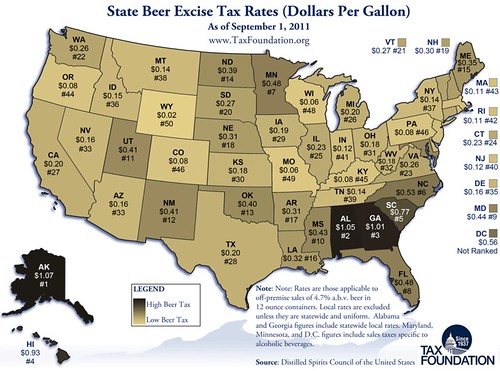
The Tax Foundation, a Washington think tank dedicated to al things taxable, had last week for their weekly Monday Maps on the Tax Foundation’s blog an infographic on State Beer Excise Tax Rates as of September 1, 2011. Alaska has the highest tax rate and Wyoming the lowest. And, of course, the chart doesn’t include the federal excise taxes breweries have to pay or any local taxes, either. Still, it’s always interesting to see the differences laid out on the map.

beermap_large-2011
Obviously, it’s hard to read at this size, but you can check it out full size at the Tax Foundation blog.

Filed Under: Beers, Breweries, Politics & Law Tagged With: Law, Statistics, Taxes

The Great Beeramid Of Calories & Carbs

March 14, 2012 By Jay Brooks

food-pyramid
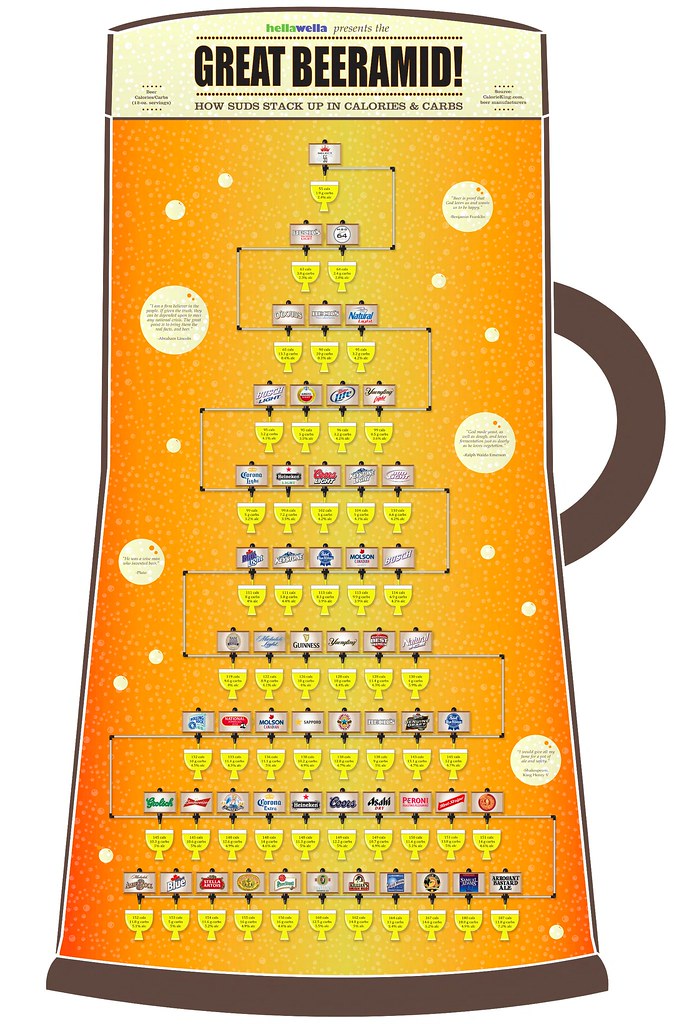
Here’s an interesting infographic, though for most craft beer drinkers it won’t be of much use. It’s a pyramid — or beeramid — showing many of the most popular mainstream beers with their calories and carbohydrates shown, ranking them with the lowest in both at the top of the beeramid and the beers with the most calories and carbs as the foundation on the bottom.

beeramid
It’s hard to read at this size, but you can see it full size at HellaWella.

It was created by HellaWella, a health-oriented website. And while I realize they mean well, I’ve never been convinced that calories or carbohydrates should ever be part of the decision-making process for choosing a beer. I realize other people feel differently, but watching the caloric content necessarily means sacrificing flavor so you can drink more. I say drink less, but better.

They believe that with their chart “you can figure out ahead of time how to keep the calories and/or carbohydrates to a minimum.” But by that criteria, Budweiser’s Select 55 is the best choice. The Top 10 include two non-alcoholic beers (which frankly shouldn’t even be here) and the other eight are low-calorie light beers, not one of which would I voluntarily drink or ever order at a bar or restaurant. But that’s the problem with these health suggestions. When you stick to the numbers, health means giving up what makes beer a great choice in the first place: flavor. If I have to give up beer that tastes of anything to be healthy, to my way of thinking there’s just no point. Except that beer is already healthy (even though the anti-alcohol folks have seen to it breweries aren’t aloud to say so) and since moderation is already the best course to take, why anyone would ever choose a beer with the lowest calories is beyond me.

So I’m a sucker for infographics, and this one is very well done, but in the end its flaw is in the intention, which is to steer people to the blandest possible beers imaginable, supposedly in the interest of health. That’s a mistake, I believe, and not part of a healthy lifestyle. Health also includes mental, as well as physical, health. If drinking responsibly and moderately means (according to the most recent dietary guidelines) having no more than 4 beers in a singe day (3 for a woman) and no more than 14 in a week (7 for women) then you should make them count. Choose the most flavorful, best-tasting beer you can. The difference in calories or carbs just isn’t worth the sacrifice. Skip the piece of cake and go for the better beer. To me, that’s a healthy choice.

Filed Under: Beers, Editorial, Just For Fun Tagged With: Health & Beer, Statistics

The American Beer Revival

February 9, 2012 By Jay Brooks

usa
Regular Bulletin readers know how much I love infographics, a marriage of data and graphic illustration that shows information in a beautiful and understandable way. So I was thrilled when I got an e-mail this morning from a new Silicon Valley start-up, Visual.ly, whose mission is just that, to create and help others create cool visual charts, infographics and videos.

One of their latest works is The American Beer Revival, created by Nate Whitson. Here’s how they describe it:

Over the last hundred or so years, the brewing industry in the United States has changed dramatically. From the saloon era through consolidation to today’s flourishing craft beer culture, it’s been quite a ride. Take a look at how the small brewer is making quite a comeback after nearly a half century of decline.

But better yet, just watch.

Filed Under: Just For Fun Tagged With: Business, History, Statistics, Video

A Mea Culpa: Hoodwinked By Propaganda

February 4, 2012 By Jay Brooks

snake-oil-salesman
On Thursday I posted what I though was a fun little piece with some interesting statistics about how much is consumed on Super Bowl Sunday. In The Super Bowl: By The Numbers, I selected a few of the fun statistics that had been posted a few years earlier in a post on the blog Tree Hugger. Because it was “just for fun,” I didn’t question their statistics or look to see where they came from.

But it looks like I should have, as a few trustworthy commenters have pointed out that one of those factoids doesn’t make sense. The statistic in question? That Americans drink 325.5 million Gallons of beer on Super Sunday. As was pointed out, that math doesn’t really stand up to scrutiny. As Jess put it: “Doesn’t that equal over ten 12 oz. bottles of beer for every man, woman and child in the country? Or if only the 151 million watching the game are drinking, close to a case of beer for every viewer. And, at over 10 million barrels, 5% of all the beer sold in the US all year long is consumed in one day?” So what’s going on?

The estimated population of America in January 2010, when this number was first published was an estimated 308.4 million people. Today, according to the Census Bureau’s Population Clock we’re closing in on 313 million.

325.5 million gallons is roughly 41,664,000,000 ounces, or 3,472,000,000 12-oz. bottles (that’s nearly 3.5 billion bottles) or 2,604,000,000 pint glasses (2.6 billion pints). So assuming the 2010 population, that means each man, woman and child would have to drink 11.258 bottles of beer during the Super Bowl to make that math work. In pints, it would amount to 8.44 pints per person.

But, of course, kids aren’t drinking so let’s take them out of the equation. The census bureau states that in 2010 there were 234,564,000 adults in America (which, you have to laugh, is 18-year olds and above). Since apart from being allowed to drink alcohol, U.S. citizens are considered adults at age 18, I don’t have any statistics for 21 and above. But alright, let’s use that figure; after all the neo-prohibitionists keep claiming our youth are a bunch of drunks anyway. Assuming the 234.5 million figure, each adult would have to drink nearly 15 bottles of beer each or just over 11 pints.

And despite evil alcohol advertising, not every adult chooses to drink alcohol. But how many? That’s trickier. CBS reported in 2010 that 60% of American drink alcohol while a Rasmussen Report in November 2010 found that 29% said they never drink alcohol, meaning 71% do. Additional studies report findings that range widely, so it’s pretty hard to pin down an exact number. So for our purposes let’s examine 60% and 70%. 60% of 234.5 million is 140,736,000 and 70% is 164,194,800. So depending on whose number you accept adult American drinkers had 24.7 bottles (just over a case) or 21.2 bottles (a few bottles shy of a case). For 16-oz. servings, it’s between 18.5 and almost 16 pints. Even drilled down that far, that’s some Brobdingnagian drinking on the part of every American for the Super Bowl.

So from just about every angle, that 325.5 million gallons of beer on one day factoid appears to be a complete fantasy. It doesn’t seem physically possible that Americans could consume that much, even if they were so inclined. So who’s the Snake Oil Salesman selling that lie?

snake-oil-salesman

To Tree Hugger’s credit, they did include links at the bottom of their original post under the headline References, where the links take you to the sources they used. They’re a bit of a mishmash, and I had to essentially look at each one to sort it out, but eventually I found the source of the beer figure. Regular readers will not be surprised to learn that it came from Alcohol Justice, back in the day when they were still called the Marin Institute. As soon as I saw that name, I knew it was probably them. When you click on the link, you can download the 2010 “Fact” Sheet from their ridiculous “Free the Bowl” campaign. And there on page 4 is “Americans consume more than 325.5 million gallons of beer during the Super Bowl.” While many of the factoids there are footnoted with the source, this one, of course, is not. So where did they get it? I have to assume they just made it up, since it’s so absurd a figure.

I’m constantly amazed that an organization that claims to hold the alcohol industry “accountable” for what it calls lies and exaggerations, can be so utterly lacking in its own truthiness. Because that number simply can’t be true, and they can’t possibly be unaware that it’s not true. If you’re insisting that others be truthful, I’d think at the very least that you should apply that same standard to yourself. At the very least, it’s hypocritical.

And that’s also why it’s so insidious. They make up a number, put out a press release, which is then picked up and disseminated uncritically by someone either unfamiliar or unaware of their agenda. Who knows how many other news organizations, websites, blogs, etc. cited that statistic. And each one of them, like Tree Hugger, has the potential to spread it again, without the original source. Even though they cited it, however vaguely, most people wouldn’t even notice or question it. Many probably passed it along without even citing where it came from, and in short order it’s out there and people believe it. So that’s my mea culpa. I was hoodwinked by the propaganda. I should have looked at that number more closely, and the source of it, as well. I was just trying to have a bit of fun with the Super Bowl. Serves me right, I guess. So now you know.

Filed Under: Editorial, Just For Fun Tagged With: Anti-Alcohol, Prohibitionists, Statistics

The Super Bowl: By The Numbers

February 2, 2012 By Jay Brooks

super-bowl-xlvi-2012
You usually see this kind of list for Oktoberfest; how much beer, how many sausages, etc. But Tree Hugger put together a list of what’s consumed during the Super Bowl: By the Numbers: Super Bowl Facts and Figures. The statistics are from 2010’s big game, but I feel confident they’re close enough. Here’s the most important numbers, about the beer.

  • 325.5 million: Gallons of beer drank by Americans that day.
  • 493: Number of Olympic-sized swimming pools that could be filled with all that beer.

A few more:

  • $5.6 billion: Amount consumers will spend on Super Bowl related items.
  • 1 billion: Number of chicken wings consumed on Super Bowl Sunday.
  • 194 million: Approximate number of blades of grass on the football field.
  • 151.6 million: Number of people who will watch at least part of the game.
  • 28 million: Pounds of potato chips consumed.
  • 293,000: Number of miles of potato chips, laid end to end, consumed during the game.
  • 232: Number of countries and territories in which the game will be broadcast.
  • 34: Number of languages the game is broadcast in.
  • 1: Number of languages in which the word “football” doesn’t mean “soccer.”

Check out the rest of the list on Tree Hugger.

Filed Under: Just For Fun Tagged With: Football, Sports, Statistics

« Previous Page
Next Page »

Find Something

Northern California Breweries

Please consider purchasing my latest book, California Breweries North, available from Amazon, or ask for it at your local bookstore.

Recent Comments

  • Ernie Dewing on Historic Beer Birthday: Charles William Bergner 
  • Steve 'Pudgy' De Rose on Historic Beer Birthday: Jacob Schmidt
  • Jay Brooks on Beer Birthday: Bill Owens
  • Steve 'Pudgy' De Rose on Beer Birthday: Charles Finkel
  • Steve 'Pudgy' De Rose on Beer Birthday: Bill Owens

Recent Posts

  • Beer In Ads #5204: Oh Brother! Griesedieck Bros. Genuine Premium Bock Beer Is Here! February 15, 2026
  • Historic Beer Birthday: Emil Resch February 15, 2026
  • Historic Beer Birthday: Philip Zang February 15, 2026
  • Beer In Ads #5203: Robert Portner’s Bock Beer February 15, 2026
  • Historic Beer Birthday: August Schell February 15, 2026

BBB Archives

Feedback

Head Quarter
This site is hosted and maintained by H25Q.dev. Any questions or comments for the webmaster can be directed here.