Brookston Beer Bulletin

Jay R. Brooks on Beer

  • Home
  • About
  • Editorial
  • Birthdays
  • Art & Beer

Socialize

  • Dribbble
  • Email
  • Facebook
  • Flickr
  • GitHub
  • Instagram
  • LinkedIn
  • Pinterest
  • RSS
  • Twitter
  • YouTube

Powered by Genesis

Beer In Art #103: David Hockney’s Wheat Field Near Fridaythorpe

November 21, 2010 By Jay Brooks

art-beer
This week’s work of art is by contemporary British artist David Hockney. It was painted in August of 2005 and is known as Wheat Field Near Fridaythorpe. It was part of a series of paintings Hockney did entitled “A Year in Yorkshire.”

David_Hockney-Wheat_Field_Near_Fridaythorpe

For more about David Hockney, Wikipedia is a good place to start, and there’s a biography at DavidHockney.com. There are also tons of links at the ArtCyclopedia, the Web Museum and the Art Archive.

Filed Under: Art & Beer, Beers Tagged With: UK, Wheat

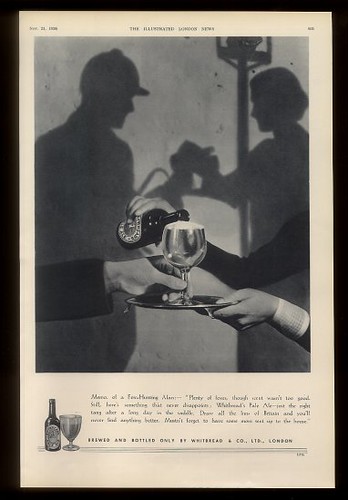
Beer In Ads #244: Whitbread Shadows

November 16, 2010 By Jay Brooks

ad-billboard
Tuesday’s ad is an early one for Whitbread Pale Ale. The 1936 ad is all shadows and light, with the shadowed man wearing some sort of riding hat, or is he Sherlock Holmes?

Whitbread-1936

Filed Under: Art & Beer, Beers Tagged With: Advertising, History, UK

Zythophile Examines 40 Years Of CAMRA

November 12, 2010 By Jay Brooks

camra
With the 40th anniversary of the Campaign For Real Ale (CAMRA) just around the corner, one of my favorite beer historians, Martyn Cornell, takes a close look at some mistakes they’ve made along the way and some things they might have done better. He writes Maybe They Should Have Kept to ‘Revitalisation’. And Dropped the ‘Ale’at his wonderful blog Zythophile. Full disclosure, like Martyn, I’m also a CAMRA member.

Filed Under: Editorial, Politics & Law, Related Pleasures Tagged With: Cask, UK

Full Fact Disputes UK Alcohol Statistics

November 9, 2010 By Jay Brooks

beer-syringe
In response to the highly unscientific study published in The Lancet last week suggesting alcohol is more dangerous than heroin, FullFact.org — “A [British] independent fact-checking organisation” — asked the question “Are alcohol-related problems on the rise?” Their conclusion? “Full Fact finds little support in the evidence.”

Filed Under: Beers, Editorial, News, Politics & Law Tagged With: Science, Statistics, UK

MolsonCoors To Launch “Girlie Beers” In UK

November 5, 2010 By Jay Brooks

woman
According to the Publican, next year MolsonCoors will launch a line of beer aimed specifically at the female market.

From the Publican:

Molson Coors is to have another crack at the female beer drinking market next year with the UK roll-out of a range of products that it hopes will appeal to women.

Mark Hunter, chief executive of the UK arm of the global brewing behemoth, said today that the range had undergone more than a year’s worth of research, including a series of trials with numerous focus groups, and was ready for sign off before Christmas.

“This won’t be just about launching a beer aimed exclusively at the female drinker,” he said, although with 60 per cent of women admitting to not drinking beer he added he was encouraged to go after some of that potential customer base.

The soon-to-be launched beers, details of which have yet to be revealed, will be partnered with special glassware designed by fashion guru Amy Molyneaux, with goblets made of black glass, embossed with gold lettering.

Hunter said the range evolved from the Bittersweet Partnership, a strategy created by the brewer to help broaden beer’s appeal.

I don’t know why big companies keep doing this, as they seem to miss the point entirely. First, they emphasize the packaging — it’s always about the packaging and rarely about what’s inside of it — and that just feels foolish.

They also seem to always make beer aimed at women lower in alcohol. But isn’t the stereotype that women prefer wine to beer? And wine is three times stronger than the average English beer, so what am I missing? My wife loves barley wine, and many other stronger styles. She hates low-calorie beer because it tastes of nothing. She wants, like all of us really, flavor. And I can’t see how that’s a gender issue.

My son Porter has been train obsessed since he could express a preference, so I’ve watched a lot — I mean a lot — of train videos. I remember in one the story about how Lionel, the toy train company, a number of years ago came out with a pink train engine, with all pastel cars, to appeal to girls, hoping to pull more of them into the hobby. It was, of course, a miserable failure because the girls who liked toy trains wanted authentic-looking ones, not pink trains that some marketing “expert” thought she would like. And that’s how I see beer. Pandering to women with something you think they’ll like, no matter how many focus groups you conduct, seems like the wrong approach on so many levels.

To me, the fact that women don’t drink beer has more to do with the male-leaning marketing that the big companies have been doing their entire lives. That pandering I have to believe has left them feeling like beer is not aimed at them and is not for them. Pandering to them now with a pink beer in the hopes of undoing decades of stereotyping seems doomed to fail.

The other common stereotype is that beer is too bitter for many women. Again, I think that’s due to stereotypes, too, but this time of the beer itself. I hate to keep going back to Mrs. Brookston Beer Bulletin, but hers is a story I know only too well. When we first met, she drank Natural Light and knew precious little — nothing, really — about beer. The first thing we did together, before I even asked her out on our first date, was go to a brewpub where I ordered her a sampler of the beers they offered. I tasted her through the range of beers, talking about each one, and explaining the differences, the history, how they were made, etc. Not only was she very open and responsive, but she loved them. In fact, she’s never looked back and has been a lifelong lover of good beer from that point to today, some 16 or so years later. And I’ve heard similar stories from people over the years, too. That leads me to believe that the stereotypes heaped on women about why they don’t like beer are, for the most part, pure horseshit. But alcohol companies continue to treat them as gospel and make business decisions as if they really were true.

Carlsberg is also currently testing their own female-friendly beer, Cardinal Eve, or just Eve, from their Swiss brewery, Feldschlösschen Beverages. According to the press kit, there are four flavored beers — lychee, passion fruit, peach and grapefruit — at 3.1% a.b.v. Frankly, those sound like they’re treading dangerously into wine cooler or alcopop territory.

Since I know dozens, perhaps hundreds, of women who love beer — and I see thousands more all the time — it’s hard to take seriously this notion that women don’t like beer. I continue to think the reason that more women (that is more, from a purely business point of view) don’t drink beer is a self-inflicted wound by the big beer companies that they’re now trying to figure out how to undo without losing their core marketing techniques involving sports and images of women that appeal to men but often demean women. They could also make beers that taste of something, too. I’ll be interested to hear what the more vocal female beer writers think about this.

Filed Under: Beers, Breweries, Editorial, News Tagged With: MolsonCoors, UK, Women

Beer More Dangerous Than Heroin!?!

November 1, 2010 By Jay Brooks

beer-syringe
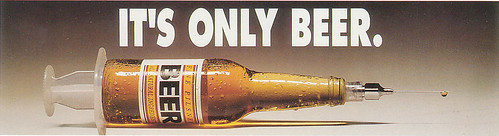
I suppose it was inevitable. Anti-alcohol folks have been saying for years that alcohol is the worst drug on the planet. And comparing it to heroin is not exactly new, either. A popular neo-prohibitionist PSA shows a beer bottle as a syringe to remind people that alcohol is also a drug. You can even buy bookmarks and posters of it at Face, the one-stop shop for neo-prohibitionist propaganda. Of course, aspirin is also a drug, but who would drink beer in either pill or syringe form?

its-only-beer-lg

The characterization of alcohol as a drug is mostly a specious one, because it ultimately depends on how you define what a drug is or how it’s used. You might be tempted to think that it’s fairly easy to explain exactly what is a “drug,” but it’s actually not. Even the most common dictionaries define it rather differently, and how people connote it varies even more widely. Some say it’s only a drug if it’s used as medicine, others any chemical substance that alters something physical, while still other definitions insist a drug is something illicit or illegal. A lot of what definition you choose is dependent on your message or what point you’re trying to make. In other words, context matters. What we can agree on — I hope — is that there are both good and bad drugs. I know there won’t be universal agreement on which is which, but that they’re not all the same I trust can be acknowledged by either side of the alcohol divide.

Today the scientific journal The Lancet published a new article entitled Drug Harms in the UK: A Multicriteria Decision Analysis that purports to show that alcohol is more dangerous than heroin. According to their results it is indeed claimed that alcohol is more dangerous to society and individuals than anything else on Earth, including crack, cocaine, tobacco, Ecstasy and LSD. The article — I refuse to call it a study — was authored by David Nutt, the former UK chief drugs adviser who was fired in October of last year by the British government.

Why this so-called study is garnering such media attention has to do with its volatile headline. As they say, if it bleeds it leads, and this definitely has blood on it. But it’s not exactly scientific. I’d always thought of the Lancet as one of the more rigidly scientific journals, but this gives me pause. Essentially, the way the results of this article were collected was by gathering together sixteen “experts,” specifically “members of the Independent Scientific Committee on Drugs (an organization founded by David Nutt after his firing), including two invited specialists” who then sat down for a one-day meeting — called a “workshop” — where each of them was asked to “score 20 drugs on 16 criteria: nine related to the harms that a drug produces in the individual and seven to the harms to others. Drugs were scored out of 100 points, and the criteria were weighted to indicate their relative importance.” Well, how scientific.

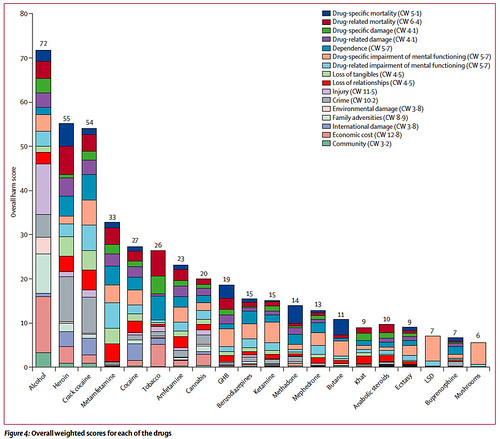
This is the 16 criteria they scored:
Lancet-Nov10-fig-1

So essentially this “study” is simply the scores collected by a few so-called “experts” — almost entirely made up of members of one organization thick with agenda — during a one-day retreat. That’s hardly “proof” of anything. If I were The Lancet, though, I’d be a little embarrassed about having so unscientific a piece being in my previously distinguished pages. Throughout the article, the author infuriatingly keeps referring to the results as “findings,” as if they’re a tally of something more meaningful than mere opinion. Self-fulfilling prophecy is a more reasonable assessment of their “findings.”

Here’s how they explain themselves:

The issue of the weightings is crucial since they affect the overall scores. The weighting process is necessarily based on judgment, so it is best done by a group of experts working to consensus. Although the assessed weights can be made public, they cannot be cross-validated with objective data.

They also admit that their opinionated scores only include the supposed harm of the substances they’re evaluating, and that they did not take into account any benefits, apart from admitting that some do exist.

Limitations of this approach include the fact that we scored only harms. All drugs have some benefits to the user, at least initially, otherwise they would not be used, but this effect might attenuate over time with tolerance and withdrawal. Some drugs such as alcohol and tobacco have commercial benefits to society in terms of providing work and tax, which to some extent offset the harms….

So they admit alcohol’s economic benefits, but still conveniently ignore the many health benefits of responsible, moderate consumption, including the rather important fact that most people who drink moderately will live longer than those who either totally abstain or over-indulge.

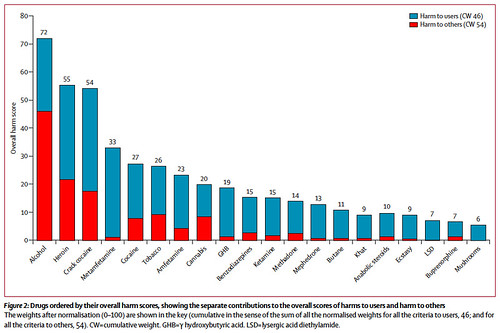
No matter, the experts conclude that both heroin and crack-cocaine are nearly a third less dangerous than alcohol. Mushrooms, they’ve declared, are the safest of all.

Lancet-Nov10-fig-2

But essentially they’re taking the minority of people who abuse alcohol and from there go on to imply that essentially everyone who drinks alcohol exacts that same cost to themselves and society, extending the data out to include all drinkers. But that’s clearly untrue and quite ludicrous. All they’ve done is dress up opinions — and biased ones at that — and presented them as facts and findings, based solely on the idea that expert opinions are facts. That The Lancet went along with it shows how mesmerized we are by the lure of so-called, and even self-proclaimed, “expert opinions.”

Finally, the chart below shows the breakdowns of each of the 16 criteria and how much they assigned to each “drug.”
Lancet-Nov10-fig-4

The BBC even collected drinkers’ responses and one woman noted that her grandmother has had a glass of wine every single day since she was 18 and is still going strong, reasonably suggesting that she might not still be here if she’d been taking heroin every day for the same period of time. Professor Nutt won’t even concede that point, saying that it’s not necessarily true, stating that the woman’s grandmother might be better off if she’d taken the heroin instead! He says “all medicines are safe if they’re used appropriately.” Maybe, but why wouldn’t that same logic then extend to alcohol? Why can’t he concede that it’s also safe if used “appropriately?” Can anyone really believe that a prescription of heroin every day is safer than a drink or two of beer per day, just because it didn’t come from a doctor’s advice?

Is it possible there’s another reason for Professor Nutt’s war on alcohol? Well here’s at least one possibility. In December, the London Telegraph reported that Nutt was leading a team at Imperial College London in developing a synthetic alcohol, produced using chemicals related to Valium. According to the report, it “works like alcohol on nerves in the brain that provide a feeling of well-being and relaxation,” but “unlike alcohol its does not affect other parts of the brain that control mood swings and lead to addiction. It is also much easier to flush out of the body.” And because it’s “much more focused in its effects, it can also be switched off with an antidote, leaving the drinker immediately sober.” It’s not too hard to imagine that the scarier and more dangerously alcohol is perceived as a societal evil and health risk, the more customers for synthetic alcohol there would be.

No matter what his true motives, Nutt is … well, I’ve been trying to avoid this but there’s just no way around it, something of a nutter. He claims that his “findings showed that ‘aggressively targeting alcohol harms is a valid and necessary public health strategy.'” Of course, that’s been his position since well before this farce began, so again, it’s much more of an agenda in search of its own validation. Not so much a self-fulfilling prophecy, but a self-created justification for a position he already held. All he needed to do was to create the official-sounding organization “Independent Scientific Committee on Drugs” and then have them say the same thing he’s been saying all along, this time with charts and people with strings of alphabets after their names so it all sounds on the up and up. But this is just another case of the Emperor having no lab coat, and few people in the media even noticing.

UPDATE: As expected, Pete Brown has also tackled Nutt’s Lancet article and its attendant publicity in The MAIN reason Professor Nutt is bad for our health. Check it out.

Filed Under: Beers, Editorial, News, Politics & Law Tagged With: Prohibitionists, Science, Statistics, UK

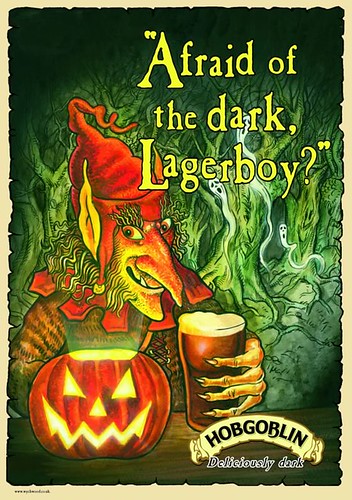
Beer In Ads #230: Hobgoblin, “Afraid of the Dark, Lagerboy?”

October 30, 2010 By Jay Brooks

ad-billboard
With the World Series and baseball ads plus Halloween this weekend, I’m doubling up on ads so I can highlight both baseball and Halloween-themed ones. Today’s Halloween ad is fairly contemporary and is for UK beer Hobgoblin, brewed by the Wychwood Brewery located in Witney, part of Oxfordshire.

hobgoblin_lagerboy_halloween

Filed Under: Art & Beer, Beers Tagged With: Advertising, UK

Good Pub Guide Announces Pay To Play

October 29, 2010 By Jay Brooks

good-pub-guide
I’m not quite sure what to think about this. The Publican reported today that the highly respected and nearly 30-year old UK Good Pub Guide is going to begin charging pubs to be included in the guide. Starting with next year’s edition, fees to be included “will be either £99 or £199, depending on the size of the outlet.” The current issue includes over 5,000 listings, so that would mean future books would realize between £500,000 and £1,000,000 (or between $800,900 and $1.6 million dollars).

The reason for the charge is explained by editor Fiona Stapley, and it’s just what you’d expect. “Putting together a guide like this is quite expensive and we are looking at the business model. More and more guides like this are charging. She added that the judging criteria would remain the same and pubs would still have to reach the same standards to gain a listing.”

good-pub-guide-2010

And yes, I’m sure that it is expensive to put the book together. Having been involved in publishing for a lot of years, I don’t doubt that it’s become increasingly pricey to produce the book. Unfortunately, I’m not sure this is necessarily the best fix. As Stapley states, “more and more guides like this are charging.” Maybe, but I have a hard time believing by doing so they maintain the same level of integrity and independence. The most obvious problem would come when some, or perhaps a lot, of pubs choose not to spend the money. After all, a lot of pubs in the UK are struggling to stay afloat. As a result, the “Good Pub Guide” could become the “Good Pubs Willing to Pay the Fee Guide.” It would no longer be complete. Undoubtedly, many successful pubs would feel compelled to pay in order to not have their business suffer from being excluded. Whenever that happens — and however perfectly legal — it would still be hard not to see it as de facto extortion.

Could they charge pubs to be included and then remain independent in their reviews? I’m sure it’s possible. After all, magazines that accept advertising do it all the time. But this seems slightly different insofar as this is paying to be in a guidebook whose sole purpose it to provide impartial reviews of each pub’s quality and worthiness. Even if they started out with the best of intentions, it seems very likely, to me at least, that over time the pubs that are paying would come to expect something in return for their continued support and the dynamic of the publication would change. And increasingly, pubs that should be recommended would come to not be included just because they balked at the idea of paying for the privilege. That would do a grave disservice to both those good pubs and the potential customers using the guidebook to find them. No matter how hard they tried to remain impartial, it just feels like it would still create an undesirable perception of the potential for misconduct. What do you think? Inevitable and unconcerning or a death blow to impartiality?

Filed Under: Editorial, News, Politics & Law Tagged With: Beer Books, Pubs, UK

Save the Ales, Or At Least the Word

October 11, 2010 By Jay Brooks

yeast-buddy
My friend, colleague and kindred curmudgeon, Martyn Cornell, is fed up. And rightly so. In a new post today at his blog Zythophile entitled Look, will you all stop misusing the word ‘ale.’ Thank you, he charts the transformation of the word from its earliest usage through the present. It’s a fascinating journey and an even more compelling story. Listen to him, he knows what he’s talking about.

Filed Under: Beers, Editorial Tagged With: History, UK

Beer In Ads #194: Barclay’s London Lager

September 14, 2010 By Jay Brooks

ad-billboard
Tuesday’s ad is for Barclay’s London Lager. I love the simplicity of the ad, with few colors and using a lot of white negative space to great effect.

barclays-london-lager

Filed Under: Art & Beer, Beers Tagged With: Advertising, History, UK

« Previous Page
Next Page »

Find Something

Northern California Breweries

Please consider purchasing my latest book, California Breweries North, available from Amazon, or ask for it at your local bookstore.

Recent Comments

  • Ernie Dewing on Historic Beer Birthday: Charles William Bergner 
  • Steve 'Pudgy' De Rose on Historic Beer Birthday: Jacob Schmidt
  • Jay Brooks on Beer Birthday: Bill Owens
  • Steve 'Pudgy' De Rose on Beer Birthday: Charles Finkel
  • Steve 'Pudgy' De Rose on Beer Birthday: Bill Owens

Recent Posts

  • Historic Beer Birthday: Adolph Schell February 12, 2026
  • Beer Birthday: Jennifer Talley February 12, 2026
  • Beer In Ads #5199: Fresh As A Frosty Morn, Congress Bock Beer February 11, 2026
  • Historic Beer Birthday: John Weidenfeller February 11, 2026
  • Beer Birthday: Dylan Schatz February 11, 2026

BBB Archives

Feedback

Head Quarter
This site is hosted and maintained by H25Q.dev. Any questions or comments for the webmaster can be directed here.