Brookston Beer Bulletin

Jay R. Brooks on Beer

  • Home
  • About
  • Editorial
  • Birthdays
  • Art & Beer

Socialize

  • Dribbble
  • Email
  • Facebook
  • Flickr
  • GitHub
  • Instagram
  • LinkedIn
  • Pinterest
  • RSS
  • Twitter
  • YouTube

Powered by Genesis

Wisconsin Historian Compares Current State Politics To Prohibition

March 6, 2011 By Jay Brooks

wisconsin
Here’s an interesting op-ed piece by Wisconsin historian John Gurda entitled Smashing ‘Demon Government’ in which he examines the many parallels between the current political climate in his state and the temperance movement that led to Prohibition. Thanks to Wisconsin Bulletin reader Jason H. for sending me the link. Subtitled “Walker’s small-government zeal resembles that of the prohibitionists,” here’s a few choice excerpts below:
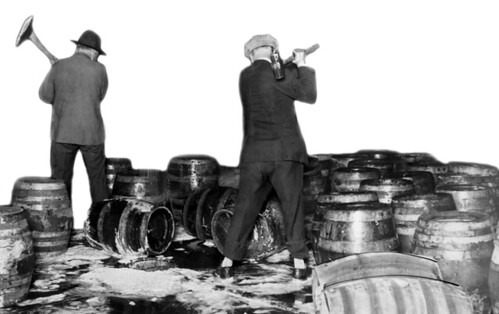
MJS prohibition

In its moral fervor, its contempt for compromise, its demographic base and even its strategies, today’s new right is the philosophical first cousin of prohibitionism.

Consider a few of the parallels. The prohibitionists went after “Demon Rum,” while the tea party attacks Demon Government. The Anti-Saloon League preached that barrooms were destroying America’s moral fiber, while the new right declares that onerous taxation and excessive regulation are doing precisely the same thing. Carrie Nation smashed whiskey barrels, while today’s conservatives want to smash the welfare state. Addiction to spending, they might argue, is ultimately as destructive as addiction to alcohol.

Like the temperance movement of the last century, the tea party draws heavy support from Protestant evangelicals such as Walker himself, and their political playbook is a throwback as well. The prohibitionists were media-savvy opportunists, taking advantage of every opening to advance their cause.

When the United States entered World War I, they wasted no time demonizing beer as “Kaiser brew” and even accused Milwaukee’s producers of spreading “German propaganda.” When food shortages loomed during the conflict, the dry lobby convinced Congress to divert America’s grain supply from breweries and distilleries to less objectionable industries. The result was “wartime prohibition,” a supposedly temporary measure that went into effect in 1919 and soon gave way to the 18th Amendment. The national drought would last for 14 years.

It’s worth noting that America wasn’t alone in using the conflict of World War I to push anti-alcohol agendas. Like-minded measures in several countries led to similar alcohol prohibitions, many of which lasted far longer than ours, such as Australia, Canada, Finland, Hungry, Iceland, New Zealand, Norway and Russia. In each of those nations, temperance groups took advantage of wartime circumstances to push their plans on the rest of the populace in their respective places.

In much the same way that prohibitionists turned World War I to their advantage, the current crop of conservatives is making political hay from another temporary phenomenon: the global economic recession. The need for fiscal austerity has rarely been more obvious, but it’s being used as a pretext for advancing the new right’s legislative agenda.

We’re seeing that happen in most, if not every state, with anti-alcohol groups turning our nation’s economic adversity into an opportunity to raise taxes on beer, already the most heavily taxed consumer good (along with tobacco). The Marin Institute has even created propaganda showing the “worst” ten states, with “worst” meaning the states with the lowest taxes on beer, completely out of context and with no understanding whatsoever of why each individual’s states excise taxes are set where they are. Shortly after Governor Walker created Wisconsin’s deficit by giving tax cuts to the wealthy, Michele Simon of the Marin Institute tweeted that beer should make up the difference. “Dear Gov. Walker: Wisconsin has not raised its beer tax since 1969. At .06/gallon, among lowest in nation. Just one of many ideas.” If that’s not what Gurda was talking about, I don’t know what is. That’s using a grave political situation to further an unrelated agenda.

Walker began with a demand that public employees pay more for their pensions and health insurance – a necessary step to which they have agreed – and then proposed to strip them of their collective bargaining rights. That’s an epic non sequitur that makes sense only when you invoke tea party logic: If taxes are bad, then the people we pay with tax dollars must be brought to heel, even if it means freezing a new teacher at first-year wages until retirement.

But the new right’s agenda goes far beyond public employee unions. With solid majorities in the state Legislature, Walker first declared a budget emergency and then cut taxes by $140 million, which is equivalent to taking blood from a patient with severe anemia. In last week’s budget message, he pronounced the patient so sick that amputations are necessary. Walker’s juggernaut of tax cuts and service cuts, combined with his no-bid privatization plans, trends in one direction and one direction only: dismantling government one line item at a time, regardless of the consequences.

It is here, finally, that prohibitionism and tea party conservatism find common ground: Both are ideologies. They represent fixed, blinkered views of the world that focus on single issues and dismiss all other positions as either incomplete or simply wrong-headed. Get rid of alcohol, the prohibitionists promised, and the U.S. would become a nation of the righteous and a beacon of prosperity to the world. Just cut government to a minimum, the new right contends, and you will usher in a brave new era of freedom and opportunity.

And that’s how I see all of the neo-prohibitionist and anti-alcohol groups, as “ideologies.” All of the anti-alcohol groups that I’m aware of do everything in their power to punish alcohol companies because of their perceived sins and because they want to tell you and me how to live our lives. They do so without thinking through the consequences and overall use an “ends justify the means approach,” especially in the way they frame and distort their propaganda. Simply put, I believe that they think they know better than everybody else, there’s a certain smugness in their position; in its unwavering certainty, their righteousness that borders on religious fervor.

They’re convinced that there’s no free will, people are incapable of ignoring advertising, or knowing their limits when drinking. And while there are a few tragic figures who may fit that description, they’re the tiny minority that such groups are fixated on to make their case. The vast majority who drink alcohol do so responsibly and in moderation. Most people take personal responsibility for their actions, as they should. But personal responsibility rarely, if ever, figures into alcohol abuse if you listen only to anti-alcohol rhetoric and propaganda. It’s always the fault of the alcohol itself, and usually beer because it plays better to the people with money who fund such organizations (they drink wine after all). An op-ed piece in the UK Telegraph by Brendan O’Neil recently shed a light on the class issue in anti-alcohol efforts. If they’re not going after the children, then they’re preying on the weak-minded with the most effective advertising the world has ever wrought. Earlier this year, the hue and cry was because there were 3.5 minutes of beer commercial during the nearly four hours of the Super Bowl and — gasp — the little kiddies might see it.

But anti-alcohol rhetoric single-mindedly focuses on only the negative. I’ve never heard any of them say one word that was positive about any alcohol company. Even when Anheuser-Busch packaged cans of water and sent then to earthquake-ravaged Haiti, one anti-alcohol group criticized them for the deed, because they put their logo on the cans and sent out a press release (oh, the horror). Let no good deed go unpunished, indeed. That alone should convince us they’re idealogues.

I suspect they might say the same of me, but I understand and acknowledge that there are some people who should not drink. That such people can and do cause problems for themselves and often the people around them. I don’t write about it very much because I don’t have to; there’s plenty of lopsided anti-alcohol rhetoric already. I’m just trying to balance the conversation, though more often than not I feel like the lone voice in the wilderness.

But back to Wisconsin. My wife is a political news junkie, and she informs me that a careful reading of the facts reveals that Scott Walker’s entire political career has been in service to a single ideology: union busting. He apparently promised that was not his agenda throughout his campaign for governor, and the media swallowed that wholesale with few examining or reporting the discrepancy between what he said while campaigning and his entire career leading up to that point. In that, there’s yet another parallel between the new prohibitionists and the new political conservatives. Most mainstream news media also take the side of the well-funded anti-alcohol groups and parrot their propaganda without questioning it or providing any meaningful views from the other side of this debate.

As to Gurda’s comparisons, I think he’s right about anti-alcohol groups’ unwillingness to compromise and being self-righteous with “blinkered views of the world that focus on single issues and dismiss all other positions as either incomplete or simply wrong-headed.” That’s certainly been my experience. So as if there wasn’t enough reasons to support the protesters in Wisconsin, if this political test case is successful, not only will we see more unions busted in other states, but I suspect anti-alcohol groups are also closely watching this to see how they might use the same bullying tactics in furtherance of their own agenda. And that may be the scariest prospect of all. As usual, I’m with the Green Bay Packers on this one.

Filed Under: Beers, Editorial, News, Politics & Law Tagged With: History, Law, Prohibitionists, Wisconsin

Wisconsin Food Pyramid

February 6, 2011 By Jay Brooks

nfl-gb
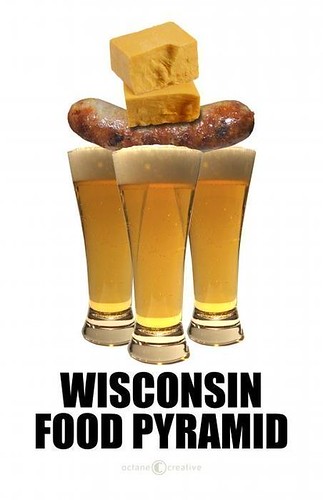
I imagine the “Wisconsin Food Pyramid” was originally meant to be derogatory, but what could be a better meal for a football game than sausages (cooked in beer), cheese and beer? That’s what I’m having at my Super Bowl party, along with chips, pretzels and more cheese. And Sean Paxton, the Homebrew Chef, has promised to bring Shepherd’s Pie. Yum. Go Packers!

wis-food-pyramid

Filed Under: Food & Beer, Just For Fun Tagged With: Food, Football, Humor, Sports, Wisconsin

Beer In Art #86: Erik Olsen’s Faux Beer Posters

July 25, 2010 By Jay Brooks

art-beer
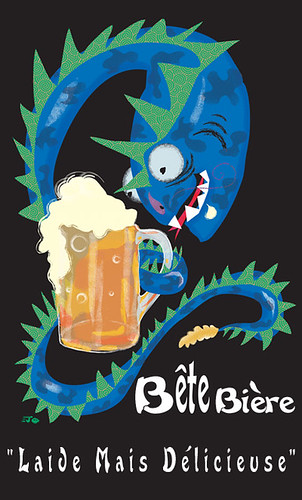
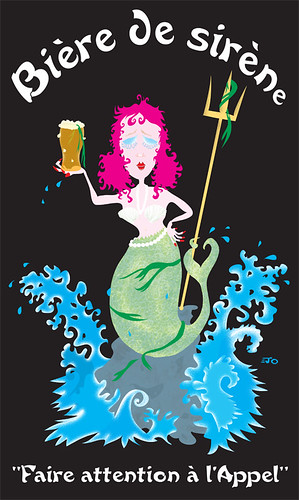
Today’s works of art are by an illustrator apparently living in the Bay Area, Erik Olsen. I say apparently, because a number of the links from his blogs are dead ends, and the faux beer poster’s I’m highlighting here were abandoned in 2006 after only three posts on that blog, Faux Posters. He created three posters as an homage to the great beer posters on the early 20th century. There he described the idea for the project:

It’s a tribute to some of the great poster designs in the early twentieth century. (Specifically those early French beer posters) Our first series is focused on the theme “beer”, each series of 12 prints will be focused on a new topic with limited prints runs. We have many sizes of prints available, everything for the beginner collector to the serious collector. Stay tuned as we add new Images and new themes to our gallery as we design more Faux Prints!

Unfortunately, only these three were done, beginning with the monster below.

Erik_Olsen-Monster
Bete Biere translates as “Beast Beer,” with the slogan “Ugly But Delicious.”

Erik_Olsen-Mermaid
Biere de Sirene, essentially the Siren’s Beer and the slogan is “Faire attention a l’Appel” or “Heed the Call.”

Erik_Olsen-Prehistoric
“Biere Prehistorique,” simply Prehistoric Beer, “Aged to Perfection.”

The first and the third are available for purchase as a poster, but it’s looks like he abandoned the project before the Mermaid was made available.

You can read Olsen’s biography and see his resume. There’s also a portfolio at his personal website and a few more on Coroflot.

Filed Under: Art & Beer, Beers Tagged With: Bay Area, California, Wisconsin

New Hopyard Planted In Wisconsin

May 28, 2010 By Jay Brooks

simple-earth-hops
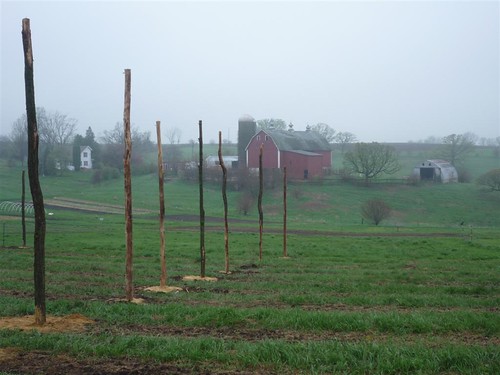
Matt Sweeny, from Fatty Matty Brewing, a homebrewing and craft beer website, announced yesterday that he’s started a small hop farm in Dodgeville, Wisconsin, named Simple Earth Hops.

simple-earth-hops

From the press release:

Simple Earth Hops is a new 1/4 acre hopyard located at Greenspirit Farm CSA in Dodgeville, Wisconsin. The hopyard was founded with the idea of providing a much needed agricultural product for local craft brewers. Simple Earth Hops was established to demonstrate that local farmers can produce a consistent, sustainable supply of ultra high quality hops by working directly with local craft brewers while still maintaining a focus on ecology, the land and the people involved.

“Craft beer producers have made it clear that they desire a local source of hops. Simple Earth Hops will address this need for a local sustainable supply of hops by small locally owned craft beer producers.”

simple-earth-1
Raising the trellises.

Look for Simple Earth Hops to elaborate more on the details of a Grand Opening hopyard tour/beer tasting event in late July, 2010 and for the hopyard harvest tour & beer tasting in early Fall, 2011.

Funding for Simple Earth Hops is provided in part by a 2009 NCR-SARE (USDA) grant. This small-scale commercial hopyard has been established by the Sweeny family of Dodgeville, Wisconsin who slowly grow earth friendly hops for local brewers with similar locavore ethics.

simple-earth-2
The hop trellises on Greenspirit Farms.

Filed Under: News, Related Pleasures Tagged With: Hops, Ingredients, Press Release, Wisconsin

Beer In Ads #32: It’s OK, I Saved The Schlitz

January 28, 2010 By Jay Brooks

ad-billboard
Thursday’s ad is for a classic Schlitz ad from 1951. Like many ads from that time period, it was drawn by Bill Fleming. His work has a distinctive look to it. I confess I have a “thing” for old Schlitz memorabilia, especially their Schlitzerland campaign and the period of years where they used the globe logo prominently, as I also had an obsession with globes, too. This one is still funny nearly sixty years later.

Schlitz-1951-saved

Filed Under: Art & Beer, Beers Tagged With: Advertising, History, Milwaukee, Wisconsin

Beer In Art #62: Steven Kozar’s Wisconsin Craft Brews

January 24, 2010 By Jay Brooks

art-beer
Today’s works of art is another modern one, painted in a style that’s known as Photorealism or, more likely, Hyperrealism (the two are similar), although the artist doesn’t characterize his work in that way. The artist is Steven R. Kozar and his painting is titled Wisconsin Craft Brews, featuring bottles of beer from three Wisconsin breweries, Capital Brewery, New Glarus and Sprecher.

Kozar_wisconsin-beer

The painting is 18 x 24 in. and is a watercolor. The original has been sold, but prints are available for $25 at his online store. Most of the works in his gallery are landscapes, and they’re spectacular.

Kozar’s a Wisconsin native, living in McFarland. Here’s a short biography from his blog:

Born 1964 in Lake Zurich, IL. Studied at ISU from 1983 to 1984, and at The American Academy of Art in Chicago from 1985 to 1986. At age 23 moved to rural Wisconsin and began full-time painting. Kozar’s paintings have been exhibited along side most of the artists he admired as an art student, including Midwestern artists Harold Gregor, James Winn, and James Butler. He has also exhibited with many of today’s contemporary masters, such as Andrew Wyeth, Gary Ernest Smith, Ralph Goings. John Stuart Ingle, Burt Silverman, Everett Raymond Kinstler, Peter Sculthorpe and Nelson Shanks.

You can see more of Kozar’s work at his website and his blog also has a few videos during the painting of this work, which are interesting to watch.

Filed Under: Art & Beer, Beers Tagged With: Midwest, Wisconsin

Beer In Ads #11: Schlitz Just Couldn’t Wait

December 24, 2009 By Jay Brooks

ad-billboard
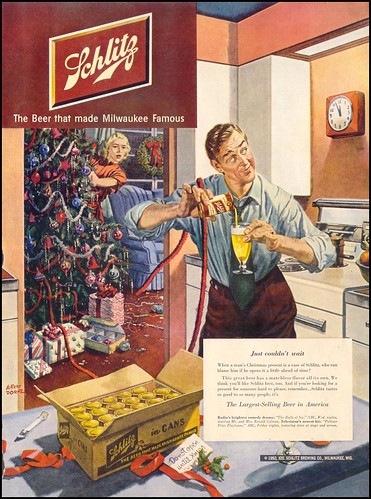
Today’s ad was chosen with Christmas is mind. It’s a Schlitz ad from 1950 and it was created by famed illustrator Albert Dorne.

I love the story unfolding in the ad. The guy is pouring the beer while peering mischievously up at the clock, which reads just a few minutes to midnight. Presumably that means they’re putting up their tree Christmas Eve at the very end of the day. Talk about procrastinators! But then there’s the look on the woman — doing all the work, as usual, right ladies? — who looks aghast at the effrontery. Or is that bemusement? Surprise? Hard to say. But it’s pretty funny, I’d say.

Anyway, drink up. Happy Xmas Eve.

schlitz-life-12-25-1950
If you can’t read the text, either click on the ad for a larger view or read the transcription below.

Just Couldn’t Wait

When a man’s Christmas present is a case of Schlitz, who can blame him if he opens it a little early?

This great beer has a matchless flavor all its own. We think you’ll like Schlitz best, too. And if you’re looking for a present for someone hard to please, remember…Schlitz tastes so good to so many people, it’s

The Largest-Selling Beer in America

Filed Under: Art & Beer, Beers Tagged With: Christmas, Holidays, Schlitz, Wisconsin

Sheboygan Brewing History

June 5, 2007 By Jay Brooks

maps-wi
Just hearing the word “Sheboygan” brings a smile to my face. I don’t know why exactly — and I certainly mean no disrespect to the town’s residents — but it’s just one of the words. The name is believed to be a Chippewa word, probably meaning “a noise underground,” or “river disappearing underground,” though some scholars think it may have meant “perforated object, as a pipe stem.” It just makes me laugh every time I hear it.

Sheboygan-postcard

In the wonderful Billy Wilder movie “Some Like It Hot,” Josephine and Daphne (played by Tony Curtis and Jack Lemmon) went to the Sheboygan Conservatory of Music. It’s located in eastern Wisconsin along the shores of Lake Michigan. The town itself has a population of just under 50,000, or almost exactly the same as the town I live in, Novato, California. But we have only had one brewery throughout the entire history of the town. Sheboygan, by contrast, has had as many as eleven at one time throughout its own history. That’s according to Bill Wangemann’s latest column in the Sheboygan Press where he details some of the breweries that have operated in Sheboygan over the years.

The earliest Sheboygan brewery was the Gutsch Brewing Co (later Kingsbury Brewing Co), which first opened in 1847. In the photo below, from the Sheboygan County Historical Research Center in Sheboygan Falls, a “truck from the Gutsch Brewing Co. is loaded with beer for delivery by driver Edwin Kreuter, right. The other man is unidentified.”

gutsch-brewing

Filed Under: News Tagged With: History, Midwest, Wisconsin

« Previous Page

Find Something

Northern California Breweries

Please consider purchasing my latest book, California Breweries North, available from Amazon, or ask for it at your local bookstore.

Recent Comments

  • Bob Paolino on Beer Birthday: Grant Johnston
  • Gambrinus on Historic Beer Birthday: A.J. Houghton
  • Ernie Dewing on Historic Beer Birthday: Charles William Bergner 
  • Steve 'Pudgy' De Rose on Historic Beer Birthday: Jacob Schmidt
  • Jay Brooks on Beer Birthday: Bill Owens

Recent Posts

  • Beer Birthday: Sean Paxton October 20, 2026
  • Historic Beer Birthday: Johann Georg Sohn October 20, 2026
  • Beer In Ads #5378: Er Is Weer Bokbier October 19, 2026
  • Historic Beer Birthday: John Barbey October 19, 2026
  • Beer Birthday: John Tucci October 19, 2026

BBB Archives

Feedback

Head Quarter
This site is hosted and maintained by H25Q.dev. Any questions or comments for the webmaster can be directed here.